



 Arguments







Recent Comments
1 2 3 4 5 6 7 8 9 10 11 12 13 14 15 16 Next
Comments 1 to 50:
-
John Hartz at 21:12 PM on 9 April 2026Skeptical Science New Research for Week #14 2026
Michael Sweet @9:
Thank you for flagging The Guardian article, A new economic superpower could spark a global retreat from fossil fuels. I am posting a link to it on the SkS Facebook page.
-
One Planet Only Forever at 08:54 AM on 8 April 20262026 SkS Weekly Climate Change & Global Warming News Roundup #14
Recent SkS posted items raise important awareness and understanding related to the historic challenge of dealing with the damage done by people who choose to fail to responsibly learn to self-regulate their actions. Thank you to Doug and Marc for curating and sharing the Weekly New Research, and to Baerbel, John, and Doug (again) for curating and sharing the Weekly News Roundups.
A related item in this week’s Climate Policy and Politics list is, Vermont Hits Back at Trump’s Effort to Block ‘Climate Superfund’ Law. It is about responsible leaders struggling to use the powers they have, State powers in Vermont, to penalize and limit the climate change harm done by the global team of undeserving economic winners.
Responsible leadership struggles to effectively discourage and disappoint people who want to benefit from being: less accepting of diversity, more harmful, and less helpful. Humanity, especially its leaders, has a history of struggling regionally and globally to collectively correct and recover from results of harmful pursuits of benefit and get the beneficiaries of the harm done to make equitable and adequate reparations. It is more challenging when members of a regional or global club of harmful unhelpful people Win positions of power that enable them to make-up inequitable rules and harmfully enforce rules to avoid being penalized and to threaten, penalize and punish everyone they believe is a potential threat to their undeserved perceptions of superiority.
People passionately pursuing being perceived to be “The Winners” are most likely “The Problem”.
Restricting a person’s freedom to continue to benefit from understandably unsustainable harmful actions - does not harm them.
Penalizing a person for benefiting from understandably harmful actions and making their penalty help those who have been harmed - does not harm them.
An earlier related item is the study The political economy of leaving fossil fuels underground: The case of producing countries, listed in Open Access Notables in Skeptical Science New Research for Week #13 2026.
The study discusses the challenging temptation to pursue ‘Private Profits and Rents’ while creating ‘Public Problems’ by extracting and exporting non-renewable resources, especially challenging for developing nations.
The developed economic system is fatally flawed in many ways. One of the major flaws is that it values the removal and use of non-renewable resources, and ignores the harm done (it also encourages more harm to be done because it is easier and more profitable to be more harmful). Non-renewable resources have no value when they are left in the ground.And the challenge is made worse by unjust made-up rules like the 1994 Energy Charter Treaty (Wikipedia link) (ECT). The EU formally withdrew from the ECT in June 2024. But the ECT rules were include ‘protection’ of Fossil Fuel investment rewards for 20 years after withdrawal (to 2044).
Another recent related item is Quantifying climate loss and damage consistent with a social cost of carbon, the first item listed in Open Access Notables in Skeptical Science New Research for Week #14 2026, (which was the basis of news item, Past CO2 emissions may drive far bigger future economic losses, in 2026 SkS Weekly Climate Change & Global Warming News Roundup #13). The study explains that calculating the penalty owed today for fossil fuel harms of emissions-to-date should begin as early as 1980 and extend far into the future.
The following quote is regarding the earliest date it would be reasonable to say leaders would struggle to deny understanding the harmfulness of fossil fuel use:
To estimate when to begin counting emissions, we set our baseline ‘year of knowledge’ as 1990, or a year after the establishment of the IPCC. This is perhaps conservative: using text-based analysis of United Nations documents, other analyses set the date a decade earlier, and internal company documents reveal that some major emitters were aware of climate risks beginning around 1980.
Any pursuer of profit from fossil fuel use since 1990, and potentially since 1980, would struggle to credibly claim that they were unaware of the harm done by fossil fuel use. This reinforces the understanding that the Energy Charter Treaty was an unjust rule made-up by undeserving wealthy people.
Both studies also relate to Don Gillmore’s 2025 book, On Oil that I recently commented about (here @ comment 25 on the SkS post, After a major blow to U.S. climate regulations, what comes next?). In addition to presenting the general understanding that Alberta and other regional populations are easily tempted to pursue benefit from harmful fossil fuel use, and things really took off in about 1980, the chapter titled The Battle Begins opens with the following reinforcement of 1980 as a legitimate start date for evaluating penalties to apply to beneficiaries of harmful fossil fuel use:
In 1980, Ronald Reagan became president of the United States and appointed James Watt, a determined anti-environmentalist, as secretary of the Department of the Interior. Watt described environmentalists as “a leftwing cult dedicated to bringing down the type of government I believe in,” and refused to meet with them. Watt was a devout Christian who believed the End Times were near. “I do not know,” he said to Congress in 1981, “how many future generations we can count on before the Lord returns.” In the meantime there wasn’t much point in preserving the environment. Reagan concurred, telling television evangelist Jim Bakker, “We may be the generation that sees Armageddon.”
Anne Gorsuch, a lawyer who was scornful of climate science (and whose son Neil sits on the Supreme Court), was given the role of Administrator of the Environmental Protection Agency, and cut the EPA budget by 22 percent and staff by almost 30 percent. Enforcement declined by 79 percent during her first year. She hired people from the industries the EPA was supposed to be regulating, tried to weaken pollution standards, and facilitated the use of restricted-use pesticides. She resigned in 1983 amid scandal, ... Her most lasting legacy may have been to solidify political battle lines around oil and the environment: If you were a Republican, you were pro-development and, if not anti-environment, at least anti-environmentalist. It began as a corporate issue, then became a political issue and to some extent a generational issue, and finally, like so much these days, it became a tribal issue.
The formation of the ECT in 1994, 14 years after 1980, should be understood to be a misleading attempt to unjustifiably obtain benefit and protect against the loss of undeserved perceptions of superiority. And since 1980 it has continually become clearer that investments in new fossil fuel pursuits should be considered to be bets in the marketplace that deserve whatever ‘penalties or losses of opportunity for benefit’ happen. The people who benefited from the delay of transition away from fossil fuel use since 1980, particularly business leaders and investors, could and should be penalized rather than be protected and rewarded. ‘Legal creations’ like the ECT should not be able to be used to evade penalty for past ‘bad bets made on benefiting from fossil fuel use’.
There is a long diverse history of harmful pursers of personal benefit seriously damaging and delaying the development of sustainable improvements for the future of humanity. The, now officially discredited, Doctrine of Discovery developed as Papal Bulls in the 1400s (Link to Canadian Museum for Human Rights) and was formally brought into American Law by US Supreme Court Justice John Marshall in 1823 (Link to Wikipedia). It was misleading marketing to excuse undeniably harmful colonialism, racism, and slavery. The incorrect beliefs about the ‘fundamental superiority of a sub-set of humanity’ persist in the supposedly most advanced societies today, and contaminate the thoughts and actions in many developing societies, allowing neocolonialism (link to Wikipedia) to flourish.
People passionately pursuing being perceived to be “The Winners” are most likely “The Problem”.
I have also been re-reading Thomas Piketty’s 2021 book, A Brief History of Equality (first english translation 2022). The following are selected related quotes:
From Chapter 9, Exiting Neocolonialism, which includes a sub-section with the heading, The Pretenses of International Aid and Climate Policies.
The battle for equality is not over. It must be continued by pushing to its logical conclusion the movement toward the welfare state, progressive taxation, real equality, and the struggle against all kinds of discrimination. The battle also, and especially, involves a structural transformation of the global economic system [including reparations (penalties) for harms done by past emissions, and no compensation for people claiming to be harmed by restrictions of their harmfulness and penalties for being harmful] .
…
Our current economic organization, which is founded on the uncontrolled circulation of capital lacking either a social or environmental objective, often resembles a form of neocolonialism that benefits the wealthiest persons. This model of development is politically and ecologically untenable. Moving beyond it requires the transformation of the national welfare state into a federal [multi-national] welfare state open to the global South, along with a profound revision of the rules and treaties that currently govern globalization.
...
We must also emphasize the extreme hypocrisy that surrounds the very notion of international aid. First, public aid for development is much more limited than is often imagined: in all, it represents less than 0.2 percent of the global GDP (and scarcely 0.03 percent of the global GDP for emergency humanitarian aid). In comparison, the cost of climatic damage inflicted on poor countries by past and current emissions from rich countries amounts by itself to several points of the global GDP. The second problem, which is not a detail [not a minor technicality], is that in most of the countries supposedly “aided” in Africa, South Asia, and elsewhere, the amount of outflow in the form of multinationals’ profits and capital flights [evading taxation] is in reality several times greater than the incoming flows from public assistance, …Chapter 10 sub-section with the heading, Climate Change and the Battle Between Ideologies.
All the transformations [sustainable improvements reducing harmful inequality] discussed in this book, whether the development of the welfare state, progressive taxation, participatory socialism, electoral and educational equality, or the exit from neocolonialism, will occur only if they are accompanied by strong mobilizations and power relationships. There is nothing surprising about that: in the past, it has always been struggles and collective movements that have made it possible to replace old [harmful unsustainable] structures with new institutions.
…
Environmental catastrophes are, of course, among the factors that may help accelerate the pace of change. In theory, we could hope that the mere prospect of these catastrophes, whose future occurrence scientific research has increasingly confirmed, might suffice to provoke adequate mobilization. Unfortunately, it is possible that only tangible concrete damage greater than we have already seen will manage to break down conservative attitudes and radically challenge the current economic system.
…
In the darkest scenario, the signals will come too late to avoid conflicts between nations over resources, and it will take decades to realize possible, as yet hypothetical reconstructions [sustainable developments like Diversity, Equity and Inclusion pursuits to mitigate and correct high levels of inequality] [we are potentially already experiencing that Darkest Scenario].
…
We can also foresee hostile reactions towards countries and social groups whose ways of life have contributed most to the disaster, starting with the richest classes in the United States, but also in Europe and the rest of the world.
…
the global North, despite a limited population (about 15% of world population for the United States, Canada, Europe, Russia, and Japan), has produced nearly 80% of the carbon emissions that have accumulated since the beginning of the Industrial Age.
…
However, we have to qualify the idea that a green Enlightenment will be likely to save the planet. In reality, people have suspected for a long time – indeed almost since the beginning of the Industrial Revolution – that this accelerated burning of fossil fuels might have harmful effects. If reactions have been slow and remain so limited even today, that is also and especially because the economic interests at stake are considerable, between countries as well as within them. For the countries most affected (in particular in the global South), the attenuation of the effects of a warming climate and financing for measures to adapt to it will require a transformation of the distribution of wealth and the economic system as a whole, and this in turn will involve the development of new political and social coalitions on a global scale. The idea that there might be only winners is a dangerous and anesthetizing illusion that must be abandoned immediately.It all closes back to the SkS items that this comment started with.
People passionately pursuing being perceived to be “The Winners” are most likely “The Problem”.
-
Nick Palmer at 22:22 PM on 7 April 2026Our new research is published - but we're not done yet with the 'Experiment'
£25 on way!
-
michael sweet at 22:04 PM on 7 April 2026Skeptical Science New Research for Week #14 2026
The Guardian had an article today describing a new international organization that will focus on the switch to renewable energy. About 85 countries have signed up. The rules will not allow a few (fossil fuel loving governments) to veto climate solutions like happens at UN meetings. The objective is to provide guide posts for economies to become more carbon free and to develop solutions to problems.
They have organized the First International Conference on the Just Transition Away From Fossil Fuels.
It will be interesting to see the results of the first meeting!
-
John Hartz at 13:41 PM on 6 April 2026Skeptical Science New Research for Week #14 2026
Prove we are smart @7:
Thank you for the clarificiation. Peace.
-
prove we are smart at 10:14 AM on 6 April 2026Skeptical Science New Research for Week #14 2026
John Hartz @4, the fact that most American politicians become much more wealthy while in office and after, should tell you many things. With the American president wanting a trillion dollars for the next military budget, this US military is the largest emitter of greenhouse gases of any institution on Earth, generating an estimated 636 million metric tons of CO₂ equivalent (a standardised measure of greenhouse gas emissions) between 2010 and 2019.www.sciencefocus.com/news/us-military-carbon-footprint
Some countries leaders are deniers of climate change and the USA has now elected twice, a very good example of this. I'm advocating your politicians follow what their constituents want, not what a wanna be dictator wants. The only good thing (from the biospheres perspective), coming from this American/Israeli war is how attractive renewables look as they mostly free a country from fossil fuel dependence.
-
michael sweet at 07:43 AM on 6 April 2026Skeptical Science New Research for Week #14 2026
John,
Great references! There is so much to read. I hope everyone calls for renewable energy to protect the economy from these expensive price shocks. It will also help counter climate change.
-
John Hartz at 02:25 AM on 6 April 2026Skeptical Science New Research for Week #14 2026
Michael Sweet @1:
Here's another article:
- How Trump’s Iran war could make the world more reliant on coal The energy crisis sparked by the war is making some countries consider ramping up their use of dirty fuels by Eduardo Porter, The Guardian, Apr 5, 2026
-
John Hartz at 02:00 AM on 6 April 2026Skeptical Science New Research for Week #14 2026
Prove we are smart @3:
Are you advocating that US politicians stick their individual and collective heeads in the sand and completely ignore the realities of man-made climate change? Are politicians supposed to lead, or just follow public opinion like a herd of sheep?
-
prove we are smart at 15:13 PM on 5 April 2026Skeptical Science New Research for Week #14 2026
Climate Change has dropped below number 8 of the USAs most worried concerns. Inflation/cost of living and health/social security being in the top 3 worries for 6 years now, www.statista.com/chart/32304/key-issues-in-the-us-according-to-respondents/.
Belatedly, American polititians will hopefully realize, "It's better to admit you went through the wrong door than to spend your life in the wrong room."
-
John Hartz at 14:55 PM on 5 April 2026Skeptical Science New Research for Week #14 2026
Michel Sweet @1:
For handy reference and easy access, here's a list of recent articles about the potential impacts of Trump's War of Choice Against Iran on renewable energy that I have recently posted links to on the SkS Facebook page:
- Energy fallout from Iran war signals a global wake-up call for renewable energy by Aniruddha Ghosal , Anton L Delgado & Allan Oilingo, AP News, Mar 20, 2026
- How the Iran War Reveals the Extent of Fossil Fuel Propaganda With consumer prices rising due to the United States and Israel’s war with Iran, interest in renewables and EVs is rising. Misinformation may be holding consumers back. by Lee Hedgepeth, Inside Climate News, Mar 20, 2026
- Trump’s Iran war and drilling push show ‘dangerous volatility’ of fossil fuel era Critics say president is locking into 20th-century energy systems even as his ‘bet’ on oil and gas ‘isn’t going so well by Oliver Milman, The Guardian, Mar 31, 2026
- What the Iran conflict means for gas prices, clean energy, and the climate U.S. gas prices could hit $7 a gallon if the Strait of Hormuz remains restricted through June. Here’s how that could affect EVs, wind, and solar. by Dana Nuccitelli, Yale Climate Connections, Apr 1, 2026
-
michael sweet at 03:36 AM on 5 April 2026Skeptical Science New Research for Week #14 2026
There have been widespread reports in newspapers of countries saying they plan to accelerate installation of renewable energy to escape the fossil fuel roller coaster. This would slso help with climate change.
Encourage your representatives to support more renewable energy to reduce prices and stabilize the economy. Perhaps some politicians who do not care about climate change will go for stabilizing the economy!
-
MA Rodger at 18:05 PM on 3 April 2026The El Niño cometh
green tortoise,
Concerning in-thread images - There are a number of sites offering on-line image hosting images for free. As an example, I've just uploaded an the image below with this site. It can be a for-ever upload if you choose but in this case it will be live for a month.
The graphic is actually on-line on my The Banana!!! Watch site which is hosted by GoogleSites who don't allow hot URL links.
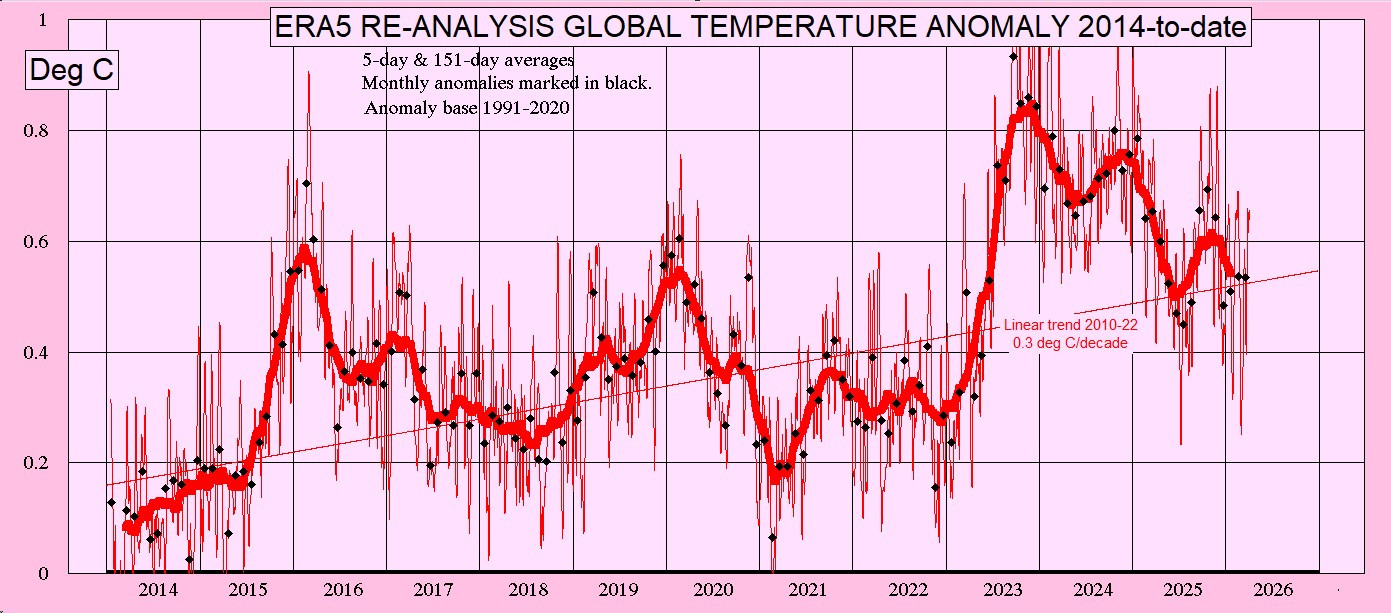
Concerning the present global SAT/SST - The Climate Pulse site is excelent for giving year-on-year up-to-the-moment temperatures but these do need to be both de-wobbled and adjusted for the underlying rate of AGW to allow the comparison you attempt.
The monthly SAT anomalies in this graphic above show the start of 2026 pretty-much on the 2010-22 trend line. That is what we also see back in 2015, prior to the 2016 El Niño. The situation in early 2023 was a little different as the La Niña had not lessened at all in preceding years, so the SAT would be expected to be significantly depressed prior to the El Niño wobble.
Of course, the 2010-22 warming trend of +0.30ºC/dec does not escape discussion. In the preceding decades, AGW had been strongly constant, stuck at roughly +0.18ºC/dec when models suggested there should have been some acceleration. The models do show today's AGW at +0.30ºC/dec with that acceleration.
The less-wobbly monthly SST anomalies (60N to 60S) provided by Climate Pulse show a strong warming since November last year and that warming has now reversed the cooling seen Jan-Nov. But comparisons with previous pre-El Niño periods show that such a warming is quite normal in pre-El Niño periods. Mind there is the possibility that the coming El Niño will come with a repeat of those 'bananas!!!' temperatures.
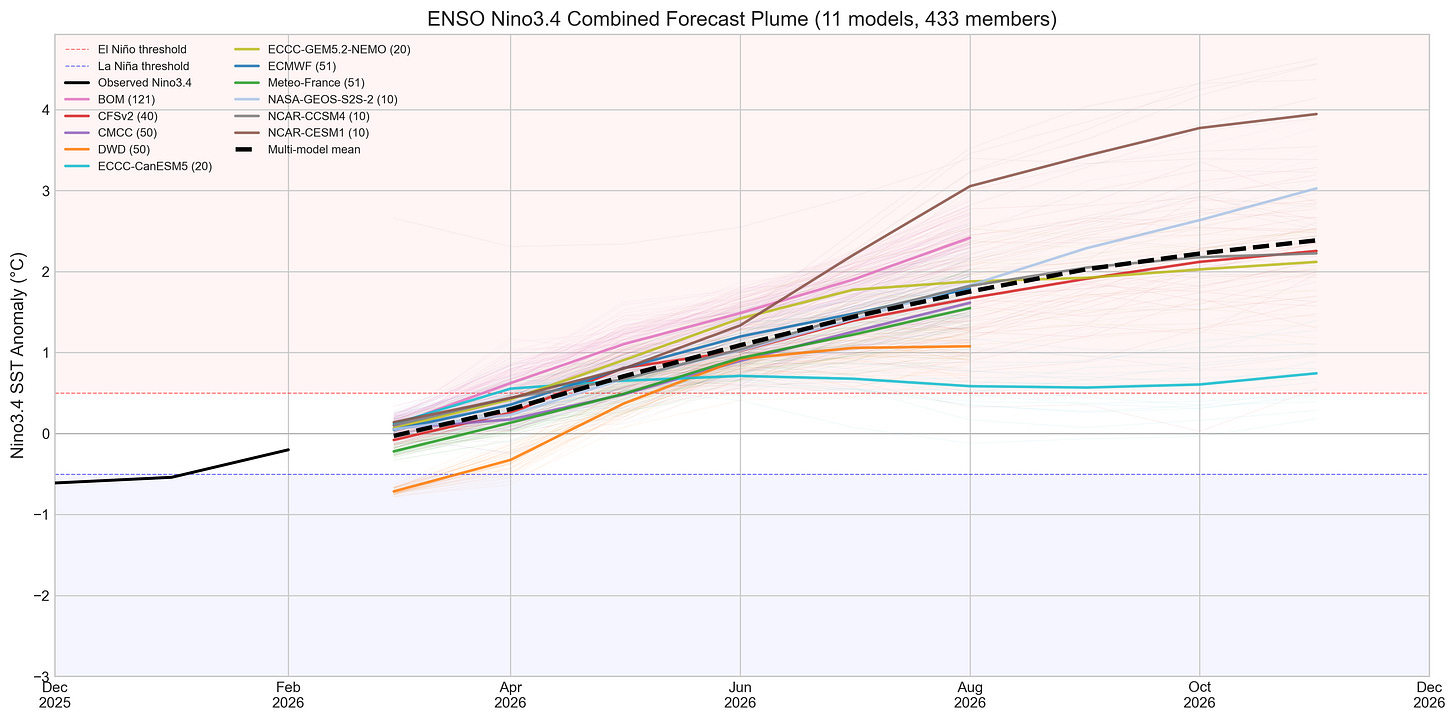
Concerning the coming El Niño - The NINO3.4 SST which is used to calculate the ONI (a measure of the ENSO) has just poked its head above zero. The forecasts are strongly pointing to an El Niño by the end of the year and the models have shifted it a little stronger in the last month. (Note that ONI has recently had a new friend RONI - Relative Oceanic Niño Index - that allows for better comparisons back through the years. Today RONI runs lower than ONI)
-
green tortoise at 08:01 AM on 1 April 2026The El Niño cometh
What I find rather disturbing is that, SST-wise, we are at much worse situation than in 2023. I will post the COPERNICUS SST and SSTA, taken from the "Climate Pulse" website:
The graph shows that 2026 has already topped 2023 and 2025, trailing barely behind only 2024. The El Niño has just begun (and not in the central Pacific yet). Current SST is at 21°C (like in the apex of 2023 series) and SSTA is increasing in like in 2023 (but offset by a warming of 0.15-0.2 °C).
If the trend persists, 2024 will be topped in a month or two (SST-wise)...
NB: unfortunately I could not post the image, as COPERNICUS just allows to dowload the jpg images, this website cannot upload raw images. Please tell me if there is some way to solve this technical obstacle...
Moderator Response:[BL] There is a brief description near the end of the Comments Policy, describing how to include images.
You are correct that you cannot upload images to SkS. Images need to be available as a file in an image format (JPG, PNG, etc.), hosted on a publicly-visible web page. You can then use the link to that image as a pointer in your comment, using the Insert Image tool on the Insert tab of the editor.
For example, the link to the first graph in the OP is the rather messy "https://substackcdn.com/image/fetch/$s_!YOJ-!,w_1456,c_limit,f_auto,q_auto:good,fl_progressive:steep/https%3A%2F%2Fsubstack-post-media.s3.amazonaws.com%2Fpublic%2Fimages%2F010d462f-072b-40f1-bbf5-c33522eafb9c_4162x2060.png."
If I use the chain link icon on the "Insert" tab of the comment editor, I can put that link behind other text so that people can follow the link (as you have done to point to the Copernicus web page).
If I use the icon on the Insert tab that looks like a tree, then I can put the link to the picture so that the image appears in the comment: (but don't forget to specify an image size <500 pixels wide).
Unfortunately, the Copernicus page you have linked to appears to be generating dynamic, interactive images. Your only choice would be to do a screen grab, save a file, place that file on some public page you can write to and SkS can read from, and then link to that file.
-
Paul Pukite at 00:05 AM on 31 March 2026The El Niño cometh
Actually the other way around. Chaose is reduced by periodic forcing. Lorenz himself explored whether the "butterfly effect" in the atmosphere could be mitigated by the annual cycle of solar heating, finding that forcing can indeed confine a system to a more restricted, predictable region of its state space.
Edward N. Lorenz (1990). "Can chaos and intransitivity be removed by periodic forcing?" Tellus A: Dynamic Meteorology and Oceanography, 42(3), 282-293.
-
prove we are smart at 17:56 PM on 27 March 2026The El Niño cometh
Air masses are related to climate zones. They are large bodies of air that influence weather patterns and climate by carrying specific characteristics, such as temperature and moisture, over different regions.
Air masses can significantly affect the climate of a region, leading to variations in weather and temperature.They are classified based on their source regions and characteristics, which determine their impact on local climates. The interaction of air masses with geographical features contributes to the establishment of climate zones, such as tropical, temperate, polar, and arid.
In summary, air masses play a crucial role in shaping climate zones and influencing weather conditions across the globe.There has always been a unpredictable forecast about how long and how far or even when the air from these climate zones will travel into their neighbouring zones. Currently, so many multitudinous disasters happening on our watch as climate change does this. e360.yale.edu/features/redrawing-the-map-how-the-worlds-climate-zones-are-shifting#:~:text=Rising%20global%20temperatures%20are%20altering%20climatic%20zones%20around,move.%20By%20Nicola%20Jones%20%E2%80%A2%20October%2023%2C%202018
My censored link was to info for the no kings rally. Without rules for all-where would we be?
Moderator Response:[BL] I don't know about "rules for all", but rules for people commenting here at SkS are clearly outlined in the Comments Policy. Those rules include:
No link or picture only. Any link or picture should be accompanied by text summarizing both the content of the link or picture, and showing how it is relevant to the topic of discussion. Failure to do both of these things will result in the comment being considered off topic.
and
All comments must be on topic. Comments are on topic if they draw attention to possible errors of fact or interpretation in the main article, of if they discuss the immediate implications of the facts discussed in the main article. However, general discussions of Global Warming not explicitly related to the details of the main article are always off topic. Moderation complaints are always off topic and will be deleted
In particular, note the last sentence in the second paragraph.
-
scaddenp at 08:05 AM on 27 March 2026The El Niño cometh
Paul, I think that is getting into the semantics of what can be described as "chaotic". In the usual sense of extreme sensitivity in complex non-linear system, then phase-locked systems can be chaotic (eg Chaos In Phase Locked Loop). While almost all ESNO switching has a predictable seasonal pattern, it appears that switching remains extremely sensitive to the details of the coupled interactions in the ocean/atmosphere.
I would also agree that ENSO tends to amplify already extreme weather. -
Paul Pukite at 02:22 AM on 27 March 2026The El Niño cometh
"Climate change is increasing the natural chaos of the air masses"
What is that even supposed to mean? El Ninos are not chaotic, as they are triggered by an annual impulse If they were truly chaotic they could would evolve at any time and not be phase-locked to the seasonal cycle.
-
prove we are smart at 11:51 AM on 26 March 2026The El Niño cometh
Climate change is increasing the natural chaos of the air masses that move around our tilted planet. In near twelve months,one hemisphere then the other, take its turn, absorbing the more perpendicular radiation from our star.
The current and ever increasing unprecedented weather catastrophes will surely be amplified by the Enso phases. All countries really need and especially in this climate, leaders and government with foresight and empathy and using qualified people to navigate. Sometimes it is obvious how poorly gov perform and sometimes you need to look up and be an unsilent majority-make science great again. www.nokings.org/
Moderator Response:[BL] The link you added at the end appears to have no connection to the topic, and has been snipped. You've been around here long enough to know the rules.
-
Eclectic at 10:10 AM on 26 March 2026Fact brief - Is 'wind-turbine syndrome' a medically recognized diagnosis?
Uncertain, whether the objection to wind turbines is partisan political or visual/artistic. Or both. Are the wind turbines ugly shapes ruining the rural vista, or are they elegant towers & harbingers of a better climate in the future? But no doubt those who object to them will seek as wide a range of reasons/pretexts as possible. That's human nature ~ even extending into the borderland of trendy hysteria. And that too can overlap with the powerful "Nocebo" effect, where we genuinely feel worse (in the absence of demonstrable disease).
Counterbalance that, with the powerful "Placebo" effect. #Picture that you have a nagging toothache, resistant to household painkillers. And no dentist is available for many days yet. Then suddenly your rich uncle in China dies, and his lawyers inform you of a $10 million inheritance coming your way. All of a sudden, your toothache becomes ever so trivial in its strength.
Anecdotally, it seems that the farmers who receive a nice rental payment for wind turbines on their land . . . suffer no "infra-sound" bad effects. While farmers on more distant properties sometimes may experience ongoing horrid disturbances of health & sleep. Are they the vocal, partisan, minority ~ or is there a genuine problem?
Just possibly, the turbine blade design could be modified toward more quietness ~ even if there were a small reduction in efficiency.
-
nigelj at 06:04 AM on 26 March 2026Fact brief - Is 'wind-turbine syndrome' a medically recognized diagnosis?
Bolt: "Nigel's strawman ad hominem is not helpful"
With all due respect, your comments aren't accurate. My comment is not a strawman, or an ad hominem .My comment was 'hyperbole'. And it was to point out out how many of the people complaining about wind turbines probably have subwoofers or similar audio systems, that can potentially damage hearing, but that doesn't seem to worry them. And if you think wind turbines are a huge problem try living next to a road with all that loud traffic noise which includes low frequency components. And billions of people live like that. So in comparison wind turbines are a trivial problem at worst. Bearing in mind that the science quoted in the article says the low frequncy noise is not damaging at all.
Bolt: "criticism of complainants as hysterical? sexist and unscientific."
Not sexist. Where did I make reference to one particular sex? And hysterical reactions are a known phemomenon in psychology one of the social science. The reactions of some people to wind turbines have the characteristics of hysteria.
Bolt; "And a sub-woofer might be a good way to mask a low frequency sound."
I don't think so. Its very difficult masking low frequency sounds. A subwoofer would only mask low frequency sounds of wind turbines if its very loud. That is basic accoustics. And playing the subwoofer loud defeats the purpose! It just creates eveen more irritation.
Bolt: "Without long term real world field recording and analysis this syndrome will not be disproven."
How do you define long term? How do you know this hasn't been done? Have you read the studies? Wind turbines have been around for decades and that is quite long term.
-
Bolt at 23:58 PM on 25 March 2026Fact brief - Is 'wind-turbine syndrome' a medically recognized diagnosis?
Low frequency sound travels further than higher frequencies as they are less prone to scattering.
Wind turbines do not operate in isolation so there are likely synergetic effects that would depend on local conditions such as air movement (louder downwind) and relative frequencies (ie phasing), resonance (ie bed springs).
It is demonstrated that sleep disturbance leads to negative health impacts.
Perhaps naming the syndrome gave people permission to complain about an issue that had hitherto been considered personal.
Nigel's strawman ad hominem is not helpful, criticism of complainants as hysterical? sexist and unscientific. And a sub-woofer might be a good way to mask a low frequency sound.
Without long term real world field recording and analysis this syndrome will not be disproven.
-
nigelj at 07:03 AM on 25 March 2026Fact brief - Is 'wind-turbine syndrome' a medically recognized diagnosis?
You can absolutely guarantee that half the people who complan about or criticise wind turbines low frequency noise, have a sub woofer in their living room. The anti wind tower thing is just hysteria.
-
One Planet Only Forever at 05:46 AM on 23 March 2026Is Nuclear Energy the Answer?
Additional points regarding one of my points @476:
When I was a field engineer every alteration, change, of the issued design that I was involved in was rigorously recorded including the record that I was taking responsibility for the ‘change’. I made sure that the record was complete clear and accurate. And I expected the same from others who were ‘field engineers’ for items I was responsible for the original detailed design of.
Also, I was involved in investigating the failure of parts of a civil/structural system to perform adequately, including out-right failures. In some cases there was evidence that the item had not been ‘constructed in accordance with the design’ but there was no record of who was responsible for the ‘change’.
Some people thrive on ‘plausible deniability’ to get away with unacceptable behavior. Reduced regulation is a gateway to ‘increased plausible deniability’.
-
One Planet Only Forever at 03:24 AM on 23 March 2026Is Nuclear Energy the Answer?
Additional points regarding my @475 response to PollutiionMonster:
The following points are based upon my expertise as a Professional Structural Engineer knowledgeable regarding dynamic design requirements such as seismic design, design for vibrating forces, and design for blast forces and missile penetration.
The IFP article (Institute for Progress) is a ‘questionable presentation of opinions’ by people who lack expertise. Their statements may ‘sound reasonable’ but are not.
An example of the ‘questionable presentation of opinions’ is the following part of the quotes I included in my previous comment:
Some regulatory increase wasn’t necessarily unreasonable.
I bolded the word Some for a reason. Using the word Some at this point in the article implies that later presented opinions would be examples of regulations that are not reasonable. Later in the article the following ‘questionable presentations of opinion’ get made:
Quote 1
In addition to generating substantial increases in labor costs, regulations also influence the direct costs of nuclear plant construction via QA/QC requirements. Plant components require extensive testing and verification to ensure they’ll continue to function even after extreme accidents. This often takes the form of carefully recording what happens to every component at each step of the manufacturing and construction process, to ensure the correct part with precise performance characteristics is put in the right place.
This sort of documentation can be extremely burdensome to create. For example, here’s a description of QA requirements during the construction of the Diablo Canyon nuclear plant, via Komonoff again:
“Simple field changes to avoid physical interference between components (which would be made in a conventional plant in the normal course of work) had to be documented as an interference, referred to the engineer for evaluation, prepared on a drawing, approved, and then released to the field before the change could be made. Furthermore, the conflict had to be tagged, identified and records maintained during the change process. These change processes took time (days or weeks) and there were thousands of them. In the interim the construction crew must move off of this piece of work, set up on another and then move back and set up on the original piece of work again when the nonconformance was resolved…
The incorrect implication is that the people doing the construction are intimately familiar with the design to the point of being experts at determining what are ‘simple changes they can make and how they can make them’. And the statement “(which would be made in a conventional plant in the normal course of work)” is a potentially dangerously misleading “opinion”. I have worked as a ‘construction engineer’. In that role I did indeed design and approve ‘field changes’. But I always contacted the original designers when I was, as a ‘knowledgeable expert’, not absolutely certain that I understood and could determine the acceptability of the ‘field change’.
Quote 2
Nuclear-grade components don’t necessarily have higher performance requirements than conventional components. Reinforcing steel in nuclear-grade concrete, for instance, is the same material used in conventional concrete. Instead, the additional cost often comes from the additional documentation and testing required.
There actually are important differences in the available reinforcing steel for concrete structures. An important difference is that reinforcing bars with the same ‘yield strength’ can be ‘more brittle’ or ‘more ductile’. And seismic, vibrating, and blast resistant structure performance requires the reinforcing to be ‘certain to be the ‘more ductile’ type. Also, the more ductile reinforcing is less likely to have micro-cracks formed when it is being bent into the shapes required. And micro-cracks increase the likelihood of corrosion failure. Note that the more ductile and more brittle reinforcing bars look almost identical. And in some cases there are producers, and buyers/constructors, who would attempt to get away with misleadingly selling/buying/installing the ‘more brittle’ bars including false documentation claiming the material is ‘more ductile’ bars. This problem also applies to seismic steel structures, not just nuclear plants, where the ‘more ductile steel and fastening bolts’ is critical to the performance.
Quote 3. The article includes the following questionable statement:
Some experts think these QA/QC requirements and their downstream market effects are the prime reason for high nuclear construction costs:
This is potentially a very questionable use of “Some” “experts” and “think” to imply that the “QA/QC requirements” are excessive or unnecessary.
It is like the claims that: Some experts think climate science is incorrect and that the ‘implied’ restrictions of freedoms and forced changes to developed desired ways of living are ‘fraudulent - all a Big Lie – a communist plot’.
-
One Planet Only Forever at 04:30 AM on 21 March 2026Is Nuclear Energy the Answer?
PollutionMonster @471,
The end quote from the abstract of the peer reviewed article in your “nuclear energy decarboninzation.” link (the quote above the link), correctly indicates the need to maintain and improve safety, equity and environmental protection.
As indicated by the series of NPR articles I pointed to in my comments @ 460, 468 and 470 the US leadership-of-the-moment has likely reduced the safety, equity, and environmental protection related to nuclear power systems.
Your brief statement comparing safety of different energy systems ending with “...Nuclear killed zero people in contrast in 2025.” is an absurdly simplistic comparison of harms and risk of harm.
The IFP article (Institute for Progress) you linked to with the rather bizarre wording ‘Red tape nuclear power construction cost and time’ does not say what you seem to believe it says. Did you read the entire article? The opening statements of IFP article are misleading. You have to read quite far into the article to see important details that are not mentioned in the opening statements.
The opening statements are:
Nuclear plant construction is often characterized as exhibiting “negative learning.” That is, instead of getting better at building plants over time, we’re getting worse. Plants have gotten radically more expensive, even as technology has improved and we understand the underlying science better. [This statement is made in spite of the detailed content of the article explaining that many reasonable factors, including important updating of safety requirements, are the reason for the cost increase.]
Nuclear power currently makes up slightly less than 20% of the total electricity produced in the U.S., largely from plants built in the 1970s and 80s. People are often enthusiastic about nuclear power because of its potential to decarbonize electricity production, produce electricity extremely cheaply [that is a blatant misleading statement] and reduce the risk of grid disruption from weather events [this ignores the reality that designing and constructing nuclear power systems for the potential risks of weather events is part of the ‘high cost of nuclear power’, unless regulations do not require those concerns to be investigated and addressed]
But U.S. nuclear power has been hampered by steady and dramatic increases in plant construction costs, frequently over the life of a single project [later explained to be due to new understandings of safety problems that had not been identified and adequately addressed before construction of the system had begun].
…
Constructing cooling systems that can continue to operate in a damaged plant contributes heavily to nuclear construction costs.Also buried later is the following: “Rising labor costs are the bulk of increased construction costs”.
Much further into the article is the following:
“One key indicator of regulatory standards, the number of Atomic Energy Commission (AEC) and Nuclear Regulatory Commission (NRC) “regulatory guides” stipulating acceptable design and construction practices for reactor systems and equipment, grew almost seven-fold, from 21 in 1971 to 143 in 1978. Professional engineering societies developed new nuclear standards at an even faster rate (often in anticipation of AEC and NRC). These led to more stringent (and costly) manufacturing, testing, and performance criteria for structural materials such as concrete and steel, and for basic components such as valves, pumps, and cables. [sounds like the original plans were inadequate and unsafe]
Requirements such as these had a profound effect on nuclear plants during the 1970s. Major structures were strengthened and pipe restraints added to absorb seismic shocks and other postulated “loads” identified in accident analyses. Barriers were installed and distances increased to prevent fires, flooding, and other “common-mode” accidents from incapacitating both primary and back-up groups of vital equipment. Similar measures were taken to shield equipment from high-speed missile fragments that might be loosed from rotating machinery or from the pressure and fluid effects of possible pipe ruptures. Instrumentation, control, and power systems were expanded to monitor more plant factors under a broadened range of operating situations and to improve the reliability of safety systems. Components deemed important to safety were “qualified” to perform under more demanding conditions, requiring more rigorous fabrication, testing, and documentation of their manufacturing history. [all this is justified ‘increased costs’ that raise valid questions about pushes to get cheaper ‘new nuclear now’]
Over the course of the 1970s, these changes approximately doubled the amounts of materials, equipment, and labor and tripled the design engineering effort required per unit of nuclear capacity, according to the Atomic Industrial Forum.”
… [still much later in the article]
Some regulatory increase wasn’t necessarily unreasonable. Early safety requirements for nuclear plants often overlooked critical risks. For instance, prior to the proposed power plant at Bodega Bay near the San Andreas fault, seismic activity had not been considered in the design of nuclear plants. Subsequent analysis revealed that the potential for severe seismic events was much more widespread than had previously been thought. Similarly, tornado design requirements weren’t created until an application to construct a plant in a high tornado area revealed that tornado risk was much more widespread than had been assumed. When accident risk was considered, it was often analyzed incorrectly. A reactor meltdown was thought to be an astonishingly unlikely accident, yet Three Mile Island experienced one after relatively few reactor-years of operation.
Regulations constantly change
In response to learning more about how nuclear reactors could fail, the NRC’s regulatory stance became a deterministic, defense-in-depth approach – the NRC imagined specific failure modes, and specific ways of preventing them, and then tried to layer several redundant systems atop each other to compensate for uncertainty. Whenever something new was learned about potential failure modes, the regulations were changed.
These changes applied not only to future plants, but often to plants under construction. In some cases existing work had to be removed, requiring intervention and oversight from design engineers, managers, field inspectors, and other expensive personnel. This became another major source of increased costs.
... [a little further along]
To minimize the likelihood of cost overrun, plants should be built using mature designs that don’t need to be changed during the construction process. In construction of the French reactor fleet, for instance, the CEO of the French utility company EDF noted that during plant construction “Whenever an engineer had an interesting or even genius [improvement] idea either in-house or at Framatome, we said: OK, put it on file, this will be for the next series, but right now, we change nothing.” [however, if an engineer raises a new safety related concern it should be rigorously evaluated and adequately addressed]
By building multiple reactors using an unchanging design, the benefits of learning-by-doing can be unlocked. In the French reactor fleet, though costs increased whenever a new reactor type was introduced, later plants using a given reactor design tended to be cheaper than earlier plants. Similarly, the 4th unit built at the UAE’s Barakah plant was 50% cheaper than the 1st unit.
…
However, it’s not impossible to deliver nuclear plants in reasonable amounts of time for a reasonable budget. We have a playbook for improving this process. By using mature plant designs that can be built repeatedly, learning-by-doing gains can be achieved, making each plant built cheaper than the last. By developing and maintaining a robust nuclear supply chain with the necessary expertise and experience, we can ensure we don’t lose the ability to deliver plants in the future. By stabilizing regulations, making them clear, and making changes to them predictable, we can prevent cost overruns associated with expensive and time-consuming on-site rework.But we should be realistic about what this playbook might achieve. Public concern about nuclear accidents likely makes any significant reduction in plant safety requirements untenable. Experience with the Navy’s nuclear program suggests that even by following the above playbook, building a nuclear plant to the level of safety required is a fundamentally expensive undertaking. Truly moving the needle on nuclear power might require a ground-up rethinking of how we build plants, towards things like small modular reactors or nuclear plants built in shipyards in large numbers and floated into position along the coast.
Note that the key understanding to avoid cost increases regarding nuclear power plants is having a ‘mature design’. That means having thorough updating to be confident of safety systems and environmental protection. That means ‘lots of time required before embarking on the building of a new nuclear system and the understanding that any newly identified safety concerns need to be properly evaluated and addressed even if that delays or increases the cost of construction or requires a shut-down of operations if the safety concern is discovered after the item is in operation.
Also note that a modular nuclear system design would need to be adequately safe in all possible worst conditions of all possible installation locations.
The prerequisites for success of small modular reactors is acceptance of the reality that they will be higher cost, potentially higher cost per unit of generated and delivered electricity than renewables with battery back-up. That revises the question for discussion to be “Why is effort being wasted on the promotion and development of more expensive electricity generating alternatives?”
And the lack of transparency by the Trump administration suggests that reduced safety, increased harmfulness and increased risk of harm, is being secretly pursued because it will reward the people who made bad bets on ‘developing small modular reactors’.
Things will indeed be quicker and cheaper if the harmfulness or the risk of harm is allowed to be increased. But that only proves the unacceptability of allowing potential benefits for a few people to justify increased harm or risk of harm to Others. This would only be OK if the only people negatively affected by the reduced safety would be the people who profit from the less safe item.
-
John Hartz at 14:00 PM on 20 March 2026Is Nuclear Energy the Answer?
@Pollution Monster #471:
You state: "The problem with nuclear is not a technological problem, but a regulatorary problem."
Do you regard the proper disposition of the nuclear waste to be a regulatory problem? If so, should this particular problem be resolved prior to the "go-ahead" for the construction of a new nuclear power plant?
-
michael sweet at 06:18 AM on 20 March 2026Is Nuclear Energy the Answer?
Pollution Monster:
Your reference Nuclear Energy Decarbonization seems to me to be simply a regurgitation of nuclear industry propaganda. It has too many false claims for me to begin to list them all. For example it claims:
"For example, in hybrid systems for island economies such as the Canary Islands, SMRs have proven to be a viable solution, achieving competitive levelized costs of electricity (LCOE) ranging from EUR 46 to EUR 84/MWh when integrated with renewables and hydrogen production." my emphasis
How can they possibly have "proven" that SMRs can do anything when no designs for non military SMRs have been approved and none have been built? This is just accepting industry propaganda. Renewable energy costs less that EUR 40 today.
Later they say:
"Finally, there are structural and economic limitations that challenge the sustainability of nuclear energy. The inherent risk of nuclear safety is so high that coverage in free markets is unfeasible without state subsidies, which undermines the principles of just sustainability and intergenerational responsibility. Moreover, the full life cycle of the technology (from uranium mining to plant decommissioning and waste management) entails an emissions footprint and environmental impacts that contradict its claimed climate benefits. In the face of increasingly competitive and safer renewable technologies, the continued relevance of the nuclear sector demands radical transformations in its governance and a structural reduction in risk in order for it to be considered a truly sustainable option." my emphasis
So I should accept an industry that is so risky they cannot provide insurance for their accidents and taxpayers will have to pay to clean up their mistakes? While they take all the profits?
They cite an economic analysis that claims nuclear is cost and materials effective compared to solar and wind that was published in 2007 (their ref 110)? Do you realize that the cost and materials of solar and wind have declined immensely since 2007 while nuclear has increased in cost? It is dishonest to use completely outdated information when up to date information is readily available.
The journal Processes does not seem to me to be a good place for an analysis of energy when many other more suitable journals exist.
You are selectively quoting Abbott 2012. He says "It can also be argued" not that he supports that opinion. Obviously your cite makes that argument. In Abbott's conclusion he states:
"There are fundamental engineering and resource limits that make the notion of a nuclear utopia impractical. It can be argued [Abbott does not agree with this argument] that a nuclear nirvana supplemented by renewables may mitigate the need to reach 15 terawatts by nuclear alone (Manheimer, 2006). However, a reduced goal of several terawatts of nuclear power would still run into many of the limitations described above. Even for a more modest goal of 1 terawatt, one only has to divide the numbers above by 15 to see that a single terawatt still stretches resources and risks considerably." my emphasis
Nuclear supporters have never responded to Abbott. They cannot now claim that his objections are null because they have not countered them.
Keep reading about renewable power. In the last day more renewable energy was installed than nuclear in the last year. Don't believe all the nuclear propaganda that nuclear supporters accept as gospel. Remember that SMR developers promised in 2006 that they would have running reactors by 2020. It is impossible for them to manufacture significant numbers of reactors before 2040. Renewable energy will generate all current electricity and transportation by then. Nuclear cannot compete on price.
With the war in Iran showing how economically risky fossil fuels are many countries are increasiing their uptake of renewables to protect their economies.
Nuclear power is too expensive, takes too long to build and there is not enough uranium.
-
Eclectic at 03:30 AM on 20 March 2026Climate Adam - The Epstein Files & Climate Denial
Lynnvinc @1 :
Similarly, I had heard that the northern Siberian soils would be poorly suited to our standard agriculture. The picture is somewhat patchy ~ but a tendency to acid and/or sandy soils and low phosphate levels.
As you say, a great amount of time and effort needed to rehabilitate the soil. Also the high cost of establishing all the necessary infrastructure.
With greater warmth, though, the soil would suit extensive grazing herds. But using the land for meat production would be very inefficient, in a world of 8 billion humans. Probably cheaper, simply to take measures to counter AGW !
-
lynnvinc at 01:44 AM on 20 March 2026Climate Adam - The Epstein Files & Climate Denial
Good video, esp how it is the rich and powerful denying CC in their efforts to hold onto wealth/power even by abusing others or allowing their harm/abuse. Also the circular firing squad thing - arguing against CC and also for it.
RE warming Canada, esp in the Arctic region. I heard from someone up there that the permafrost soil is too poor for agriculture (without the centuries and millennia of organic matter decomposing), to support the idea that we can just move north as the climate warms and permafrost melts. It is not a solution that will work, aside from the melting permafrost releasing massive amounts of methane.
-
scaddenp at 08:02 AM on 19 March 2026Why Science Communication Fails: How to Break Down Misleading Arguments and Inoculate Against Misinformation
Eric, you seem to basing your premise on a paper from 1910?? You dont think maybe our understanding of climate has moved a bit since then? Not to mention geology eg we have since discovered plate tectonics. The paper argues "The great ocean basins are permanent features of the earth's surface and they have existed, where they now are, with moderate changes of outline, since the waters first gathered" - splorff! Periodic diastrophism? Not to mention being at least a decade before Milankovich did his calculations.
-
PollutionMonster at 15:21 PM on 17 March 2026Is Nuclear Energy the Answer?
Sorry broken link for first link, no way to edit.
Nuclear energy decarboninzation.
Moderator Response:[BL] The site does not provide any editing features for regular users once you submit a comment. Typos, spelling errors, grammar, broken links, etc. are preserved in perpetuity. It's up to the user to check before clicking on "Submit".
-
PollutionMonster at 15:19 PM on 17 March 2026Is Nuclear Energy the Answer?
My last link in 469 was an editorial. I have done some more research. I think nuclear versus renewable has taken too much of the front stage. We should focus on decaboninzation.
"Overall, the findings support the role of nuclear energy in achieving global decarbonization targets, provided that safety, equity, and environmental responsibility are upheld."
nuclear energy decarboninzation.
This is a peer reviewed article from 2025 that explicity says nuclear can helpo us meet emissions targets, Abott 2012 is a bit dated and the author admits that nuclear can arguably be used to address climate change.
Each energy source has its own strengths and weakness. For example, wind is low during heatwaves. Wind turbines are also dangerous to fix and workers have died from falling. Hydroelectric dams can break causing many deaths, take for example the Banqiao Dam failure. Nuclear killed zero people in contrast in 2025.
As for the cost of nuclear there is red tape driving up consturction cost and time. Like renenwables most of the cost for nuclear is in the construction.
Red tape nuclear power construction cost and time
The problem with nuclear is not a technological problem, but a regulatorary problem. We shouldn't be arguing we should be trying to phase out fossil fuels which kill many via air pollution.
Moderator Response:[BL] Link fixed, as per following comment
-
prove we are smart at 09:25 AM on 17 March 2026The war in Iran shows us another cost of our fossil-fuel economy
The moral and capitalistic rot in the USA is changing the world, thank goodness the corporations don't own sunlight and the wind. www.youtube.com/watch?v=y_q741QO_m0&t=183s
-
Eric (skeptic) at 08:00 AM on 17 March 2026Why Science Communication Fails: How to Break Down Misleading Arguments and Inoculate Against Misinformation
Geography has long been recognized as the primary control knob for the earth's climate: www.jstor.org/stable/pdf/1635493.pdf CO2 is an important but sporadically exogenous factor, but mostly an amplifier of geographic or solar or other forcing.
-
Eric (skeptic) at 07:34 AM on 17 March 2026Why Science Communication Fails: How to Break Down Misleading Arguments and Inoculate Against Misinformation
Just Dean, at the risk of beating the dead horse a bit more, may I ask if you agree that radiative physics plus projected manmade CO2 produces the red dashed line in the diagram? If your answer is yes, then how do we reach the black dashed line, even if that requires millenia? My answer is yes dashed red line exrended linearly is where we end up, and reaching the black dashed line requires Pangea. Others will probably disagree with that, and note that other models show the dashed red line bending upwards in the long run.
I disagree with the control knob characterization. Sometimes exogenous CO2 is the cause of warming, like Siberian traps, PETM, and manmade today. Occasionally exogenous CO2 drawdown is the cause of cooling. An example is enhanced silicate weathering from tectonic uplift.
The rest of the time, CO2 is "merely" an amplifier of temperature changes by causes other than CO2 in both directions as the fast and slow feedbacks kick in.
-
Just Dean at 20:14 PM on 16 March 2026Why Science Communication Fails: How to Break Down Misleading Arguments and Inoculate Against Misinformation
Eric and everone, Here is the link to the news release article refered to in Comment 10, Study: Over nearly half a billion years, Earth's temperature has changed drastically, driven by carbon dioxide
-
Just Dean at 20:01 PM on 16 March 2026Why Science Communication Fails: How to Break Down Misleading Arguments and Inoculate Against Misinformation
The issue is straightforward. You're treating CO₂ as a dependent variable from various sources and sinks, rather than as the forcing function that drives temperature. The radiative physics doesn't care how CO₂ got into the atmosphere. A molecule from volcanoes or the ocean and a molecule from a coal plant have identical greenhouse properties.
The ice age data illustrate this precisely. During glacial cycles, orbital forcing, ice-albedo feedback, and ocean circulation drove CO₂ and temperature through completely different cycles than today — yet those data points land on exactly the same CO₂-temperature relationship as the deep-time Cenozoic record. Different mechanisms, same curve. That's not a coincidence. That's the physics.
In this news release about the Science article, Tierney states this directly:
"Carbon dioxide is the dominant control on global temperatures across geological time. When CO₂ is low, the temperature is cold; when CO₂ is high, the temperature is warm.”
“We found that carbon dioxide and temperature are not only really closely related but related in the same way across 485 million years."The slope of the modern instrumental record is much shallower than the Judd curve — not because the physics is different, but because the ocean's enormous thermal inertia means it absorbs heat slowly over decades to centuries. Nature moved CO₂ over millennia. We've done the equivalent in 175 years. The lag between the green trajectory and the equilibrium curve in the diagram is that difference in rates made visible.
-
Eric (skeptic) at 09:23 AM on 16 March 2026Why Science Communication Fails: How to Break Down Misleading Arguments and Inoculate Against Misinformation
Just Dean, thanks for the explanation and updated version of your essay. I signed up for a Science account and read through Judd 2024. They explain geography thusly:
the change in the proportion of land to ocean area relative to today (29, 84). The impact of these paleogeographic changes on planetary energy balance can be treated as a forcing (ΔFgeog) (29, 81). In the Ordovician, subaerially exposed continents constituted only ~15% of the total surface area of the planet (compared to ~30% today), with the value increasing quasi-linearly across the Paleozoic (fig. S12). This results in an overall lower surface albedo for the Paleozoic and thus a positive forcing.
My question to you is are they claiming that geography, which they simplify to a forcing, is solely a temperature effect in the context of equilibrium? We agree that geography drives the CO2 and temperature to different sections of the curve, but the key question is how. I may be mistaken but I believe your main claim is that ocean circulation and temperarture changes affecting CO2 are a key determinant of equilibrium, minus current manmade CO2 which you would consider similar to examples in Judd such as Siberian traps and PETM.
Do you believe that current ocean circulation is unimportant (or perhaps I should say non-consequential) for long term equilibrium given present day geography? Or perhaps as some suggest, deepwater formation will slow with global warming? If so then we can perhaps reach a point close to the Judd curve as the long term feedbacks add more sequestered CO2 to atmosphere overwhelming the slowing uptake.
However I believe we are currently in a cold geography evidenced by the million year ice age, reaching CO2 starvation levels during full glaciation. The primary measurement of cold geography is ocean temperature sustained by cold deepwater formation but warmed from above by manmade warming. AI tells me the ocean's warming rate is 2.2 mC per year or 0.22C per century. This affects sea level of course but also CO2 absorption modulated by vertical ocean temperature profile.
In short, it appears that Judd's simplified (perhaps oversimplified) view of geographic forcing treats that forcing as negative with present day geography. Do you believe that would preclude reaching the corresponding temperature on the Judd curve?
-
Just Dean at 22:17 PM on 15 March 2026Why Science Communication Fails: How to Break Down Misleading Arguments and Inoculate Against Misinformation
Everyone, Here is the link to my updated essay, Today’s Combination of CO₂ and Temperature Is Unprecedented in 66 Million Years
-
Just Dean at 22:12 PM on 15 March 2026Why Science Communication Fails: How to Break Down Misleading Arguments and Inoculate Against Misinformation
Eric, thanks for a substantive comment — worth addressing carefully.
On the Judd curve and geography: The Drake Passage and Isthmus of Panama are real Cenozoic climate drivers, but they worked through changes in ocean circulation and CO₂ — moving the system along the CO₂-temperature relationship, not around it. The Judd curve is an empirical regression across all those drivers. Geography explains what drove the system to different positions on the curve, not why the curve doesn't exist.
On the Pleistocene slope: We agree. The essay says exactly what you said.
On CO₂ persistence: Your 0.77%/year figure uses current ocean uptake rates, which reflect today's disequilibrium under active emissions. After net-zero, two things change: the ocean warms, reducing its CO₂ absorption capacity; and as atmospheric CO₂ drops, the concentration gradient driving uptake weakens. The Zickfeld multi-century simulations account for these nonlinear dynamics explicitly — a constant-rate calculation is precisely what those models improve on. And even if CO₂ dropped faster than Zickfeld suggests, temperature would lag further behind due to ocean thermal inertia. CO₂ removal and temperature recovery are not the same timescale.
I've just published a substantially revised and expanded version of the essay that addresses these questions in more detail: justdean.substack.com/p/how-one-diagram-reveals-the-climate
-
Eric (skeptic) at 09:19 AM on 15 March 2026Why Science Communication Fails: How to Break Down Misleading Arguments and Inoculate Against Misinformation
Just Dean, the dashed black line in the diagram in justdean.substack.com/p/how-one-diagram-reveals-the-climate comes from geographic changes that drive both temperatuire and CO2. CO2 is an amplifier of temperature and temperature is an amplifier of CO2, but geography dictates global temperature. Prominent examples are Antarctica cooling with opening of Drake Passage www.researchgate.net/publication/256822123_Influence_of_the_opening_of_the_Drake_Passage_on_the_Cenozoic_Antarctic_Ice_Sheet_A_modeling_approach Arctic glaciation with closing of Isthmus of Panama: www.sciencedirect.com/science/article/pii/S0012821X05004048 There are others.
The steepness of the purple dots is due to the combination of CO2 and temperature mutual feedback added to albedo feedback from the forming and retreat of the continental ice sheets.
So we are left with the green and red lines. In the text they assert that CO2 stays high centuries after net zero (" even 700 years after emissions cease, roughly 85–99 percent of peak warming persists. Atmospheric CO₂ remains at more than half its peak value") I beat up the AI to get current numbers:
"Thus, the ocean absorbs ~9.2 Gt of CO₂ per year from the ~1,191 Gt excess currently in the atmosphere." or 0.77% per year. That 0.77% per year will drop as the excess atmospheric CO2 drops and the ocean saturates, but it suggests less than a century to drop to half, not multiple centuries. All hypothetical of course, but it also suggests we can start to see a drop before net zero.
-
prove we are smart at 08:01 AM on 13 March 2026The climate scientist who refuses to stay objective
I like the idea behind this book, any new angle to inform or activate people to our ever worstening climate change catastrophe is welcome.
Watching the current world events, I would add the chapters- Contempt, Disgust and a multitude of emotions when I think of manufactured distraction.
-
One Planet Only Forever at 03:31 AM on 13 March 2026After a major blow to U.S. climate regulations, what comes next?
nigelj @23,
I agree that the roots of the problem have always been there. Too many people want to develop or conserve perceptions of superiority relative to Others. And I agree that new developments like social media amplify and accelerate the spread of harmful misunderstanding.
Another significant factor was the disastrous 2010 US Supreme Court decision in Citizens United v. FEC (see Brennan Center for Justice – Citizens United, Explained). Without Citizens United there would likely be far less marketing of politically motivated misunderstandings.
There is a more basic, simpler, explanation. People who harmfully unjustifiably, but legally, become powerful fight to ‘develop and maintain perceptions of superiority relative to others’ as viciously as they are able to. And the potentially most damaging and dangerous fundamentals of power are ‘wealth’ and ‘religion’.
The coupling of the Powerful drive for financial inequity (economic competition) with the Powerful drive for social control (nationalist religious competition) can produce undeniably disastrous authoritarian and fascist results. The coupling of religious extremists like US Christian Evangelicals or Middle East Islamic fundamentalists with ‘pursuers of fossil fuel wealth’ has undeniably produced many destructive results.
That ‘simple explanation’ has been reinforced by my rereading of Don Gillmor’s 2025 book, On Oil ( well summarized in this link to a review in the Literary Review of Canada). It is a fact-based story about the history of oil taking over economies and governments that contains a significant amount of the Alberta, Canada, history of oil. The opening chapter is called Babylon. It starts with the following explanation that the origins of Alberta oil power, not just the tar sands - oil sands – bituminous sands, was a collaboration between rich and influential fundamentalist Christian pursuers of wealth and power:
In 1967, John Howard Pew, the eight-five-year-old chair of Sun Oil, and Earnest Manning, premier of Alberta, attended the opening of the bitumen upgrading plant near Fort McMurray. It was part of the Great Canadian Oil Sands development, a subsidiary of Sun Oil. Both men were evangelical Christians. In 1930 Manning began preaching on a radio program, Back to the Bible Hour, [Alberta’s current Premier Smith was a radio talk show host before winning the leadership of the United Conservative Party and the Leadership of Alberta – taking over from the previous, less extremist who was pushed out by a powerful group of nationalist religious group pursuing control of the ‘conservative’ party in Alberta], and continued to preach as premier, encouraging Christians to live in the light of Jesus’s return. Pew was on the board of the magazine Christianity Today, which he helped finance, though critics said the magazine was merely a “tool of the oil interests.” He saw faith and oil as intertwined, and conflated both with freedom. “Without Christian freedom no freedom is possible,” he said.
Manning saw both progress and redemption in the oil sands. “We should be anxious,” he wrote, “for people to know about the oil which in the lamp of God’s Word produces a light that shines across the darkness of this world in order that men may find their way to Jesus Christ, the one who alone can save and who can solve their problems, whatever they may be.” Both men saw the oil sands as a gift from God.
I moved to Calgary four years after this baptism, in September 1971, …
The author worked his way through university in Alberta doing dangerous hard jobs in the Alberta oil fields in the 1970s.
The final chapter is called Rapture. It includes the following:
Sixty years before Trump courted oil and evangelicals, Barry Goldwater did the same, though he came to regret it. In 1964, Goldwater, a blunt, deeply conservative Southerner and, like Trump, an outsider, became the Republican candidate for president. He got the nomination in part due to the support of the oil industry and white evangelicals. Yet decades after his failed presidential bid (he lost by the largest margin in presidential history), Goldwater had misgivings about the creeping influence of white Christian nationalists. “Mark my word,” he said in 1994, “if and when these preachers get control of the [Republican] party, and they’re trying to do so, it’s going to be a damn problem. Frankly, these people frighten me. Politics and governing demand compromise [hopefully all parties compromising their positions to get to a shared well-reasoned common-sense sustainable understanding]. But these Christians believe they are acting in the name of God so they can’t and won’t compromise.
A simple explanation is that the co-joining of religious nationalist extremists (anti-immigrant and anti-any-other-religion) with unjustifiably harmful pursuers of oil, and other, wealth has continued to find ways to ‘legally gain illegitimate influence and control (and defy the existing law and find ways to delay or cancel the penalties of law being applied to them)’ by developing and spreading misunderstandings that they can benefit from. Note that both the US and Iranian leadership are co-joined religious nationalist wealthy groups claiming/believing that they will benefit from what is happening in the Middle East right now and have spread significant misunderstandings regarding what is happening.
A key understanding is that it costs wealthy people very little to support the social inequities and misunderstandings desired by religious nationalist groups. And the religious nationalists are willing to support and excuse the inequities of the pursuits of the wealthy as long as those wealthy people support powerful action on the desired social misunderstandings.
I would argue that the only viable future for humanity is as a collaborative, not combative, robust diversity of people competing to develop sustainable improvements of ways of living as part of a robust diversity of life on this amazing planet.
That better future will require more people, but not everyone (like John Cook states regarding how many people need to properly understand climate science in the interview presented in SkS item "Why Science Communication Fails: How to Break Down Misleading Arguments and Inoculate Against Misinformation"), to care to learn to be less harmful and more helpful to Others. And that tough, but important, work of increasing the number of people who learn to be less harmful and more helpful will be harder if Artificial Intelligence is ‘freer’ ‘less regulated’.
-
Just Dean at 23:11 PM on 12 March 2026Why Science Communication Fails: How to Break Down Misleading Arguments and Inoculate Against Misinformation
Eclectic@4:
Thank you for the thoughtful comment. You're right that the whack-a-mole dynamic is real and exhausting. My approach tries a different kind of end run — rather than arguing the science point by point, the diagram places three completely independent datasets on common axes and lets the convergence speak for itself. The goal is to make cherry-picking structurally difficult rather than rhetorically difficult. Whether it works is for readers to judge. I'd welcome your reaction if you have a chance to look at the full post.
-
Eclectic at 22:05 PM on 12 March 2026Why Science Communication Fails: How to Break Down Misleading Arguments and Inoculate Against Misinformation
Just Dean :
All very well, lining up the scientific evidence ~ but you know that the deniers/contrarians are not actually interested in it. They prefer you to become exhausted playing whack-a-mole against them as they churn & recycle their insincere objections.
You could instead do an "end run" around their fake, pseudo-science objections. Provide a useful distraction ! My favorite is to say that the Global Warming topic is like a coin ~ it has two sides. One side of the coin is the climate science, against which no-one has found any really serious criticisms or objections.
[And then quickly say :- ] But the other, much more important side of the coin is the political side ~ being the decision on what practical measures should be used or not used in order to tackle the Warming problem which is facing us in the longer run. Should we do nothing at all about the rising temperatures? Should we all go and live in caves? Should we slowly bring in more solar & wind energy ~ or do it as fast as we can? Or put more research into nuclear fission or fusion [etcetera]?
Get them away from the science, and distract them onto the practicalities & solutions. (After all, they are really only interested in the politics.)
-
Just Dean at 01:17 AM on 12 March 2026Why Science Communication Fails: How to Break Down Misleading Arguments and Inoculate Against Misinformation
Bob,
I appreciate you engaging.
However, I would really value specific reviews and comments of my efforts to tell the climate change story with one diagram. My diagram overlays the deep-time equilibrium relationship with glacial–interglacial data from the past 800,000 years and instrumental observations from the industrial era, along with a representative future scenario. Viewed together, these datasets place contemporary climate change within a broader Earth-system context. Skeptics and contrarians often cherrypick individual plots of CO2 or temperature or individual lines of evidence. It is harder when they are all plotted together on a common axes.
I have not seen this combination of datasets anywhere before and so I would really value reviews and feedback from the skeptical science community.
Here's the link again to my Substack post: [Link]
-
Bob Loblaw at 00:09 AM on 12 March 2026Why Science Communication Fails: How to Break Down Misleading Arguments and Inoculate Against Misinformation
Dean:
One of the tremendous strengths of the contrarian position is the ability to engage in compartmentalization. The ability to almost completely isolate individual lines of evidence allows one to believe several conflicting and incompatible ideas. My favourite is global temperatures: completely unreliable and incapable of telling us anything - until a contrarian thinks the record shows cooling that "disproves global warming".
From the wisdom of Alice in Wonderland:
“Alice laughed. 'There's no use trying,' she said. 'One can't believe impossible things.'
I daresay you haven't had much practice,' said the Queen. 'When I was your age, I always did it for half-an-hour a day. Why, sometimes I've believed as many as six impossible things before breakfast. There goes the shawl again!”
As you state, in science the stronger explanations are the ones that combine multiple lines of evidence and provide a small number of factors that explain a large number of observations. That requires looking at and combining multiple observations.
One example of reviewing many factors related to climate change is an old post here by Tom Curtis - Climate Change Cluedo: Anthropogenic CO2. By approaching the question like a murder mystery (the game Cluedo, or Clue), Tom brings together a series of lines of evidence ("clues") that tell us who the killer is.
-
RedRoseAndy at 22:00 PM on 11 March 2026Fact brief - Can shadow flicker from wind turbines trigger seizures in people with epilepsy?
The Kadir-Buxton Method can cure the scourge of mental illness in thirty seconds, which would save the UK alone £300 billion a year, enough for free solar panels and heat pumps for all. It also cures epilepsy.
[snip]
Moderator Response:[BL] This appears to be nothing more than an attempt at self-promotion, and has nothing to do with the topic of the post.
Please note that posting comments here at SkS is a privilege, not a right. This privilege can be rescinded if the posting individual treats adherence to the Comments Policy as optional, rather than the mandatory condition of participating in this online forum.
Please take the time to review the policy and ensure future comments are in full compliance with it. Thanks for your understanding and compliance in this matter.
-
John Hartz at 02:19 AM on 11 March 2026After a major blow to U.S. climate regulations, what comes next?
Here's yet another example of Trump's inane war on science. Thank god the researchers preserved it on their own.
Nature Report, Killed by Trump, Is Released Independently A draft assessment of the health of nature in the United States is grim but shot through with bright spots and possibility. by Catrin Einhorn, The New York Times, Mar 5, 2026
Excerpt:
"Scientists and other experts were preparing a first-of-its-kind assessment of the health of nature in the United States when President Trump returned to the White House.He canceled the report.
The researchers went ahead and compiled it on their own. This week, they released a 868-page draft for public comment and scientific review." [ https://naturerecord.org/chapters ]
To access the entire article, go to:
https://www.nytimes.com/2026/03/05/climate/trump-nature-assessment.html






