


 Arguments







Recent Comments
Prev 2589 2590 2591 2592 2593 2594 2595 2596 2597 2598 2599 2600 2601 2602 2603 2604 Next
Comments 129801 to 129850:
-
Gord at 16:38 PM on 23 April 2009It's the sun
Patrick - It's probably appropriate to disclose my qualifications at this time. I am a Electronics Technologist and Professional Electrical Engineer who has been practicing Engineering for over 30 years. For the last 20+ years I have been a Licenced Engineering Consultant that consults on communications technology that includes propogating Electromagnetic Fields. This includes AM/FM radio, TV Broadcasting, Microwave links, Satellite links, coaxial and fiber optic links and optical/laser communication links. Atmospheric phenomena plays an important part in communications systems design that involves propogating Electromagnetic Fields. My clients include many large Telecommunications Companies and Manufactures throughout North America, the U.K, and other countries. I have also consulted for multiple Governments as well as providing major communication system designs and consulting services for one Commonwealth Game and one Olympic Game. I have provided free consulting services for two additional Olympic Games. --- During my career as a Professional Engineer, I have never encountered any situation where fundamental Laws of Science have been violated. I have never heard of any Professional Engineer or Physicist that disputes these fundamental Laws of Science either. Even Non-professionals such as most high school graduates (who have gone through the academic program) have a good knowledge of these basic Laws of Science. You, however, seem to be in denial of these fundamental Laws of Science. You, even as a Non-professional amateur, should be aware that these Laws of Science are called LAWS for a reason. If you don't see this, I would recommend that you sue your previous teachers and ask for your money back. -
Thinker at 08:13 AM on 23 April 2009Is the climate warming or cooling?
"It warmed before 1940" I must respond to the above post and say that it is outlandish to claim that CO2 warming has only been dominant since the mid 70's. This would means that at the 1940's level of 300 ppm CO2 doesn't cause the planet to warm, but at the 1975 level of 368 ppm it does. This simply does not make since, especially considering that CO2's ability to reflect infrared radiation declines exponentially as it increases, not to mention that thousands of other variables (known and unknown) that affect climate.Response: This site works best if you keep your comments on topic - you're better off discussing early 20th century warming on the it warmed before 1940 page. I would also strongly recommend reading two peer reviewed papers on the topic: Estimation of natural and anthropogenic contributions to twentieth century temperature change (Tett 2002) and Solar Forcing of Global Climate Change Since The Mid-17th Century (Reid 1997). -
Patrick 027 at 04:10 AM on 23 April 2009It's the sun
I've done better than that. I've taken entire college courses - including one specifically about radiation in the atmosphere. Maybe you shouldn't post anything here at all. -
Gord at 17:49 PM on 22 April 2009It's the sun
Patrick - Please do not direct any more posts to me. I am past the point of responding to your "opinions" that continually violate basic Laws of Science. I have covered this in my posts #285 and #290. I suggest that you take your own advice and talk to a Physics Professor. -
Patrick 027 at 10:20 AM on 22 April 2009Arctic sea ice melt - natural or man-made?
Rossby Wave Wrap up again: So, if there is (diabatic) warming in one region, relative to pressure coordinates, this will displace isentropes downard in that region. The changes in Rossby wave propagation will then come from two approximately seperable effects: 1. for the given variation of f (approximately unchanging (for these purposes) over time periods less than millions of years) and wind distributions and vertical stability distributions in pressure coordinates, the wind and stability (and variations - horizontally and, if the regional heating varied in height except in certain ways, vertically) will change in isentropic coordinates due to the shifting of isentropic coordinates. 2. The vertical wind shear in pressure will tend to change in response to changing horizontal temperature gradient, and a vertical variation in warming tends to change vertical stability. ---- It occurs to me that diabatic fluctations in temperature offer another way for some wave activity to leak through barriers to propagation - by transfering air mass up and down through isentropic surfaces - of course, that can also change IPV. But if one uses material surfaces... -
Patrick 027 at 10:01 AM on 22 April 2009It's the sun
"However, one can see that on the molecular scale, heat energy fluxes actually involve particles doing work on each other." Or of course pass by each other - mass diffusion. -
Patrick 027 at 09:56 AM on 22 April 2009It's the sun
A last ditch effort to explain why photons can be emitted by the atmosphere and absorbed by a warmer surface: With inspiration from Socrates, I'll just ask you questions. You seem to admit that it is possible for the atmosphere to emit photons, provided that those photons are absorbed by a cooler object (the sensors mentioned by chris). Question1: Assuming this is not a case of quantum entanglement (how could it be expected to be quantum entanglement?), how does the atmosphere 'know' that the sensor is cooler than the atmosphere when it emits a photon in the direction of the sensor? What happens when the sensor is underneath a surface with some warmer temperature (warmer than the atmosphere) that has holes in it and is rotating very rapidly over the sensor, so that photons only have a clear path to the sensor for intervals of some fraction of a second. If the photon were emitted from a height above the sensor of 300 m, it will take at least 1 millionth of a second to reach the sensor. How does the atmosphere 'know' when to emit photons toward the sensor to avoid hitting the rotating surface above it - consider that it might have a variable speed. What if the sensor is in space, halfway between the Earth and the Sun. The atmosphere emits a photon directed toward the sensor. It takes a little over 4 minutes to reach the sensor. But 2 minutes after emission, something goes wrong with the sensor and the sensor overheats. How does the photon avoid the sensor (and the Sun) - or how does the atmosphere 'know' in advance that the sensor will overheat and thus 'decide' not to emit a photon in that direction? Technically, your statements suggest that you would not believe that the atmosphere could emit photons toward a mirror (functioning as a mirror for the wavelength of photon involved), because that photon might then be absorbed by the atmosphere (and what if the atmosphere got just 0.00000000000000001 K warmer in the intervening millionths (or less, depending) of a second?) But suppose you would allow that to occur, having not been able to answer the previous questions. In that case: The lower troposphere, say air at 280 K, and the upper troposphere/lower stratosphere, say air at 220 K (exact values will vary with season, latitude, etc.) can both emit photons at the wavelength of 15 microns. Granted, the upper cooler air will emit fewer such photons and a smaller fraction of them will reach the surface, but a few will (if they can be emitted in that direction, to which I say yes). Cool a sensor to 250 K. How does that sensor 'know' that one photon is from the warmer lower troposphere (and so 'decide' to absorb it) and that an identical photon is from the cooler upper air (and so 'decide' to reflect it, or let it pass, or whatever)? -
Patrick 027 at 09:29 AM on 22 April 2009It's the sun
I stated that work is energy (more precisely, a flow of energy) without much entropy. Ideally, it would be described as energy with zero entropy. However, one can see that on the molecular scale, heat energy fluxes actually involve particles doing work on each other. But these transfers of work lack macroscopic organization except for the organization supplied by a temperature gradient (hence the ability to have a heat engine). One could imagine that many macroscopic devices that are doing work but not with much organization relative to each other would have some disorganization on an even larger scale, so I left the possibility of having some entropy associated with macroscopic work open. However, it is clear that, just as thermodynamic analysis of a system requires some definition of a system (and it's boundaries), the scale of that system affects the maximum scale at which organization could be considered. So on the scale of a device, work is energy flow with zero entropy. -
Patrick 027 at 09:19 AM on 22 April 2009It's the sun
Gord - "Ever hear of any AGW "Scientist" ever promote this "Green Energy" source?"..."It DOES NOT EXIST!....that's why!" You are confusing all energy with useful energy. Up to a point, the backradiation from the atmosphere can be useful - for the purpose of keeping nights warmer than they otherwise would be. If you want to heat something and 'heat' is available at sufficient temperature, that 'heat' energy will have some usefulness. On the other hand, if you want to cool something off, having something with a sufficient lack of 'heat' energy will be useful. If you want (a net/ *THE*) flow of heat, you will need a temperature difference; if you need (a net/ *THE*) flow of heat out of an object at some cold temperature or into an object at some warm temperature, you need something with even lower or higher temperature. OR you can do work. Work is essentially energy without much entropy. Work can be diverted from the flow of heat from hot to cold up to the point that conserves entropy (at which point, heat flow is proportional to temperature at both the hot end and the cold end) - in a device called a heat engine. Based on conservation of entropy, the maximum fraction of heat flow at the hot temperature Th that can be converted to work by a heat engine is equal to 1 - (Tc/Th), where Tc is the temperature at the cold end of the heat engine - of course, an actual macroscopic device will tend to increase entropy at least somewhat during operation. The potential to do work from chemical reactions can be analysed using Gibb's free energy. Thermodynamic equilibrium in chemical reactions occurs when the Gibb's free energy of the system has been minimized, at which point forward and reverse reactions occur at the same rate. Altering conditions - changes in pressure or temperature - can shift thermodynamic equilbrium; chemical fluxes into or out of a system can push a system out of equilibrium - thus, doing work on a system, allowing heat to spontaneously flow where it could have done work in a mechinical heat engine, or supplying free energy by chemical fluxes, can thus drive a chemical system to do things... Gibb's free energy is useful for finding the electrical energy that may be produced by a chemical battery. -
Patrick 027 at 05:08 AM on 22 April 2009It's the sun
chris - thanks for the coverage of actual measurements! Gord - your comments on the poynting vector of radiative fluxes demonstrate that you have some concept of basic arithmetic (P/A = e*sigma*T^4 - e*sigma*Tc^4 - or if the environment also has an emissivity ec less than 1, P/A = e*ec*sigma*(T^4 - Tc^4)). This makes your refusal to apply this arithmetic to Kiehl and Trenberth's diagram all the more comical. Even though your trusted "hyperphysics" website uses the term "net", and I also offered the possibility that "hyperphysics" might not consider all radiative fluxes to be heat fluxes (though they are energy fluxes), but only the net radiative flux to be THE heat flux (this seems a bit clumsy to me, but perhaps that is the official definition of "heat", in which case most of us (including you) use the term incorrectly - but we know what we mean, and a simple word substitution of radiant energy for heat would render all of my descriptions to be correct) - still, if you do not want to think of radiant fluxes in both directions, your own logic gave you an out - you could see that the backradiation from the atmosphere is the Tc term and the radiation from the surface is the T term, and put them into the formula that you did not disagree with, so as to find the total radiant cooling rate of the surface to the atmosphere and space. You could even reword the explanation of the greenhouse effect, that it does not 'heat' the surface, but rather reduces the cooling of the surface at a given temperature (thus building up 'heat' energy until the temperature is sufficient for the cooling rate by convection and radiation to balance solar heating - bearing in mind that the role of convection is such that the temperature at all levels from the surface to the tropopause will rise or fall in response to tropopause-level radiative forcing - with regional, seasonal, and diurnal variations in that pattern). But I gave up hope that you would ever get that. Still, I will correct you on this point: "The IPCC TOTALLY ignores ALL NATURAL CAUSES OF CLIMATE CHANGE....as their MANDATE indicates."..."They, absolutely, will NOT accept ANY Scientific paper on NATURAL CLIMATE CHANGE or ANY NON-HUMAN INDUCED CLIMATE CHANGE!"..."HOW BIASED CAN YOU GET?" Wrong. http://ipcc-wg1.ucar.edu/wg1/wg1-report.html The title of chapter 6: "Palaeoclimate" Not that *you*(Gord) will believe any of it, but you might want to browse through it anyway. Paleoclimatic evidence on various timescales supports overall climate theory as it is. -
Thinker at 05:03 AM on 22 April 2009Is the climate warming or cooling?
Thank you for the response. As I continue to do my research on this issue it is very interesting that the same data is often used by both sides to prove their various points. This temperature record http://en.wikipedia.org/wiki/File:Instrumental_Temperature_Record.png is often used by skeptics to point out that the rise in temperature from 1907 until 1944 is nearly identical in length and magnitude as the rise since 1975. Yet others point to the 1975 to present rise as an anomaly which proves that CO2 is the main cause. Can you provide your view on this. Another example would be volcanic activity. In your post about the ice age (link above) you state that volcanoes made the ice age worse. However, I have read other papers that identify volcanoes as a force for warming the earth, not cooling it. This warming coming as a result of volcanoes releasing massive amounts of CO2, methane and other greenhouse gasses into the atmosphere. Your insight on this would also be appreciated.Response: These issues are addressed at it warmed before 1940 and it's volcanoes. -
chris at 04:22 AM on 22 April 2009Comparing IPCC projections to observations
1. It's not ARES and it's not AIRES. (try AIRS). I'm not being picky. It's impossible to know what you're talking about if you don't reference your sources properly. 2. That data in your picture isn't "the latest ARES satellite data". It's a snapshot of the AIRS mid-tropospheric CO2 data for July 2003. 3. Mauna Loa isn't the "red blob on the left of the picture". Mauna Loa (latitude: 19o 34' N) lies slightly more southernly than the tip of Baja California (Cabo San Lucas: latitude: 22o 52' N), so if you run your eye across the Figure you linked to you'll see that the "red blob" is a good bit North of Hawaii and Mauna Loa. You can orient yourself better by looking at this similar projection map with the position of Mauna Loa marked: http://www.eoearth.org/article/Mauna_Loa_curve 4. The colour scale in your picture shows that the area of the Hawaiian islands has a CO2 concentration around >374 ppm and < 377.5 ppm (it's difficult to be more specific than this from the small scale of the map). The directly measured atmospheric CO2 at Mauna Loa in July 2003 was 376.7 ppm: ftp://ftp.cmdl.noaa.gov/ccg/co2/trends/co2_mm_mlo.txt So your picture actually supports the accuracy of the Mauna Loa data (at least by comparison with the satellite AIRS data). 5. You can look at the AIRS site and inspect the CO2 data. You'll see that Mauna Loa isn't a spot of high CO2 (no "red blobs"). e.g. try the following AIRS data where the Hawaiian islands are marked on the image: http://photojournal.jpl.nasa.gov/jpegMod/PIA11194_modest.jpg and so on. 6. As for the fact that there is variability in the spatial distribution of atmospheric CO2 on the monthly basis, no one expects otherwise. That's very clear from measuring stations on the ground and from the satellite AIRS data. However averaged on a yearly basis atmospheric CO2 is rather well mixed. That's an inescapable conclusion from the fact that the yearly averaged atmospheric CO2 measures from different and remote surface sites all over the world show very similar yearly averaged atmospheric CO2 values. -
Mizimi at 01:21 AM on 22 April 2009Comparing IPCC projections to observations
Apologies, that should be AIRES ( like QM I have problems with my eyes when tired) and you can find the maps here: http://www.agu.org/journals/gl/gl0817/2008GL035022/2008gl035022-op03.jpg Also see http://wattsupwiththat.com/2008/07/31/a-encouraging-response-on-satellite-co2-measurement-from-the-airs-team/ "For quite some time it was accepted theory that CO2 in the free troposphere is “well-mixed”, i.e., the difference that might be seen at that altitude would be a fraction of a part per million (ppmv). Models, which ingest surface fluxes from known sources, have long predicted a smooth (small)variation with latitude, with steadily diminishing CO2 as you move farther South..... Since our results are at variance with what is commonly accepted by the scientific community, we must work especially hard to validate them. We have just had a paper accepted by Geophysical Research Letters that will be published in 6-8 weeks, and are preparing a validation paper. We have global CO2 retrievals (day and night, over ocean and land, for clear and cloudy scenes) spanning the time period from Sept 2002 to the present. Those data will be released as we satisfactorily validate them." -
Gord at 21:27 PM on 21 April 2009It's the sun
Chris - Your claims that the Back Radiation have been measured are correct, however "direct" measurements are only possible with instruments that have detectors that have been cooled far below the -20 deg C atmospheric average temperature. Example: Interferometers typically cool their detectors to 77 K (-196 deg C) or lower! These instruments work in support of the 2nd Law of Thermodynamics NOT in violation of the 2nd Law. "Direct" measurements of the Back Radiation are NOT POSSIBLE unless the detector is cooled below the atmospheric temperature. This is EXACTLY what the 2nd Law states. --- "Second Law of Thermodynamics: It is not possible for heat to flow from a colder body to a warmer body without any work having been done to accomplish this flow. Energy will not flow spontaneously from a low temperature object to a higher temperature object." http://hyperphysics.phy-astr.gsu.edu/hbase/thermo/seclaw.html#c3 --- ALL MEASUREMENTS clearly show that the Back Radiation CANNOT heat the Earth. This is PROVEN by the Solar Oven measurements done by Physics Dept.of Brigham Young University, Utah. This is also verified by the "millions of solar ovens" all over the Earth that DO NOT PRODUCE ANY HEATING AT NIGHT! If the Back Radiation really reached the "warmer" Earth our energy problems would be over. The AGW "Scientists" claim that this Back Radiation caused the entire Earth to warm from -18 deg C to +15 deg C! Ever hear of any AGW "Scientist" ever promote this "Green Energy" source? It DOES NOT EXIST!....that's why! -
Gord at 20:51 PM on 21 April 2009It's the sun
Chris - One step at a time. Conservation of Energy first. Please answer these questions: 1. Do you agree that the Law of Conservation of Energy states "ENERGY CAN NEVER BE CREATED OR DESTROYED"? 2. Do you agree that the Sun is the ONLY energy source in the following paper (Fig.7)? 3. Do you agree that the Earth and the Atmosphere are NOT energy sources? Here is a link to Kevin Trenberth's paper: Earth’s Annual Global Mean Energy Budget 4. Do you agree that: Fig.7 of the Energy Budget shows: - Incoming Solar Energy, at the top of the atmosphere, to be 342 w/m^2 ? - Surface Radiation of the Earth is 390 w/m^2 ? 5. Is 390 w/m^2 greater than 342 w/m^2 ? 6. Where did the "extra" 48 w/m^2 come from? ------------------ This is about as obvious as it gets! There is a CLEAR VIOLATION of the Law of Conservation of Energy....BEYOND DISPUTE! If you are going to try and re-write or dis-prove the Law of Conservation of Energy or claim that measurements show that "energy was created"....forget it. It is a FACTUAL IMPOSSIBILIY! ----------------- I look forward to your response. -
chris at 20:20 PM on 21 April 2009It's the sun
re #295In any case , this analysis produces experimentally falsifiable numbers . I have never found an experimental demonstration of the purported "greenhouse" effect
Bob, you're exactly right that the analysis of radiative fluxes in the Earth's surface, atmosphere, and the top of the atmosphere radiation balance and so on, produces experimentally falsifiable numbers. In fact these numbers are experimentally verifiable. The radiative fluxes can be determined by measurement using satellites, or from surface or atmospheric spectrophotometers. There are some examples of papers describing these analyses in my post just above (#302). As for experimental determination of the greenhouse effect, the measurement of radiative fluxes provides a pretty compelling experimental demonstration. To give one example, the Philipona paper cited in post #302 describes direct measurement of the downward longwave IR flux at the surface at several sites in Europe. The radiative flux at realtively low altitude sites (e.g. Locarno-Monti or Payerne in Switzerland) is around 320 Wm-2, which is close to the value in the Kiehl and Trenberth article that is being discussed in the latter part of this thread. There are a number of things about this study that gives us confidence that our understanding of the greenhouse effect is robust. (i) Theory of greenhouse gases and their effects on the Earth' temperature indicates that greenhouse gases in the atmosphere should absorb longwave IR emitted from the Earth's surface "converting" some of this energy into bond vibrational and kinetic energy in the atmosphere. The atmosphere should warm, and the atmosphere should radiate longwave IR with a magnitude consistent with its temperature. That's exactly what is measured in the real world. The downward longwave IR flux must originate from the atmosphere. The wavelengths/energies of this flux are not appropriate for direct solar irradiation. (ii) Since the downward longwave flux has its source in the atmosphere, one expects that as one goes to higher altitudes away from the Earth's surface, the downward longwave IR flux will weaken since it is originating from cooler parts of the atmosphere. This is exactly what is observed. Again looking at real world measurements, the large downward longwave IR (LWIR) flux measured at Locarno-Monti or Payerne,is a consequence of the relatively low altitude of these sites (below 500 metres). If one makes equivalent measures of LWIR at, say, Davos or Cimetta at altitudes near 1600 metres, the downward LWIR is closer to 280 Wm-2. This is just what one expects from a downward LWIR flux originating in the atmosphere. If this directly measure downward LWIR flux was originating elsewhere (e.g. the sun), it's magnitude should increase with altitude. (iii) The expectation from our understanding of greenhouse gases, is that enhanced greenhouse gas concentrations in the atmosphere will result in the "interception" of greater amounts of LWIR emitted from the Earth's surface, further slowing down emission of LWIR into space, and warming the atmosphere further. Of course once radiative balance is reestalished, the top of the atmosphere (TOA) fluxes will be in balance (total energy into the atmosphere for the sun more or less equals energy dissipated back into space). However we expect that the enhanced greenhouse gas concentrations (CO2 and water vapour), and enhanced atmospheric warming, will result in measurable increases in the downward LWIR measured at the surface. Again, the study by Philipona et al indicates that this is the case. Over the period of study the LWIR has increased (by a few Wm-2) at each of the 9 sites studied. That's just the results of one study. There are many analyses of this sort using surface, atmospheric and satellite measures of radiative fluxes.....it's all pretty much as expected from our understanding of the greenhouse effect. -
chris at 19:47 PM on 21 April 2009It's the sun
Gord, your assertions that the radiative fluxes into, within and out of the Earth’s atmosphere/surface in some way oppose the 2nd Law of Thermodynamics and the conservation of energy, fundamentally fail in the light of real world measurements. For example, the downward longwave flux (324 Wm-2 in the Kiehl and Trenberth Fig 7 that you are arguing over), is not a “made up” or modelled value. The downward longwave IR flux from the atmosphere is directly measured from IR detectors at the surface[*,**] and many of the components of the radiative balance can be measured from satellites [***,****]. There is a vast scientific literature on this. I’ve dumped four papers at the bottom of the post in which these measurements are described, but there are dozens of these. There are major programmes underway to pin down measures of the individual components of the radiative balance in an attempt to make reliable quantitative determination of the Earth’s radiative energy budget (e.g. Google ERBE, CERES, ISCCP). Ideally, precise accounting will allow a detailed determination of the excess (“out of equilibrium”) forcing from the combination of enhanced greenhouse gases/atmospheric aerosols by direct measurement. This is far from easy since the net anthropogenic forcing is a smallish number of Wm-2, that is the residual from the summation of a set of large numbers (see figure 7 of Kiehl and Trenberth, urled above). These radiative fluxes DO exist; they are measured in the real world [e.g. *,**,***,****]. Thus the assertion that radiative fluxes of the magnitudes described by Kiehl and Trenberth oppose thermodynamic laws, fails as a hypothesis. It’s straightforward to show: (i) that the enhanced thermal energy in the Earth’s atmosphere/surface over that which corresponds to the calculated temperature (e.g. using the Stefan-Boltzmann relationship for the outgoing longwave flux), is not a violation of the conservation of energy, but is simply the result of the accumulation of energy in the climate system (largely due to the effects of greenhouse gases); (ii) that enhanced longwave radiative fluxes within the atmosphere are not only compatible with the 2nd Law of Thermodynamics, but are a necessary consequence of the accumulation of energy and enhanced temperatures that result. Judging by your intransigent response to Patrick’s straightforward explanations, it may be futile to go through my explanations of these phenomena according to my understanding (I might do so anyway!). However you should consider the possibility that if your opinions don’t accord with real world observations, that it is your opinions that are in error and not the real world… [*]R. Philipona et al. (2004) Radiative forcing, measured at Earth's surface, corroborate the increasing greenhouse effect Geophys. Res. Lett. 31, L03202. This shows that the downward longwave IR measured at the surface (in several sites in Europe) is similar to the value in the Kiehl and Trenberth review, that the downward longwave IR decreases with increasing altitude as expected from its source in the atmosphere, and that the evidence indicates that the downward longwave flux has undergone an increasing trend during the period of analysis. [**]F. Prata (2008) The climatological record of clear-sky longwave radiation at the Earth’s surface: evidence for water vapour feedback? Int. J. Remote Sensing 29, 5247–5263. Similar to above, except that the downward flux is calculated from the temperature and water vapour content from surface radiosonde data. A more widespread distribution of sites is analysed for downward longwave IR flux so that a distribution of location-specific downward longwave IR fluxes is determined. [***]N. G. Loeb et al. (2009) Toward Optimal Closure of the Earth’s Top-of-Atmosphere Radiation Budget Journal of Climate 22, 748–766. One of many papers describing satellite measurements of inwards and outwards radiation which describes radiative fluxes of the magnitudes described in Kiehl and Trenberth (urled above). [****]B. Lin et al. (2008) Assessment of global annual atmospheric energy balance from satellite observations J. Geophys. Res 113, D16114, “ditto” ….and so on….there’s lots and lots of scientific literature on these topics. -
Gord at 17:50 PM on 21 April 2009It's the sun
Biased Science. These two words put together in a single phrase is an example of an oxymoron. Science that is biased does not follow the scientific method and cannot be considered to be science. --------------- Right from the IPCC website..... Mandate " Its role is to assess on a comprehensive, objective, open and transparent basis the latest scientific, technical and socio-economic literature produced worldwide relevant to the understanding of the risk of human-induced climate change, its observed and projected impacts and options for adaptation and mitigation." http://www.ipcc.ch/about/index.htm What does "human-induced climate change" mean? Does it include Naturaly occuring climate change like the VAST expanse of time before the "industrial revolution"....NO IT DOES NOT! Ignoring all the NATURAL Climate Changes that occured before the equivalent of a "Milli-second" in geological time that Man has populated the Earth is FRAUDULENT and, obviously, EXTREMELY BIASED! Did the NATURAL Climate Changes somehow DISAPPEAR?. The IPCC TOTALLY ignores ALL NATURAL CAUSES OF CLIMATE CHANGE....as their MANDATE indicates. They, absolutely, will NOT accept ANY Scientific paper on NATURAL CLIMATE CHANGE or ANY NON-HUMAN INDUCED CLIMATE CHANGE! HOW BIASED CAN YOU GET? ----------------- The IPCC cannot be, even remotely, viewed as a "scientific" body. -
Thinker at 14:35 PM on 21 April 2009Is the climate warming or cooling?
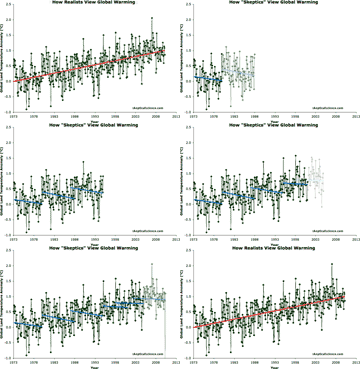
Thanks for the post, but I have to point out that your argument can be applied to the very data that was presented. The initial graph displayed runs from 1975 until 2006 which is quite a short period of time. It also seems quite misleading to post the graph showing only the short term trend from the bottom of a cooling period that ended in 1975 and not show the current cooling trend, thereby displaying a longer term variability. If we step back even further and look at temperatures from 1880 to present we do see a rise in temperature of about .5c per 100 years which is quite consistent with the warming we should expect as we recover from the little ice age. Also, I always take exception to graphs produced by computer models since they are based on assumptions that simplify our climate to ridiculous degree . This one in particular is quite maddening since it shows a nice, neat linear increase in temperature over the next 100 years. Hardly a realistic prediction if you ask me (although I know your not asking). The creators of these models also argue that our climate simply is not variable enough to account for the rise in temperature from 1975 to present, however, this post would seem to say that it clearly is.Response: The point of the paper is to show that even during a warming trend, you will find shorter periods of cooling or no trend. So it makes sense to try and find cooling periods during the "modern warming trend" from 1975 to present. As there was no statistically significant trend from around 1945 to 1975, it makes little sense to point out periods of no trend in that period.
I address elsewhere the argument that we're coming out of an ice age. -
David Horton at 12:00 PM on 21 April 2009Is the climate warming or cooling?
Hi John, yes, I agree, sadly, that the point must be made, my comment wasn't a criticism of the subject being addressed. The "warming has stopped" nonsense appears vigorously on every thread to do even vaguely with climate change. And appears to be the core of Plimer's Denialist Manual". When scientists (although Plimer is a geologist, and therefore only an honorary scientist) pretend not to understand regression you know they are either fools or rogues. -
David Horton at 10:36 AM on 21 April 2009Is the climate warming or cooling?
The proposition that a graph showing the variable response of one measurement to a causative factor will be variable is so self-evident that the idea of picking out individual shorter periods within the graph and pretending that they show an opposite trend must be a sign of deliberate deception. If every graph was a straight line relationship there would have been no need to develop the mathematics of regression. Well, maybe it isn't all deliberate deception, but it always shows people who are completely unfamiliar not just with statistics but with the basic idea of graphs. And don't get me started on the misuse of the term "model".Response: It is self evident and completely obvious and yet the argument "global warming has stopped because it's been cooling over the last few years" is a prevalent argument these days. So the point must be made. -
Patrick 027 at 09:11 AM on 21 April 2009It's the sun
“The Geography of Poverty and Wealth” by Jeffrey D. Sachs, Andrew D. Mellinger, and John L. Gallup, Scientific American, March 2001, pp.70-75, http://www.earth.columbia.edu/sitefiles/File/about/director/documents/SCIAM032001_000.pdf p.74: "Winter could be considered the world’s most effective public health intervention." -
Patrick 027 at 06:42 AM on 21 April 2009It's the sun
... and the albedos of snow, ice, and clouds are much higher for solar radiation than for terrestrial radiation. The terms 'albedo' and 'albedo feedback' are generally assumed to refer to SW (shortwave; solar radiation) effects; for Earthly conditions, LW (longwave; terrestrial) radiation processes are dominated by emission and absorption with reflection/scattering playing only a minor role. -
Patrick 027 at 05:18 AM on 21 April 2009It's the sun
"It's average albedo has no effect . See http://cosy.com/Science/TemperatureOfGrayBalls.htm . The implementation there needs to be extended to colored spectra ," Earth's albedo at solar-dominated wavelengths is about 0.3. At wavelengths dominated by terrestrial emissions, it is closer to zero. -
Patrick 027 at 04:59 AM on 21 April 2009It's the sun
Gord - so you aren't going to talk to a physics professor? Too bad for you. Bob Armstrong - skinny spectral lines? Have you ever seen the CO2 spectrum? Satellites can and have measured the spectrum of radiation emitted by the Earth to space and both water vapor and CO2 take significant chunks out of the total energy from the surface (by hiding it underneath the cooler atmosphere, which radiates to space but with less power). CO2 does this significantly between about 12 and 18 microns; the effect at the tropopause is saturated near the center of this band but not at the edges; the tendency is for each doubling of CO2 (within a range that we are currently in) to reduce net outgoing radiation at the tropopause by nearly 4 W/m2; the climatic response to this forcing is for the troposphere and surface temperature to increase until the radiative balance is restored; feedbacks occur that make the process a bit complicated. The band of absorption by a gas consists of some or many absorption lines; in the absence of line spreading mechanisms, these would have little width and not have much effect over the whole spectrum; however, random molecular motions and collisions broaden each contributing line so that they can form an absorption spectrum with peaks and valleys, but with significant absorption occuring even in the valleys. Unless the total C content of the biosphere and ocean are changing, the large C fluxes between those and the atmosphere must be balanced. The very small geologic outgassing rate also tends to be balanced by C sequestration by chemical weathering and organic C burial. There is a negative feedback that acts significantly over very long periods of time (generally longer than glacial-interglacial time scales), changes in the sun, geological outgassing, and forced changes in chemical weathering and organic carbon burial caused by continental drift and the raising of mountain ranges, etc, cause climate changes that tend to (depending on geography) change the chemical weathering rate in a compensating way (it may also change the organic carbon burial rate, though not necessarily in a compensating way (?), and also depending on geography); a long-term equilibrium climate occurs when the chemical weathering rate and organic carbon burial rate together balance the geologic outgassing rate. The biologic portion of the C cycle (any portion of it) will also be affected over many millions of years by biological evolution. The glacial-interglacial variability on the 20,000 to 100,000 year time scale is likely caused by Milankovitch cycles; not so much by changes in global annual average radiative forcing, but by large latitudinal and seasonal redistributions of solar heating, which, when certain thresholds are exceeded in one or the other directions (won't be the same value in both directions), can favor ice sheet formation and growth, or ice sheet decay and disintegration. The climatic response involves globally-averaged positive feedbacks - in particular, the positive albedo feedbacks of snow and ice, with some contribution from vegetation and aerosol changes, and also a positive greenhouse gas feedback from changes in CO2 and a couple other gases (and of course the faster-acting feedbacks that are involved in all climate changes, including water vapor). The precise mechanisms of the greenhouse feedbacks is not fully understood, but is understood to exist based on the robust correlation between greenhouse gas concentrations and climate on the glacial-interglacial time scale. Changes in atmospheric CO2 on this time scale can be caused by redistribution of C among the atmosphere, biomass, soil, upper ocean, and deep ocean; one potential factor is an increase in biological C sequestration from the upper ocean (which will then take CO2 from the atmosphere); this doesn't necessarily involve a large increase in geological sequestration because organic C precipitating from the upper ocean may be oxidized in the deep ocean; however, it will then be stored in the deep ocean until currents transport it upward - thus C storage in the ocean depends on the locations of biological C uptake relative to oceanic circulation patterns, and both can change in response to climate. Changes in oceanic pH caused by changing CO2 concentration can be buffered by dissolution of carbonate minerals and, generally over longer time periods, by the supply of dissolved elements by chemical weathering. Human activity has caused most if not all of the increase in CO2, CH4, CFCs, and if I'm not mistaken, N2O, over the last couple centuries. A majority, especially recently, is from the burning of fossil fuels - effectively an artificial acceleration (by well-over an order of magnitude) of geological outgassing. Some is also from cement production, and some (especially farther back in time) is from deforestation. This has occured significantly faster than glacial-interglacial changes in atmospheric composition and has gone outside the range of the variations over at least the last several hundred thousand years. The CO2 increase has been too rapid for oceanic pH buffering. There have been and are still some addtional uptakes, by oceans and biomass, of CO2 in response to the anthropogenic emissions; however, they are only a portion of the anthropogenic flux, so atmospheric CO2 has and is still increasing. There are limitations to how much more CO2 can be taken up from the atmosphere over a given time scale (limits to much more can the mass of C in biomass and soil increase, and limits on oceanic uptake because of oceanic chemistry and the limited rate of water exchanged between the upper and deep ocean), and climate change itself has the potential to reduce if not reverse these additional uptakes of CO2 from the atmosphere (as well as adding more CH4). Rapid and large changes into relatively unfamiliar conditions (unfamiliar as gauged by how long ago such conditions last occured) put stresses on ecosystems (even when species migrate or adapt, they may do so at different rates or in different ways - for example, the change in the activity of pollinators may not match the change in the plants whey would pollinate; also, different plant species will not respond the same way to CO2 changes and their response can be limited by other conditions - this is of relevance to agriculture) and can cause extinctions over and above the background level, up to the point of mass extinctions. Ecosystems are even more vulnerable if they are already under other stresses - such as habitat destruction and disintegration. If ecosystem stresses cause deforestation faster than aforestation (which is likely for a rapid climate change), then this could be an additional CO2 feedback. A CO2 sink will eventually materialize when boreal forests advance northward to replace tundra, although that will also be a positive albedo feedback. Human culture, including the economy, including infrastructure and farming, constitute an ecosystem - certainly one which can evolve in at least some ways much faster than any 'natural' ecosystem. However, an imposed change that requires adaptation will not be without costs. Soil does not migrate very fast. As with plants in general, some crops are photoperiod sensitive and so cannot simply be moved to follow temperature and moisture without additional breeding or loss of productivity. Temperature in not the only limiting factor in the growing season, and tropical conditions are not kind to many valued food crops. While some regions may experience increased agricultural productivity at first, this is only up to a point beyond which further climate change will reduce productivity, and this also tends to apply more to regions which already have enough food (for now). There are also biological ecosystem services, such as free pollination, that must be acknowledged (as well as natural pest control - biotic and abiotic factors apply). It is naive to expect global warming and CO2 increases to result in dependable bumper crops world-wide. The regular availability of fresh water resources - not just for agriculture - is of great concern in some regions. Warming also increases risk for some tropical diseases. It has been said that winter is our most effective public health program (see later comment for reference**). Our buildings and other infrastructure are designed for conditions - when those conditions change, infrastructure will require remodeling. Of course, the full cost is reduced when accounting for maintenance that must be done anyway (and that infrastructure yet to be developed). But it will cost when people must migrate upward from sea level (a large fraction of the world's people have settled near sea level) and away from newly arid regions, and perhaps abandon an even larger fraction of homes in some places than would be otherwise justified to reduce river and urban flooding costs. There are concerns about severe weather (not just tropical cyclones - extreme precipitation events in general, perhaps among other things; although in some places, winter headaches (land and air travel problems and costs) will be reduced - but not when and where snow is replaced by ice). There is confidence that a doubling of CO2 will increase global average surface temperature by about 3 +/- 1 degree C or so. Some regional effects, including general poleward shifts in midlatitude storm tracks, with associated drying on the low-latitude edge of storm tracks and increasing precipitation at high latitudes, as well as a sea level increase (which will not stop at 2100 - there are long term effects), are expected with confidence. But some uncertainty remains in the global average changes and especially with associated regional effects. This uncertainty imposes some adaptation costs by reducing the ability to plan - although it may also have a benifit in discouraging use of climate as a weapon. -
XPLAlN at 03:18 AM on 21 April 2009Is the climate warming or cooling?
I woke up today feeling great - like I was 10 years younger. So I cross referenced my birth certificate with the calender and was upset to discover that I am in fact continuing to age. Bummer, but good job I checked.Response: I on the other hand tend to feel older than I really am. Dang natural variability! -
Gord at 16:46 PM on 20 April 2009It's the sun
AGW Theory: 1. VIOLATES the 2nd Law of Thermodynamics. 2. VIOLATES the Law of Conservation of Energy. 3. VIOLATES Electromagnetic Physics. 4. VIOLATES the Stefan-Boltzmann Law 5. VIOLATES Heat Radiation Physics. 6. VIOLATES Vector Mathematics. 7. VIOLATES Actual Measurements. 8. VIOLATES Cause and Effect logic. Further, despite over $50 Billion having been spent on AGW "research" and literally thousands of papers produced on the subject: - There is not even ONE Law of Science that supports AGW. - There is not even ONE measurement that shows that atmospheric CO2 can heat the Earth. ----------- "In academia and science, fraud can refer to academic fraud – the falsifying of research findings which is a form of scientific misconduct – and in common use intellectual fraud signifies falsification of a position taken or implied by an author or speaker, within a book, controversy or debate, or an idea deceptively presented to hide known logical weaknesses." http://en.wikipedia.org/wiki/Fraud Forms of scientific misconduct include: fabrication – the publication of deliberately false or misleading research, often subdivided into: - fabrication – the actual making up of research data and (the intent of) publishing them - falsification – manipulation of research data and processes or omitting critical data or results Another form of fabrication is where references are included to give arguments the appearance of widespread acceptance, but are actually fake, and/or do not support the argument" http://en.wikipedia.org/wiki/Scientific_misconduct ------------- I think AGW Theory is fraudulent and the people who claim that AGW is factual are guilty of fraud and scientific misconduct because: 1. AGW is deceptively presented to hide known logical weaknesses. 2. AGW omitts critical data or results. -
Bob Armstrong at 10:31 AM on 20 April 2009It's the sun
Scanning the above , a lot is excessively complex . Simple application of Stefan-Boltzmann and Kirchhoff shows the mean temperature of the earth will inevitably be about 1/21st the effective surface temperature of the sun . It's average albedo has no effect . See http://cosy.com/Science/TemperatureOfGrayBalls.htm . The implementation there needs to be extended to colored spectra , but its highly unlikely the couple of skinny spectral lines of CO2 , particularly when multiplied by the small portion released by man , relative to the already highly saturated base , has virtually any detectable effect . In any case , this analysis produces experimentally falsifiable numbers . I have never found an experimental demonstration of the purported "greenhouse" effect . Of course , plants being almost totally CO2 + H2O love that extra 3% man released from that sequestered in geologically lush ages . There is no question the planet is greener for the CO2 we are returning to the atmosphere . -
Quietman at 03:30 AM on 20 April 2009There is no consensus
HealthySkeptic My point was less the conversion than the words that he used. "There is no real substitute, except the get the real science right" -
Quietman at 03:27 AM on 20 April 2009It's the sun
Patrick My point is simply that it is yet another variable that was not accounted for in the models. There are just too many factors ignored for the models to work. -
GFW at 18:36 PM on 19 April 2009Arctic icemelt is a natural cycle
What jecht8 either doesn't know or acknowledge is that it took Amundsen 3 years to make the trip because only bits opened up at a time. Also, he took an extremely shallow water route sticking close to the mainland shore. When we speak of the NW passage opening now, we're talking about being able to go pretty much full speed, just steering around a few bergs - and it's the more northern, deep water route. -
Patrick 027 at 13:59 PM on 18 April 2009It's the sun
Re Quietman - My earlier use of a ratio of 30,000,000,000,000,000 for the heat capacity of the climate system to the heat capacity of the solar wind may have been a bit off. If the solar wind plasma has a specific heat comparable to air, the heat capacity per square meter of the faster-reacting portion of the climate system (including the top 100 m of the ocean) is about 100,000,000,000 times that of the solar wind passing through a square meter in about 20 years. 150,000 K / 100 billion = 0.0000015 K. That doesn't include the factor of 4 for spherical geometry, although it also doesn't include the ratio of the effective capturing area to the area of the Earth. -
Patrick 027 at 13:29 PM on 18 April 2009It's the sun
Clarification end of my comment 254: ..."much much greater forces (Winds, climate-driven buoyancy variations, tides) shape the ocean's conditions and dynamics and variability in these dwarf any short-term volcanic effects (Panama wasn't built in a single millenium). " I was refering in that context to just the direct geothermal heating effects, and not the radiative forcing of volcanic aerosols. ---- Other notes (with no significant climatological implications) Relativistic effects - if two blackbodies are moving toward each other, their radiation will be blueshifted upon absorption relative to the energy it had upon emission. The blackbodies would appear to be hotter to each other than they actually are. Where does the energy come from? For simplicity, consider two blackbody surfaces sliding toward each other like pistons in mirrored tube, so they only see each other and nothing else. 1. As the pistons move toward each other, the volume in between decreases. At thermodynamic equilibrium, the volume between bodies with nonzero emissivity will be filled with radiation with some energy density that depends on the temperature of those bodies. Even outside of equilibrium, the volume between the two blackbody pistons will contain photons being exchanged. As that volume shrinks, the energy density of that space will tend to increase due to the blue-shift that causes (if the blackbody pistons are insulated on their opposited sides) the temperature of the pistons to rise, but not enough to maintain the same total energy of the photons in the space between the pistons. Thus, the decreasing total energy of the radiation contained between the pistons is due to a net transfer of energy to the pistons. 2. Energy is also added to the system by the work that must be done against radiation pressure to push the pistons together. -
Patrick 027 at 13:05 PM on 18 April 2009It's the sun
Gord - You might want to actually talk to a physics professor sometime. -
Gord at 08:27 AM on 18 April 2009It's the sun
Patrick - You are entitled to your "opinions". It appears that is all you have posted. Laws of Science are generally accepted as being fundamental truths in any scientific endeavor or discussion. I do accept attempted re-writes, attempted dis-proofs or use of analogies that violate these fundamental laws to be a valid basis for any scientific debate. My posts are based on established Laws of Science and actual physical measurements that have been duplicated and verified. Third-party readers, who accept these Laws of Science as being valid, are my target audience. -
HealthySkeptic at 15:30 PM on 17 April 2009There is no consensus
Yes Quietman, And David Evans is just one of a growing number of scientists who work or have worked in AGW-related fields to finally 'see the light' as it were. -
HealthySkeptic at 15:21 PM on 17 April 2009Misinterpreting a retraction of rising sea level predictions
Thanks Mizimi, I can't wait for Chris' creative interpretation of this new data. When reading the protestations of fervent AGW proponents I am constantly reminded of creationist leader Henry Morris who decreed that any scientific evidence that did not support a 'young earth' was to be "explained away". -
Patrick 027 at 14:47 PM on 17 April 2009Why is Antarctic sea ice increasing?
Timothy Chase - I have actually tracked down some articles on the subject, though haven't actually gotten to reading most of them yet. I may post the websites sometime... I have a long-running series of comments at: http://www.skepticalscience.com/Arctic-sea-ice-melt-natural-or-man-made.html (Starting at comment ~272) about atmospheric circulation, eventually focussing on wave-mean interactions, in particular Rossby waves. By the time of my last comments on that matter so far (~ 491 - 496), I had only just established the basic concepts that may be necessary for understanding storm track variability and troposphere-stratosphere interactions...(I was figuring some of it out as I explained it). -
Patrick 027 at 10:19 AM on 17 April 2009It's the sun
"If this were not true, then I could build a perpetual motion machine. If an orange hot object can emit red photons " Later in that paragraph I accidentally switched "orange hot" for "white hot" - out of habit. Either would work in this example. Sorry for the confusion (Don't think you've gotten me to waste my time writing stuff you don't care about, Gord - I wrote this for the benifit of third-party readers). -
Patrick 027 at 10:13 AM on 17 April 2009It's the sun
corrections/clarification: Another reason objects in the solar oven may reach lower temperatures at night than the surrounding land surface is that they are not connected to the heat capacity of the land surface (bearing in mind that the later is effectively limited for any heating cycle by the time it takes for heat to diffuse over distance; I think for the diurnal cycle, the surface can store and draw heat to and from depths of maybe 20 cm ?). Depending on local weather conditions, Brigham Young University may be a better site to use the solar oven for cooling purposes than other places - places with higher humidity and lower elevation. An object being heated by 168 W/m2 solar radiation and 324 W/m2 from the atmosphere will warm up or cool off until it loses, by convection and radiation emission, 168 + 324 = 492 W/m2. Even with a majority of the 324 W/m2 of atmospheric radiation remaining, removal of the 168 W/m2 of solar heating will cause that object to cool to a lower temperature until it only loses by convection and emission 324 or less W/m2. ----- Locally, the average Poynting vector of diffuse solar radiation, from blue sky or clouds, may tend to be nearly straight downward, but obviously the Poynting vector of the direct (beam) solar radiation will vary, being nearly horizontal (and per unit area horizontal surface, nearly zero) close to sunrise and sunset. ________________________________ Gord: "Falsification Of The Atmospheric CO2 Greenhouse Effects Within The Frame Of Physics." I, and many others, have been over that piece of trash before - see this selection of comments (all of mine and a few of some others, but feel free to see all responses by others, of course): http://www.realclimate.org/index.php/archives/2009/03/olympian-efforts-to-control-pollution/langswitch_lang/in (*** indicates comment by another person) Radiation in the atmosphere: 131 - 17 March 2009 at 11:40 PM 132 - 17 March 2009 at 11:50 PM 133 - 17 March 2009 at 11:55 PM 144 - 18 March 2009 at 1:32 PM *** 145 - 18 March 2009 at 1:44 PM 149 - 18 March 2009 at 11:29 PM 150 - 18 March 2009 at 11:42 PM 186 - 19 March 2009 at 11:00 PM 188 - 19 March 2009 at 11:28 PM Responses to G&T: *** 163 - 19 March 2009 at 11:21 AM (note link!) 189 - 19 March 2009 at 11:37 PM - http://www.realclimate.org/index.php/archives/2009/03/olympian-efforts-to-control-pollution/langswitch_lang/in#comment-115353 *** 194 - 20 March 2009 at 7:59 AM 210 - 20 March 2009 at 5:58 PM 211 - 20 March 2009 at 6:08 PM 231 - 21 March 2009 at 2:12 PM 232 - 21 March 2009 at 4:05 PM 254 - 23 March 2009 at 1:35 PM 267 - 23 March 2009 at 8:16 PM 268 - 23 March 2009 at 8:24 PM 269 - 23 March 2009 at 8:29 PM *** 271 - 23 March 2009 at 11:17 PM 274 - 23 March 2009 at 11:48 PM *** see link in response to 297, 24 March 2009 at 12:40 PM 308 - 24 March 2009 at 11:13 PM (note links!) 309 - 24 March 2009 at 11:43 PM 310 - 24 March 2009 at 11:52 PM *** 314 - 25 March 2009 at 7:18 AM 323 - 25 March 2009 at 6:07 PM *** 337 - 28 March 2009 at 9:03 AM - http://www.realclimate.org/index.php/archives/2009/03/olympian-efforts-to-control-pollution/langswitch_lang/in#comment-116369 not dealing specifically with radiation: 148 - 18 March 2009 at 11:11 PM 230 - 21 March 2009 at 2:05 PM ________________ "I am really amused when I read "science" like this:"... "The Greenhouse Effect" http://www.physicalgeography.net/fundamentals/7h.html "Tutorial on the Greenhouse Effect- University of Arizona" http://www.lpl.arizona.edu/~showman/greenhouse.html The first one states that 90 % of atmospheric radiation is to the surface; I think the actual value is different (and it could be described more clearly, though I am only going by the excerpt you provide). The second implies that none of the radiation directly from the surface reaches space, and that the atmosphere emits equally upward and downward; these are not true, but the excerpt refers to a 'simple' model; often when a concept is introduced it is introduced with a very simple model that illustrates a process qualitatively but cannot readily be applied to actual situations. "Somehow, they must have missed the fact that the Sun is the only energy source and what they describe is really a perpetual motion machine in a positive feed-back loop." Somehow, amazingly (to the point that I have wondered if you are being honest in your demonstration of apparent inability to understand physics and also perhaps lack of basic arithmetic skills - or perhaps you are not even trying to understand anything), you have missed the fact that they, Kiehl and Trenberth, climatologists in general, and myself, all realize that the sun is the only significant energy source (tides, geothermal heat fluxes being tiny) in the energy budget of the climate system. You also seem to have little understanding of what a perpetual motion machine actually would do. ---- "No matter how much you want to believe that there is a way around the 2nd Law of Thermodynamics and the Law of Conservation, there is none." Same to you. With variation over wavelengths, overall the atmosphere looks cooler from above than from below because of the general temperature decrease with height in the troposphere; it radiates more downward than upward. (The atmosphere recieves more heat (from convection and radiation) from below from the solar-heated surface than it does directly from radiation; convection can reduce the temperature decrease with height only to a moist-adiabatic limit (where it occurs - within the troposphere).) Whereever there is radiative energy exchanged by thermal emission and absorption between bodies which are themselves in local thermodynamic equilbrium, the net flow of energy is from warmer to cooler, because for two objects, at any given wavelength, each of any emissivity (with absorptivity = emissivity) as any function of wavelength, for each line of sight (whatever turns it may take by scattering, refraction, or reflection) that connects the two, of the radiation emitted and absorbed by the objects being considered, there will be greater radiant intensity in the direction toward the cooler object than in the reverse. You can add the two sets of electromagnetic waves and find an average Poynting vector that goes from warmer to cooler, if you prefer that. But at any given wavelength (and direction, polarization, etc., for local thermodynamic equilibrium), an object has to have the same absorptivity as emissivity - for reasons stated in the "hyperphysics" website that you trust for your information about the second law of thermodynamics. If this were not true, then I could build a perpetual motion machine. If an orange hot object can emit red photons to a red hot object that absorbs them, and yet not absorb any red photons from that red hot object, then its optical properties are such that I could substitute a blue hot object for the red hot object, use an optical filter so that only red photons can go between the objects (other photons being reflected back to the objects), and have the white hot object spontaneously lose heat to the blue hot object. Using spontaneously heat flow from the blue hot object to the white hot object along a different path, I could run a heat engine. This set-up would convert heat energy to work energy in a manner that decreases the entropy of a closed isolated system; it would draw in heat energy at high entropy (low temperature) to run a perpetual motion machine. That would violate the second law of thermodynamics. And I AM TELLING YOU that this will not happen in physical reality. (In case you need another analogy, in thermodynamic equilibrium in a chemical reaction, the forward and reverse reactions are happening at the same rate; it does not mean activity on the molecular level has ceased.) The optical properties will not spontaneously change just by moving external objects around. Have you ever had your stovetop heating elements on? Did you notice them glowing red? Did you turn on an incandescent light bulb (filament hotter than red-hot) while the heating element was on? If so, did the heating element suddenly stop glowing in order to avoid radiating millions of photons toward the bulb, to avoid one of those photons being scattered into the bulb (as the light from a frosted light bulb is scattered on the way out) at the right direction to hit the filament and be absorbed? That's not how physical reality works. "On that note, I will no longer respond to any of your posts where you have used repeated violations of these basic Laws of Science to make your points." Those violations are a figment of your lack of understanding. Anyway, I ought to be saying that to you. -
chris at 07:33 AM on 17 April 2009Comparing IPCC projections to observations
Not really Mizimi. If one compares the Mauna Loa data with the CO2 data averaged over the marine surface sites, it's pretty clear that we have a pretty reliable measure of monthly averaged, and especially yearly averaged atmospheric CO2 data: both data sets here: http://www.esrl.noaa.gov/gmd/ccgg/trends/ Apart from the the contrived "fishing" for problems that don't exist, are you at some point going to indicate in what respect the Mauna Loa data is inadequate for a specific purpose? and what is the "ARES satellite data"? Link please. and can you give an example of what you mean by "...projections using that data..."? An example of your "projections" please. rather than just saying stuff, why not show us the evidence. Where is the "red blob", and on what satellite data? argumentation by vagueness and insinuation isn't very scientific Mizimi. Be specific. Show us the data ("ARES" ??....."red blobs on the left of the picture" ??). -
Mizimi at 04:31 AM on 17 April 2009Comparing IPCC projections to observations
Chris: take a look at the latest ARES satellite data on CO2 levels. Mauna Loa stands out as a small red blob on the left of the picture; in other words as an anomaly - high compared to other sea level measurements. Mauna Loa may well be a reliable measure of levels, AT THAT SITE ( your words) but that is not the same as accurate. The satellite data shows ML to be high compared to the global condition and thus any projections using that data are suspect. -
Mizimi at 04:12 AM on 17 April 2009Misinterpreting a retraction of rising sea level predictions
Have a look at this: http://www.friendsofscience.org/assets/documents/FOS%20Essay/GlobalTroposphereTemperaturesAverage.jpg which shows a linearised temp trend downwards since 2002, an actual decrease of 0.2C in 6 years. Yes, 1998 was an anomaly, but the cooling trend is continuing. -
Mizimi at 03:49 AM on 17 April 2009The link between hurricanes and global warming
#24 The graphs at the website QM points to in #23 show a steep decline in cyclone activity in both hemispheres ( if you go to the bottom of the page both hemispheres are shown over a time series from 1970 to 2009). This suggests that there is decreasing overall energy in the climate system as both the frequency and intensity have fallen to historic lows. This correlates ( at face value) with satellite data showing a cooling trend over the last decade. So one might argue that weather is becoming less dynamic...but the sensitivity of our instrumentation has improved and the sensitivity of our societies to weather based disruption has increased..so it 'seems' the weather is more dynamic. One possibility that may give some further insight is to access a meteorological database that logs windspeed and use that as an indicator. -
Mizimi at 03:27 AM on 17 April 2009Does Urban Heat Island effect add to the global warming trend?
One issue about UHI seems to be swept under the carpet...namely they affect weather - not just locally but over quite large distances. Warm air plumes,wind shadows,water vapour additions all serve to change the local microclimate which in turn affects the general conditions. Whilst the thermal data may be adequately corrected for UHI effects, how do you factor in the physical changes caused by the very existence of cities? -
Mizimi at 03:16 AM on 17 April 2009Temp record is unreliable
#45 Unfortunately most of the weather stations in Siberia have been shut down and if you look up the current distribution of weather stations globally they are distributed very unevenly...the highest density being in the USA. Many other parts of the world are not 'thermally' represented so any global mathematical average (however it is derived) is going to be wrong. Satellite measurement has been around now for only 30 years so whilst we have a more even distribution of data (not necessarily more accurate) the data series is too short for any predictive climate modelling. Interestingly, the current series of satellite temperature data shows a clear cooling trend since 2002 despite increasing CO2 levels. -
Gord at 18:25 PM on 16 April 2009It's the sun
I am really amused when I read "science" like this: ---- The Greenhouse Effect "Absorption of longwave radiation by the atmosphere causes additional heat energy to be added to the Earth's atmospheric system. The now warmer atmospheric greenhouse gas molecules begin radiating longwave energy in all directions. Over 90% of this emission of longwave energy is directed back to the Earth's surface where it once again is absorbed by the surface. The heating of the ground by the longwave radiation causes the ground surface to once again radiate, repeating the cycle described above, again and again, until no more longwave is available for absorption." http://www.physicalgeography.net/fundamentals/7h.html ---- Tutorial on the Greenhouse Effect- University of Arizona "In this case, the Earth still gains 240 Watts/meter2 from the sun. It still loses 240 Watts/meter2 to space. However, because the atmosphere is opaque to infrared light, the surface cannot radiate directly to space as it can on a planet without greenhouse gases. Instead, this radiation to space comes from the atmosphere. However, atmospheres radiate both up and down (just like a fire radiates heat in all directions). So although the atmosphere radiates 240 Watts/meter2 to space, it also radiates 240 Watts/meter2 toward the ground! Therefore, the surface receives more energy than it would without an atmosphere: it gets 240 Watts/meter2 from sunlight and it gets another 240 Watts/meter2 from the atmosphere -- for a total of 480 Watts/meter2 in this simple model." http://www.lpl.arizona.edu/~showman/greenhouse.html ----- Somehow, they must have missed the fact that the Sun is the only energy source and what they describe is really a perpetual motion machine in a positive feed-back loop. -
Gord at 18:01 PM on 16 April 2009It's the sun
Falsification Of The Atmospheric CO2 Greenhouse Effects Within The Frame Of Physics. International Journal of Modern Physics B, Vol. 23, No. 3 (30 January 2009), 275-364 Notice what is said in the Abstract: "The atmospheric greenhouse effect, an idea that authors trace back to the traditional works of Fourier 1824, Tyndall 1861, and Arrhenius 1896, and which is still supported in global climatology, essentially describes a fictitious mechanism, in which a planetary atmosphere acts as a heat pump driven by an environment that is radiatively interacting with but radiatively equilibrated to the atmospheric system." AND... "According to the second law of thermodynamics such a planetary machine can never exist. Nevertheless, in almost all texts of global climatology and in a widespread secondary literature it is taken for granted that such mechanism is real and stands on a firm scientific foundation." http://arxiv.org/abs/0707.1161 -
Gord at 17:40 PM on 16 April 2009It's the sun
Patrick - Re: Your Posts #281, #282, #283, #284 etc. Again, I disagree with all these Posts. I really think that the Law of Conservation of Energy, the 2nd Law of Thermodynamics are beyond dispute. The Trenberth Energy Budget diagrams show the Earth radiating 390 w/m^2 and the in-comming Solar radiation (the only energy source) is only 342 w/m^2. This is a clear violation of the Law of Conservation Energy and is not disputable. The colder atmosphere Back Radiation of 324 w/m^2 is also shown to be absorbed by the much warmer Earth surface. This violates the 2nd Law of Thermodynamics and is proven to do so by actual measurements done by Physics Dept.of Brigham Young University, Utah. These same results have been verified by previous tests at Brigham Young University. The Back Radiation of 324 w/m^2 is also greater than the 198 w/m^2 Solar radiation reaching the Earth's surface (as shown in Trenberth's Energy Budget diagram). Another clear violation of the Law of Conservation Energy and is not disputable. Remember this Back Radiation is supposed to have caused the entire Earth to increase in temperature from -18 deg C to +15 deg C, according to the AGW'ers. But, obviously, it can't even prevent water from freezing when the Back Radiation is concentrated at the focal point of a Solar Oven, as proven in the Brigham Young University experiments. If the 324 w/m^2 Back Radiation actually reached the Earth's surface it should produce more heating than Solar radiation, even at night. There are probably over a million Solar Ovens on the planet and none will produce heating at night. If they did, the worlds energy problems would be solved. There is no "refigerator in the sky". No matter how much you want to believe that there is a way around the 2nd Law of Thermodynamics and the Law of Conservation, there is none. On that note, I will no longer respond to any of your posts where you have used repeated violations of these basic Laws of Science to make your points. -
Patrick 027 at 12:29 PM on 16 April 2009It's the sun
"This is closely related to inverse square laws." The relationship between the solid angle filled by an object from a point to the distance between that point and the object is such that the same inverse square laws for point masses and charges (gravitational force due to a point mass and electric force due to a point charge being inversely proportional to the square of the distance from that mass or charge) are analogous to the way radiant flux per unit area facing a point source of radiation varies with distance, and also, the analogy extends to distributions of masses, charges, and radiation sources - that outside of a spherically symmetrical distribution of such things, that force (equal to field line density - the gravitational or electric field flux per unit area) or radiant flux per unit area due to the distribution is inversely proportional to the square of the distance from the center; for a infinite straight line radiator, mass, charge, or current, or outside a cylindrically symmetrical distribution about the center of such a straigth line, the radiant flux per unit area, the gravitational field, the electric field, or the magnetic field will be in proportion to the inverse of the distance from the line; for an infinite flat surface or sheet with even distribution in directions parallel to the surface or sheet of radiation source, mass, charge, or current, the radiant flux per unit area, gravitational field, electric field, or magnetic field, due to that surface or sheet distribution, will be constant across all space on one side of the sheet. (An infinite sheet will fill a full hemisphere of solid angle as seen from any location).
Prev 2589 2590 2591 2592 2593 2594 2595 2596 2597 2598 2599 2600 2601 2602 2603 2604 Next