Arguments







Recent Comments
Prev 2597 2598 2599 2600 2601 2602 2603 2604 2605 2606 2607 2608 2609 2610 2611 2612 Next
Comments 130201 to 130250:
-
Philippe Chantreau at 17:45 PM on 10 February 2009Arctic sea ice melt - natural or man-made?
Quietman, you're the one interpreting the number of citations that way. Among researchers, nobody cares about your interpretation. If a paper has a bunch a cites refuting it, then that makes it relevant too. Why do you think that Elsevier and everyone else provide links to cites and individual citing articles? Get over yourself. Your interpretation is not everyone's interpretation, especially not among those who actually work and research a field. I no longer think that you deserve to be called a skeptic. You accuse RC of political or other biases yet you have no problem throwing around links to Morano's pathetic bull***t. You linked Hays' letter but failed to mention how his very non scientfic objections were thoroughly addressed by the author he criticized. Oh, sorry, I forgot, you don't read RC. That limits your reading to critics of RC posts from other sources and restricts your access to responses that would be on RC. But it all fits with your idea of "skepticism" and "balanced view", I'm sure. You keep on citing stuff that does not support what you say it does and when called on that by Chris, you go on accusing him of bias or "not liking the authors" without ANY basis for the accusation. You give credence to far fetched ideas with a scant or non existent publication record while holding doubts on published ideas that have succesfully cleared authentic scientific scrutiny. When confronted with that, you resort to the tried and true, whiny excuse of creationists, i.e. "scientific journals are biased against our ideas so we can't publish." Pretty sad. You're not showing any true skepticism. By the way, I recall you mentioning scientific evidence of a coming ice age. Care to show the references? Are the majority of glaciers around the world growing? I also recall you talking about the weather and how cold it was wherever. Well, in Australia, it's mighty hot, and in China, Chile, Argentina, it's very dry and hot, and where I am we had extreme winter heat by the coast and a miserable snowpack. We've had spring skiing conditions in January, with warmer temps at 7000 ft than at 100ft. That's my weather report, local and other. -
Quietman at 09:43 AM on 10 February 2009Arctic sea ice melt - natural or man-made?
Patrick Yes, that's my point. Just the number of citations makes it appear to be endorsement while in fact they all could be arguments against the paper. I don't think that the number of citations is relavent for that reason. -
Quietman at 07:52 AM on 10 February 2009It's the sun
piszkace There are a couple of factors involved. GHG is one. The sun another and plate tectonics another. The sun provides most of the heat and the earth, via plate tectonics both provides additional heat and determines how it is distributed, ie. it controls ocean patterns and oscillations which in turn control the air circulation and weather patterns. GHGs maintain the heat but can not cause or provide any heat. This is why the term "global warming" is incorrect. We have temperature anomalies appearing in several places on the planet, most notably is the west antarctic penn. and northern Greenland. There are others but these two shine out because of the ice melt. They are both (as well as others) tectonically driven (what we term as "root cause" in engineering. (Engineers look for root cause because fixing symptoms gets you nowhere, it's a bit like taking aspirin for a flu - you stop the fever but you still are sick). -
Quietman at 07:39 AM on 10 February 2009There is no consensus
ps You left out that Meteorologists are about evenly divided on the cause. I think it was a 47/53 percentage split. Engineers disagree because they realize that the laws of thermodynamics are not actually applicable to the earth or living things (something the greens and creationists don't seem to understand). Those scientists behind AGW are actually not "climatologists" (the number of people with PhDs in this field number only a couple hundred and Hansen is not one of them, Fairbridge for example taught climatology and he was a "denier"). -
Quietman at 07:30 AM on 10 February 2009There is no consensus
Re: "The greatest doubt is held by petroleum geologists (what a surprise)." They are also among the best qualified to know what is really causing this problem, no surprise here, after all it is a tectonic issue. -
Quietman at 07:22 AM on 10 February 2009Volcanoes emit more CO2 than humans
The Keweenaw rift That sounds logical enough. I thought that you were talking about a recent event when you first said "a failed rift". It does not seem to have failed, just old and later compressed. My cousin has a degree in geology (not a PhD) and showed me some of the features upstate New York some years ago. Where he is now (near Albany) has Devonian rock all over, covered with fossils. Interesting stuff. -
Quietman at 07:16 AM on 10 February 2009Volcanoes emit more CO2 than humans
Patrick "Obviuosly they stopped work on it. " Was that before or after they realized the fault had a potential for activity? The blasting caused an earthquake. Not a good thing under downtown NYC. :) -
Patrick 027 at 06:04 AM on 10 February 2009Volcanoes emit more CO2 than humans
"Obviuosly they stopped work on it. " Was that before or after they realized the fault had a potential for activity? PS - a little fuzzy on some of this, but I think: The Keweenaw rift formed (as a rift) just before 1000 Ma, and this may coincide with the Grenville orogeny (to the east if oriented as now) - (perhaps the rift occured over a descending slab of subducted oceanic crust, from the subduction zone to the east (if oriented as now)). Shortly afterward, it reversed from being extensional to being compressional; fallen blocks (The Saint Croix horst?) (having been covered with basalt and sediment) were forced back up again. This occured between 1000 Ma and 900 Ma, during another collision (I believe distinct from and coming after the Grenville orogeny, though not completely sure). But, faults were again reactivated during another collision in the Ordivician, with the former rift absorbing a bit more compression. -
piszkace at 05:13 AM on 9 February 2009It's the sun
#239 & 240 Maybe sience never was objective, seeking answers fitting our needs. Or maybe it was, being critical to it's own theories... But even regardless the news: the graph shows that, the SR was lower before 1935, than it is now. If the Sun is responsible for the supply of 99,9% of Earth's energy (maybe less, maybe more - I don't really know) this rise, despite its now being stable (or not) for the last few decades, may be the cause. Maybe somewhere in between 1365,6 and 1366 lies the border, exeeding which, the earth can no more cool off enough? But I agree: there are much more factors to think about. So maybe I'm wrong: the rain in Fabuary, and plus 10 C, on 51 N and 17 E is just a possible fluctuation of the climate. But if I am wrong, can anyone tell me something for sure? Theory of chaos - isn't it? -
Quietman at 04:15 AM on 9 February 2009Is Antarctic ice melting or growing?
John Gault I think you may be interested in this thread: It's volcanoes (or lack thereof) (this site under arguments). -
glider at 14:55 PM on 8 February 2009Does Urban Heat Island effect add to the global warming trend?
You are very selective in your cherry picking. Do you ever research anything or simply mine for what you want the outcome to be? -
robbrian at 11:21 AM on 8 February 2009Global warming stopped in
1998,1995,2002,2007,2010, ????
It is my understanding that methane traps heat only while forming its hydrate and can hold up to 400 degrees F in each and every molecule and its ignition continues without melting the ice which it encompasses. Is there not a serious threat from these hydrates both in the warming deep sea and permafrost that would contribute to global warming since methane hydrate is 20 to 30 times more dangerous as an absorber of heat than CO2? Is it likely that this coming Spring, as it warms and the hydrates that have formed during the winter start fighting to survive the warmer weather, they will dissociate especially in Russian, Canadian and Scandanavian permafrost? -
chris at 21:47 PM on 7 February 2009Climate sensitivity is low
please pay attention Quietman! We've already seen that paper (linked in John Cook's top post). My link is to the correction that Stephen Schwartz published in which he determined that the conclusions of the original version of the paper (your link), were incorrect and that his original climate sensitivity value was far too low..... -
Patrick 027 at 06:18 AM on 7 February 2009Arctic sea ice melt - natural or man-made?
Quietman - but I think Philippe also pointed out that a paper which disagrees with, overturns, rebuts, and/or especially finds errors in another paper, can/will cite that paper. Now I forget - was the number of citations originally brought up to point out the number of scientists (or scientists * work per scientist) who took the paper seriously enough to do follow-up (agreement or not)? -
Quietman at 05:22 AM on 7 February 2009Arctic sea ice melt - natural or man-made?
Philippe My point is that the number of citations is pure consensus, not science. Consensus is flat-earth proof, not necessarily factual. WA makes an excellent point above in 415. -
Quietman at 15:33 PM on 6 February 2009Volcanoes emit more CO2 than humans
I forgot the "booming" noises (enough to rattle windows in north western NJ) that were in all the NJ papers in the 70s. It took them a while to realize that they were earthquakes because no one alive at the time had ever felt them in NJ. They thought the Ramapo fault was dead and that's the main one through NJ. -
Quietman at 15:27 PM on 6 February 2009Volcanoes emit more CO2 than humans
ps thats 2nc Avenue in Manhatten (NYC). -
Quietman at 15:27 PM on 6 February 2009Volcanoes emit more CO2 than humans
Yes, the fault that follows the Hudson river had a 5+ back in the 70s near Bear Mountain. I remember that one because I felt it in N.J. over a hundred miles away and there was concern about the epicenter being close to a nuclear power plant. I was born and raised in N.Y. and raised my children in N.J. so I am familiar with the area. Never even heard of earthquakes there until the 70s. Knew about the 2nd avenue fault from history, they discovered it blasting for a subway. Obviuosly they stopped work on it. -
Patrick 027 at 11:20 AM on 6 February 2009Volcanoes emit more CO2 than humans
"I was referring to New England and Nova Scotia being on a seperate plate. It's actually more than New England but that's irrelavent. The joining of this land mass from the bottom left to the canadian shield is responsible for much mountain building and the primary appalachian fault which is still active. " - Okay... aside from there being one fault that can be designated the primary fault, I was aware of that. Isn't possible, though, that there has been no increase in activity? Because: "They just had a 3.0 quake in Morristown N.J. a couple days ago - extremely rare event for N.J." (PS I heard about that one. I had known about the New Madrid fault quite some time ago but just a couple or so years ago I was surprised to see on a map that there was significant seismic hazard in South Carolina and elsewhere in eastern North America. I think there've even been a few big earthquakes in the New York/eastern Canada region (historical).) When events are so rare, it is really hard to tell from a short record just what would signify a trend in activity. Maybe there's an average of one >= 3.0 earthquake in NJ every 500 years or so (pure hypothetical example - I don't know what the number actually is). You did refer to news about scientific findings from the Arctic ridge, but it was never established that there was an actual significant increase in speed. Mantle convection and the large scale plate motions that follow it are gradual on the scale of many years to many hundreds of thousands of years ... not sure where the long cut-off would be - the point being that, as some portion of the stress is relieved in jolts, I would expect the finer time scale will show some irregularity in motion on the spatial scale of the stress build up and relief by single or a few earthquakes. But this will tend to average out on intermediate timescales because the source of such stress is from the pressure variations due to elevation, composition, and temperature variation, which change significantly only on much longer timescales. -
Quietman at 06:37 AM on 6 February 2009Volcanoes emit more CO2 than humans
Patrick I was referring to New England and Nova Scotia being on a seperate plate. It's actually more than New England but that's irrelavent. The joining of this land mass from the bottom left to the canadian shield is responsible for much mountain building and the primary appalachian fault which is still active. They just had a 3.0 quake in Morristown N.J. a couple days ago - extremely rare event for N.J. which I am assuming occurred along the Ramapo fault (a parallel fault). This makes sense when you realize that the arctic ridge increased speed and is pushing the canadian shield south again. -
Patrick 027 at 11:10 AM on 5 February 2009Volcanoes emit more CO2 than humans
Re 165 - yes, I know ultimately every sizable chunk of continent came together from smaller terranes. Of course the Keweenawan rift likely cut through some older boundaries and may well have incorporated some older boundaries. But it was itself a rift. Although it is also true that it absorbed some compression at a later time (but not much later?)- formerly fallen blocks were forced back up. "I don't believe anything "fused" is actually a permanent condition" - well, that makes sense, but I would guess that, other things being equal, forces would be more likely to reactivate more recently active faults than faults that have been dead for longer. Re 164 - each is a hypothetical ~1000 year 'graph' of tectonic activity. I altered J in an attempt to show what one might expect it to look like if recent global warming were driven by an increase in tectonic activity. Even if it did look that way, however, there is still the problem that there is not enough reason to expect one to cause the other. Whereas there is much reason to expect adding CO2 to the atmosphere to cause warming, with or without paleoclimatic and geologic record correlations, though every bit can help clarify matters. I don't see what your point is about the map http://www.scotese.com/newpage1.htm (458 Ma). The Keweenawan rift (underlying Lake Superior but extending elsewhere) predates this map and within the borders of the portions (or at least mostly so) of North America so far assembled and still together at 458 Ma. -
Quietman at 10:22 AM on 5 February 2009Volcanoes emit more CO2 than humans
pps To see what I mean look at this map: http://www.scotese.com/newpage1.htm Look at New England and Nova Scotia near the bottom left of the map. -
Quietman at 10:12 AM on 5 February 2009Volcanoes emit more CO2 than humans
ps To clarify, does J indicate the current time and what time frame are you depicting? -
Quietman at 10:02 AM on 5 February 2009Volcanoes emit more CO2 than humans
Patrick No offense meant. I did assume that you understood more geology than I do. Your questioning if volcanos are active over an active subduction zone threw me a curve. I assumed that you knew where the subduction zones were (Hansen et. al. apparently doesn't). The pattern of activity has been increasing since the 1970s. Looking at paleomaps, it is clear that the "canadian shield" is not a solid plate. The rifting really is not a failed rift. What we have is a compression along an old plate edge that we assumed to have fused when beringia was formed. I don't believe anything "fused" is actually a permanent condition. PS I don't understand what 158 represents. -
Mizimi at 05:58 AM on 5 February 2009CO2 measurements are suspect
Mauna Loa, sitting on a volcano in the middle of a large CO2 source ( warm tropical ocean), affected by updrafts from local plantations is, of course, unperturbed. -
Mizimi at 05:33 AM on 5 February 2009Water vapor is the most powerful greenhouse gas
"We have tried to outline some of the unresolved issues concerning water in the atmosphere. But there are others. For example, it is well known that at low temperature pairs of water molecules will stick together to form a weakly bound molecule known as a dimer. The absorption properties of the water dimer at visible wavelengths will be different from those of a single water molecule, but these remain to be characterized. Furthermore, it has so far proved impossible to determine the proportion of atmospheric water molecules that are present as dimers in either laboratory or atmospheric measurements. And we have not even dared to discuss the many problems in understanding clouds. Clouds are highly variable in their make-up, distribution and size. They contain aerosols and mini droplets of water vapour, which have spectroscopic properties that are even more uncertain than those of normal water vapour. " http://physicsworld.com/cws/article/print/17402 A very interesting read. -
Mizimi at 23:29 PM on 4 February 2009What does CO2 lagging temperature mean?
"Or if mankind were to succumb while a denuded life on Earth went on without out us, that would be catastrophic, wouldn't it? " Not if you were one of the surviving life-forms!! -
Patrick 027 at 17:27 PM on 4 February 2009Volcanoes emit more CO2 than humans
"that you are up on geology" Well I guess that depends on what you mean by 'up on'. I have a good basic understanding of the rock cycle, plate tectonics, mantle convection, some stuff about the core, geochemistry, how material is processed so as to concentrate some materials in some places in some forms (repeated partial melting and freezing for igneous rocks), crystal lattices, the large scale of geologic history; I could draw a rough map of Pangea; am less clear on Rodinia, I've heard of Mazatzal (spelling?); I know detrital pyrite is an indicator of lack of oxygen; ... But no, there are certainly a lot of minerals (especially the rare ones) that I couldn't identify or have never heard of, I don't know every division of time, I don't know every minor fault, I don't know precisely where the line is drawn between active, dormant, and extinct; I have some more detailed knowledge about a few things, like Baraboo quartzite (it goes back ~ 1.8 billion years, has some association with the Penokean orogeny; color an indication of presence of atmospheric oxygen at the time). -
Patrick 027 at 15:59 PM on 4 February 2009Volcanoes emit more CO2 than humans
PS 160 follows 158, not comment 159 "This is why geologists make good climatologists." What "This"? - for comment 159 is essentially all about geology. Why not then assume that because I have a grasp of climatology, I might then know more about geology than you do - that would also potentially be erroneous. Yes a fault, volcano, etc., might be thought dead/extinct and later discovered to still be active or have potential for activity in the not too distant future, etc. But that doesn't mean that all new discoveries of potentially active faults had already been identified as faults, does it? An example of what I am aware of - The New Madrid seismic zone is a leftover of a failed rift - an aulacogen (aka Mississippi Embayment ?) - from around the time of the breakup of Pangea or around that time (I'm better at the generalities than the exact dates). A much older example of a failed rift underlies Lake Superior and is ~ a billion years old or so - at least roughly in the same temporal territory as the Grenville orogeny (might they be causally linked?). -
Patrick 027 at 15:48 PM on 4 February 2009Volcanoes emit more CO2 than humans
PS don't think too hard about it. All except J are just random sequences (I used a spreadsheet to make the text strings). (Not that there aren't such things as random trends.) The first few follow power laws; the last few have each level about half as likely as the next highest. Anyway, even with some correlation between tectonics and climate, one still has to show at least either that the correlation is robust (reoccurs with statistical significance) and/or that there is some reason to expect a predictable (as opposed to butterfly effects) causal relationship. At least that is met for short term volcanic aerosol cooling, for longer term geologic influences on atmospheric CO2 concentration, and changing geography (but a local land rise of 5 inches isn't generally significant as a regional or global climate cause). -
Quietman at 15:47 PM on 4 February 2009Volcanoes emit more CO2 than humans
Patrick I have been assuming that you are up on geology since you are studying climate. Your recent comments have indicated that I made a false assumption. I am sorry if I have confused you. On the antarctic: The penninsula of west antarctica sits on a subduction zone, that is the reason that the volcanos are active and mountain building is still occurring in that region. That is the southernmost extent of what they call "the ring of fire". The New Madrid area is a juncture of a fault line and a fracture zone. In each of these areas there is only one main fault but it has fractures running perpendicular and minor faults running parallel. The appalachian chain follows the main fault. It has many inactive volcanos all along it from Texas to Maine as proof. They are "discovering" old faults that were considered "dead" but they were simply not very active, and that activity has been increasing for about 25 to 30 years now all along that main fault. Another area of subduction is the northern edhe of Greenland and Arctic Canada. Again this area has only recently increased in activity. The subduction zones along Asia and Alaska have also increased activity, the recent volcanic activity is simply indicative of the tectonic activity. This is why geologists make good climatologists. -
Patrick 027 at 07:26 AM on 4 February 2009Volcanoes emit more CO2 than humans
A. -^^__A|__^||^^|^|__||A|_^-A^^^A-A|A-_^-^-_|^---_-A-|A^^_|A_A_^^^A-AA^^^_-_A-^-_||__--A-_^-^A_||-__^_--_|A-^^_|- B. A----A-|A-^|AA^--|A___-|^-A_|_||-|-|^-_^___-_A|_-^^A_-_^AAA_A|^A_^|A_^__-AA_A-__|A|A^^A^^A-_||___^^|__-A^AA^-A- C. _|_^^^AAA^_|-__-_|^A|----A^|^_|A-^__|___|_|___A^_AA|_---_-^|--_____A|_|^A--^|_-^A_|A-|-|-__A__A-_^A-_|^-|^^-^A_ D. __^__^-|^--_AA_^__A____^-||_^||__A__^-_--_-_^_-_-____|-_-||_-A__A__|__^__A^-____||-_|_A_|_____|-___A|-__^___^__ E. __^____^A____--_|-^--|__-__|A-|^-_|A__-||_A__-A^^-__|-|___|___|_---_^^__|A-^-A__-^-_-__A-_^____|___|__^|_______ F. ___^___--__|-_-_|__|____|___-_-|____|__^-____||_-__-_-|-_-__^____|_-____|_|___--__|-__^_^|^____|___|-_-_-|-_-_| G. --|-____-___-A-^__-|---_-__-_A____-_-__--A__---_-__|-|-_|-_A-|_|_|_-_^|_A--_-^^^_-_-_^___-__^--___|___|_|_|____ H. _____A_--A|__-_^-_-A_^_-_-___--_|_|__----|__--_^A-^---_-|-A____|__---___---__|^___^___|-_____A_-|_^_-|______^|_ I. -_-__--A|__|-_^^------__|-^-_---__-|__-|__-_|-_-____-_|_^-_-___|_|-__^___A___-||A-|-A_______^__^-__-_-^___A_|_^ J. _-_A|-_-|---_|^--__---^_---|-__-_A_-_|^-_A-__^-__|-^_-__-_||_^-_-|____-____-_--^|__|_--_--^__-__-|_--|^-A^A-|^A^ -
Patrick 027 at 05:57 AM on 4 February 2009Volcanoes emit more CO2 than humans
"The "new" fault is obviously not new, it just has become active again. I knew it was there, so obviously " Are you sure the fault you knew about is the specific one they described as recently discovered? I didn't get the impression from the article that there has been any recent activity at that specific fault (where I heard about it from a different source, my impression was that the bubbling liquefied sand was not an ongoing process but something that had happenned and left a mark in the geologic record, which helped identify the fault), which is near but not the same as the New Madrid fault, which I also already knew about. "So how can it be more than usual, as there is apparently no usual." Of course it is not constant, but as with climate and weather, there will be a general state of tectonic activity within which variations and events occur on smaller time scales. There does seem to me to be more tectonic activity right now than 10 years ago (but is that a false impression created by a very small data set? - in other words, this isn't something I've followed closely). Is this level unusual for the last 100 years? The last 1000? There was an earthquake in Portugal - I think during the little ice age, actually (but I'm not sure) - and it killed something like over 70,000 people. Which is a great tragedy, of course, but what does that imply in as far as tectonic trends or short term tectonic activity - climate relationships? Not much. When you picture the level of tectonic activity over time - let's say the last 1000 years - what do you picture: (_ low, , - medium, | high, ^ higher, A highest) (graphs coming soon) -
John Gault at 16:15 PM on 3 February 2009Is Antarctic ice melting or growing?
The earth's climate is a complicated enviornment. I find it hard to believe that one single issue, that of mankind off gassing co2 is the cause for all global warming, or now at least more widely known as climate change. Mankind cannot predict tomorrow' weather but mankind can predict climate change and it is all due to one minor atmospheric element like man-made CO2. That issue alone, is very hard to believe. Arguement #1 - The loss of the earth's magnetic field and the South Atlantic Anomoly - Per the National Geopgraphic Channel, the earth has lost over 5% of its magnetic power over the last 30 years. The loss in power also has with it magnetic anomolies. One area in particluar, is the South Atlantic Ocean. Here the magentic anomoly is so weak that cosmic rays aer channeled into the earth, heating the South Atlantic Ocean seveal degree. The earth's oceans are a big maker and cleaner of CO2. How much heat is being created here in the South Atlantic and is that causing higher CO2 off-gasing and higher temperature near the Antartic ice cap? Where are other magnetic anomolies onthe earth and what are then coucing with the air and water temperature as well a CO2 off-gassing? Aurguement #2 - Techtonic Plate Movement and the Earth's Climate - Per the Science Channel, a group of scientist are looking into the collision of the Indian Plate with the Asian Plate. During the last Ice Age some 10,000 years ago, this Ice Age was not a Global Ice Age, but only occured in North America. Why? Some scientists believe that the collision of the Indian and Asian Plates pushed up the Himilayin Mountians causing a shift in the jet stream that brought cold weather down on to the Northern Hemisphere. Is this going on now again? Look at the weather in the UK and Europe. Arguement #3 - Technoic Plate Movement - Again, per the National Geographics Channel, the entire Andes Mountian Rnage is growingin height some 6" every 100 years, I believe. This mountian range growth stops almost all weather from going over the Andes. Prior to 1200 AD there were no galciers in the Andes, Now we have them but they are also melting. Is the loss of the earths magnetic power related to Tectinoic Plate movement? Auguremetn #4 - Tecitnoic Plates cause fissures in the ocean,, which causes a rise in under water volcanos, water temperature and off-gassing. As North America moves away from Europe, more under water volcannos can be expected to be formed in the ocean and thus provie the world with higher water temperatures plus higher contents of co2 in the earth as ocean emperature around the islands rise due to volcanic vents under the main island. New under water volvanos have been recnetly found in Antartica and these have been flet to b a mjor cause of any antartic ice melt. I can go one, but I am very tired this night. John Gault -
Quietman at 15:08 PM on 3 February 2009Christmas cartoon on melting North Pole
chris RE: What lends you to come to that conclusion? The statements of AGW alarmists. -
Quietman at 10:52 AM on 3 February 2009Volcanoes emit more CO2 than humans
ps The "new" fault is obviously not new, it just has become active again. I knew it was there, so obviously they should know at LEAST what I was able to learn. It's a very sad state of affairs for the educational system in the U.S. -
Quietman at 10:49 AM on 3 February 2009Volcanoes emit more CO2 than humans
Patrick I am referring back to the articles posted above in this thread. Yes the activity increased in the late 1970s and has continued. That is exactly what all of the above links indicate. And what is usual? The realization that tectonic activity is not a constant is a recent realization (the article on this concerns mountain building in fits and spurts). So how can it be more than usual, as there is apparently no usual. -
Patrick 027 at 06:11 AM on 3 February 2009Volcanoes emit more CO2 than humans
"ps We are also looking at overall trends, over millions of years in addition to the current phase. It certainly does pertain. " To the subject of climate in general, but not so much to AGW specifically in as far as the causes of recent changes (last 100 years, especially last few decades) must be, outside of natural variability contributions, things which have recently changed and in so doing reached states unseen for some longer time. "What matters is current phase which is an active phase. This was noted in an article this past year " Which article? "Yes, those volcanos are active. And those are only the ones that are under the ice, not the ones on the ocean floor. It's a subduction zone. " But are they unusually active? The numbers just don't add up to explain much of recent climate changes, if even to suggest some significant multidecadal trend in tectonic activity. -
Lee Grable at 06:07 AM on 3 February 2009It hasn't warmed since 1998
Two out the three graphs show defenite tempurature rises. That always seems to be ignored by the deniers. -
Quietman at 04:45 AM on 3 February 2009Volcanoes emit more CO2 than humans
Patrick Here is a couple more new items of increased tectonic activity: New Fault Raises Threat of Eastern Earthquakes Yellowstone Earthquake Swarm Puzzles Scientists -
Quietman at 04:37 AM on 3 February 2009Volcanoes emit more CO2 than humans
ps We are also looking at overall trends, over millions of years in addition to the current phase. It certainly does pertain. -
Quietman at 04:34 AM on 3 February 2009Volcanoes emit more CO2 than humans
Patrick It has been determined that the earth does not work slowly but just like evolution, in fits and spurts, ie. it does not matter if it's a million years or a hundred years. What matters is current phase which is an active phase. This was noted in an article this past year (more new information not taken into account by the IPCC). Yes, those volcanos are active. And those are only the ones that are under the ice, not the ones on the ocean floor. It's a subduction zone. -
black2deep at 14:43 PM on 1 February 2009It's the sun
piszkace at 06:20 AM on 25 January, 2009 Back to the beggining please.- the article and first posts... Could someone explain, why is it so important to see a trend in the suns radiation? Isn't it enough to say that it stabely radiates more than it did a few centuries ago? You don't have to warm more and more to boil the water. It's enough to set your oven to a stable temrature.==========Answer. The graph would suggest that solar radation was stable. But if you have read the post I made which came right from the news media. Solar activity in the last ten years has risen. The reoport suggest a stable sun cycle. When all the evedence is to the contrary. The next question that would come to mine, is why would a false report be published that countered the suggested cause of global warming as solar related. I am open to all arguments but in the face of such evidence you can understand why I would become skeptical. Tom R. -
Mizimi at 02:12 AM on 1 February 2009It's aerosols
Which aerosols are you referring to? Man-made presumably? Aerosols are also produced by the biosphere and the atmospheric concentrations vary considerably. For example, many plant species produce aromatic oils (terpenes) which generally persist for a few minutes to a couple of days. Species include pines,eucalypts, beech,citrus, as well as the 'herbs'... rosemary, thyme, sage etc. These oils degrade in the atmosphere and form aerosols. A recent study indicates that plant aerosols can affect cloud cover : "The team found the terpenes react in the air to form tiny particles called aerosols. The particles help turn water vapour in the atmosphere into clouds. Spracklen said the team's computer models showed that the pine particles doubled the thickness of clouds some 1,000m above the forests, and would reflect an extra 5% sunlight back into space. He said: "It might not sound a lot, but that is quite a strong cooling effect. The climate is such a finely balanced system that we think this effect is large enough to reduce temperatures over quite large areas. It gives us another reason to preserve forests." The research, which will be published in a special edition of the Royal Society journal Philosophical Transactions A, is the first to quantify the cooling effect of the released chemicals. The scientists say the findings "must be included in climate models in order to make realistic predictions". Because trees release more terpenes in warmer weather, the discovery suggests that forests could act as a negative feedback on climate, to dampen future temperature rise. The team looked at forests of mainly pine and spruce trees, but Spracklen said other trees also produce terpenes so the cooling effect should be found in other regions, including tropical rainforests." http://www.guardian.co.uk/environment/2008/oct/31/forests-climatechange -
Mizimi at 01:46 AM on 1 February 2009Water vapor is the most powerful greenhouse gas
According to http://wattsupwiththat.com/2008/06/21/a-window-on-water-vapor-and-planetary-temperature-part-2/ and http://landshape.org/enm/greenhouse-thermodynamics-and-water-vapor/ atmospheric WV appears to be decreasing at the height where GCM's predict it should increase. -
Patrick 027 at 17:53 PM on 31 January 2009Arctic sea ice melt - natural or man-made?
More on Rossby Waves coming soon... -
Patrick 027 at 12:07 PM on 30 January 2009Volcanoes emit more CO2 than humans
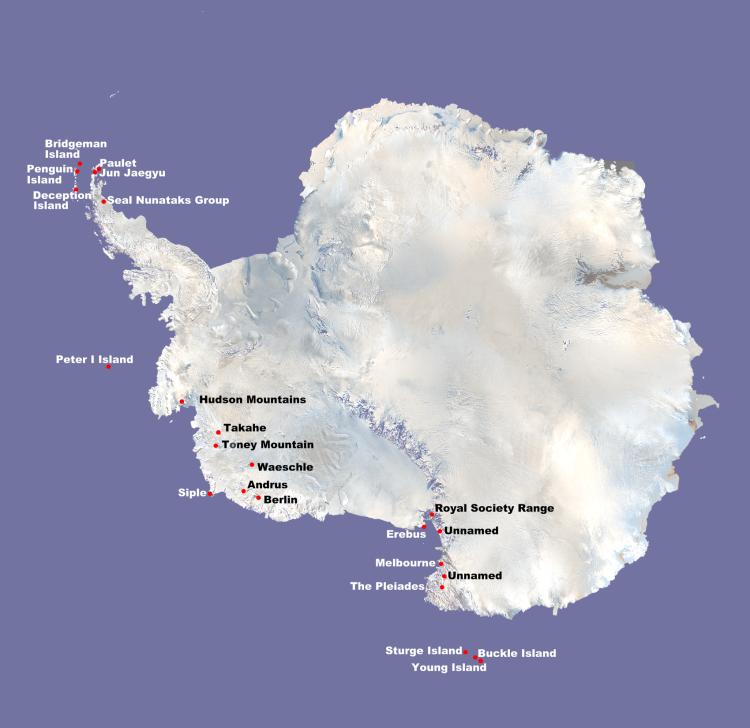
http://icecap.us/images/uploads/AntarcticVolcanoes2.jpg Nice map. Are these all active right now? When was the last time they were active? Is the activity unusual for the last 1000+ years? "Geophysicists Show That Crust Temperature Variation Explains Half Of Elevation Differences In North America" Yes, that's interesting. If we were discussing changes over millions of years, it could potentially pertain. -
thewags at 05:41 AM on 30 January 2009It hasn't warmed since 1998
A few points: 1. I am intrigued by the slant, depending on the POV. Ie, if the temp is trending up, it is the result of manmade causes. However, a cold year (2008) is the result of natural causes (La Nina). Hmmm... 2. I'd be interested to see the variation in measuring points over the years, to confirm or reject the notion that some of the warming is due to the removal of Siberian monitoring stations after the USSR disintegration. 3. Looking at the charts for the last 10 or so years, it seems the warming is mostly concentrated in the far northern hemisphere. Would be interesting to see how that is explained. -
Quietman at 15:34 PM on 29 January 2009Volcanoes emit more CO2 than humans
This is where the volcanos are active in Antarctica Funny coincidence? -
Quietman at 15:31 PM on 29 January 2009Is Antarctic ice melting or growing?
Phillipe Yes, about that.
Prev 2597 2598 2599 2600 2601 2602 2603 2604 2605 2606 2607 2608 2609 2610 2611 2612 Next