



 Arguments







Recent Comments
Prev 1 2 3 4 5 6 7 8 9 10 11 12 13 14 15 16 Next
Comments 151 to 200:
-
prove we are smart at 07:22 AM on 23 September 2025Koonin providing clarity on climate?
"In 2019, the Trump Administration proposed to create a "Presidential Committee on Climate Security" at the National Security Council that would conduct an "adversarial" review of the scientific consensus on climate change. Koonin was actively involved in recruiting others to be part of this review. The committee was scrapped in favor of an initiative not "subject to the same level of public disclosure as a formal advisory committee".[39][40][41]
From Wikipedia en.wikipedia.org/wiki/Steven_E._Koonin
It seems so many societies are distracted and divided and disinformationed to elect malignant leaders.
-
michael sweet at 03:25 AM on 23 September 2025Climate change is accelerating, scientists find in ‘grim’ report
Radman365:
You say "It does at least appear to me that there is an excessive degree of certainty with regards to "the truth" on both sides." There are two truths here to determine.
1) Is sea level rise accelerating? On one side we have a paper published in an obscure journal by authors who have produced erroneous analysis before on this topic and did not review their work with anyone with expertise in the subject. On the other we see hundreds of scientists who have discussed the data extensively with each other and reached a consensus that sea level rise is accelerating. The hundreds of scientists have identified multiple large errors in the obscure authors work.
In this case it is relatively simple to do the analysis and the results are very strongly indicating acceleration. I note that in addition to the tide guage data the hundreds of scientists have independant satalite data that reaches the same conclusion. The obscure scientists simply do not know what they are doing and have screwed up. Why did they ignore the satalite data that showed their analysis was incorrect?
The data is clear, sea level rise has accelerated over the past 50 years. Ignoring half of the data and assuming that sea level rise is independant at different locations in the world is simply an ignorant way to look at the data.
2) The important question is: will sea level continue to accelerate in the future? Data from the future is difficult to obtain. Scientists are debating what we should expect in the future. A few thnk it will not be too bad while others think it will be catastrophic. The fact that sea level rise is accelerating makes many of us very worried. The last time CO2 was over 400 ppm sea level was over 20 meters higher than today. I note that every time an IPCC report is released the projections of sea level rise increase.
You are welcome to think that sea level rise will not be too bad. That might be the case. Since sea level rise is accelerating, most of the readers here thinik we should be concerned about it. 20 meters of sea level rise would submerge most of the major cities in the entire world, although it will take a long time. Since the answwer to sea level rise is installing cheap renewable energy everywhere, why not try supporting renewable energy in your community?
-
Evan at 19:49 PM on 22 September 2025Koonin providing clarity on climate?
CO2 fluctuating 100 ppm over 100,000-year cycles is sufficient to cause sea-level to flluctuate 400 ft. This indicates just how delicate our ecosystem is to CO2 forcings.
CO2 is now increasing at a rate of 100 ppm every 40 years. Can we expect anything but difficulties from such a strong, upward, persistent push?
-
radman365 at 05:16 AM on 21 September 2025Climate change is accelerating, scientists find in ‘grim’ report
I apologize for my two posts regarding the recent Voortman article; I am new to this site and didn't mean to make two posts. From the comments following the RC response to Voortman's article it does seem to me that as usual there are an extraordinary number of variables that confounds are ability to get reliable numbers. I have a new appreciation for the complexity of the subject. It does at least appear to me that there is an excessive degree of certainty with regards to "the truth" on both sides.
BTW how do we know that there was little to no review? (again I apologize if this is easily determined)
Moderator Response:[BL] Regarding lack of review.
MDPI journals have a very bad reputation. They strongly resemble a "pay as you play" publisher, where the only real review is whether or not your credit card charge clears. Again, read the Wikipedia link I gave you before.
If you look at your own link to the paper, you will see that the paper was first submitted to the journal on June 20, and a revised version submitted on August 15 - which means that reviews and changes were completed in less than two months. Final acceptance followed on August 20 - only 5 days after re-submission. These time frames are very short for proper review, and strongly suggest that very few changes were requested by reviewers.
The review comment are available on the journal's web page, They are mostly superficial in nature. The reviewers have either not done a serious evaluation of the methodology, or they do not have the expertise to do a thorough review of the methodology.
In the RealClimate post, they have a link to a response by Kopp et al. In that review, one of the points to make is that the Voortman and de Vos paper ignores many relevant papers in the literature. A good review by a knowledgeable reviewer would have pointed that out. And an evaluation by a good editor would have insisted that the authors fix that in their paper. All signs pointing to a quick and dirty review - possibly by friends of the authors.
The fundamental statistical error that Voortman and de Vos made was that they argued there is no global signal of acceleration, but they used a statistical test that assumes that there is no connection between the tidal stations (statistical independence). You can't assume there is no connection when you start your analysis, and then conclude that your analysis demonstrates that feature. Again, a proper review by a knowledgeable reviewer would have pointed this out.
-
Paul Pukite at 00:35 AM on 21 September 2025Sea level rise is exaggerated
radman365 asked:"So what do people think of this recent article"
Since you asked, I thought the article had some interesting insight, not necessarily related to trends, but to the nature of local sea-level variability.
I posted comments on the aforementioned RC thread
Much has been written on sea-level variability, especially in the Baltic sea, where there are scores of sites with records longer than 100 years. Consider Stockholm sea-level which shows synchronization with long-period tides and their aliased harmonics. Notice that these aren't the classical diurnal or semi-diurnal tides, but those related to monthly lunar cycles (T, D, etc) interacting with the annual cycle.

https://www.tandfonline.com/doi/pdf/10.3402/tellusa.v67.25642
-
radman365 at 01:10 AM on 20 September 2025Climate change is accelerating, scientists find in ‘grim’ report
And yet here's evidence that the models are wrong about one of their most fundamental predictions: accelerating sea level rise. Instead, this study using 60 years of tidal gauge data show an annual rate of approximately 1.5mm, not 3-4mm.Oops!
https://www.mdpi.com/2077-1312/13/9/1641
Blockbuster sea level study may turn climate change orthodoxy on its head!
Moderator Response:[BL] You pointed to the same paper on another thread. It is considered bad form to thread-blast the same comment in multiple places.
No matter how many times you tell us about the paper, it is still crap. Read the moderator's comment that has been added to your first post.
The only thing that is getting turned on its head is the hope that one of these days the contrarians will be able to come up with an analysis that isn't based on bad assumptions and bad methodology.
It's worth repeating the opening sentence of the RealClimate post referred to in the moderator's comment on your other posting:
Here we go again. An obscure, methodologically poor, paper published with little to no review makes a convenient point and gets elevated into supposedly ‘blockbusting’ science by the merchants of bullshit, sorry, doubt.
-
radman365 at 00:53 AM on 20 September 2025Sea level rise is exaggerated
So what do people think of this recent article on 60 years of tidal guages concluding an average of only 1.5mm annual rise without significant acceleration?
https://www.mdpi.com/2077-1312/13/9/1641
Moderator Response:[BL] What do people think? People think that this most recent paper repeats errors that the same authors have made before - and the authors have had pointed out to them before.
RealClimate has a good rebuttal posted yesterday, with lots of links to better analyses.
The RealClimate post also points to recent post at Tamino's where he points out details on what was done wrong. Some specific Tamino posts:
US government makes old lies new again
It's also worth noting that the paper is in an MDPI journal, which has a reputation for publishing some awful stuff.
The RealClimate opening sentence pretty much sums it up:
Here we go again. An obscure, methodologically poor, paper published with little to no review makes a convenient point and gets elevated into supposedly ‘blockbusting’ science by the merchants of bullshit, sorry, doubt.
-
Evan at 19:58 PM on 19 September 2025Climate change is accelerating, scientists find in ‘grim’ report
MA Rodger@11, thank you very much for your detailed answer and for the explanation about AF.
Katharine Hayhoe has an analogy about driving on a dead-straight road in Texas and saying that "relying on past climate patterns is no longer a reliable guide for the future because of the speed of climate change." (this is the Google AI version of her quote). It is reassuring in a sense that AF has been steady for so long, but ...
Despite the data you showed, because we are pushing the climate so hard (CO2 rising on average 2.5 ppm/yr), I remain skeptical that we can really be sure that AF will remain constant into the future. But for the sake of harmony, can we figure out wording that we all agree on.
Do you agree that climate scientists use 2C warming as a guesstimate of the point at which we begin to lock in warming in the pipeline? In other words, even if we achieved Net-0 after crossing the 2C warming threshold, do climate scientist agree that at that point we would have locked in additional future warming?
A lot of this is semantics, because the socio-political inertia does not give me much hope that we will put on the brakes before we cross the 2C barrier, but I would like to arrive at a common understanding so that my posts here don't seem to be at odds with professional climate science.
-
MA Rodger at 09:08 AM on 19 September 2025Climate change is accelerating, scientists find in ‘grim’ report
Evan @8,
(Hopefully my reply here, your third to #7, isn't piling too much at you.)Quantifying CO2 global emissions is reliant on the data reported and that data does suggest that emissions are still edging up. And these annoying still-rising emissions will result in accelerating increases in atmospheric CO2 levels and leaving net zero further away than ever.
The question of whether "the carbon cycle is not doing what we thought" revolves around Af, the Airborne Fraction which does wobble quite a bit year-to-year. Studies do show that there is no sign of an increasing Airborne Fraction (eg Bennett et al (2024) 'Quantification of the Airborne Fraction of Atmospheric CO2 Reveals Stability in Global Carbon Sinks Over the Past Six Decades', their Fig4 below). Of course, if there were an increasing Airborne Fraction, it would be a game-changer. But the major long-term sink we rely on is the ocean absorbtion which is a case of reasonably straightforward chemistry. Over a millennium the oceans will take up about 75% of our emissions.
A simplistic reassurance can be gleaned from the work of the Global Carbon Project whose annual data shows annual emissions and the annual atmospheric increase (both in GtCarbon) with no perceptible sign of increases in the Airborne Fraction.
-
nigelj at 07:57 AM on 19 September 2025Climate change is accelerating, scientists find in ‘grim’ report
Evan @3 said: "My point is that as we warm the planet, it is likely that the natural emissions will increase, and it is equally likely that the sinks that have removed the natural emissions, will decrease. Hence, the imbalance caused by our 4% emissions will likely be added to by the combination of increased natural emissions and decreased natural sinks. We don't have to perturb the 96% too much to completely swamp our efforts to reduce GHG emissions."
My understanding is your scenario would only happen if we let warming get so high that we crossed certain tipping points, so that even if we froze emissions at that point in time, CO2 and methane release would continue at very substantial levels thus offsetting or swamping our efforts to then drastically cut emissions. We haven't reached that point, and my understanding is we wont provided we keep warming under 2 degrees. Bear in mind theres a fine line between a positive feedback which stops when the primary forcing stops, and crossing a tipping point where emissions become self sustaining. And Im not sure how self sustaining they would really be.
-
One Planet Only Forever at 05:17 AM on 19 September 2025Climate change is accelerating, scientists find in ‘grim’ report
Evan,
Thank you for further clarifying what your primary concern is.
I fully agree that the Keeling Curve, and the concentrations of all other ghgs, should be what people pay attention to. Those measurements should be the basis for claims regarding the success of efforts to rapidly end the harmful human impacts and hopefully limit the harmful climate change impacts on future generations to far less than 2.0 degrees C (with unprofitable carbon extraction being required to bring excess impacts back down to 1.5 degrees C).
There is a chance that the recent set of unexpectedly warm years are the result of human impacts to date triggering significant long lasting feedbacks that are not yet identified and understood.
But I think it is significantly more likely that the ways that the rate of ‘human global warming and resulting climate change impacts’ are measured are inaccurate. And those inaccurate measurements lead people to make inaccurate claims, claims that are inconsistent with the Keeling Curve and the measurement of other ghgs.
To be clear, a leveling off of the annual rate of human impacts does not mean that the Keeling Curve would level off. Humans having sustainably achieved net-zero global warming impact would be indicated by the Keeling Curve leveling off and starting to slowly sustainably decline.
-
Evan at 20:05 PM on 18 September 2025Climate change is accelerating, scientists find in ‘grim’ report
MA Rodger@7, thanks for the review of the carbon cycle. I understand the principles here: I just don't accept the confidence with which the claims are made that carbon sinks will take care of carbon sources if we were to reach net-0.
But my real point is this. I caution people to listen less to all of the optimistic talk about how emissions are starting to flatten out and getting ready to decline, and watch instead what is happening to the Keeling Curve, because it represents the net effect of the carbon cycle. If the carbon cycle is really going to clean up our mess, then that should be reflected in the Keeling Curve (I understand that currently about half of our GHG emissions are absorbed by the oceans and the land).
But so far the Keeling Curve continues to accelerate upwards, and the annual average rate of increase is a colossal 2.5 ppm! I wonder if people really appreciate the magnitude of that kind of push on our environment?
For the Keeling Curve to continue its upward acceleration in the face of so much positive, optimistic emissions news means that either the carbon cycle is not doing what we thought it should be doing, or our emissions estimates underestimate reality. Either way, we are a long, long way from achieving anything like Net-0.
Perhaps my skepticism originates because I am a professional modeler and understand the uncertainties of such modeling. But beyond that, I am concerned about the confidence placed in our emissions estimates. The US is heading down a path to obfuscate climate science. Certainly such obfuscation is occurring elsewhere. For these reasons and more I encourage people to follow the trajectory of the Keeling Curve, because in the end, it is rrepresents the unvarnished truth about what is really happening to the carbon cycle.
-
MA Rodger at 14:45 PM on 18 September 2025Climate change is accelerating, scientists find in ‘grim’ report
Evan @3,
You set out your "point" that, in your opinion, "the warming would likely continue due to how we have already affected the balance of natural GHG sources and sinks" even after every humanity has effectively disappeared.
The carbon cycle is understood enough (and has been understood for some time) to allow studies to conclude that the carbon sinks will continue to outweigh any natural sources and the resulting reduction in GHG will roughly balance the remaining unfulfilled warming from our emissions. Thus warming effectively stops once our emissions stop.
There has been work looking at the potential for large new sources of natural emissions or the stifling of sinks. These include the likes of methane emissions from melting permafrost or warming Arctic seas, the cascading collapse of econsystems like the Amazon rainforest or the capacity of oceans to absorb CO2 in a warmer world. (Your mention of "feedbacks" @5 - you may have specific examples in mind.) Some of this past work has sounded pretty worrying but such worrying findings have not survived full analysis.
Beyond 'net zero', there are also calls for 'net-negative emissions' that don't get discussed as much as they should. These are seen as globally necessary if our emissions are not cut quickly enough, a situation which seems pretty certain to happen. 'Net-negative' does not address future warming but works to reduce the time over which peak warming continues.
-
One Planet Only Forever at 12:21 PM on 18 September 2025Climate change is accelerating, scientists find in ‘grim’ report
Evan,
My Stating
“how bad things get, including how much unexpected feedback is triggered, is totally controlled by human actions.”
is not the same as stating
“we understand the ecosystem well enough to claim that humans can completely control the ecosystem and all feedbacks.”
My understanding includes the knowledge that we do not understand the global and local ecosystem(s) well enough to develop and implement geoengineering activities that will produce a sustained desired controlled reduction of climate change harm to the global ecosystem(s) and all feedbacks.
My understanding is that human impacts that increase ghg levels will make things worse in the future. And humans are the only beings on the planet who can control how harmful they are collectively. Tragically, that ‘control’ can include collectively being more harmful because higher status, more influential, members of humanity are able to gather support for being more harmful and less helpful to others.
-
Evan at 07:57 AM on 18 September 2025Climate change is accelerating, scientists find in ‘grim’ report
OPOF@4, you state,
"However, my point remains that how bad things get, including how much unexpected feedback is triggered, is totally controlled by human actions."
IMO, we simply do not understand the ecosystem well enough to claim that humans are still in complete control of the ecosystem and all feedbacks.
-
One Planet Only Forever at 06:55 AM on 18 September 2025Climate change is accelerating, scientists find in ‘grim’ report
Evan,
Thank you for clarifying the focus of your comment @1. My take is that you are concerned that feedback mechanisms that will cause significant unanticipated warming far into the future have been triggered by human impacts to date.
My understanding is that, at the present and near future level of human impacts (with peak total impacts significantly lower than 2.0 C), sea level rise is one of the few impacts that will be increasing for a long time after human activity stops increasing ghg levels.
Recent years of unexpected global average surface temperatures raises questions. However, my point remains that how bad things get, including how much unexpected feedback is triggered, is totally controlled by human actions.
Lower total peak human ghg impacts in the future will produce lower amounts of harmful consequences in the future.
The wording in the article that concerns me is the moving away from the Paris Agreement goals by saying “the study finds that its [the Paris Agreement] primary target of limiting global warming to 2°C remains within reach."
As presented by the Wikipedia item for the Paris Agreement:
The Paris Agreement has a long-term temperature goal which is to keep the rise in global surface temperature to well below 2 °C (3.6 °F) above pre-industrial levels.
Limiting impacts to 2 degree C does not reach the Paris Agreement objective. And every bit of increased impacts increases the risk and magnitude of harmful unexpected feedback.
-
Evan at 02:38 AM on 18 September 2025Climate change is accelerating, scientists find in ‘grim’ report
OPOF, in attempting to be brief and to the point, I created a misunderstanding.
I understand that historically the other 96% of GHG emissions has been in balance with equivalent sinks, leaving the 4% due to humans to cause the warming. My point is that as we warm the planet, it is likely that the natural emissions will increase, and it is equally likely that the sinks that have removed the natural emissions, will decrease. Hence, the imbalance caused by our 4% emissions will likely be added to by the combination of increased natural emissions and decreased natural sinks. We don't have to perturb the 96% too much to completely swamp our efforts to reduce GHG emissions.
I think it is arrogant to assume that we understand the natural world so well and the current state of the climate as to assume that the future continues to remain in our hands. Climate scientists have been scrambling the last few years to explain the sudden increase in warming. Their scrambling to understand this increased warming is a good example of why I don't think that future warming is entirely in our hands.
My point is that even if we eradicated every last human from the planet (one of the many possible Net-0 strategies), that the warming would likely continue due to how we have already affected the balance of natural GHG sources and sinks. You can call this my opinion, but it is based on a healthy respect for just how delicate our ecosystem is, and hard we have been pushing it the last century or so.
-
One Planet Only Forever at 02:19 AM on 18 September 2025Climate change is accelerating, scientists find in ‘grim’ report
Evan,
My understanding is that the global warming, climate changes, and sea level rise due to increasing ghg levels is due to the 4%. How much future harm is done is indeed totally dependent on what global humanity collectively does in the future.
What global humanity has done to date, including the failure to dramatically reduce activities that undeniably increase ghg levels, especially the most fortunate failing to lead the transition to less harmful ways of living (and the related failure of the most fortunate to help those who are tragically unfortunate have better less harmful life experiences), made things worse now than it had to be.
If humans stop causing impacts that continue to increase ghg levels then the global warming, climate change and sea level rise impacts will stop getting worse.
So, “Future emissions [do] control future warming,” when those emissions are understood to be the human caused excess emissions increasing ghg levels (the 4%). And that understanding is reinforced by the complete quote “Future emissions control future warming, … And if the world were to rapidly act on carbon dioxide and methane emissions, we could halve the rate of warming.”
And that understanding can be extended to state that: If global humanity were to rapidly act on carbon dioxide and methane emissions and rapidly act to develop and implement effective sustainable reduction of levels of ghgs then the maximum level of future harm due to future human impacts will be less than would otherwise be created.A reminder about an often ignored aspect of reality regarding effective methods to limit the total future harm of human climate change impacts. A significant action that can immediately be implemented, needing no technological development or growth of production and use of a technology, is the ending of energy use that, while potentially enjoyable or popular or profitable, is not required to live a decent healthy helpful (unharmful) life.
Technological developments that require less energy consumption should be the priority. Less energy use would reduce the harm done during the transition from harmful unsustainable energy systems to harmless sustainable energy systems.
-
Evan at 21:36 PM on 17 September 2025Climate change is accelerating, scientists find in ‘grim’ report
The phrase “Future emissions control future warming,” concerns me. It assumes that the fate of the climate is still in our hands. Human emissions represent just 4% of total emissions, yet this phrase implies that nothing we've done has irreversibly increased that other 96% of emissions.
-
Evan at 20:38 PM on 17 September 2025Fact brief - Has the greenhouse effect been falsified?
Bob and Michael, thanks for the additional comments.
My comment was originally offered to help people rebut those who might retort as my brother did. Obviously I agree with both of you.
-
michael sweet at 23:55 PM on 16 September 2025Fact brief - Has the greenhouse effect been falsified?
Evan,
It seems to me that there is a stark difference between ideas people had 200 years ago that have not been supported for 150 years and ideas that have stood the rest of time for 200 years. The greenhouse effect has been validated innumerable times over the past 200 years. It is not a theory that is accepted based on 200 year old data.
-
Bob Loblaw at 22:53 PM on 16 September 2025Fact brief - Has the greenhouse effect been falsified?
Evan:
Indeed. In fact, Fourier's contribution to heat transfer is stll called "Fourier's law of heat conduction". In the same scientific realm as Newton's law of gravity, Boyle's law and Charles' law for gases, etc.
-
Evan at 21:10 PM on 16 September 2025Fact brief - Has the greenhouse effect been falsified?
When I conveyed this information to my brother, he instantly retorted that 200 years ago they were bleeding people as routing medical art, so that he was not impressed by the "science" that existed 200 years ago.
The difference, of course, is that the names of the great "bleeders" of 200 years ago are likely no longer taught in modern medical schools. But the name of Joseph Fourier routinely appears in modern science text books, not just in connection with his discovery of the greenhouse effect, but for his contributions to math (Fourier analysis) and to heat-transfer science.
Fourier was one of those great scientists who contributed greatly to our scientific knowledge and to our understanding of how our world works.
-
Eclectic at 07:22 AM on 16 September 2025It's only a few degrees
A follow-up.
"Professor" Dave's video has now passed 200,000 views in 12 days. In the words of James Bond : "Not too shabby".
Readers who dip into the voluminous comments below the video, will be amused by the contrast between Prof Dave's engagement style when dealing with morons & obnoxious trolls ~ versus the engagement style of Potholer54 within his own climate videos on YouTube.
Potholer54's style is educative and nicely suave, almost bordering on excessive politeness. Prof Dave's style is a tad more pugnacious, New-York-style ~ a lot of "Wham-Bam-FU-mam" . . . a torrent of ad-hominems (which the trolls richly deserve, of course).
Which of the two approaches is better, I am not sure. But I recall a quote by Oscar Wilde, to the effect of : "A gentleman never offends anyone unintentionally".
-
Leitwolf at 11:20 AM on 10 September 2025Climate Sensitivity
I would like to go back to an older post here on the tropospheric hot spot. I know the discussion, especially like Santer et al 2005. I do not really care if the hot spot is there or not. The interesting fact is that it should be there, and what jumps into my eyes when I see this graph..
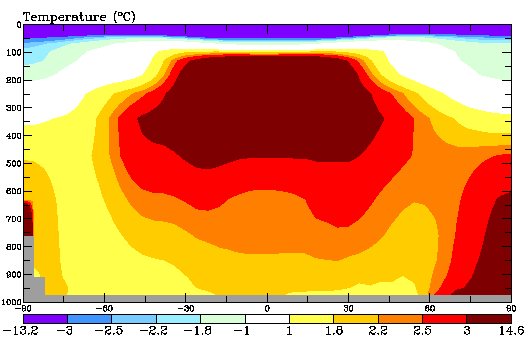
Roughly speaking the graph suggests a 1.5K increase in Ts in the tropics, and about a 3K increase ot Tz, if you assume the average emission altitude to be in 450-400mb range in the tropics. I know, some emissions will occur from below, some from above, but the higher the more warming, so it should largely cancel out anyway.
This graph indirectly implies a very low climate sensitivity. If you assume Tz ~261K in the tropics and a Planck Feedback of 3.6W/m2 there, you can do some math. For Tz +3K, going from 261 to 264, we can calculate..
(264^4-261^4)*5.67e-8 = 12.3W/m2 delta OLR
Planck Feedback would only amount to 1.5 * 3.6 = 5.4W
So you would get a negative lapse rate feedback of 12.3 -5.4 = 6.9W/m2
Or normalized per K of warming of 6.9/1.5 = 4.6W/m2.
This figure is insanely large, way larger than all positive feedbacks combined. Eventhough I only used ballpark estimates, the fundamental problem is simply the huge increase in Tz. Of course one could say it is mainly a thing of the tropics, but the "hot spot" expands well beyond 30° latitude, and the tropics between 30° S and N account for 1/2 of the planet. Even if you just halve it, you are still left with 4.6/2 = 2.3W/m2 of negative lapse rate feedback.
Although the "hot spot" does not seem to materialize, the fact that it should in theory, and the logical consequences to it, is kind of a non-negligible detail when considering climate sensitivity.
Moderator Response:[BL] If you want to "go back to an older post", then the proper thing to do is to go back to that post. And read it in its entirety, along with the comments. Here is a direct link to the Advanced tab on the tropospheric hot spot:
https://skepticalscience.com/tropospheric-hot-spot-advanced.htm
The figure that you present is included in that post. And its significance is discussed in detail. It does not imply what you think it implies.
Please go to the correct thread, read the post, and place any further comments there.
-
Eclectic at 18:50 PM on 5 September 2025It's only a few degrees
"Only a few degrees" is the central argument of a very prominent *Denier* by the name of Matt Ridley. Though he much prefers to call himself a Lukewarmer.
Mentioned today, because the Ridley spiel has been massively debunked by the latest YouTuber posting on the series Professor Dave Explains. The YT post was made a little over 24 hours ago (and has thus far >70,000 views). Title: Matt Ridley is Lying to You About Climate Change.
A two-hour video. The first 1.5 hours is Dave giving a fairly good overview of Global Warming as science, while at the same time showing how Matt Ridley has (over the years) been . . . ah . . . extremely economical with the truth.
Then Dave digresses into Matt Ridley's very poor track record in several other scientific fields. And in the final quarter-hour returns to the climate topic in a more general way.
A long video, but might be recommendable to the earnest newcomer wishing to learn much on the climate topic in a relatively short time.
-
Paul Pukite at 10:34 AM on 5 September 2025Climate Sensitivity
Bob: "It's amazing how contrarians often focus on one tail of the distribution and argue in favour of it, while pretending the other taill does not exist."
Indeed. Judith Curry'smuncertainty monster is a two-tailed beast. For every potential outsized gain in the left tail, there is a mirror-image risk of an outsized loss in the right tail. The contrarian pretends this right tail doesn't exist or is negligible. That's also related to the gambler's fallacy, where a blind eye is attached to losing.
Yet, we're screwed when it comes to removing the CO2 already in the atmosphere. It's 100% certain that it will go up in the future. No way it will go down, physically impossible due to the properties of CO2 and the fat right tail of time to sequestration.
-
Paul Pukite at 03:38 AM on 5 September 2025Climate Adam - The Dumbest Climate Denial Ever?
True that climate scientists obviously have a grasp of seasons, and true that many people use seasons as a strawman argument to bash climate change, but it's also the case that climate science hasn't figured out non-seasonal natural climate variability — for example, being able to predict the next El Nino more than a few months before it happens. Yet, there may be a seasonal interaction with another factor that will unlock the mystery behind the erratic natural climate cycles. It's all related to nonlinear interactions of the seasonal cycle with lunar tidal forces. Go to the github site pukite.com and see how well a model works to fit various climate indices — it also works on monthly extreme tidal levels on various coastal sites around the world — there are 130 of these spanning around 100 years each. The caveat is that a long interval of data is required to avoid over-fitting. The basic physical mechanism is simple — the ocean's thermocline is very sensitive to tidal forcing and because the thermocline varies seasonally, the math of tidal effects is much more complicated than that used for conventional tidal analysis. Climate scientists have simply overlooked this kind of analysis all these years. I published this approach in late 2018, so please dive in if you are interested. A reminder that this is not a contrarian argument but a peer-reviewed explanation of natural climate variation.
-
Bob Loblaw at 23:36 PM on 3 September 2025Climate Adam - The Dumbest Climate Denial Ever?
There is an old joke in places that I have lived where people say "if you don't like the look of the weather, wait five minutes - it will change".
Likewise, calling this "the ... dumbest ever" may not last long. Don't underestimate the limits of arguments presented by the contrarian world.
In the video, I particularly liked where Adam highlights the contradiction between "its called summer" and "you can't predict the weather two weeks from now, so you can't predict climate" (number 63 on the Arguments list). As Adam says, identifying seasons as a recurring cycle is, in fact, a climate prediction. A reliable one. Not just because we have many observations of the cycle to look back on - but because we understand the physics involved.
Physics explains the earth's orbital patterns, and those orbital patterns explain the distribution of solar energy arriving at different locations and times on earth, and physics explains how those differences and cycles lead to the seasons. A year from now, the northern hemisphere will again be experiencing "summer". A climate prediction.
Skeptical Science used to have a list of the contradictions in contrarian arguments. It became too difficult to maintain.
-
Bob Loblaw at 04:56 AM on 3 September 2025Climate Sensitivity
John @ 3:
Ken may or may not respond himself here, but whenever SkS reposts his articles it is worth going to his web site to see the comments on the originals.
At the end of the original post over at Ken's, you can see that his articles are grouped into classes and tagged with various markers. Under this post ("Climate Sensitivity"), you can see that it is under the group "Climate Sensitivity", and that is also has tags for "ECS" and "Equilibrium Climate Sensitivity" (which are the same thing in terms of climate science, but different tags).
Links to those three groupings of Ken's posts are:
Equilibrium Climate Sensitivity
There are dozens hundreds of posts listed under these categories (which overlap)...
....but to answer your question ("how many?") directly, it's either:
- Too many (if you think in terms of how many times does this have to be explained before the message sinks in)
- Not enough (if you think in terms of the fact that it has not yet sunk in).
(I guess that's not really an either/or question, though. It's probably both too many and not enough.)
-
John Hartz at 03:09 AM on 3 September 2025Climate Sensitivity
Ken Rice:
How many articles containg "Clime Sensitiyity" in their titles have you posted on your And There'e Phusics website?
-
Bob Loblaw at 22:46 PM on 1 September 2025Climate Sensitivity
It's amazing how contrarians often focus on one tail of the distribution and argue in favour of it, while pretending the other taill does not exist.
-
ubrew12 at 16:15 PM on 1 September 2025Climate Sensitivity
"values between 1.5°C and 2°C are quite plausible." So are values between 3.5°C and 4.5°C. In either case, the issue isn't their plausibility, it's their permanence. You don't just throw away this petri dish once it reveals it's secrets to you. Not unless you've terraformed yourself another planet.
-
BaerbelW at 03:29 AM on 1 September 20252025 SkS Weekly Climate Change & Global Warming News Roundup #35
OPOF @1
Thanks for the heads-up, OPOF! I fixed the link to the CNN-article.
-
One Planet Only Forever at 02:29 AM on 1 September 20252025 SkS Weekly Climate Change & Global Warming News Roundup #35
In addition to my comment @1,
The following needs to become The Common Sense.
How deserving people are of their perceptions of higher status relative to Others should be measured by their actions and ways of living being less harmful than Others.
And among the people who are least harmful, the sub-set of the population most deserving of higher status than all of those who are more harmful, the ranking should obviously be based on how Helpful they are to Others.
An allowed exception is that people who live less than a decent basic life, because of a lack of help from people who are more educated and higher status or harm done by those people are allowed to be harmful to improve their lives.
-
One Planet Only Forever at 02:12 AM on 1 September 20252025 SkS Weekly Climate Change & Global Warming News Roundup #35
The link to "5 easy ways college students - ..." iink the Climate Change Mitigation and Adaptation section is not correct.
Here is the correct link to the CNN Health item by Gina Park, Aug 29, 2025: The 5 easy ways college students — and everyone else — can practice sustainability
I like that the majority of the recommendations are about deliberately limiting energy consumption. That is a significant immediately achievable action to limit the magnitude of climate change impact while the transition to end all human impacts causing climate change is pursued.
Note that the reduction of energy demand due to deliberate ending of unnecessary energy consumption by the portion of the population that cares to be responsibly less harmful and more helpful to Others must not be allowed to excuse delaying the rest of the required transition of human ways of living. The examples of wealthy people living less harmfully than their wealth-peers should be the basis for penalizing those who care less about learning to be less harmful and more helpful to Others.
-
Paul Pukite at 18:31 PM on 30 August 2025Another pause?
I wasn't born yesterday, been blogging since 2004. [snip]
Moderator Response:[BL] Off-topic deleted.
-
Paul Pukite at 08:15 AM on 30 August 2025Another pause?
They owners delete comments that they don't like...
[snip]
at the https://andthentheresphysics.wordpress.com blog so I will link to it here:

I use an RSS feed so can see the comment was approved and then posted, but was later removed.
Moderator Response:[BL] This web site is not a place for you to air grievances about things that happen at other web sites. If you have an on-topic comment you want to make here, then make it - but don't make it about the moderation actions at the original web site. We re-post to to widen the audience of the article to our readers, and allow discussion of the content here. Do not treat this web site as if it is an alleyway you can fight in when your fight gets tossed out of the bar.
-
wilddouglascounty at 01:53 AM on 24 August 2025Getting climate risk wrong
Thank you, nigelj, for exposing the BTI as a kind of apologist aggregator, which, upon a visit to their web page, I'd have to draw that conclusion. It not only downplayed renewables, I noticed several bizarre articles about how we needed to eliminate wilderness because it is so damaged that it causes undue suffering for animals living there, and how energy conservation/efficiency measures cause the famous Jevons rebound effect without looking into how this is a product of the capitalist endless growth pressure, which should be addressed at the same time.
Seems that the line has been crossed from a throughtful consideration of assumptions to an apologist site with an agenda. Pay no attention to that man behind the curtain.
-
prove we are smart at 20:16 PM on 23 August 2025Getting climate risk wrong
Thanks for some truth telling nigelj. Your opinions certainly match my worrisome ones too Evan. In climate system scientist Paul Beckwiths latest video www.youtube.com/watch?v=kz_MilyXkk0 I read in the comments section something very relateable to my public interactions,
"I have two personalities. One that is aware of our climate reality and one that I have for public life. Makes life surreal."
-
michael sweet at 02:13 AM on 23 August 2025Have renewables decreased electricity prices: European edition
Cesar Madrid at 16:
In general the cost of transmission is a small fraction (say 10%) of the cost of building out new renewable infrastructure. In practice, the cost of renewables to the grid includes the costs that were paid to transmit the energy. It seems to me that the wholesale price of electricity would include the cost of transmission, although the OP does not state that. If you were buying PV electricity from Morocco in England (which has been proposed) you would look at the delivered price, not the price in Africa. Can you provide a reference that contains data that the cost of renewables does not include the cost of transmission?
In the USA most long distance transmission lines were built decades ago. The cables in the lines can be replaced at very low cost, and no new permits. The lines will then be able to transmit much more power than currently. My understanding is that upgrading the transmission cables will provide half of the transmission capacity required by an all electrical power system.
-
michael sweet at 01:54 AM on 23 August 2025Is Nuclear Energy the Answer?
The most recent report by the National Infrastructure and Service Transformation Authority (Nista) in England has concluded:
"Plans to dispose of the UK’s high-level nuclear waste in an underground repository – a Geological Disposal Facility (GDF) – have been described as “unachievable” by a Treasury unit."
While nuclear supporters claim that it is simple to build underground storage facilities for high level nuclear waste it is proving difficult in practice. The USA currently has no proposed facilities. The current practice world wide is to store the waste in temporary casks on the grounds of existing reactors. Sometimes the waste is moved to another site.
Apparently FInland has a repoisitory near completion and Sweden has just started building a repository expected to begin taking waste in about 2040.
-
John Hartz at 14:19 PM on 22 August 2025Have renewables decreased electricity prices: European edition
More recommended supplemental reading:
The Researcher Who Wrote the Book on How Solar Got Cheap Is Back to Assess the Current Moment
With an updated edition of his 2019 book, Greg Nemet looks at global progress and puts U.S. obstacles in perspective.
by Dan Gearino, Inside Clean Energy, Inside Climate News, Aug 21, 2025
-
John Hartz at 13:49 PM on 22 August 2025Have renewables decreased electricity prices: European edition
Recommended supplemental reading:
Affordability, Not Volatility: Renewables' Cost Advantage Grows
Renewables’ edge over fossil fuel electricity is growing, recent reports show. In 2024, more than 90 percent of new global renewable energy capacity was cheaper.
by Will Atkinson, RMI Spark Chart, Strategic Insights, Aug 13, 2025
-
nigelj at 06:43 AM on 22 August 2025Getting climate risk wrong
Ted Nordhaus talks about climate issues. Its important to understand his background and involvement in certain organisations. He has a BA degree in history, and was a founding member of the Breakthrough Institute. Wikipedia has a good page on the Breakthrough Institute. Some key excerpts:
The Breakthrough Institute is an environmental research center located in Berkeley, California. Founded in 2007 by Michael Shellenberger and Ted Nordhaus,[5] The institute is aligned with ecomodernist philosophy.[6][7] The Institute advocates for an embrace of modernization and technological development (including nuclear power and carbon capture) in order to address environmental challenges. Proposing urbanization, agricultural intensification, nuclear power, aquaculture, and desalination as processes with a potential to reduce human demands on the environment, allowing more room for non-human species.[8][9][10][11]
Since its inception, environmental scientists and academics have criticized Breakthrough's environmental positions.[12][13][14][15][16] Popular press reception of Breakthrough's environmental ideas and policy has been mixed.[17][18][19][20][21][22][15][23][24][25]
Programs and philosophy:
Breakthrough Institute maintains programs in energy, conservation, and food.[33] Their website states that the energy research is “focused on making clean energy cheap through technology innovation to deal with both global warming and energy poverty.” The conservation work “seeks to offer pragmatic new frameworks and tools for navigating" the challenges of the Anthropocene, offering up nuclear energy, synthetic fertilizers, and genetically modified foods as solutions.
Criticism:
Scholars such as Professor of American and Environmental Studies Julie Sze and environmental humanist Michael Ziser criticize Breakthrough's philosophy as one that believes "community-based environmental justice poses a threat to the smooth operation of a highly capitalized, global-scale Environmentalism."[12] Further, Environmental and Art Historian TJ Demos has argued that Breakthrough's ideas present "nothing more than a bad utopian fantasy" that function to support the oil and gas industry and work as "an apology for nuclear energy."[13]
Journalist Paul D. Thacker alleged that the Breakthrough Institute is an example of a think tank which lacks intellectual rigour, promoting contrarianist reasoning and cherry picking evidence.[15]
The institute has also been criticized for promoting industrial agriculture and processed foodstuffs while also accepting donations from the Nathan Cummings Foundation, whose board members have financial ties to processed food companies that rely heavily on industrial agriculture. After an IRS complaint about potential improper use of 501(c)(3) status, the Institute no longer lists the Nathan Cummings Foundation as a donor. However, as Thacker has noted, the institute's funding remains largely opaque.[15]
Climate scientist Michael E. Mann also questions the motives of the Breakthrough Institute. According to Mann, the self-declared mission of the BTI is to look for a breakthrough to solve the climate problem. However Mann states that basically the BTI "appears to be opposed to anything - be it a price on carbon or incentives for renewable energy - that would have a meaningful impact." He notes that the BTI "remains curiously preoccupied with opposing advocates for meaningful climate action and is coincidentally linked to natural gas interests" and criticises the BTI for advocating "continued exploitation of fossil fuels." Mann also questions that the BTI on the one hand seems to be "very pessimistic" about renewable energy, while on the other hand "they are extreme techno-optimists" regarding geoengineering.[16]
-
Bob Loblaw at 05:45 AM on 22 August 2025Have renewables decreased electricity prices: European edition
Cesar @ 16:
What argument do you want to make that a renewable system needs more infrastructure? Loads on existing infrastructure are already designed to handle peak loads, so if renewables require increased transport during off-peak periods, the system can probably handle it - at a first guess. A system that spreads the load through time is more efficient than a system that is designed for peak loads and sits under-utilized much of the time.
And renewables can do a better job of placing generation close to consumption, reducing transmission requirements, if many small renewable generation sites replace a few very large centralized fossil fuel sites.
Please make your argument.
-
Bob Loblaw at 05:33 AM on 22 August 2025Welcome to Skeptical Science
Curtis @ 125:
What Eclectic said at #126. You really have not expressed clearly just what point you want to make.
You start by claiming that science (climate science?) is "blind to temperature". Given that a large part of the concern about climate change is focused on rising global temperatures, this seems to be a rather odd argument to make.
Most of your discussion seems to focus on buildings in urban areas. If your argument is that global temperature records are unreliable due to urban influences, then there are two threads here at SkS where you can read and learn about this, and discuss the science.
Are surface temperature records reliable?
Does Urban Heat Island effect exaggerate global warming trends?
What you have posted here (including your link) kind of looks like you are just advertising a service that is available.
-
Cesar Madrid at 01:35 AM on 22 August 2025Have renewables decreased electricity prices: European edition
Hi Andrew. Nice post! Just a sugestión. Would not be better to include transmission and supply costs in order to get a more precise comparison. It is true that a more renewable system needs more network infraestructure in order to get all the electricity suplied to final consumption points. It is logical to eliminate tales but O jave my doubts when eliminating network costs. Regards!
-
Evan at 01:16 AM on 22 August 2025Getting climate risk wrong
Well stated ubrew12!
There a couple of problems I have with this discussion about to what temperature we're headed. The underlying assumption is that we will get to net-0, and that once we get there we will have learned our lesson, the world will only have net-0 technology available to it, and therefore that we will never again go down the path of burning fossil fuels that release GHG's. This is the view presented in Star Trek, about how humans learn and evolve. But in the US we just repealed the only major legislation to even attempt a transition away from fossil fuels to renewable energy. Apparently it is possible and likely to reverse course.
There is also the assumption that the climate will always be ours to control. Therefore, achieving net-0 would mean stabilization of the environment. It is possible that by the "modest", good-news forecast of 3C warming that we have pushed the climate sufficiently hard to lock in warming that will continue for millenia. The predictions are not, after all, perfect. We really don't know for certainty what will happen at 3C.
I advocate for ridding ourselves of this discussion of where we're headed. Let's focus on decreasing GHG emissions as fast as possible and doing more to prepare for an increasingly difficult future. After all, if you had at your disposal an unimpeachable prediction that indicated 6C warming by 2100, with 100% certainty, if we did not alter our ways, and if you brought that prediction before the leaders of the world, is there anything in our recent experience to suggest that the current leaders would even change their opinions about what to do? Much less convince their electorate to go along with such a modified view?
I vote that we stop fixating on to what temperature we're headed, and simply focus on minimizing GHG emissions and preparing for what is coming.
-
ubrew12 at 16:19 PM on 21 August 2025Getting climate risk wrong
If you tell your fellow hikers that taking the left trail ends in a cliff, you're not being an alarmist. Maybe its a tall cliff, maybe a short one. What you're really saying is there's no way back. What you know for sure is the elevation you're at now, and that taking the right trail keeps you at that elevation. Whether the left trail leads to a long drop or a short one, what you can say for sure is you won't recover your previous elevation, so that whatever the new one is, you'll be forced to accomodate to it. Climate change is obviously not catastrophic yet. But it is permanent, which not enough people understand: they are used to trails they can backtrack out of.
Secondly, I would say that its the pace of current climate change that is so troubling, not the absolute amount of it. Most of the ecosystems that share our planet won't be able to adjust quickly enough to that rate of change.






