



 Arguments







Recent Comments
Prev 670 671 672 673 674 675 676 677 678 679 680 681 682 683 684 685 Next
Comments 33851 to 33900:
-
Tom Curtis at 12:46 PM on 23 December 2014Examining Hansen's prediction about the West Side Highway
Roger Knights @various, I quote the most accurate account of the interview:
"Reiss asked me to speculate on changes that might happen in New York City in 40 years assuming CO2 doubled in amount."
The problem with that statement is that it is multiply amibuous. It could mean Mann was asked to speculate on any of the following scenarios:
- Assume CO2 is 560 ppmv now (ie, in 1988), then what would the changes be in New York City in 2028;
- Assume CO2 levels rise to 560 ppmv by 2028, then what would the changes be in New York City in 2028; or
- Assume that at some time t, CO2 levels rise to 560 ppmv, then then what would the changes be in New York City in t + 40 years.
Because of that ambiguity, if you want to check Hansen's opinions on sea level rise, it is a ridiculous quote to do so on. That is particularly the case as he has stated his position on sea level rise far more clearly elsewhere. Thus, in the New Scientist, he writes:
"As an example, let us say that ice sheet melting adds 1 centimetre to sea level for the decade 2005 to 2015, and that this doubles each decade until the West Antarctic ice sheet is largely depleted. This would yield a rise in sea level of more than 5 metres by 2095."
Based on that scenario sea level rise in 2028 would be approximately 0.043 meters, not the three meters required for covering the WSH.
It should be noted that Hansen does not consider the 5 meter sea level rise by 2100 the most likely scenario. He does think sea level rise will be measured in meters, ie, that it will be significantly greater than that projected by the IPCC and considers 5 meters a plausible estimate in the upper range of possibility. Even assuming that it is his actual estimate, however, clearly his more accurately stated views are inconsistent with the common interpretation of the WSH quote.
Now, it is possible that Hansen is merely being inconsistent. It is far more probable, however, that his critics (notably at WUWT) have merely misinterpreted his comments - and that ergo their criticism is still fraught with error. Absent an explicit attempt by those critics to determine exactly what Hansen meant in his comment, either by directly asking him or by finding the original transcript of the interview so that the exact words used can be used to rule out possible interpretations, they are clearly indulging in an attempted "gotcha" where the purpose it is only rhetorical. And because rhetorical, it is more important what they can persuade their audience to believe about what Hansen said, than what he actually said and meant.
As a side note, absent specific clarrification by Hansen, and given his apparent recent reiteration that he stands by his comments, then consistency requires that Hansen actually to have intended his words to be a response to scenario 3 above.
As a further note, I believe Hansen is wrong about sea level rise, even in his more clearly stated views. I doubt sea level rise over this century will exceed 2 meters, and it may be as low as 0.6 meters. That still represents a significant cause for concern.
Finally, while it is appropriate for SkS to acknowledge (in a footnote) at least that Watts has slightly ammended his post to eliminate one error, while retaining many others. That is so regardless of the standards of error correction at WUWT that, or other "skeptic" sites. It is unreasonable, however, to expect continuous inspection of posts on which SkS comments in the off chance of a rare correction. SkS authors are volunteers with many other demands on their time. Therefore concluding that SkS is unreliable because they got the fact correct at the time of publication but failed to take note of a correction by Watts of which they had not been notified is unreasonable. It suggests you are merely seeking a pretext to arrive at that conclusion - particularly given multiple egregious errors you seem prepared to over look at WUWT.
-
Digby at 12:13 PM on 23 December 2014CO2 effect is saturated
KR, you say the 220 K value in your first graphic corresponds with the -50 to -70 C temps of the tropopause, but your second graphic shows that the temperature of the atmosphere does not change at all between the tropopause, at 10 km, and the lower stratospphere up to around 20 km. This is seen more clearly in the graph in post #376 in Tom's post. It means, judging by temperature, the CO2 radiates anywhere from the tropopause to the lower stratosphere, or, anywhere from 10 km up to 20 km.
-
Tom Curtis at 11:52 AM on 23 December 2014Hockey stick is broken
As Scaddenp seems to have forgotten the link, here is the Santa Monica tide guage data:
http://www.psmsl.org/data/obtaining/stations/377.php
And here is the annual data from that site:
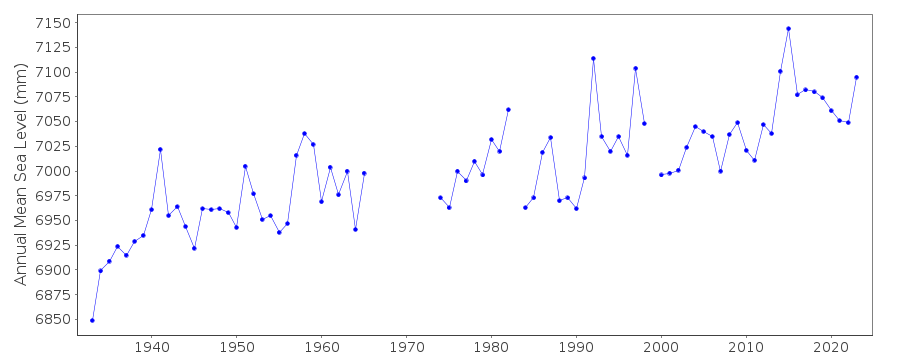
The trend since 1933 is 1.37 mm per annum.
-
Tom Curtis at 11:42 AM on 23 December 2014Hockey stick is broken
Gumball67 @143:
1) As Stephen Baines has already noted, the IPCC does not publish original research. Rather, it reviews original research already published in the peer reviewed literature.
2) Michael Mann's iconic hockey stick graph, as reproduced by the IPCC in the Third Assessment Report (IPCC TAR, 2001) was published in the Geophysical Research Letters in 1999 (PDF version of paper).
3) That version was an update and extension of the prior version published in Nature in 1998, which only extended back to 1400 (PDF version of paper).
4) Those papers were revolutionary in being among the first to use actual temperature proxies from a several cites around the globe to determine NH temperatures, and more importantly, being the very first to assess the error margins of the estimates. They represented a major step forward in paleoclimate temperature reconstructions for the last few thousand years, but not the last or most recent step by any means.
5) The graph used by the IPCC in its First Assessment Report (IPCC FAR, 1990) was a version of a graph devised by Hubert Lamb. Hubert Lamb's graph was based on the Central England Temperature series, a thermometer based record of temperatures in central England. That record only extends back to 1659, whereas Lamb's graph extended back prior to 1000 AD. Astute observers will therefore note that he must have relied on other information for the extension, and that other information was anecdotal historical data, mostly from Europe and Greenland. Astute observers will further note that Central England is not the World, or even the Northern Hemisphere. They will even note that Central England plus Greenland is still not the world or the NH and conclude that using strictly regional temperature information (and anecdotal information in the crucial period) is not an adequate methodology, and not to be preffered to using a number of temperature proxies from around the world.
6) In the IPCC Second Assessment Report (IPCC SAR, 1996), the figure based on Lamb's guesses was replaced by proxy data, primarilly that from Bradley and Jones, 1993, which was a reconstruction based on 16 proxies and hence already a quantum leap in methodology over Lamb's free hand line drawn based on regional anecdotes:

(Image version from wikipedia)
The SAR also featured icecore records from around the globe, giving a similar picture.
So, in summary, every feature of your account of the events relating to the IPCC, Lamb and Mann's graph is wrong. But that is indeed why the world is full of deniers. Because it is full of people who seize on convenient "facts" as an excuse to avoid uncomfortable conclusions - never bothering to check their sources. Consequently it is full of people who confidently assert fictions as the basis of their opinions, and then go on to assert fraud by scientists for disagreeing with those opinions (as the scientist's opinions must, being based on facts).
-
scaddenp at 11:17 AM on 23 December 2014Hockey stick is broken
And as an aside, the tide gauge data at Santa Monica does not seem to squate with your assertion of no sealevel rise. But given possibility of local tectonics, dont you think a better guage of sealevel rise would from satellites or analysis of the global tide guage data?
What is your evidence that a perception of a Mann graph is the reason for climate denial? In my experience, denial is mostly rooted in political values and identity and will jump on any ridiculous excuse to bolster a position. A cool-headed review of all available data seems beyond many people.
-
Rob Honeycutt at 10:19 AM on 23 December 2014Record-Breaking Sea Surface Temperatures in 2014: Has the Climate Shifted?
Gumball... Those are not questions the article is addressing. The article is addressing indicators that may signal whether we will see accellerated warming in the coming decades.
If you want to know about past sea surface temperatures you could try research posted on the NOAA website here.
-
Riduna at 10:15 AM on 23 December 2014Record-Breaking Sea Surface Temperatures in 2014: Has the Climate Shifted?
The short-term prognosis seems rather grim for corals and the cryosphere, particularly in the Arctic and all that implies.
Perhaps Rob Painting or other SkS scientists will publish their conclusions on the consequences of sustained rising SST on these areas in the near future. A glimpse is provided at Figs 3 and 4. Both are disturbing.
-
Stephen Baines at 09:46 AM on 23 December 2014Hockey stick is broken
Gumball.
No. The IPCC does not publish original research in journals. It only reviews the original research. IPCC authors may publish their own work in journals like Science, because as experts they do some of the original research being reviewed. Science may have published an IPCC figure from a report, but they are not doing so as the IPCC.
I have a guess as to what you're talking about, but the dates don't match up. You will have to provide more specific — providing links to these figures etc — before anyone can clear up your confusion about this.
-
Gumball67 at 09:18 AM on 23 December 2014Hockey stick is broken
Unless I am mistaken, the IPCC published Mann's 1995 "Hockey Stick" graph in "Science" magazine. They also published the graph for roughly the same time frame 5 years earlier in the same "Science" magazine. In the 1990 graph, the Medieval period showed massive heat for a few hundred years, much hotter than today. Much, much hotter than today. Mann's 1995 graph conveniently changed his later graph by illiminating that great warming period. That specific act is why the world is full of deniers. (Also because the water levels have not risen at Malibu Beach.
-
witsendnj at 08:45 AM on 23 December 2014Rising air and sea temperatures continue to trigger changes in the Arctic
I do hope that there will be more discussion of methane in light of this latest study: http://www.eurekalert.org/pub_releases/2014-12/c-cf-mil122214.php
and the lecture by James White at the AGU about abrupt climate change, which seems to closely link methane release with extreme temperature change in the past - linked here with some notes: http://witsendnj.blogspot.com/2014/12/all-about-us.html
-
Gumball67 at 08:22 AM on 23 December 2014Record-Breaking Sea Surface Temperatures in 2014: Has the Climate Shifted?
All very confusing. Bottom line: how much has the global ocean temp risen? And, when is the last time it was this high?
-
scaddenp at 05:55 AM on 23 December 2014My AGU talk on tackling climate myths in a free online course
"Perhaps addressing such denial may be a much more effective use of the course than attempting to change right wing minds."
Any course of action by a democratic government needs enough assent to retain voter loyalty. At the moment, right wing denial is a major road block to effective action.
-
Examining Hansen's prediction about the West Side Highway
Roger Knights - Not really, the positing of a Gedankenexperiment, a 'what if' thought experiment, is entirely reasonable. Expecting Hansen to have thought through every possible misinterpretation of his words, and to phrase his speech accordingly, is not reasonable.
Looking at the WUWT article you mentioned, they are still misinterpreting the content of that Hansen interview, falsely posing a thought experiment for doubled CO2 (which has not happened) as a prediction for current, and quite different, CO2 levels. They are continuing to make a debunked claim.
-
One Planet Only Forever at 01:12 AM on 23 December 2014My AGU talk on tackling climate myths in a free online course
saileshrao,
I consider the development of a sustainable better future for all life to be the main objective of life. Therefore, all unacceptable behaviour is to be targetted for effective curtailing, no matter how popular or profitable. However, if the required actions were to be prioritized the following factors are main points to be considered:
- What is the total global magnitude of the impacts? Globally more significant impacts affecting the ability of any and all life to thrive and survive being more severe than regional issues.
- How many people participate in creating the impacts?
- How likely is the unacceptable activity to be percieved to improve the comfort, convenience and pleasure for the trouble makers? The more enjoyment or benefit perceived to be obained, the more difficult it will be to fight against, but the more important it is to fight against because of its potential to persist and expand.
- How much profit is made from activities creating the unacceptable impacts?
It is pretty clear that curtailing the burning of buried hydrocarbons is at or near the top of each significant consideration. So it must be addressed, along with action against what you are referring to.
The trouble makers love to have their trouble making believed to be 'too valued to be curtailed'. It is clear that the failure of the current socioeconomic system to curtail unacceptable activity, its development of effective promotion of such activity, is what needs to change.
It is clear that the success of people who fight against 'developing and acting on the better understanding of what is going on' is what needs to be curtailed. No sustainable good thing has ever developed from the success of those type of people. They thrive on benefiting at the expense of others. Some even try to justify profiting from making trouble for others, especially future trouble, by comparing how much benefit they believe they would have to give up against how much trouble they believe they are creating for others and future generations.
-
Roger Knights at 01:00 AM on 23 December 2014Examining Hansen's prediction about the West Side Highway
CBDunkerson at 22:19 PM on 22 December, 2014:
"Correction to your correction... Hansen was asked about changes which would occur in 40 years (i.e. by 2028) if atmospheric CO2 levels doubled."Er, you're right. I'd lost sight of that point.
But it's strange that Hansen didn't bridle or quibble at the question for assuming too steep a rise in CO2 in too short a time. (In the unlikely event that he shared that assumption, it was a bad error.)
-
jgnfld at 23:25 PM on 22 December 20142014 will be the hottest year on record
Why the focus on whether a single year is greater than the previous year? That seems to be returning to the notion of some sort of monotonic increasing curve as the fundamental proof or disproof of warming.
Neither a healthy nor statistically sensible way to go IMO, anyway. -
saileshrao at 23:18 PM on 22 December 2014My AGU talk on tackling climate myths in a free online course
One Planet Only Forever:
Indeed, a sense of caring for all life, both present and future, would be a pre-condition for those who can overcome their denial of climate science. But in that vein, scientific denial is much more widespread than just in the right wing community.
An estimated 52% of all vertebrates in the wild have been killed off between 1970 and 2010 and yet our routine behaviors do not reflect that simple fact. Perhaps addressing such denial may be a much more effective use of the course than attempting to change right wing minds. -
CBDunkerson at 22:19 PM on 22 December 2014Examining Hansen's prediction about the West Side Highway
Correction to your correction... Hansen was asked about changes which would occur in 40 years (i.e. by 2028) if atmospheric CO2 levels doubled.
Given that atmospheric CO2 levels haven't doubled, and are highly unlikely to do so before 2028, the entire 'debate' is staggeringly moot. It was an estimate based on a pre-defined set of conditions which haven't occurred. You might as well argue that saying, 'If you jump out of an airplane without a parachute you are likely to die' can be disproven by looking at cases of people jumping out of airplanes with parachutes.
-
Roger Knights at 18:57 PM on 22 December 2014Examining Hansen's prediction about the West Side Highway
Correction to the above: "It was in response to a question about how much the everyday sea level would have risen what NYC would look like by that time (40 years). Hansen responded that the West Side Highway (elev. 10 feet) would be underwater.
-
Roger Knights at 18:42 PM on 22 December 2014Examining Hansen's prediction about the West Side Highway
Michael Sweet wrote, "Since Hurricane Sandy already submerged New York as Hansen suggested, Hansen has already been proved right . . . ."
Hansen's prediction can't rationally be read as saying that there would be a one-time 14-foot flooding of NYC within 40 years. It was in response to a question about how much the everyday sea level would have risen by that time. He implied: at least ten feet.
-
Roger Knights at 18:29 PM on 22 December 2014Examining Hansen's prediction about the West Side Highway
As promised, here's the <a href="http://wattsupwiththat.com/2014/12/19/friday-funny-mann-overboard-at-agu14/">link</a> to the comment on WUWT that triggered my replies.
-
Roger Knights at 18:22 PM on 22 December 2014Examining Hansen's prediction about the West Side Highway
Michael Sweet wrote, "Why are you so concerned that SkS is perfect when the bulk of WUWT is in error?"
I have no over-riding, general concern about SkS’s accuracy. The motivation for my comment was a specific trigger: In the two-day-old WUWT thread "friday-funny-mann-overboard-at-agu14," newbie poster "kevinschmidtojai" commented (at December 19, 2014 at 9:21 pm) by reposting the entire head post of this SkS thread, followed by a link to it. He added nothing of his own (and hasn't yet responded to the four replies I made soon afterwards). (I provide the link to his comment in a separate comment below, because three of my prior comments were deleted because of link-format problems.)
My replies pointed out to him that Watts had retracted his claim within three weeks of this SkS thread, so it was no longer operative; and that SkS should reword its head post so it no longer gave its readers the impression that Watts was still making that claim.
I assumed that the moderators here at SkS were aware, or soon would be, of his comment and my responses, so I didn't feel the need to provide that background information. It was the moderators and/or the author of the head post I was mostly addressing.
If I have spurred SkS to update its thread, it will be viewed as a more reliable and conscientious source. SkS readers who, like "kevinschmidtojai," cite this SkS thread in good faith and get rebutted will no longer find out that it has misled them, causing them to be warier of it in the future--as will lurking warmists at WUWT, who have read my rebuttal.
I can easily imagine an SkS regular making this point too—that being forthright is the best policy. There's nothing necessarily nasty about saying so. Anyway, even had I been testy, "Your opponent is [or can be] your friend" (Burke)—by forcing you to up your game.
Unfortunately, the change SkS has has made so far--adding a link to the WUWT thread containing Watt’s retraction--is insufficient. Most readers will not click on it, and so most will continue to be misled. Something like the following text should precede or follow that link:
"In March 2011, perhaps in reaction to this March 10 SkS thread, Watts updated his original 2009 story to correct the record; he conceded that 40 years was the correct number."
-
One Planet Only Forever at 15:54 PM on 22 December 2014My AGU talk on tackling climate myths in a free online course
saileshrao@15,
When you say "we must replace this with a factual alternative that is compatible with a minimally regulated socioeconomic system", I will add that a minimally regulated socioeconomic system will only work if every individual in it wants 'the development of a sustainable better future for all' significantly more than they want a better present for themself.
If you are preferring all people to be 'free to do as they please', no need to bother themselves with better understanding the consequences of their actions and without any concern for the development of a sustainable better future for all then the obvious required action becomes 'effective regulation of the behaviour of those people who only care about their personal interests and allowing them to be free of the regulation when they change their attitude' by as small a government as it takes to keep the trouble-makers from making trouble.
Smaller government being sustainable requires everyone to care about everyone else, and actually requires everyone to care about all other life on this amazing planet, and most importantly it requires them all to care about the future they will never live in.
-
scaddenp at 12:59 PM on 22 December 2014My AGU talk on tackling climate myths in a free online course
Well instead of denial that problem exists, what is needed then is for the right wing to come up with a solution that isnt "big goverment" - I looked for suggestions here. If the right cant do so, then it is admitting to believing in a failed political philosphy. I find resorting to denial rather than thinking of solutions irksome and unworthy of right-wing predecessors.
-
Roger Knights at 11:26 AM on 22 December 2014Examining Hansen's prediction about the West Side Highway
@Michael Sweet:
In informal (inductive) logic, a Tu quoque accusation like yours is a fallacy. Here's Wikipedia's definition. (I don't provide the link because its improper formatting was apparently causing my comment to be moderated-out.)
"Tu quoque (/tuːˈkwoʊkwiː/;[1] Latin for "you, too" or "you, also") or the appeal to hypocrisy is an informal logical fallacy that intends to discredit the opponent's position by asserting the opponent's failure to act consistently in accordance with that position. It attempts to show that a criticism or objection applies equally to the person making it. This attempts to dismiss opponent's position based on criticism of the opponent's inconsistency and not the position presented.[2] It is a special case of ad hominem fallacy, which is a category of fallacies in which a claim or argument is rejected on the basis of fact about the person presenting or supporting the claim or argument.[3] To clarify, although the person being attacked might indeed be acting inconsistently or hypocritically, such behavior does not invalidate the position presented." -
saileshrao at 09:19 AM on 22 December 2014My AGU talk on tackling climate myths in a free online course
It seems to me that when we debunk the myth of climate science denial, we must replace this with a factual alternative that is compatible with a minimally regulated socioeconomic system or else, the targeted people will continue to reject the climate science. To quote Jonathan Kay from the National Post,
""The people I work with at the National Post — because there are some colleagues I have who are what you may call 'climate change deniers' — generally the one universal aspect is that they tend to be right-wing in their thinking, they see market-based solutions as the solution to enriching our society in every respect and it bothers them, the idea that here's this problem that cannot be solved with unfettered industrial activity."
Given this, I can understand why Naomi Klein's progressive triumphalism frightens these people:"Responding to climate change requires that we break every rule in the free-market playbook and that we do so with great urgency. We will need to rebuild the public sphere, reverse privatizations, relocalize large parts of economies, scale back overconsumption, bring back long-term planning, heavily regulate and tax corporations, maybe even nationalize some of them, cut military spending and recognize our debts to the global South."
That screams "big government" to them and frankly, to me, as well. -
Tom Curtis at 08:40 AM on 22 December 2014My AGU talk on tackling climate myths in a free online course
scaddenp @12, and Turboblocke @13, That, and all without three potentially game changing technologies which have popped up on the horison.
Closest to commercial development is the Isentropic pumped thermal energy storage, which potentially ends issues about off peak to peak load sharing meaning the primary argument against renewables is no longer valid.
In the five to ten year horizon is a development in wind turbine design that could reduce the cost of wind energy by a factor of three, making it far and away the cheapest energy source on levelized costs (although not necessarilly when combined with energy storage).
Finally, in the 15 - 20 year range (for commercial development) is Lockheed Martin's Fusion project, which could end all future concerns about renewable energy. Of course, there is quite a bit more ahead of that project than just engineering development, so Lockheed Martin could end up with a fizzler, or (more likely) an energy source with uncommercial levelized costs so I would not put all (or any, at this stage) of our eggs in that basket. But while such major firms are staking their reputation so publicly on the viability of the project, it is a bit absurd to go around saying the prospect of renewable energy in large amounts, cheaply is simply a myth.
-
Turboblocke at 08:13 AM on 22 December 2014My AGU talk on tackling climate myths in a free online course
The Germans pay about 6 Eurocents/kWh as a Renewable Levy. With the average family of 4 having an annual consumption of less than 4,000 kWh, that's about 60 Euros per person per year. Is that really hair-shirt territory?
-
scaddenp at 06:14 AM on 22 December 2014My AGU talk on tackling climate myths in a free online course
I wonder if Wol considers UK, German or NZ citizens to live a "hair-shirt" existance? These people all manage on less than 1/2 the energy per capita than the USA or Canada. The poor hair-shirted Swedes manage to get by on only 7tCo2/person compared to around 25 for US and Australia.
-
One Planet Only Forever at 05:50 AM on 22 December 2014My AGU talk on tackling climate myths in a free online course
Wol,
Though total population numbers are a problem the real problem is the highest consuming higest impacting among the population.
This planet will potentially be habitable for several hundred million years. A smaller population of high consumption high impact humans would not be sustainable.
The required development is for the most fortunate to be the lowest impact on the planet living in totally sustainable ways helping the less fortunate develop to that higher-level of decent considerate living.
I disagree with the claim that that would require the most fortunate to live a 'hairshirt life'. Such a claim is a poor excuse for not requiring all of the most fortunate to behave better and all participate in the serious effort toward the development of a sustainable better future for all. And I would argue that it is not the responsibility of only the caring and considerate to try to overcome the unacceptable impacts of those who willfully choose not to care.
-
Wol at 04:28 AM on 22 December 2014My AGU talk on tackling climate myths in a free online course
SAILESHRAO
Nice link, especially para. 3 in it.
Once again, it brings us back to population numbers. I see no real virtue in espousing a hair shirt model for the future only to allow even higher numbers on the planet, necessitating an even hairier shirt.
S
Moderator Response:[JH]
You are skating on the thin ice of sloganeering which is prohibited by the SkS Comments Policy.
Please note that posting comments here at SkS is a privilege, not a right. This privilege can be rescinded if the posting individual treats adherence to the Comments Policy as optional, rather than the mandatory condition of participating in this online forum.
Please take the time to review the policy and ensure future comments are in full compliance with it. Thanks for your understanding and compliance in this matter.
-
saileshrao at 03:33 AM on 22 December 2014My AGU talk on tackling climate myths in a free online course
Andy Skuce:
Indeed, Naomi Klein has advanced the view that much denial of climate change science is rooted in values and culture:
www.thenation.com/article/164497/capitalism-vs-climate#Jonathan Kay of the National Post, a decidedly conservative publication, pretty much concurs here:
www.pressprogress.ca/en/post/national-post-editor-explains-why-many-his-colleagues-are-climate-change-deniers -
One Planet Only Forever at 03:00 AM on 22 December 2014My AGU talk on tackling climate myths in a free online course
Learning the best way to help those who are inclined to want to 'better understand what is going on' to actually better understand an issue is indeed important. The more difficult task is effectively addressing those who are inclined not to want to better understand what is going on.
As an engineer with an MBA I have dealt with many people, including technically knowledgeable people, who will listen to the presentation of a detailed explanation on an issue, not just climate science issues, and at the end simply say they are not convinced. In some cases they say they need more proof that what they would prefer to believe is wrong. Usually, the motivation for their preferred belief is that it would be more beneficial for them (easier quicker cheaper) if they could stick with what they prefer to believe.
So far, I have found the only real effective way to deal with such people is to not allow them to do what they believe they should be allowed to do. As a Professional Engineer in Canada I have that authority and responsibility. However, the ones wanting to believe what they prefer can shop around for a different Professional who will support their beliefs. Sound familiar? Unsafe practice by a Professional Engineer in Canada can lead to them having their registration as Professional cancelled.
So it would seem that, in addition to helping others better understand, there needs to be effective mechanisms to cancel the purported legitimacy of those who try to maintain unjustified beliefs. That does not really seem to be something that scientists can do effectively. It requires sociopolitical leadership that is genuinely interested in developing a better future. That is hard to find in a socioeconomic system that promotes the pursuit of personal desire any way it can be gotten away with. So the socioeconomic system focused on popularity and profitability that has no motivation to develop a sustainable constantly improving better future for all is the problem. That is what also needs to be challenged and changed.
-
Andy Skuce at 02:02 AM on 22 December 2014My AGU talk on tackling climate myths in a free online course
saileshrao:
The course is concerned with the rejection of the physical science behind climate change. There will be some commentary on the relationship between political orientation and people's willingness to accept the science of climate, but we will not be focussing on solutions or policy questions.
To be sure there's plenty of dispute and misconceptions about solutions and a continuing conversation about policy is necessary. However, most of the disagreements that exist on policy do not fit easily into the myth/fact framework that we will be adopting for this course. Much of the dispute in this area centres around values and culture, as opposed to the reliable knowledge that emerges from the physical sciences.
-
saileshrao at 00:05 AM on 22 December 2014My AGU talk on tackling climate myths in a free online course
Unfortunately, denials abound in this arena. Would you be tackling denials other than the denial of anthropogenic climate change existence in the course? For instance, please see, e.g.,
http://www.resilience.org/stories/2014-11-26/six-myths-about-climate-change-that-liberals-rarely-questionModerator Response:[PS] Fixed link
-
michael sweet at 22:29 PM on 21 December 2014Examining Hansen's prediction about the West Side Highway
Roger,
Thanks for your definition. We'll see if it survives moderation this time.
You still have to address the fact that you want SkS to correct their post when WUWT has not changed their false claim. They now make their own projection for 25 years in the future. Since Hurricane Sandy already submerged New York as Hansen suggested, Hansen has already been proved right while WUWT is incorrect. Perhaps you want to dispute the damage to New York during Hurricnae Sandy?
Since you appear to be a troll I will not respond to you again.
Moderator Response:[JH] Please tone down the rhetoric.
-
One Planet Only Forever at 10:01 AM on 21 December 2014What happens if we overshoot the two degree target for limiting global warming?
wili,
The current CO2 levels have not locked in endless increase in temperature. What has been locked-in is a long-term feedback response system which will raise temperatures for several decades before a balance condition is reached. The current CO2 levels will not lead to an endless always increasing temperature, just like the 280 ppm level over the past 1000 years had not caused endlessly increasing global average temepratures.
So curtailing the addition of CO2 by curtailing the burning of buried hydrocarbons is the most important thing to do. And once humans stop adding CO2 from that activity the eventual maximum global average impact will have been established, and it will be reached several decades later as the feedbacks collectively develop a new balanced condition. However, other changes of human activity can actually reduce atmospheric CO2 levels by things like:
- reforesting to increase the locking in of carbon into trees
- CO2 capture and storage applied to biofuel burning (CO2 capture on coal burning reduces CO2 emissions but is still adding CO2).
A more difficult thing to evaluate is the potential for the feedbacks to collectively lead to very significant additional rapid changes resulting in the new balanced point being extremely magnified beyond the simple additional CO2 impact. Mann and others have repeatedly tried to raise awarenss of this concern so that policy makers do not get the idea that it is OK to shift to a higher target of human impact if we don't want to limit things to 2.0 degrees C.
The lack of action by the biggest impacting humans since 1990, when there was no doubt about the need to reduce the human impacts, resulted in a limit of 1.5 C being virtually unachievable by 2009. As much as I agree with the point that a continued lack of concern by current generations resulting in 2.0 C being unachievable would be no reason to stop trying to limit the impact, it is very dangerous to imply that it would be reasonable and decent or acceptably 'pragmatic' (a work I despise being applied to the knuckle-dragging done by many 'leaders' regarding this issue), for a current generation to decide 'it is too hard' for them to do what 'needs' to be done. The real problem is that the need is a future need. The current socioeconomic system encourages too many people to only care about their current 'desires' even making some people believe the 'desires' are 'needs'.
-
wili at 09:31 AM on 21 December 20142014 SkS Weekly News Roundup #51B
Second word of second title needs to be corrected: "Aboriginal kowledge could unlock climate solutions"
Moderator Response:[JH] Done. Thank you.
-
MA Rodger at 07:31 AM on 21 December 2014Arctic sea ice has recovered
Responding to off-topic comment here (as is #68 & #69 above).
The David Rose item in the Rail on Sunday of 30/8/14 basically does the usual Rose trick of "hiding his bogus decline" in AGW predictions by making such predictions as extreme as possible and then proving them to be in error. Sadly, and Rose is a real saddo, he is unable to do this without misrepresenting those extreme positions and his proofs.
To debunk his 30/8/14 piece would take a while to write out. But it would likely start something like this.
☻ Rose misrepresents what Gore said in 2007. Firstly Gore was reporting what others had said and secondly he mentioned two predictions for an ice-free summer - 7 years and 22 years. Rose usually plays an extremly strong game misrepresenting AGW comment.
☻ The 25th August date is a bit of a cherry-pick. A couple of days earlier and it would have been "since 2009" not since "since 2006" because 2009, 2013 and 2015 SIE were very similar through the height of the melt season.
☻Rose mischaracterises the period 2012-14. Most of the SIE increase (90%) occurred 2012-13. His comment about 'consentrations' is likewise a mischaracterisation. Most of the SIA increase (95%) occurred 2012-13. So his news story is a year out-of-date. SIV is however more even between the two years.
☻ Judy Curry is more a denialist blog-mom these days and no longer a pukka climatologist. Her assertion that the "death spiral" is (or will be) entering a reversal which will last decades is air-headed lunacy of her own creation.
And on and on and on. -
MA Rodger at 07:25 AM on 21 December 2014Antarctica is gaining ice
alan2112drums @371.
I think the writings of David Rose of the Daily Mail on the subject of AGW are usually requiring "rebuttal" rather than "peer review". Even the IPCC have found it necessary to carry out such corrections, as SkS posted here.
I will add comment on this particular serving of gobshite from Rose on the same thread linked @373 & 375.
-
John Cook at 07:01 AM on 21 December 2014My AGU talk on tackling climate myths in a free online course
Shoyemore: am very familiar with Kahneman's fast and slow thinking, which is extremely relevant to how people think about climate change. Very insightful and influential work.
BTW, I've uploaded the slides for my talk in PDF form (link at the top of the OP).
-
Daniel Bailey at 06:50 AM on 21 December 2014Antarctica is gaining ice
I have replied to that nonsense about Al Gore and Arctic Sea Ice demise by such-and-such date, here.
-
Daniel Bailey at 06:47 AM on 21 December 2014Arctic sea ice has recovered
In reality, Gore echoed Wieslaw Maslowski's prediction.
Maslowski's prediction, originally made in 2006, was that Arctic sea ice would decline to <1,000,000 square kilometers extent (with no ice at the North Pole) by the end of the September melt by 2016, +/- 3 years. So 2013-2019. [Source, slide 6]
But that truth is always inconvenient to deniers, who revert to their preferred idiom of mendacity, prevarication and lies indiscriminately, without pretext needed.
-
Daniel Bailey at 06:44 AM on 21 December 2014Antarctica is gaining ice
I have placed some updated information on Polar Bears here.
-
Daniel Bailey at 06:42 AM on 21 December 2014Polar bear numbers are increasing
Polar Bear populations are declining.
In 2005, the IUCN Polar Bear Specialist Group (PBSG) classified the Polar Bear as a vulnerable species. In 2009, they reported that of the 19 subpopulations of Polar Bears:
8 are declining
3 are stable
1 is increasing
7 are without sufficient dataThis compares with, in 2005:
5 declining
5 five stable
2 increasing
7 data deficient[Source]
· A decline in survival of female polar bears of all age classes, from 1194 to 806, between 1987 and 2011 in western Hudson Bay was due to earlier sea ice break-up in the spring and later freeze-up in the autumn.
· In 2010, polar bear numbers in the southern Beaufort Sea appeared to stabilize at 900 bears following a period of low survival during 2004-2006 that led to a 25-50% decline in abundance. However, survival of sub-adult bears declined during the entire period.
· Polar bear condition and reproductive rates have also declined in the southern Beaufort Sea, unlike in the adjacent Chukchi Sea, immediately to the west, where they have remained stable for 20 years. There are also now twice as many ice-free days in the southern Beaufort Sea as there are in the Chukchi Sea.
· Genetic studies indicate that polar bears have been through long and dramatic periods of population decline during the last one million years, and that during periods with little sea ice there have been multiple episodes of interbreeding between polar bears and brown bears.
[Source]
"The primary habitat for polar bears and their prey, sea ice, is declining rapidly in extent in all seasons, and particularly in summer, with concurrent and even more dramatic reductions in total volume (Laxon et al. 2013). Since the satellite record began in 1979, minimum sea ice extent has declined 13.3% per decade (see the essay on Sea Ice). Given the close association between polar bears, their primary prey and sea ice, climate warming remains the most significant threat to the long-term survival of this species (Stirling and Derocher 1993, Amstrup et al. 2008, 2010)."
[Source]
The evidence is clear: Polar Bear populations are declining.
-
wili at 05:35 AM on 21 December 2014What happens if we overshoot the two degree target for limiting global warming?
OPOF, what is the source for your last claim. It would seem to contradict recent work by MacDougal et al. and other papers that take carbon feedback into account, unlike most earlier models.
-
shoyemore at 05:18 AM on 21 December 2014My AGU talk on tackling climate myths in a free online course
I watched the Muller video and it reminded me of this book:
Thinking Fast and Slow by Daniel Kahneman
Kahneman is an Israeli psychologist and Professor at Yale who won a Nobel Prize in Economics. The book is about what he calls Fast Thinking ("heuristics" or short cuts), and Slow Thinking which is more logical but mentally draining and demanding, but more likely to give right answers.
Fast Thinking has its place in time of crisis "fight or flight", but as humans we over-use it in a lazy fashion.
It seems to me Miller is saying that to teach physics, or probably any science, you need to engage Slow Thinking. Bit off-topic, but you might find Kahneman's book enlightening, John, if you have not already read it.
-
wili at 05:06 AM on 21 December 2014Two degrees: Will we avoid dangerous climate change?
The second sentence in section 5: "In order to meet limit warming to two degrees the world must..." has something wrong. I think you want to drop "meet."
(But of course the whole section is essentially saying that we need to rely on fairy dust. How did we go so very far down such a very wrong road?)
-
Composer99 at 04:35 AM on 21 December 2014Antarctica is gaining ice
alan2112drums:
I have responded here to the point raised by the Daily Mail about sea ice. Perhaps others will offer additional perspectives.
I must leave it to others to address the polar bear matter - although the on-topic post I have shared does, too.
(I have to get to cleaning a bathroom. Fun times.)
-
Composer99 at 04:33 AM on 21 December 2014Arctic sea ice has recovered
alan2112drums:
Further to your comment on the Antarctic thread, please see the original post and review the findings on sea ice.
You may also wish to review the behaviour of the sea ice relative to the IPCC AR4 projections (here) - note that this information is only from 2009, so it doesn't show the record low set in 2012 - or the behaviour of the sea ice over the last (not quite) 1,500 years (here).
Basically, Arctic sea ice has fallen off the proverbial cliff. Al Gore got that right, at any rate.
Arctic sea ice minimum in 2014 (September) was 5.02 million km², which NSIDC reports is the 6th lowest on record. Arctic sea ice maximum in 2014 (March) was 14.8 million km², which NSIDC reports is the 5th lowest on record.
Arctic sea ice behaviour year-over-year is not monotonic, and as far as I can see the Daily Mail is taking advantage of this fact to form a narrative that casts doubt on the science, when in fact what is seen is merely the result of stochastic fluctuation.
Just to be clear, what I perceive the Mail as doing is:
- Provide quote from Al Gore (despite Gore emphatically not being a climate scientist, "spokesperson" for climate science, or otherwise generally a source of information used by scientists), possibly omitting contextual remarks (and definitely ignoring Gore's own inclusion of uncertainty - note the words "could" and "in as little as seven years", which allow that an ice-free summer could be more than 7 years away, too) to maximise dramatic effect.
- Contradict Gore with very careful framing (notice how much the Mail emphasises the degree to which Arctic sea ice has increased relative to 2012, despite the general irrelevancy of that information).
- This allows a reader who wishes to dismiss the actual science to do so - "Well, if Gore got it so wrong in 2007, why should we take climate scientists so seriously now?" - without the Mail taking responsibility for making false claims.
Prev 670 671 672 673 674 675 676 677 678 679 680 681 682 683 684 685 Next






