Arguments







Recent Comments
Prev 671 672 673 674 675 676 677 678 679 680 681 682 683 684 685 686 Next
Comments 33901 to 33950:
-
michael sweet at 04:02 AM on 21 December 2014Examining Hansen's prediction about the West Side Highway
Roger,
Have you gone to WUWT and asked them to correct al the other posts they have with errors? It will be a long post since you will have to correct virtually everything they have. Why are you so concerned that SkS is perfect when the bulk of WUWT is in error?
In examining your link they still claim that Hansen is wrong. Why should SkS change their article when WUWT has not changed their claim? You need to correct WUWT before you try to get the post here changed.
-
Composer99 at 03:56 AM on 21 December 2014Antarctica is gaining ice
alan2112drums:
I believe you can simply share the link (which you did at the bottom of your post - unless that's for a related post) and either paste/quote relevant highlights or paraphrase what you think are the key points, rather than copy/pasting the entire article - especially since the Daily Mail still has copyright on its own content.
Please note that this original post & thread are meant to discuss the behaviour of Antarctic ice, and as such remarks about either the Arctic sea ice or polar bear populations - which appear to be the main poitns of contention raised by the Daily Mail article - are off-topic.
Threads for further follow-up (including responses):
- Arctic sea ice
- Polar bear populations
- There may be other appropriate threads following a search.
-
alan2112drums at 03:17 AM on 21 December 2014Antarctica is gaining ice
I am not a scientist, merely a layman that discusses politics and current events with my 20 year old son studying engineering, physics and math at the University of Waterloo in Canada. He supports the claim that climate is changing and the polar ice cap is shrinking. I am a right wing skeptic so I am searching for more info on this claim. Our only right wing media (Sun News) regularly scrutinizes these and other topics with in depth reports and documetaries. I find them extremely interesting and much more balanced than what I see on main stream media, (hence my skepticism). I found this article from "mail online", also called "Daily Mail" and was hoping this forum could do a "peer review" of sorts on it. (I'm sorry to have copied & pasted the entire document but I knew no other way to share it here).
Read more: http://www.dailymail.co.uk/sciencetech/article-2738653/Stunning-satellite-images-summer-ice-cap-thicker-covers-1-7million-square-kilometres-MORE-2-years-ago-despite-Al-Gore-s-prediction-ICE-FREE-now.html#ixzz3MSUzouTW
Moderator Response:[Rob P] Please don't copy/paste screeds of text. I have removed it but, in the future, a simple link will suffice. Also, note the correct threads for this are the Arctic sea ice and polar bear myths - as Composer99 points out.
-
BillEverett at 02:41 AM on 21 December 2014My AGU talk on tackling climate myths in a free online course
@bouke Thanks for the link. I had not seen that TED Ed talk, but I had seen D. Muller's video "Khan Academy and the Effectiveness of Science Videos" at https://www.youtube.com/watch?v=eVtCO84MDj8, which presents basically the same message, and I downloaded his thesis to read from the link in the YouTube video description. "Start with the misconception." People don't learn from being told; they learn from thinking (mental effort).
-
John Cook at 02:32 AM on 21 December 2014My AGU talk on tackling climate myths in a free online course
Yes, I have seen his work and watched his online talks (which are very good). We discussed interviewing him when we were at UNSW interviewing climate scientists but apparently he's abroad at the moment.
-
bouke at 01:59 AM on 21 December 2014My AGU talk on tackling climate myths in a free online course
I wonder if you're familiar with the work of Derek Muller; he did a PhD on how to teach physics. Your approach reminded me of his work, but watch for yourself:
https://www.youtube.com/watch?v=AcX3IW00nuk
Moderator Response:[PS] Fixed link
-
Joel_Huberman at 00:34 AM on 21 December 2014Rising air and sea temperatures continue to trigger changes in the Arctic
I've just looked at the full report. The word "permafrost" is mentioned only four times in the report, and never in depth. The word "methane" is not mentioned at all. This year's report contains ten substantive chapters, each dealing with a different aspect of Arctic conditions. None of the chapters in this year's report was targeted at permafrost, sea level, or coastline stability. Perhaps those subjects will be addressed in future reports.
-
Roger Knights at 21:31 PM on 20 December 2014Examining Hansen's prediction about the West Side Highway
In March 2011, perhaps in reaction to this March 10 SkS thread, Watts updated his original 2009 story to correct the record and concede that 40 years was the correct number. He wrote, “So I’m happy to make the correction for Dr. Hansen in my original article, since Mr. Reiss reports on his original error in conflating 40 years with 20 years.”
See the updated first pages at: http://wattsupwiththat.com/2009/10/22/a-little-known-but-failed-20-year-old-climate-change-prediction-by-dr-james-hansen/
SkS should update its head post by mentioning Watts’s update. As-is, it can be read as implying that Watts is continuing to make a debunked claim. (It says, “One climate myth found on the internet, propagated by Anthony Watts, is that James Hansen erroneously predicted . . . .”) In addition, “previously” should be inserted before “propagated.”
Moderator Response:[JH] Your concerns have been duely noted.
-
One Planet Only Forever at 15:11 PM on 20 December 2014What happens if we overshoot the two degree target for limiting global warming?
denisaf,
You are correct about the damage to the ocean due to excess CO2 being absorbed. And the ocean is taking in a large amount of heat energy, however, because it is such a large mass it has not gotten very much warmer. A very small amount of ocean warming represents a huge amount of energy. However, the temperature will not continue to rise is humans curtail the creation of excess CO2 acummulation in the atmosphere.
The extra CO2 simply absorbs more infrared radiation that is being emitted by the planet surface. There is always a balance point when the warmer surface is emitting enough extra infrared to balance with the incoming solar radiation.
Though the excess CO2 that has accumulated in the atmosphere (most of the excess is being absorbed in the oceans), is expected to persist as excess for a very long time before it naturally gets lowered, the global average surface temperature will reach a 'balanced energy state' (balancing solar energy in with emitted energy getting out through the thicker CO2 'blanket'), at any level of CO2. It is expected to take at least 10 years for the 'balanced state' to be established for any level of CO2. However, if the excess CO2 concentration stops increasing the global average is expected to also stop increasing. So it is possible for human activity to change in ways that will reduce the future impact.
-
denisaf at 14:53 PM on 20 December 2014What happens if we overshoot the two degree target for limiting global warming?
The current atmospheric concentration level of greenhouse gases has put in place a blanket that is causing irreversible global warming. The objective of the so-called 2 degree of warming is meaningless.The degree of warming will coninue to increase even if the rate of greenhouse emissions slow down due to decisions made and implemeted by governments. Ironically, the absorption of heat by the oceans will only slow the atmospheric heating down slighlty while the absorption of some of the greenhouse gases is causing the damaging ocean acidification.
-
One Planet Only Forever at 09:56 AM on 20 December 2014What happens if we overshoot the two degree target for limiting global warming?
shastatodd@6,
The amount of climate difference resulting from only the 0.4 C cooling that occurred during the time of the Mauder Minimum is indeed significant. It does suggest that a 2.0 C increase would result in very significant changes. That is indeed the concern.
A recent SkS item here presents the case that 2.0 degrees C should be considered an increase of significant concern and be the upper limits of impacts resulting from policy makers decisions of actions to be taken. Earlier reports have indicated that even a 1.5 C increase would lead to significant and difficult to forecast rapid changes of regional climate. Those changes could be difficult to effectively adapt to regionally since they would be changing so rapidly. At Copenhagen in 2009 global leaders had to admit that the lack of action by the already developed highest impact people, including the increased impacts of a dastardly few who already were very fortunate, had made a 1.5 C limit virtually impossible to achieve.
So 2.0 C is not just a concern it is a serious concern. Exceeding it is not considered to be decent, however, as has been stated, it would be even less acceptable to declare that since the impacts to date are so significant there is no reason for any attempts to reduce the impacts that the highest impact people of this generation have on future generations.
-
Riduna at 09:52 AM on 20 December 2014Rising air and sea temperatures continue to trigger changes in the Arctic
Interesting Report Card.
Thank goodness the effects of Arctic Ampilification have, apparently, had no effect worth mentioning on carbon release from thawing permafrost, instability on foundations of buildings or infrastructure, no effect on average global sea level and no effect on erosion of Arctic Ocean coastlines.
Some might think the report incomplete.
Moderator Response:[JH] Please note that the OP is only a news release summary of the full report.
-
scaddenp at 05:44 AM on 20 December 2014What happens if we overshoot the two degree target for limiting global warming?
Further to Rob's comment, I dont know what you are using as your source of information on the LIA, but I would strongly recommend you read the chapter in the IPCC report (paleoclimate) for a summary of the science to date on the LIA. It is more accurate to say that the maunder minimum contributed to the LIA than caused it. To get a better idea of the effect of the Grand minimum alone, then it would be best to look at the Southern hemisphere climate in the LIA.
You can see here to comment on what a Grand minimum would bring. +2 is no picnic but projecting from LIA is too extreme.
-
Rob Honeycutt at 05:31 AM on 20 December 2014What happens if we overshoot the two degree target for limiting global warming?
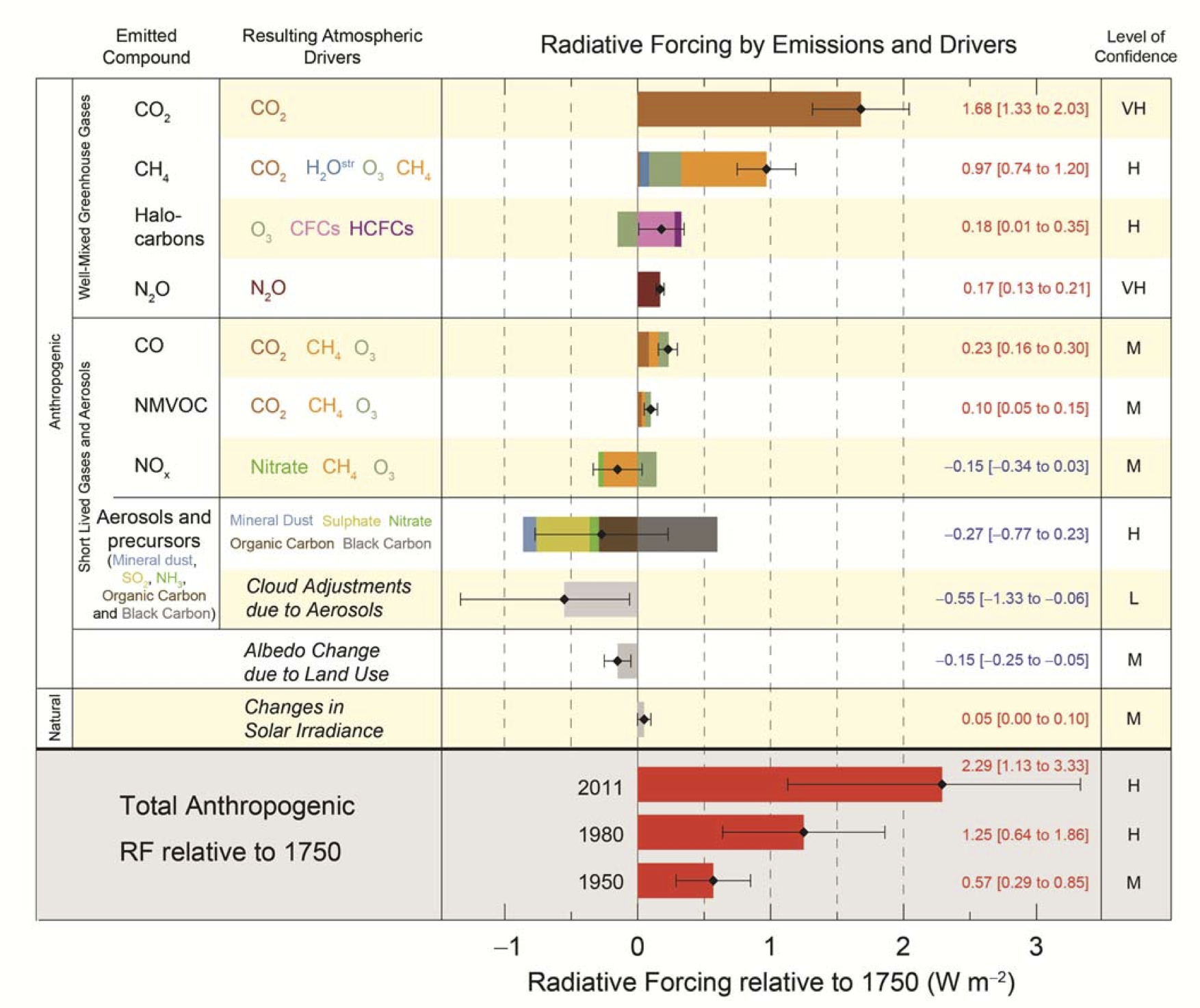
shastatodd... A new Maunder minimum is highly speculative, but even if it were to occur, it would likely have only a small influence on global temperature trends. Radiative forcing for solar is on the order of 0.05W/m2, whereas the change for anthropogenic forcing is >2W/m2.
Solar barely registers relative to man-made causes.
-
shastatodd at 04:12 AM on 20 December 2014What happens if we overshoot the two degree target for limiting global warming?
it is speculated that the sun is entering another "maunder minimum"... in doing some online research about that event, the associated "little ice age" was caused by an estimated -.4 C degree cooling, from decreased solar output.
if -.4 C created that much change, how is that +2 degrees C is considered acceptable? -
jja at 03:41 AM on 20 December 2014Rising air and sea temperatures continue to trigger changes in the Arctic
Twice the Global Average, not "anywhere on earth".
-
MA Rodger at 20:41 PM on 19 December 2014CO2 lags temperature
davytw @447.
I have to say that your denialist has a pretty poor graph. There is a far better one, also from Wood-for-trees, up-thread @391.
As folk here describe, there is a tiny CO2 effect due to rising global temperature but also due to ENSO which wobbles temperature & CO2 both, small (or perhaps more correctly very small) effects when compared with the direct anthropogenic inputs of CO2.
These tiny wobbles are used by some, with added smoke and mirrors, to 'demonstrate' that rising CO2 is natural. I think Murray Salby takes the saddo prize in these works of lunacy as he has actually managed to line all his mirrors up to link this modern-day lagging of CO2 with the measured lags in CO2 in the ice core data. (If you can cope with such madness, there is a 68 minute video of his presentation here. I think it helps if you wear tin-foil hat, just to get into the spirit of the thing.)
Encountering such mind-blowing nonsense once too often prompted me to produce this graphic (usuallt 2 clicks t 'download you attachment'). I forget whose equasion it was, possibly Humlum's. And I'm pretty certain there is a SkS version as well, somewhere.
-
localis at 18:22 PM on 19 December 2014What happens if we overshoot the two degree target for limiting global warming?
The latest C02 levels are now very close to passing the 400 ppm level again which may mean that 2015 could be the first year that remains above that level throughout. This seems to indicate that C02 levels are still increasing at an accelerating rate. Quite how we can even consider achieving a limit on future warming seems more based on optimism than science until we can stabilize C02 levels at their current level.
-
Tom Curtis at 16:25 PM on 19 December 2014CO2 lags temperature
davytw @447, you have three excellent responses so far. Let me add that it is often worthwhile taking denier cherry picks or other selective data at face value. If you do in this case, for example, you see that the lag shown is about 1 year. So, assume CO2 lags temperature by one year, and assume also, as per denier dogma, that there has been a pause in global temperatures. It follows that from one year after the pause started (1995 and 1998 seem to be the preffered values) there has been a pause in the rise of global CO2 concentrations. If your interlocuter cannot show you that pause the raw CO2 data, then it follows that either:
There has been no pause in global temperatures; or
CO2 does not simply lag global temperatures and the graph has been deceptively constructed to show an appearance that is not real; or both.
In other words, even at face value combined with the raw data, the claim refutes itself.
On a more subtle point, the partition of CO2 between the three main surface reservoirs (atmosphere, ocean and terrestial biosphere) is governed by temperature. In particular, increased temperatures will shift CO2 from the ocean to the atmosphere. If there are no other relevant factors, this is the primary short and medium term controller of CO2 concentration, and given the size of the effect relative to the increase in global temperature, dominates CO2 concentrations at sub decadal time scales. However, anthropogenic emissions over a decade or more far exceed the variation in CO2 concentration caused by small temperature effects so that anthropogenic emissions control almost completely the long term rise.
Long term temperture trends (such as occur at the start and end of glacials) can result in long term changes in CO2 concentration. However, taking the graph your denier interlocuter provided, the ratio appears to be 1 ppmv of CO2 increase for every 2.5 C increase in temperature. (Again the advantage of face value. Your interlocuter must either admit that figure or something very close, or admit the graph has been deceptively constructed.) Based on that figure, the approximate 1 C temperture increase since the preindustrial can only be responsible for about 0.5 ppmv increase on CO2 concentration ;)
Of course that figure is way to low, because the graph is deceptively constructed. Using the ratio between temperature and CO2 concentrations in the glacial, the actual increase in CO2 due to the 1 C increase in temperature may be as much as 20 ppmv. Of course, that increase is itself no more natural than the warming.
-
dvaytw at 16:14 PM on 19 December 2014CO2 lags temperature
As usual, fellas, your help is much appreciated!
-
One Planet Only Forever at 14:32 PM on 19 December 2014What happens if we overshoot the two degree target for limiting global warming?
Unfortunately the discussion of the science and the clearly indicated required changes of how people can enjoy their life appears destined to lead to an insufficient response from leadership in current society.
Levermann's end of comment "... but that is for society to decide." is the crux. How can the future global society that will have to deal with these consequences influence the decisions made by today's society? The problem is the lack of consequences to the leaders of the current global powerful and wealthy societies (leaders of politics, industry, and finance).
The science has been strong and continues to get stronger. Yet people who are undeniably aware of the science continue to attempt to increase profit taking from activities known to need to be curtailed. As a result, the 'target' temperature will increase until there are meaningful consequences for the powerful people in a current society who knowingly deny and resist the need to act more decently.
Continued development of the science will strengthen the case for penalties against those who willfully try to benefit in ways they understand they should not (including carbon taxes). Hopefully some of the worst actors will be penalized retroactively for past actions. When that first such 'significant penalty' is effectively applied to a wealthy and once powerful person the motivation for more decent behaviour will grow and we can then begin meaningfully forecasting the likely maximum global temperature.
-
CO2 lags temperature
Looks like one of the heavily massaged graphs that Smokey/dbs/dbstealey, WUWT moderator and sock puppet extraordinare keeps posting. Congratulate your guy, he's (re) discovered that atmospheric CO2 varies with the growth and die-off of global seasonal vegetation. Which we already knew.
The short term and the use of 'isolate' are the give-aways; removing the long term rise in CO2 and ignoring mass-balance, isotope, oxygen level, and all the other evidence demonstrating an anthropogenic cause for rising CO2.
It's simply amazing how much deliberate effort goes into these denial graphs. At best (!) confirmation bias, searching for a combination that confirms what they believe despite the evidence, or at worst, flatly attempting to lie with a misrepresentation of the data. Really no way to tell which, unless the person presenting this junk is a known lobbyist...
-
scaddenp at 13:02 PM on 19 December 2014CO2 lags temperature
Pure misinformation. Go to that link and take off the detrend on the CO2 and look at the picture. When you detrend, all you have left is the short-term seasonal wiggle in CO2 caused by the change in winter/summer vegetation primarily in the Northern hemisphere. Southern hemisphere doesnt have same effect (way less land vegetation) so his plot looks like lag. Try it with Northern hemisphere instead. How much effort do you suppose went in constructing such a story and do you think that some could find that accidentally? If the guy created this himself, then I think you are dealing someone who is delibratedly intending to misled with the full knowledge of what they are doing.
-
Composer99 at 12:34 PM on 19 December 2014CO2 lags temperature
I'm suspicious of the 'detrend' term written into the CO2 time series, and the fact that your interlocutor is using the HadCRUT3 unadjusted southern hemisphere temps, instead of global.
-
dvaytw at 12:28 PM on 19 December 2014CO2 lags temperature
I'm arguing with a couple guys in the comments under George Marshall's excellent video presentation, How to Talk to a Climate Change Denier
One fellow there keeps pointing at this one graph as irrefutable smoking, gun proof that CO2 lags temperature:
I speculate that this is pretty short-term and in any case we know the source of atmospheric CO2, but can anyone suggest anything more to say about this?
Moderator Response:[RH] Shortened url that was breaking formatting.
-
Trevor_S at 10:19 AM on 19 December 2014What happens if we overshoot the two degree target for limiting global warming?
With emissions accelerating faster than they are now for the next few decades, global temperature rise in RCP8.5 reaches five degrees by about 2120 and six degrees by 2150. This is a worst-case scenario, says Levermann, but that doesn't mean it's not a possibility.
As Professor Richard Alley states in seversl lectures of his I have watched on Youtube... the uncertianty is on the upside and it is not our friend. We should be mitigating because we might get 4C+, the thought of actually hitting 4C+ is... nearly unimaginable.
Professor Wanless from Miami U>
Wanless says a two-metre rise in sea level by 2100 is likely, but says it’s also plausible it could be as much as five metres by the end of the century, and it will continue rising for centuries after that
and yet some places (In Australia, Queensland and New South Wales) aren't doing infrastructure planning for any rise at all by 2100 and some for only 0.8.. We should be planning for 4m. If you plan for 4m and you 2m, no issue, if you plan for 0.8m and you get 2m ... well... You will want to take a whole lot of tax to undo your planning "incompetence."
-
jhint at 07:17 AM on 19 December 2014What happens if we overshoot the two degree target for limiting global warming?
I look forward to a response to this seemingly very important question. I don't see where the unacceptable repetiton occurs, that the moderator JH has admonished dagold for.
Moderator Response:[JH] Ooops! My comment was meant for another commenter, not dagold. My bad!
-
Stephen Baines at 06:31 AM on 19 December 2014There is no consensus
"The enormous evidence base that you cite does not preclude other factors causing the most recent warming."
Actually, it does preclude them as that list is really rather small. It would have to be something that affected the net heat balance of the earth by affecting incoming radiation (solar inputs, aerosols, clouds), the reflectivity of the earth (ice caps, land use changes) or the ability of the surface to cool (greenhouse gases). The only thing that has been changing in a way that should increase global heat balance over the last 40 years are greenhouse gases.
Your equivalent of H pylori would be to discover a new way for heat to be produced, absorbed or lost by the atmosphere in a large enough quantity to challenge the importance of those other factors. I'd argue the likelihood that such a missing component of the heat budget exists and has not been seen is virtually nil, because we can close the heat budget now.
"and whilst you are right that there is a lot of knowledge about paleo climate I have yet to see anything that comes close to proof that C02 changes are the main factor in those. "
First, what explains variations in paleo climate does not have to be the same thing that explains current climate change. I.e., The glaciations were not initiated by CO2, but they were exacerbated by feedbacks that increased CO2. Current warming is only really related to changes in greenhouse gases though.
Second, we will always know less about what drives paleo climate because we know less about the key factors that drive global heat balance in the distant past than we know about the present, for which we have precise measurements. The lack of certainty about past climate variations does not undercut what we have learned by studying current conditions. Still, there have been puzzles raised by past climate conditions that have seemed to challange the consensus, which has generated futher research to understand the factors underlying the energy budget better for those periods. I can't think of a current case in paleoclimate, however, that hasn't been reconciled with the accepted role of CO2 in climate once more was understood about conditions affecting the earth's energy balance.
"As I said before icecaps existed at both poles when C02 concentrations were 100 times the current levels."
A case in point. Actually, the high CO2 concentrations during large glaciations in the paleozoic were discovered by scientists trying to understand how the earth became deglaciated after essentially freezing over. Glaciation of the earth should have been hard to overcome because a white earth reflects a lot of sunlight, and therefore greatly reduced incoming energy. That lead many to doubt evidence that the earth was actually glaciated — because it still would be.
But, the glaciations alsostopped processes that typically removed CO2 from the atmosphere, allowing it to build up, which heated the earth and allowed the glaciers to melt. So paradoxically, the phenomenon you hold up as challenging a role for CO2 in climate, is actually understood by scientists to reinforce the idea that CO2 is important in climate.
-
Tom Curtis at 06:01 AM on 19 December 2014Human CO2 is a tiny % of CO2 emissions
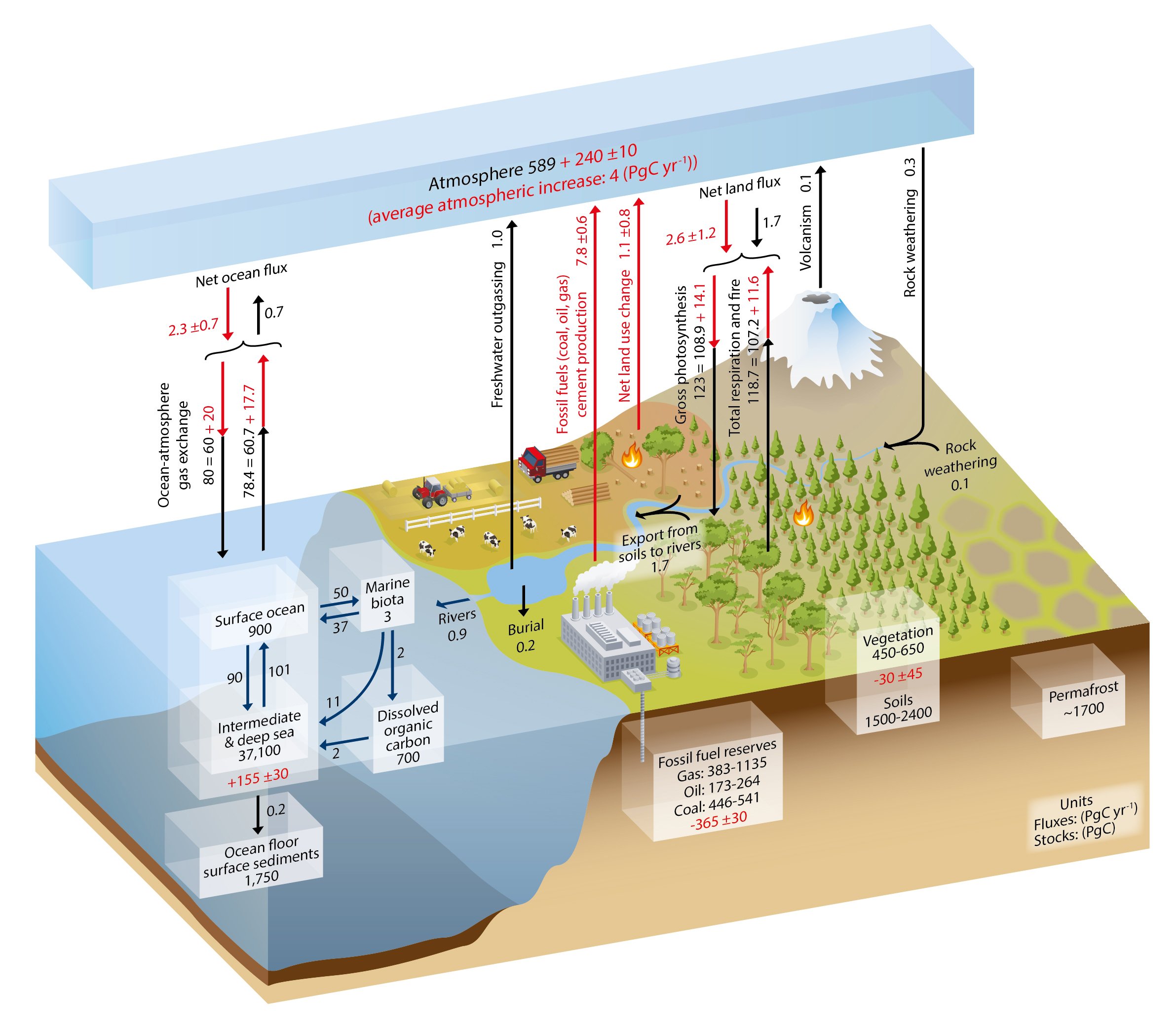
MA Rodger @264, I believe the figure originally came from calculations of the residence time of CO2 in the atmosphere made from measurements of the rate at which the C14 spike from nuclear testing dissipated. From such measurements it was determined that approximately 203 gigatonnes of Carbon in the form of CO2 (GtC) leaves the atmosphere each year. Given a total atmospheric reservoir of 829 GtC, the average duration of a carbon atom in the atmosphere is just over four years. Ergo, for a year n years ago, the approximate fraction remaining in the atmosphere is 0.75^n. Even with an assumed constant emissions of 8 GtC per annum, that means only approx 24 GtC in the atmosphere was emitted from an anthropogenic source, and has never left the atmosphere since emission. That turns out to be 2.9% of the atmospheric concentration. (Obviously the figure will vary slightly with more exact calculation.)
Taking a simple ratio of annual gross natural emissions to annual anthropogenic emissions gives you a ratio of 4.1% if you only include fossil emissions, but 4.7% if you include emissions from land use change and 17.5% if you include all anthropogenic emissions including outgassing due to global warming.
Both calculations assume that any emissions from the ocean or plants and animals cannot have come from fossil sources. That is, of course, absurd. Indeed, it is assumed by both methods that most anthropogenic emissions are stored in either plants or the ocean as a result of the rapid exchange of CO2 between atmosphere and the other surface reservoirs of carbon. It follows that a certain proportion of the "natural emissions" are emissions of carbon that until a few hundred years ago (and in most cases a decade ago or less) was stored in a fossil reservoir. A rough calculation of the proportion of CO2 in the atmosphere that was recently in a fossil reservoir is then given by the ratio of the sizes of the combined reservoirs to the cumulative emissions. That works out to approximately 12% excluding the deep ocean and soil (for which exchange is slow). The actual number may be lower than that, but not by much. (It may also be higher given the average life span of trees.)
All this, however, is as you note, beside the point. The real question is how much of the increase in atmospheric emissions is due to anthropogenic emissions. To that the answer is 100%. Ergo, 30% of the current atmospheric concentration would not have been in the atmosphere without anthropogenic emissions. That is the case regardless of whether or not any individual atom was recently in a fossil reservoir for the approximately 20% of atmospheric CO2 that would not have been there without emissions, but whose carbon was not recently in a fossil reservoir has merely displaced CO2 whose carbon was recently in a fossil reservoir due to equilibrium exchanges.
(Note, all figures calculated using values from Fig 6.1 of AR5 WG1.)
-
There is no consensus
Peter Lloyd - The consensus on AGW, although very consistently measured in the high 90%'s, is not immutable.
In the early 20th century the consensus on climate was that natural causes predominated. There were early researchers like Tyndall Fourier, and Arhennius who made some quite prescient predictions, but until the mid-20th century there was no general opinion that anthropogenic factors were important. But then things changed due to new evidence. Callendar in the 1930's (AGW a factor in early 20th warming), Plass (radiation balance) and Revelle (oceans won't absorb all anthropogenic CO2) in the 1950's, Keeling measuring CO2 in the 1960's, Manabe and others in the 1970's modelling GHG effects, etc - all contributed to the body of evidence.
And over the 1960's-1980's, the scientific consensus on climate changed, to the currently held view that AGW is the dominant factor in recent warming, accounting for ~100% of it (with natural factors such as insolation providing negative contributions).
The consensus changed due to evidence and how it is viewed by those who have studied these topics. It could certainly change again - but that would require a considerable amount of new (and contrary) evidence to that effect. There's no sign of such whatsoever - just inconsistent, contradictory and unsupported claims (it's the sun, it's a cycle, cosmic rays, it's not happening at all, there's a grand conspiracy toward a 'World Order', etc), claims that appear, quite frankly, loony.
Now, as to the meaning of such a strong scientific consensus - that's important because laypeople (quite wisely) will take expert opinions into consideration when deciding public policy.
You've claimed uncertainty where it doesn't exist. And your comments simply don't hold up in the face of the evidence.
-
Rob Honeycutt at 05:19 AM on 19 December 2014There is no consensus
Peter... The point isn't that it took so long. Once actual evidence was presented scientists changed their position based on the evidence. The previous position was one where there was little active research that made up the basis of the consensus position.
AGW is not a case where little research is being done and scientists are just accepting what has been assumed.
This is an issue that has been actively researched for 100 years. There are thousands of papers coming out every year on various aspects of man-made climate change. It's a field of intensive research.
In the past 100 years there have been various challenges to the core idea that increasing greenhouse gas concentrations will warm the planet. Each of those challenges have been shown to be wrong. And in the meatime, more and more research is being published confirming the consensus position.
The comparison to H. pylori is just not a valid.
-
MA Rodger at 05:09 AM on 19 December 20142014 will be the hottest year on record
robert way @16.
It's not really cherry-picking as it's not just the NOAA (NCDC) that is set for the hottest year on record. The Jan-Nov NASA GISS average is also above the hottest calendar year on record, as is the HadCRUT4 Jan-Oct average. Likely BEST will show similarly.
The satellite records, UAH & RSS, wobble far more with ENSO so the 'warmest year' is more to do with the size of El Ninos than rising global temperature. And today we remain without an El Nino, which is added reason for considering the surface temperatures worthy of note.
-
Peter Lloyd at 04:58 AM on 19 December 2014There is no consensus
645. I think we are at cross purposes here. Neither of us doubt that there was a, let's call it strong, or established if you like, consensus prior to the discovery of the effect of H. pylori. Neither of us disagrees that new evidence did change the consensus although I would argue that the fact that it took as long as it did illustrates that medics were very keen to hold on to their previous consensus view.
Where we would probably disagree is on whether there is sufficient scientific proof underlying the consensus on the degree of man-made global warming and the degree to which that consensus is reflected correctly in the statements made at the top of this thread.
I think that looking at the science and its credibility is important and that the use of "consensus" is being corrupted to give a false impression of certainty
644. No. I am arguing that there is ignorance and you seem to be in denial of it! It is freely admitted by paleo-climatologists that they know a lot about many of the factors involved but not enough to know the exact reasons behind paleo-climatic changes.
Taking your Tom Curtis conclusion from Marcot et al:
"Global temperature, therefore, has risen from near the coldest to the warmest levels of the Holocene within the past century, reversing the long-term cooling trend that began ~5000 yr B.P.
and your conclusion from it:
"In other words, little temperature wiggles up-and-down notwithstanding, human emissions are the only cause of the current sustained warming trend."
The conclusion you draw cannot logically be made from that Marcot statement. There maybe many reasons for the cooling and for the most recent warming of which human emissions are likely to be a contributory factor.
The enormous evidence base that you cite does not preclude other factors causing the most recent warming and whilst you are right that there is a lot of knowledge about paleo climate I have yet to see anything that comes close to proof that C02 changes are the main factor in those. As I said before icecaps existed at both poles when C02 concentrations were 100 times the current levels.
...."Unless you care to suggest that, say, plate tectonics, quantum electrodynamics, gravity-as-distortion-of-spacetime, and evolution of biological organisms are also "guesswork"."....
I don't care to say it because they are all demonstrably true and repeatedly proven by observation and / or experiment. The theories and mechanics behind them have been, and are, still subject to many different "consensuses". But none of those causal theories are held as unshakeable truth in the way, say for example, that the movement of crustal plates is, via something described as plate tectonics. This will not be falsified.
The same cannot be said for the claim that man-made emmissions of C02 are causing 100% (ish) of temperature increases on earth.
Moderator Response:[JH] You are now skating on the thin ice of excessive repetition which is banned by the SkS Comments Policy.
Please note that posting comments here at SkS is a privilege, not a right. This privilege can be rescinded if the posting individual treats adherence to the Comments Policy as optional, rather than the mandatory condition of participating in this online forum.
Please take the time to review the policy and ensure future comments are in full compliance with it. Thanks for your understanding and compliance in this matter.
-
dagold at 04:46 AM on 19 December 2014What happens if we overshoot the two degree target for limiting global warming?
A question: The World Bank commissioned report from 2012 about the prospects of a 4C warmer world states: "Even with the current mitigation commitments and pledges fully implemented, there is roughly a 20 percent likelihood of exceeding 4°C by 2100. If they are not met, a warming of 4°C could occur as early as the 2060s." You cite "the most extreme scenario" as being a 4C rise by 2100 at the earliest. This is quite a discrepancy - almost a 'halving' of the time period (from 2012) for such a rise. What is the disrepancy....is it possible that it is due to an inherently conservative nature of the IPCC projections? (that is, assuming the mitigation commitments are NOT met, something that the world has amply demonstrated to be a possible if not probable outcome).
Moderator Response:[JH] You are now skating on the thin ice of excessive repetition which is banned by the SkS Comments Policy.
Please note that posting comments here at SkS is a privilege, not a right. This privilege can be rescinded if the posting individual treats adherence to the Comments Policy as optional, rather than the mandatory condition of participating in this online forum.
Please take the time to review the policy and ensure future comments are in full compliance with it. Thanks for your understanding and compliance in this matter.
The above was meant for another commenter. My bad and my apologies!
-
MA Rodger at 03:52 AM on 19 December 2014Human CO2 is a tiny % of CO2 emissions
CBDunkerson @263.
The 0.006 value being quoted is probably ppm CO2 by weight which is roughly 1.5x the 'by volume' value for dry air.
The 2%-7% is probably that derived from the relative size of CO2 fluxes into the atmosphere, from man-made sources and from natural sources, a particularly stupid value to use as the natural fluxes are bi-directional while the man-made ones only go one way.
-
Rob Honeycutt at 02:45 AM on 19 December 2014There is no consensus
Peter Lloyd... "You don't show in what way my H. plyori story has "little basis in fact" or isn't relevant."
You stated that there was an unshakable consensus. I quoted for you the words of one of the researchers who discovered the H. plyori saying it only took a few years for his work to become accepted. That means, in actuality, that previous consensus was very quickly overturned by presenting the research.
-
Composer99 at 02:37 AM on 19 December 2014There is no consensus
Peter Lloyd:
You are essentially admitting to arguing from ignorance. Please desist (arguing from ignorance, that is).
Maybe you don't know much about paleoclimate, but that doesn't mean nobody knows. (See chapter 5 of the IPCC AR5 WG1, or any paleoclimate articles at this website.)
Maybe you don't know much about the sum of radiative forcings, or findings from paleoclimate, that allow climatologists to calculate that human emissions of greenhouse gases are responsible for 100+% of recent warming, but that doesn't mean nobody does.
Regarding paleoclimate findings supporting "global warming is happening and we are the cause", see Tom Curtis' comment here regarding Marcott et al 2013; in which Tom notes that Marcott et al found:
Global temperature, therefore, has risen from near the coldest to the warmest levels of the Holocene within the past century, reversing the long-term cooling trend that began ~5000 yr B.P.
In other words, little temperature wiggles up-and-down notwithstanding, human emissions are the only cause of the current sustained warming trend.
Maybe you don't know about the enormous evidence base that undergirds the consensus position, but that doesn't mean nobody does - in fact, the consensus position exists as a result of the evidence base (Like in any other field of science with a strong consensus position (*)).
As just a tiny example, consider this Skeptical Science post discussing the basics of the greenhouse effect. Note the final image presented in the article, taken from Conrath et al 1970 in which they ran an experiment, comparing theoretically calculated vs. empirically measured infrared radiance.
Kindly also provide actual documentation that the mainstream position among doctors and medical researchers regarding stomach ulcers was an "unshakeable consensus" as you assert.
(*) Unless you care to suggest that, say, plate tectonics, quantum electrodynamics, gravity-as-distortion-of-spacetime, and evolution of biological organisms are also "guesswork".
-
One Planet Only Forever at 01:27 AM on 19 December 20142014 will be the hottest year on record
Tom Curtis, Regarding the table of data @ 6,
Though the variation of temperature values of the highlighted years indicate 2014 does not appear to be 'statistically significantly warmer', when you review the NOAA ONI values (here) for the period preceding the years highlighted it is clear that there is a statistically significant factor.
The El Nino bump of global average surface temperature clearly occurs shortly after the ONI indicates a warm event on the Tropical Pacific Ocean surface. Reviewing the magnitude of warm values in the ONI for the years of the highlighted 'warm' global average surface temperature it is possible to see the significance of 2014 being in the top group (and being number 1).
1998 was the result of the most significant ONI set of July to June values for that set of years. It was clearly a massive ONI warm anomaly, resulting in a massive surface temperature anomaly. The other highlighted years also have more significant warm ONI values related to them than 2014, with the possible exception of 2013 which also stands out as a very warm year without a significant El Nino bump.
Of course the ONI by itself is not what results in a temporarily warmer global average surface temperature. The integration and interaction of the ONI with the SOI combine to create the ENSO. Reviewing the SOI (here) the relationship between the SOI the ONI and global average is also clear. And there is also the dimming effect of volcanic aerosols which were also very low in 1998 compared to more recent years.
So, more things considered, the 2014 global average surface temperature being the warmest so far does appear to be quite significant, perhaps even 'statistically very significant'.
-
Peter Lloyd at 01:06 AM on 19 December 2014There is no consensus
Thank you gents
I haven't had a chance to read the paper and accept the point about endorsement of the IPCC position
Thank you for agreeing that there are other factors at work in global warming and bearing in mind the strength of those as demonstrated by climate history then any claim that man - made factors are anywhere near as large as 100% or greater are going to have to demonstrate the current and past natural changes and how they interact. No one knows this yet.
I would point out that the huge red circle at the top of this thread with the 97% figure in it says "Global warming is happening and we are the cause" without the caveat that it is not the only cause.
As a result, however interesting it may be that half the population doesn't share the 97% figure, the concensus view remains guesswork and miles away from the experimentally demonstrated effect of H. pylori that I used as a contrast.
You don't show in what way my H. plyori story has "little basis in fact" or isn't relevant. It is true that H.pylori is the primary cause of many stomach ulcers. There undoubtedly will be many elements of how and why that remain unknown as yet. The point is not to make too much of the fact that there was a strong concensus about the previous view. In general medical science is quite good about not creating an idea of certainty unless the experimental evidence is very strong indeed.
My problem with the waving around of the 97% figure is it gives a false impression of the certainty if you don't temper it in the same pronouncement.
-
CBDunkerson at 00:59 AM on 19 December 2014Human CO2 is a tiny % of CO2 emissions
Brain Washed wrote: "I'm open minded about science, and willing to listen to anyone who can provide substantive information."
You might have tried reading/searching first. The various arguments you present are all covered in the 'climate myths' section of this web-site;
"the best I can tell, about .006, just over 1/2 of 1% of the atmosphere is made of CO2"
No. The current atmospheric CO2 level is about 400 parts per million... 400 / 1,000,000 = 0.0004.
the manmade portion of that amount is only 2%-7% (BTW, [400 - 280] / 400 = 30%, whoever told you 2% to 7% is really bad at math)
Color me stupid, but I just have a hard time believing that has any impact whatsoever.
CO2 levels FOLLOW rising temps
"Currently the consensus is that 15% of global climate change is due to the sun."
P.S. Seriously, don't do Tom's hypothetical arsenic experiment.
-
michael sweet at 23:55 PM on 18 December 20142014 will be the hottest year on record
Tom,
Several factors affect the error over short time periods (like the time since the last three record temperatures). The short time is not affected much by urban heat island effects while the longer period is. Recent time periods have more stations and better coverage . Both these factors make the error smaller for the recent time period than for the entire record.
We have the additional larger error that the temperature record we are discussing is incomplete. After the final numbers are released it will be easier to compare several records (as Robert suggested) and the actual magnitude of the difference will be clear.
Robert: can you give us a hint what the satelite kriged (sp?) data might look like for the year?
-
Tom Curtis at 23:53 PM on 18 December 2014Human CO2 is a tiny % of CO2 emissions
Common Sense > Brain Washed:
1) Benjamin Franklin said it best:
"Common Sense is neither common nor sensical. Much of what passes for common sense is not based on any underlying principle it’s just anecdotes that have worked for the current situation."
2) Your "common sense" requires not only that much of the public be brainwashed but that the vast majority of climate scientists have undertaken a conspiracy to delude the public. That is not common sense in any terms, but much closer to the ravings of a loon.
3) And for the moderator, if an offensive wanker (profanity removed) is allowed to use a monikor that amounts to an accusation of massive fraud by scientists, then he should be expected to take his lumps in turn.
4) I will be convinced that small concentrations are irrelevant when you sit in a chamber containing 400 ppm Arsenic pentaflouride (LC50 at 20 ppm) for an hour and tell me who little effect it has had.
(Warning: Just in case your sense is as sensible as your post suggests, LC50 means a 50% probability of death as a result of exposure to that concentration for an hour in test animals. Do not conduct this experiment.)
Moderator Response:[JH] Your point #3 is spot on. I have also issued Standard Moderation Comment #1 on his/her post.
[PS] Please observe comments policy on profanity
-
Tom Curtis at 23:39 PM on 18 December 20142014 will be the hottest year on record
greenman has drawn attention to the Gaurdian version of this post, as well as providing more information from Discovery.com.
In the comments, omnologos (of illfame), attempts to suggest the "uncertainty was 10 times bigger" than the projected margin in a 2008 paper about the NCDC temperature index. He appears, however, to be citing the mean uncertainty for individual station records (0.2 C standard error) rather than the mean uncertainty for the global mean temperature record (0.03 C standard error over the period 1951-2000, see Table 5). I draw attention to this because that mean value represents a smaller error than that I cited above. That may be partly due to the additional months data, but may also be partly due to there being more temperature stations in the period prior to 2000.
I also draw attention to it because I am unable to comment on greenman's site due to third party registration reqirements (sorry, just not going to sign up to twitter to comment at another site). Somebody not so restricted may wish to draw attention to omnologos's error.
-
robert way at 23:28 PM on 18 December 20142014 will be the hottest year on record
Isn't this cherry picking in the same way we accuse contrarians of doing so - picking an individual temperature series which supports a particular narrative. There are multiple datasets out there which do not agree that 2014 will be the warmest on record - that should be considered here.
-
Tom Curtis at 21:38 PM on 18 December 20142014 will be the hottest year on record
michael sweet, try here.
http://www.ncdc.noaa.gov/sotc/global/2014/11
-
michael sweet at 20:58 PM on 18 December 20142014 will be the hottest year on record
GISS always discusses their error and if the difference between the current year and other years is significant. Once we reach January this data will be readily available. GISS often says years are tied because the difference is not significant. Hansen 2010 claims on page 16 that their standard deviation = 0.025 between close years. They claim two years are different if they are 1 standard deviation or more separate. This is very close to the .024 in the OP. We will have to see what the data ends up being.
Tom: your link to NOAA does not work in my computer.
-
Tom Curtis at 20:55 PM on 18 December 20142014 will be the hottest year on record
devobrun @11, I've looked another way in which "0.024 C" might be considered a big margin by comparing with the mean margin of new global temperature records. As it turns out, that mean is 0.037 C, and the median is 0.029 C, so even on that basis it is not a large margin. Indeed, it would represent the 15th smallest increase in the record out of 22 such increases.
Interestingly, only one new record in the full 135 year record represented a statistically significant increase over the prior record - 1998. Indeed, on average, only the fourth new record after any given record differs from it statistically. Based on that, we would not expect 2014 to be statistically distinguishable from 1998 (which it is not projected to be), but do expect it to be statistically distinguishable to the prior record year to 1998 (ie, 1997). As 1997 had an anomaly of 0.514 C, that is almost guarantteeed.
-
TonyW at 20:28 PM on 18 December 2014Two degrees: Will we avoid dangerous climate change?
Gosh, and all of this for only a 66% chance of limiting warming to 2 degrees? It doesn't seem likely, does it.
And AR5, I seem to remember, gave those budgets in ranges, all of which start at zero. That is, it's possible that we've already used up the budget to keep warming to below 2 degrees.
Simon is right, though, 3 degrees is relatively better than 4 degrees and 4 degrees is relatively better than 5 degrees. At what point does it make no difference to our fates? Is 9 degrees better than 10 degrees, for humans (and most other species)?
-
alby at 19:57 PM on 18 December 2014Is Earth’s temperature about to soar?
I agree with this post
even if not completely.
Regarding long-term (I mean > 30 years) trend, the global surface T data from approx 1970 shows a clear and stable rise, with good approximation linear.
Of course it is difficult to see it on the rough data with the average global T for months or years, but if we look at the trend with even if with a short smoothing (i.e. 6 months)
(using Cowtan“calculator” http://www.ysbl.york.ac.uk/~cowtan/applets/trend/trend.html is easy)
the uphill is still recognizable while the fluctuations (which are real, non merley noise) are disturbing our eye.
It is better for this reason use longer moving average (I suggest at least > 96 months): if you try (again starting from 1970), the whole trend will be very close to the linear regression, as showed by Tamino in his smoothed trend. But if you look at some smaller details (on the line with a long moving average but not on Tamino trend) you can see a little increasing of the slope just before 2000 and a small deceleration on the late ’00.
We can call this behaviour a short-term (I mean approx. 10 years) slow-down? I think yes,
as a matter of fact decreasing th moving average to 48 months (because we are looking for short-term trend) and starting from 1985 (in this way we are using the calculator as a magnifier) we found the same behaviour:
faster warming after 1995 ( we know that 1998 was a record year) and deceleration after 2005 but also a steady increasing from approx. 1997 to 2005 as well as a detectable cooling from 1990 to approx 1995.
Of course the moving average itself introduce some disturbance because we are at the border of the series and we don’t know the data regarding T for the next months and years.
But don’ t worry, the recent short-term slow-down is not significative on the long-term and it is easy t o foreseen for the next 25-30 years (and after) a general increasing (smoothing the fluctuations that in every case will happen) of the T with an average slope of approx. 15 hundredths of degree per decade or more.
Unfortunately the warmer is not always the better.
P.S: if you want to find a long term slow-down or pause (of course with short-term slope changing due to fluctuations, a sort of warming and cooling small waves) you can lok at the data from 1940 to 1970 with a moving average of approx. 48 months (not surprisingly you can see the same general trend on Tamino model fit for this span but the fluctuations are flattened).
-
Common Sense > Brain Washed at 19:05 PM on 18 December 2014Human CO2 is a tiny % of CO2 emissions
This landed in my mailbox a day or so ago. It comes from a gentleman whose speciality is Heliophysics. In addition to what he has to say here, I'd like to add that, the best I can tell, about .006, just over 1/2 of 1% of the atmosphere is made of CO2. And of that, depending on who you believe, the manmade portion of that amount is only 2%-7%. Either way, we're talking about an infinitesimal figure. Using the 7%, that still only comes to .000042 of the atmosphere is affected by manmade CO2 emmissions.
Color me stupid, but I just have a hard time believing that has any impact whatsoever.
Now, I do not claim in any way whatsoever to be a scientist. Those numbers are what I grabbed from a few of what I consider to be reliable internet sources. Please, if you have evidence to prove me wrong, by all means, do so. I'm open minded about science, and willing to listen to anyone who can provide substantive information. I think the main thing, which I've found from many sources, as the guy I'm quoting below points out, is that CO2 levels FOLLOW rising temps, not vice versa. Like I say, I just study as much as I can on something which interests me and try to make a sound conclusion based on what I find. And I am in no way offended by conflicting information. We'll just have to look deeper into the backgrounds of the sources to see if they have anything to gain or lose one way or the other.
"Currently the consensus is that 15% of global climate change is due to the sun. I think that this might be a bit low. for the last 10 years GISS [I assume he's referring to the Goddard Institute for Space Studies at Columbia University] has seen a decreasing, trend of global temperature. I would caution that the decrease is consistent with no change. CO2 continues to increase. Further the glacial record shows that increases in CO2 levels lag global temperature increase."Moderator Response:[JH] On this site, it's considered to be in poor taste to include more than one denier myth in a single comment. It's also in poor taste to try to disguise where you are coming from by quoting someone else.
Please note that posting comments here at SkS is a privilege, not a right. This privilege can be rescinded if the posting individual treats adherence to the Comments Policy as optional, rather than the mandatory condition of participating in this online forum.
Please take the time to review the policy and ensure future comments are in full compliance with it. Thanks for your understanding and compliance in this matter.
Prev 671 672 673 674 675 676 677 678 679 680 681 682 683 684 685 686 Next