



 Arguments







Recent Comments
Prev 1 2 3 4 5 6 7 8 9 10 11 12 13 14 15 16 Next
Comments 301 to 350:
-
William24205 at 10:05 AM on 12 April 2024At a glance - Does CO2 always correlate with temperature?
Instead, the correct way to look at temperature trends is to examine them over multiple decades - 30 years is standard in climate science. So to answer the question, "where are we now?", one would look at the temperature record from 1992-2022.
30 years is a tiny sample size - there has been 4.5billion years of weather. The next 100, 1000, or even 10,000 of weather would not necessarily mean anything either way.
It could be 3c colder or warming and still be natural variation . We just don't have the records . We have guess for large periods of milliosn of years - but nothing on any specific period of less than 1000 .
There could have been multiple periods of 100 years whne the temp when up or down by 1.2c. It is statiscally likely there have been . because there have millions of 100 year periods.
Moderator Response:[BL] "We have guess [sic]" only applies if "we" means people that have ignored the huge amounts of evidence about past climates and what we understand about the climate processes that created that evidence.
I am pretty certain that you are correct in including yourself in that "we", but your "we" does not include climate scientists.
You can read more about what climate scientists know about past climates (and how this influences our expectations of future climates) by reading this SkS page. Or this one. Or this one. Or this one. Or this one.
-
William24205 at 09:53 AM on 12 April 2024A data scientist’s case for ‘cautious optimism’ about climate change
scaddenp
Thanks again for you reasonable reply - you do at least seem to believe in reason and the real world . It is refreshing
Moderator Response:[BL] Why don't you actually try answering some of his questions?
-
William24205 at 09:51 AM on 12 April 2024A data scientist’s case for ‘cautious optimism’ about climate change
"New Health Data Shows Unabated Climate Change Will Cause 3.4 Million Deaths Per Year by Century End."
It is a prediction for the far future.
That currently over 400,000 deaths are caused every year by climate change
An obscure article with no credible data or evidence. What are the extra 400,000 dying of? Deaths have gone down . it is a familar tactic of citing existing occurances and saying it is climate change - it would be plausable if there were increases in what was cited - but it is not credible when there are fewer .
Moderator Response:[BL] You are again repeating yourself - treating one statistic as if it is the only thing that matters, and treating predictions about the future as if they mean nothing at all.
Amongst other things, this is just getting boring. Please come up with a new argument, or stop wasting people's time.
-
nigelj at 05:19 AM on 12 April 2024Skeptical Science New Research for Week #15 2024
"Rebutting 33 False Claims About Solar, Wind and Electric Vehicles, Eisenson et. al., Sabin Center for Climate Change Law, Columbia University."
Very interesting, informative and useful resource. Thanks!
-
Grumnut at 20:39 PM on 11 April 2024Climate - the Movie: a hot mess of (c)old myths!
I think it's bizarre, that Durkin has basically made the same movie again. This is "The Great Global Warming Swindle" made over with the same players. One of the oddest parts of BOTH films is the contention of the claim that warming comes first, followed by CO2 rise, 800 years later. They even use the graph (at least in TGGWS) from the paper from Caillon et al. The trouble is, that paper clearly states that CO2 rose first in the Northern Hemisphere followed by warming. Highly educated scientists, some with doctorates, can't read a simple scientific paper, it seems.
They wouldn't be trying to put one over on us, would they?
-
scaddenp at 06:32 AM on 10 April 2024A data scientist’s case for ‘cautious optimism’ about climate change
"Would you not acknowledge that transitioning away from fossil fuels to a different energy form carries some risks in itself "
William, it isn't clear what you meaning by risk. Financial risk, increased mortality? or what? I would say that in any case, how you transition would be relevant - and that varies country to country, region to region. Suddenly dropping fossil fuels without replacing with other energy sources or better efficiency would indeed be damaging but I am not seeing advocates for that.
-
ubrew12 at 04:54 AM on 10 April 2024Climate Adam: Is Global Warming Speeding Up?
Tamino adjusts the raw data for 1) volcanic aerosols 2) El Nino/La Nina cycle, 3) solar variations. The adjusted graph is much clearer that the global warming signal is accelerating upward, as should be expected from the input signal (greenhouse gases). NASA GISS yearly averages, adjusted, shows the clearest signal:
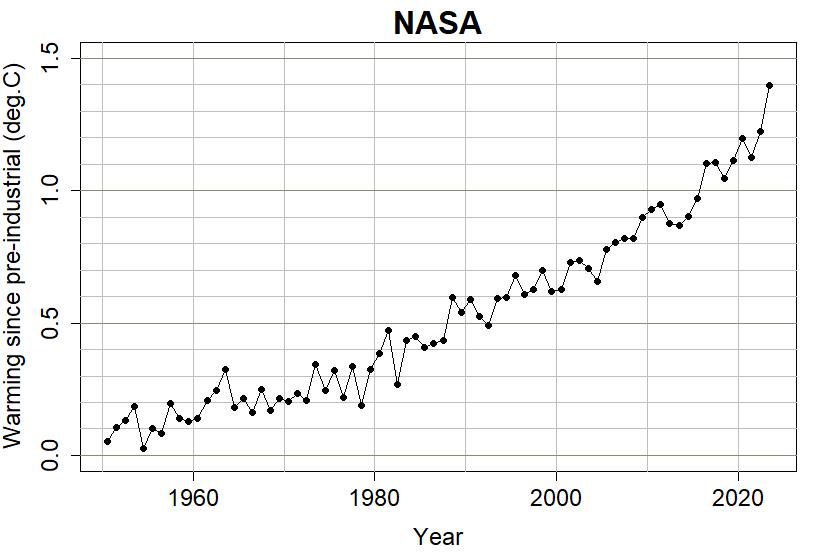 I got this link from this website a few weeks ago.
 -
Eclectic at 04:38 AM on 10 April 2024Climate Adam: Is Global Warming Speeding Up?
Steveeeeej @1 : Also, google is your friend, independently.
Dr Adam is intelligent, well-informed, yet a tad histrionic..
I suppose that's better than being the opposite !
-
Bob Loblaw at 04:30 AM on 10 April 2024Climate Adam: Is Global Warming Speeding Up?
steveeeej:
If you are genuinely curious, you could try following the link behind "Dr. Adam Levy", near the end of the first line in the green box.
-
Steveeeej at 01:30 AM on 10 April 2024Climate Adam: Is Global Warming Speeding Up?
Adam,
Please tell me what your credentials are in order for me to understand who I'm listening to.
Steve Jesus
-
John Mason at 16:50 PM on 8 April 2024Gigafact and Skeptical Science collaborate to create fact briefs
Right on the money, Eclectic. 150 words is a tall order and every single one has to be considered. There's one in the pipeline on the topic of consensus where this area can be considered with more detail.
-
Eclectic at 11:19 AM on 8 April 2024Gigafact and Skeptical Science collaborate to create fact briefs
Joel @1 ,
like you, I strongly suspect that a new survey, of scientific papers published in the last 5 years, would show a 99+% figure "agreement". The original gold standard ( the Cook study of 2013 ) was in a large number of papers ~ with a median date approx 2005 [note: approx date only; I haven't summed it precisely]. So that's a median date 15-20 years ago. Almost ancient history !
But that would be on evidence in published papers ~ and it might be a point or two lower in casual conversation with climate-related scientists. Casual conversations or anonymous surveys of "opinion" , where other somewhat emotional factors come into play.
Emotions were very evident in a survey of (IIRC) metorologists in the USA last decade ~ where only 90% were in "agreement". Presumably the outlier 10% could not produce scientific evidence to support their position . . . but they could express a (casual) opinion that fitted with their rather extremist political affiliation. A tribal vote, of sorts.
None of all this could be pointed out in a 150-word bite.
-
Joel_Huberman at 08:16 AM on 8 April 2024Gigafact and Skeptical Science collaborate to create fact briefs
I suspect the % of climate scientists agreeing that global warming is real and human-caused is now, in 2024, much closer to 100% than when the 97% measurement was made.
-
BaerbelW at 00:07 AM on 8 April 2024The science isn't settled
Please note: the basic version of this rebuttal was updated on April 7, 2024 and now includes an "at a glance“ section at the top. To learn more about these updates and how you can help with evaluating their effectiveness, please check out the accompanying blog post @ https://sks.to/at-a-glance
-
michael sweet at 16:10 PM on 7 April 2024A data scientist’s case for ‘cautious optimism’ about climate change
William,
I am sorry, I don't usually comment on deaths caused by climate change
This article documents that currently over 400,000 deaths are caused every year by climate change. Your claim of 12,500 deaths is grossly incorrect. You have ignored the major causes of death caused by climate change. If you ignore enough data you can make any absurd argument that you want to.
The link to this headline was broken:
"New Health Data Shows Unabated Climate Change Will Cause 3.4 Million Deaths Per Year by Century End."
It appears that your death estimates are off by a factor of about 300. Because your argument is so far from reality the people who post here at Skeptical Science are not familiar with the data.
-
michael sweet at 07:39 AM on 7 April 2024A data scientist’s case for ‘cautious optimism’ about climate change
William,
We generally feel it is a waste of time to listen to views that have no basis in facts.
I note that according to Wikipedia:
From June to August 2022, persistent heatwaves affected parts of Europe, causing evacuations and a confirmed death toll of 24,501.
and " More than 70,000 additional deaths occurred in Europe during the summer 2003."
You have neglected to count these deaths. These are only European deaths, third world deaths are not counted. You also do not count any deaths caused by starvation during droughts. I note that most of the aliens crossing the southern border of the USA are climate refugees. Are you willing to take in an additional 100,000,000 to 300,000,000 refugees when sea level really gets going?
-
William24205 at 22:37 PM on 6 April 2024A data scientist’s case for ‘cautious optimism’ about climate change
Nigelj - thank you for your reasonable reply - that did accept the evidence .
So when I look at the big picture there is a strong case to stop greenhouse gas emissions and transition to a new zero carbon energy grid.
Would you not acknowledge that transitioning away from fossil fuels to a different energy form carries some risks in itself ?
-
William24205 at 22:29 PM on 6 April 2024A data scientist’s case for ‘cautious optimism’ about climate change
This means by 2080 there will be around 12,500 heat-related deaths and 36,500 cold-related deaths.
Firstly it is relatively tiny either way .
2nd - They say without adaption - so in their own terms it will be even smaller.
-
William24205 at 22:24 PM on 6 April 2024A data scientist’s case for ‘cautious optimism’ about climate change
Echo chambers help no one. People should be brave enough to hear opposing views .
Moderator Response:[BL] This is essentially a moderation complaint, which is expressly forbidden by the Comments Policy.
- All comments must be on topic. Comments are on topic if they draw attention to possible errors of fact or interpretation in the main article, of if they discuss the immediate implications of the facts discussed in the main article. However, general discussions of Global Warming not explicitly related to the details of the main article are always off topic. Moderation complaints are always off topic and will be deleted
Hearing "opposing views" is one thing. Hearing someone say the same thing over, and over, and over, and over, and over, and over, and over - is not at all constructive. Especially when that person will not look at all the opposing views that others are responding with, and simply keep going back to the same tired argument.
Please note that posting comments here at SkS is a privilege, not a right. This privilege can be rescinded if the posting individual treats adherence to the Comments Policy as optional, rather than the mandatory condition of participating in this online forum.
Please take the time to review the policy and ensure future comments are in full compliance with it. Thanks for your understanding and compliance in this matter.
-
Just Dean at 22:15 PM on 5 April 2024Renewable energy is too expensive
I have now posted a reply to the Energy Bad Boys, EBB , with references to my Notes at Substack that include graphics. Here is a copy of that reply.
--------------------
A thorough review of electricity prices for the 48 contiguous states suggests that there is no correlation between increased use of wind and solar and higher electricity prices. If anything, the opposite appears to be true.
Using data available at the EIA electricity data browser, a comparison of the increase in average electricity prices from 2002 to 2022 for the contiguous U.S. as a function of the percentage of renewable electricity generated suggests that more renewables lead to lower electricity prices, not higher.
A comparison of the retail price of electricity for 2022 for the 48 states as a function of percentage of renewable electricity also shows a similar trend, states with more renewables tend to have lower electricity prices.
------------------
-
Eclectic at 21:27 PM on 5 April 2024Climate - the Movie: a hot mess of (c)old myths!
"Climate ~ The Movie" is still pinned at top of WUWT articles.
Number of comments there seems to have stopped at 433.
No new comments for about 48 hours = death zone, for WUWT.
( Denialists have been mighty quiet at SkS also, for a day or two )
Yeah , a slow news day !
-
r.pauli at 12:36 PM on 5 April 2024Climate - the Movie: a hot mess of (c)old myths!
Well, I liked the music in the movie.
-
Bob Loblaw at 02:59 AM on 5 April 20242024 SkS Weekly Climate Change & Global Warming News Roundup #13
Gavin Schmidt has also posted about this over at RealClimate.
In the concluding paragraph:
Remarkably, the Hansen et al projections are basically indistinguishable from what the mean of the TCR-screened CMIP6 models are projecting. Or, to put it another way, everybody is (or should be) expecting an acceleration of climate warming (in the absence of dramatic cuts in GHG emissions)
-
michael sweet at 02:53 AM on 5 April 20242024 SkS Weekly Climate Change & Global Warming News Roundup #13
Dr Gavin Schmidt published an opinion piece in Nature today. He asserts that the heat in 2023 cannot be explained by known factors. It mentions aerosols, El Nino, the volcano and the items we have discussed. A newspsper article about Gavin's piece quoted Michael Mann as thinking that El Nino was the primary cause of the heat in 2023. Gavin thinks El Nino does not explain the data. I think the blog I linked above puts Dr Dressler in the natural variation group.
It is very interesting to see how this scientific question is discussed in the literature and in the press. Usually scientific issues are discussed primarily in peer reviewed papers. This issue is getting a lot of informal discussion since it is changing so fast. I cannot argue with the likes of Mann, Schmidt, Hausfather and Dressler. Hansen is probably saying I told you so. Chose your own favorite explaination, we will have to wait for more data. On the bad side, March set another huge heat record.
-
Bob Loblaw at 01:07 AM on 5 April 2024Welcome to Skeptical Science
cookclimate @ 118:
I have looked at the paper in the volume I linked to in comment 121. There are definite changes compared to an earlier version I found that said "submitted to Earth and Space Science", so I presume that you've had some sort of review and modified the paper since the earlier drafts.
It looks like you have identified the 1470-year cycle using your eyecrometer. I see nothing in the paper that actually does any sort of signal processing to identify cycles using any objective statistical technique. You are seeing a cycle because you want to see a cycle.
Your speculation includes arguments that include all sorts of stuff that has been debunked many times before. Pages are available on Skeptical Science that cover thee topics:
- Geothermal heat flux is included in this post.
- The "CO2 lags temperature" argument is discussed here.
- Most of your examples use regional, not global, temperature proxies. Regional temperatures are far more variable than global ones, and it is invalid to compare the two directly. This is discussed in this SkS post.
- You're convinced that an increase in volcanoes are adding to warming. That is the opposite of the argument commonly made by "skeptics" that increasing volcanic activity caused the Little Ice Age, so a subsequent decrease is causing warming (discussed here). In any event, just counting the number of volcanoes (your figure 3) is extremely simplistic. Arguing that more volcanoes implies more geothermal heat is a non-starter, as discussed in the post linked above.
- Your "computer models are unreliable" is an old, tired argument, scoring position 6 on the SkS Most Used Climate Myths. The rebuttal is here.
So, your paper is really nothing more than an "I see it" 1470-year cycle mixed with a rehash and Gish Gallop through a variety of common "skeptic" myths. I could probably find more, but it isn't worth the time.
I hope you didn't pay too much money to get it published.
-
Bob Loblaw at 11:33 AM on 4 April 2024Welcome to Skeptical Science
Ahhh. Here is a link to the journal issue that contains the paper:
-
Bob Loblaw at 11:22 AM on 4 April 2024Welcome to Skeptical Science
Cookclimate @ 118:
Your paper link seems to be broken.
Google Scholar finds multiple links to papers by you with that title, but it's hard to tell if they are all the same paper. Most links seem to be pre-prints, not actual peer-reviewed publications. One of them states that it was submitted to Earth and Space Science in 2020. Another seems to indicate that it was published in late 2023, in Journal of Marine Science Research and Oceanography, which is a title published by Opast. That journal's web page seems to use a DOI: 10.33140/JMSRO prefix, but searching for "Eugene Cook" fails to find the paper.
Opast is listed on Beall's List as a predatory publisher. As such, it appears to have little or no proper review. Can you tell us anything about the efforts you have made to publish your work, and what any reviewers have told you (if there have been any)?
So, by all appearances, you have pointed us to a "paper" that has not been peer reviewed. Perhaps between 2020 and 2023 you had the paper rejected by other journals? And finally managed to "publish" it in a pay-to-play journal?
Anyway, your 1470-year cycle looks awfully close to previous efforts that have identified 1500-year cycles. Skeptical Science has a page that covers this:
https://skepticalscience.com/1500-year-natural-cycle.htm
I'd hate to waste time looking at a pre-print that may have been changed before publication, so if you can properly point us to the correct copy of the paper, that would help.
...and please post anything else on the correct page, linked above. And read that post, and give us some reason why you think that your magical 1470-year cycle is any different from the many other cycles that people have failed with.
Eclectic is most likely correct: your analysis probably has some serious errors.
-
Eclectic at 09:45 AM on 4 April 2024Welcome to Skeptical Science
Cookclimate @118 :-
You are wrong. When the arctic/Greenland ice-sheets melt, that raises the sea level near the equator, and consequently that slows the Earth's rotation. Basic physics. And you are wrong about so very much of the other stuff you posted.
Where do you get all that wrong info from?
-
cookclimate at 09:28 AM on 4 April 2024Welcome to Skeptical Science
CO2 does not cause Earth’s climate change.
It is estimated that it will cost $62 trillion to eliminate fossil fuels, but eliminating fossil fuels will be a complete waste of our tax and corporate dollars, because it will not stop the warming. You can’t stop Mother Nature.
The IPCC (Intergovernmental Panel on Climate Change) frequently shows that temperature correlates with CO2 for the last 1,000 years as proof that CO2 is causing the warming. But if you extend that to the last 800,000 years, the temperature and CO2 lines do not correlate or fit (Figure 14 in Supplemental Data). If the lines don’t fit, then you must acquit CO2. CO2 is not guilty of causing climate change. CO2 does not control Earth’s temperature. The IPCC has not demonstrated any scientific evidence that CO2 controls Earth’s temperature (they only have unproven theories).
The facts:
• Earth is currently warming (it is still below the normal peak temperature).
• CO2 is increasing (it is above the normal CO2 peak).
• Earth’s current warming is being caused by a 1,470-year astronomical cycle.The 1,470-year astronomical cycle warms the Earth for a couple of hundred years and melts ice sheets primarily in Greenland and the Arctic. It has repeated every 1,470-years for at least the last 50,000 years. It is normal that it would be happening again. It accelerates Earth’s rotation, stopping length of day increases (Figure 9). It warms the Earth. Based on historical data, the current warming should peak near the year 2060 and then it should start to cool.
For more information, see A 1,470-Year Astronomical Cycle and Its Effect on Earth’s Climate,
and Supplemental Data,
www.researchgate.net/publication/379431497_Supplemental_Data_for_A_1470-Year_Astronomical_Cycle_and_Its_Effect_on_Earth's_Climate#fullTextFileContent -
Eclectic at 08:59 AM on 4 April 2024Climate - the Movie: a hot mess of (c)old myths!
Jimsteele @97 / 98 :-
John Mason is quite correct, in that the SkS website is open to all-comers. And so, unsurprisingly, as you gaze around the threads, you will occasionally see comments by climate crackpots who have delusional unscientific fixations and who are impervious to reason and scientific facts ~ whereas, at the WUWT website, those sorts of commenters come in droves. (Indeed, they are the 95% majority there.)
But at SkS , you need to comply with the very reasonable rules of posting ~ and you should provide rational fact-based discussion, not pseudo-science & repetitive ranting.
Jimsteele, you have some serious work to do, to reconcile your self-contradictory statements.
-
jimsteele24224 at 08:54 AM on 4 April 2024Climate - the Movie: a hot mess of (c)old myths!
John Mason, I could easily refute your ridiculous post but when I do, only my posts are deleted and deemed off topic. I dont have the privilege posting here that you do
Moderator Response:[BL] One last try:
All you need to do is look at the table presented in this blog post, find the topic that you want to discuss, and follow the link to a place where that topic is the key subject. Then your deleted comments will be on topic.
As part of your comment, you can point back to the comment you are responding to. The date/time label at the top of each comment is a link you can use.
Final Warning
Please note that posting comments here at SkS is a privilege, not a right. This privilege can and will be rescinded if the posting individual continues to treat adherence to the Comments Policy as optional, rather than the mandatory condition of participating in this online forum.
Moderating this site is a tiresome chore, particularly when commentators repeatedly submit offensive, off-topic posts or intentionally misleading comments and graphics or simply make things up. We really appreciate people's cooperation in abiding by the Comments Policy, which is largely responsible for the quality of this site.
Finally, please understand that moderation policies are not open for discussion. If you find yourself incapable of abiding by these common set of rules that everyone else observes, then a change of venues is in the offing.Please take the time to review the policy and ensure future comments are in full compliance with it. Thanks for your understanding and compliance in this matter, as no further warnings shall be given.
-
John Mason at 08:16 AM on 4 April 2024Climate - the Movie: a hot mess of (c)old myths!
Jim, which is it to be?
"But truth is I have never denied the greenhouse effect."
"Clearly commneting here on SkS is a privelege only given to those who support the CO2 warming narrative."If you have never denied the greenhouse effect, you must surely accept that enhancing its intensity warms the planet. Likewise you must surely accept that reducing its intensity cools the planet.
Both, I must add, based on very old, tried and tested first principles.
There are as we all know other factors that should be taken into account at all times. We are talking about one component, albeit highly significant, of the climate system here.
So I suggest you try and reconcile the two statements above, upon which I have quoted you. -
jimsteele24224 at 07:54 AM on 4 April 2024Climate - the Movie: a hot mess of (c)old myths!
I would respond to Charlie_Brown and Eclectic, but the moderator will simply remove my comments that refute your comments. Clearly commneting here on SkS is a privelege only given to those who support the CO2 warming narrative. Allowing scientific debate is not something that is honored here as revealed by the "moderator" deleting my post on polar bears, and other trivia. WUWT is clearly offtopic, but is always allowed because it dishonestly trashes skeptics which is the mission of SkS.
Moderator Response:[BL] The moderator will simply apply the rules described in the Comments Policy.
-
Eclectic at 06:19 AM on 4 April 2024Climate - the Movie: a hot mess of (c)old myths!
Scaddenp @94 :
Thanks for that. What a surprise. Actually, I don't remember seeing Jimsteele's name among the WUWT comments . . . but the WUWT commentariat has a cast of thousands . . . and memorywise I might well be developing some Fronto-Temporal Dementia (sadly, one of my bigly favorite rightwing politicians is showing early signs of that condition. Stay tuned ! )
And perhaps my memory was influenced by Jimsteele saying that every skeptic he knew totally understands the greenhouse effect . . . but that quote would be incongruous with Jimsteele being extremely familiar with WUWT, don't you reckon ?
-
scaddenp at 06:07 AM on 4 April 2024Climate - the Movie: a hot mess of (c)old myths!
Eclectic - the role infrared radiation in retaining heat in the ocean has some experimental verification. See The Response of the Ocean Thermal Skin Layer to Variations in Incident Infrared Radiation 2018
-
scaddenp at 05:44 AM on 4 April 2024Climate - the Movie: a hot mess of (c)old myths!
Eclectic - a cursory look will assure you that Jim Steele is extremely familiar with WUWT - and also perhaps indicate whether discussion with him is worth bothering with.
-
nigelj at 05:10 AM on 4 April 2024A data scientist’s case for ‘cautious optimism’ about climate change
William @ 38
"At what point - would you start to not trust a climate alarmist - if deaths continue to fall or not rise for another 40 years - would you think maybe we should not trust those who make these predictions and fuel the narrative. Or do they just get a forever pass - and you will always accept more predictions - even though the people and movements who made them before have always been wrong."
Scientists are making the best predictions and projections they can. The best evidence they have says heatwaves have already become significantly more frequent and intense (refer last IPCC report), and that this situation will get worse over time particularly as warming gets above 2 degrees C. I see no reason to doubt them. The predictions are rational, logical and evidence based. I am a sceptical sort of person but Im not a fool who thinks all predictions should be ignored or that everything is fake or a conspiracy.
Scientists generally predict heatwave mortality will increase and be greater than reducing deaths in winter due to warmer winters, as per the reference I posted @34. What scientists cannot possibly predict is what advances there might be in healthcare and technology that might keep the mortality rate low. All we know is there will likely be further improvements in healthcare and technology, but quantifying them is impossible and it would be foolish to assume there will be massive improvements. We have to follow the precautionary principle that things could be quite bad.
If warming over the next 20 years causes less harm than predicted mitigation policies can be adjusted accordingly. This is far better than just making wild assumptions that global warming would be a fizzer.
Please appreciate that contrary to your comments elsewhere, multiple climate predictions have proven to be correct. Just a few examples:
theconversation.com/20-years-on-climate-change-projections-have-come-true-11245
www.politifact.com/factchecks/2022/oct/25/charlie-kirk/many-climate-predictions-do-come-true
"I think people just want to believe things will be terrible and there are primed believe end of days narratives."
Some people yes. Other people think things will always be fine. Both are delusional views. I would suggest the vast majority of people between those extremes have a more rational, nuanced view and that they look at the overall evidence. Polling by Pew Research does show the majority of people globally accept humans are warming the climate and we need to mitigate the problem.
"Yes - anything could happen in the future and deaths and damage levels could rise again- but it is nor healthy to ignore the present - or trust people that wilfully distort it."
I'm not ignoring the present or past. The mortality rate from disasters has mostly fallen over the last 100 years and that looks like robust data. I didn't dispute this above. I dont recal anyone disputing it. However you cant assume that trend will always be the case. The climate projections show deadly heatwaves are very likely to become very frequent and over widespread areas, and so obviously there is a significant risk the mortality rate will go up.
It's almost completely certain that at the very least considerably increased resources will have to go into healthcare, air conditioning, adaptation, etc,etc. This means fewer resources available for other things we want to achieve in life. Once again its not all about the mortality rate per se. So when I look at the big picture there is a strong case to stop greenhouse gas emissions and transition to a new zero carbon energy grid.
Moderator Response:[BL] Please exercise restraint in responding to William. Think about whether this actually advances the discussion, or merely starts another spin cycle on the washing machine.
-
Eclectic at 05:09 AM on 4 April 2024Climate - the Movie: a hot mess of (c)old myths!
Gentlemen ~ "Climate The Movie" is currently being featured and featured "bigly" , at the WattsUpWithThat [WUWT] blogsite. WUWT has the topic "pinned" for consideration and comments. Comments are currently numbering 422. Yes, 422.
However, please do not waste your time by seeking through the 422 for any sign of perceptive & intelligent comments. I assure you that I have skimmed the 400-ish . . . and it's merely the typical WUWT "usual suspects" who are angrily venting into the WUWT echochamber.
Jimsteele , it sounds like you are completely unfamiliar with the WUWT website. It is full (well ~ at the 95% level) of commenters who deny the greenhouse effect ~ either directly or indirectly. Yes, I view the website to "educate" myself . . . mostly about the follies of Motivated Reasoning which are on display there daily. WUWT manages to be both interesting and tiresome. But the cynical reader will see some amusing comments there ~ of egregious fatuities & unintended ironies.
Jimsteele @91 ~ please go back and carefully re-read my comment @84. No, I did not state or allege that you "denied the greenhouse effect". But among your convoluted statements on ocean warming/cooling, you both allege and imply that CO2 contributes little or nothing to the (presently unfrozen) temperature of the Earth's ocean. Do you see the irony/incongruity of your position ?
-
Charlie_Brown at 05:02 AM on 4 April 2024Climate - the Movie: a hot mess of (c)old myths!
The discussion of the heat transfer mechanisms at the ocean’s surface is irrelevant for understanding the mechanism of global warming caused by increasing greenhouse gas emissions. It neglects infrared radiant energy emitted from the surface and the overall global energy balance.
jimsteele @91 claims that he does not deny the “greenhouse effect”, yet the movie and his initial post @67 direct to myths about “global warming caused by increasing GHG emissions.” He reveals his lack of knowledge about the “greenhouse effect” when, @83, he accuses eclectic: “It is your narrative that grossly incomplete! You make a totally unsubstantiated assertion that without CO2 the oceans would freeze.” It is a correct assertion substantiated by a simple radiant energy balance over the globe: Solar In = Infrared Out.
The surface of the ocean and the land are blackbodies that absorb and emit radiant energy based on Planck’s Distribution Law. Gases, being simple molecules, emit at specific wavelengths as internal energy levels change determined by bending and stretching depending on the molecular structure. CO2 has many strong absorptance/emittance lines in the wavelength band of about 14 to 16 microns and many more weak lines on the shoulders of this band.
Absorptance equals emittance at thermal equilibrium (Kirchoff’s Law). That is the energy balance of a molecule. The condition of thermal equilibrium is important because it is conservation of energy, not conservation of photons at a specific frequency. Because the bottom layer of the stratosphere is cold, the intensity of emitted energy from CO2 is lower than the intensity emitted in the same wavelength band from the surface. Thus, energy emitted to space is reduced. With increasing CO2, the emittance lines fill in and the range of the CO2 emittance band becomes wider. Infrared out is reduced. Energy accumulates. The pre-industrial steady state balance when accumulation was zero is upset. Warming occurs until the energy balance is restored. It is restored when the temperature of the surface increases enough such that the energy emitted by the surface at other wavelengths outside of the CO2 absorptance band matches the reduced energy emitted to space from within the CO2 band.
-
jimsteele24224 at 03:39 AM on 4 April 2024Climate - the Movie: a hot mess of (c)old myths!
Second, when you Bob told me to discuss this elsewheere I didnt know it was said by a moderator. You never made that clear, so it appeared you were just a random commenter deflecting the discussion.
I also believed the topic here was about the Climate the Movie and whether or not the facts presented in it were just refuted myths.
SkS topic 31 greenhouse stated the argument "Increasing CO2 has little to no effect" is a myth and that "The strong CO2 effect has been observed by many different measurements."
I had not argued about the greenhouse effect in general, just about how the ocean is warmed. Then Eclectic dishonestly alleged I denied the greenhouse effect. So please explain why his post is still up but my reply gets deleted?
Moderator Response:[BL] I'll leave this intact for now, but the original comment advising where to take the discussion was a general comment to all involved.
The only comments of yours that have been deleted are the ones posted after the initial gentle warning. All posts prior to that have been left intact.
Please note that posting comments here at SkS is a privilege, not a right. This privilege can and will be rescinded if the posting individual continues to treat adherence to the Comments Policy as optional, rather than the mandatory condition of participating in this online forum.
Moderating this site is a tiresome chore, particularly when commentators repeatedly submit offensive or off-topic posts. We really appreciate people's cooperation in abiding by the Comments Policy, which is largely responsible for the quality of this site.
Finally, please understand that moderation policies are not open for discussion. If you find yourself incapable of abiding by these common set of rules that everyone else observes, then a change of venues is in the offing.Please take the time to review the policy and ensure future comments are in full compliance with it. Thanks for your understanding and compliance in this matter.
-
Just Dean at 03:36 AM on 4 April 2024Renewable energy is too expensive
I came across a recent substack post by Energy Bad Boys, EBB, claiming that wind and solar make for expensive electricity. They used a very limited example of California and their home state of Minnesota to make that claim. I countered with Iowa and South Dakota that have very high percentages of wind and cheaper electricity, which they dismissed.
This motivated a more complete analysis using data from EIA, EIA electricity data browser , for 2022 for all 48 contiguous states comparing average retail electricity prices to the percentage of renewable electricity generation - wind plus all solar, i.e., utility solar plus small solar. The data for 2022 extends the percentage of renewables out to greater than 60%, Hosted images . (Sorry, I could not get the image insert function to work.)
The conclusion is still the same. There is no correlation between state electricity prices and percentage of renewables. If anything there is a slight trend towards lower prices with increased penetration.
Moderator Response:[BL] The ability to insert images is limited to images that are on a publicly-available server with a direct URL to the image. Your "hosted images" link goes to a Google page, not a stand-alone image. This site does not cache or store a copy of the image - it will only be visible as long as the original on the external site is still available.
It looks like Google does not allow such linking and display, even if you use the link that leads to the image only.
-
William24205 at 03:22 AM on 4 April 2024A data scientist’s case for ‘cautious optimism’ about climate change
Bob
It is clear that you cannot look beyond one statistic about historical patterns.
It is not just one stat. Despite predictions. There has been no discernible increase in drought, floods, land burnt by bushfire, typhoons, hurricanes.famines, migration from hot to cold places. Actually people continue to move from colder to hotter places.Yes , there has been in heatwaves - but we have discussed the flipside of that before.
All the data is available on World in Data - it is interactive - just put in hurricanes or floods and it gives you the information
Moderator Response:[BL] Yes, "discussed ...that before" is the definition of repetition.
Repetition snipped.
-
jimsteele24224 at 03:20 AM on 4 April 2024Climate - the Movie: a hot mess of (c)old myths!
Hmmmm. You deleted my polar bear post because you deemed it off topic despite the fact I was responding to SkS' original post calling
"Polar bear numbers are increasing" is a myth and then stating
"Polar bears are in danger of extinction as well as many other species."
Clearly I was on topic and your subjectively deleting my post that refuets SkS' claim!
Moderator Response:[BL] Every single one of the entries in the table in the OP includes a link to the proper place where the topic can be discussed - and where the myths in the movie have been previously debunked.
I'll repeat the part from the Comments Policy, with added emphasis to the last part.:
- All comments must be on topic. Comments are on topic if they draw attention to possible errors of fact or interpretation in the main article, of if they discuss the immediate implications of the facts discussed in the main article. However, general discussions of Global Warming not explicitly related to the details of the main article are always off topic. Moderation complaints are always off topic and will be deleted
-
jimsteele24224 at 03:15 AM on 4 April 2024Climate - the Movie: a hot mess of (c)old myths!
Eclectic, LOL What are you talking about saying " Jim ~ you would lose all scientific credibility if you assert that the so-called greenhouse effect does not exist."
But truth is I have never denied the greenhouse effect. Your allegations are typical of alarmists trying to denigrate skeptics. Every skeptic I know totally understands the greenhouse effect and are grateful for its warming effect. The question is how much does further increased CO2 cause further warming and is that beneficial or not.
Your second funny is telling me not to get distracted by the details of the actual mechanisms of the ocean is warming, simply because you believe ,without ever substantiating, that there are equilibrium points that are unaffected by those proven dynamics.
Please educate yourself Eclectic.
Moderator Response:[BL] You're not getting the message. Re-post of off-topic deleted comment deleted again.
There are plenty of better threads here to discuss the Greenhouse effect. There is a box on the upper left of each page that says "Search". I'll let you try to figure out on your own what that is for.
-
William24205 at 02:26 AM on 4 April 2024A data scientist’s case for ‘cautious optimism’ about climate change
I don't dismiss predictions and opinions.
I am however a great believer in evidence, especially hard evidence .
It is difficult to discuss matters with someone who ignores evidence because it does not fit their pre conceived opinion and biases.
If you say t will rain tomorrow -and I say it will not - and we both agree to a bet on it.
And it did not rain - you can't say I think it will rain nest week therefore i was right - and I am not paying you.
This is the basic tactic of climate alarmist - they keep being proved wrong - so they move the timelines. - the new timeline are wrong - so they move them again - and so on and so on.It is why people still say Thomas Malthus was right. One can never win with them - because they just say somethimng that is unfalsifiable .
It is like someone saying - prove there are no UFO
And btw – it is not just one metric deaths – there has been no increase in economic damage in real terms, no increase in droughts, floods, land burned by bushfires, famine , migration from hot places to cold. None of these ( despite 40 years of predictions ) have occurred – but yes you will be able to find new predictions – and maybe in your book – that means they have occurred.
Moderator Response:[BL] You have now crossed the line in terms of repetition.
Please note that posting comments here at SkS is a privilege, not a right. This privilege can be rescinded if the posting individual treats adherence to the Comments Policy as optional, rather than the mandatory condition of participating in this online forum.
Please take the time to review the policy and ensure future comments are in full compliance with it. Thanks for your understanding and compliance in this matter.
In particular:
Comments should avoid excessive repetition. Discussions which circle back on themselves and involve endless repetition of points already discussed do not help clarify relevant points. They are merely tiresome to participants and a barrier to readers. If moderators believe you are being excessively repetitive, they will advise you as such, and any further repetition will be treated as being off topic.
-
jimsteele24224 at 02:19 AM on 4 April 2024Climate - the Movie: a hot mess of (c)old myths!
Eclectic, LOL What are you talking about saying " Jim ~ you would lose all scientific credibility if you assert that the so-called greenhouse effect does not exist."
But truth is I have never denied the greenhouse effect. Your allegations are typical of alarmists trying to denigrate skeptics. Every skeptic I know totally understands the greenhouse effect and are grateful for its warming effect. The question is how much does further increased CO2 cause further warming and is that beneficial or not.
Your second funny is telling me not to get distracted by the details of the actual mechanisms of the ocean is warming, simply because you believe ,without ever substantiating, that there are equilibrium points that are unaffected by those proven dynamics.
Please educate yourself Eclectic.
Moderator Response:[BL] Contents snipped - off-topic.
-
jimsteele24224 at 02:05 AM on 4 April 2024Climate - the Movie: a hot mess of (c)old myths!
I would also take issue with SkepticalScience claiming Polar bears are in danger of extinction as well as many other species.
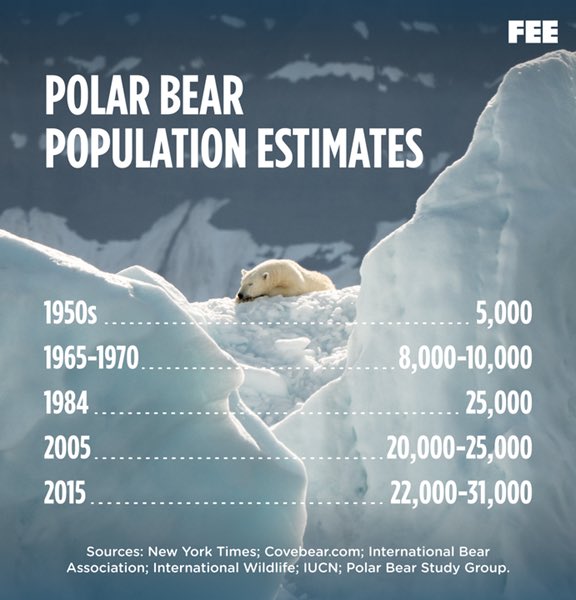
Polar bears are believed to be affected by reduced sea ice because their main prey, the ringed seal, remains in the Arctic all year and they give birth to their pups on the ice where they are very vulnerable to the bears.
• There are 2 types of sea ice. Land-fast ice and pack-ice. Unlike fast-ice, pack ice is mobile. When winds cause pack ice to collide with the shore or other ice slabs, the pack ice thickens as ice slabs are pushed on top of each other. Thick pack ice doesn’t melt completely in the summer. However, shifting winds can blow thick pack ice out of the Arctic, as happened in the 1990s9.
• Ringed seals depend on fast-ice. Thin fast-ice naturally melts completely by July, and then re-forms starting in October.To breathe, ringed seals must create breathing holes by head-butting through any newly forming thin ice. Then gnawing and clawing at the ice as it thickens, keeps their breathing holes open throughout the winter. Multi-year pack ice is too thick for seals to create breathing holes.
• Ringed seals mostly give birth to their pups on land fast-ice in March and April. Pups remain on the ice while nursing and then molting in June. Land-fast ice is thickest during the seals reproduction cycle and remains until late June. Seals then abandon the ice to hunt in open water starting in July and only crawl out on ice unpredictably to bask in the sun for a few hours. Melting ice after July has no effect on how available the seal pups are to bears.
• Polar bears gain almost all of their body fat in the late spring and early summer from feeding on baby ringed seals. In contrast, all bears lose weight during the winter when there is the greatest amount of ice. Feasting on baby seals from March thru June determines if the bears will survive the winter. Unlike feasting on baby seals, any feeding on ice or land after June is purely opportunistic. Pregnant females enter hibernation just as ice begins to reform and emerge only as ringed seals are giving birth
• Ringed Seal are so abundant they are considered a Species of Least Concern, so Arctic climate change does not appear to have had a negative effect.
• More open water from July to September increases sunlight reaching phytoplankton, generating greater photosynthesis and a more productive Arctic Ocean.3 Increased photosynthesis improves the whole Arctic food chain, eventually increasing fish populations that ringed seals depend upon. More ringed seals provide more food for polar bears.
• Since hunting polar bears was restricted, polar bear populations have increased.Moderator Response:[BL] Contents snipped - off topic.
-
jimsteele24224 at 01:56 AM on 4 April 2024Climate - the Movie: a hot mess of (c)old myths!
Loblaw, You have said absolutely nothing to refute the science I preented here. Instead you try to eflect and redirect the issue. Not a very scientific approach. I will await your refutation here.
Moderator Response:[BL] No, I was trying to give you a polite nudge to post things in places where there are on topic.
Skeptical Science has a Comments Policy. There is a link to it above the edit box you use to type in comments. You agreed to follow that policy when you signed up for an account. The first two sections of it are:
- All comments must be on topic. Comments are on topic if they draw attention to possible errors of fact or interpretation in the main article, of if they discuss the immediate implications of the facts discussed in the main article. However, general discussions of Global Warming not explicitly related to the details of the main article are always off topic. Moderation complaints are always off topic and will be deleted
- Make comments in the most appropriate thread. Some comments, while strictly on topic, may relate to issues discussed in more detail in some other thread. Extended discussion of those points should be carried out in the more appropriate thread, with link backs to reference the discussion as needed. Moderator's directions to move discussion to a more appropriate thread should always be followed.
Since you have refused to follow that gentle advice, I have no choice but to enforce it more strongly. Any further off-topic posts will simply be deleted.
Please note that posting comments here at SkS is a privilege, not a right. This privilege can be rescinded if the posting individual treats adherence to the Comments Policy as optional, rather than the mandatory condition of participating in this online forum.
Please take the time to review the policy and ensure future comments are in full compliance with it. Thanks for your understanding and compliance in this matter.
-
Bob Loblaw at 00:39 AM on 4 April 2024A data scientist’s case for ‘cautious optimism’ about climate change
William:
It is clear that you cannot look beyond one statistic about historical patterns.
I value the opinion of the authors of a study much more than I value your opinion about it.
Your dismissal of any predictions whatsoever (except, it would seem, your own opinions) shows a state of denial of anything scientific. It makes me wonder how you can get out of bed in the morning, since it is impossible for you to predict whether or not the floor will support you.
-
William24205 at 00:09 AM on 4 April 2024A data scientist’s case for ‘cautious optimism’ about climate change
nigelj
At what point - would you start to not trust a climate alarmist - if deaths continue to fall or not rise for another 40 years - would you think maybe we should not trust those who make these predictions and fuel the narrative. Or do they just get a forever pass - and you will always accept more predictions - even though the people and movements who made them before have always been wrong.
I think people just want to believe things will be terrible and there are primed believe end of days narratives.
Yes - anything could happen in the future and deaths and damage levels could rise again- but it is nor healthy to ignore the present - or trust people that wilfully distort it.






