



 Arguments







Confidence in climate forecasts
Posted on 4 August 2010 by Kevin Judd
Guest post by Kevin Judd
 Climate scientists are telling us that the earth's average temperature is going to rise 2 to 3 degrees over the next 50 to 100 years. How do they make this prediction? And why are they confident their prediction will be correct? Climate scientists make this prediction using a climate model. So what is a climate model?
Perhaps you have seen, or even had a ride on, one of those model stream-trains. These are miniature working replicas of real steam-engines. Climate models are the same; they are a working replica of the earth, only instead being made of rock and water and other materials, they are made from mathematical equations.
These mathematical models are the basis of science and technology. There are models for how microwave ovens work; models for car engines and power stations; models for jet-aircraft. Models allow scientists and engineers to build things that have never been built before, by testing how they will work before they are made. Models were used to build the rockets that took astronauts to the moon and back safely. Models allows scientists to predict complex things like the weather.
These models make correct predictions because they are based on general scientific principles, often referred as "Laws", like the law of gravity. General scientific principles are important because they connect phenomena that are not obviously connected. For example, the principles of microwave ovens are related to the greenhouse effect. The principles of car engines and power stations are related to how the earth will warm up. The principles of aircraft are related to winds, storms, and ocean currents.
This interconnectedness gives scientific models great power. If the general principles of climate models were wrong, scientists would have known long ago: microwave ovens wouldn't work, aircraft wouldn't fly, weather couldn't be forecast.
Based on general principles alone climate scientists have every reason to be confident in their predictions, because the principles have been well tested. Furthermore, the climate models of twenty years ago accurately forecast temperature rises over the last 20 years. This successful prediction further validates the general principles, and gives us confidence in climate models. Add to this that the climate models of today are much better than 20 years ago.
Of course there will always be some uncertainty about how the details of climate change will play out, but there is no doubt on the basic story that the earth's average temperature is going to rise 2 to 3 degrees over the next 50 to 100 years. Anyone who says otherwise, either does not understand how science works, or is being deliberately misleading.
In my next segment I'll consider what the consequences of this warming will be.
 NOTE: this post is also being "climatecast" by Kevin Judd on RTR-FM 92.1 around 11.30 AM WAST today. You can listen to a streaming broadcast of RTR-FM online via http://www.rtrfm.com.au/listen.


 0
0  0
0 As others have pointed out we should not be misled (either way) by short term variations (eg 1993 or 1997). We should also remember that adding appropriate error bars will make the question of divergence academic, at least for the moment.
 Forecast of Hansen et al.2 (blue line) evaluated against observational data (black). Twenty-year trends of forecast and observations are indicated with thick lines, as is the null hypothesis of zero trend (red).
So we see that 22 years ago it was possible to construct a model that would predict behavior of the the Earth climate system w/some fidelity, no need for backwards-looking tweaking or the like.
12 years later, from 2000, we have another sample including more model runs to look at:
Forecast of Hansen et al.2 (blue line) evaluated against observational data (black). Twenty-year trends of forecast and observations are indicated with thick lines, as is the null hypothesis of zero trend (red).
So we see that 22 years ago it was possible to construct a model that would predict behavior of the the Earth climate system w/some fidelity, no need for backwards-looking tweaking or the like.
12 years later, from 2000, we have another sample including more model runs to look at:
 From Intercomparison of Present and Future Climates Simulated by Coupled Ocean-Atmosphere GCMs
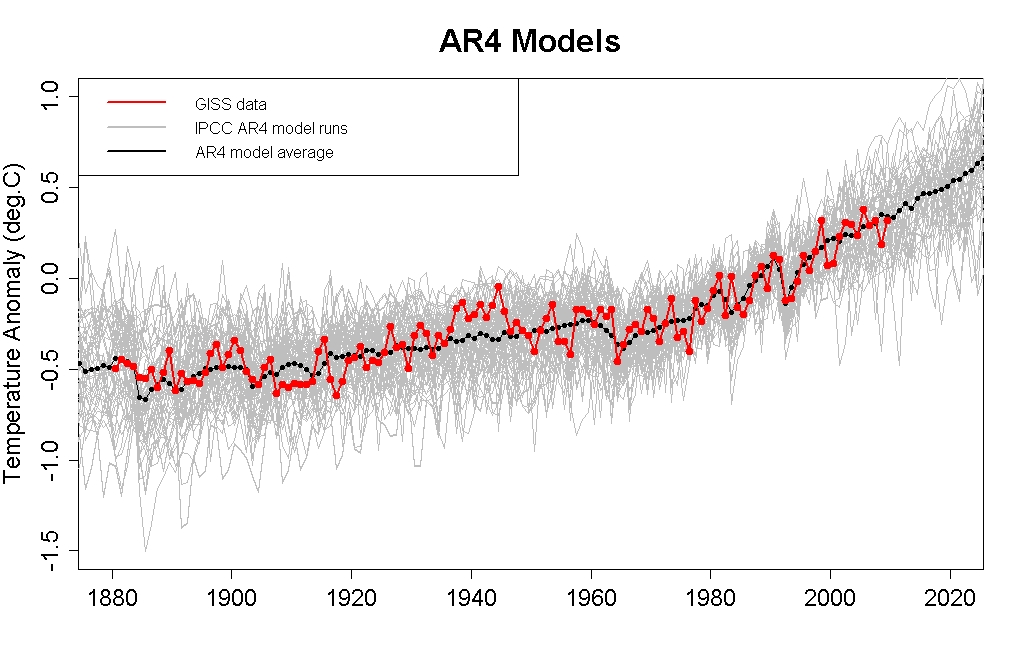
As Hargreaves remarks, it's hard to imagine models are becoming worse over time. It's also possible to see that so-called "wide variances" between different models and different model instantiations don't have much to tell us about the fundamental utility of models because while such variances do indeed emerge decades into various model runs those models still tell us the same basic story, the planet will continue warming up. "Just models," of course, but observational evidence seems to largely coincide w/model output as we can see from Hansen's very early example.
Quibble over wiggles, we can still do that of course.
From Intercomparison of Present and Future Climates Simulated by Coupled Ocean-Atmosphere GCMs
As Hargreaves remarks, it's hard to imagine models are becoming worse over time. It's also possible to see that so-called "wide variances" between different models and different model instantiations don't have much to tell us about the fundamental utility of models because while such variances do indeed emerge decades into various model runs those models still tell us the same basic story, the planet will continue warming up. "Just models," of course, but observational evidence seems to largely coincide w/model output as we can see from Hansen's very early example.
Quibble over wiggles, we can still do that of course.







Comments