



 Arguments








Urban Heat Islands: serious problem or holiday destination for skeptics?
Posted on 31 August 2010 by mothincarnate
The Urban Heat Island Effect (UHI) is a phenomenon whereby the concentration of structures and waste heat from human activity (most notably air conditioners and internal combustion engines) results in a slightly warmer envelope of air over urbanised areas when compared to surrounding rural areas. It has been suggested that UHI has significantly influenced temperature records over the 20th century with rapid growth of urban environments.
Scientists have been very careful to ensure that UHI is not influencing the temperature trends. To address this concern, they have compared the data from remote stations (sites that are nowhere near human activity) to more urban sites. Likewise, investigators have also looked at sites across rural and urban China, which has experienced rapid growth in urbanisation over the past 30 years and is therefore very likely to show UHI. The difference between ideal rural sites compared to urban sites in temperature trends has been very small:
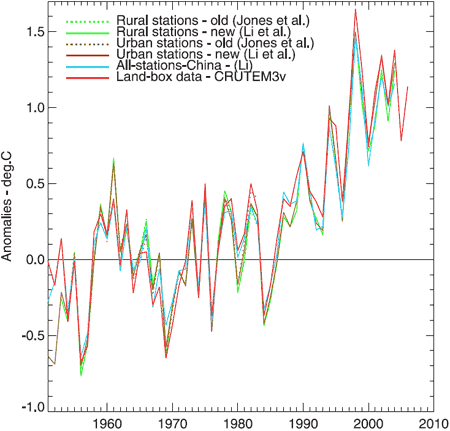
Figure 1. Annual average temperature anomalies. Jones et al (dotted green and brown) is a dataset of 42 rural and 42 urban sites. Li et al (solid green and brown) is an adjusted dataset of 42 rural and 40 urban sites. Li (blue) is a non-adjusted set of 728 stations, urban and rural. CRUTEM3v (red) is a land-only data set (Brohan et al., 2006). This plot uses the 1954–83 base period.
Another way to explore the UHI would be to look at where the majority of warming has occurred across the globe. The UHI should match where most people live. However, if you look at the 2006 global temperature anomaly (figure 2.), you find that the greatest difference in temperatures for the long term averages where across Russia, Alaska, far north Canada and Greenland and not where major urbanisation has occurred.

Figure 2. Using source data from NASA/GISS, this illustration shows the amount of change in global surface temperatures in 2006 from 1885.
The Urban Heat Effect has no significant influence on the record of global temperature trends.
This post is the Basic version (written by mothincarnate) of the skeptic argument It's urban heat island effect.


 0
0  0
0
 Source code and data are available via the link.
Note the unsurprising similarity to the other surface temperature records.
Source code and data are available via the link.
Note the unsurprising similarity to the other surface temperature records.
 As you can see the scatter plot is not very different for these categories. Therefore, if there is a dependence of UHI on local population density, it extends well below 1/km2 indeed with no breakdown of the relation in sight.
But the most important finding is that there is a (not very strong) correlation between these two parameters, so a regression line can be computed.
Average temperature trend for these stations was about 0.32°C/decade between 1990 and 2000. But part of this increase is due to the 0.2 increase in base 2 logarithmic population density during this timespan, so we have to consider the regression line at zero. It is about 0.15°C/decade there.
So more than 50% of the trend is due to increase in local population density around GHCN stations (most of the rest is probably NH soot pollution over snow and ice). This effect is also known as UHI (Urban Heat Island), although as we have seen it has not much to do with urbanization as such, it's just the local effect of increasing population density, even in very sparsely populated areas.
I think this is the proper way to look for an UHI effect in land surface temperature records. That is, one should analyze the connection between changes in local population density around measurement points and surface temperature trend at the same location.
I am afraid it is not done (yet) by those, who are responsible for maintaining these datasets, although by now many thousand billion dollar political and business decisions are dependent on their correctness (or its lack thereof).
Also, I can see the problems with the GPWv3 dataset. Perhaps satellite shots of night light distribution is a better proxy for UHI than population density trends averaged over administrative districts.
As you can see the scatter plot is not very different for these categories. Therefore, if there is a dependence of UHI on local population density, it extends well below 1/km2 indeed with no breakdown of the relation in sight.
But the most important finding is that there is a (not very strong) correlation between these two parameters, so a regression line can be computed.
Average temperature trend for these stations was about 0.32°C/decade between 1990 and 2000. But part of this increase is due to the 0.2 increase in base 2 logarithmic population density during this timespan, so we have to consider the regression line at zero. It is about 0.15°C/decade there.
So more than 50% of the trend is due to increase in local population density around GHCN stations (most of the rest is probably NH soot pollution over snow and ice). This effect is also known as UHI (Urban Heat Island), although as we have seen it has not much to do with urbanization as such, it's just the local effect of increasing population density, even in very sparsely populated areas.
I think this is the proper way to look for an UHI effect in land surface temperature records. That is, one should analyze the connection between changes in local population density around measurement points and surface temperature trend at the same location.
I am afraid it is not done (yet) by those, who are responsible for maintaining these datasets, although by now many thousand billion dollar political and business decisions are dependent on their correctness (or its lack thereof).
Also, I can see the problems with the GPWv3 dataset. Perhaps satellite shots of night light distribution is a better proxy for UHI than population density trends averaged over administrative districts.







Comments