



 Arguments







New Book - Climate Obstruction: A global Assessment
Posted on 22 October 2025 by BaerbelW
Climate Obstruction: A Global Assessment is a new book from Brown University’s global Climate Social Science Network, for which a team of more than 100 scholars explored who’s blocking action on climate change and how they’re doing it. John Cook - founder of Skeptical Science and senior research fellow with the Melbourne Centre for Behaviour Change at the University of Melbourne - co-authored chapter 7 in the book titled "Understanding the Political and Psychological Roots of Climate Misinformation and Its Impact on Public Opinion". The book is available open access for download from the Climate Social Science Network.
The book
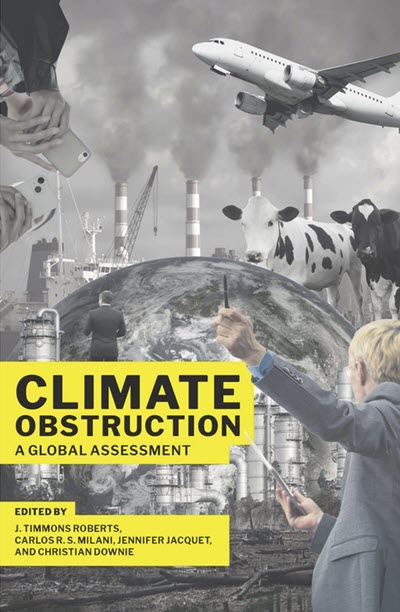
In addition to an introduction by the editors J. Timmons Roberts, Carlos R. S. Milani, Jennifer Jacquet, and Christian Downie the book contains 12 chapters exploring the many different shapes and forms climate obstruction takes around the globe:
- The Global Role of the Oil and Gas Industry in Climate Delay and Denial - Lead Authors: Geoff Dembicki, Kristoffer Ekberg, and Kert Davies / Contributing Authors: Ann-Kristin Bergquist, Ada Nissen, and Stella Levantesi
- How Coal, Utilities, and Transportation Impede Climate Action - Lead Authors: Jen Schneider and Gregory Trencher / Contributing Authors: Peter K. Bsumek, Christian Downie, Paul K. Gellert, Giulio Mattioli, Jason Monios, Peter Newell, Jennifer Peeples, Joeri Wesseling, Emily Williams, Ryan Wishart, and Ben Youriev
- The Animal Agriculture Industry’s Role in Obstructing Climate Action - Lead Authors: Kathrin Lauber and Viveca Morris / Contributing Authors: Jennifer Jacquet, Peter Li, Ina Möller, Silvia Secchi, Alex Wijeratna, and Melina De Bona
- Climate Policy Obstruction on the Right and the Far Right - Lead Authors: Dieter Plehwe and Justin Farrell / Contributing Authors: Lucas Araldi, Robert J. Brulle, Jesse Callahan Bryant, William Callison, Kert Davies, Ruth E. McKie, Sotiris Mitralexis, and Alexandru Racu
- Steering the Climate Discourse: Legacy News, Social Media, Advertising, and Public Relations - Lead Authors: Melissa Aronczyk and Maxwell Boykoff / Contributing Authors: Travis G. Coan, Myanna Lahsen, Hanna E. Morris, and Chris Russill
- Understanding the Political and Psychological Roots of Climate Misinformation and Its Impact on Public Opinion - Lead Authors: Dominik A. Stecula and John Cook / Contributing Authors: Arunima Krishna, Adrian Dominik Wójcik, Jean Carlos Hochsprung Miguel, Matthew Hornsey, and Salil Benegal
- Climate Obstruction Across the Global South - Lead Authors: M. Omar Faruque and Ruth E. McKie / Contributing Authors: Lucas G. Christel, Claire Debucquois, Guy Edwards, Paul K. Gellert, Ricardo A. Gutierrez, Kathryn Hochstetler, Yifei Li, Carlos R. S. Milani, Elisabeth Möhle, Oluwaseun J. Oguntuase, and Jonathan R. Walz
- Blocking Climate Action at Subnational Levels - Lead Authors: Rebecca Bromley-Trujillo, Joshua A. Basseches, and Marcela López-Vallejo / Contributing Authors: Lucas G. Christel, Andrew B. Kirkpatrick, Simone Lucatello, and Maria Isabel Santos Lima
- Obstruction in the United Nations Framework Convention on Climate Change and the Intergovernmental Panel on Climate Change - Lead Authors: Kari De Pryck and Eduardo Viola / Contributing Authors: Stefan C. Aykut, Larissa Basso, Danielle Falzon, Matías Franchini, Friederike Hartz, Hannah Hughes, Vinícius Mendes, Carlos R. S. Milani, Bruna Bosi Moreira, Géraldine Pflieger, and Emanuel Semedo
- Obstructing Global and Local Climate Change Adaptation - Lead Authors: Laura Kuhl and Stacy-ann Robinson / Contributing Authors: Natalie Dietrich Jones, Danielle Falzon, Andrew Malmuth, Michael Mikulewicz, Meg Mills-Novoa, Michelle Mycoo, Meg Parsons, M. Feisal Rahman, E. Lisa F. Schipper, Kimberley Anh Thomas, and Edward Walker
- Legal and State Efforts to Address Climate Obstruction - Lead Authors: Grace Nosek, Joana Setzer, and Benjamin Franta / Contributing Authors: Alyssa Johl, Lisa Benjamin, Sharon Yadin, William W. Buzbee, and Aria Kovalovich
- Confronting Climate Obstruction: The Role of Civil Society and Non–State Actors - Lead Authors: Jennie C. Stephens and Sharon Yadin / Contributing Authors: Laurence L. Delina, Louise M. Fitzgerald, Francisco Garcia-Gibson, Fergus Green, Noel Healy, David Hess, Tariro Kamuti, Cristiana Losekann, David Michaels, Sonja Solomun, and Robin Tschoetschel
A closer look at chapter 7
The chapter "Understanding the Political and Psychological Roots of Climate Misinformation and Its Impact on Public Opinion," lead-authored by Dominik A. Stecula and John Cook, investigates how decades of climate disinformation—funded by the fossil fuel industry—have successfully sabotaged public debate. These campaigns exploited common human psychological traits, leading to widespread polarization.
The authors identify five critical climate beliefs necessary for fostering political urgency: that climate change is real, human-caused, experts agree, it's a bad thing, and that we have hope to avoid the worst-case scenarios. The climate counter-movement systematically promotes five corresponding disbeliefs to obstruct action.
The key method for cultivating these disbeliefs is by FLICCing off scientific integrity—using the five techniques of science denial:
- Fake experts
- Logical fallacies
- Impossible expectations
- Cherry picking
- Conspiracy theories
Most excuses for inaction make use of one of these techniques. For example, the Impossible expectation is used to dismiss crucial local climate policy by arguing it won't solve the entire global problem by itself. Additionally, "Fake experts" exploit “like-me” biases, where people trust messengers who share their ideology.
Crucially, this disinformation campaign worked through political elites who serve as trusted messengers. Research on the "elite cue" effect shows that after the Kyoto Protocol, Republican elites began explicitly denying climate change, and their voters followed suit. This powerful effect means people often judge climate policies based on who proposes them, rather than their actual content. Ultimately, the industry's lies have led substantial segments of the public to hold misinformed views—knowing things that are simply not true, but are convenient for the fossil fuel industry.
Discussions about the book
John Cook participated in a panel discussion recorded in September about the book with editor Timmons Roberts and one of the lead-authors for chapter 6 "Steering the Climate Discourse: Legacy News, Social Media, Advertising, and Public Relations" Melissa Aronczyk. Their panel discussion is available on Youtube:
From the video's description:
A panel-pod on the scourge of climate disinformation and misinformation - "the firehose of falsehoods" as one panellist poetically puts it! We need to understand which groups are running climate change disinformation and misinformation campaigns - and who is funding them - if we are to make progress. "We don't need to change the minds of everyone in society to get climate action - we just need to activate enough people!" Featuring three people involved in a landmark new book called Climate Obstruction - A Global Assessment - out from Oxford University Press. Timmons Roberts is a co-editor of the book, and Melissa Aronczyk and John Cook are two of the many contributors to it.
Update Oct 30, 2025: Amy Westervelt discussed the book chapter in episode 3 (season 14) of her podcast "Drilled" with John Cook and Dominik Stecula:
If you want to understand how misinformation works in general…and anyone who cares about democracy should right now…there’s no one better to talk to than researchers who have been studying climate misinformation for years. In today's episode, John Cook (University of Melbourne) and Dominik A. Stecu?a (Colorado State University) join to walk us through everything the research is telling us so far.









Looks to be an impressive compilation of the climate denial industry. Does it add significantly to the already existing body of evidence, i.e. does it provide any new tools for those in the trenches listening to the new wave of climate denial that seems to be cresting in our political and financial circles? Specifically:
-The divestment from fossil fuels and investments in conservation/renewables movement seems to be hitting a real wall and is being reversed in several circles. Does this compilation provide any effective strategies for managing and reversing this change of direction and getting back on track? Who in the financial and investment circles are doing this and how can we assist them under the current assault coming from so many corporate reversals who are walking away from their sustainable goals?
Dismantling the scientific infrastructure that is providing information collection essential to understanding our climate in publicly funded collected data thru NOAA, EPA, as well as corporate funding for that matter, etc. seems to be going full speed ahead. Does this book provide any defensive bulwarks that can address this horrendous active suppression and dismantling of the scientific endeavor that has provided our current understanding of the dynamics of our climate as it relates to human activities?
I haven't read this book, but it seems like it's a great effort that describes PAST efforts at misinformation and delays. But I'm really worried that our efforts for understanding this obstruction is not what is currently needed. Understanding the type of gasoline used, how it was poured through the house and who brought the match to light it is important in the long run, but what we need now is a fire truck, plenty of water and firefighters to put out that fire, because the house is on fire RIGHT NOW and we are inside that house!
I want to see who the firefighters are right now, who is putting out the most water most effectively, and how we can support the most effective efforts. Like with so many other fronts, we are all shocked at how quickly our efforts have been crumbling under this assault. But unless we can take our understanding and translate it into counteracting and reversing the assault, it will become a largely irrelevant historical exercise.
Bill McKibben has done an admirable job in providing a counter narrative, but he seems to be pretty lonely out there. I'm hoping that Skeptical Science can play a role in actively highlighting successful efforts whereever they can be found and thereby helping us all weather the current storm.
The commentary says:
The key method for cultivating these disbeliefs is by FLICCing off scientific integrity—using the five techniques of science denial:
Fake experts
Logical fallacies
Impossible expectations
Cherry picking
Conspiracy theories
All good, but does it need a category of "pseudoscience", where flawed but superficially convincing scientific reasoning is used to attempt to debunk the greenhouse effect, or climate models, etc,etc.
wilddouglascounty @1,
I downloaded and read the ‘Book Summary’ last week. This book was presented in last week’s Skeptical Science New Research for Week #42 2025 (it is the first item in the ‘From this week's government/NGO section:’).
The book title at the beginning of the text in the green box at the top of this post is a link to the book’s webpage. The Book and the Book Summary can be downloaded from that webpage.
I have just re-read the summary and offer the following:
I would add the following action as something helpful being done. The UK government Bill “Elected Representatives (Prohibition of Deception)” to “Create offences in relation to the publication of false or misleading statements by elected representatives; and for connected purposes”. It was “Ordered, by The House of Commons, to be Printed, 28th June 2022”
The following is a sequence of some of the reporting on actions by the Welsh government.
And I will finish by raising a new concern: The deliberate harmful misleaders have been ruining the term “Common Sense” by calling their misleading nonsense “Common Sense”.
Trump uses 'common sense' to make a political point. It has populist appeal – NPR News
The harmful misleaders have also been ruining the term “Reasonable” by calling their irrational unjustifiable unreasonable claims “Reasonable”.
Developing sustainable improvements for humanity is challenged when people are misled to believe that Unreasonable Nonsense is Reasonable Common Sense.
Regressing to the days when “the Earth is Flat and the center of the universe” was considered to be reasonable common sense is not sustainable improvement.
The right to lie, listen to how we got here and this USA disease intentionally causing a divided populous. www.youtube.com/watch?v=Czk9QF3nLfU
OPOF #3
Sadly, the UK Parliament's Elected Representatives (Prohibition of Deception) Bill 2022-23 was a Private Member's Bill that did not complete its passage and has not become law.
Nick Palmer @3,
It is indeed unfortunate that there was insufficient UK leadership support for action to limit the ability of leadership competitors to benefit from being harmfully misleading.
Hopefully the people pursuing meaningful action to limit the success of harmful misleaders will be able to develop a good example in the Welsh Senedd.
Reading the items I linked, especially the 2025 February: Welsh Parliament: Standards of Conduct Committee: Individual Member Accountability - Deliberate deception document, indicate that this is a complex issue needing rigorous Reasonable Common Sense evaluation by all involved.
A particularly challenging aspect is making it very difficult for a misleader to abuse a provision that ‘allows misleading action that is deemed to be in the National (or regional) Interest’. There are many examples, in the past as well as daily today, of harmful misleaders claiming their actions are justified by 'the need to protect the National/Regional Interest’.
In Alberta, Canada, where I live, the current government (and previous governments) misleadingly argue(d) against action to limit climate change harm that would ‘reduce the ability of Alberta to benefit from extraction and export of fossil fuel resources’. As an example, the current government is arguing against a cap on harmful emissions from oil sands operations:
Alberta Government Document:
Alberta's response to the federal oil and gas emissions cap : Government of Alberta technical submission
A couple of minor corrections and clarifications:
- My comment @6 is to Nick Palmer @5,
- In my comment @3: I ahve now downloaded the book and see that it is presented as 13 chapters. The Chapter numbers match the numbering in the SUmmary.
The following article supplements the Alberta Government item I linked at the end of my comment @6: CBC News -Alberta throne speech pledges new pipelines and a boost for artificial intelligence
In addition to arguing against an emissions cap that would limit the harm done by Alberta’s pursuit of benefit from extracting and exporting fossil fuels, particularly the oil sands, the Alberta government has presented other objectives. They deny that they have any obligation to limit the global harm done by their pursuit of benefit from exporting fossil fuel resources. The following are quotes from the article:
…the speech outlining the provincial government’s agenda says it has been successful at convincing the rest of Canada of the importance of selling Alberta’s natural resources and recommits the province to doubling oil and gas production by an unspecified timeline.
...
“Alberta is winning and will continue to win this battle for our freedom and provincial rights – because your government believes we are on the right side of history and Albertans will not be denied their prosperous future,” the speech says.
…
Although (Premier) Smith did not point to a specific international agreement Canada had signed that Alberta wished to opt-out of, she said timelines to meet climate goals the federal government "arbitrarily arrived at" have harmed Alberta's economy.
They also want a new pipelines to increase the rate of oil sands export. A pipeline to the northern BC coast would negatively impact BC and many First Nations groups. The Alberta Government would need to obtain agreement from all affected parties. Instead of doing that they have tried to claim that the opportunities for BC to benefit from its coastal resources are not BC opportunities. Supposedly the BC coast is Canada’s coast, not BC’s. And Alberta’s leaders try to claim that the Federal government needs to force the pipeline onto the affected parties (CBC News: Alberta will need B.C. government’s support to build proposed pipeline: energy minister). Of course that way of arguing also means the oil sands in Alberta are not Alberta’s resource, they are Canada’s eh?
Being reasonable and developing sustainable Common Sense understanding are not strengths of Alberta’s leadership-of-the-moment, no matter how many times they claim they are being reasonable or claim their beliefs are Common Sense.
And, picking a rotten cherry to put on top of that harmful misleading nonsense, following the lead of other harmful misleaders pursuing personal economic benefit who ‘unjustifiably attack others, especially immigrants’, there is the following:
“Using Alberta’s constitutionally protected provincial rights, the government of Alberta will return to a more stable number of primarily economic migrants, so that newcomers come here to work and contribute as they have historically done, while Canadian citizens living in Alberta are given first priority to the social programs, jobs and opportunities our economy creates,” the speech says.
Historically, many refugees and poorer immigrants have started their lives in Canada in Alberta.
prove we are smart @4,
Mallen Baker’s presentation definitely helps understand ‘The Problem’. Developing sustainable improvements requires a proper thorough understanding of ‘The Problem’.
However, I think the ‘Right to Lie and related claims that it is justified Free Speech’ is just a more extreme version of Doublespeak. And Doublespeak has been a Problem, of varying degrees of severity, for as long as humans have been competing for perceptions of superiority and related pursuits of leadership influence. (links to Wikipedia items for Doublespeak and Doublespeak Awards - note that the 2005 Award was given to "Philip A. Cooney, for editing scientific reports to deceive the public about the nature of global warming and climate change and of the Bush Administration's negligence in dealing with these issues.")
The efforts of misleaders to benefit from Doublespeak amp-up in absurdity as the general population gains increased awareness and improved understanding regarding matters. Those who unjustifiably obtained perceptions of superior status via harmful unsustainable misleading actions have to double-down on their Doublespeak.
An example of the doubling-down of Double-speaking is the following (related to my comment @6):
CBC News item: Danielle Smith affirms Alberta's 2050 net-zero goal at testy committee appearance.
The following is a selected quote from the article:
“Her virtual appearance included testy exchanges as Bloc Quebecois MP Patrick Bonin repeatedly demanded to know whether Smith believes in climate change. She suggested that as a Quebecer, he could not grasp the substance of one of Canada's biggest industries.
Bonin repeatedly asked the premier whether she agreed the climate is warming up, and if human activity is primarily the cause.
Smith initially dodged the questions — first by talking about forest management practices, then by diving into Alberta's 2050 emission reduction plan. She and Bonin continually talked over each other as she repeated her points and he continually insisted she was not answering his question.
The exchange got so boisterous, Liberal chair Angelo Iacono was forced to interject to bring things back under control.
Bonin finally got an answer when he asked Smith to state "yes or no" whether she believes the climate is warming.
"Yes," she said.
Smith then said she agreed humans are contributing to climate change but wouldn't say it's the main factor driving it.
"I don't know the answer to that. I'm not a scientist. But we do know we need to get to carbon neutral by 2050 and we have a plan to do that," Smith said.
Later, after Bonin asked Smith if Alberta knew whether its plan to double oil and gas production would affect its 2050 net-zero target, Smith questioned his knowledge of the sector.
It is important to understand that although the need to reduce global warming emissions from Alberta, ultimately having no impact by 2050, was understandable well before the 2015 Paris Agreement, there has been no measurable action by the industry in Alberta towards that reduction (there has been limited government subsidized carbon capture).
It is also undeniable that wealthier portions of the current global population, like the portion benefiting from extraction and export of Alberta’s fossil fuels, need to minimize how harmful their actions are as they transition towards ending their harmfulness. The total amount of harm done is the important measure, not a promise to maybe-end the harmfulness at some ‘Future date’ like the claim to be ‘Net-Zero by 2050'.
Net-Zero may not actually be ‘harmless’. Double-speakers will just claim they are harmless, claim that they are not the problem, and/or claim that others are the problem.
Also reduction of impact now is more beneficial than reduction later.
As a worst case example, rapidly doubling the rate of Alberta oil and gas export but doing nothing to reduce the emissions, then shutting it all down in 2050 would theoretically meet the promise (the Promise is not a Lie).
The worst case for the future of humanity is Doublespeak continuing to be successful. Hopefully, the Welsh Senedd will act in a way that triggers the beginning of significant action to sustainably limit the success of Double-speakers trying to maximize their benefit from being harmful.
Link to Wikipedia Doublespeak Award I failed to include in my comment @9.