



 Arguments
Software
Resources
Comments
The Consensus Project
Translations
About
Support







Latest Posts
- Skeptical Science New Research for Week #44 2026
- Climate change plus a super El Niño could add up to a record-wet winter for California
- Fact brief - Do nearby wind turbines decrease home values by an average of 75%?
- How not to detect warming acceleration
- 2026 SkS Weekly Climate Change & Global Warming News Roundup #43
- Skeptical Science New Research for Week #43 2026
- As El Niño fuels drought in Panama, trees help ranchers maintain their water supply
- Climate Trunk - Daily Life
- The strongest El Niño in a thousand years?
- 2026 SkS Weekly Climate Change & Global Warming News Roundup #42
- Skeptical Science New Research for Week #42 2026
- Climate Trunk - Governance
- Fact brief - Does onshore wind power need subsidies to compete with fossil fuels?
- How Hurricane Isaias broke through to become the first Atlantic hurricane in an extremely quiet 2026 season
- 2026 SkS Weekly Climate Change & Global Warming News Roundup #41
- Skeptical Science New Research for Week #41 2026
- Scientists link fossil fuel producers to the West’s worsening water shortages
- The world without solar and wind?
- America is hurtling toward a power grid crisis
- 2026 SkS Weekly Climate Change & Global Warming News Roundup #40
- Skeptical Science New Research for Week #40 2026
- The impacts of this year’s record-shattering El Niño
- The Worst Case Is Still on the Table
- Scientists link fossil fuel producers to the West’s worsening water shortages
- 2026 SkS Weekly Climate Change & Global Warming News Roundup #39
- Skeptical Science New Research for Week #39 2026
- India’s power-sector emissions flat for two years due to clean-energy surge
- Fact brief - Does wind power require backup from fossil fuels?
- Rapid Warming in the Himalaya Exacerbates Geohazard Cascades Beyond Adaptation Limits
- 2026 SkS Weekly Climate Change & Global Warming News Roundup #38

Comment Search Results
Search for skeptics
Comments matching the search skeptics:
- Why Science Communication Fails: How to Break Down Misleading Arguments and Inoculate Against Misinformation
Just Dean at 01:17 AM on 12 March, 2026Bob,
I appreciate you engaging.
However, I would really value specific reviews and comments of my efforts to tell the climate change story with one diagram. My diagram overlays the deep-time equilibrium relationship with glacial–interglacial data from the past 800,000 years and instrumental observations from the industrial era, along with a representative future scenario. Viewed together, these datasets place contemporary climate change within a broader Earth-system context. Skeptics and contrarians often cherrypick individual plots of CO2 or temperature or individual lines of evidence. It is harder when they are all plotted together on a common axes.
I have not seen this combination of datasets anywhere before and so I would really value reviews and feedback from the skeptical science community.
Here's the link again to my Substack post: [Link]
- Why Science Communication Fails: How to Break Down Misleading Arguments and Inoculate Against Misinformation
Just Dean at 19:47 PM on 10 March, 2026John's discussion of cherrypicking — one of the five FLICC techniques — resonated with me in a specific way. One of the most effective forms of cherrypicking in climate communication isn't the deliberate kind; it's the inadvertent kind. When we present the modern instrumental record of CO₂ and temperature in isolation — as most data visualizations do — we're unintentionally handing skeptics an opening. The data is hanging out in parameter space with no reference point, vulnerable to the response: "the climate has always been changing."
As an engineer and former experimental physicist, my instinct when evaluating any measurement is to overlay independent diagnostics. If they converge, you have something real. Applied to climate, that means placing three completely independent datasets on the same CO₂–temperature axes: the deep-time equilibrium relationship from Cenozoic reconstructions spanning 66 million years (Judd et al., Science 2024), glacial–interglacial variability from Antarctic ice cores covering the past 800,000 years, and the modern instrumental record since 1850. These datasets were developed by different scientific communities, using different methods, to answer different questions. When plotted together, they don't just approximately agree. They land on top of each other.
What this ensemble makes structurally harder is cherrypicking. To dismiss the composite, a skeptic must simultaneously discredit three independent lines of evidence — geological proxies, ice cores, and direct measurement — each developed without reference to the others. More importantly, the composite provides a direct visual answer to the "climate has always been changing" myth. Yes — and here are 66 million years of it on one plot. What it shows is that nowhere in that entire record does Earth evidence the specific combination of CO₂ concentration and global temperature that exists today. It is not the individual values that are unprecedented. It is the combination.
At the end of the episode, Nate asked John what individuals can do. His answer — that we each bring something different to the table — struck me as both honest and important. I'm not a climate scientist. But the instinct to overlay independent diagnostics, standard practice in experimental physics, turned out to be useful here.
For anyone interested, the most recent post developing these arguments is here: [link]
- Trump just torched the basis for federal climate regulations. Here’s what it means.
Bob Loblaw at 01:43 AM on 3 March, 2026nigel @ 38:
Going back in history, many trades operated guilds that helped identify skilled craftsmen. But as you point out, there is a fine line between controlling entry to the association to ensure that the people in it are truly skilled versus controlling entry to maintain some sort of privilege and exclusivity (and economic advantage). When it comes to regulation, the equivalent to the latter is regulatory capture (which I mentioned in #10). Someone has to watch the watchers, to make sure that the system is kept honest.
Even for something like engineering, where a person is accredited to design structures, there is a dependency on other accreditation processes. An engineer designing a building does not design and test the beam that will be used - they buy one "off the rack" from a company that makes them and provides specifications of the load it can handle. And that company will need to test their beams according to some sort of independent methodology developed by an accredited standards association.
I would argue that climate change is indeed a topic that has massive health and safety implications for the public, but as you say it is a much less tangible and immediate than things such as health outcomes, electrical safety, etc. The current EPA has codified this by barring the use of any indirect costs in the economic analysis of regulations.
The implications that can arise from climate change are also influenced by many other factors, which makes it easy for the contrarians to engage in a variation of whataboutism - assigning blame of any observed bad outcomes on something else. The tobacco industry perfected this technique in delaying actions against tobacco's health impacts.
Another issue with something like climate change is that is it not a well-defined target zone of study. Atmospheric science will help you understand why a region's climate is what it is, and how it might change, but to understand sea level rise you need to know oceanography. And to know food production implications, you need to know agricultural science. And to know flooding risks, you need to know hydrology. And to know ecosystem stresses, you need to know ecology. Thus "climate change" is by its nature an extremely multidisciplinary subject. You need a lot of people cooperating to put it all together. No single person can do it all alone, and the fake skeptics that act as if they know it all are clearly working outside their area of expertise. The width of the “climate change” net can be seen by the tremendous variety of references listed in things like the IPCC reports. The shallowness of the contrarians' analysis can be seen in the highly-selective and self-referential lists of publications they include in their reports.
In the current Trump administration, the phrase "conflict of interest" takes on new meaning - "Only my interests matter, and the only conflict is how others dare to challenge me".
- Is Nuclear Energy the Answer?
One Planet Only Forever at 06:52 AM on 22 February, 2026A followup to my comment @460,
The US leadership-of-the-moment’s push to deploy massive amounts of small nuclear reactors without rigorous proof that it will be safe continues as described in the following report:
US military airlifts small reactor as Trump pushes to quickly deploy nuclear power, reported in NPR, by Associated Press, Feb 21, 2028.
This is an example of misleading marketing abused by gamblers (inventor/investors) who will try to harmfully maximize their benefit from potentially bad bets (or bad ideas). The harm will be discovered in the future (because the innovator is not required to rigorously investigate potential for harm). And it is likely that the promoters of the ‘innovation’ will obtain benefits that cannot be taken away from them in the future when the harm they benefited from causing becomes undeniable – like the fossil fuel climate impact issue.
Selected quotes from the article:
Energy Secretary Chris Wright and Undersecretary of Defense Michael Duffey, who traveled with the privately built reactor, hailed the Feb. 15 trip on a C-17 military aircraft as a breakthrough for U.S. efforts to fast-track commercial licensing for the microreactors, part of a broader effort by the Trump administration to reshape the country's energy landscape.
...
Skeptics warn that nuclear energy poses risks and say microreactors may not be safe or feasible and have not proved they can meet demand for a reasonable price.
Wright brushed those concerns aside as he touted progress on Trump's push for a quick escalation of nuclear power. Trump signed a series of executive orders last year that allow Wright to approve some advanced reactor designs and projects, taking authority away from the independent safety agency that has regulated the U.S. nuclear industry for five decades.
...
The minivan-sized reactor transported by the military is one of at least three that will reach "criticality" — when a nuclear reaction can sustain an ongoing series of reactions — by July 4, as Trump has promised, Wright said.
"That's speed, that's innovation, that's the start of a nuclear renaissance," he said.
...
Edwin Lyman, director of nuclear power safety at the Union of Concerned Scientists, said the transport flight — which included a throng of reporters, photographers and TV news crews — was little more than "a dog-and-pony show" that merely demonstrated the Pentagon's ability to ship a piece of heavy equipment.
The flight "doesn't answer any questions about whether the project is feasible, economic, workable or safe — for the military and the public," Lyman said in an interview.
Rapid scale-up to power AI data centres could see 1000s of these ‘potential disasters’ in operation by 2030. The expected global power demand for AI data centres by 2030 is over 1000 TWh. Assuming a 5 MW generator, like the one reported to have been shipped by the military on Feb 15, 2026, operates at full power 24 hrs a day every day it would produce 5 x 24 x 365 = 43,800 MWh = 0.0438 TWh. (Also note that a typical AI data centre requiring 100 MW would need twenty 5 MW generators).
Poorly regulated, unrestricted, innovation in pursuit of personal benefit has a history of producing harmful results that Others have to deal with. New Nuclear appears to be rapidly becoming a New Future Disaster promoted by Master Misleading Marketers.
- 2025 SkS Weekly Climate Change & Global Warming News Roundup #14
One Planet Only Forever at 10:22 AM on 9 April, 2025nigelj,
Though we substantially agree, I need to respond to the part of your comment @23 (on the SkS re-posting of “Climate skeptics have new favorite graph; it shows the opposite of what they claim”)
You said: “For example the Democrats proposed some truly stupid ideas like defunding the police. I guess it was an emotive reaction to police abuses but its still stupid.”
That is a commonly claimed criticism. And it is as valid as claiming that “Tax is evil and Socialist– and imposing a Carbon Price is a tax - therefore Carbon Pricing is Socialist evil” which is the product manufactured by the misleading marketing efforts of people who resist learning to be less harmful and more helpful to Others. Taxes are not evil (or Socialist). And a lack of a Carbon Price that funds full neutralization of the impacts of fossil fuel use is the reason that so much harmful activity became so popular, profitable and powerful - bad enough that many of the more informed and smarter minds are protecting their interests rather than fighting to limit the climate change harm done.
For the police issue, Defund he Police was a punchy poster statement promoting a more involved matter. The real problem was paying to have the police try to do things they did not have proper training to do – like deal with cases of homelessness, mental health, drug use, and domestic abuse. Shifting some police funding to employ specialists in those non-police realms was the objective. “Defund the Police” was the punchy poster that became the basis for unjustified misleading marketing.
See the following Brookings Institute presentation on the topic “7 myths about “defunding the police” debunked”
- 2025 SkS Weekly Climate Change & Global Warming News Roundup #14
One Planet Only Forever at 08:04 AM on 9 April, 2025This week’s news includes several items in the Climate Change Impacts category about the damaging impact of human-caused global warming and climate change on developed and developing global socioeconomic systems.
- Big Banks Quietly Prepare for Catastrophic Warming
- Global warming of more than 3°C this century may wipe 40% off the world’s economy, new analysis reveals
- Climate crisis on track to destroy capitalism, warns top insurer,
Those articles provide a basis for continuing a discussion here that started on the recent SkS reposting of “Climate skeptics have new favorite graph; it shows the opposite of what they claim”. The comment discussion had evolved away from the topic of the OP. The discussion had shifted to matters related to the development of sustainable improvements for the total global population, now and into the very far future.
The three articles listed above prompted me to expand on my semi-conspiracy theory about the development of opposition to the efforts to increase awareness and improve understanding of how people can be less harmful and more helpful to Others. (see my comment @22 and nigelj’s reply @23 on that SkS reposting linked above)
Additional considerations related to this week’s News items are:
Big Banks Quietly Prepare for Catastrophic Warming:
Quote:
“The recent reports — from Morgan Stanley, JPMorgan Chase and the Institute of International Finance — show that Wall Street has determined the temperature goal is effectively dead and describe how top financial institutions plan to continue operating profitably as temperatures and damages soar.”
Related thoughts:
This suggests that some people who know better are not powerfully raising awareness and improving the understanding of the general population. They are trying to maximize their collective benefit in spite of knowing how harmful their lack of action to limit the global harm done will be. It is like the way that the 2008/9 global financial disaster turned out to be beneficial for many of them (very few of them faced a negative change of status relative to Others – many of them increased their status relative to Others). The least fortunate who got little benefit from the sub-prime mortgage scams suffered the most.
Global warming of more than 3°C this century may wipe 40% off the world’s economy, new analysis reveals
Quote:
“Any impacts from weather events elsewhere, such as how flooding in one country affects the food supply to another, are not incorporated into the models.
Our new research sought to fix this. After including the global repercussions of extreme weather into our models, the predicted harm to global GDP became far worse than previously thought – affecting the lives of people in every country on Earth.”
Related thoughts:
A group of people today have proudly watched a 10% hit happen to global economic activity in a matter of a few days. They think they will be the winners. Everyone will lose because of the unjustified tariff attacks. But the likes of Trump probably think they will suffer less harm that Others will. Some of them may even believe they will benefit from the inequitable unjustifiable actions (paying members of Trump’s Mar-a-Lago Cult could have an unfair advantage if they heard about what the Trump Administration would actual do before it became public knowledge). These type of people would have even less concern about actions they benefit from causing 40% harm to the future economy Others have to live with.
Climate crisis on track to destroy capitalism, warns top insurer
Quote:
“The insurance sector is a canary in the coalmine when it comes to climate impacts,” said Janos Pasztor, former UN assistant secretary-general for climate change.
The argument set out by Thallinger in a LinkedIn post begins with the increasingly severe damage being caused by the climate crisis: “Heat and water destroy capital. Flooded homes lose value. Overheated cities become uninhabitable. Entire asset classes are degrading in real time.”
“We are fast approaching temperature levels – 1.5C, 2C, 3C – where insurers will no longer be able to offer coverage for many of these risks,” he said. ...
“This applies not only to housing, but to infrastructure, transportation, agriculture, and industry,” he said. “The economic value of entire regions – coastal, arid, wildfire-prone – will begin to vanish from financial ledgers. Markets will reprice, rapidly and brutally. This is what a climate-driven market failure looks like.”
Related thoughts:
All of the resistance to the achievement of Sustainable Development Goals, not just resistance to efforts to limit the harm done by climate change impacts, is raising doubts about, and reducing the sustainability of, capitalism (and democracy – given the recent authoritarian ‘winning of unjustified popular beliefs and related abusive power’ in many democracies).
The following time-line of events is part of the basis for my semi-conspiracy theory about the reasons there is such a powerful resistance to learning to be less harmful and more helpful to Others. (note that there are many similar things along the timeline ... since the beginning of recorded human history and more recently)
- 1913 – US 16th Amendment ratified allowing Congress to impose an Income Tax. (Still resisted by many wealthy and influential people who almost certainly know that their resistance is harmfully incorrect. Also resisted by people who are less aware or misunderstand things and have unjustified doubts about the benefits of an Income Tax because they are easily tempted to be misled that way)
- 1933 – 1938 – US New Deal series of reforms (Resisted - See above)
- 1948 – UN Universal Declaration of Human Rights (Resisted - See above)
- 1962 - Silent Spring first published (Resisted - See above)
- 1964 - US Surgeon General report regarding smoking (Resisted - See above)
- 1965 – UN Development Programme - evolved from UN programs that started in 1949 (Resisted - See above)
- 1972 - Stockholm Conference – identified many harmful developed human impacts (Resisted - See above)
- 1990 – IPCC first report (Resisted - See above)
- 2020 – COVID19 – (Influential people opposed to learning to be less harmful and more helpful to Others found new ways to maximize their ability to benefit from being misleading)
Constantly improving global civilization is not a guarantee. It is very hard work to limit the harm done by people who resist learning to be less harmful and more helpful to Others. They know better, but do not care about how harmful their actions and lack of actions are.
- At a glance - Is the CO2 effect saturated?
Bob Loblaw at 06:54 AM on 18 January, 2025Now for the question posed in #22, about the logarithmic effect of CO2.
There is more than one place in the CO2/climate system where we see logarithmic relationships.
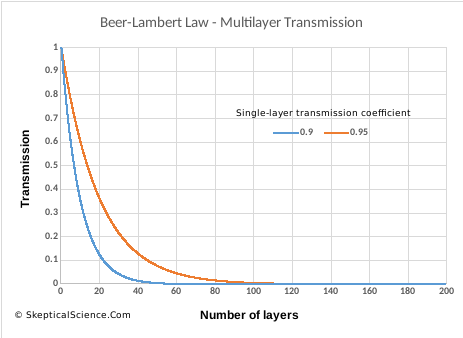
The first place is in the fundamental aspect of the absorption of IR radiation by CO2 (or other greenhouse gases, such as methane). This is described mathematically by Beer's Law, which you can read about on Wikipedia, or by reading this post I made here at SkS about three years ago.
- In non-mathematical terms, the absorption of radiation by a given thickness of air occurs as a proportion of the radiation. If that thickness of air absorbs 10% of the radiation, it will absorb 100W/m2 out of 1000W/m2, but only 10W/m2 out of 100W/m2.
- So, if you start out with 1000W/m2, and absorb 100W/m2, you're left with 900 W/m2.
- But when that 900W/m2 passes through the next identical layer, only 90W/m2 is absorbed, and 810W/m2 is passed on.
- ...and in the next layer, 81W/m2 is absorbed, and 729 W/m2 is passed on.
- ...and so on.
- And this sequence is a logarithmic relationship.
- Although you never get to 0W/m2, after enough layers you do get to the point where it is essentially 0 for all practical purposes. At this point, you can say "with all those layers, absorption has reached a saturation point".
Those "skeptical" of the CO2 effect on climate focus on this "many layers already absorb all the IR" case and then argue "adding more CO2 will not absorb any more". They are wrong.
The catch is that this "saturation" idea only applies when you look at IR radiation that started in the beginning and passed through all those layers. There are two issues with this:
- Even if all the radiation is absorbed by many layers, adding CO2 will change how much was absorbed in layer 1, or layer 2, etc. Thus we are still changing where in the atmosphere the radiation is absorbed.
- This will alter the energy flows in the diagram I posted in the previous comment.
- This diagram shows how changing the absorption rate changes the amount absorbed in the earlier layers. (The diagram comes from this post, which I mentioned earlier.)
- The second issue related to what other commenters have said, that "skeptics" seem to ignore: that the atmosphere itself is emitting more IR radiation.
- Even though less and less of the original radiation entering layer 1 (closest to the surface, if we are thinking of our earth-atmosphere system) reaches the upper layers, constant emission of IR radiation locally (i.e., at that height) is replacing at least some of the IR radiation that was absorbed.
- The local emission depends on local temperature (the kinetic energy source)
- The local emission will be half upwards, and half-downwards, which means that it is now harder for that energy to reach a point where it can be lost to space (greenhouse effect discussion in previous comment).
There is another important place where a logarithmic relationship is seen. In Beer's Law, we talked about a layer containing something that absorbs IR radiation. What happens to the absorption ratio if we double the amount of CO2?
- We might think it doubles the amount of absorption, but this is only the case for low concentrations.
- At higher concentrations, the amount of absorption will not quite double
- ...and at yet higher concentrations, the absorption will not quite not quite double, etc.
- ...so we see a "law of diminishing returns".
- Eventually, at very high concentrations, there will be very little additional absorption. Again, we can call this "saturation".
- ...but current atmospheric CO2 concentrations are a loooong way from reaching this "saturation" point. We're a little over 400ppm now, and we'd need to get to concentrations several times higher before "saturation" is reached.
- From our starting point at 300ppm, we'll see 2-5C rise when we double to 600ppm, and then another 2-5C rise if we double again to 1200ppm, so we can see the logarithmic relationship.
- ...but a climate with 1200ppm of CO2 will not be a pleasant place compared to what we have now. The logarithmic decreasing effect will not save us from a very different world.
Whenever you see a "saturation" or "logarithmic" argument, you need to try to understand which version someone is claiming. The key error in all of them is that they are isolating one small part of a complex system and ignoring other parts that are affected by increasing CO2. Only by including the complex relationships among all the parts of the system can you determine the warming effects of CO2.
- Models are unreliable
Bob Loblaw at 06:26 AM on 12 November, 2024Syme_Minitrue @ 1332:
Your comment contains several misunderstandings of how models are developed and tested, and how science is evaluated.
To begin, you start with the phrase "If a hypothesis should be considered proven..." Hypotheses are not proven: they are supported by empirical evidence (or not). And there is lots and lots of empirical evidence that climate models get a lot of things right. They are not "claimed to be true" (another phrase you use), but the role of CO2 in recent warming is strongly supported.
In your second and third paragraphs, you present a number of "alternative explanations" that you think need to be considered. Rest assured that none of what you present is unknown to climate science, and these possible explanations have been considered. Some of them do have effects, but none provide an explanation for recent warming.
In your discussion of "parameters", you largely confuse the characteristics of purely-statistical models with the characteristics of models that are largely based on physics. For example, if you were to consider Newton's law of gravity, and wanted to use it to model the gravitational pull between two planets, you might think there are four "parameters" involved: the mass of planet A, the mass of planet B, the distance between them, and the gravitational constant. None of the four are "tunable parameters", though. Each of the four is a physical property that can be determined independently. You can't change the mass of planet A that you used in calculating the gravitational pull with planet B, and say that planet A has a different mass when calculating the attraction with planet C.
Likewise, many of the values used in climate model equations have independently-determined values (with error bars). Solar irradiance does not change on Tuesday because it fits better - it only changes when our measurements of solar irradiance show it is changing, or (for historical data prior to direct measurement) some other factor has changed that we know is a reliable proxy indicator for past solar irradiance. We can't make forests appear and disappear on an annual basis to "fit" the model. We can't say vegetation transpires this week and not next to "fit" the model (although we can say transpiration varies according to known factors that affect it, such as temperature, leaf area, soil moisture, etc.)
And climate models, like real climate, involve a lot of interconnected variables. "Tuning" in a non-physical way to fit one output variable (e..g. temperature) will also affect other output variables (e.g. precipitation). You can't just stick in whatever number you want - you need to stick with known values (which will have uncertainty) and work within the known measured ranges.
Climate models do have "parameterizations" that represent statistical fits for some processes - especially at the sub-grid scale. But again, these need to be physically reasonable. And they are often based on and compared to more physically-based models that include finer detail (and have evidence to support them). This is often done for computational efficiency - full climate models contain too much to be able to include "my back yard" level of detail.
You conclude with the question "Can you adjust them so that you get a good fit with historical data, and good predictive capability at a significantly lower, or even completely excluded CO2-dependency?" The answer to that is a resounding No. In the 2021 IPCC summary for policy makers, figure SPM1 includes a graph of models run with and without the anthropogenic factors. Here is that figure:
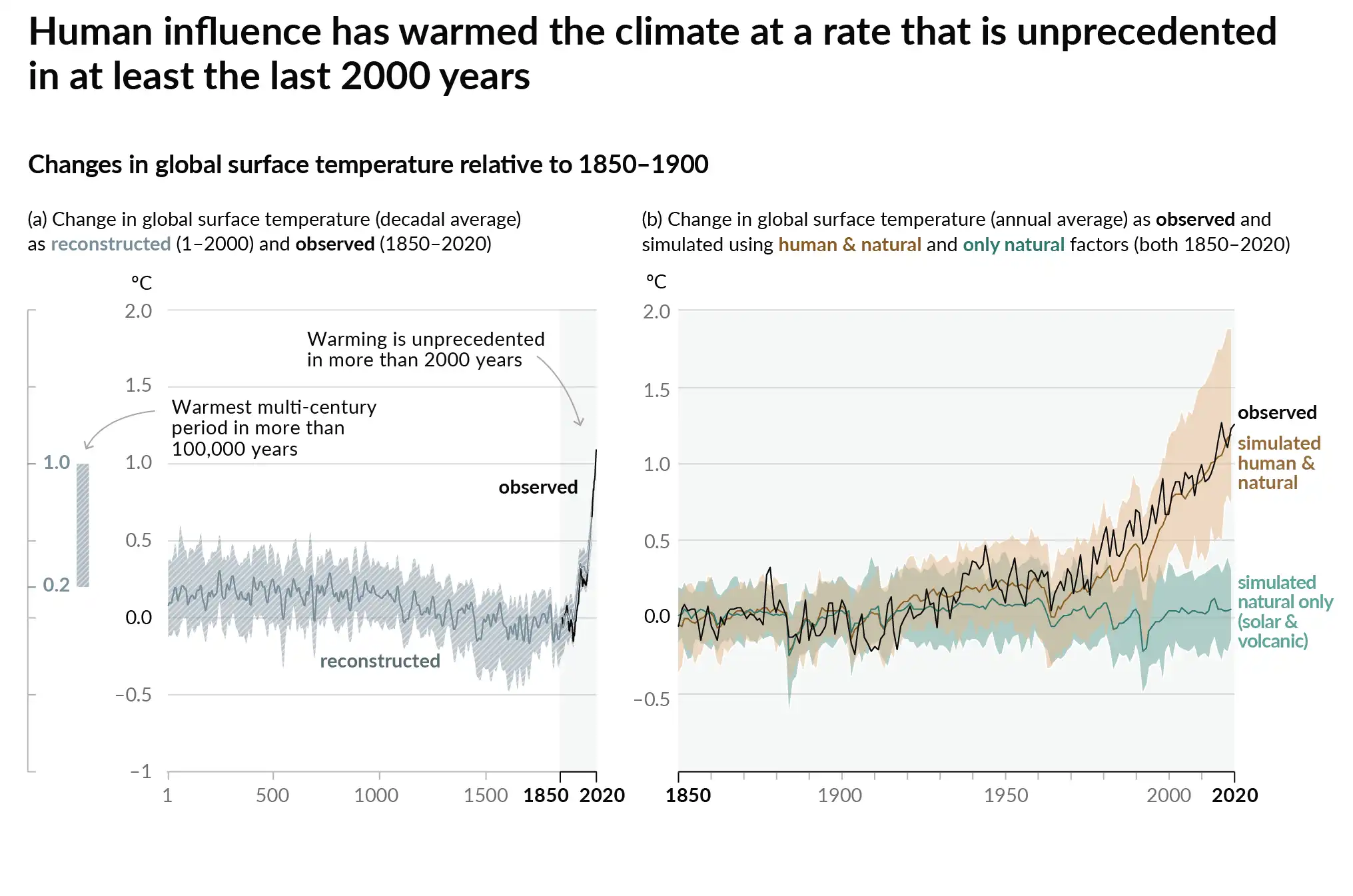
Note that "skeptics" publish papers from time to time purporting to explain recent temperature trends using factors other than CO2. These papers usually suffer from major weaknesses. I reviewed one of them a couple of years ago. It was a badly flawed paper. In general, the climate science community agrees that recent warming trends cannot be explained without including the role of CO2.
- Just have a think: Arctic Sea Ice minimum 2024. Three degrees Celsius warming now baked in?
Eclectic at 12:50 PM on 27 September, 2024Jim Hunt @2 ,
you were, two or three days ago, crossing swords with the amiable skeptics at WUWT blog, about Arctic ice.
It seems they feel that a sort-of flat-lining of minimum Arctic sea-ice extent during the past decade . . . is a disproof of the contemporary reduction in Arctic sea-ice volume . . . which in turn demonstrates that there will be no further ice melt as sea-level continues to rise ~ the ongoing rise which in turn disproves that global warming is occurring. (If I have understood their argument correctly.)
And since global warming is not continuing, despite rising measurements by worldwide thermometers, then the whole AGW thing is a hoax and can be ignored.
Or something like that.
And if Plan Denial eventually crumbles, then the WUWT skeptics will develop "concepts of a plan" to deal with the non-problem. [Please excuse contemporary 2024 political joke.]
- Welcome to Skeptical Science
Bob Loblaw at 01:07 AM on 5 April, 2024cookclimate @ 118:
I have looked at the paper in the volume I linked to in comment 121. There are definite changes compared to an earlier version I found that said "submitted to Earth and Space Science", so I presume that you've had some sort of review and modified the paper since the earlier drafts.
It looks like you have identified the 1470-year cycle using your eyecrometer. I see nothing in the paper that actually does any sort of signal processing to identify cycles using any objective statistical technique. You are seeing a cycle because you want to see a cycle.
Your speculation includes arguments that include all sorts of stuff that has been debunked many times before. Pages are available on Skeptical Science that cover thee topics:
- Geothermal heat flux is included in this post.
- The "CO2 lags temperature" argument is discussed here.
- Most of your examples use regional, not global, temperature proxies. Regional temperatures are far more variable than global ones, and it is invalid to compare the two directly. This is discussed in this SkS post.
- You're convinced that an increase in volcanoes are adding to warming. That is the opposite of the argument commonly made by "skeptics" that increasing volcanic activity caused the Little Ice Age, so a subsequent decrease is causing warming (discussed here). In any event, just counting the number of volcanoes (your figure 3) is extremely simplistic. Arguing that more volcanoes implies more geothermal heat is a non-starter, as discussed in the post linked above.
- Your "computer models are unreliable" is an old, tired argument, scoring position 6 on the SkS Most Used Climate Myths. The rebuttal is here.
So, your paper is really nothing more than an "I see it" 1470-year cycle mixed with a rehash and Gish Gallop through a variety of common "skeptic" myths. I could probably find more, but it isn't worth the time.
I hope you didn't pay too much money to get it published.
- Climate - the Movie: a hot mess of (c)old myths!
jimsteele24224 at 07:54 AM on 4 April, 2024I would respond to Charlie_Brown and Eclectic, but the moderator will simply remove my comments that refute your comments. Clearly commneting here on SkS is a privelege only given to those who support the CO2 warming narrative. Allowing scientific debate is not something that is honored here as revealed by the "moderator" deleting my post on polar bears, and other trivia. WUWT is clearly offtopic, but is always allowed because it dishonestly trashes skeptics which is the mission of SkS.
- Climate - the Movie: a hot mess of (c)old myths!
jimsteele24224 at 03:15 AM on 4 April, 2024Eclectic, LOL What are you talking about saying " Jim ~ you would lose all scientific credibility if you assert that the so-called greenhouse effect does not exist."
But truth is I have never denied the greenhouse effect. Your allegations are typical of alarmists trying to denigrate skeptics. Every skeptic I know totally understands the greenhouse effect and are grateful for its warming effect. The question is how much does further increased CO2 cause further warming and is that beneficial or not.
Your second funny is telling me not to get distracted by the details of the actual mechanisms of the ocean is warming, simply because you believe ,without ever substantiating, that there are equilibrium points that are unaffected by those proven dynamics.
Please educate yourself Eclectic.
- Climate - the Movie: a hot mess of (c)old myths!
jimsteele24224 at 02:19 AM on 4 April, 2024Eclectic, LOL What are you talking about saying " Jim ~ you would lose all scientific credibility if you assert that the so-called greenhouse effect does not exist."
But truth is I have never denied the greenhouse effect. Your allegations are typical of alarmists trying to denigrate skeptics. Every skeptic I know totally understands the greenhouse effect and are grateful for its warming effect. The question is how much does further increased CO2 cause further warming and is that beneficial or not.
Your second funny is telling me not to get distracted by the details of the actual mechanisms of the ocean is warming, simply because you believe ,without ever substantiating, that there are equilibrium points that are unaffected by those proven dynamics.
Please educate yourself Eclectic.
- A data scientist’s case for ‘cautious optimism’ about climate change
Bob Loblaw at 22:44 PM on 2 April, 2024Regarding heat deaths vs cold deaths, RealClimate had a post on that a few years ago:
From the introduction:
Climate skeptics sometimes like to claim that although global warming will lead to more deaths from heat, it will overall save lives due to fewer deaths from cold. But is this true? Epidemiological studies suggest the opposite.
As for William's latest @8, once again William simply does not accept the extensive economic calculations that say avoiding the problems will cost less than dealing with them.
Air conditioning will not help people that have to work outside. Air conditioning will not save agriculture. Air conditioning will not stop flooding.
William demands "absolute certainty" before any action should be taken to prevent a problem.
Do you have car insurance, or fire insurance, William? Or are you waiting until you have absolute certainty that a car accident or fire has already happened?
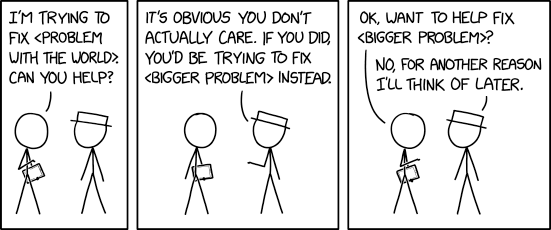
As a general rule, it seems that people that argue "there are bigger problems" [cough]Lomborg[cough] never seem to actually put any effort or resources into taking actions on those "bigger problems".
[Courtesy of XKCD]
- Climate - the Movie: a hot mess of (c)old myths!
Bob Loblaw at 03:59 AM on 2 April, 2024Frankly, Two Dog, you are continuing to put words in other people's mouths, and continuing to create strawman caricatures of climate science. Many people working in climate science are actually well-trained (if not primarily trained) in physics and geology. All you are doing is showing your abysmal ignorance of the science and the people involved.
I'll choose one example - in fact, the first example I decided to check. Michael Mann is often a target of the fake "skeptics". He is a well-respected member of the "climate science" community. You can find his biography at realclimate.org. Here is his academic training:
Dr. Mann received his undergraduate degrees in Physics and Applied Math from the University of California at Berkeley, an M.S. degree in Physics from Yale University, and a Ph.D. in Geology & Geophysics from Yale University.
You should be embarrassed at how easy it is for people to show that you have no idea what you are talking about.
Once again, nobody has ever claimed "knowledge of all factors that impact the climate." Nobody has claimed that natural factors are not significant. Nobody has claimed that all natural factors are temporary (which is what I presume you have meant with your use of the term 'temporal').
Natural factors exist on a variety of time scales, from hours to thousands of years, and "climate science" has considered many of them, and found that many of them can be both measurable and predictable. And they have collected evidence to support the position that these factors are having impacts that are much less important that CO2 over the past few decades - and are extremely unlikely to become more important than CO2 in the coming decades.
What you have utterly failed to do is to provide any new "natural factor" that you think has not been considered and can possibly have a large enough impact to explain what is already fairly well-explained by the factors that we do know about and have quantified. It's time to put up, or shut up.
What you have done is refuse to actually engage in discussion with people that have pointed out your errors. You simply re-assert your unfounded and uniformed opinions. As OPOF says, you have an "apparent resistance to learning".
Before you comment again, I suggest that you read the Comments Policy, especially the part about excessive repetition. If you are only going to repeat your uninformed and unfounded strawman arguments, you should expect to see parts or all of your comments subject to moderation.
Comments should avoid excessive repetition. Discussions which circle back on themselves and involve endless repetition of points already discussed do not help clarify relevant points. They are merely tiresome to participants and a barrier to readers. If moderators believe you are being excessively repetitive, they will advise you as such, and any further repetition will be treated as being off topic.
- Climate - the Movie: a hot mess of (c)old myths!
Eclectic at 17:29 PM on 28 March, 2024John Mason @30 : Quite right !
"Denier" is as good a term as any, for the deniers /climate deniers /science deniers. The term has been around for decades, and everyone knows who & what is meant by it. Yes, the Deniers themselves know full well that it accurately applies to them ~ even though they bristle (and distract) about the "denier" label. For the Lady doth protest too much , when she keeps insisting desperately that she is a "realist" or "skeptic".
Possibly the poster Two-Dogs has not given any actual thought to the old hand-wavy claim that there might be some undiscovered mysterious physical cause responsible for the recent rapid global warming.
That's where I find that the self-styled "skeptics" run into the problem of (what I call) the Two Sides of the Coin. Indeed, I have never had any decent answer from any denier /provocateur /troll /sealion whatsoever.
And the problem is this :- since the known anthropogenic causes of rapid warming are neatly explaining the global warming ~ then, if the modern warming were largely caused by mysterious forces unknown to today's science . . . then it follows that there must exist another unknown mysterious factor, a cooling factor, which precisely (and increasingly) is counteracting the ongoing warming effect of higher GreenHouse Gasses in the atmosphere.
Mr W. Occam must have very raised eyebrows indeed, at the suggestion of at least two new mysterious explanations !
Quite the puzzle. Perhaps, maybe, Two-Dogs can give the answer.
- Climate - the Movie: a hot mess of (c)old myths!
Two Dog at 00:33 AM on 28 March, 2024I am relatively new to criticisms of the man-made global warming narrrative but it seems to me that some of the points made in this film have merit.
First, the use of emotive language in a critique like "climate change denial" (what does that even mean?) is problematic. The climate has never been in perfect equilibrium, so presumably nobody denies it changes - best to stick to the arguments. Second, we seem to focus on the wrong question. I think very few anthropogenic climate change skeptics would deny we are pumping more CO2 into the atmosphere right now than ever before and that has a warming effect (the "greenhouse effect"). Surely the question is: "To what extent are man-made increases in CO2 emissions driving the current warming we are experiencing?". It clearly cannot be 100% and for me that is the nub of the question.
Given the huge unknowns about the factors that drive climate (and their significance) it seems unfortunate to me that there is an intolerance around this question. The BBC, for instance, should consider other theories on this. It may well be that the scientific weight suggests anthropogenic CO2 is by far the major cause, but in my reading there are some good reasons to doubt that.
The problem with “shutting down debate” is best evidenced with covid where many of the “conspiracy theories” proved to be correct. - John F. Clauser: the latest climate science-denying physicist
Just Dean at 07:27 AM on 20 November, 2023Almost all Nobel Laureates and National Academy of Sciences members have different different views than the handful of outliers that get a lot of outsized attention.
In 2015 and 2016, 76 Nobel Laureates signed the Mainau Declaration on Climate Change with an urgent warning about the consequences of climate change.
I have scoured the internet looking for NAS members who appear to be climate change skeptics, contrarians or deniers. I have found 7 living members, two of which are Nobel Laureates, Ivar Giaever and Robert Laughlin. The other five are Claude Alegre, John Dewey, William Happer, Richard Linzen and Steven Koonin. As of 2022 there were 2493 NAS members. These seven are all over 70 and represent 0.3%. If I'm off by a factor of 3, they will still represent less than 1%.
- 2nd law of thermodynamics contradicts greenhouse theory
Bob Loblaw at 04:11 AM on 28 September, 2023FYI, there is a more complete debunking of Peter Ward's "theories" at this blog site:
https://hannahlab.org/climate-skeptics-peter-wards-ozone-depletion-theory/
- It's cooling
Rob Honeycutt at 06:54 AM on 5 September, 2023CORK... "But this is not incompatible with a cooling at geological time scales."
What's important to understand is that warming or cooling, on whatever scale, is due to physical processes, most of which are at least fairly well understood by researchers.
The Escalator graphic is demonstrating there are inherent variations in the surface temperature trend. This makes sense when you understand that short term changes surface temperature is a function of energy going into and coming out of the earth's oceans.
The Escalator graphic is presented to explain how "skeptics" will use very short trends in global temperature to claim the "globe" has stopped warming, when nothing could be further from the truth.
The earth, on the whole, is rapidly warming primarily due to increasing atmospheric concentrations of greenhouse gases. That fact is true regadless the short term rate of warming at the surface.
- There is no consensus
rkrolph at 17:00 PM on 15 August, 2023I have been wondering lately if some of the more famous climate change skeptics, climate scientists like Judith Curry, have modified or adjusted their outlier positions as the global warming crisis grows worse year by year.
But apparently not, based on the article I read in the Torrance Daily Breeze by John Stossel, titled "The fake climate change consensus", that quoted her extensively, Most of the article I recognized as long ago debunked garbage, but it seems surprising to me that experienced climate scientists like Curry would still be promoting this kind of nonsense.
- 2nd law of thermodynamics contradicts greenhouse theory
scaddenp at 11:32 AM on 14 June, 2023Likeitwarm - thanks for those answers, though if you realize that IR leaving the surface is captured by GHG (CO2, water) without having traveled very far; and then re-radiated, I am surprized that you were not understanding that GHG gases result in a warming surface. ok, file that away.
I leave others to discuss sources of your beliefs about renewables and chinese efforts, but I would have to ask this: If you became convinced that conversion to renewables was not going destroy world economies would that reduce your skeptics about global warming do you think? If it had been obvious to you when you first heard about global warming that getting off fossil fuels was both possible and economical, then would you have been so skeptical of science?
Do you feel differently about CO2"Science" now that you have seen them play with strawman arguments or would like other examples of their game before you wrote them off?
- There is no consensus
Rob Honeycutt at 09:25 AM on 22 April, 2023Okay, let's go over this again, Albert.
The premise of the paper is as stated in the introduction.
We examined a large sample of the scientific literature on global CC, published over a 21 year period, in order to determine the level of scientific consensus that human activity is very likely causing most of the current GW (anthropogenic global warming, or AGW).
Do you honestly not see the words: human activity is very likely causing most of the current AGW?
That statement creates the fundamental basis of papers that either endorse or minimize that position.
If you're telling me that most "skeptics" agree that human activity is very likely causing most of the current GW... hey! We're good!
"It is a clear indication that only 1.6% of the papers thought that humans were causing most of warming."
Nope, precisely because categories 1, 2 and 3 all endorse the idea that human activity is very likely causing most of the current GW.
"...AMS in 2016 and it explicitly asked members if they vpbelieved humans were responsible for the majority of warming and 67% said yes."
And they also explain that most of their members were NOT experts in climate science and do not publish climate research. The greater their expertise, the greater their level of agreement, with the highest level of expertise also demonstrating ~97% agreement with the idea that human activity is very likely causing most of the current GW.
"...why Cook went to considerable lengths to hide the category numbers."
He didn't.
"I am passionate about truth in science..."
Clearly, quite the opposite.
"...I have an open mind on all matters..."
As Carl Sagan used to say, "It's good to keep an open mind, but not so much that your brain falls out." I think that perfectly describes your position in this matter.
"In the sixteenth century, 99.9% of scientists believed the Sun orbited the Earth."
No, it was 16th century scientists who were explaining to people the earth orbited the sun. Once presented within a scientific/mathematical structure, scientists of the day readily accepted this fact.
"i Won't be commenting on this thread again."
We are relieved.
- There is no consensus
Albert22804 at 09:02 AM on 20 April, 2023"No, Albert. Most "skeptics" do not endorse the idea that humans are the primary cause of global warming. They minimize human contribution to warming"
Sorry Rob, that is not what a I said. Most sceptics accept the primary greenhouse theory where ECS is about 1.2C but Not the positive feedback theory where ECS increases to 3-4.5C.
This puts them in category 2 or 3 and not category 5,6 or 7.
So it's not surprising that categories 5,6 and 7 have low numbers.
- There is no consensus
Rob Honeycutt at 05:23 AM on 20 April, 2023In order to come to the conclusions he is, Albert has to completely ignore this important statement in the introduction of the Cook paper.
We examined a large sample of the scientific literature on global CC, published over a 21 year period, in order to determine the level of scientific consensus that human activity is very likely causing most of the current GW (anthropogenic global warming, or AGW). [emphasis added]
This is the fundamental premise of the research. This explains why there are endorse vs minimize categories. Albert is laser focused on a misinterpretation of only one sentence in the paper, to the exclusion of all else, in order to confirm his priors.
As I've pointed out innumerable times over the decade since the publication of Cook, the "skeptics" are more than welcome to do the exact same research and see what results they get. And in that decade none of them have taken up that challenge, more often than not coming up with lame excuses why they can't or won't.
- There is no consensus
Rob Honeycutt at 01:04 AM on 20 April, 2023@922... No, Albert. Most "skeptics" do not endorse the idea that humans are the primary cause of global warming. They minimize human contribution to warming.
- There is no consensus
Rob Honeycutt at 14:35 PM on 19 April, 2023And... "Skeptics believe in the direct effect of CO2 causing an ECS of about 1.2C but reject the positive feedback theory pushing ECS to 3C and beyond."
Actually, that would be a denial position. You'd have to throw out an enormous body of research to come to such an absurd conclusion.
The direct effect from CO2 is, as you say, ~1.2°C but you can't just reject physics and say there wouldn't be feedbacks. The feedbacks are very well known.
- There is no consensus
Albert22804 at 13:09 PM on 19 April, 2023Once again I ask, why have 3 categories lumped into the "97%" result when only one category saying "explicit or implicit support that humans contribute to global warming".
Again, virtually every sceptic scientist, meteorologist, geologist, etc would agree with the above statement so they will not be publishing a paper saying there is little or no anthropogenic warming.
Skeptics believe in the direct effect of CO2 causing an ECS of about 1.2C but reject the positive feedback theory pushing ECS to 3C and beyond.
So categories 5,6 and 7 are really meaningless, because of the above.
Quite commonly I see statements saying that Cooks paper said the "97% of scientists believe that humans are largely (>50%) responsible for global warming" but Cooks paper category 1 clearly and unambiguously states that the figure is 1.6%.
- There is no consensus
Bob Loblaw at 05:04 AM on 19 April, 2023Albert @909 starts off by questioning the groupings in the Cook et al 2013 study, saying that he searched and could not find totals for the individual categories.
I have linked to the journal article above, and you can scroll down and find the "Supplementary data" link. In that data, one of the files provides every single paper/abstract included in the study, and it's ranking. It's pretty trivial to read that into a spreadsheet and get totals for each group. Those totals are:
1
Explicitly endorses and quantifies AGW as 50+%
64
2
Explicitly endorses but does not quantify or minimise
922
3
Implicitly endorses AGW without minimising it
2910
4
No Position
7970
5
Implicitly minimizes/rejects AGW
54
6
Explicitly minimizes/rejects AGW but does not quantify
15
7
Explicitly minimizes/rejects AGW as less than 50%
9
The paper points out that category 4 includes two groups, which need to be treated differently:
- No position (7930 papers)
- Uncertain (40 papers)
"No position" must be excluded entirely, as it is impossible to conclude a position that is not expressed in the paper's abstract. That makes a total of 4014 papers that express an opinion (explicitly or implicitly).
Given the groupings of 1-3 and 5-7, it is obvious that 1-3 share the trait of "not minimized". It is perfectly reasonable to treat "not minimized" as ">50%", when the paper does not quantify a value.
Likewise, grouping 5-7 together is the opposite: they all share the trait of "minimizes", whether they have quantified the minimization or not.
The point of the three categories is to distinguish between explicit quantification, explicit without quantification, and implicit without quantification - on both sides of the equation.
Now, what about that 1.6% number that Albert throws out? To get 1.6%, you have to pick category 1 (64 papers) and divide by 4014 (the total number that expressed an opinion, explicitly or implicitly).
So, while Albert is questioning the grouping of papers into 1-3 and 5-7, he sees no problem in grouping 2, 3, 5, 6 and 7 together into one category and calling it "papers that disagree that humans caused most of the recent warming". That grouping is far less supportable than the grouping used in the paper. Categories 2 and 3 (totalling 3832 papers) clearly are not defined in such a way that you can interpret "not minimized" as "<50%".
In fact, if you only consider the papers that explicitly quantify the effect as >50% or <50%, there are only 73 papers in categories 1 and 7 - and 64 of them say >50% of recent warming is due to humans. That is 88% of the total. A far cry from Albert's 1.6%.
We can also compare categories 2 vs. 6. 98% are on the "endorses" side.
And we can compare categories 3 and 5. Again, 98% on the "endorses" side.
Either Albert has not really considered where the 1.6% value came from, or he is deliberately trying to bias the result in one direction.
As for his final claim about "skeptics" being included in the 97%, Skeptical Science has another blog post on that matter. Scroll down to the section titled "Confused Contrarians Think they are Included in the 97%".
Albert is just repeating frequently-debunked crap.
- At a glance - What do the 'Climategate' hacked CRU emails tell us?
jimspy at 18:41 PM on 1 April, 2023If I had a nickel for every time I had to remind skeptics that there are two, subtly but distinctly differentiated meanings of the word trick... A simple way to present it, at least in person, is to demonstrate how to mutiply by 9 on your fingers. The multiplicand is 9. Count on the fingers of your left hand up to the multiplier, let's say it's 5. You bend your fifth finger (pinky) down. There are 4 fingers remaining on your left hand, and 5 remaining on your right - 45. Now, I just showed you a trick....but did I trick you?
- Renewable energy is too expensive
stranger1548 at 07:53 AM on 6 March, 2023Sorry for the confusion! I forgot put in the quote marks. The first paragraph is what I wrote. The rest was the skeptics claim.
- It's not bad
PollutionMonster at 11:08 AM on 21 February, 2023Eclectic @410
Right now I am talking with a person who's position is ambiguous. The individual claims they are not a climate denier. Yet, they make many of the denier's talking points. Similar to dog whistling. My guess is they are a climate change denier, but won't admit it.
Instead, hiding behind how much the "working class" is harmed by "rip off merchants". Sample argument below:
"But I'm not a Trump supporter or a climate change denier I'm concerned about costs to the working classes you claim you are also yet you sound exactly like one of the rip off merchants who feign concern over the planet yet profit significantly from forcing people into green schemes they cannot support, you have no explanation on how it's in anyway reasonable to expect people to pay for electric cars or solar panels, you also want to punish them further by insisting they cycle long distances to work in every sort of condition." sample probably climate change denier argument
This seems like classis motte and bailey strategy to me. My advice to you is push a little further than you feel comfortable into the innermost motte by pushing climate change action. Giving no place to retreat, this advice is from the skeptics guide to the universe book by Steven Novella, MD.
I've found very few climate change deniers will straight out deny warming. Instead, hiding behind more "moderate" stances. The result is the same whether a hardcore or moderate denier, slothful climate action. Anti-vaxxers do the same, "I'm not anti-vaxx I am anti-mandate and mask".
I. Ban Gasoline leafblowers. One of my favorites to show climate change mitigation can be very small. Many people want to get rid of them anyways.
II. Transfer fossil fuel subsidies to renewable. Showing the true cost of fossil fuels.
I think you are 100% correct about persuading the onlookers. Good points on A, B, and C I will try them. C seem very interesting the part about denialists hating the idea of refugees and migrants. :)
- The connection between Hurricane Sandy and global warming
stranger1548 at 10:05 AM on 29 January, 2023Sorry, this is the only reference I could find to hurricanes. My question is that it seems I've for read for years that there is no scientific consensus on increasing numbers of hurricanes but that there is consensus on growing intensity. Exchanging posts with a skeptic I failed to back the statement on hurricane intensity. The studies I've looked use modeling the future but as we know the word modeling only receives derision from climate skeptics. I couldn't find any actual proof that hurricanes have intensified. I couldn’t find any climate signals that support the premise.
- We’ll keep tweeting (for now) but have also started tooting.
Eclectic at 18:06 PM on 27 December, 2022Slumgullionridge @71 :
Fair enough. SkepticalScience was set up as an educational resource. With its long list of Most Used Climate Myths , it provides you (or anyone) a reasonably quick & efficient way to gain scientific knowledge about climate. You can wade through the Myths one after the other, in turn. Or if you already have moderately good background knowledge, then you can pick out those Myths which fill the gaps (and read the discussions of the peer-reviewed studies, to be found in the comments columns there). I must confess I have not found a better website for that educational purpose.
The problem then becomes: what do you do when you have achieved a high passing grade in the comprehension of climate science? I do not mean by that, the achievement of mastery & expertise in all the minutiae & technicalities, I mean, enough knowledge to see that the mainstream climate science is correct ~ and the skeptics/contrarians haven't a leg to stand on (despite their repetitious assertions).
I guess you then consider retiring to your cabin by the lake, and dismissing the climate problem from your mind. Or you consider spending some time on the subsequent aspect ~ what to actually do, in terms of political science, ethics, and so on. Plenty of room there for hot-headed conversations . . . most of which crop up in the ephemeral/daily topic threads (such as the one where you are now posting).
Some amount of rhetoric & pomposity is almost inescapable in discussing political matters. ~ Just the nature of the beast.
- Welcome to Skeptical Science
Bluepenguin at 13:57 PM on 13 September, 2022the whole prospect of climate change is scary. I mean it made it look scary if we don't do anything now people are saying that our planet is in danger and so are we. I do believe in climate change it is something that I have felt over the years. I am someone who likes to question and find the answer to things that I do not know. So I understand how there are skeptics out there when the evidence isn't solid. all I can do is form My opinions. I want our climate to get better but I need more knowledge on the subject before I can say anything.
- Welcome to Skeptical Science
Reagan123 at 10:13 AM on 13 September, 2022There is no doubt that climate chnage and global warming are happening all around us. I understand there are skeptics but how could you look at all the research and evidence and still go hmmmm maybe not? There are articles about icecaps melting, wildfires due to drout, warmer climate due to moisture in the warmer air. I think it's time we come together as a people and try to cut down our carbon emissions worldwide. We've been gifted this wonderful planet that takes care of us, lets take care of it in return!
- Welcome to Skeptical Science
Bobby21796 at 03:05 AM on 13 September, 2022While studying climate change, it is important that we have a skeptic mindset and not a denial mindset. Skeptics look for a definitive answer backed by evidence while peopel with a denial mindset shut down anything that is not proven correct. All the data with climate change should be viewed with skeptic mindset, not denial. This is so any theory or data that is not 100% proven is still accepted. A denialist would shut down anything that is only 99% correct. A skeptic would say that 99% is probably true. Not everything always lines up or makes sense to us, but that does not mean it is not true and can be denied.
- Welcome to Skeptical Science
jonsnow at 09:09 AM on 12 September, 2022I agree that skepticism is better than denial. I think that in order to form a decent opinion regarding climate change, all of the facts need to be considered. That being said, I myself can see that we need to have more people who are "skeptics" rather than in "denaial". We need this change in order to stop the planet from burning up. If we do not make this change, the damage we could cause now and in the future is unfathomable. I will thoroughly enjoy looking at all of the theories and myths regarding climate change on this website.
- There's no tropospheric hot spot
MA Rodger at 19:23 PM on 23 August, 2022Cedders @33,
And having had a read of that PDF...
Cedders @33,
Having examined the PDF (16 pages not 24), it is quite evident that it is a pile of utter nonsense, a "welcome to the lunatic asylum" message and not anything in any way scientifically-based.
The author is Piers Corbyn, a well-kown denialist and an elder brother of Jeremy Corbyn (a long-serving left-wing Labour MP who bizarrely gained the heady position of Leader of the Labour Party for 4½ years).
Piers Corbyn is described in Wikithing as "an English weather forecaster, businessman, anti-vaxxer and conspiracy theorist" and does feature here at SkS being (1) Cited within a spot of denialism of 2015 in the Daily Express tabloid/comic, (2) The main source of a pile of climate nonsense of 2013 from the then Mayor of London Alexander Boris von Pfiffle Johnson, a man now renowned throughout the known world for not being particularly truthful, (3) Listed here at SkS as a denialsit with zero peer-reviewed writings.
The 16 page thesis linked up-thread @33 is a 2019 thesis presented to the Reading University Debating Journal and sitting at the top of a list of 24 such theses posted 2018-19, top of the list because it is the most recent (the journal lasted less than a year), a list which addresses such important topics as 'Why Self-Service Checkouts are the Invention of the Devil' and 'The Great University of Reading Catering Con: Man Shall Not Live off Sandwiches Alone' and an anonymous piece 'Why I Support the Conservatives: The Most Successful Party in British History'.
The Piers Corbyn thesis begins by citing David Legates' dismissal of the 97% AGW consensus before dismissing that because "it is about facts; and no Global-Warming Inquisition is going to prevent me exposing their nonsensical theories."
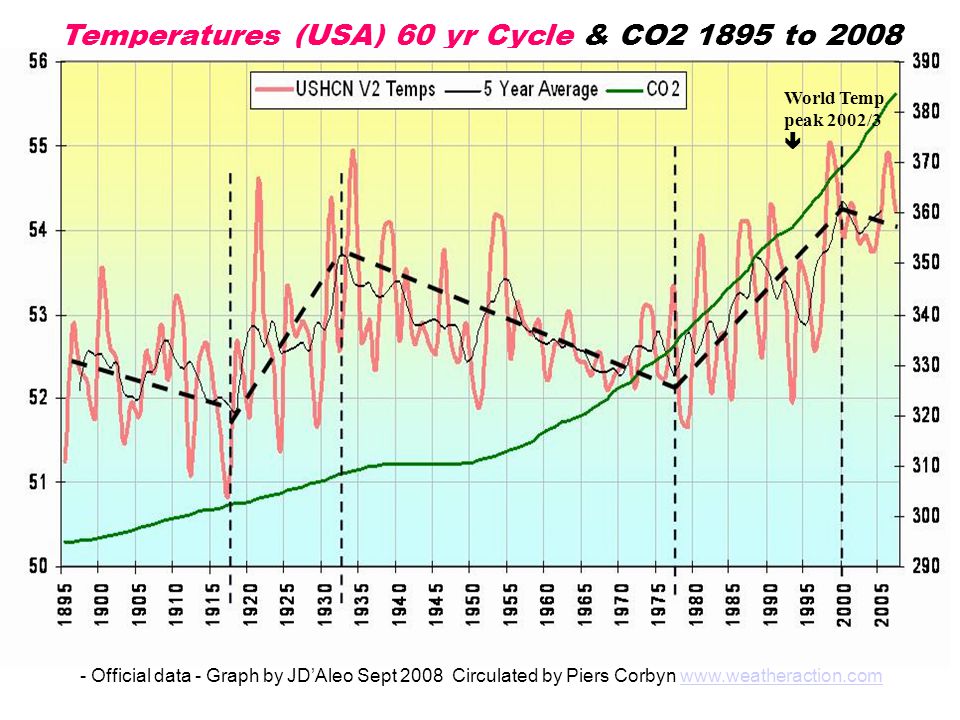
Corbyn then kicks off by asserting anthropogenic CO2 comprises 4% of atmospheric CO2 (thus confusing FF carbon with naturally-cycled carbon) and that CO2 is not the main controller of global temperature (here presenting a graphic which confuses the US temperature with global temperature - shown below in this comment).
A further assertion is then presented, that CO2 is the result of warming oceans with six references/notes provided in support which seem to all point back to crazy denialist Murry Salby.
So, a la Salby, the present rise in CO2 is claimed to result from the good old Medieval Warm Period. A graphic is presented comparing a denialist 1,000y temperature record (based on the schematic FAR Fig 7c) with the much-confirmed scientifically-based Hockey Stick graph.
This brings us to the halfway page of Corbyn's denialist rant.
The thesis continues with pageful of misunderstanding of how the GH-effect works, ending with accusations that this misunderstood 'theory' breaks the 2nd Law of Thermodynamics (or it does if you misinterpret the 2nd Law of Thermodynamics).
Happily, this misunderstanding is considered to be not supported by "better scientists" who consider the lapse rate. And this indeed is a 'better' consideration. But here Corbyn perhaps confuses the tropical 'hot spot' (which is caused by increased tropical rainfall transporting more latent up into the troposphere) with some CO2 effect. (The 'hot spot' results from a warmer tropics and not per se any enhanced GH-effect.) And he fails to address the reasons why there is difficulty detecting this tropical 'hot spot'. Indeed he brands it as a 'coldspot' that he seems to say is caused by "more CO2 & other GHGs" which cause a diurnal fluctuation in the IR "heat-exit height" to become greater and, due to the 4th-power in the SB equation, this causes cooling. Whether such a phenomenon extends beyond the tropics (thus globally more-than negating the 'hot spot') is not properly explained but, due to the lapse rate this phenomenon can apparently also negate "the original expected surface warming."
A first graphic box is presented with three unsubstantiated bullet points explaining "Why CO2 theory does not work" alongside two similar "apart from"s.
A second graphic box also titled "Why CO2 theory does not work" states:-
In the real atmosphere there are day/night temperature fluctuations (eg in upper atmosphere). They are larger with more CO₂ because CO₂ (infra red absorber / emitter) gains & loses heat easier than N₂ & O₂ and so enables all the air to adjust quicker.
This is a fundamentally different explanation from the previous fluctuation in IR "heat-exit height" explanation described earlier, and it is still wrong.
(A packet of air with X concentrations of CO2 will both emit and absorb an IR photons of quantity P. With absorb=emit, it is thus in equilibrium. Add CO2 so the concentration is doubled to 2X, and the emitting photons will double to 2P and the absorbed photons will also double to 2P so absorb=emit and the same equilibrium is maintained. The main result is that twice the level if IR emission has half the pathlength before absorption so at any point the IR flux remains unchanged. And CO2 does not "gain & lose heat easier than N₂ & O₂" when it remains thermally coupled to the N₂ & O₂. )
The remainder of this second graphic box on PDF page 9 is a little too confused to rebut with any confidence. A diurnal range of "about 5 or 6 deg" is given which is apparently a temperature range yet whatever “deg” means (presumably Kelvin), the bulk of the troposphere has a far smaller diurnal range than even 5ºF. The mechanism for the enhanced cooling from the "heat-exit height" is presented as due to a fluctuating temperature losing more heat (by radiating IR) than a constant temperature (which is true). A rather dodgy-looking equation is followed by the note "Detail subject under research" but no reference is given and three-years-on there is no sign of such "research."
And a third graphic box is shown on the next page also titled "Why CO2 theory does not work," this third such graphic mainly presenting a pair of images from Australian denialist David M. W. Evans who has his own SkS page of climate misinformation.
The thesis then turns to the proposition that it is not CO2 but solar forces that "rules climate temperature" with the dotted line on the graphic below described as such a ruling influence. It apparently shows how the "9.3yr lunar-nodal crossing & the full 22yr solar magnetic cycle" allegedly shift the jet stream and "many circulation patterns." The graphic's 60-yr periodicity is less than convincing,being fitted to US rather than global temperature which, when extended beyond the 1895-2008 period shows itself to be simple curve-fitting (eg the Berkeley Earth US temperature record 1820-2020 does not show it, even to a blind man). The graphic was presented by Corbyn at the Heartland Institute's 2009 conflab in NY in which Corbyn [audio] insists other findings demonstrate “something is going on” but why it is this graphic being reused in this 2019 thesis is not clear – perhaps the forecast of world temperature dropping to 1970s levels by 2030 is too evident on other slides he used in that Heartland presentation.
To support his thesis Corbyn mentions an alleged cover-up by the likes of the BBC in reporting only global warming when the 'true' data shows cooling, the reported support for all this Piers Corbyn craziness from oil companies who shy away only because they want to use AGW to "make higher profits" and how these AGW-inspired mitigation agendas are already directly responsible for needlessly killing "millions" annually.
The thesis ends with a challenge:-
It is for this reason that I, Piers Corbyn, challenge whoever is willing in Reading University or other appropriate institutions to a debate on the failed Global warming scam vs evidence-based science.
So I interpret the thesis as a "welcome to the lunatic asylum" message from Piers Corbyn.
- It's the sun
Bob Loblaw at 04:35 AM on 9 August, 2022HK @ 1303:
Those numbers are consistent with other sources.
Note that the shorter wavelengths do not reach the earth's surface. They are absorbed in the upper atmosphere - e.g., by ozone in the stratosphere. Absorption of radiation is what heats the stratosphere, as seen in this image I linked to in another thread last week (from Manabe and Weatherald, 1967):
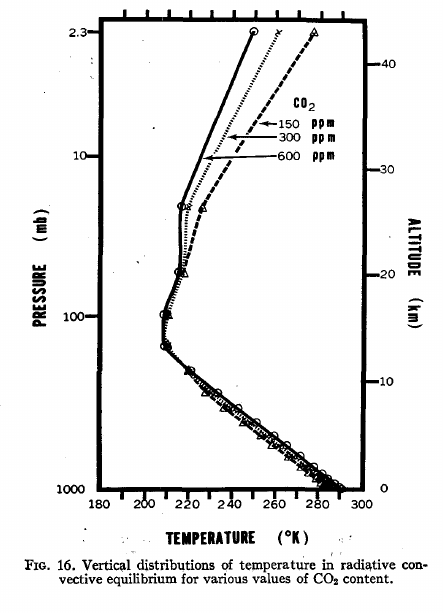
This page, from highly-respected radiation instrumentation company Kipp and Zonen, gives a breakdown of atmospheric transmission of various wavelengths.
https://www.kippzonen.com/Knowledge-Center/Theoretical-info/Solar-Radiation
The shorter UV-B and UV-C wavelegnths are either mostly or completely absorbed before reaching the surface. A table from that page:
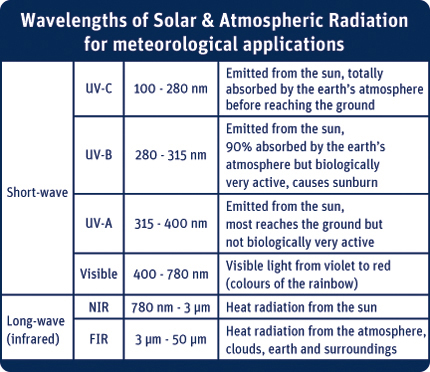
The low amounts of energy in those short wavelengths - plus the low amounts that penetrate past the stratosphere - are the main reason that climate "skeptics" look for indirect effects, such as cloud formation, cosmic rays, etc. (They are still looking...)
- CO2 effect is saturated
OldHickory at 17:21 PM on 6 August, 2022Where I believe the climate scientists are wrong is in their common response to climate change skeptics about why we need to be concerned about atmospheric CO2 when it is H2O vapor that is the much stronger GHG. Their answer to this question is the claim of a water vapor feedback (also called a CO2 "control knob") as explained in the rebuttal of Climate Myth 36. This only works, however, if the CO2 greenhouse effect isn't already saturated, and more CO2 actually does give a rise in temperature. Eventually, after adding enough CO2, the rise in temperature starts to decline when adding more CO2, and in fact approaches zero. At this point, we say the CO2 greenhouse effect is saturated. Well, it turns out that near the surface of the earth, this effect is highly saturated, and even doubling the CO2 concentration would not result in any signficant temperature change. This, of course, means that the "control knob" fails, and we need not worry about CO2 emissions, anthropogenic or otherwise.
- It's cooling
Bob Loblaw at 01:52 AM on 20 July, 2022Rationalise @ 320.
Welcome to Skeptical Science. Glad to hear that you are looking through the material available here - there is much useful information available.
This web site has a specific goal: to take many of the myths that exist in the understanding of climate science and show what the science actually says. These are labelled myths because there is strong evidence that they are incorrect. They are not dismissed because they are speculative, or because their "conclusions" are disliked - they are dismissed because of the evidence, which is the way science works.
One of the other things you will find here is information on the rhetorical and logical tactics and fallacies that are often used in promoting these myths. For example, the argument that you appear to be making - that science advances through ideas that run contrary to established thinking - is known as the Galileo gambit. Not all "contrary thinking" is a Galileo gambit, but it is one false argument that has been commonly used in the climate science "debates". We even have a page devoted specifically to it here at Skeptical Science:
https://skepticalscience.com/climate-skeptics-are-like-galileo.htm
Also note that here at Skeptical Science, there is a strong desire to keep comments on topic. Please review the Comments Policy, where this is one of the key points. (There is also a link to the policy above the box you use to enter comments.) If you wish to pursue your line of thinking, the above Galileo post is a better place than here, where the myth being debunked is that the globe is cooling.
Also note that each myth debunking usually has Beginner, Intermediate, and (sometimes) Advanced tabs that can be read for more and more detail.
- How to inoculate yourself against misinformation
Philippe Chantreau at 03:52 AM on 3 July, 2022Well, now Petra is displaying projection: accusing others of what one is doing him(her)self. Frank Luntz was instrumental in developing pre-emptive projection, which is far more effective than simple post-facto projection. Your attempt, Petra, is rather clumsy.
There is a quote from you from post#4 above: "In fact, NZ doctor, Dr Sam Bailey, who has made extremely iconoclastic claims with regard to the alleged SARS-CoV-2 virus and viruses in general..."
You brought up Covid misinformation. Nobody else. You did. You were the one who did not "respect that this site was about climate in the first place." In the case of this particular thread, I find it actually appropriate to mention Covid, since the misinformation and disinformation effort about it has been hyperactive and shares many traits with the lies spread by climate pseudo-skeptics. Moderators will tell us to stop if hey see fit.
Then of course, you failed to substantiate your claims. You make very general remarks about Sam Bailey raising questions about viruses in general but makes no effort to explain what said claims are. As for the other assertions, specifically that what was called misinformation has not been identified, you obviously have not substantiated that either.
My conclusion: I am doing exactly what you advocate and apparently are incapable of doing. I am not taking your word for anything. I am skeptical of any and all of your claims until they are properly substantiated. If you offer substance, I will remain skeptical and scrutinize it to make sure it is credible and relevant.
So far you are just waving your hands and accusing others of doing what you are guilty of yourself. I am not impressed.
- The Climate Shell Game
Bob Loblaw at 03:30 AM on 29 March, 2022Jan @64:
And I don't care if the document was peer-reviewed because:
- We have scientists like Ivar Giaever and similar creators here
I don't consider Ivar Giaever to be a reliable source:
https://www.desmog.com/ivar-giaever/
- you can choose peer-review as a service from your defined contacts, even in reputable journals.
Ah, the old "Pal Review" myth. It sure works well for the fake skeptics. Covered elsewhere here at Skeptical Science.
- Skeptical Science New Research for Week #9 2022
michael sweet at 06:30 AM on 7 March, 2022Recently someone who was questioning climate science claimed that they used to think climate change was a big problem but they learned that the problem was much smaller than scientists had predicted. They said both sides exaggerate.
About a week ago the IPCC released a new report about the consequences of climate change. This Guardian article documents that the changes caused by current climate change are much worse than scientists predicted. I have noticed several times in the past that posters come to SkS and say they used to think cimate change was bad but they learned that it was not as bad as scientists predicted. Perhaps that line needs to be added as an argument to the list of skeptics arguments.
My understanding of the situation is that the changes in temperature are very close to the predictions of climate science. The changes in weather extremes, wildfire, floods droughts and other weather related disasters have been much worse than scientists predicted.
I am currently 63. I have a strong recollection from 2014 when AR5 was released by the IPCC and I read the projected problems. I wondered if those problems would be obvious to everyone during my lifetime (I expect to live to be about 85). Many of the problems projected in 2014 are being realized now. Examples include the wildfires worldwide, massive droughts like the one in the American West, floods like those last week in Australia, worldwide coral bleaching, sunny day flooding from sea level rise.
Those claiming that scientists exaggerated the problem are simply repeating the lies of the fossil fuel lobby.
- 2022 SkS Weekly Climate Change & Global Warming News Roundup #7
Philippe Chantreau at 05:56 AM on 28 February, 2022I thought that n factor looked funny.
I also thought that the publication looked suspicious. This is not a paper that I would ever had paid attention to, regardless of what it said.
Explanation: After following this so-called debate for 20 years, digging in the "skeptics" (a qualificative they truly don't deserve) arguments and examining what is actually in the science litterature to the best extent of my abilities, I reached the conclusion that the weight of the scientific evidence points, without contest, to CO2 caused anthropogenic warming.
However, that does not exonerate me from being critical toward any piece of information. If something as dubious, as low quality, poorly thought out as Coe, Fabinski & Wiegleb came along in a publication with all the hallmarks of a pseudo-journal, but with a conclusion reinforcing the one I already reached, I would dismiss it as junk because, well, it is.
That is what being skeptical consists of.
I'm having serious doubts that Santalives is putting forth a sincere effort to evaluate information.
- 2022 SkS Weekly Climate Change & Global Warming News Roundup #7
Philippe Chantreau at 10:14 AM on 27 February, 2022"the content at WUWT seems to be better researched."
That is the funniest thing I have read in a while. People like me who have been following this non-debate for a long time know better.
WUWT is the site where the superbly absurd idea that excess CO2 fell back on Antarctica as carbonic snow was presented, and bitterly defended by the peanut gallery, even after multiple posts showing the phase diagram of CO2 and emphasizing the importance of partial pressure. Finally, someone could beat some sense into Anthony Watts' head, and made him realize that he had better take this off the site if he wanted any appearance of credibility. It is still accessible through the wayback machine, I believe.
The very premise of WUWT existence was the following: there is no warming, it is all an artefact of poorly designed temperature reporting stations, and the whole thing might even be intentional (insert ominous music).
This theory was successfully challenged on multiple occasions: first by a John V, who did a quick analysis of the high quality stations showing no significant difference with the major other datasets. Then, there was the BEST project, led by Richard Muller, who somehow lent credence to the concerns of some so-called "skeptics." At the time this effort was launched, Watts solemnly swore that he woud accept the conclusions. That enthusiasm evaporated (another feedback perhaps?) when the conclusions were released, confirming what the other datasets were already showing. Then, some NOAA researchers published a paper reaching, again, the same conclusions. Then, after much, much time, Watts himself participated in a research paper that essentially redid what the NOAA researchers had done, and reached the same conclusions again, but he pulled a "Spencer" by still making some vacuous argument that, in some way, he could still be right.
Over time, of course, the continued warming forced it to go silent about the very hypothesis that caused its existence in the first place, but there was never any shortage of new spots where other goal posts could be moved. It has now evolved and received help from people who managed to give it a better appearance. Nonetheless, it is still the same motivated reasoning machine that it always was.
- CO2 emissions do not correlate with CO2 concentration
JohnMashey at 08:23 AM on 17 February, 2022The Skrable, et al paper appears akin to last summer's HGSS mess, i.e., HG6-9, Case D in taxonomy of how poor climate papers get published, off-topic journal, weak editorial process, possible "pal review." Publisher Copernicus handled this well, paper retracted, relevant editor and author/editor left.
In this case, the 3 authors were labeled as affiliated with UMass Lowell.
Kenneth Skrable was already emeritus in 2012, p.14 of physics dept brochure.
George Chabot is Professor Emeritus of Physics.
Clayton French is also Professor Emeritus of Physics and you can see his papers there, many coauthored with Skrable and Chabot, often published in Health Physics.
Some were coauthored with current UMAss Lowell prof Mark A. Tries, who is one of the editors at Health Physics.
His 2000 PhD Dissertation p.3 had:
Supervisor: George Chabot, also on p.4. and see p.8 for Acknowledgments
Committee: Kenneth Skrable, Gus Couchell, Clayton French.
Of course, that may be coincidence, as the 3 authors had published many papers in Health Physics, but the question must be raised, given the editorial process:
"Review and Editing Process. After you have submitted your manuscript, a Health Physics associate editor and two peer reviewers (selected by the associate editor) will review it using a double-blind process. The reviewers will evaluate your manuscript's scientific or technical merit, originality, practicality, interest to our readers, and conformance with these guidelines. The reviewers will decide if your manuscript should be accepted, revised, or rejected, and you will be notified of their decision. If your manuscript requires revisions, you can resubmit the revised manuscript. At this point, your manuscript may be accepted, rejected, or the peer-review process may be repeated. When your manuscript is accepted, Journal editors will copyedit it to conform to Journal style requirements. You will be asked to review and approve any changes to your manuscript before it is published."
It appears that a paper is handed over to associate editor who then makes the decisions, akin to the infamous de Freitas pal review at Climate Research years ago.
This case also seems akin the the (eventual) retraction of Florides et al(2013), accomplished by dogged work of SKS' Ari Jokamaki. Sooner or later, journals need to learn to reject papers out of their field.
- SkS Analogy 1 - Speed Kills: How fast can we slow down?
Evan at 02:31 AM on 17 February, 2022wilddouglascounty@8 Thanks for your comments and suggestions. I will readily switch to a new metaphor if it seems appropriate, and I appreciate you offering a menu of suggestions. Thanks.
Part of the reason I picked the land-use change metaphor is that I specifically want to include some level of "hurt" and undesirability. I don't believe we will get out of our climate mess without people making sacrifices that include getting by with fewer conveniences and overall consuming less. Whereas many GW/CC skeptics/deniers say that a switch to renewable energy will ruin our economy, and whereas leading organizations are proclaiming that we can maintain "robust economic growth" while reaching net-zero by 2050 (read the IEA report here), I interpret effective solutions as a mixture of these two views. The degree to which the transition will hurt depends on the time frame involved. Please understand that I am only talking about the pain associated with the transition. Obviously the longer we take to fix the climate mess, the worse it will be for future generations. I am not dealing with that issue here. Only the pain associated with the transition itself. That is, how fast can we slow down?
If we set a longer time horizon (e.g. more than 50 years) for reaching net zero, then we could possibly maintain "robust economic growth". If we try to reach net zero in 10 years, then we are likely to ruin our economy by trying to accelerate reasonable depreciation schedules so that we prematurely absolecing goods that still have useable lives. Given the 25-year time frame that is being advertized (I am rounding down a bit from 28 years), IMO, we are somewhere in the range where what we are being asked to do will hurt a lot more than I see being advertized. So I like an analogy that implies hurt, even though I agree that whereas we are trying to stabilize climate, road-building does not necessarily convey the same warm fuzzy feelings that building a renewable-energy based society does.
I will consider your suggestions for a different metaphor.
- Skeptical Science New Research for Week #39, 2021
David-acct at 21:39 PM on 3 October, 2021its great to see Mann fighting back agains the skeptics. As the article notes above, there are now 70+ studies validating his findings. It would be great to have all the individual proxies published in a format so that everyone could easily see the underlying data that supports the findings. Everyone could easily see the long term proxies and the short term proxies used on the studies such as Pages2k, et al. While such a display would not dispel the hard core skeptics, it would certainly inspire confidence in those that are agnostic and relegate the hard core skeptics to the fringe.
- The New Climate War by Michael E. Mann - our reviews
Nick Palmer at 09:33 AM on 23 June, 2021Just in case you lot are still resisting the idea that the politics relating to climate science have become extremely polarised - in my view to the point where ideologues of both the left and right think it justified to exaggerate/minimise the scientific truths/uncertainties to sway the democratically voting public one way or the other - here's a video blog by alt-right hero and part of the original Climategate team who publicised the emails, James Delingpole basically saying that 'the left' have infiltrated and corrupted the science for the purpose of using political deception to seize power for themselves.
https://www.youtube.com/watch?v=866yHuh1RYM
Deconstruct or follow up Delingpoles' rhetoric elsewhere and you will find a helluva lot of intelligent articulate people who believe that the public's environmental consciences are being exploited by closet socialist forces to deceive them, using 'fear porn', into voting for policies which they otherwise wouldn't consider voting for, in a dark strategy to bring in some form of latter day Marxism. They insinuate this has got its tentacles into climate science which they assert has led to the reality of the science, as presented to the public, being twisted by them for political ends. It's absolutely not just Greenpeace, as I already said, who've 'gone red' to the point where it has 'noble cause' corrupted their presentations of environmental matters and, crucially, the narrow choice of solutions they favour - those which would enable and bring on that 'great reset' of civilisation that they want to see. It's much, much bigger than that.
I think we are seeing a resurgence and a recrystallisation of those who got convinced by Utopianist politics of the left and free market thinkers of the right taught at University - Marxist-Leninism, Ayn Rand, Adam Smith etc. Most of those students eventually 'grew up' and mellowed in time, leaving only a small cadre of incorrigible extremists but who are now, as the situation is becoming increasingly polarised politically, revisiting their former ideologies. In essence 'woking' up. I submit that the real battle we are seeing played out in the arena of climate matters is not between science and denialism of science - those are only the proxies used to manipulate the public. The true battle is between the increasingly polarised and increasingly extreme and deceitful proponents of the various far left and right ideologies and their re-energised followers.
It is now almost an article of faith, so accepted has it become, amongst many top climate scientists and commentators, that 'denialism' is really NOT motivated by stupidity or a greedy desire to keep on making as much money as possible but is rather a strong resistance to the solutions that they fear are just 'chess moves' to bring about the great Red 'reset' they think the 'opposition' are secretly motivated by.
Here's an excellent article by famous climate scientist Katharine Hayhoe identifying those who are 'solutions averse' as being a major factor in denialism. It touches on the 'watermelon' aspect. You can turn a blind eye to what I am saying if you want, but in that case you should also attack Hayhoe too - but don't expect many to applaud you...
https://theecologist.org/2019/may/20/moving-past-climate-denial
Also try this: https://www.thecut.com/2014/11/solution-aversion-can-explain-climate-skeptics.html
https://today.duke.edu/2014/11/solutionaversion
I think some people who fight climate science denialism still have the naive idea that just enlessly quoting the science to them, and Skepticalscience's F.L.I.C.C logical fallacies, will make denialists fall apart. I too used to think that if one would just keep hammering away, eventually they would give up. Anyone who tries this will find that it actually does not work well at all. Take on some of the smarter ones and you will rapidly find that you are, at least in the eyes of the watching/reading/listening public, who are the only audience it's worthwhile spending any time trying to correct, outgunned scientifically and rhetorically. That's why I don't these days much use the actual nitty-gritty science as a club with which to demolish them because the smarter ones will always have a superficially plausible, to the audience at least, comeback which looks convincing TO THE AUDIENCE. Arguing the science accurately can often lose the argument, as many scientists found when they attempted to debate such notorious, yet rhetorically brilliant sceptic/deniers such as Lord Monckton.
I haven't finished trying to clarify things for you all but right back at the beginning, in post#18, I fairly covered what I was trying to suggest is a more realistic interpretation of the truth than the activist's simplistic 'Evil Exxon Knew' propaganda one. In short, most of you seem to believe, and are arguing as if, the science was rock solid back then and that it said any global warming would certainly lead to bad things. This is utterly wrong, and to argue as if it was true is just deceitful. As I have said, and many significant figures in the field will confirm, I've been fighting denialism for a very long time so when denialists present some paper or piece of text extracted from a longer document as 'proof' of something, I always try and read the original, usually finding out that they have twisted the meaning, cherry picked inappropriate sentences or failed to understand it and thereby jumped to fallacious conclusions - similarly I read the letters and extracts that Greenpeace used and, frankly, either they were trying deliberately to mislead or they didn't understand the language properly and jumped to their prejudiced conclusions and then made all the insinuations that we are familiar with and that nobody else seems be questioning much, if at all. The idea that Exxon always knew that anthropogenic climate change was real (which they, of course, did) AND that they always knew that the results of that would be really bad and so they conspired to cover that bad future up is false and is the basis of the wilful misreading and deceitful interpretation of the cherry picked phrases, excerpts and documents that has created a vastly worse than deserved public perception of how the fossil fuel corporations acted. Always remember that, at least ideally, people (and corporations) should be presumed innocent until proven beyond reasonable doubt to be guilty. Greenpeace/Oreskes polemics are not such proof. Their insinuations of the guilt of Big Oil is just a mirror image of how the Climategate hackers insinuated guilt into the words of the top climate scientists.
Here's a clip from my post#18
NAP: "When activists try to bad mouth Exxon et al they speak from a 'post facto' appreciation of the science, as if today's relatively strong climate science existed back when the documents highlighted in 'Exxon knew' were created. Let me explain what I think is another interpretation other than Greenpeace/Oreskes'/Supran's narratives suggesting 'Exxon knew' that climate change was going to be bad because their scientists told them so as far back as the 70s and 80s. Let me first present Stephen Schneider's famous quote from 1988 (the whole quote, not the edited one used by denialists).
S.S. "On the one hand, as scientists we are ethically bound to the scientific method, in effect promising to tell the truth, the whole truth, and nothing but – which means that we must include all doubts, the caveats, the ifs, ands and buts. On the other hand, we are not just scientists but human beings as well. And like most people we’d like to see the world a better place, which in this context translates into our working to reduce the risk of potentially disastrous climate change. To do that we need to get some broad based support, to capture the public’s imagination. That, of course, means getting loads of media coverage. So we have to offer up scary scenarios, make simplified, dramatic statements, and make little mention of any doubts we might have. This “double ethical bind” we frequently find ourselves in cannot be solved by any formula. Each of us has to decide what the right balance is between being effective and being honest. I hope that means being both.""
Stephen Schneider, as a climate scientist, was about 'as good as it gets' and he said that in 1988. Bear in mind that a lot of the initial framing to prejudice readers that 'Exxon knew' used was based on documents from considerably longer ago, so what are the activists who eagerly allowed themselves to be swept up in it until no-one questioned it turning a blind eye to? It's that the computer models of the time were extremely crude because computer technology back then was just not powerful enough to divide Earth up into enough finite element 'blocks' of small enough size to make model projections of much validity, in particular projections of how much, how fast and how bad or how good... Our ideas of the feedback effects of clouds and aerosols back then was extremely rudimentary and there were widely differing scientific opinions as to the magnitude or even the direction of the feedback. The scientific voices we see in Exxon Knew tend to be those who were suggesting there was lot more certainty of outcome than there actually was. That their version has been eventually shown to be mostly correct by a further 40 years of science in no way means they were right to espouse such certainty back then - just lucky. As I pointed out before, even as late as the very recent CMIP6 models, we are still refining this aspect - and still finding surprises. To insinuate that the science has always been as fairly rock solid as it today is just a wilful rewriting of history. Try reading Spencer Weart's comprehensive history of the development of climate science for a more objective view of the way things developed...
ExxonMobil spokesperson Allan Jeffers told Scientific American in 2015. “The thing that shocks me the most is that we’ve been saying this for years, that we have been involved in climate research. These guys (Inside Climate News) go down and pull some documents that we made available publicly in the archives and portray them as some kind of bombshell whistle-blower exposé because of the loaded language and the selective use of materials.”
Look at the phrases and excerpts that were used in both Greenpeace's 'Exxon Knew' and 'Inside Climate News's' exposés. You will find they actually are very cherry picked and relatively few in number considering the huge volumes of company documents that were analysed. Does that remind you of anything else? Because it should. The Climategate hackers trawled through mountains of emails - over ten years worth - to cherry pick apparently juicy phrases and ended up with just a few headline phrases, a sample of which follow. Now, like most of us now know, there are almost certainly innocent and valid explanations of each of these phrases, and independent investigations in due course vindicated the scientists. Reading them, and some of the other somewhat less apparently salacious extracts that got less publicity, and comparing them with the 'presented as a smoking gun' extracts from Greenpeace/Oreskes/Supran etc I have to say, on the face of it, the Climategate cherry picks look more evidential of serious misdeeds than the 'Exxon Knew' excerpts. Except we are confident that the Climategate hackers badly misrepresented the emails by insinuating shady motives where none were. Why should we not consider that those nominally on the side of the science did not do the same? Surely readers here are not so naive aas to believe that everyone on 'our side' is pure as the driven snow and all those on the 'other side' are evil black hats?
Here's a 'top eight'
1) Phil Jones "“I’ve just completed Mike’s [Mann] Nature trick of adding in the real temps to each series for the last 20 years (i.e. from 1981 onwards) and from 1961 for Keith’s [Briffa] to hide the decline.”
2) “Well, I have my own article on where the heck is global warming…. The fact is that we can’t account for the lack of warming at the moment and it is a travesty that we can’t.” [Kevin Trenberth, 2009]
3) “I know there is pressure to present a nice tidy story as regards ‘apparent unprecedented warming in a thousand years or more in the proxy data’ but in reality the situation is not quite so simple." Keth Briffa
4) Mike [Mann], can you delete any e-mails you may have had with Keith [Trenberth] re AR4? Keith will do likewise…. Can you also e-mail Gene and get him to do the same? I don’t have his e-mail address…. We will be getting Caspar to do likewise.” [Phil Jones, May 29, 2008]
5) “Also we have applied a completely artificial adjustment to the data after 1960, so they look closer to observed temperatures than the tree-ring data actually were….” [Tim Osborn, Climatic Research Unit, December 20, 2006]
6) “I can’t see either of these papers being in the next IPCC report. Kevin [Trenberth] and I will keep them out somehow, even if we have to redefine what the peer-review literature is!” [Phil Jones, July 8, 2004]
7) “You might want to check with the IPCC Bureau. I’ve been told that IPCC is above national FOI Acts. One way to cover yourself and all those working in AR5 [the upcoming IPCC Fifth Assessment Report] would be to delete all e-mails at the end of the process. Hard to do, as not everybody will remember it.” [Phil Jones, May 12, 2009]
8) “If you look at the attached plot you will see that the land also shows the 1940s warming blip (as I’m sure you know). So, if we could reduce the ocean blip by, say 0.15 deg C, then this would be significant for the global mean—but we’d still have to explain the land blip….” [Tom Wigley, University Corporation for Atmospheric Research, to Phil Jones, September 28, 2008]
Please at least consider the possibility that Greenpeace, who have been deceiving the public about the toxicity and carcinogenicity of this, that and the other for decades (ask me how if you want to see how blatant their deceit or delusion is... showing this is actually very quick and easy to do) were, in a very similar way, and motivated by their underlying ideology, deliberately (or delusionally) misrepresenting innocent phrases to blacken names excessively too.
- The New Climate War by Michael E. Mann - our reviews
Philippe Chantreau at 02:58 AM on 12 June, 2021Nick Palmer,
I can not agree that your characterization of CMIP6 as running "too hot" accurately reflects the performance of the models involved in the exercise. Some of the models have a higher ECS than any found in CMIP5 and thus pulled up the average ECS for the ensemble. They may be wrong, and the Zelinka paper suggests a possible reason, but that is no reason to discount the rest of them, and not even a reason to consider their high ECS as impossible. Everyone would love to see a low ECS materialize, especially so-called skeptics, but AFAIK nobody has shown that any ECS significantly lower than the most common 3degC estimate has a higher probability of being real than one that is much higher. The high ECS models tend to perform lower at hindcast, but that also says only so much.
I did not find at Real Climate anything that would remotely confirm the blunt language you used, which is awefully similar to the types you condemn. When inputting CMIP6 in the RC search box, I found these posts:
https://www.realclimate.org/index.php/archives/2019/11/sensitive-but-unclassified/
https://www.realclimate.org/index.php/archives/2020/06/sensitive-but-unclassified-part-ii/
Both are good reads for anyone truly interested in understanding what goes on in the CMIP6 exercise. Zeke Hausfather has a great take on the CMIP6 issue, which I suspect was posted before publication of the Zelinka paper:
https://thebreakthrough.org/issues/energy/cold-water-hot-models
Forgive me if I misinterpreted, but the overall tone of your remarks on models seem to suggest that their performance has been poor, in general, and that they can't be trusted. This couldn't be further from the truth, as shown by Gavin Schmidt in the latest update at RC on the subject:
https://www.realclimate.org/index.php/archives/2021/01/update-day-2021/
I don't really know what the Oreskes and others' message is, as I don't read much from advocacy groups. It seems you have a beef with the idea that accusing Exxon, among others, of wrongdoing back in the pre-1990 times is misleading. That may be so. However, that would leave one wondering why they continued to support the bullshit factories churning out propaganda favorable to their short-term financial interests in the following 30 years, as uncertainty dwindled away.
- Dr. Ben Santer: Climate Denialism Has No Place at Lawrence Livermore National Laboratory
nigelj at 17:56 PM on 25 May, 2021Steven Koonin truth teller apparently. That had me in howls of laugher. From his wikipedia entry:
"Koonin's views on the status and conclusions of climate science have been authoritatively criticized. In an article in Slate, Raymond Pierrehumbert, the Halley Professor of Physics at the University of Oxford, criticized Koonin's 2014 commentary in the Wall Street Journal, "Climate Science Is Not Settled,"[18] as "a litany of discredited arguments":
The nuggets of truth in Koonin’s essay are buried beneath a rubble of false or misleading claims from the standard climate skeptics’ canon. To pick a few examples:
He claims that the rate of sea level rise now is no greater than it was early in the 20th century, but this is a conclusion one could draw only through the most shameless cherry-picking...
He claims that the human imprint on climate is only "comparable" to natural variability, whereas multiple lines of research confirm that the climate signature of human-caused greenhouse gas increases has already risen well above the background noise level...
A large part of the natural greenhouse effect is due to substances (mainly water vapor, and consequent cloudiness) that are in the atmosphere only because carbon dioxide keeps the Earth warm enough to prevent them from condensing out...
He states that the effects of carbon dioxide will last "several centuries," whereas "several millennia" would be closer to the truth...
[He] doesn’t seem to appreciate that oceans cannot be a cause of long-term warming because almost all of the mass of the oceans is colder than the lower atmosphere.[19]"
- We're heading into cooling
Eclectic at 06:42 AM on 2 May, 2021ClimateBuddha @41 ,
your second-to-last sentence doesn't make much sense. Please be kind enough to correct whatever typo or jumbled thought produced your error.
PhilippeC @42 ,
it will be most interesting to see what (if any) evidence our friend ClimateBuddha can come up with. Unfortunately for denialists & pseudo-skeptics, their cherry tree has few (if any) cherries left that they can pick.
Philippe, you may be amused to go outside the scientific papers, and visit the Youtuber world ~ where 10 months ago, the science journalist Potholer54 produced a 5-minute video listing more than a dozen failed Global Cooling predictions. These failed cooling predictions were made in the last 20 years (since 2001) by various scientists and wannabe-scientists. [video title: A short chronology of failed 'ice age' predictions]
No, not the failed Global Cooling predictions of last century. Just some of the failures of this century. As always, Potholer54 puts a humorous touch on things.
- An exponential increase in CO2 will result in a linear increase in temperature
Eclectic at 12:40 PM on 7 April, 2021Crashed @14 ,
Quite right. And it goes in the opposite direction, too ~ some "skeptics" say well-established physics theory (e.g. gravity causing downward acceleration, or CO2 radiational properties causing planetary warming) must be false because whatever-it-is has not yet happened. Or more precisely: has not yet happened "enough" to impress them to a drastic extent.
Rather like the tale of the Optimist who fell off the top of the Empire State Building ~ "25 floors and okay so far . . . 28 floors and okay so far . . . 32 floors and okay so far . . . "
Until the final predictable Splat onto the pavement, the Optimist refuses to make a realistic assessment of the overall situation.
You see that sort of thing very often with "skeptics" ~ the globe isn't warming (enough) . . . the ice isn't melting (enough) . . . the sea-level rise can't accelerate ( because it didn't do so during the previous century). And they turn the logic inside out, to claim this proves AGW & climate science must be fake.
Crashed ~ if you could analyse & explain that sort of stupid thinking, I would be very grateful !
- An exponential increase in CO2 will result in a linear increase in temperature
Crashed at 11:01 AM on 7 April, 2021
Some skeptics have claimed that these projected amounts of warming have not been borne out in the surface temperature changes over the past decade. But there are many factors which impact short-term global temperatures, which may conceal the long-term warming caused by increasing atmospheric CO2. So if we want to know if the IPCC projections are realistic, rather than examining noisy short-term temperature data, we should examine how much atmospheric CO2 is increasing.
That is not really helpful. When you break it down what it says is... some skeptics might say that what's happening on the ground doesn't reflect the theory, so for that, we use the theory to proove that what didn't happen will happen in the future.
You cant use what we expect to see in the future as a rebuttal against what we haven't seen in the past, that seems like abit of a fallacy.
- Skeptical Science New Research for Week #7, 2021
Bob Loblaw at 03:43 AM on 21 February, 2021Jamesh @ 8:
As you seem to be struggling to find appropriate places to discuss stuff, let me try to help you.
First, The the most recent ice sheet to cover New York State would have been the Laurentide Ice Sheet, which covered pretty much all of Canada and the northern US states. It had several distinct and somewhat independent areas of motion, though. "Polar" is probably not a good descriptor for it.
https://en.wikipedia.org/wiki/Laurentide_Ice_Sheet
If you want to argue that it represents evidence that climate has changed before and therefore humans can't be the cause now, then the reasons why that argument are wrong is #1 on the Most Used Climate Myths page "Climate's changed before":
https://skepticalscience.com/climate-change-little-ice-age-medieval-warm-period.htm
If you want to use it to argue that climate scientists were predicting a return to ice age conditions in the 1970s, then the reasons why that argument are wrong is #11 on the Most Used Climate Myths page "Ice Age predicted in the 1970s":
https://skepticalscience.com/ice-age-predictions-in-1970s.htm
If you want to use it to argue that we are now heading into another glacial period, then the reasons why that argument are wrong is #14 on the Most Used Climate Myths page "We're heading into another ice age":
https://skepticalscience.com/heading-into-new-little-ice-age.htm
If you want to use it to argue that the current warming is just a continued pattern from a previous cold period, then the reasons why that argument are wrong is #48 on the Most Used Climate Myths page "We're coming out of the Little Ice Age":
https://skepticalscience.com/coming-out-of-little-ice-age.htm
If you want to use it to argue that climate follows natural cycles and the current warming is no different, then the reasons why that argument are wrong is #56 on the Most Used Climate Myths page "It's a Natural Cycle":
https://skepticalscience.com/global-warming-natural-cycle.htm
If you want to use it to argue that you know of some special factor affecting climate that climate science has ignored, and you are the only one that knows this, then you might want to go to Climate Myth #130 "Climate Skeptics are like Galileo":
https://skepticalscience.com/climate-skeptics-are-like-galileo.htm
If you want to use it to argue that humans can survive large shift in climate, then Climate Myth #197 "Humans survived past climate changes" is your destination:
https://skepticalscience.com/humans-survived-past-climate-changes.htm
- Critical Thinking about Climate - a video series by John Cook
Eclectic at 21:11 PM on 7 October, 2020The "skeptics" - those who are in denial about climate science - are like gambling addicts.
Intellectually the gambling addict knows that he is not going to win in the end, because elementary mathematics show that the House is destined to win. But emotionally, the addict is strongly drawn to bet against the House, and he is always hopeful that somehow magically he will come out as victor.
As time progresses, the evidence continually grows that the House is winning. But the addict cannot admit he is wrong. The addict keeps on doubling down.
"It's not happening . . . it's not us . . . the experts disagree . . . it's good for us . . . it is hopeless to transfer to renewable energy." Rinse and repeat. Then use all five arguments at once. Then eventually retreat to full-on Conspiracy. Then double down on everything.
- Critical Thinking about Climate - a video series by John Cook
Bob Loblaw at 00:59 AM on 7 October, 2020JoeZ:
With my 40 years of studyig climatology and watching the public discussion, I disagree that it is an exaggeration. I have watched years of mis-informed "skeptic" behaviour that clearly follows the sequence:
- I'ts not happening. (instrumental error, site locations, urban heat island, data fudging accusations, etc.)
- It's not us (natural cycles, the sun, El Nino, cosmic rays, recovery from Little Ice Ag/Big Ice Age, CO2 change is not from fossil fuels, etc.)
- Experts disagree (there is no consensus, science isn't done by consensus, here is a list of "experts" that disagree, the IPCC is political, the greenhouse effect doesn't exist, there is no such thing as "back radiation", etc.)
- It's good for us (saves us from the next glacial cycle, CO2 is plant food, agriculture is better in a warmer climate, cold kills more than heat, etc.)
- There is no hope - well, that's the next step in the successive retreat from unsupportable "skeptic" positions.
That you finish your comment with the phrase "your cause" tells me a lot about how you are approaching this issue. My cause is good science, which "skeptics" are frequently lacking in.
- Critical Thinking about Climate - a video series by John Cook
JoeZ at 21:33 PM on 6 October, 2020I haven't watched the video series yet- but from the top- "Climate change misinformation is like a bizarro world version of this summarized with five categories: it's not real, it's not us, experts are unreliable, it's not bad, there's no hope."
I think that's an exageraton of how climate change skeptics think. Not yet having drawn any conclusions- out of curiousity, I have read a lot of books and blogs by such skeptics. It seems to me that most do agree there is climate change- that humans have something to do with it- that SOME experts are reliable- that some of it is bad- as for "hope", I doubt that word ever shows up one way or the other in such writing. If I am to take climate scientists seriously, I should think such exagerations of the opposite perspective is not helping your cause.
- Spreading rock dust on fields could remove vast amounts of CO2 from air
RedBaron at 15:22 PM on 12 July, 2020@Michael Sweet,
I am aware that you are unconvince, as are many who do not understand the significant difference regenerative agriculture can make. It is why I tried to fund a peer reviewed experiment at experiment.com.
Unfortunately the site closed all new launches indefinitly due to the corona virus outbreak just 3 days before mine was to launch.
Without funding, my personal attempt to add to the evidence is just anecdotal evidence and not enough to convince a skeptic from another field of expertise.
So I hesitantly agree with your criticisms. Not that I believe you are correct, but that I agree for a skeptic it is not enough published evidence on most crops. (excepting possibly SRI rice and grazing management which have far more published evidence)
I also agree with the statement "I doubt that you can even begin to get most farmers to utilize the strategies you espouse.", again tentively. Because it wont be from convincing that accomplishes this goal. Only economics can make this happen. This is why I am also working at putting together a "proof of concept" hub using “modular autarky” for a demonstration farm to fork. If it is profitable, people will change.
Ultimately much like solar and wind, the changes will come from market forces when the economics beats the current antiquated systems. In this case it is doable even without subsidies. And with a properly designed carbon market adding to those profits, I believe it can change even faster.
Unfortunately only about 2-3% of the money going to solving AGW is earmarked for these natural sorts of environmental solutions. So far I haven't been able to capture either the research or the business side of these funds to prove my synthesis to skeptics. But the evidense continues to roll in year by year as more and more people begin to seriously consider the evidence that is available.
At some point I am confident the scale will tip, with or without me. Too many others have begun to see it for it to be only in my head. Case in point, William's post above.
- Models are unreliable
scaddenp at 14:57 PM on 4 July, 2020Deplore_me. Hmm, some disappointing stuff there - it is very disappointing when the best predictor of person's beliefs on a purely scientific question is which side of the US cultural wars they on - but if you are prepared to invest in courses to get answers, then that is great and makes me hopeful. While I am tempted to respond to your answers, I doubt that would either productive or on topic, so sticking to topic.
Assuming you get a model by some means and figure out the workings, it would be interesting to know how you would use it. In particular, what kinds of answers could you imagine your investigations producing that would change your mind. It would be good to be thinking about this and getting the necessary domain knowledge so that you are not misled. Many "skeptics" go after straw-men - trying to take apart claims that modellers and scientists never made. (eg modellers claim no skill in decadal level of prediction). EdGCM would be a good starting point.
Oh and I am in NZ, working in more or less the equivalent of the USGS though our science structures are very different to US.
- Models are unreliable
Deplore_This at 01:25 AM on 4 July, 2020@scaddenp
As I stated in my first post 1162 I am an anthropogenic climate change skeptic because I’ve read criticism of the validity of the climate temperature models referenced by the IPCC like those posted in 1193 and 1194. The corrupt media and the bureaucrats at the EPA say it’s settled science but I see no record of balanced climate research or any open debate. It appears that scientists who raise doubts of the validity are shunned and unfunded.
So my dilemma is how do I know what and who to believe. It is my nature not to blindly believe anything, especially what the government tells me. I thought a solution would be to take a university course in climate modelling so that I could hands on use and understand the development of GCMs and form my own opinion. If this was the 16th century and I’d probably get a telescope to test Galileo’s claim of heliocentrism. I am surprised to find that there aren’t such courses which leads to an even more startling revelation that the majority of the “97% of climate experts agree humans are causing global warming” have never been taught or used a GCM themselves and base their opinion on the opinion of others. To me that looks more like group think than science. And they call us climate skeptics “flat earthers”.
So my dilemma remains and I’m not sure what to do next. I may contact Penn State and see if course material is available from their last course on GCM. I’m not going down the paleological path because there are other issues there and because the IPCC’s opinion that is used for public policy is based on GCM predictions. I remain open to any suggestions. Thank you again for your help.
- Coronavirus doubters follow climate denial playbook
Esop at 02:11 AM on 15 April, 2020So very, very true!
It struck me immediately, as I noticed that it was the same old suspects, both local and world wide, that were ''skeptical'' of the virus.
Same tactics, same desperate search for any ''expert'' that shared their opinion. Same exact type of denial, only forwarded at 1000X the speed. On the bright side, these science deniers have lost even more credibiliy now.
Not that they had much to begin with.
However, laypeople can now hopefully see that with ''virus denial'' failing miserably and dangerously in the face of reality, they might think twice about listening to those same ''skeptics'' with regards to climate change. - A history of FLICC: the 5 techniques of science denial
Daniel Bailey at 00:11 AM on 3 April, 2020"I like to watch a lot of debates on both sides and it is complicated"
Actually, it's not very complicated at all. The scientific debate-train left the station, decades ago.
In the discussions around global warming and its anthropogenic causation, there are those who focus on the science using the scientific method and logic, seeking reproducible evidence that best explains what we can empirically measure.
Then there is everyone in the extreme minority, those who ignore the above in favor of slander, innuendo, unsupported assertion and character assassination in favor of promulgating false equivalence to support the ephemeral facade of "debate" and "sides".
But it is not about the science, the bulk of the science was settled, decades ago. Deniers posing as skeptics set up a charade tableau of false equivalence to poison the well of public acceptance of that science.
A parsimonious harping at the font of stolen, out-of-context and context-less emails proven not germane to the science is continuing on in the prosecution of the agenda of denial.
Truth, science and reputable journalism all sacrificed to the unholy alter of false equivalence under the guise of promulgating a fallacious "debate".
There is no debate. All that remains is the informed and the uninformed.
- A history of FLICC: the 5 techniques of science denial
One Planet Only Forever at 12:36 PM on 2 April, 2020JoeZ @5,
I believe it is more important to distinguish between:
- People who are less aware, with a related lack of understanding, who are interested and willing to learn.
- People who are less aware, with a related lack of understanding, who are unwilling to learn - including people who have a lack of interest in learning - especially people who sense that learning would require them to change their mind about things they have developed a liking for.
All skeptics are in the first group. And every scientist has to be a skeptic to be a successful scientist.
Given the depth and breadth of expanded awareness and improved understanding that is summarized in the IPCC Reports (since the very first IPCC Report), it is unlikely anyone today has a basis to be Skeptical of the Generally Understood Conclusions of the IPCC Reports.
Many people claim to be skeptical of some specific details of the science that is the basis of the IPCC Reports. But because of the massive diversity of investigations with consistent findings there is not likely to be a new validated learning that changes the Generally Understood Conclusions. If those people claim that their skepticism of a detail in the IPCC Report justifies dismissing the Generally Understood Conclusions of the IPCC Reports, they are clearly in the second category of people.
Some people even continue to try to claim that things like "already admitted typos in an IPCC Report" or "A few carefully selected Excerpts from a massive packet of stolen emails from climate scientists that are presented out of context" prove that the entire IPCC process and every bit of research that is referenced in the IPCC Reports of the Compilation of constantly improving understanding justifies being skeptical of the entirety of the IPCC. Those people are Conspiracy Theorists - Outright Deniers. And the people who arranged for the stealing of the emails, and organized the sifting through to find a few nuggets, and directed the development and dissemination of the misrepresentations are worse than Deniers.
So there are:
- Skeptics who would all accept the Generally Understood Conclusions of the IPCC Reports. Some of them just need to do more learning.
- Deniers who resist learning.
- Misleaders who know better but want to encourage Denial. They are the worst. And many of them are very wealthy, or have very powerful positions, or are both (the worst of the worst).
- A history of FLICC: the 5 techniques of science denial
duncan61 at 12:02 PM on 2 April, 2020I still believe that there are a lot of people that are seeking information on the entire concept of AGW.I like to watch a lot of debates on both sides and it is complicated.We have deniers and skeptics can I suggest a new group called middle earthers that are us layman that have an interest in this subject and are still on the fence.
- A history of FLICC: the 5 techniques of science denial
JoeZ at 06:17 AM on 2 April, 2020It might be useful to distinguish between deniers and skeptics.
- There is no consensus
MA Rodger at 05:05 AM on 16 March, 2020I see the Heartland Institute has a new format for its misinformation campaign - At-A-Glance Summaries which back up a few bullet points with a page or two of paragraph-long summaries. High on the list of these lie-cards is one entitled "Consensus".
This "Consensus" lie-card mainly cites (or more correctly misrepresents) a 2016 survey of American Meteorological Society members.
The first bold-as-brass assertion runs:-
"A majority of scientists (including skeptics) believe the Earth is warming and humans are playing a role, but a strong majority of scientists are not very worried about it."
There is no indication of the evidence they have to support this "strong majority." Heartland's initial mention of this survey does rattle on about how many responding AMS members said they were "worried" by AGW and to what extent. Yet the survey never mentions the word "worried" once (or anything like it). Perhaps the proper take-away from the AMS survey is the finding from the responses that only "about one in twenty (3 to 5%) don’t think there will be any harm from climate change in the next 50 years." (Note that when the AMS members were also asked in the survey if they considered themselves "expert in climate science" only 37% were able to answer 'yes'.)
Heartland also say of this same survey:-
"Fully 40% of AMS members believe climate change impacts have been primarily beneficial or equally mixed between beneficial and harmful. Only 50% expect the impacts to be entirely or primarily harmful over the next 50 years. That is nowhere near a consensus." [My bold]
The sole basis for this statement made by Heartland actually concerns not 'global' AGW but 'local' AGW - "the impact(s) of local climate change in your area." It is also a mash-up of two seperate questions, one concerning "the past 50 years" and one "the next 50 years." And each question is only asked of those who responded 'yes' to two preceding questions of the form "To the best of your knowledge, has/will the local climate in your area change over the past/next 50 years?" with 'yes' response of 74% for the past and 78% for the future. These 74%/78% then answered as follows:-
The impacts will be exclusively beneficial - past 0%, next 0%
The impacts will be primarily beneficial - past 4%, next 2%
The impacts will be approximately equally mixed between beneficial and harmful - past 36%, next 29%
The impacts will be primarily harmful - past 36%, next 47%
The impacts will be exclusively harmful - past 2%, next 3%
Don't know - past 21%, next 19%
So the lie-card's "fully 40%" concerns the past 50 year's local climate change and is only the view of ([4%+36%] x 74% =) 29.6%. The word "fully" is a straight lie.
A final assertion runs as follows:-
"Scientists with NASA, NOAA, MIT, Harvard, Columbia, Princeton, and Penn, along with scientists who have served as official state climatologist for their states, are climate realists making the case against an impending climate crisis. These include many of the science giants of the past half-century, including Freeman Dyson, S. Fred Singer, and Will Happer."
So with the exception of a trio of very ancient scientists (one of whom died the month before these At-A-Glance cards were launched), these AGW consensus-busting scientists who are "making the case against an impending climate crisis" appear to be all nameless phantoms of Heartland's imagination. - How deniers maintain the consensus gap
One Planet Only Forever at 01:32 AM on 25 February, 2020JoeZ @8 (and other points),
First - Do you have anything to share about my point regarding the rather deliberately harmful behaviour of the supposedly smart likes of Crichton?
Then - "I suggest that it's wrong to think that all climate skeptics are "deniers" who don't believe the climate is warming and don't believe CO2 is a GHG. I suggest most skeptics think the likelihood of change is on the low end. They do understand that the climate is warming and that CO is a GHG. Maybe they can't provide proof that the change will be on the low end because most skeptics aren't scientists. It's just that most skeptics don't think it's anything to freak out over."
The ability to collectively develop expanded awareness and improved understanding and apply that shared learning to develop improvements, from the personal-today level up to the future of global humanity level, is what has produced everything that can be seen to be sustainable improvements of humanity.
It is indeed true that humans can simply fundamentally behave like selfish animals. But humans have the ability to lean to be helpful and avoid being harmful. And sustainable animal life even requires animals to limit their actions to what is required for their survival as a part of the robust diversity of life on this amazing planet.
As an engineer with an MBA I offer the following advise: do not expect to get rich through unsustainable harmful actions. Some people have definitely gotten rich that way. But expanded awareness and improving understanding is developing to the point where more and more of these types of people are 'losing some of their undeserved perceptions of success and opportunity', as they should because the future of humanity requires that they be disappointed and penalized.
- How deniers maintain the consensus gap
JoeZ at 04:26 AM on 24 February, 2020response to #7
"And the range of 1.5C to 6.0C actually indicates a consensus of understanding that increased CO2 will result in global warming." I suggest that it's wrong to think that all climate skeptics are "deniers" who don't believe the climate is warming and don't believe CO2 is a GHG. I suggest most skeptics think the liklihood of change is on the low end. They do understand that the climate is warming and that CO is a GHG. Maybe they can't provide proof that the change will be on the low end because most skeptics aren't scientists. It's just that most skeptics don't think it's anything to freak out over. This gets to the critique about the 97% thing. I wonder about the following- what percent of that 97% think climate change is pontentially catastrophic and that we must spend trillions in the short term to prevent the catastrophe? And in case you're wondering- yes- I'm one of those skeptics who KNOWS that the climate is warming because I've worked out doors as a forester in Massachusetts for 47 years and I KNOW it's warmer- and I do agree that CO2 is a GHG. But, I don't know anybody around here complaining about it. Just got a call from my wife visiting friends south of Boston. They're sitting on the porch and she said it's almost 60 F and they're enjoying it very much- no complaints that it's not -20 F.
- Climategate CRU emails suggest conspiracy
ScienceFre4k at 05:08 AM on 18 February, 2020Hi,
in your article above you portray Climategate as follows: "Focusing on a few suggestive emails, taken out of context ..."
After some minutes of googling I came across this article from the renowned british newspaper "The Telegraph" (in case someone doesn't know: the weekly version of "The Daily Telegraph"): LINK
Citation: "There are three threads in particular in the leaked documents which have sent a shock wave through informed observers across the world. Perhaps the most obvious is the highly disturbing series of emails which show how Dr Jones and his colleagues have for years been discussing the devious tactics whereby they could avoid releasing their data to outsiders under freedom of information laws."
The article also says that this scandal goes right to the heart of the IPCC: "Professor Philip Jones, the CRU's director, is in charge of the two key sets of data used by the IPCC to draw up its reports."
The problem is that these pictures given differ so geatly that there is only one explanation: One side must be lying like a trooper.
If the author of the article, columnist Christopher Booker, and the colleagues he is referring to, are all lying, he and them must have made up their accusations, that means the emails and the years of deceit do not exist, it is all invented. Or he misread the emails, he and his colleagues are just stupid. Or, on the other hand, climate alarmists are defending their cause by playing down a terrible scandal. Everyone shall decide for their own, which is more probable.
The start page I read here was quite good and you made some interesting points I eventually will investigate on further. But here, talking about Climategate I once more come to the conclusion that Skeptics sometimes aren't quite that skeptic at all but love to trust in what authorities proclaim, without checking the facts.
- Welcome to Skeptical Science
JoeZ at 07:23 AM on 13 February, 2020Much better description of climate skeptics.
Now regarding "mass deforestation" - now we're my area of expertise. I've been a forester for 47 years. It's not just deforestation that is a problem but possibly even more so- really bad forestry pracitices which lower the health of the forest which reduces carbon sequestration. I suggest that the vast majority of "forestry" is abusive. I've been arguing FOR imporved forestry practices all that time with immense resistance. Also, in the name of producing "clean and green" energy- forests are being destroyed to install solar "farms". About 3,000 acres of forest in tiny Massachusetts, where I live, have been converted to solar "farms" in the past several years. Not only are the trees cut- but they need to bulldoze the site to level it for the panels. Doing so releases much of the soil carbon. And, let's remember that forests produce oxygen in addition to sequestering carbon. I think we all like oxygen. And, the forests produce ecosystem services. I'm not saying this shouldn't happen- but at least those promoting solar "farms" where there now are forests shouldn't pretend this conversion is totally "clean and green". An honest evaluation of the tradeoffs is necessary.
- Welcome to Skeptical Science
One Planet Only Forever at 03:53 AM on 13 February, 2020Would it be better to say: "Climate 'skeptics' come in a diversity of forms including people who vigorously attack any evidence for man-made global warming and people who uncritically embrace any argument, op-ed, blog or study that supposedly refutes global warming."?
However it is stated: People resisting expanded awareness and improved understanding and its application to help develop sustainable improvements for the benefit of the future of humanity, including making rapid corrections to limit the harm done by harmful unsustainable but popular and profitable developments like the burning of fossil fuels and mass deforestation that are the major causes of human-induced global warming and the related climate changes - are a serious problem that humanity has to over-come, the sooner the better for the future of humanity (even if the corrections are a set-back for current day people who have harmfully over-developed perceptions of personal status - the Richest being Less Richest).
- Welcome to Skeptical Science
JoeZ at 02:14 AM on 13 February, 2020"Climate 'skeptics' vigorously attack any evidence for man-made global warming yet uncritically embrace any argument, op-ed, blog or study that supposedly refutes global warming."
That's a bit severe. Other sciences don't have vast political implications as climate science does. Hence, little need for the general public to be concerned about the work of chemists and physicists. Many climate skeptics DO NOT "vigorously attack any evidence....". And many do NOT "uncritically embrace any argument....". So, describing all climate skeptics this way isn't helpful nor will it convince skeptics that non skeptics are playing fair. It's also the fact that not all skeptics are deniers which seems to be the belief of this blog. I find it also severe that this site implies all skeptics are fools and ignorant.
- IPCC global warming projections were wrong
bjchip at 04:08 AM on 9 February, 2020I understand that the graph from the IPCC "is what it was" but it does not reflect the current temperature record and it is NOW being used to claim that the model projections were wrong.
Yes I know that anyone who believes that is being foolish but for those "skeptics" who actually refer to this site, such things can be weaponized. I suggest we keep the original and then show it with the current added in.
- Milankovitch Cycles
Map at 07:08 AM on 3 February, 2020Moderator JH, I would like to ask, if the website is named skeptical science and most people in the scientific community agree with global warming, then why are all of the skeptics expected to formulate their questions like a scientist? Also want to point out post @47 somehow duplicated into @49
- 2020 SkS Weekly Climate Change & Global Warming News Roundup #4
Eclectic at 13:08 PM on 27 January, 2020Bob @12 , you are superbly optimistic.
But the past 30 years are almost certainly going to be very different to the coming 30 years. Past and future changes in technology & social attitudes (and consequent economics) . . . ensure that the past cannot be extrapolated linearly into the future. Which makes it pointless to attempt to model a "re-run of history" from 1990.
If the Byzantine Empire had not fallen to the Turks . . . if Kaiser Wilhelm's father had not died prematurely . . . if Adolf Schicklgruber had died in childhood . . . if . . . if. So many broadbrush and "narrowbrush" events which might have been, and could have disrupted the course of history. And nowadays, the course of history is mutating ever faster.
No, the provision of data has no beneficial effect on the climate pseudo-skeptics. They do not "refute" ~ they have had decades of experience in unrelenting denial of reality. It is rare for any of them to change, short of death. They will continue to pervert (in their own minds) the logical scientific analysis of evidence. And when backed into a corner, they resort to playing the "political conspiracy" card. Really, Bob, it's all just a form of intellectual insanity.
And unless you can discover a cure for intellectual insanity . . . well then, your time would be better spent on more practical aims.
- 2020 SkS Weekly Climate Change & Global Warming News Roundup #4
Bob dde V at 11:38 AM on 27 January, 2020It seems we have the modelling capacity to predict the impact of what the current usuage of fossil fuel will have on CO2 concentrations in the atmosphere and subsequent effect on global temperature. That being the case, it should not be too difficult to predict the impact that would have occurred if fossil fuel use was halved in 1990. We could then compare any positive outcomes (e.g. temperature reduction) that would have resulted if we took that course of action versus what is in place today. Maybe we could also get a handle on any negative outcomes, e.g. reduced development in poorer countries or inconveniences in richer countries. Thus we could better determine how important it is to pursue reduction of fossil fuels use into the future. Surely that would provide "hard" data that any skeptics could not refute. It would also provide firm targets for emission reduction that would make a real difference as we go forward.
- Skeptical Science New Research for Week #2, 2020
GwsB at 21:51 PM on 20 January, 2020nigelj, your answer was very helpful. 4600 joule heats one liter of water by one degree C. Hence 228 zetajoule heats the ocean with a volume of 1.35 zetaliter by 228/1.35/4600=0.04 degrees Celcius. Add 10% for the deep ocean (below 2000 meter), see p 139 in the Cheng et al (2020) paper, to obtain an average increase in the temperature of 0.044 degrees Celcius for the whole ocean. The CNN estimate of 0.075 degrees grossly over estimates of the effect of climate change.
Perhaps you can help me with another issue.
https://disc.gsfc.nasa.gov/datasets/IRISN4RAD_001/summary
shows the spectrum of the outgoing radiation on May 5, 1970 over the Sahara. The absorption due to CO2 is clearly documented. A more recent spectrum, say from 2019, might show in how far the situation has deteriorated over the last fifty years, and help convince skeptics that there is no saturation. Where can one obtain a plot with more recent data?
- 2020 SkS Weekly Climate Change & Global Warming News Roundup #2
Joel_Huberman at 00:53 AM on 13 January, 2020One can explain to skeptics that, even if every single one of the fires was caused by arson, the years of drought and current record-high air temperatures have created conditions where the arsonists' fires generate far more damage than would have been the case with normal rainfall and normal temperatures.
- 2020 SkS Weekly Climate Change & Global Warming News Roundup #2
Mathieu18981 at 00:39 AM on 13 January, 2020Sadly this attempt to close the lid on this arson lunacy is more in itself a denial than an argument. I have no material to confront my skeptics friends with numbers and proofs of bushfires policies and actions.
A link with australian official number about firebreaks and bushfires preventive activities would be sufficient to prove skeptics wrong. The case is simple, if there is no reduction or an increase in preventive activities the debate is won.
If there is a decrease there is a case for more discussion on the causes. The article i read and its links simply push aside any skeptic's claim instead of attempting to debunk. Like always it will increase even more theirs feeling of confidence that we live in a bubble.
- Skeptical Science New Research for Week #48, 2019
Mal Adapted at 14:29 PM on 14 December, 2019nigelj @14:
Yeah maybe the intent in the name sceptical science was to fishook in a few climate sceptics. No big deal. Clever move.
That's part of the rationale for the name, and it has worked well for the purpose. OTOH, science is a centuries-long, worldwide collective enterprise by trained, disciplined, competitively skeptical individuals, who adopt Nullius in verba as a guiding principle. As nigelj well knows, soi disant "skeptics" of anthropogenic global warming are actually pseudo-skeptical, and are appropriately called AGW-deniers. For the most part, volunteer AGW-deniers are neither trained nor disciplined, and readily succumb to the Dunning-Kruger effect. They scorn the lopsided consensus of genuine experts, namely the international peer community of climate specialists; but gladly take the word of professional disinformers who obfuscate reality for hire, with or without scientific credentials. It's no surprise that a robust public deception industry has flourished, under savvy long-time reinvestment of a tiny fraction of annual fossil fuel profits. The persistent failure of the US to enact effective decarbonization policy is a positive ROI.
Many non-Americans find both our long history of truculent anti-intellectualism, and the vast power of fossil-carbon wealth over our politics, hard to fathom. Alas, they are realities confronting the world 8^(. FWIW, I apologize for my country, and I cling to hope we can somehow blunder our way to a carbon-neutral economy before it's too late for any economy at all!
- It's magnetic poles
Eclectic at 11:48 AM on 13 December, 2019Brp7312 @6 ,
you seem to have restricted yourself to the first definition of "fossil" that you found by googling.
And just below that, on the same page, is the word's French & Latin origin, where "fossil" translates as something dug up. Which sounds a pretty good term for a hydrocarbon fuel which is dug up out of the ground. This also fits with the OED definition number 1.
Of course, even more futile nitpicking will indicate that the alcohol in vodka made from potatoes . . . must be a form of fossil fuel !!
And please don't make a pseudo-semantic attack on the "greenhouse effect" of GreenHouse Gasses [GHG's] . . . or why electric current does/doesn't flow from Positive to Negative.
Brp7312 , if you really wish to complain about the travesties of inappropriate word usage, then please go to the WUWT website and complain about their science-deniers calling themselves "skeptics" and "realists". Watt a Larf ! ;-)
Science-deniers and real skeptics are "magnetic poles apart" (which is the only phrase I could use, to link these past two posts to being on-topic ).
- Skeptical Science New Research for Week #48, 2019
John Hartz at 00:27 AM on 7 December, 2019ed56 @9:
If you click on the About button on this website's Home Page, you will find the following statement:
Skeptical Science is a non-profit science education organisation, run by a global team of volunteers.
The goal of Skeptical Science is to explain what peer reviewed science has to say about global warming. When you peruse the many arguments of global warming skeptics, a pattern emerges. Skeptic arguments tend to focus on narrow pieces of the puzzle while neglecting the broader picture. For example, focus on Climategate emails neglects the full weight of scientific evidence for man-made global warming. Concentrating on a few growing glaciers ignores the world wide trend of accelerating glacier shrinkage. Claims of global cooling fail to realise the planet as a whole is still accumulating heat. This website presents the broader picture by explaining the peer reviewed scientific literature.
Often, the reason for disbelieving in man-made global warming seem to be political rather than scientific. Eg - "it's all a liberal plot to spread socialism and destroy capitalism". As one person put it, "the cheerleaders for doing something about global warming seem to be largely the cheerleaders for many causes of which I disapprove". However, what is causing global warming is a purely scientific question. Skeptical Science removes the politics from the debate by concentrating solely on the science.
This has been the mission of Skeptical Science since its inception and will continue to be its mission in the future.
- Skeptical Science New Research for Week #48, 2019
Daniel Bailey at 12:30 PM on 6 December, 2019Being a skeptic is not being given a license to lie. The science underlying AGW is almost 2 centuries old, and has been independently researched and validated as accurate by the fossil fuel companies themselves.
I understand that pretend-skeptics don't like actual science that runs counter to their preselected opinions, but then, that's not skepticism. It's flagrant denial: denial of facts, physics and history.
Time and history are not on the side of pretend-skeptics, for the time for denial is long over.
All that is left is to stand up and be counted, either as someone who understands science...or someone who doesn't.
- Skeptical Science New Research for Week #48, 2019
scaddenp at 09:56 AM on 6 December, 2019Scientists the true skeptics - demanding evidence for everything. Pseudo-skeptics are only skeptical about positions that offend what they would like to beleive, swallowing garbage without a blink if it backs their preferrences
"Then again, when there is no refusal of AGW (any more), why does the world need a website like this?"
If that true, then sure, the site could shut down. However, visitor no.s suggest otherwise. If you think there is no refusal of AGW anymore, then just peruse back through the "comments" link at top for a few pages and see whether you still think so. There is a very strong science consensus but not so much among the voting public who clearly prefer to convenient lies.
- Here Are 3 Climategate Myths That Have Not Aged Well
nigelj at 16:40 PM on 2 December, 2019nyood @56
"you accept the political behaviour by the "11" as legit and only consequent. "
Virtually all organisations have their office politics. I accept this isn't always a great thing, but the problem for me is you are not providing convincing evidence that the scientists in question have done anything significantly wrong. You are not being objective.
"In the end the IPCC is not researching itself but only analyzing and interpreting and they have a clear mandate, so even the egomaniac behaviour of M.Mann can be excused, he is only doing his job."
The only mandate is the IPCC have to review the science and see where it leads. You have provided no evidence otherwise. Careful you dont slander people. Real sceptics are clear about what they mean by 'mandate'
"It is just not fair, the IPCC is mising an organ that tries to falsify itself, here you will claim that they do that carefully, I will say: This is up to the skeptics that are cornered, shamed and excluded and people like Lindzen or Curry are no lunatics, just to name the best.
Its a interesting point you make and I agree we need sceptical points of view, but that does not mean I have to agree with what the sceptics say, and it does not mean its ok for a scientific journal to have a board completely dominated by sceptics and Mann was justified in being annoyed by this, and scientists were justified by being annoyed by the Soon / Balinaus paper as pointed out by PC above. You have to see things in context. This was one paper and scientists haven't taken the same stance over all sceptics papers. If they had, their might be cause for genuine concern.
"Sceptics cornered shamed and excluded?"
This is a wild exaggeration. Please note the IPCC goes out of its way to include sceptics in its review teams, eg Dr Vincent Grey. Please note the official investigations of climategate went out of their way to include sceptics. Please note that the scepetics have dozens of journals they can publish in, and they keep telling us how much research they publish.
Some sceptics deserve to be shamed: I have quoted a few examples such as Moncton and Soon, but you refuse to engage and discuss.
"9 separate investigations have completely exonerated all scientists of all charges"
"This might be true, at the same time they were scolding the "11" for a lack of ingenuousness and transparency"
There is no might be true about it. It is true.
"The "Hockestick" that you use in the OP is an audacity and always will be."
This is a composite of multiple detailed studies of the MPW. Not sure what more you would expect. How many studies would be enough for you?
Calling it an audacity doesn't make it an audacity. Perhaps it doesn't tell you want you want to see, so you throw mud at it.
"This is the political thinYou know this. You know that warming periods are missing. "
All I know is all the studies of the MPW I have seen show it was weak and I've seen dozens of studies. I have no particular reason to doubt their veracity. Manns analysis was criticised for some bad statstics or something but the shape of his graph has been replicated over and over by other scientists using different methods. Thats good enough for me. Why would that not satisfy you?
You sound like you are just angry that the science doesn't match how you want it to be, for whatever reason.
- Here Are 3 Climategate Myths That Have Not Aged Well
nyood at 14:35 PM on 2 December, 2019@nigelj, Philippe Chantreau. Comments 53, 55.
Thanks for all the detailed replies, i can see where you are coming from and that you accept the political behaviour by the "11" as legit and only consequent. I can not change this view, only express that it does not go along with my understanding of scientific behaviour.
In the end the IPCC is not researching itself but only analyzing and interpreting and they have a clear mandate, so even the egomaniac behaviour of M.Mann can be excused, he is only doing his job.
It is just not fair, the IPCC is mising an organ that tries to falsify itself, here you will claim that they do that carefully, I will say: This is up to the skeptics that are cornered, shamed and excluded and people like Lindzen or Curry are no lunatics, just to name the best.
To the moderators reponse which i want to shorten with:
"9 separate investigations have completely exonerated all scientists of all charges"
This might be true, at the same time they were scolding the "11" for a lack of ingenuousness and transparency.
Since i am called upon to read the OP again i want to conclude with a final note and then i will stop bothering you:
The "Hockestick" that you use in the OP is an audacity and always will be.
You know this. You know that warming periods are missing. You are aware of that it is targeting the public and media that do not know better.
It is the very manipulative method that you accuse the skeptics of.
This is the political thinking and acting i am talking of.
- Here Are 3 Climategate Myths That Have Not Aged Well
Philippe Chantreau at 12:03 PM on 2 December, 2019Nyood at 51 cites e-mail in which the infamous 2003 Soon/Baliunas paper is discussed. That calls for some context.
This paper was so bad that it really could not make it in a legitimate peer-reviewed journal. This was a problem for fake skeptics, who denigrate the peer-review process and the validity of proper science publishing, but nonetheless trumpet loudly any and every "paper" they think defends their camp if it has even only the appearance of being peer-reviewed. The timing of pending legislation further suggests that this was a poor attempt at presenting in Congress a competing point of view to what by then had necome well established scientific understanding. Unfortunately for Imhofe and others, their chosen paper was total bunk.
The Soon/Baliunas paper was a piece of junk, squeezed through a unusual process that could be worked to allow for hand picking friendly reviewers. It was a blatant perversion of the true peer-review mechanism and its intention, and it benefited from an organized publicity campaign to attract attention that it could never have gathered on its own merits.
It is entirely legitimate that real scientists be up in arms against such an underhanded and dishonest campaign. Any researcher worth their salt who sees such deceitful nonsense as Soon/Baliunas being elevated to the same level of validity as careful, sincere scientific work should be outraged, and should do something about it. It is only in our weird post-truth world that someone can manage to twist this situation into conspiratory paranoid wordage.
The Soon Baliunas paper was so bad that half of the editorial board resigned in protest when they realized what had happened. In Nyood's selected quotes, the authors express surprise and doubts about Von Storch himself, some of it seemingly rooted in not knowing his character well. It should be said that Von Storch showed integrity and attempted to do the right thing; he unfortunately met a very different attitude from the likes of De Freitas, Legates amd others, and separated himself from the journal with the following words:
"editors used different scales for judging the validity of an article. Some editors considered the problem of the Soon & Baliunas paper as merely a problem of 'opinion', while it was really a problem of severe methodological flaws. Thus, I decided that I had to disconnect from that journal, which I had served proudly for about 10 years."
There is plenty more to read on this pathetic fiasco, including that the "paper" was in part underwritten by $53,000 from the American Petroleum Institute, or how the journal had been specifically targeted by so-called skeptics because they identified weaknesses in the review process.
So, as it turns out once again, the concerns of the people cited by Nyood were entirely legitimate, justified, and their reaction was appropriate. A lack of such reaction in a case like this would be suspicious, not the other way around.
- Here Are 3 Climategate Myths That Have Not Aged Well
nyood at 07:51 AM on 2 December, 2019@ Ma Rodgers and nigelj
I feel like you do not want to understand why i find it hard to trust people that talk like this. These "11" are the elite, they lose all intregrity with the leaking and i am scared by people like you that are willing to accept such behaviour considering the enormous power these "advisers" have:
M.Mann:
"It is pretty clear that the skeptics here have staged a bit of a coup, even in the presence of a number of reasonable folks on the editorial board30(Whetton, Goodess, ...). My guess is that Von Storch is actually with them (frankly, he’s an odd individual, and I’m not sure he isn’t himself somewhat of a skeptic himself), and with Von Storch on their side, they would have a very forceful personality promoting their new vision.There have been several papers by Pat Michaels, as well as the Soon andBaliunas paper, that couldn’t get published in a reputable journal.This was the danger of always criticising the skeptics for not publishing in the “peer-reviewed literature”. Obviously, they found a solution to that—take over a journal!"
"So what do we do about this? I think we have to stop considering Climate Research as a legitimate peer-reviewed journal. Perhaps we should encourage our colleagues in the climate research community to no longer submit to, or cite papers in, this journal. We would also need to consider what we tell or request of our more reasonable colleagues who currently sit on the editorial board.."
This is borderline paranoid. This extreme focus on public and media perception and on control of the peer reviewed processes is way beyond any professional behaviour.
P.Jones:
"I hope you’re not right about the lack of warming lasting till about 2020. I’d rather hoped to see the earlier Met(eorological) Office press release with Doug’s paper that said something like—“half the years to 2014 would exceed the warmest year currently on record, 1998”!Still a way to go before 2014.I seem to be getting an email a week from skeptics saying “where’s the warming gone”? I know the warming is on the decades scale, but it would be nice to wear their smug grins away."
There are countless emails of this kind. Please try to be neutral and read them all, you can skip the skeptical explanations in black like i did and read only the colored quotes:
This is all about power, i avoided to get into the political side of climate change, i was all busy with the science, eventualy i turned my atention to climategate and my worst apprehensions came true. Climategate reads like a second - rate thriller, this is indeed sinister.
- Here Are 3 Climategate Myths That Have Not Aged Well
One Planet Only Forever at 09:19 AM on 1 December, 2019nyood @20,
Others have already provided accurate responses.
I wish to add my own 'improvement of the awareness and understanding' to help you appreciate the accurate context and perspective.
You claim I missed the point of your comment because your "... concern was that the hiatus is considered to be something bad by some authors of the emails. It does not need any skeptic here, it is the authors themselfs, hence the terms pschology and political thinking. ... It is about considering good news (less warming) as bad news. Despite of all poralization one would hope that these scientists still want the best for humanity and not see cooling as a problem."
The reason for concerns by climate scientists regarding short-term less rapid temperature rise (hiatus) or short-term cooling is that the they are only short-term events in the temperature data. However, each one is claimed by the worst of the skeptics to be proof that the warming has ended and the science is wrong.
It is almost as bad to try to claim that concerns about any of the many short-term reductions in the rate of temperature rise due to added CO2 in the atmosphere are wrong because 'cooling is Good'.
The Escalator I pointed you to in my earlier comment should have made that clear. Either it was not obvious to you, or you never checked it out. To be clearer, in the escalator it can be seen that at the end of each 'hiatus or cooling event that you claim everyone should be thrilled to see', there is a dramatic step up to the start of the next 'hiatus or cooling event that you claim everyone should be thrilled to see'. Can you see how anyone more aware and understanding of what is really going on would not be Thrilled?
Sustainable Cooling would indeed be Good. But the science is clear that that will only happen if the levels of CO2, and other human generated ghgs, in the atmosphere are reduced. And the reduction of CO2 is almost certain to only happen when the use of fossil fuels is ended.
And until the use of fossil fuels is ended the CO2 and other ghgs will continue to increase. And the science is clear that a 1.5 C total warming is the point beyond which the climate impacts can be very severe. Even a 2.0 C warming is likely to be very hard on the future generations.
And as michael sweet has pointed out there has already been more than 1.0 C of warming with the CO2 only at 410 ppm (a 140 ppm increase from pre-industrial) but is currently rising at more than 20 ppm per decade.
Any claim to see "A cooling trend in the temperature data" without a reduction of CO2 is "Claiming False Hope" (now and in the past), and deserves the be corrected. And promoters of the harmful fictional claims deserve to be ridiculed if they persist in unethically resisting becoming more aware and better understanding.
- Here Are 3 Climategate Myths That Have Not Aged Well
nyood at 22:47 PM on 30 November, 2019nigelj @16
T.Wigley was not proven incorrect, quite the opposite for two reasons:
1: His concern was confirmed with hundreds of emails of the following decade. Here are two more examples: M.Mann to E.Cook:
"I don’t in any way doubt yours and Jan’s integrity here.I’m just a bit concerned that the result is getting used publicly, by some, before it has gone through the gauntlet of peer review. Especially because it is, whether you condone it or not, being used as we speak to discredit the work of us, and Phil and his co-workers; this is dangerous. I think there are some legitimate issues that need to be sorted out ....I’d be interested to be kept posted on what the status of the manuscript is."
E.Cooks reply:
"Unfortunately, this global change stuff is so politicized by both sides of the issue that it is difficult to do the science in a dispassionate environment. I ran into the same problem in the acid rain/forest decline debate that raged in the 1980s. At one point, I was simultaneous accused of being a raving tree hugger and in the pocket of the coal industry. I have always said that I don’t care what answer is found as long as it is the truth or at least blood close to it."
And E.Cook to K.Biffa:
"Also, there is no evidence for a decline or loss of temperature response in your data in the post-1950s (I assume that you didn’t apply a bodge here)"
2. You state that Wrigley was wrong since it turned out he was hindering the 11 on their path to prove warming is manmade and a threat.
This is wrong to me, ten years ago we were estimating with a warming of 3°C, now we have come to the lowest threshold of 1,5°C. To me the explanoray power of the IPCC declines towards none.
I want to remind here that in my original post i was saying that climategate reveals the extent in which the thinking is political and strategical within the IPCC. Wrigley seems to realize this early on.
I do not want the IPCC to fight an information war for us. The emails show countless concerns, predominantly expressed by M.Mann towards skeptics publishing stuff in Natur, Science and alike.
The public and media perception of the global warming issue seems to be the dominant task for M.Mann.
The science itself is not in focus anymore, focus shifted towards: "What is the public thinking" and "How can we make our enemies look bad or hinder them from publishing".
This is evidenced by numerous emails where certain media is considered "on our side" while others are considered "lost" to the skeptics:
P.Jones to M.Mann:
"Writing this I am becoming more convinced we should do something ...I will be emailing the journal to tell them I’m having nothing more to do with it until they rid themselves of this troublesome editor. A ClimaticResearch Unit person is on the editorial board, but papers get dealt with by the editor assigned by Hans von Storch."
M.Mann replies:
"The Soon and Baliunas paper couldn’t have cleared a “legitimate” peer review process anywhere. That leaves only one possibility—that the peer-review process at Climate Research has been hijacked by a few skeptics on the editorial board. And it isn’t just De Freitas; unfortunately, I think this group also includes a member of my own department... The skeptics appear to have staged a “coup” at Climate Research (it was a mediocre journal to begin with, but now it’s a mediocre journal with a definite “purpose”)."
I do not want such peolpe to advise our gouverments, can you understand that?
According to you and pretty much all alarmists, skeptics should be clowns, it should be easy to crush them in debates. There should be no reason to fear them this much. Ironically the fierce fight against skeptics makes them stronger, giving them meaning.
This happened over and over in history.
- Here Are 3 Climategate Myths That Have Not Aged Well
nyood at 21:21 PM on 30 November, 2019One Planet Only Forever @18
You are missing the point. My concern was that the hiatus is considered to be something bad by some authors of the emails. It does not need any skeptic here, it is the authors themselfs, hence the terms pschology and political thinking.
So it is not about skeptics abusing the hiatus.
It is not about reasoning why the haitus happened.
It is about considering good news (less warming) as bad news.
Despite of all poralization one would hope that these scientists still want the best for humanity and not see cooling as a problem.
If skeptics wish that it will be colder, just because they are "more" right is demasking, almost childish.
If the IPCC wishes it will get warmer or stay hot, just because they will be right is demasking and reduces integrity.
- Here Are 3 Climategate Myths That Have Not Aged Well
One Planet Only Forever at 12:29 PM on 30 November, 2019nyood @10,
It is very polarizing indeed to still see people still make claims like: "And other sentences make you wonder why a cooling or hiatus is considered to be a problem, instead of a relief when it comes towards warming as a threat."
The trend of the temperature record is undeniable. The existence of variations in the short-term rate of warming is abundantly clear. The skeptics harmfully abusing any period of slower temperature change to reduce popular support for the required Responsible Leadership Actions are definitely deserving of derision (not praise for relieving concern).
Refer to the SkS Escalator.
- Here Are 3 Climategate Myths That Have Not Aged Well
nyood at 22:29 PM on 29 November, 2019Thank you for your view nigelj, it is confirming how polarized the debate is.
However, with the leaked emails that you quote in advance, you mention those which I agree on to be unproblematic with my sentence: "Climategate is not about scientific fraud to me, I am aware of the quotes taken out of context as a cheap trick on the far skeptical side.."
This email here by Tom Wigley might be a good quote that shows that there is concern about the antagonism amongst themselves:
"Dear Eleven,I was very disturbed by your recent letter, and your attempt to get others to endorse it. Not only do I disagree with the content of this letter, but I also believe that you have severely distorted the IPCC “view” when you
9say that “the latest IPCC assessment makes a convincing economic case for immediate control of emissions.” ...This is a complex issue, and your misrepresentation of it does you a disservice. To someone like me, who knows the science, it is apparent that you are presenting a personal view, not an informed, balanced scientific assessment. What is unfortunate is that this will not be apparent to the vast majority of scientists you have contacted. In issues like this, scientists have an added responsibility to keep their personal views separate from the science, and to make it clear to others when they diverge from the objectivity they (hopefully) adhere to in their scientific research. I think you have failed to do this.Your approach of trying to gain scientific credibility for your personal views by asking people to endorse your letter is reprehensible. No scientist who wishes to maintain respect in the community should ever endorse any statement unless they have examined the issue fully themselves. You are asking people to prostitute themselves by doing just this! I fear that some will endorse your letter, in the mistaken belief that you are making a balanced and knowledgeable assessment of the science—when, in fact, you are presenting a flawed view that neither accords with the IPCC nor with the bulk of the scientific and economic literature on the subject....When scientists color the science with their own personal views or make categorical statements without presenting the evidence for such statements, they have a clear responsibility to state that that is what they are doing. You have failed to do so. Indeed, what you are doing is, in my view, a form of dishonesty more subtle but no less egregious than the statements made by the greenhouse skeptics .... I find this extremely disturbing" - Here Are 3 Climategate Myths That Have Not Aged Well
nigelj at 05:59 AM on 29 November, 2019nyood @10
"However, as an every man lay when you come in contact with these leaked emails for the first time, it makes you really wonder why there is such a severe hostility towards skeptics"
The reasons for the hostility towards sceptics include the following:
1) the sceptics relentlessly mislead and cherry pick. Dont ask me for examples - read this website regularly.
2) the sceptics tie up working scientists with endless pointless information requests.
3) the sceptics verbally abuse scientists and have made death threats, particularly with M Mann, and naturally this in turn makes all climate scientists hostile towards sceptics. Why wouldn't it?
4) the sceptics relentless junk science.
This is more than enough to explain the scientists hostility towards sceptics, and if anything scientists have been very restrained and patient. As far as I'm concerned some of the sceptics should be in jail.
"The language used in these emails is concerning, they are very political and extremely polarized to a point where it makes one wonder if it is still possible for the authors to keep a scientific neutrality. As I am not sure if quoting emails is allowed here..."
Oh I'm happy to post a few from an article in Forbes, and that will be enough. We don't need too many silly lists distracting us all. I don't know if they are genuine. They are indicative of normal people dealing appropriately with difficult issues as anyone does. If they are political, its no more than any other organisation on this fine planet. There is nothing criminal, unethical or sinister, and numerous official investigations found no corruption of science.
You denialists make me laugh. You are the people with obvious political motives, mostly right wing, and with lashings of paranoia. But people with nasty suspicious minds and bad motives assume everyone is the same. News flash - we aren't all the same.
The emails:
“The trick may be to decide on the main message and use that to guid[e] what’s included and what is left out” of IPCC reports, writes Jonathan Overpeck, coordinating lead author for the IPCC’s most recent climate assessment."
This is meaningless without background context. Its a selective quote. And professional people decide content all the time, theres no indication of wrong doing.
“I gave up on [Georgia Institute of Technology climate professor] Judith Curry a while ago. I don’t know what she thinks she’s doing, but its not helping the cause,” wrote Mann in another newly released email."
It helps to actually know something about Judith Curry then you would understand and commiserate with the scientists in question.
“I have been talking w/ folks in the states about finding an investigative journalist to investigate and expose” skeptical scientist Steve McIntyre, Mann writes in another newly released email."
Oh dear oh dear. Given M Mann has received death threats and packets of white powder in the mail, and endless abusive emails. I'm going to "cut him some slack".
- Here Are 3 Climategate Myths That Have Not Aged Well
nyood at 05:12 AM on 29 November, 2019To me Climategate is about the psychology and about the casual conversation within East Anglia, nothing more but nothing less.
Climategate is not about scientific fraud to me, I am aware of the quotes taken out of context as a cheap trick on the far skeptical side and I am aware that there is in general, some ferocity in the operating language of such an institute. I can also follow the antagonistic attitude to an extent, since the attacks by skeptics are not always fair and go on for decades now.However, as an every man lay when you come in contact with these leaked emails for the first time, it makes you really wonder why there is such a severe hostility towards skeptics. And other sentences make you wonder why a cooling or hiatus is considered to be a problem, instead of a relief when it comes towards warming as a threat.
The language used in these emails is concerning, they are very political and extremely polarized to a point where it makes one wonder if it is still possible for the authors to keep a scientific neutrality.
As I am not sure if quoting emails is allowed here, I will not risk to quote any, if it is within the policy of SkepticalScience please tell me, then we could talk about some examples which highlight political thinking and involuntary confessions.
- Brief overview of new IPCC report on oceans and ice risks
Daniel Bailey at 09:26 AM on 16 October, 2019"there is nothing skeptical here with all that about carbon dioxide levels causing climate change"
That the climate changed naturally before the impacts of humans became the dominant forcing of climate is uncontentious.
That the impacts of human activities are now the dominant forcing of climate is equally uncontentious, from a scientific basis.
Scientists (the actual skeptics) have evaluated all natural forcings and factors capable of driving the Earth's climate to change, including the slow, long-term changes in the Earth’s movement around the Sun (Milankovitch cycles or orbital forcings), and it is only when the anthropogenic forcing is included that the observed and ongoing warming since 1750 can be explained.
Natural vs Anthropogenic Climate Forcings, per the NCA4, Volume 2, in 2018:
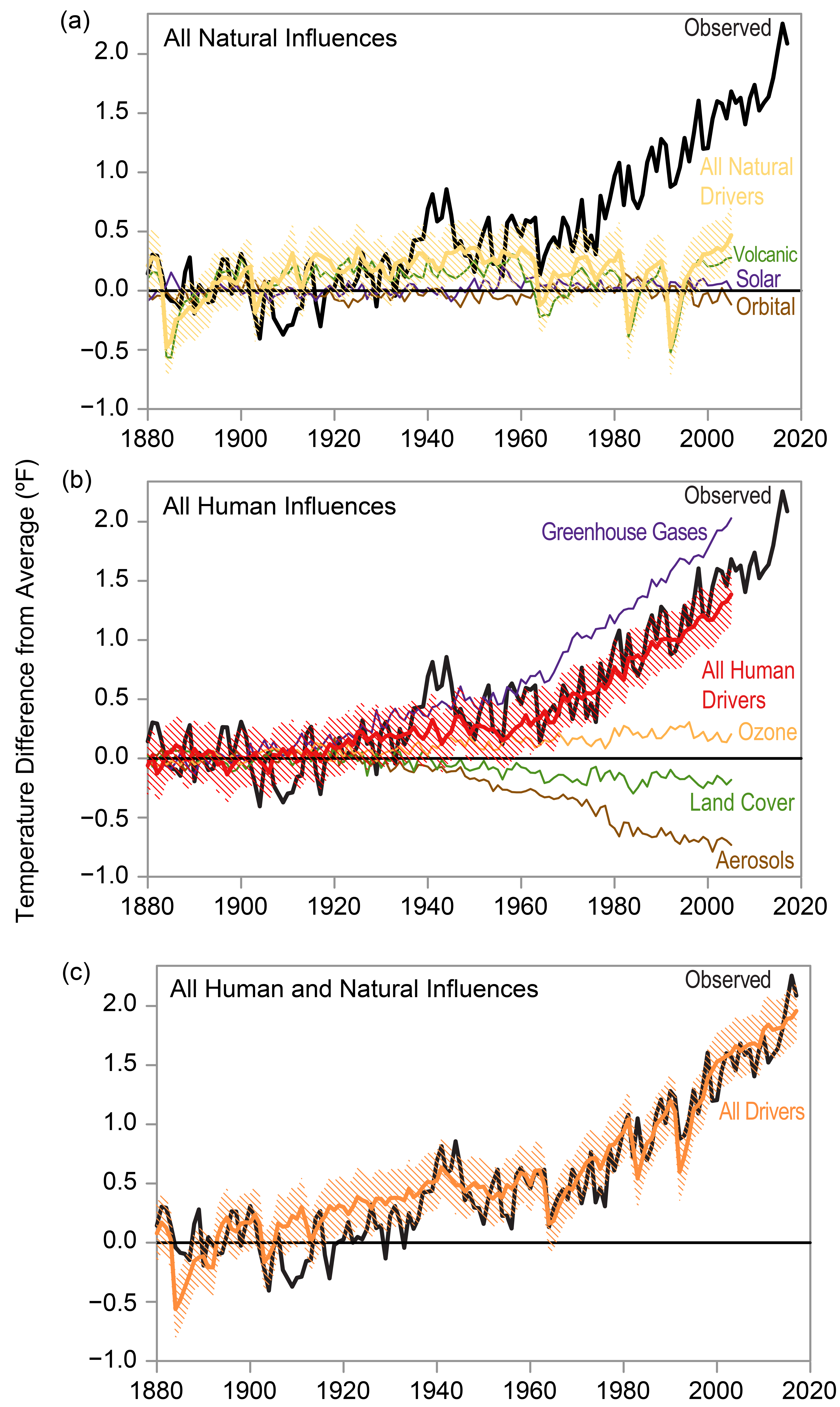
Scientists have also quantified the warming caused by human activities since preindustrial times and compared that to natural temperature forcings.
Changes in the sun's output falling on the Earth from 1750-2011 are about 0.05 Watts/meter squared.
By comparison, human activities from 1750-2011 warm the Earth by about 2.83 Watts/meter squared (AR5, WG1, Chapter 8, section 8.3.2, p. 676).
What this means is that the warming driven by the GHGs coming from the human burning of fossil fuels since 1750 is over 50 times greater than the slight extra warming coming from the Sun itself over that same time interval.
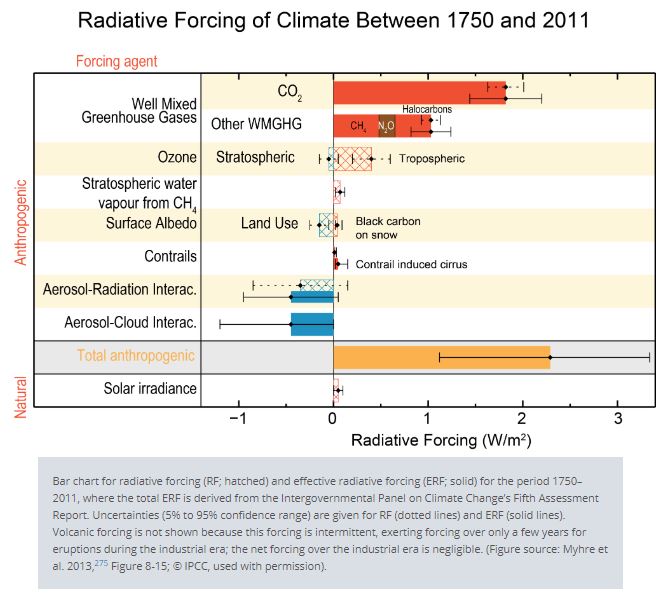
In the early 20th century human activities caused about one-third of the observed warming and most of the rest was due to low volcanic activity. Since about 1950 it's all humans and their activities.
https://journals.ametsoc.org/doi/10.1175/JCLI-D-18-0555.1
https://onlinelibrary.wiley.com/doi/full/10.1002/wcc.522Further, the detection of the human fingerprint in the observed tropospheric warming caused by the increase in atmospheric concentration of greenhouse gases like CO2 has reached 6-sigma levels of accuracy.
https://www.nature.com/articles/s41558-019-0424-x
There have been many, many scientific studies over the past 175 years examining the properties of greenhouse gases, the radiative physics of carbon dioxide and the role it plays in the Earth’s atmosphere. One of the most comprehensive, recent and openly-accessible is the US 4th National Climate Assessment (Volume 1, released in 2017 and Volume 2, released in 2018). You can download the whole thing or by chapter:
https://science2017.globalchange.gov/
https://science2017.globalchange.gov/downloads/https://nca2018.globalchange.gov/
https://nca2018.globalchange.gov/downloads/FAQ’s:
https://nca2018.globalchange.gov/chapter/appendix-5/#section-1In short, human activities (primarily via the human burning of fossil fuels) have warmed the globe, which in turn are impacting the Earth’s climate.
Please demonstrate actual skepticism by reading the furnished sources before replying. - It's cooling
richieb1234 at 23:48 PM on 13 October, 2019Here is an example of an argument I see over and over between climate researchers and climate skeptics: https://www.quora.com/What-stage-of-which-Milankovitch-cycle-are-we-in-and-does-this-have-any-bearing-on-current-climate-change. (Sorry, I haven't mastered how to paste the graphics into my comment). It relates to whether the current global average temperature is higher than the medieval maximum. The dueling groups each seem to have their own set of facts. Can someone clear this up for me? Thanks.
More than 100 comments found. Only the most recent 100 have been displayed.
More than 100 comments found. Only the most recent 100 have been displayed.






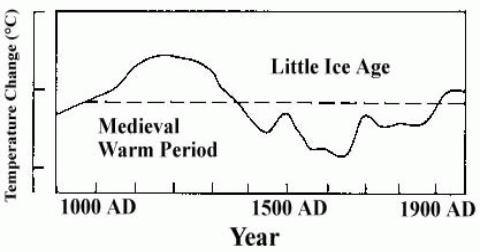
THE ESCALATOR
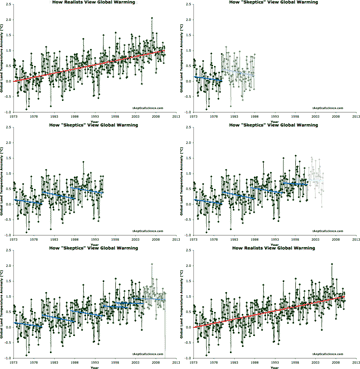
(free to republish)