


 Arguments







Recent Comments
1 2 3 4 5 6 7 8 9 10 11 12 13 14 15 16 Next
Comments 1 to 50:
-
Bob Loblaw at 06:53 AM on 15 January 2026Fact brief - Does clearing trees for solar panels release more CO2 than the solar panels would prevent?
For readers that are not as dug in to a position as David-acct, there are several posts here at SkS that cover changing levels of CO2 and O2. It's a well-covered aspect of climate science. In general, one of the pieces of evidence in support of the argument that burning fossil carbon is the primary source of increasing atmospheric CO2 is the correlated decrease in atmospheric O2.
Here are posts that discuss this:
What-is-causing-the-increase-in-atmospheric-CO2
Several of those posts contain graphs of observed atmospheric O2 levels. Here is one, from the second link:
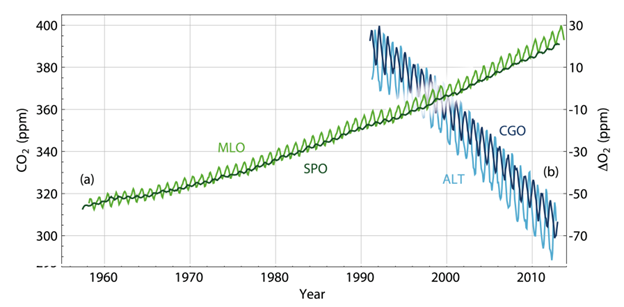
Note that a drop of 70ppm in O2 levels is not particularly worrisome from a human health standpoint. We're at 21%, and OHS warnings don't kick in until O2 drops to about 18%.
...but if David-acct is really worried that we're going to run out of oxygen because science is hiding something, he might want to get on to a path that helps stop burning fossil fuels.
-
Bob Loblaw at 05:42 AM on 15 January 2026Fact brief - Does clearing trees for solar panels release more CO2 than the solar panels would prevent?
You're losing it, David-acct.
Let's quote the full context, since you're big into context:
In the U.S., replacing equivalent natural gas power with one acre of solar prevents about 175 to 198 metric tons of CO2 emissions per year.
In contrast, an average acre of forest sequesters less than 1 metric ton of CO2 per year. An acre of solar cuts roughly 200 times more CO2 than an acre of trees.
Now, since you want to emphasize O2, please do the full calculations to compare the O2 involved in all the fluxes mentioned in that quote from the OP.
Why do you truncate the discussion to just the O2 involved in the forest uptake (which wlil no longer happen)? Is it because looking at the O2 involved in the CO2 reductions from the solar panel installation becomes inconvenient to your advocacy?
The CO2 reduction from the solar panels results in less atmospheric O2 being consumed as carbon is burned. In far greater quantities than the "lost" O2 production from the forest you think is so important.
-
David-acct at 05:27 AM on 15 January 2026Fact brief - Does clearing trees for solar panels release more CO2 than the solar panels would prevent?
CO2 is the bad guy
O2 is the Good guy
Again - Why does the OP truncate - Skip over - important facts ? is it because it becomes inconvenient to present full and complete facts that reflect poorly on the advocacy?
-
Bob Loblaw at 05:18 AM on 15 January 2026Fact brief - Does clearing trees for solar panels release more CO2 than the solar panels would prevent?
David-acct @ 8:
Take your own advice.
The CO2 that is not absorbed involves the same O2 that is not created. I have already quoted the section of the OP that quantifies this: "an average acre of forest sequesters less than 1 metric ton of CO2 per year." That tells us how much O2 will not be produced if the forest is removed.
Unless, as I have asked, you know of some other magical source of O2 released by the forest that is not involved in the forest growth (CO2 uptake).
-
David-acct at 05:01 AM on 15 January 2026Fact brief - Does clearing trees for solar panels release more CO2 than the solar panels would prevent?
Bob - Read the OP in the full context - it specifically mentions the future carbon dioxide not absorbed because the trees are gone. But again doesnt discuss the O2 that is not created becasue the trees are gone, thus a lose of an element that is more essential the human and animal life.
The issue is that the OP truncates/ skips over an important aspect of the topic that is inconvenient. Why does the OP omit the discussion?
-
Bob Loblaw at 04:56 AM on 15 January 2026Fact brief - Does clearing trees for solar panels release more CO2 than the solar panels would prevent?
David-acct@5:
You posted while I was preparing #6.
Same question for you: the O in CO2 is O2. What other O2 flux are you going on about?
-
Bob Loblaw at 04:53 AM on 15 January 2026Fact brief - Does clearing trees for solar panels release more CO2 than the solar panels would prevent?
David-acct @ 1:
What on earth are you talking about? The OP specifically mentions "Cutting forest does release stored carbon, but even if all 304 metric tons of CO2 in a forested acre were emitted during construction..."
Are you saying thet there is some unaccounted O2 flux into the forest that is distinct from the O2 that is consumed in turning forest carbon into CO2 (which is included in the above statement)?
Normally, a growing forest (defined by accumulations of carbon, be it trees, other vegetation, soils, or detritus) is releasing O2, as it splits CO2 into C and O2. What exactly is being "not replenished" in your scenario? Are you talking about replenishing atmospheric O2?
-
David-acct at 04:39 AM on 15 January 2026Fact brief - Does clearing trees for solar panels release more CO2 than the solar panels would prevent?
Nigelj - It remains a legitimate question. The article specifically compared.
"Clearing trees to build solar farms does not negate their climate change benefits, because one acre of solar panels prevents far more CO2 emissions than an acre of forest absorbs."
Comparing apples to apples remains a valid question, even if one doesnt like the applicable comparison.
-
nigelj at 04:11 AM on 15 January 2026Fact brief - Does clearing trees for solar panels release more CO2 than the solar panels would prevent?
David-acct says: "Any reason the discussion does not include any of the O2 molecules that are not replunished when the trees and other vegitation is removed for the solar farms?"
Except "other vegetation" is not removed, or it is replaced. Solar farms are freqently built over large areas of grass, standing on support struts so the areas of grass are not significantly impacted. You can even farm these areas. So impacts on oxygen are insignificant.
-
Philippe Chantreau at 03:31 AM on 15 January 2026Fact brief - Does clearing trees for solar panels release more CO2 than the solar panels would prevent?
Indeed, let's not forget the part concerning oxygen that is accomplished by every gas, coal and oil power plant, and every single internal combustion engine:
CH+O2 --> CO2+H2O
It seems obvious that if we are concerned about oxygen, this process is also a concern, a rather gigantic one, in fact.
-
One Planet Only Forever at 01:43 AM on 15 January 2026Fact brief - Does clearing trees for solar panels release more CO2 than the solar panels would prevent?
David-acct,
Any reason your question seems to be missing the understanding that a more comprehensive evaluation would include that O2 is removed and locked into CO2 and H2O by the oxidation of fossil fuels?
The evaluation of the impacts of solar farms would be to fully compare them with the impacts of the alternative energy systems, which would be more than the O2 impacts.
I look forward to a more comprehensive evaluation done by you reported back here.
-
David-acct at 00:47 AM on 15 January 2026Fact brief - Does clearing trees for solar panels release more CO2 than the solar panels would prevent?
Any reason the discussion does not include any of the O2 molecules that are not replunished when the trees and other vegitation is removed for the solar farms? I would think a more compehensive discussion of all factors would provide better insight.
-
MA Rodger at 07:39 AM on 14 January 2026Joseph E. Postma and the Greenhouse Effect
Re coments @ 162, 163, 164 & 165,
I guess the fool believes his new Kindle publication 'Introduction to the Climate:- There is No Greenhouse Effect' requires a bit of publicity to prop up its lacklustre sales.
Also note the link in the second line of the OP to the PDF of his wondrous work (actually available here at the home of bonkers pseudpscience Principa Scientific) is pointing to a piece in german with a title that translates as 'Shop for Luxury Goods Online at Great Prices'. What a jolly wheeze!!
Moderator Response:[BL] We'll see what we can do about that broken link. Thanks for noticing. It looks like the originating web host has either dropped the page, or the domain name has changed hands and contents.
The spam links in comments 162-165 have been removed. SkS is not an advertising service. Especially not for pseudoscience.
Addendum, Jan 14, 2026. It looks like Postma's original paper is also available at Principia-scientific's .com web site. (Their .org web site seems to be empty.) https://principia-scientific.com/publications/The_Model_Atmosphere.pdf
-
JPostma at 23:21 PM on 13 January 2026Joseph E. Postma and the Greenhouse Effect
[snip]
In the Cold Light of Day, with forward by Tim Ball, is of course excellent
https://www.amazon.com/Cold-Light-Day-Physics-Numerical-ebook/dp/B07L2KWJB7/
Moderator Response:[BL] Another spam link advertising an ebook for sale, snipped.
-
JPostma at 23:16 PM on 13 January 2026Joseph E. Postma and the Greenhouse Effect
[snip]
Formatted url link for
Moderator Response:[BL] Another spam link advertising an ebook for sale, snipped.
-
JPostma at 23:14 PM on 13 January 2026Joseph E. Postma and the Greenhouse Effect
And do not forget
[snip]
Planet Wars, which explains why imposters have pretended such enamoration with Earth's climate:
https://www.amazon.com/Planet-Wars-Investigation-Intellectual-Philosophical-ebook/dp/B09S1CFWRS
Moderator Response:[BL] Another spam link advertising an ebook for sale, snipped.
-
JPostma at 23:10 PM on 13 January 2026Joseph E. Postma and the Greenhouse Effect
Finally
[snip]
we have a physics-based explanation of the temperature of Earth's climate:
https://www.amazon.com/Introduction-Climate-There-Greenhouse-Effect-ebook/dp/B0G2X8XB34
This book will form standard introductory pedagogy to understanding the climate in the future.
Moderator Response:[BL] Our web site is not a place where you can spam our readers with links to purchase your ebooks. If you have comments to make on our posts, and want to link to materials on other web sites where readers can freely access additional material, then do so (within the limits outlined in the Comments Policy). Please do not simply repeat comments made in the past (in most cases, years ago) - unless you have something new to say, you will be wasting everyone's time.
-
Geomancer at 15:35 PM on 12 January 2026How does global warming affect polar bears?
Eric the Red @5 we now have the benefit of hindsight and new data showing that it's sea ice loss. The U of T Scarborough study demonstrated the direct link between loss of sea ice and loss of caloric intake for the bears and lower survival rate for the cubs in the Western Hudson Bay.
-
Geomancer at 01:49 AM on 11 January 2026At a glance - How will global warming affect polar bears?
The U of T Scarborough study demonstrated the direct link between loss of sea ice and loss of caloric intake for the bears and lower survival rate for the subs. I'm surprised it didn't make a bigger splash.
https://alphasteward.com/climate-change/polar-bears-and-climate-change-current-research-and-population-trends/ -
Geomancer at 13:29 PM on 10 January 2026Fact brief - Are polar bears endangered?
The U of T Scarborough study demonstrated the direct link between loss of sea ice and loss of caloric intake for the bears and lower survival rate for the subs. I'm surprised it didn't make a bigger splash.
https://alphasteward.com/climate-change/polar-bears-and-climate-change-current-research-and-population-trends/ -
Geomancer at 12:10 PM on 10 January 2026There is no consensus
Eclectic @958
There is a market for "railing against the establishment/elites" and somehow science has been bundled into the same category as the loss of middle classs buying power and continued concentration of wealth into the hands of a few, as if they're the same subject. I've lost track how many times I correct someone's mistakes only to be met with "wait, so you're siding with the establishment?" as if facts themselves are irrelevant and we're all just wearing either pro or anti establishment jerseys. People like Petersen have tapped into that lucrative market. I suspect ego plays a huge role as well. To my knowledge he wasn't very influential in his field and didn't publish much. TBH I'm a bit rusty on my Potholer videos I'll check out his Petersen takes. -
Eclectic at 11:30 AM on 10 January 2026There is no consensus
Geomancer @957 :
I have to agree ~ and it is increasingly my impression that, on most subjects, listening to Dr Peterson is a waste of everyone's time.
As I mentioned above, he seems to be sententious and addicted to limelight ~ whether for reasons of ego or for reasons of commercial benefit (or both). A psychologist with a deteriorated level of self-insight. Sad.
You mention Potholer54, and so presumably you have viewed Potholer's two recent videos on Peterson.
I confess that I have not yet discovered any climate science contrarians that would qualify as "smartest contrarians". This is mildly worrying to me, for there (almost surely?) ought to be one or two counter-arguments (even if weak) against the climate science consensus about the observed rapid global warming. But I have not seen any. Please, if you are aware of any sensible valid counter-arguments, I should be most grateful to learn what they are.
For over a decade, I have scanned the website WUWT [the doyen website for propaganda & echo-chambering of climate contrarianism & crackpottery] and I have seen nothing of value there. Except in what we might call a "negative lesson".
-
Geomancer at 10:18 AM on 10 January 2026There is no consensus
Eclectic @953 I have been following Jordan Peterson for years. Outside of his immediate and specific field he is no more informed than someone who has decided to read up on "the contrarian stance," and he selectively interviews subject matter "experts" that push said stance. The only value to be found is to hear what the smartest contrarians are saying.
-
Geomancer at 10:12 AM on 10 January 2026There is no consensus
RicardoB @950 I watched some of it and it recycles the usual talking points. It's not a debate, they're agreeing on denier talking points that aren't even true.
"We're telling developing countries they can't industrialize"
There is no evidence of this, and in fact, there are cleaer ways to industrialize compared to 100 years ago. There's a lot of editorializing, talk of the "powers that be." Not a very scientific conversation. I suggest checking out Potholder 54. -
Geomancer at 04:04 AM on 10 January 2026Climate's changed before
Brainscientist @902:
It's like you didn't even read the post. The difference is we know WHY it's changed in the past, AND we know past climate change has resulted in extinctions. This time around we're causing it AND this time around there are 6 billion humans on the planet, most of them depending on a few bread baskets and many of them living along coasts, both of which depend on stable climates. Climate change is already leading to worsening droughts, floods, fires, etc. Soon we'll see an increase in resource wars.
Moderator Response:[BL] Brainscientist has not been sighted here since his comment nearly a year ago. I doubt you're going to entice him into a discussion.
-
Geomancer at 03:59 AM on 10 January 2026Climate's changed before
It's amazing how in 2026, deniers are still repeating the "climate has changed before, so what's the big deal" non sequitur.
-
nick51 at 04:53 AM on 6 January 2026Venus doesn't have a runaway greenhouse effect
To amend the pressure readings are:-
50km 0.95 bar approx.
60km. 0.2 bar
70km 0.01 bar. At 75km The lapse rate no longer applies.
80km 0.001 bar.
After 75km the clouds reach their maximum height with the heating of the sun on the equator. Above this height, it is the mesosphere, which extends up to 120km
Moderator Response:[BL}
nick51: Even with these amended numbers your comment at 269 is a rambling, incoherent mess. I find it almost impossible to see what argument you are trying to make, and how it relates to the topic of the OP.
I suspect, but I can't tell, that you are trying to make some sort of argument that follows the rambling of sources such as Nikolov & Zeller, Gerlich & Tscheuschner, or Postma. All of these have been previously discussed - sometimes in this thread, or in other threads here at SkS. You can follow this link to see a debunking of Postma, and there is considerable discussion of Gerlich & Tscheuschner earlier in this thread.
Unless you can provide a coherent argument, there seems to be little point in posting further.
-
Eclectic at 03:34 AM on 6 January 2026Venus doesn't have a runaway greenhouse effect
Philippe Chantreau @270 :
You ask: "What exactly is a pressure of -58 atm ?"
Simples ~ it is a pressure exactly 600% lower than zero.
Or exactly 1500% lower than 1 atm.
btw: the planet has now been renamed as Venuszuela.
Thank you for your attention to this matter.
(Excusez lame political joke for first week of Jan'26. )
-
Philippe Chantreau at 02:00 AM on 6 January 2026Venus doesn't have a runaway greenhouse effect
That's some impressive sciency looking stuff. As a non expert in planetary science, I am wondering about that "profile," what exactly is a pressure of -58 atm?
-
nick51 at 00:21 AM on 5 January 2026Venus doesn't have a runaway greenhouse effect
Venus main statistics of the planet.
Size 12,104km
Gravity 8.87 m/s2
Atmosphere co2 96.5%
Clouds circle the planet sulfuric acid
Lapse rate 10.47 K/km
Rotational speed 6.52 km/h
Axis inclination 3 degrees
Energy received from the sun 2,613 W/m2
Super rotational winds (SRW) 100 m/s
Height of sulphuric acid clouds 40 km to 75 km
Direction of rotation of the planet Clock wise
Direction of SRW ACWSulphuric acid clouds
clouds are made of 75–96% sulfuric acid.
These are formed by photochemical reactions in the upper atmosphere, involving solar light acting on carbon dioxide, sulfur dioxide (SO2), and water vapor, create the sulfuric acid.These sulphuric acid clouds drive the climate on Venus.
Properties of sulphuric clouds
Albedo effect is between 0.75 to 0.80, which means they reflect 75-80% of the suns energy
Suns energy is 2,613 W/m2, approximately 2,000 W/m2 reflected back into space.
This leaves 613 W/m2 do drive Venus climate.
Sulphuric acid clouds absorb energy in the ultra violet (UV) which is about 10% of the suns energy and the remaining 20% of visible light left which enters the sulphuric acid cloud, 10% of this is absorbedUV 450 nm, with a sharp edge around 400 nm. The iron-bearing mineral phases, such as rhomboclase and acid ferric sulfate, dissolved within the sulfuric acid droplets are the likely candidates for this absorption
No IR is absorbed by these clouds.
So the final figures are:-
Suns energy = 2613 W/m2
Reflected by the albedo effect = 2000 W/m2
Absorbed by the UV = 11% = 287 W/m2
Absorbed by the Visible Light = 11% = total = 577 W/m2.
This leaves 2,613 - 2,577 = 36 W/ms arriving at the surface (12 W/m2. Average) This means there can be no greenhouse effect. It is enough to get a faint haze glow on the surface.So this 577 W/m2 drives the super rotational wind in the Venetian atmosphere.
This heats the clouds, rising the cloud tops to 75km in height.
The clouds are heated on the sunny side most, due to the slow rotation, the super heated clouds move to the cooler atmosphere, 2nd law of thermodynamics, which is in an anti clockwise direction. This causes this super rotational winds of 100 m/s to circle the planet, in a narrow band around the equator, where they lose some energy as the wind circle the planet and spread out towards the poles.
This doesn’t change during Venus year as its axis is only 3 degrees, so there is little or no change as it orbits the sun.
As these SRW approach the dark side the winds increase again as the dark side clouds are lower, and colder, this causes extra turbulence as the hot winds encounter the cooler atmosphere. This also causes more of the winds to migrate towards the poles, combined with the downwelling of the winds. This is shown by the pictures taken by the Japanese orbiter Akatsuki.
The SRW then approach the day side again where they receive extra energy from the sun and continue its journey to where the sun is directly overhead, receiving the 577 W/m2, where the cycle starts all over again.What happens to the atmosphere as it down wells towards the planets surface.
The atmosphere has its driving force for this rotation now (the super rotation winds down welling):
Adiabatic lapse rate 10.47 c/km (Gravity rating on the specific heat capacity of the atmosphere)
We have the heights that this happens at. (Sulphuric acid clouds between 40-75km) and the temperatures. Two key points are 43km temperature is most earth like 14c, and planets surface temperature 465c.
We also have the adiabatic charts for Venus to check the results
The temperature profile of Venus is shown below:-
Height (km) Temperature (C) Pressure (1 atm)
0 465 93
10. 360 71
20 255 50
30 151 18
40. 49 7
43 14 1
50 -59 -15
60 -164 -37
70 -269 -58As can bee seen, it explains the pressure on Venus - its driven by the temperature.
-
prove we are smart at 09:51 AM on 31 December 2025Direct Air Capture
I think this may be the link you are refering to, a very sobering truth about DAC realities. www.youtube.com/watch?v=EBN9JeX3iDs
If anyone needs an understanding about why the big five mass extinctions happened and why we are currently on the trajectory now for number six..www.youtube.com/watch?v=77Q07i1HSYc&t=130s
-
prove we are smart at 08:08 AM on 29 December 2025How climate change broke the Pacific Northwest’s plumbing
"Its not that climate change isn't real, the cost of admitting it is too high." Here is just one example of a powerful industry manipulating reality and worsening the crisis for its own short term profit. www.youtube.com/watch?v=pST_KrbrFHM
-
nigelj at 06:11 AM on 28 December 2025Zeke's 2026 and 2027 global temperature forecasts
Just a clarification on my previous comments. In no way am I dismissing the climate change problem. I was only concerned about the resource scarity issue, and this ultimately apples regardless of whether we use renewable energy (preferably) or fossil fuels. Althought it does appear that renewables are more sustainable than fossil fules longer term because the sun and wind is a limitless form of energy.
-
prove we are smart at 08:25 AM on 27 December 2025How climate change broke the Pacific Northwest’s plumbing
It seems to be that only when people are part of an unusually extreme weather event themselves or it happens in their local area do they acknowledge "things have changed".
To me, many are too de-sensitised, distracted and misinformed to react to at least a selfish response to a threat to their current quality of life.
The largest coal port in the world was blocked- at least for a while. Is this what we need more of? www.msn.com/en-au/money/markets/shipping-movements-disrupted-as-climate-change-protesters-block-coal-ships-from-entering-port-of-newcastle/ar-AA1RptoX?ocid=msedgntp&pc=U531&cvid=692c9a2d72ee4e84b01066c5d0bea4ef&ei=12
Media in Australia, 82% is controlled by 2 corporations. This protest got little reporting or a pro fossil fuel bias. Major weather extremes are "beat-up" for their clicks but the climate change connection is poorly explained.
-
prove we are smart at 18:19 PM on 26 December 2025Zeke's 2026 and 2027 global temperature forecasts
@2 MA Rodger "His argument is really simply that the current trajectory of mankind is pointing to some really bad outcomes. You could use such projections to point to, say, pre-industrial mankind drowning in horse shit."
I never read that story before-a funny shitless outcome for technology and fossil fuels saving the cities, the twist to that is the savior is now the villain and an existential threat to, well,everything. ???????????? Human health
Extreme heat increases risks for vulnerable groups, including pregnant women and infants.Heatwaves, air pollution, and the spread of diseases all worsen as temperatures rise.
???? Economies
Countries face major economic losses from reduced productivity, damaged infrastructure, and disrupted supply chains.
For example, Cyprus could lose up to €29 billion from its GDP by 2050 without action.????️ Ecosystems & wildlife
Species that depend on stable climates — like mountain meadow animals or cool-stream amphibians — are already struggling as their habitats change or disappear.????⚡ Water and energy systems
Asia’s water and power systems are being hit hard by floods, droughts, and extreme weather, putting millions at risk and requiring trillions in adaptation spending.???? Communities & infrastructure
Rising sea levels, stronger storms, and more frequent wildfires threaten homes, roads, and essential services.NASA notes that effects like sea ice loss, glacier melt, and more intense heat waves are already happening and will worsen.
???? Food security
Droughts, heat, and unpredictable weather reduce crop yields and disrupt food supply chains.????️ Earth’s natural systems
Global assessments highlight extreme weather, biodiversity loss, and destabilization of Earth’s systems as top long-term risks for humanity.There is no argument the earth temperature is still rising,in fact,arguably accelerating. All the nation states are playing in an international poker game,where everyone is cheating. The unfriendly USA is openly and aggressively war mongering for Venezuela's heavy crude and more than eyeing off the sovereign nation of Greenland for its particular usefulness.
All the responders opinions agree that last link I mentioned is complete "pretentious twaddle". I see something else. I see tipping points of no return happening on our watch. I see a tragedy from a thousand cuts to our biosphere. I see political leaders too "involved" with corporations/big business and election cycles to plan sincerely.
Worst of all,the consumer has only a little appetite for a meaningful change to their bubble. The commodification of everything and the insidious media manipulation means a continuation of an economical system driving us all towards that cliff.
At least 6@ nigelj adds a little realism to it all. I don't have an answer to turn societies to less comforts, we need to be less capitalistic and more community minded and that goes against most western countries lifestyles.
-
nigelj at 07:39 AM on 25 December 2025Zeke's 2026 and 2027 global temperature forecasts
I would just add we could encourage people to make at least small voluntary cuts to their levels of consumption. Everything helps and I think it would be prudent and not compromise lifestyles excessively.
However even this plan doesn't look that achievable, given our addiction to consumption and how even small cuts to consumption tend to cause recessions and unemployment. So I'm a bit cynical I guess, and I'm inclined to think consumption will only fall if and when shortages emerge.
-
nigelj at 06:04 AM on 25 December 2025Zeke's 2026 and 2027 global temperature forecasts
MAR, good comment. I would say 90% pretentious twaddle, 10% grain of truth. Regarding the 10% grain of truth. Our current trajectory is looking bad. In terms of population numbers and economic growth and industrial culture clearly has us heading towards a resource crisis where we could potentially run short of energy and various important minerals. More specifically these things could start to become ominously expensive to extract. This all seems well known and relatively uncontroversial.
Surely the most likely outcome is that there will be some shortages of energy and materials and we will be forced to prioritise things and ration things and do a lot of recycling. There may be a drop in standard of living. Its impossible to say how much, because there are so many unknown variables like population trends and discoveries of new mineral deposits and technological substitution. I could be a very small drop in standard of living or quite drastic.
The economic system will change in some way and economic growth will be forced to or stop slow by shortages of resources. Humanity will not just lie down helplessly and give up. It will mitigate and adapt in some way. Capitalism may morph into something different but then again it might not. Capitalism does not strictly speaking need endless gdp growth.
The alternative is to be proactive to avoid shortages emerging in the first place. But this would require our generation to make drastic and urgent voluntary cuts in our use of energy and materials to make what is left last a very long time, without rising in price too much. Or we could make drastic cuts in the size of our population.
Well good luck persuading humanity to all volunteer to live like poor people or kill of about 5 billion people. I'm sure that will be adopted with enthusiasm. And any drastic cuts in consumption could cause massive levels of unemployment so we are caught between a rock and a hard place. And such a plan is very risky because we cant even quantify the problem beyond saying we will likely run short of some things eventually sometime.
People also talk about abandoning capitalism and having another go at something socialist. Im very suspicious of any sort of planned utopian solutions to the resource problem, having seen how disastrous communism was. I dont oppose all socialist ideas. For example there is a strong place for some government provision of services but I think the concept of private property is so entrenched that its unlikely to change. I certainly dont believe it should change.
Or another alternative is we do both adaptation and proactive change: For example we are adopting renewable energy, which does have the virtue its not reliant on non renewable resources like burning coal. This leaves such resources for other uses like petrochemicals.
Its a very complex issue. Clearly we need to change our ways, and this will either be forced on us by deteriorating circumstances or we will be a bit more proactive about it.
-
nigelj at 04:39 AM on 25 December 2025Zeke's 2026 and 2027 global temperature forecasts
Prove we are smart @1
Regarding a possible acceleration of global warming since around 2015. The following might be of interest and looks to me like a reliable analysis of the situation.
Grant Foster and Stefan Rahmstorf
Orono, ME, USA 3
Potsdam Institute for Climate Impact Research, Potsdam, GermanyAbstract. Recent record-hot years have caused a discussion whether global warming has accelerated, but previous analysis found that acceleration has not yet reached a 95% confidence level given the natural temperature variability. Here we account for the influence of three main natural variability factors: El Niño, volcanism, and solar variation. The resulting adjusted data show that after 2015, global temperature rose significantly faster than in any previous 10-year period since 1945.
www.researchgate.net/publication/389855619_Global_Warming_has_Accelerated_Significantly
There is a pdf file of the complete paper.
Basically they are saying the surface temperature record shows strong signs of an acceleration since around 2015, but it hasn't quite reached a 95% statistically significant level but if you separate out the underlying anthropogenic warming trend by ignoring el nino, the solar cycle and volcanic activity the underlying anthropogenic warming trend has definitely accelerated with good statistical significance:
-
Eclectic at 19:34 PM on 24 December 2025Zeke's 2026 and 2027 global temperature forecasts
Prove @1 :
Gotta agree with MAR @2 : The Newbury substack comments are rather bizarre in their construction. Like A.I. generated !
"Acceleration" of global warming is arguable ~ but "linear" rise is bad enough, as it is !
-
MA Rodger at 18:42 PM on 24 December 2025Zeke's 2026 and 2027 global temperature forecasts
prove we are smart@1,
Your request for "proof" is a bit off the subject of climate..This Steven J. Newbury describes himself as an "Amateur Anthropogenic Entropy Theorist and Free Software developer." His (latest?) web presence dates back a month and sports 41 posts allegedly of non-trivial substance. These are not good signs.
He cannot write for nuts: another bad sign.The particular post you link-to manages to tell us he:-
argued that to avoid the “Resource Entropy Singularity”—the point where the energetic cost of maintaining our society exceeds the energy available to it—we must transition from an economy based on Exchange-Value (financialisation, infinite growth) to one based on Use-Value (utility, biophysical reality).
Readers, quite naturally, have asked the follow-up question: “How do we get there?”
He then deigns to provide his "uncomfortable truth" that "we cannot 'manage' our way to survival" and that the "best case" would be that we initiate a human catastrophe to stop us "strip-min(ing) the biosphere down to the bedrock."
The employment of thermodynamical principles within non-thermodynamical circumstances is not a robust use of the physics. Such use is pure analogy and prone to the usual panoply of pitfalls for analogies. Talking 'energy use' simply dresses such analogy in pseudo-science.
His argument is really simply that the current trajectory of mankind is pointing to some really bad outcomes. You could use such projections to point to, say, pre-industrial mankind drowning in horse shit. Or perhaps to consider that the increasing ability of humanity to wage destructive war and the use of such war over ideological differences would reach the point where we can and thus eventually will inevitably destroy ourselves.
Or you could argue that humanity is today gaining access to new technologies that are exceedingly dangerous which our societies are entirely ill-equipped to harness in any way safely. Or you could argue that the nation states around the world will be unable to mitigate the emerging climate crisis and then be unable to cope with that climatic crisis and instead resort to military force precipitating an even worse crisis. And if not the emerging climate crisis, how about the emerging ecological crisis? Or one of the multitude of resource crises (of which 'energy' is but one)? And maybe a future malthusian crisis could yet reappear despite the passing of 'peak-baby'.
I'm sure Steven J. Newbury could happily invoke such threats into his "Grand Agency" bad and "Ground Agency" good. But really? Is this idea that we can chill out and be good if only we could precipitate the revolution which allows a utopian society to appear and flourish on the bones of today's world. Is there in some manner a metaphorical island we can inhabit and grow, fat like the Kākāpō, a species which only had laughing owls to fear as long as they stayed nocturnal? And in that analogised setting, was suddenly nature actually no longer red in tooth and claw?
You've probably guessed by now, I'm of the opinion that this little essay of
Steven J. Newbury is pretentious twaddle. -
prove we are smart at 07:30 AM on 24 December 2025Zeke's 2026 and 2027 global temperature forecasts
Tis the season to be jolly, tralala, tralala, lal,lal,lar... Occasionally I still get optimistic but less frequently now. I agree with Zeke's conclusion {from a link above} "Consilience of evidence
If we were solely relying on drawing trend lines through cherry-picked periods in surface temperature records, I too would be pretty skeptical about making strong claims regarding a recent acceleration in warming.But we don’t just have surface temperatures:
Acceleration in surface temperatures is more readily apparent and significant when removing natural variability.
Our climate models expect a faster rate of warming under current policy scenarios.
We have a clear mechanism in declining aerosol emissions to explain a recent acceleration.
Acceleration is apparent in both ocean heat content and earth energy imbalance measurements.
In my view this consilience of evidence tips the scale toward pretty clear acceleration in recent years. I hope I am wrong – I’d prefer to live in a world where the rate of warming was flat or falling – but the evidence is becoming too strong to ignore." Here is his link from the re-post article above, www.theclimatebrink.com/p/the-great-acceleration-debate
But as I have learnt, delving into the links and especially the comments to those links,reveal many new avenues of thought.
This link from comments from the James Hansen's link on his recent estimates (above), has really lined up with my thoughts. Can anybody explain to me why this author Steven J Newbury is wrong? theuaob.substack.com/p/the-agency-trap-why-we-must-fail
-
wilddouglascounty at 01:56 AM on 24 December 2025Emergence vs Detection & Attribution
One post script note: Note that in the #50 Global News Warming Roundup, the Trump Administration has been busy scratching out all references to fossil fuels as the cause of climate change, and in #51, the article detailing the reasons for shutting down the all-important NCAR was because it was the cause of too much climate anxiety.
It is up to the scientific community to keep the causality eye on the ball: human activities in general and fossil fuels in particular are the causing the increased frequency of severe weather events, and the cause of the shifting climate, so it is incumbent in all discussions to make sure that any use of the phrase "climate change" includes the human activity adjective such as anthropogenic, fossil fuel-driven, greenhouse gas-induced, etc.
-
wilddouglascounty at 10:49 AM on 17 December 2025Emergence vs Detection & Attribution
@10 Bob, we completely agree until the very last sentence. The exact analogy that I'm driving at is that we're NOT saying "He was on steroids." The analogy, if carried to its simplified analog to "steroids" is "fossil fuels" or "carbon emissions" or "greenhouse gases" and the like, not "climate change." There is a real psychological underpinning behind the need to simplify a complex topic: just make sure you simplify it in a way that points out what needs to change if you want the changing climate to stabilize!
As you have pointed out, the complexity of the climate includes all of the other factors as a system, including solar irradiation, volcanic activity, long term orbital dynamics, and on and on, which we know goes "whoosh" over the average person's head, which the fossil fuel companies have taken advantage of, by the way. But the systemic changes we're seeing in the climate is from the change in carbon emissions that are overwhelming the system's ability to absorb it, causing a change in the composition of the atmosphere and ocean that supports increasingly frequent severe weather events. So we need to really hone in on that single fact: rising greenhouse gas percentages in the atmosphere and oceans is changing the climate, not "climate change." It is easier for everyone to understand the source of the changes occurring in a very complicated system in the same way as "he was on steroids" cuts to the chase. And #11, Nigelj, I'm completely fine with the term "anthropogenic climate change" and for everyone, I don't honestly expect us to just immediately stop using "climate change" as an important phrase in our vocabulary and discussions about the topic. What I do sincerely hope is that this phrase be modified to include the human driven nature of the changes in the climate, so in addition to "anthropogenic climate change" I'm hoping folks will always use such phrases as "human activity induced climate change," "fossil fuel driven climate change," "greenhouse gas induced climate change," "carbon emission driven climate change," etc. if you need to use the phrase at all. These phrases include true causality, while "climate change" by itself does not pinpoint the causal problem as finely as it needs to be made if we have any chance of changing our future.
-
nigelj at 05:38 AM on 17 December 2025Emergence vs Detection & Attribution
Regarding whether its accurate use of terminology to say that anthropogenic climate change is changing the weather, by making certain events more frequent or extreme. Climate change involves a warming global climate and changes in average global precipitation and circulation patterns, its that extra warmth and precipitation that effects weather events, therefore it is correct terminology to say climate change is changing the weather.
-
Bob Loblaw at 04:52 AM on 17 December 2025Emergence vs Detection & Attribution
Wild:
The most common (and probably the most familiar) example of a descriptive approach to climate is the Koppen Climate Classification system. It uses seasonal observations of temperature and precipitation to classify a regions using qualitative terms. This system aligns with our common concepts of tropical, arid, temperate, polar, continental, coastal climates, etc.
Attribution studies need some sort of model that allows an estimate of the likelihood of events (e.g. severe weather) under two different regimes (with greenhouse gases, and without). The Koppen system is a model - but largely a descriptive model. It uses numerical results, but those are descriptive statistical models.
Attribution requires a much more quantitative model - a physical model. The model simulates climate under one set of controlling conditions, and then it is run under a different set (greenhouse gases, in this case). It can be a bit hard to see the physics behind that, though, as physical model outputs are often interpreted using a descriptive model. The statistics with and without greenhouse gases help determine the probability of an event of a particular intensity, with or without climate change. But keep in mind that those descriptive statistics of the physical model output are just as complex as doing descriptive statistics of actual weather observations.
In the case of the "juiced athlete", the attribution to performance-enhancing drugs (PEDs) is difficult, for very similar reasons. You can't claim "this home run was caused by PEDs" for the same reason you can't claim "this severe weather event was caused by climate change". Arguing that a particular drug is a PED needs to be based on detailed physiological studies, as you suggest.
...but that level of detail isn't going to get a message across to the general public very well - it will go "whoosh" over their heads. "He was on steroids" is the short form. Just as "the climate has changed" is the short form for all the things that have happened due to our release of greenhouse gases and other human activities that have altered the climate.
-
wilddouglascounty at 01:42 AM on 17 December 2025Emergence vs Detection & Attribution
Thank you, @8 Bob, for sharing your perspective on this issue and the climate as a causal factor. I guess I'm not sure whether its descriptive or physical when you are doing attribution of a hurricane's intensity as being caused by climate change as it seems that it has elements of both.
That aside, what I'm saying, once again to use the analogy of the juiced athlete, is that if there is a change in the constellation of factors that make them a professional athlete including years of strength and endurance training, strategic coaching, genetic predisposition, etc., along with the performance enhancing drugs, as contributing to the increased frequency of home runs, does it make sense to to talk about the athlete in general terms that includes the entire cluster of factors (physical), or the performance statistics (descriptive); OR rather does it make sense to focus on the relevant causal factor of the practice of using performance enhancing drugs as causing the changes in the athlete's performance? For clarification's sake, the changing performance of athletes in general could not really be addressed until the key causal factor, performance enhancing drugs, was identified, after which people "got it" and took actions that penalized their use.
In a similar way, yes, physical climatology has causality in a general, collective way that clusters the real causal factors "under the hood". Since there is an identifiable subset of those "under the hood" factors called "greenhouse gases," "human activity emissions," "carbon emissions from human activities, primarily fossil fuel use" or what have you, it's time to start focusing on those "performance enhancing chemicals" we're emitting as the cause of the observed changes, so that people "get it." Otherwise vested interests will just continue to spread misinformation about the other factors, such as the sunspot cycle, cosmic rays, the end of the ice age and other things they can point to also under that hood. They are not incorrect in pointing to other factors that contribute to the climate; it's just that the science is clearly pointing to the changes in the climate as being linked to the changes in the atmospheric and oceanic chemistry caused by carbon emissions.
-
Bob Loblaw at 11:21 AM on 16 December 2025Emergence vs Detection & Attribution
Wilddouglascountry @ 2, 4, 6.
I would tend to disagree with your characterization of the term "climate change". You appear to be exclusively thinking of climate in terms of what is called "descriptive climatology". In that context, "climate" is just a description of what is going on.
"Descriptive climatology" gave way to "physical climatology" at least as far back as the 1950s, when the science began looking at "climate" as the physical processes that link together to produce the observations that made up "descriptive climatology".
[Note: the textbook I used when taking my undergraduate climate course was "'Sellers, W.D. 1965: Physical climatology. Chicago: University of Chicago Press, 272 pp.]
As such "climate change" is a causal factor: through the physical processes of climate, changes in one part of the system (greenhouse gases and radiative transfer) lead to changes in other parts of the system (severe weather).
I don't think your change in nomenclature is justified.
-
Eclectic at 10:16 AM on 16 December 2025Emergence vs Detection & Attribution
Wilddouglascounty @6 :
I suspect that the adults in the village are more concerned with the actual threat to the sheep, rather than whether the threat is categorized as a wolf or coyote or wild dog. Semantics and chicken-or-egg arguments would be very low on their list of concerns, I'm sure.
If we argue on over-fine points, then the essential message gets lost.
Best to use the K.I.S.S. principle.
-
wilddouglascounty at 09:03 AM on 16 December 2025Emergence vs Detection & Attribution
Bottom line: attribution studies should point to the real cause of increased frequency and severity of weather events: human activity, fossil fuel emissions and greenhouse gases, NOT climate change. Climate change does not cause anything: it's the result of the changes caused by the changed chemistries.
-
Eclectic at 08:42 AM on 16 December 2025Emergence vs Detection & Attribution
Wilddouglascounty @4 :
Agreed ~ but the metaphor is flexible. Some of the villagers think the shepherd-boy [or Thunberg-girl ] is lying . . . and some of them wouldn't know a wolf if it bit them . . . especially if the village Chief said all wolves are hoaxes.
You just have to do your best, remembering human psychology.