



 Arguments
Software
Resources
Comments
The Consensus Project
Translations
About
Support
Arguments
Software
Resources
Comments
The Consensus Project
Translations
About
Support







Latest Posts
- Skeptical Science New Research for Week #24 2026
- June update: Help still needed to get translations prepared for our website relaunch!
- How many people does heat actually kill?
- Check out the brand-new hurricane ‘cone of uncertainty’ graphics arriving this season
- 2026 SkS Weekly Climate Change & Global Warming News Roundup #23
- SkS Housekeeping: Updating the Comments Policy
- Skeptical Science New Research for Week #23 2026
- Nobody knows the future of energy
- Fact brief - Do electric vehicles almost always have a lower carbon footprint than gasoline-powered cars?
- Solar, wind, and EVs have knocked out a doomsday climate scenario
- 2026 SkS Weekly Climate Change & Global Warming News Roundup #22
- Skeptical Science New Research for Week #22 2026
- The next era of Atlantic hurricanes could be far more destructive
- On the death of RCP8.5
- RCP8.5 Update
- 2026 SkS Weekly Climate Change & Global Warming News Roundup #21
- Skeptical Science New Research for Week #21 2026
- What’s a ‘super El Niño’? And other El Niño questions, answered
- Fact brief - Does electromagnetic radiation from wind turbines pose a threat to human health?
- Five things you need to know about El Niño’s likely comeback
- 2026 SkS Weekly Climate Change & Global Warming News Roundup #20
- Skeptical Science New Research for Week #20 2026
- Higher warming predictions for 2026 and 2027
- A look back at ‘An Inconvenient Truth,’ 20 years later
- Two videos about the Atlantic Meriodonal Overturning Circulation (AMOC)
- 2026 SkS Weekly Climate Change & Global Warming News Roundup #19
- EGU2026 - Five days of virtual learning
- Skeptical Science New Research for Week #19 2026
- Climate Adam - Climate Change is Destroying Lives... Now
- EGU2026 - Presentation about the Skeptical Science Experiment

Comment Search Results
Search for ice.
Comments matching the search ice.:
- CO2 is not increasing
Bob Loblaw at 06:38 AM on 26 April, 2026Richz @ 43:
I am not following your point(s).
Ice core samples contain bubbles of air that tell us what the atmospheric gas amounts were at the time the air bubbles were closed off and stopped exchanging air with the atmosphere above the accumulating snow/ice. (It takes some years of compressing the snow to close the air space off and isolate it.) The CO2 is not "absorbed" in the ice in the sense that it would chemically bond with the ice. The air is trapped in the ice and preserves its own chemistry.
So yes, we "have a clue" as to what proportion of the air was CO2 100k years ago. And comparing the proportion over time (different layers of ice) is quite reasonable. And "overlaying" the actual direct measurements of atmospheric CO2 proportions with what we see in the bubbles in ice cores is precisely why we can say that the ice core values match up with direct measurements.
What are you trying to say about the peaks over 400,000 years? Global atmospheric CO2 does not go through huge changes in a short time period. It has taken humans 100 years to increase CO2 from 300 to 400 ppm. Annual variation from natural cycles causes less than 10 ppm change. Are you trying to say that there is possibly some past hidden spike in CO2 that was too short to show up in the ice cores? Do you have any evidence that such a short-term spike is possible, given the nature of the carbon cycle? Any reasonable mechanism that could create such a spike? If you have no evidence, and no explanation of how you think there could be one, then you will find it difficult to convince anyone that you have anything more than wild speculation.
- CO2 is not increasing
Richz at 02:24 AM on 26 April, 2026Looking at the ice core samples shows CO2 that was being absorbed by ice. We have no clue how much CO2 was remaining in the atmosphere going back the 100k years. So isn't comparing that to the current atmospheric CO2 levels like comparing apples and oranges. And overlaying the atmospheric levels onto the ice core samples misleading. It would seem we have no idea if the atmospheric CO2 levels during each of the peaks over 400 000 years were also in the 400ppm
- What’s cheaper: Fueling your car with gas or electricity?
Evan at 21:42 PM on 17 April, 2026Bob,
Ugh! What a pain in the neck for the installation you describe. Yes, I can see why you hired an electrician.
Because I wired our house when we built it, I was able to plan all of the charging circuits from day 1. In total, there are currently 6 vehicle charging points, with conduit leading to two more potential sites. Three of those are on the outside of the house, three on the inside. So easy to do while building the house.
And as you mentioned, we had to size the wire for proper heat dissipation, according to whether it was bundled wires or separate wires in a conduit. I got a good education from our inspector!
Although standard service is 200A for new construction, we went with 320A service split between two 200A panels: one in the garage and one in the mechanical room. That gives the amperage and space to add circuits now and in the future. In Minnesota it is easy to petition for 320A service. You just have to itemize your electrical needs and demonstrate why the additional 120 amps are needed. We have ground-sourced heat pumps, so installing 320A service was a no-brainer and not questioned by our utility.
- Is Nuclear Energy the Answer?
michael sweet at 06:18 AM on 20 March, 2026Pollution Monster:
Your reference Nuclear Energy Decarbonization seems to me to be simply a regurgitation of nuclear industry propaganda. It has too many false claims for me to begin to list them all. For example it claims:
"For example, in hybrid systems for island economies such as the Canary Islands, SMRs have proven to be a viable solution, achieving competitive levelized costs of electricity (LCOE) ranging from EUR 46 to EUR 84/MWh when integrated with renewables and hydrogen production." my emphasis
How can they possibly have "proven" that SMRs can do anything when no designs for non military SMRs have been approved and none have been built? This is just accepting industry propaganda. Renewable energy costs less that EUR 40 today.
Later they say:
"Finally, there are structural and economic limitations that challenge the sustainability of nuclear energy. The inherent risk of nuclear safety is so high that coverage in free markets is unfeasible without state subsidies, which undermines the principles of just sustainability and intergenerational responsibility. Moreover, the full life cycle of the technology (from uranium mining to plant decommissioning and waste management) entails an emissions footprint and environmental impacts that contradict its claimed climate benefits. In the face of increasingly competitive and safer renewable technologies, the continued relevance of the nuclear sector demands radical transformations in its governance and a structural reduction in risk in order for it to be considered a truly sustainable option." my emphasis
So I should accept an industry that is so risky they cannot provide insurance for their accidents and taxpayers will have to pay to clean up their mistakes? While they take all the profits?
They cite an economic analysis that claims nuclear is cost and materials effective compared to solar and wind that was published in 2007 (their ref 110)? Do you realize that the cost and materials of solar and wind have declined immensely since 2007 while nuclear has increased in cost? It is dishonest to use completely outdated information when up to date information is readily available.
The journal Processes does not seem to me to be a good place for an analysis of energy when many other more suitable journals exist.
You are selectively quoting Abbott 2012. He says "It can also be argued" not that he supports that opinion. Obviously your cite makes that argument. In Abbott's conclusion he states:
"There are fundamental engineering and resource limits that make the notion of a nuclear utopia impractical. It can be argued [Abbott does not agree with this argument] that a nuclear nirvana supplemented by renewables may mitigate the need to reach 15 terawatts by nuclear alone (Manheimer, 2006). However, a reduced goal of several terawatts of nuclear power would still run into many of the limitations described above. Even for a more modest goal of 1 terawatt, one only has to divide the numbers above by 15 to see that a single terawatt still stretches resources and risks considerably." my emphasis
Nuclear supporters have never responded to Abbott. They cannot now claim that his objections are null because they have not countered them.
Keep reading about renewable power. In the last day more renewable energy was installed than nuclear in the last year. Don't believe all the nuclear propaganda that nuclear supporters accept as gospel. Remember that SMR developers promised in 2006 that they would have running reactors by 2020. It is impossible for them to manufacture significant numbers of reactors before 2040. Renewable energy will generate all current electricity and transportation by then. Nuclear cannot compete on price.
With the war in Iran showing how economically risky fossil fuels are many countries are increasiing their uptake of renewables to protect their economies.
Nuclear power is too expensive, takes too long to build and there is not enough uranium.
- After a major blow to U.S. climate regulations, what comes next?
John Hartz at 22:20 PM on 3 March, 2026The battle has been joined!
Scientists Decry ‘Political Attack’ on Reference Manual for Judges More than two dozen contributors to the manual criticized the deletion of a chapter on climate science by the Federal Judicial Center by Karen Zraick, The New York Times, Mar 2026
Excerpt:
"More than two dozen contributors to a widely used reference manual for judges are raising alarm bells about political interference after the deletion of a chapter on climate science.
The uproar is over the latest edition of the Reference Manual on Scientific Evidence, which has been published since 1994 by the Federal Judicial Center, an agency that provides resources to judges. A group of Republican state attorneys general sent a letter to the center on Jan. 29, claiming that the climate chapter was biased and demanding its retraction. About a week later, the center deleted the chapter from its online edition of the nearly 1,700-page manual.
A new letter posted on Monday, signed by 28 experts in science, technology and law who had written other chapters of the manual, strongly criticized the move. The topics they had written about included engineering, neuroscience and toxicology. Their letter was posted online by Science Politics, a publication of Georgetown University’s School of Foreign Service."
To access the entire article, go to:
https://www.nytimes.com/2026/03/02/climate/climate-science-judges-manual.html - Trump just torched the basis for federal climate regulations. Here’s what it means.
nigelj at 12:31 PM on 26 February, 2026Bob Loblaw @ 02:00 AM on 26 February, 2026
BL: "What you describe for building codes is similar to what we have in Canada"
I have a vague recollection NZ actually modeled its building code on a combination of Canadas and Americas. Prior to about 1992 NZ didn't have a national building code as such. Local city councils had their own sets of rules on how houses had to be constructed. They did use the NZ standards which had been around for ages, and were effectively a national set of guidelines. But the net result is every city had its own building rules and they were all a bit different and confusing and they were very prescriptive.
In 1992 the government adopted a national building code with more of a performance based approach. Councils could not set local rules except in very limited circumstances. Its all been good but with some problems as well.
BL: "I had to get two permits and deal with two inspection processes: electrical, and everything else."
In NZ local city councils check drawings and issue building consents, and do all inspections including electrical. We are too small for regions. I think the sign off process has altered recently, I've lost track a bit.
BL: "When you say "signed off by Governments Cabinet", I assume that you mean the collection of ministers appointed by the Prime Minister (PM) to run the different government departments. (NZ is like Canada - following the Westminster system. We have an elected House of Commons, and an appointed Senate. It looks like you only have an elected house?)In practice, many decisions made within our government require sign-off by the Minister, but I don't think there are many (if any) that require sign-off by cabinet."
Yes we have the Westminster system. To be honest I'm not 100% sure whether something like a building code needs sign off by a minister or all of cabinet. I'm fairly sure some things need sign of by all of cabinet.
BL: "Some politicians and voters that disagree with government actions are convinced that the entire public service consists of partisan hacks working for the other political party......We're wandering much off-topic here, but to tie this back into the OP and what is happening in the US and the EPA, the US is devolving into a situation where large swaths of the "public" service are becoming political service."
I've only seen a very few people in NZ suggest the public service are partisan hacks. Generally appointments appear to be on merit. We certainly haven't had a leader like Trump making blatantly partisan appointments. But right now it would not be possible. The heads of public service departments are appointed by the Public Service Commissioner and his office. he PSC is appointed by the Governor General. NZ is still technically a monarchy. Politicians are consulted on appointments, but don't decide the appointments.
The problem is some of our conservative and right leaning politicians clearly admire some of what Trump has done. They don't embrace Trump like your conservative and right leaning politicians, but there is some leaning towards him particularly with Winston Peters of NZ First. But fortunately they would have a hell of a difficult job changing the system to allow them to make partisan appointments to the PS.
The thing with Trump is all he has to do is get personal control of the police and army by getting their loyalty, and he can do anything. I honestly think he's trying to do that, and ICE is the first move in that direction. Hopefully he's out of office before he can do this. Ok all getting a tad off topic. But Trump has such monumental influence I think its worth some discussion. I had decided to ignore reading about him in his second term, but hes inescapable. Agree with your views on him and his presidency.
- Trump just torched the basis for federal climate regulations. Here’s what it means.
Bob Loblaw at 02:00 AM on 26 February, 2026nigel @ 28:
What you describe for building codes is similar to what we have in Canada (where OPOF and I both live, albeit in different provinces). We develop national building codes, but provinces are the ones that control building practises, so they will make their own codes. They usually follow the national codes, but may adapt them to local circumstances.
To further devolve responsibility, provinces usually transfer the process of inspection, approval of plans, etc. down to the municipal level (cities, regions, etc.) Thus, it is local government that will have people that examine and approve plans, issue building permits, perform inspections, etc. In my province, electrical inspections are handled by a province-wide agency, but plumbing (including HVAC) and structural inspections are by the city. So, when I wanted to finish my basement, I had to get two permits and deal with two inspection processes: electrical, and everything else.
When you say "signed off by Governments Cabinet", I assume that you mean the collection of ministers appointed by the Prime Minister (PM) to run the different government departments. (NZ is like Canada - following the Westminster system. We have an elected House of Commons, and an appointed Senate. It looks like you only have an elected house?)
In practice, many decisions made within our government require sign-off by the Minister, but I don't think there are many (if any) that require sign-off by cabinet. As I mentioned in earlier comments, at this point a Minister is acting as a member of the Executive branch, using powers and authority granted to ministers by Parliament - i.e. acting according to law. If a Minister wants to do something that is outside their authority, they'd have to take it to cabinet and the PM and argue that it needs to be taken before Parliament and a new law passed. A common example of "not your authority" would be when a minister wants to do something that law says is the responsibility of a different department - or perhaps a provincial responsibility according to our Constitution.
Within our system, deputy ministers (DM) are the ones that run the day-to-day operation of the department. These appointments are at the will of the politicians (minister, cabinet, PM) and can (and will) be changed as political winds change. As you move down through the bureaucracy to assistant deputy ministers (ADM; there will be several in a department, responsible for different branches), directors general (DG), directors, managers, etc. At each lower level, there will be more people at that level, responsible for smaller parts of the system. At each level, their authority is limited to what the Minister delegates to that level, which is largely controlled by the rules set in place by Parliament (AKA "the law").
Only the few at the top are political appointees, though. ADMs, DGs, etc are expected to be non-partisan, merit-based appointments. Most will survive a change in government, as the political masters at the top accept that these people will give non-partisan advice (although the major job description remains "don't embarrass the minister").
Things fail (and there is worry about this) when political motives spread downwards into the "non-partisan" public service. Some politicians and voters that disagree with government actions are convinced that the entire public service consists of partisan hacks working for the other political party. (Some believe that the public service does nothing, and they should all be fired.) As distrust grows, and more and more appointees are selected based on political motives, the harder it is to get "expert advice".
We're wandering much off-topic here, but to tie this back into the OP and what is happening in the US and the EPA, the US is devolving into a situation where large swaths of the "public" service are becoming political service. The US cabinet is not elected - it is appointed by the president. In theory, Congress needs to approve these, but more and more confirmation votes go entirely down party lines. The president wants the authority to fire many employees in the public service, and has shown a propensity to replace them with political hacks. He wants them to swear an oath of allegiance to the president, not the constitution. He does not want the rule of law to constrain him, and he does not want a "public" service that serves the people or the law. IMHO, this is not a happy place to be.
The question of "who gets to sign off on the regulations?" is only one very small part of "who gets to decide the process by which the regulations are developed?" To me, the elected officials are already in control of defining the process. If they don't like the outcome, they can re-define the process, but turning final decisions into a political football that can ignore any sort of reasonable process is not a good way to go.
- Trump just torched the basis for federal climate regulations. Here’s what it means.
Bob Loblaw at 01:02 AM on 24 February, 2026nigel:
First, I didn't find the term "elected politicians" confusing. It's just that I'd forgotten you had added "elected" within the meat of the text, and I was in the mind set where a lot of "politicians" are outside the small set that are actually holding elected office.
The problem I see with your "let the legislature vote" aspect is that it seems completely impractical to me. The legislature can only vote on matters that the constitution allows. (Well, they can vote on other things, but then the judicial system is supposed to void that vote when someone challenges it in court.) Once the legislature votes, that vote becomes law. Saying "let the legislature vote" is basically saying "to do this, we need a new law".
The problem is that it seems highly unlikely that you can design any effective process where it becomes easy to identify that a particular pollutant (in this case) is one that is important enough to require that legislative approval. Any simple metric will fail, in my mind. How does environmental damage show up in GDP? And then you need to codify that into law ("legislature votes").
The Canadian legislation that I am familiar with requires that costs, impact on different sectors of the economy, etc. are all considered when proposing regulations. There are always trade-offs. The example that I am most familiar with is the banning of ozone-depleting CFCs. When the bans were implemented, exceptions were made for industries where there were no alternatives (or excessively-expensive ones).
The "let the legislature vote" risks excessive micro-management. I have seen the effects on government efficiency when politicians decided that "responsible management" meant requiring authorization at higher and higher levels. Middle management becomes a relay service shuffling requests upstream and answers (if you get one) downstream. Decisions end up getting made by people at the top who are not at all familiar with the issues. (Yes, I would put many politicians into that class. They are limited in number, and even their collective knowledge cannot make them experts on everything.)
A huge question is the issue of trust. If you can't trust the administrative branch to make a good decision, can you trust them to make a good recommendation? Can you trust them to do a thorough job in examining the issue and providing the politicians with a balanced summary? If you don't trust them, then what other sources of information can be used to enable the politicians to make an informed decision?
[I suspect we agree that in the current US administration, the president doesn't trust anyone that questions him. And he doesn't trust science. And he doesn't trust anyone that he thinks "works for the Democrats", or "the deep state". We see in the recent EPA analysis just who they trust when it comes to climate science.]
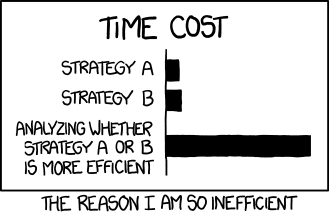
As for tracking the costs of regulations: that to me suggests the creation of a huge Rube Goldberg-like bureaucracy. Again, my government experience has exposed me to too may instances where the system is willing to spend thousands of dollars of people's time to make sure that $100 was properly spent. I lived in a world of this XKCD comic:
- Is Nuclear Energy the Answer?
One Planet Only Forever at 06:52 AM on 22 February, 2026A followup to my comment @460,
The US leadership-of-the-moment’s push to deploy massive amounts of small nuclear reactors without rigorous proof that it will be safe continues as described in the following report:
US military airlifts small reactor as Trump pushes to quickly deploy nuclear power, reported in NPR, by Associated Press, Feb 21, 2028.
This is an example of misleading marketing abused by gamblers (inventor/investors) who will try to harmfully maximize their benefit from potentially bad bets (or bad ideas). The harm will be discovered in the future (because the innovator is not required to rigorously investigate potential for harm). And it is likely that the promoters of the ‘innovation’ will obtain benefits that cannot be taken away from them in the future when the harm they benefited from causing becomes undeniable – like the fossil fuel climate impact issue.
Selected quotes from the article:
Energy Secretary Chris Wright and Undersecretary of Defense Michael Duffey, who traveled with the privately built reactor, hailed the Feb. 15 trip on a C-17 military aircraft as a breakthrough for U.S. efforts to fast-track commercial licensing for the microreactors, part of a broader effort by the Trump administration to reshape the country's energy landscape.
...
Skeptics warn that nuclear energy poses risks and say microreactors may not be safe or feasible and have not proved they can meet demand for a reasonable price.
Wright brushed those concerns aside as he touted progress on Trump's push for a quick escalation of nuclear power. Trump signed a series of executive orders last year that allow Wright to approve some advanced reactor designs and projects, taking authority away from the independent safety agency that has regulated the U.S. nuclear industry for five decades.
...
The minivan-sized reactor transported by the military is one of at least three that will reach "criticality" — when a nuclear reaction can sustain an ongoing series of reactions — by July 4, as Trump has promised, Wright said.
"That's speed, that's innovation, that's the start of a nuclear renaissance," he said.
...
Edwin Lyman, director of nuclear power safety at the Union of Concerned Scientists, said the transport flight — which included a throng of reporters, photographers and TV news crews — was little more than "a dog-and-pony show" that merely demonstrated the Pentagon's ability to ship a piece of heavy equipment.
The flight "doesn't answer any questions about whether the project is feasible, economic, workable or safe — for the military and the public," Lyman said in an interview.
Rapid scale-up to power AI data centres could see 1000s of these ‘potential disasters’ in operation by 2030. The expected global power demand for AI data centres by 2030 is over 1000 TWh. Assuming a 5 MW generator, like the one reported to have been shipped by the military on Feb 15, 2026, operates at full power 24 hrs a day every day it would produce 5 x 24 x 365 = 43,800 MWh = 0.0438 TWh. (Also note that a typical AI data centre requiring 100 MW would need twenty 5 MW generators).
Poorly regulated, unrestricted, innovation in pursuit of personal benefit has a history of producing harmful results that Others have to deal with. New Nuclear appears to be rapidly becoming a New Future Disaster promoted by Master Misleading Marketers.
- Is Nuclear Energy the Answer?
Bob Loblaw at 02:17 AM on 10 February, 2026PollutionMonster @ 458:
Expecting to be "100% sure" is an impossible goal.
Reading over that link you provide, I see a few unqualified assumptions:
- "I also think we need to add fusion to the mix,..."
- I'm old enough to have heard the "fusion is just around the corner" argument for several decades. I am strongly in the "I'll believe it when I see it" camp.
- "We can, however, build nuclear almost anywhere"
- No, we can't. Nuclear plants, with current technology, require lots and lots of cooling water. He does say "We can swap them in, one-for-one, for retiring coal plants." Since coal plants also require large cooling capabilities, this is probably true - but we don't have coal plants "almost anywhere".
- Building nuclear plants "almost anywhere" will also require overcoming resistance to placing nuclear in peoples' back yards, and resistance to transport of nuclear fuels and waste "almost anywhere".
- He goes on to state "...the newer designs are safer, more efficient, and more dispatchable", but when it comes to newer designs such as small modular reactors, these designs are still not being built and added to the grid in operational situations. It has not been shown that they can be built in short time frames and at reasonable cost (compared to renewables).
- "Nuclear can potentially give us the 30-50 years it will take to advance our technology and build all that renewable infrastructure."
- Nuclear can't be built on short notice. How much nuclear can be built in that 30-50-year time frame? Nuclear built at the end of that time frame won't help.
- He goes on to talk about the time it will take to build panels and batteries and upgrading and expanding the grid for renewables. He ignores the time it will take to build nuclear plants, expand the production of uranium, and update and expand the grid to handle the nuclear power generation.
So, I see that blog post as yet another marketing presentation, rather than evidence that nuclear provides a quick and reliable way of adding energy to the grid. It's an opinion piece, not a rigorous analysis.
- Fact brief - Does clearing trees for solar panels release more CO2 than the solar panels would prevent?
Bob Loblaw at 05:18 AM on 15 January, 2026David-acct @ 8:
Take your own advice.
The CO2 that is not absorbed involves the same O2 that is not created. I have already quoted the section of the OP that quantifies this: "an average acre of forest sequesters less than 1 metric ton of CO2 per year." That tells us how much O2 will not be produced if the forest is removed.
Unless, as I have asked, you know of some other magical source of O2 released by the forest that is not involved in the forest growth (CO2 uptake).
- Is this the most embarrassing error in the DOE Climate Working Group Report?
Bob Loblaw at 04:35 AM on 17 October, 2025History suggests that the authors of the DOE report are largely incapable of being embarrassed. Their determination to spread their message, in spite of numerous criticisms and corrections, is quite remarkable.
Charlie Brown @ 4:
That is an interest take: that they argue 3 W/m2 is small compared to the total radiative flux. It seems that they are using the "it's a trace/small amount compared to [X]" template that has been used in a variety of poor contrarian arguments; vis a vis:
Anthropogenic emissions are small compared to natural cycles
Are there any other arguments that fit this same template?
DenialDepot had a fun post (15 years ago!) on how to cook a graph by playing with the Y-axis. Of course, in its standard mocking of the contrarians, DenialDepot accuses Skeptical Science of cooking the graphs by not expanding the Y-axis to make the change look minuscule. (DD looked at sea ice.) DD shows the "proper" method should be to compare the lost sea ice area to the total area of the earth. In DD's words, "That's far more clear. Immediately I am having trouble seeing the sea ice. This is good. If you can't see it, it's not a problem."
It's like a defendant in court arguing "how can it be grand larceny? I only took $100,000. He has billions."
- Is this the most embarrassing error in the DOE Climate Working Group Report?
prove we are smart at 09:45 AM on 10 October, 2025I have to use simple breathing techniques to read/listen to anything from this Trump regime! Enabled by a political party of grifters and cowards with little conscience and no mirrors in their many houses.
Generations of this countrys populous fed on years of media stereotyping dumbing most down and culminating in electing a malignant man not once but twice. A mob boss,whose arsehole has swapped places with his mouth.
Indeed, Wikipedia on their "false and misleading statements by Donald Trump" page, have trouble deciding whether to split the narrative into 2 pages! en.wikipedia.org/wiki/False_or_misleading_statements_by_Donald_Trump
I guess it is about people voting against their own best interests. Seeing the big picture without the baggage you have grown up with or picked up along lifes journey. It seems not becoming a fatalist is much harder now and giving in to such is a guarantee of a dismal future for those generations to come.
- Is Nuclear Energy the Answer?
michael sweet at 01:54 AM on 23 August, 2025The most recent report by the National Infrastructure and Service Transformation Authority (Nista) in England has concluded:
"Plans to dispose of the UK’s high-level nuclear waste in an underground repository – a Geological Disposal Facility (GDF) – have been described as “unachievable” by a Treasury unit."
While nuclear supporters claim that it is simple to build underground storage facilities for high level nuclear waste it is proving difficult in practice. The USA currently has no proposed facilities. The current practice world wide is to store the waste in temporary casks on the grounds of existing reactors. Sometimes the waste is moved to another site.
Apparently FInland has a repoisitory near completion and Sweden has just started building a repository expected to begin taking waste in about 2040.
- The coolest new energy storage technologies
Riduna at 11:39 AM on 19 August, 2025I thought fire in Lithium-ion batteries was was caused by short-circuit resulting from growth of dendrites - so the older a battery the more likely the risk of fire. This risk had been significantly reduced by including sensors in each battery cell which detects risk of short-circuit, isolates the cell and warns of the defect. The ‘fire’ problem has been significantly reduced - except in older batteries manufactured before these sensors were introduced.
Laboratory work on solid state Lithium-ion Batteries shows that replacement of the liquid buffer between cathode and anode with a solid one eliminates the risk of fire. It also shows that Solid State Lithium -ion batteries also have the following advantages over batteries presently in use:
- Risk of fire removed,
- 10 -15 minute re-charge time,
- Twice the density, holding a lager charge,
- Much reduced weight,
- Operation over wider temperature range,
- Longer battery life,
- Increased utility.
These make commercial development of solid state batteries an all important goal but one which is fraught with manufacturing com plexities which have yet to be overcome and which could increase battery price.
Could AI have a role to play on overcoming design and manufacturing problems?
- 2025 SkS Weekly Climate Change & Global Warming News Roundup #29
One Planet Only Forever at 23:58 PM on 24 July, 2025This new NPR story: Trump's EPA now says greenhouse gases don't endanger people, appears to be an attempt to mislead people about the reality of the climate change harm done by using fossil fuels. It contains the following:
Already, environmentalists, climate advocates and others are bracing for what could be a fundamental shift away from trying to address the problem of a hotter climate. And the Trump administration is celebrating the proposal as a potential economic win.
"Today is the greatest day of deregulation our nation has seen," EPA Administrator Lee Zeldin said in announcing the proposal in March. "We are driving a dagger straight into the heart of the climate change religion to drive down cost of living for American families, unleash American energy, bring auto jobs back to the U.S. and more."
The economic wins cause others to pay the price. It taxes those who are harmed. The International court ruling pointed to in my comment @5 exposes this as just another example of how harmfully misleading the likes of Trump are.
That is the harmful belief that vicious competition for superiority - reduced taxes and more personal benefits - is the only option. That is the current rage on the right. They believe that - Things would be Greater if people wanting to benefit from being more harmful and vicious are freer to do as they please and are excused for any harm they cause because of the perceptions of benefits obtained.
- Sabin 33 #32 - Is range restriction a problem for EVs?
Bob Loblaw at 00:35 AM on 12 June, 2025Michael:
Our car came with a portable charger that can plug into a standard 120V 15A wall socket, but that only charges at 1.2 kW, which is a slow charge indeed. The charger itself can have 240V cables (extra cost) attached to it that plug into a variety of 240V outlets, but that still would have required us to install a 240V outlet in the garage.
As part of the negotiations, we got the car dealership to include a wall-mounted permanent charging box at reduced price. We then had our electrician install it. (I did the work of preparing the route for the cable run through our finished basement from the main panel to the garage.)
The 1.2 kW charger would still be able to easily handle the daily commute needs with only a few hours of plug-in time. Our electricity rates drop after 7pm, so we wait until evening to plug the car in. We do not need to plug it in every night, but we usually do. My wife's commute is about 40km round trip, but we're averaging about 60km between charges with extra short trips thrown in. On average, we put in about 12 kW each charge cycle, so just 10 hours if we used the slower 1.2 kW 120V charger.
...but as you say, the actual human resources time to do the charging is less than a minute in the evening to plug it in, and less than a minute in the morning to unplug it. With zero travel time.
- Electric vehicles have a net harmful effect on climate change
Charlie_Brown at 02:36 AM on 29 May, 2025Unfortunately, a key phrase was dropped from the source reference footnote [4] which makes the sentence in the green box for “What the Science Says” misleading. The reference says “EVs convert over 77% of the electrical energy from the grid (underline added) to power at the wheels. Conventional gasoline vehicles only convert about 12%–30% of the energy stored in gasoline to power at the wheels.” The source of power for EVs is not included in Eisenson, et al. “Electric vehicles have lower lifecycle emissions than traditional gasoline-powered cars because they are between 2.5 to 5.8 times more efficient.” Larson, et al., Final Report, p. 40, also compares units of electricity to units of gasoline. Furthermore, the articles do not define efficiency, whether it is g CO2/mile, g CO2(eq)/mile, or BTU/mi. Where coal is the power source for the grid, CO2 g/mi is about the same for EV and ICE. Where natural gas is the source, CO2(eq)/mi is close to the same after accounting for methane leakage from production and transport. Most simplified analyses use the source power mix from the regional grid. When the incremental power source to meet added demand for EVs (and other demands such as AI and growth), the situation is much more complex.
I am a strong supporter of EVs and I love my new car. To meet greenhouse gas emission reduction goals, transition to EVs is needed. The electric power grid also needs to reduce fossil fuel generation.
- Sabin 33 #28 - How reliable is wind energy?
michael sweet at 07:28 AM on 18 May, 2025tder2012:
We agree that decarbonizing as rapidly as possible is the target.
Oil is primarily used for transportation. As cars are switched to electric oil use will start to go down. Trains are already switching to electric (except in the USA). Electric trucks are being tested on the road. The cost savings for trucks switching to electric are substantial.
I understand electric freighters are economic up to about 1500 miles and some are being manufactured in China. Google says that some river freighters and ferries are the largest currently in service. Additional batteries can be loaded as containers on the freight deck and connected to the ships power, then switched at the next port.
Small planes have been built that are electric.
The key is to build out carbon free electricity as rapidly as possible and tax carbon emissions. As cheap electricity becomes more widely available and carbon more expensive, more users will switch to electric.
Vote for politicians who support more carbon free electricity!!
- Sabin 33 #13 - Is solar energy unreliable?
michael sweet at 00:57 AM on 8 May, 2025tder2012:
You need to find a more reliable source of information. In post 2 you claim:
"Electricity generators need to provide ancillary services such as black starts and synchronous inertia. Wind and solar are not capable of doing these on their own. BESS can do fast frequency response, but cannot assist with synchronous inertia."
Solar systems and batteries can be used for black starts already and can be used for synchronous inertia with proper inverters. In the past they have not been built with such inverters because they were not needed. As more wind and solar are implemented capable inverters will be deployed. It is deliberately misleading to claim that renewable energy cannot do something that was not needed in the past but where currently available inverters are capable of providing that service. The cost will be trivial.
It appears to me that your references completely leave out the cost of existing hydro. Hydro provides a significant source of on demand electricity and is the most flexible energy. Looking at the cost of 100% solar alone without taking into account existing hydro does not give an accurate idea of complete system costs.
Both Spain and Texas generate way more than 30% renewable energy. Many other countries generate as much as 100% renewable energy. Claiming that is not possible in your post 2 when it is already widely done is beyond misleading. It has been widely documented that Texas would have had blackouts in the past two summers without renewable energy.
Your post claiming high cost of LFSCOE (made on another thread) is simply fossil fuel propaganda. It has been known for years that the last 10-20% of renewable energy will be the most expensive. My link at post 1 of this thread documents how renewables save large amounts of money for the first 80% of generation and addresses the last 20%. It also demonstrates that fossil fuel interests lie and pay think tanks to produce "papers" that are simply false. Perhaps you would be interested in reading it.
We will see if LFSCOE is considered useful by anyone besides fossil fuel interests. The paper you linked was published in 2022 and Lazard has not implemented their analysis. Presumably Lazards experts would have made changes if they thought LFSCOE was a more accurate measure. I note that your link also claimed nuclear provides four times the financial benefits of renewables. It did not discuss the fact there is not enough uranium to generate a significant amount of power world wide.
I suggest you read Bryer et al 2022 and the references theirin for more accurate information. These papers actually calculate the full system costs of completely renewable systems. For example, Jacobson et al 2022 details all the solar panels, wind generators, batteries and other needed materials to generate 100% renewable energy. Jacobson does not find the cheapest route to 100% renewables since he does not use any thermal sources (like waste incineration). Since he considers all sources of renewable energy he does not grossly overestimate the cost of the last 20% of energy (although that is the most expensive energy).
I note that wind and solar compliment each other in 100% systems and result in much lower costs that wind or solar only. LFSCOE costs of solar only or wind only do not reflect 100% renewable system costs. Thermal baseload like nuclear do not compliment renewables and result in higher system costs.
- Medieval Warm Period was warmer
Eclectic at 08:29 AM on 7 May, 2025Dick van der Wateren @ 273 / 274 :-
Your third reference (the Nature paper) leads off by saying: "The Antarctic landscape is one of the most stable environments on Earth ... [for] approximately 14 million years"
Which is what you would rather expect, seeing that the Antarctic ice-sheet is simply a super-colossal block of ice. The 14 million year period is not an intuitive matter ~ but the task of finding a slight variation of temperature (probably less than 1 degree) occurring at some stage during recent millennia . . . would be a daunting and ultimately pointless task.
I ran into a "blockage" seeking your earlier references, and will therefore fall back on my old memories of a study of coastal temperatures on a portion of (eastern) South America. That study was (IIRC) rather unimpressive in validity ~ especially since it covered only a tiny part of the planet. Can you supply a detailed discussion of those earlier papers you mentioned?
- 2025 SkS Weekly Climate Change & Global Warming News Roundup #14
One Planet Only Forever at 10:22 AM on 9 April, 2025nigelj,
Though we substantially agree, I need to respond to the part of your comment @23 (on the SkS re-posting of “Climate skeptics have new favorite graph; it shows the opposite of what they claim”)
You said: “For example the Democrats proposed some truly stupid ideas like defunding the police. I guess it was an emotive reaction to police abuses but its still stupid.”
That is a commonly claimed criticism. And it is as valid as claiming that “Tax is evil and Socialist– and imposing a Carbon Price is a tax - therefore Carbon Pricing is Socialist evil” which is the product manufactured by the misleading marketing efforts of people who resist learning to be less harmful and more helpful to Others. Taxes are not evil (or Socialist). And a lack of a Carbon Price that funds full neutralization of the impacts of fossil fuel use is the reason that so much harmful activity became so popular, profitable and powerful - bad enough that many of the more informed and smarter minds are protecting their interests rather than fighting to limit the climate change harm done.
For the police issue, Defund he Police was a punchy poster statement promoting a more involved matter. The real problem was paying to have the police try to do things they did not have proper training to do – like deal with cases of homelessness, mental health, drug use, and domestic abuse. Shifting some police funding to employ specialists in those non-police realms was the objective. “Defund the Police” was the punchy poster that became the basis for unjustified misleading marketing.
See the following Brookings Institute presentation on the topic “7 myths about “defunding the police” debunked”
- Greenhouse effect has been falsified
Bob Loblaw at 10:57 AM on 7 April, 2025Reed Coray @ 208, 213:
You continue to avoid the real question. It may be that you don't understand the question - but I agree with Dikran that you probably simply don't want to answer his question.
At least you have abandoned your attempt to claim that "trap heat" is not a term that would appear in "a generic dictionary".
Let's play word games again, and look at another definition of "trap" - this time as a noun. It comes from one of the links I gave earlier.
- a dangerous or unpleasant situation which you have got into and from which it is difficult or impossible to escape:
- The undercover agents went to the rendezvous knowing that it might be a trap.
- fall into a trap She's too smart to fall into the trap of working without pay.
- Don't fall into the trap of thinking you can learn a foreign language without doing any work.
- His foot was caught in the jaws of the trap.
- We set a trap and they walked right into it.
- They put rabbit traps all over the wood.
- We set traps to try to control the mice.
Your attempts to divert attention away into more word games is obviously because of the "unpleasant situation which you have got into and from which it is difficult or impossible to escape". It is also a trap of your own making - posting poorly-thought-out arguments in a public forum, where others are free to point out your errors.
[Note that all three of the dictionaries that I referenced in comments 205 and 206 provide similar definitions.]
I agree with Dikran @ 210, when he says that your sort of behaviour is common from "contrarians". Avoid the questions. Avoid dealing with the arguments presented. Avoid admitting to the glaring errors of logic and inconsistency that are pointed out to you.
Word of advice: when you find yourself in a deep hole, stop digging.
- Climate skeptics have new favorite graph; it shows the opposite of what they claim
nigelj at 08:10 AM on 6 April, 2025OPOF @21
I go along with your philosophical position on system change etc,etc.
-------------------
OPOF @22
"A reduced global total population would definitely improve the ability of all humans on this amazing planet to sustainably enjoy better lives, now and into the distant future."
Exactly. Warming projections are based on business as usual population growth so only slowing mildly. Any way we can get that growth to slow quicker, will help the climate issue.
"This recent BBC – In Depth article “The influencers who want the world to have more babies - and say the White House is on their side” is about beliefs that ignore or conflict with that common sense understanding...."
Yes and its frustrating. This is why I suggested a declining population is not guaranteed (although personally I think population will still decline). There are forces in opposition to a smaller population mostly 1) people worried about the economics of the transition period of declining numbers of young people having to support an aging population tending to live longer and 2)people driven by the bible "go forth and multiply" and 3) the natural instinct to have large families is strong in some people even although it no longer makes much economic sense in developed countries. 4) people who tend to think more people is just good economically. 5) people worried about their culture losing dominance
And I can acknowledge the economic arguments and at least understand the religious and cultural arguments. But I think they arent very good arguments overall, and they will all still loose the argument because even in countries where governments have tried to encourage or financially incentivise large families it hasnt worked - people continue to prefer small families. There are examples in SE Asia easily googled. And family size is decling even in Catholic and Islamic countries. So I'm not that worried about Vance backing large families.
"[JD]Vance has often spoken about the need to fix a "broken culture" that is tearing the US family apart, by undermining men."
This appears to mean men are being underminded because they can no longer exploit, abuse, control and discriminate against women. Or because society now accepts trangender people. Vance and his ilk are never able to provide any other reasons of any significance.
"My semi-conspiracy theory......"
Something like that process is definitely going on. I dont think you have quite nailed it completely, but I cant immediately improve on it.
I tend to think that what is happening at the most general level in society is theres a unfortunate conservative backlash against gobilisation, which tends to have a liberal agenda, and which I broadly support. But it does have a few downsides which has left it open to attack.
The emergent conservative camp wants a return to economic protectionism, traditional family values, fossil fuels , and attracts people with largely traditionalist leaning values like that. There is no sign of much of a compromise solution emerging. Its very much armed and angry camps.
I think we have to stand up for the values we believe in and argue why, and also be open to understanding valid criticisms of our own positions. For example the Democrats proposed some truly stupid ideas like defunding the police. I guess it was an emotive reaction to police abuses but its still stupid.
"Note: I admit to also wanting ‘more of a certain type of people’. I want more people who pursue learning to be less harmful and more helpful to others. That may be ‘divisive’. But it is arguably ‘a good divisiveness’."
Agreed. And this is an example of promoting values we believe in. I dont see what more we can do. We have to take a stand, but without being closed minded about valid criticisms either. But sometimes I think liberals are a bit too polite - most of Trumps policies look idiotic to me and we have to sometimes call a spade a spade.
- Greenhouse effect has been falsified
Bob Loblaw at 00:32 AM on 29 March, 2025It's also worth noting that the word "trap" is barely used at all in the OP that we are commenting on. In the Basic tab, it appears twice. Once in relation to comparing the earth (with an atmosphere) to the moon (no atmosphere), and once in relation to the atmosphere trapping radiation. In the Intermediate tab, the word "trap" does not appear in the OP at all.
Reed Coray's complaint about overly-simplified explanations of "trapping heat" seem rather oddly placed under a blog post that gives a lengthy discussion of the greenhouse effect (which is of itself a poor term, as is explained in the OP!). Complaining that something should not be done when it does not occur in the OP starts to look like someone is complaining just for the sake of complaining.
The comments section here is intended to discuss the science presented in the original posts. This is explained at the top of the Comments Policy. As a new user, it behooves Reed Coray to actually read the posts he wants to comment on.
- How to find climate data and science the Trump administration doesn’t want you to see
prove we are smart at 13:38 PM on 20 February, 2025Agree, the "ugly American" is alive and well and one of the many is now president again!
All governments worldwide practise "narrowing public understanding" with their enabling corporate media cronies. Disinformation,distraction,divided and a dumbed down education system helps keep a populous from rallying.
If nearly 40% on average of eligible voters don't bother to show for the last 4 elections,I'm not holding my breath for a peoples united steet protest to force government to change to a much more social democracy and to actually govern for you.
A comment I read- "It sure feels like our Republic/Democracy has totally failed... ;-( We are spiraling down the drain with no decent candidates able to step up in a two Party System of big money and Corrupt Forces...
It was about people hurting and continuing to be hurt the last 4years. Your instinctive reaction is if you have a choice between more of the intolerable same and a roll of the dice- rationally you are going to choose a roll of the dice.
This entitled country living with capitalism on steroids has voted for chaos, many threats to our fragile social order exist however greed and forever growth instead of empathy and understanding is a irresistable lure for our sociapathic leaders.
With the looming and worsening climate change disasters becoming more apparant, perhaps my naive dream of people finally living in a very different way but within a planets boundary will come true. Of course my Trumpian nightmare of fascism spreading as tipping points/collapses force the worst from us is slowly realized.
- 2025 SkS Weekly Climate Change & Global Warming News Roundup #07
One Planet Only Forever at 04:59 AM on 19 February, 2025There are many items this week in the Climate Policy and Politics category, and in other categories, regarding anti-learning actions by Trump/Musk-led Republicans.
This new CBC News item “Scientists at U.S. weather forecasting agency ordered to get clearance before talking to Canadian counterparts” provides some additional details. The article opens with a general statement and a rather weird specific example.
Travelling for international meetings or even joining a call with Canadian counterparts has become impossible for some U.S. government scientists, under new directives since U.S. President Donald Trump took office.
Canadian ecologist Aaron Fisk says he recently tried to set up a virtual call to discuss plans with American colleagues, including a government scientist, around sampling fish.
"We tried to have a quick meeting with one of our collaborators … and they were denied access," Fisk said.
Attempts to restrict and control ‘learning’ are to be expected whenever and wherever people who like to benefit in ways that are potentially, or actually understandably, detrimental to Others become significantly powerful and influential threats that emerge and grow from inside a socioeconomic group.
There is a long history of anti-learning types becoming harmfully popular and powerful. See my comment on Weekly News #6 that includes details of anti-learning actions in Canada in the early 2000s. Note that the Trump/Musk-led Republicans can also be seen to be promoting the growth of popularity of anti-learning in Europe and elsewhere around the world.
- Antarctica is gaining ice
John Hartz at 08:19 AM on 13 February, 2025Suggested supplemental reading:
Introductory text:
"Social media posts sharing a graphic comparing sea ice levels in the Antarctic on the same date 45 years apart misrepresent the data to suggest climate change is a hoax.
The graphic, opens new tab depicts two authentic maps of the continent from the University of Colorado Boulder’s National Snow and Ice Data Center (NSIDC), one labelled as 'Sea Ice Extent, 24 Dec 1979' and the other 'Sea Ice Extent, 24 Dec 2024,' with white regions indicating sea ice.
'Antarctic sea ice extent is 17% higher today than it was in 1979. Ice doesn’t lie, but climate scientists do,' the text reads."
Verdict:
"Misleading. The posts cherry-pick specific dates that misrepresent Antarctic sea ice trends and ice dynamics that are influenced by multiple factors beyond global warming."
by Staff, Reuters Fact Check, Feb 11, 2025
- Fact brief - Can CO2 be ignored because it’s just a trace gas?
nigelj at 06:03 AM on 29 January, 2025Evan @8, and OPOF @9
Interesting. I agree with OPOFs views on the climate issue, in a theoretical sense. For example, it is obvious to me high income people can mostly cut their consumption significantly and still have a decent enough life, and that leaders of society should set an example. However I share Evans concern that greed and self interest get in the way, and human nature is unlikely to change.
But the situation is quite nuanced because most people are not hugely greedy. They clearly make personal sacrifices for a good cause, up to a limit, on average over the population. For example they donate to charity and help others. The majority of people have accepted things like carbon taxes or emissions trading schemes up to a certain extent, knowing this is ultimately a personal sacrifice. This has helped build renewable energy.
I think our job is to persuade people to make as much sacrifice as possible in terms of things like accepting carbon taxes or government subsidy schemes. But it seems unlikely we would get people to make huge personal sacrifices of the type where they stop flying, or turn thermostats down low in the middle of winter and cycle everywhere. These things can become very uncomfortable and have various downsides. This is all why I tend to promote the renewables and electric cars side of the equation. I dont fly much myself , but for many people travel is viewed almost as an essential of life.
The energy consumption issue has another dimension as well. If we cut our levels of energy use too much and too fast it could cause a severe recession and unemployment, as demand is sucked out of the economy. And this means its unlikely such a policy would gain traction. This is why I tend to think we are mostly or almost completely reliant on an energy substitiution process of building renewables and EV's. Im not saying this is the ideal perfect solution - just that is likely the only workable solution in the real world.
I think the misinformation thing is a different issue, although it is used to make greed sound acceptable.
OPOF: "My more global concern is that we could be witnessing the early days of a powerful resurgence leading to many decades, possibly centuries, of global humanity being dominated by extremely harmful misunderstandings."
It has shocked me how 50% of people could support a leader who spreads huge volumes of misinformation. Its really a bit depressing and shows how thin the veneer of civilisation is. However its hard to say how long harmful misunderstandings would last. If a harmful misunderstanding causes a global trajedy like a nuclear war the pendulum might quickly swing back to the need to truth and accuracy. Or maybe people will just tire of all the misinformation and normality will be restored quite quickly. But in the medieval period of human history, the middle ages, people believed in complete nonsense and it was a dark time that lasted over 1000 years. It kind of self corrected as people slowly realised their lack of accurate information was holding them back and science emerged to promote accurate information. But that was a slow process. Maybe a centuries long period of misinformation could happen again especially if there is a huge drop in trust in science. We must do all we can to counter that.
- At a glance - Is the CO2 effect saturated?
MA Rodger at 02:42 AM on 29 January, 2025sychodefender @30,
Another take on answering you questioning....
As you say, the climate forcing from mankind's CO2 emissions does cause feedbacks, these most evident in the water cycle, humidity, cloud cover, cloud height (this last the least understood). But there is no "self-sustaining loop" or even any significant CO2 emissions consequent from mankind's emissions as a feedback. There is thus no need for a natural mechanism to prevent run-away global warming.
You mention CO2 in this "natural mechanism" and CO2 has operated naturally as the major control knob for the climate through the eons. (Calling CO2 the 'control knob' should not be in any way controiversial.) The ancient Earth's climate is a bit of a mystery as the sun was less energetic in the early solar system (and from its weak beginning will continue to strengthen) and with no means of knowing the ancient atmospheric composition the 'faint sun paradox' remains unexplained. More recently, over the last 500 million years the temperature record is reasonably well known. (Through that time the sun has brightened by about 5% which is a climate forcing equivalent to roughly a quadrupling of CO2.)
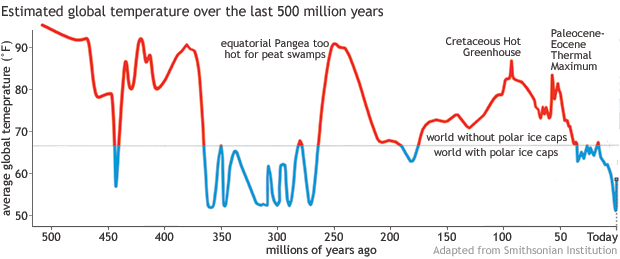
There are a few very-long-term mechanisms at work altering the carbon available for the carbon cycle (in the atmosphere, bliosphere and ocean waters, these being in equilibrium for multi-millenial periods).
Taking CO2 from the atmosphere into rocks as coal was a major process in warm climates for early parts of this 500My period as back then fungi were not well developed enough to decompose plants which could thus be buried and turned to coal. Modern fungi prevents such significant coal formation.
A second mechanism is the water-weathering of mountain rocks which allows the formation of carboniferous rock in sea water. When the 700Gt(C) humanity has emitted so far has reachen equilibrium between biosphere, ocean and atmosphere (which takes abut a millenium), the remaining 25% of our emissions in the atmosphere (assuming only natural processes) will require rock-weathering to be extracted, this taking tens of millenia to complete. At a similar rate of action, the formation of the Himalayas and associated increase in rock-weathering has seen the atmospheric CO2 content drop over the last 50 million years and with it the cooling of the planet.
Once this deposit of carbon into the geology occurs, it is volcanism that works to return it to the carbon cycle. Thus when the planet is so cold that there is no rain to weather rocks and no significant biosphere at work, the volcanic activity will slowly pump CO2 back into the atmosphere restoring the level of greenhouse effect. The emissions are very small relative to mankind's emissions (perhaps about 1%).
You mention Milankovitch cycles which have been waggling the planet's temperature for the past 3 million years (initially as a 40ky cycle, then 100ky).
The Milankovitch cycles are not so strong in themselves but are amplified by positive feedbacks. Within these cycles, CO2 is part of that positive feedback (increasing the size of the wobbles) with carbon being locked away under frozen land and in cooling oceans under increased sea ice. However the big driver of recent ice ages is albedo not CO2.
You mention the logarithmic relationship between CO2 levels and climate forcing. This is an empirical relationship for concentrations in the range 150ppm to 1300ppm. As Zhong & Haig (2013) fig 6 shows, beyond 1300ppm the forcings increase faster than logarithmic. By then, of course, an increase in the CO2 consentrations would need to be four-times an increase to add the same extra forcing. But we don't want to be creating a world with 1300ppm. It would have already been under a forcing of 8.4Wm^-2 from the extra CO2, perhaps global warming of +7ºC.
- At a glance - Is the CO2 effect saturated?
Bob Loblaw at 01:39 AM on 29 January, 2025sychodefender @ 30:
The ultimate limiting factor for warming induced by greenhouse gas increases is the infrared radiation emitted to space from the upper part of the atmosphere. As the earth-atmosphere system heats up (primary a surface effect in the case of greenhouse gases) more IR is emitted to space, and (hopefully) eventually balances again. Think of it in stages:
- Earth is in a stable climate, with a stable (over years or decades) temperature. Energy absorbed from the sun is balanced by IR losses to space.
- Something causes that equilibrium to go out of balance. In the case of greenhouse gases, the direct factor is a reduction in the IR loss to space.
- Now, absorbed solar exceeds IR losses, so we are adding energy to the earth-atmosphere system.
- The net energy increases causes some part of the system to warm up. That energy cascades through the system in a variety of forms (radiation, thermal energy, evaporation/condensation).
- After a while (many years), the system evolves to a point where IR losses to space increase enough so that we reach a new balance with absorbed solar.
- Once a new balance is achieved, we have a (new) stable climate again. In the case of doubling CO2, this new stable climate will be a surface temperature that is a few degrees warmer than it was before.
So, ultimately, the ability to regain equilibrium requires that the system respond to a point where IR loss to space - from the upper part of the atmosphere (you'll often see "TOA" to indicate "Top of Atmosphere") can rebalance the energy absorbed from the sun. In a stable climate, you can have short-term shifts away from equilibrium, but this "energy balance with space" will keep pulling the climate back to its stable position - kind of like a marble rolling around in the bottom of a round bowl.
So, next let's think about feedbacks, such as the "CO2 warming increases water vapour, increases warming, increases water vapour" go-on-forever loop. SkS does have a lengthy discussion of that topic, on this thread here, but let's take a quick look at it now.
- In climate science terms, the water vapour effect you describe is called a positive feedback. A system change in one factor causes a change in another factor that adds to the initial change.
- If the initial change is an increase, a positive feedback will cause more increase.
- ...but if the initial change is a decrease, a positive feeback will cause more decrease.
- Positive feedbacks do not necessarily lead to values that increase forever. As long as the feedback multiplier is small enough, a new equilibrium will still be reached.
- "Small enough" is anything less than 1.
- If the initial change is 1, and the feedback adds another 0.5, then the next time through the sycle we'll only add 0.5*0.5 = 0.25, and the next time will only add 0.25*0.5 = 0.125, etc.
- This will stop increasing once it reaches a total change of 2.
Let's look at this graphically. The following image shows 10 time steps with eight different feedback multipliers.
- For all curves the initial change from time 0 to time 1 is a system change of 1 (you can think of it as temperature, but the math doesn't care what it represents.)
- For time 1 to time 2, we add another change of 1*feedback multiplier.
- an increase of 0.1 for a multiplier of 0.1.
- an increase of 0.2 for a multiplier of 0.2.
- etc.
- The figure shows feedback multipliers ranging from -0.5 to 2.

Note some key features in the figure:
- For a multiplier of 0, there are no further changes after time step 1. The system change has already reached a new equilibrium and remains constant forever.
- For a multiplier of 1, we see a continuous linear increase. We add another 1 at each time step.
- For a multiplier of 2, we see an accelerating, exponential increase over time. Not a good place to live.
- For all multipliers between 0 and 1, we can see that the rate of increase tapers off and a new equilibrium is reached after 10 time steps.
- ...but that new equilibrium is higher for higher feedback multipliers.
- For multiplier 0.5, note that the final result is an increase of 2.
- This one is closest to our known climate system feedbacks - the direct effect of CO2 is roughly doubled by feedbacks such as water vapour and snow/ice.
Note that I threw in a multiplier of -0.5, too. This is a negative feedback, opposing the initial change. The final change is 0.67, not 1.0.
- In a real world, the negative feedback would not wait until the initial change of 1.0 happens - all feedbacks kick in as soon as any change occurs. You'd see smooth curves, not the jumps we see in the figure. The -0.5 curve would just gradually increase from 0 to 0.67 in the first few time steps.
Also, note that you can find out more about these issues by using the search box on the SkS web page (upper left), or by looking at the Most Used Myths list (linked below the search box and social media emblems).
- Sabin 33 #12 - Do solar panels work in cold or cloudy climates?
Bob Loblaw at 02:09 AM on 24 January, 2025Upstream, in comment 4, I talked about some of the aspects of solar panel installation and orientation. Words are nice, but pictures are often better, so I've graphed out some data to show some difference between clear/cloudy, winter/summer, and horizontal/tilted measurements of solar radiation.
The following graphs are a continental location, at about 50°N latitude.
All radiation graphs show five different measurements:
- The "Direct" measurement is "direct normal" - an instrument pointed directly at the sun, with a narrow field of view.
- "Diffuse" is the radiation on a horizontal surface of just the sky - direct sun blocked.
- "Global" is a full sky view (direct plus diffuse) on a horizontal surface.
- "Titled" is also direct plus diffuse, but at a 50° tilt to the south, so it sees some sky and some ground.
- "Reflected" is the same type of instrument as "Global", but upside-down so it sees all the solar radiation being reflected off the ground surface.
The first graph is a clear day at the beginning of January. Direct radiation peaks at over 900W/m2, and diffuse radiation is less than 100W/m2. Because the sun is low in the sky, the global reading is much less than the direct - peaking slightly over 300 W/m2. The tilted sensor, though, peaks at over 800 W/m2 - not only is it pointing much closer to the sun, but it also sees a lot of ground that is very bright. The reflected reading peaks at over 200W/m2 - the ground is snow covered, reflecting about 75% of the global signal, so much brighter than the deep blue sky of the diffuse signal.

Clearly, a tilted solar panel would produce much more power than a horizontal one. We can see why when we look at the solar elevation angle (how high about the plane of the panel the sun is located). This graph shows the elevation above a horizontal surface (global instrument) and tilted surface. The sun is barely 20° above the horizon of the horizontal sensor, but is over 60° above the tilted sensor's "horizon". Note that the daylight period is only about 8 hours - elevation>0° for the horizontal view. Even though the titled sensor has an elevation >0° for much longer, those "extra" hours mean nothing, as the view of the sun is blocked by the earth!

The next day, cloud moved in. Direct radiation is zero, except for a brief period in early afternoon when the clouds thinned enough to let a bit of direct sun through. The four other lines are, from highest to lowest, tilted, Global and Diffuse (virtually tied), and Reflected. With no direct sun, and a snow-covered surface that reflects most of the solar radiation, there isn't much difference between the horizontal and tilted readings.

Note that for the horizontal sensor (global) the cloudy day is not much lower than the clear day. It peaks around 250W/m2, compared to a little over 300W/m2 on the clear day.
What about summer? Here is a "mostly" clear day in early July. Direct beam peaks only slightly higher than in January, but global radiation is much higher because of the higher solar elevation. The titled sensor peaks a little higher than global - it's tilt is no longer much of an advantage over the global sensor, and the portion of ground it sees is now dark (reflecting only about 20% of the global). Diffuse is again <100W/m2.

Daylight is now more like 16 hours, though, so daily totals will be quite different from January. We also see something odd in the tilted sensor - it peaks higher than the global (horizontal) sensor, but in early morning and late afternoon, it sees less than the global sensor. In fact, at the extremes it looks like it is only seeing the diffuse radiation - no direct.
We can understand this by looking at the solar elevation again. Note that for the titled sensor, the sun "rises" much later and "sets" much earlier (elevation <0°) than for the global sensor. What is happening is that the sun rises in the NE and sets in the NW, so it is actually behind the tilted sensor, not in front of it.

And lastly, we'll look at a cloudy summer day, right on the summer solstice. We do see some direct sun getting through in the afternoon, but we can see the cloudy period that covers most of the day. We see a substantial reduction in global before noon local time (compared to the clear day). After 12pm, we see a higher value for global as the cloud thins and a bit of direct radiation makes it through the clouds. During the cloudy period, the tilted sensor is not much different than the global one - both are seeing the same diffuse radiation.

So, hopefully this helps illustrate some of the complexities related to solar panel installation and orientation. To refer back to the OP - no, cloudy skies does not mean "no solar energy". The OP is correct - the myth is busted.
This is only one location, and a few days of data. And this level of data is not readily available for most locations. But it does illustrate that installation may be dependent on local factors such as amount of cloud, type of cloud, timing during the day, etc.
- 2024 SkS Weekly Climate Change & Global Warming News Roundup #45
nigelj at 06:29 AM on 13 November, 2024The AI (artificial intelligence) does appear to use a lot of electricity. It raises the issue of where we should cut our electricity use to help mitigate the climate problem. One can talk about focusing on meeting needs rather than wants. We probably need some basics to survive in cities like a fridge and electric stove and a radio and home heating. We dont really need a television and vaccum cleaners and cars and fancy audio systems, and travelling to other countries or even cars in most cases. We probably mostly dont need AI unless it helps the healthcare sector. We dont even really need computers. We sure don't need bitcoin.
But wants are also very important. Its what makes life nice. So we have to decide on what wants are legitimate. Is a television legitimate? If it is, what sort of television is legitimate? How much long distance motorised travel is appropriate? Its all a nightmare really.
And one persons wants are another persons needs. Even deciding on what is a need and a want is not as easy as it seems. A computer is a perfect example. Its not absoluely essential but its getting close to being essential?
I'm not a huge energy user myself. Im just highlighting some of the challenges in figuring out wants versus needs, and what constitutes a workable low energy use society, and getting people to voluntarily adopt this.
- Remembering our friend John Mason
FiMason at 19:09 PM on 18 October, 2024Hello - I'm Fi, John's sister.
We say farewell to John at 14:00 BST on Tuesday 22nd October 2024 at Aberystwyth Crematorium. All are welcome.
The service will also be live streamed at website https://watch.obitus.com
Please input the following details:
Username: rida7538
Password: 992865
The broadcast will start a few minutes before the service commences and will last for the duration of the service. Following this, the recording will be 'offline' for a couple of days before becoming available to watch again for a further 28 days.
You can try these login details ahead of the service and if successful, you will see a video of a waterfall.
I hope you will be able to join in person or online.
Thank you.
Fi - Just have a think: Arctic Sea Ice minimum 2024. Three degrees Celsius warming now baked in?
Eclectic at 12:50 PM on 27 September, 2024Jim Hunt @2 ,
you were, two or three days ago, crossing swords with the amiable skeptics at WUWT blog, about Arctic ice.
It seems they feel that a sort-of flat-lining of minimum Arctic sea-ice extent during the past decade . . . is a disproof of the contemporary reduction in Arctic sea-ice volume . . . which in turn demonstrates that there will be no further ice melt as sea-level continues to rise ~ the ongoing rise which in turn disproves that global warming is occurring. (If I have understood their argument correctly.)
And since global warming is not continuing, despite rising measurements by worldwide thermometers, then the whole AGW thing is a hoax and can be ignored.
Or something like that.
And if Plan Denial eventually crumbles, then the WUWT skeptics will develop "concepts of a plan" to deal with the non-problem. [Please excuse contemporary 2024 political joke.]
- What Project 2025 would do to climate policy in the US
One Planet Only Forever at 01:54 AM on 10 August, 2024Thank you for sharing this item. It’s a great supplement to the Story of the Week in “2024 SkS Weekly Climate Change & Global Warming News Roundup #29”
Doug Bostrom’s observation about the selective secrecy of the politically conservative collective pursuing Project 2025 is a justified concern.
Harmful exploitation of flaws and weaknesses in the US Constitution is possible and can be very damaging. The US Constitution has been proven to be open to biased poor judgment interpretations. An example is that the Constitution can be interpreted to never require the Senate to vote to approve Supreme Court (SC) nominees. The death of SC Justice Scalia on February 13, nearly 9 months before an election, did not require the New Right Republican Senate to vote on the President’s nominee replacement. But the death of SC Justice Ginsburg on September 18, less than 2 months before an election, resulted in the New Right Republican Senate expediting voting to appoint a new SC justice.
Exploitation of that systemic flaw shows how the freedoms and fairness of democracy can only survive if rational judgments govern and the institutions that make a socioeconomic system work as a democracy are defended against irrational influence.
The secrecy regarding the “fourth pillar” of Project 2025 is a serious concern given the following ‘open declaration’ in the item linked to by Doug:
“The 2025 Presidential Transition Project has convened the conservative movement in support of the ideas that will reclaim our nation.”
The New Right Republicans behind Project 2025, including Trump in spite of his denial, do not consider the USA to be a nation for anyone other than ‘their type of people’. By saying “reclaim” they imply that the majority of the current US population is a threat to ‘Their New Right Nation’.
As noted by nigelj @2, Project 2025 is understandably a collective of poorly justified passionately held emotion-based anti-intellectual opinions that conflict with ‘better judgment based on unbiased investigation and thoughtful consideration in pursuit of learning to be less harmful and more helpful to Others’. However, it is well understood that many people can tragically be tempted to passionately fight to embrace and preserve emotion-based opinions, regardless of their ability to learn that they are harmfully incorrect.
Many people who understand the importance of rapidly ending climate change impacts are likely to vote against that rational understanding because of a more powerful harmful desire for Other emotion-based opinions excusing poorly justified harmful Interests.
- 2024 SkS Weekly Climate Change & Global Warming News Roundup #29
nigelj at 07:33 AM on 24 July, 2024Just adding to Bob Loblows comments. In my view the term free market is a bit problematic, because what is meant by the term free? Taken literally it would mean people are free to do what they like including theft and murder, so you have the rule of the jungle. Of course no modern markets work like that, there is basic criminal and property law. The free market is thus really a managed market in practice.
The question is how many other restraints / constraints are acceptable? Many economists say markets should not have tariff protections or price controls but its acceptable to have governmnet regulations relating to health and safety and the environment and anti monopoly laws. This is common in practice in many countries, and seems sensible to me. Some even call this a free market.
Free markets really is a terrible term and when we use the term we need to define what we mean by it. I should have done that. I did in fact mean the free market in its unconstrained form and without governmnet interventions, and this is not inherently good at providing adequate health and safety outcomes. Thus the need for adequate regulations. Whether we have this in practice is of course up for debate.
- What’s next after Supreme Court curbs regulatory power: More focus on laws’ wording, less on their goals
Philippe Chantreau at 10:32 AM on 13 July, 2024I don't mean to dogpile, but I find the turn that this argument has taken quite intriguing, especially this bit about aircraft design, manufacturing and certification: "if an accident results from flawed design, manufacture or operational procedure only the private sector participants pay the price, the regulators who type, production and airworthiness certified the equipment pay no price." If this was the incentive structure, one has to wonder why title 14 of the Code of Federal Regulations is so thick and contains such stringent rules about these subjects. In fact, "the price" that people pay is exactly the reason why regulations and their strict enforcement are very much needed in this particular area, a strange argument coming from someone who seems so opposed to the very idea of a regulator.
It appears to be a swipe at the FAA for allowing Boeing to fool them in the miserable 737Max fiasco, and if so, it is the most underhanded turning of the world on its head that one could ever think of. It is the equivalent of the abuser telling the victim "look what you made me do!"
The certification process for an aircraft is notoriously throrough, long, difficult, and has been an object of constant complaining from many "private" actors in the aviation industry for decades. Some have argued, rightfully in some cases, that it stifles innovative designs and slows down progress, although that is probably more true in the general aviation sector. Nonetheless, the level of safety that has been achieved by this industry is truly remarkable. It is owed in large part to the efforts of regulators and to the sincere cooperation between industry and regulator, at least back in the days when industry had principles. Everyone (outside of McDonnell Douglas) knew that these pesky regs have been bought by blood, and that they pay dividends in saved lives on the long run.
Fast forward: Boeing realized they did not have a suitable airplane to compete with Airbus. Instead of designing one, they attempted to iterate yet another reincarnation of their 1960's worhorse. It is now well known that the short legs of "Fat Albert" (the 737's nickname) were a problem, that could only be adressed by potentially dangerous design compromises. They probably would have done better using he 757 as a basis, but that is another story. The solution was one from the modern world: flight envelope protection software. However, the essentially new flight characteristics would normally mandate crews to be retrained into a full new type rating, because of, you know, pesky regulations. The ubiquitous Airbus cockpit, consistent flight characteristics and control laws make it very easy for crews to transition from one airplane to another, requiring minimal expenses for transition. So, to get the same benefits, the software was made "silent" and the full extent of its scope and role was essentially hidden from the regulator. This was made easier because Boeing had prepared the terrain by convincing the FAA to let them do their own self certification of a lot of subparts of the process. Kinda like an airframe and powerplant mechanic doing all the tasks involved in an annual inspection and then having an Inspection Autorized A&P review the work and do a quick examination of the plane before signing the books. This can work, when high levels of integrity are maintained.
For Boeing, this self policing did not work. That was clearly demonstrated in the years following type certification. Boeing took it as license to make bucks on the back of quality and safety, and that's exactly what they did. Incidentally, it led to more scrutiny and the full extent of the company's decay was revealed.
So, indeed, a flawed design was allowed by the regulator to hit the market, because the regulator was convinced to let the designer self discipline. Faulting the FAA is like saying: "this is your fault because you should have known we were crooks, despite all the clever arguments we used to convince you we weren't." Hardly a case for less stringent regulations and enforcement.
As for this bit "only the private sector participants pay the price." It really does not apply to all private participants. Dave Calhoun, as private a participant as there was in this sad story, presided over the final blows to a once exemplary and legendary aircraft maker, that was the envy of the World. He never put forth even the slightest attempt at changing direction. His price to pay? Walking away with 30 million dollars of severance, give or take (published umbers vary).
- What’s next after Supreme Court curbs regulatory power: More focus on laws’ wording, less on their goals
TWFA at 13:44 PM on 12 July, 2024I appreciate all the insults and vituperative assertions as to my ignorance and wickedness, not very persuasive, but I am used to it, actually amused.
I understand that climate activists, like many others, generally love regulation because it is more efficient and easier to achieve their aims by lobbying for regulation than persuading folks to do as wished on their own... compulsion for their own good whether they know it or not. Persuasion requires far too much marketing and creativity outside their skill set to present the proper value proposition that closes the sale, skills like those of a successful capital equipment sales rep flying an ICE aircraft around the country as I was years ago... you know, the deplorables.
It's not that I am against regulation in the public interest, the point I was making is that there is no accountability for regulators and the process is far from public... how many people have the means to file FOIA requests to see what pharma reps have been meeting with which regulators and go to court when such requests are routinely ignored?
Pilots under the influence, fatigued, or who allow their equipment to fly race tracks in known ice while on autopilot and gossiping about the job, only to have the AP disengage and hand them an unflyable aircraft, or for 20 minutes descend in a full stall into the Atlantic while arguing over which law their fly-by-wire aircraft is operating under pay the same price as their charges.
On the other hand if an accident results from flawed design, manufacture or operational procedure only the private sector participants pay the price, the regulators who type, production and airworthiness certified the equipment pay no price. They might get reassigned, but they never get fired and never lose their pensions and benefits, let alone their lives.
Again, I am not against regulation in the public interest, but I am absolutely against regulation in the regulators' interests, and I simply want to make sure we are regulating the regulators, or at the very least have a means for protecting ourselves from the regulators, and that would be the other two branches of government.
- What’s next after Supreme Court curbs regulatory power: More focus on laws’ wording, less on their goals
Eclectic at 10:59 AM on 10 July, 2024TWFA @1 :
in a sense, it is rather refreshing to hear that you have such innocent faith in the competence of the judicial system (and of our elected representatives) . . . . despite so many examples of incompetence or malice. ( I won't mention details of certain egregious judicial decisions of recent times.)
Also, in a sense you are correct that for some matters, a non-expert opinion by a non-expert judge can be a useful way of deciding simple issues. This system worked moderately well 200 years ago when society & technology were simple.
For better or worse, we nowadays live in vastly more complex circumstances. Not only is there greater scope for Dunning-Krugerly ignorant decisions to affect medical & engineering & other scientific-based operational matters ~ but the timeliness of proper rapid decision-making gets destroyed by years of legal wrangling and multiple layers of appeals systems.
You really ought not to have a Court driving a bus, or flying a jetplane, or choosing the response to a major new epidemic. (And I won't mention political hot-potatoes like emergency abortions, etcetera.)
- Skeptical Science New Research for Week #21 2024
michael sweet at 22:26 PM on 26 May, 2024David-accct:
And where you live fossil fuels are free? You fill up your car for free? Electricity is free? Heating and cooling are free? This is such a stupid argument that it is difficult to reply.
You are like the teenager who tells his dad that a $30,000 Tesla is too expensive so he has to buy the Ferrari. (He doesn't mention that the Ferrari costs $200,000).
Jacobson 2022 (free copy) states:
"In the “Total USA” case, the 2050 BAU annual private energy cost is $2.5 trillion/yr, and the 2050 BAU annual social energy is $6.8 trillion/yr (Tables 4 and S20; Figs.5 and S3). Thus, the private and social costs of WWS energy (both $933 billion/yr) are~63% and ~86% lower, respectively, than those of BAU"
The energy costs alone of fossil fuels are 2.7 times more expensive than renewable energy (WWS in Jacobson). Millions of people are killed every year by fossil pollution in your choice. The social costs are about 7.3 times the cost of renewable energy.
Your argument about costs is simply ignorant bluster.
- Skeptical Science News: The Rebuttal Update Project
lchinitz at 00:05 AM on 4 May, 2024Hi all,
In a previous thread I tried to convince people that this site needed to address a specific topic. I don't think I managed to do that, but I'd like to try again here.
The topic title would be something like "The Cure is Worse than the Disease." The argument to be addressed is that advocates of changes to address GW do not ever address the negative effects those changes would have, especially on less affluent people who could not pay more for gas to get to work, energy to heat their homes, food that is more expensive due to transportation costs, etc.
The response would need to include those negative effects in a cost/benefit analysis, and yet still (likely) conclude that changes need to be made.
I'm raising this again because I just saw this same argment made, again, by George Will in the WaPo, quoting an article in the WSJ. A few clips:
Will article:
https://www.washingtonpost.com/opinions/2024/05/01/rising-threat-nuclear-war-annihilation/
"A recent peer-reviewed study of scientific estimates concludes that the average annual cost of what the excitable U.N. secretary general calls “global boiling” might reach 2 percent of global gross domestic product by 2100."
WSJ article:
https://www.wsj.com/articles/follow-the-science-leads-to-ruin-climate-environment-policy-3f427c05
This is behind a paywall, but the first paragraph sort of lays out the argument. "More than one million people die in traffic accidents globally each year. Overnight, governments could solve this entirely man-made problem by reducing speed limits everywhere to 3 miles an hour, but we’d laugh any politician who suggested it out of office. It would be absurd to focus solely on lives saved if the cost would be economic and societal destruction. Yet politicians widely employ the same one-sided reasoning in the name of fighting climate change. It’s simply a matter, they say, of “following the science.”
So the basic argument here is that climate change is not a big enough threat to warrant the cures being proposed, and that any reasonable analysis would show that to be the case. Apparently those cures lead to "societal destruction."
I think we should rebut that. To be clear, this is different from the "It's not bad" rebuttal. That one says "yes it is bad." What is needed here is an analysis that says (1) yes there will be pain involved in making changes to address GW, but (2) that pain is justified by the badness that will result from not making those changes.
If I am able to get anyone to agree that this makes sense, I'd like to work on it with anyone else interested.
- Welcome to Skeptical Science
Eclectic at 15:40 PM on 1 May, 2024Brtipton @123 :
Bob, you are correct. As you know, roughly 83% of society's energy use is coming from fossil fuels. And total energy use is continuing to increase. And it is unhelpful & misleading, when "renewable" wind & solar gets reported not as actual production, but as the potential maximum production (the real production being about 70% lower, on average, than the so-called "installed capacity").
However, the biggest need is for more technological advancement of the renewables sector (and especially in the economics of batteries). Maybe in 15-20 years, the picture will look much brighter. And maybe there will be progress in crop-waste fermentation to produce liquid hydrocarbon fuel for airplanes & other uses where the (doubtless expensive) liquid fuels will still be an attractive choice.
Carbon Tax (plus "dividend" repayment to citizens generally) would be helpful ~ if political opposition can be toned down. But technological advancement is the big requirement, for now. There is political opposition to more-than-slight subsidies to private corporations . . . but surely there is scope for re-directing "research money" into both private and non-profit research ~ so long as it can avoid being labelled as "a subsidy". Wording is important, in these things.
With the best will in the world, it will all take time.
- Simon Clark: The climate lies you'll hear this year
nigelj at 05:54 AM on 28 April, 2024Some commentary on a recent form of climate scepticism that I thought was interesting:
Prof Jem Bendell: When my book Breaking Together came out in May, some of my climate activist friends were surprised that I gave significant attention to rebutting scepticism on the existence of manmade climate change. I also surprised some of my colleagues at COP27 a year ago, when I gave a short talk on the rise of a new form of scepticism. That new form is couched in the important desire to resist oppression from greedy, hypocritical and unaccountable elites. I think the surprise of some that we still need to respond to climate scepticism reflects the bubble that many people working on environmental issues exist within. That’s a bubble of Western middle classes who believe they are well-informed, ethical and have some agency, despite relying on the Guardian, BBC or CNN for much of their news. Outside that bubble, there has been a rise in the belief that authorities and media misrepresent science to protect and profit themselves, while controlling the general public. That was primarily because of the experience of the pronouncements and policies during the early years of the pandemic. When people who are understandably resistant to that Covid orthodoxy have discovered the way elites have been using concern about climate change to enrich themselves, such as through the carbon credits scam, many have become suspicious of the whole agenda on climate change. Those of us who know some of the science on climate, and pay attention to recent temperatures and impacts, can feel incredulous at such scepticism. My green colleagues ask me: “How can someone deny what’s changing right before their very eyes?”
My correspondence with people expressing a new type of freedom-defending climate scepticism has led me to conclude that something else is needed than simply correcting their views with clear logic and evidence. My answers to the questions, which you can read below, may not have been perfect (he presents a list of climate myths and correct information similar to skepticalscience.com) . But the responses from sceptical people have sometimes seemed irrational. For instance, one type of response is an inconsistent switching between epistemologies (the fancy word for describing our view of how we come to know things about the world). That inconsistency involves sometimes claiming to reject all scholarship as untrustworthy instead to trust only firsthand experience. It is inconsistent because they ignore lots of firsthand experience contrary to their view, while also reaching for second hand and poorly referenced or debunked scholarship (often in the form of a blog or video clip) that might seem to support their view. Another irrational approach is the repetition of a claim that has already been debunked, which is the intellectual equivalent of raising one’s voice. One example is sending a blog or a video that repeats previously debunked claims. Another approach is to switch topic on to values and principles, while repeating false binaries given to them by the media. Specifically, that is the binary that climate change can’t be real because globalist elites are profiting from the issue and trying to control us. Instead, both the former and latter can be true at the same time (yep, quite elementary logic). Finally, the most widespread and pernicious irrationality is to regard these discussions as just one topic, and then choose criticism of the globalists as being the most important response, rather than understanding the situation of the natural environment and responding to it in a better way. That happens when people think “after all this debate, I’m not sure about climate change but I’m certain about resisting the globalists, so I’ll focus on that.” If one’s motivation for inquiring into public affairs is to feel like a moral agentic person and experience a burst of energy from belonging to the good guys in a fight, then such a conclusion is seductive. That is especially because it requires no painful recognition of the ecological tragedy, no sacrifices, no risk taking, no changing of lifestyles, and no complicated participation in community projects. It also generates easy likes on social media from people similarly addicted to narratives that avoid difficult self-reflection and change. Unfortunately, the result of this irrationality is people don’t begin to prepare emotionally and practically for what has already started unfolding around them.
wijembendell.com/2023/10/10/responding-to-the-new-wave-of-climate-scepticism
( I don't entirely agree with the writers own tendency towards criticism of globalism and elites, and of the mainstream authorities motives, and of the idea of covid lockdown policies, but I thought he makes some good points on other issues as above)
- A data scientist’s case for ‘cautious optimism’ about climate change
William24205 at 03:36 AM on 13 April, 2024Can renewables provide baseload power?
No , because we do not have the battery storage capacity . the USA currently has 7 minutes of storage capacity . - they need at least 3 months. So we are not even remotely close.
Is renewable energy too expensive?
Yes - because of the above - Renewables are cheap in theory but not in practice - not in practice because they don’ t do the job required . It is the equivalent of buying an expensive electric car and still having to use petrol.
From source to the end user they are expensive - which is why the Germany despite having spent billions on subsidies for renewables have one of if not the highest energy costs in Europe. And why they had to rely on Putin's gas. You have to pay twice.
- Climate - the Movie: a hot mess of (c)old myths!
jimsteele24224 at 02:05 AM on 4 April, 2024I would also take issue with SkepticalScience claiming Polar bears are in danger of extinction as well as many other species.
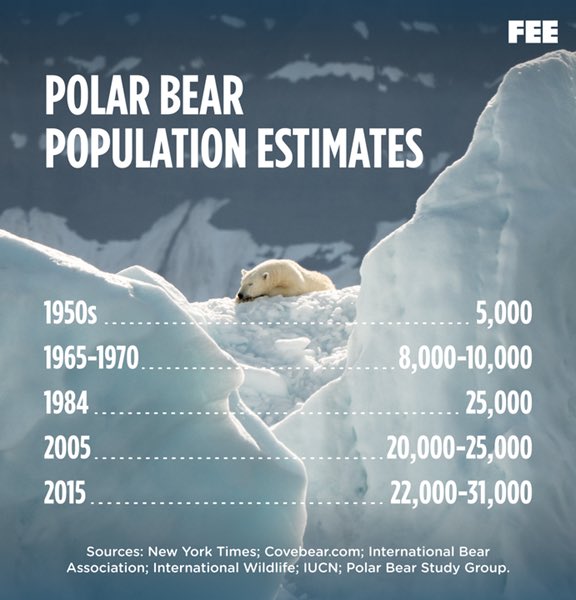
Polar bears are believed to be affected by reduced sea ice because their main prey, the ringed seal, remains in the Arctic all year and they give birth to their pups on the ice where they are very vulnerable to the bears.
• There are 2 types of sea ice. Land-fast ice and pack-ice. Unlike fast-ice, pack ice is mobile. When winds cause pack ice to collide with the shore or other ice slabs, the pack ice thickens as ice slabs are pushed on top of each other. Thick pack ice doesn’t melt completely in the summer. However, shifting winds can blow thick pack ice out of the Arctic, as happened in the 1990s9.
• Ringed seals depend on fast-ice. Thin fast-ice naturally melts completely by July, and then re-forms starting in October.To breathe, ringed seals must create breathing holes by head-butting through any newly forming thin ice. Then gnawing and clawing at the ice as it thickens, keeps their breathing holes open throughout the winter. Multi-year pack ice is too thick for seals to create breathing holes.
• Ringed seals mostly give birth to their pups on land fast-ice in March and April. Pups remain on the ice while nursing and then molting in June. Land-fast ice is thickest during the seals reproduction cycle and remains until late June. Seals then abandon the ice to hunt in open water starting in July and only crawl out on ice unpredictably to bask in the sun for a few hours. Melting ice after July has no effect on how available the seal pups are to bears.
• Polar bears gain almost all of their body fat in the late spring and early summer from feeding on baby ringed seals. In contrast, all bears lose weight during the winter when there is the greatest amount of ice. Feasting on baby seals from March thru June determines if the bears will survive the winter. Unlike feasting on baby seals, any feeding on ice or land after June is purely opportunistic. Pregnant females enter hibernation just as ice begins to reform and emerge only as ringed seals are giving birth
• Ringed Seal are so abundant they are considered a Species of Least Concern, so Arctic climate change does not appear to have had a negative effect.
• More open water from July to September increases sunlight reaching phytoplankton, generating greater photosynthesis and a more productive Arctic Ocean.3 Increased photosynthesis improves the whole Arctic food chain, eventually increasing fish populations that ringed seals depend upon. More ringed seals provide more food for polar bears.
• Since hunting polar bears was restricted, polar bear populations have increased. - A data scientist’s case for ‘cautious optimism’ about climate change
lchinitz at 02:37 AM on 3 April, 2024Hi all,
Thanks for the comments. Let me try to address a few, and refocus on the question I was asking.
First, I am definitely not advocating for a market-based solution to climate change. For all of the reasons that Bob Loblaw raised (and more), I consider the failure to address climate change a classic example of a market failure. We are heavily discounting the future, we are not considering externalities, and we are allowing ourselves to be caught in a Prisoner's Dilemma trap in which "common sense" says that it make more sense to continue to consume and hope that everyone else solves the problem. So climate change is, to me, a perfect example of a collective action problem. We have to work on it together, and government is the mechanism by which we make collective decisions and take collective action.
THAT BEING SAID, to address Bob Loblaw's question ("Do you (or others) have a reason to think that such costs are not part of the economic analysis?"), my answer is that based on my reading, they are not part of the economic analysis. I could be wrong, but look again at what Francis Collin's said in my post #13, above. "You attach zero value to whether this actually totally disrupts people’s lives, ruins the economy..." So Collin's is basically saying that in their analysis of the right thing to do, they simply didn't consider those other "costs" at all. They attached zero value to them, which means they were not considered. There was no way for those effects to influence policy, since they had no value.
What I'm asking is, has anyone specifically attempted to look at those costs in the context of climate change? I guess I'm not convinced of Eclectic's opinion that the task would be "gargantuan". This is what economists do, right? Based on uncertain information attempt to align limited resources to best accomplish a set of goals?
So the question would be, suppose we implement a set of policies (from any of the policy documents). What would be the effect on, let's say, food, sanitation, health care, heat, cooling, transportation, etc? And would it be clear from that analysis that the effect on those things would not be so bad as to convince you not to implement the policies in the first place.
I am personally convinced that that is the case. That is, that no matter how you look at it, immediate action to address climate change is necessary. But my personal opinion isn't necessarily persuasive. There is obviously already a lot of solid data supporting my opinion. But it would be nice to have some data looking at the perspective I've tried to describe. At least, I think it would be nice.
- A data scientist’s case for ‘cautious optimism’ about climate change
Bob Loblaw at 00:26 AM on 3 April, 2024lchinitz:
Do you (or others) have a reason to think that such costs are not part of the economic analysis? Basic economics talks about "supply and demand", where consumption of a good will tend to decrease as prices rise. The rate of decrease in relation to the price increase is call "the elasticity of demand". A highly elastic demand (easy to avoid the purchase, or people just can’t afford it) results in a big drop, while a low elasticity (people buy anyway) results in a small decrease. (Maybe demand goes up if they increase prices, as far as I can tell with Apple.) Elasticity of demand on each product modelled would need to be specified as an input or constraint on the model.
(The supply side of "supply and demand" suggests that as prices rise, more people will be willing to produce and sell. The balancing point is when prices encourage enough producers to produce and sell to the number of people willing to buy at that price.)
Another common economic concept is "opportunity cost". Look! I got 3% this year by buying a GIC! Yes, but you lost 3% because you took the money out of another investment that would have produced 6%... There is a cost associated with the loss of opportunity that the 6% investment offered. This "which is better - mitigation or adaptation?" question appears to me to be essentially an "opportunity cost" question. Not a surprise to economists.
I don't know the internals of economic models, but I would expect that at least some (if not most) of the increased costs associated with climate action would cascade into negative impacts elsewhere, via implicit relationships such as supply and demand and opportunity costs. Even if there is not an explicit statement within the model or analysis, the concept is embedded as a result of other things explicitly included in the model.
- A data scientist’s case for ‘cautious optimism’ about climate change
William24205 at 22:36 PM on 2 April, 2024Michael,
The £1.4trl ( likely an underestimate ) is amongst other things the cost of changing the grid.
As you also know ( without going into the whole thing ) renewables are intermittent you need fossil fuel or nuclear back up. So you pay twice.
Hopefully there will be a cheaper and cleaner alternative to fossil fuels , pretending renewables are - helps no one. They are part of the mix and a welcome one - but they are not a replacement - Climate - the Movie: a hot mess of (c)old myths!
Doug Bostrom at 03:27 AM on 28 March, 2024There's a lot of "inside baseball" language in play involved with meta-climate discussion, Two Dog.
"Climate change denial" seems to have become shorthand for "climate science denial" and "climate change denial." Both phenomena have rich factual basis.
There is still to this day a shrinking population of folks who don't believe Earth's climate and climate-mediated systems are changing at what current and paleoclimate data indicate are unusually rapid rates. This would be "climate change denial" as labeled on the tin.
Meanwhile another population are focused on what is still slightly more fertile ground, that of calling into question the scientific community's (geophysicists in this domain, specifically) competence of understanding the controlling processes of Earth's climate. This is "climate science denial.'
While often uttered in a context of emotional heat and frustration, "climate change denial" and "climate science denial" are not fundamentally emotive but rather are descriptive language attached to facts.
Both species of denial face what will prove an insurmountable common challenge: consilience. By example, biologists are observing phenonena that would demand answers from geophysicists focused on Earth's climate systems. As it happens, geophysicists already had substantially useful explanations for what biologists are seeing in the natural world. This is retail level consilience. One of the purposes of our weekly climate-related academic research listing is to help people to see consilience on anthropogenic climate change, understand the overall perspective of experts having connection to matters influenced by climate— which includes numerous disciplines not directly connected with geophysics.
if one follows climate research output and its present concerns, it's plain to see we're quite far past the "huge unknowns" stage with respect to the geophysics of climate. The accidental perception of "huge unknowns" in climate geophysics is a mark of the success of climate science deniers in the public square. It's a product of what we might clinically term "synthetic ignorance," a feeling of not knowing what we actually know perfectly well enough, thanks to calculated practice in public messaging.
Is every stripe on every graph we see 100% about us? No. Certainly the climate change we see today is influenced by "natural variation," on the time scale we're concerned with a matter of dithering around a mean. However, numerous and broad secular trends we're seeing not only in direct geophysical attributes of climate but myriad other features having climate as a major controlling variable find reliable explanation and predictive power in one naturally evolved feature of Earth, namely the planet's human population and culture— and how we've powered ourselves by liberation of energy from fossil fuels. We can hypothesize elaborate mechanisms for system-wide changes of the type we're seeing but scientific parsimony asks "why invent where no invention is necessary?" The dominant rationale for such invention seems to lie outsiide of scientific practice.
As to greening, greening enthusiasts should note that this phenomenon is accompanied by loss of albedo for a variety of reasons. Loss of albedo is not something we need at this juncture. It's also notable that for "climate change deniers" of all stripes, greening is a powerful contradiction of the basis of preferred beliefs.
- Is Nuclear Energy the Answer?
michael sweet at 04:26 AM on 2 February, 2024It is difficult to reply to a post filled with so many half-truths and mistakes. All your claims have been shown to be false upthread.
1) As you pointed out, Jacobson and hundreds of other researchers have shown that an all renewable energy system (primarily wind and solar) can support the entire economy. It will cost trillions of dollars less than fossil fuels and save millions of lives. Your mentioning a few days with low wind is simply fake news. Since you provide no links to support your wild claims I will not link any either. There are several countries that generate essentially all of their electricity using renewables, a technology that has only been installed widely for less than10 years. France had to purchase a boatload of expensive electricity from its neighbors during the electricity crisis because their reactors failed. I note that no energy researchers support using nuclear power as the primary energy to power the world. Few or no researchers support using even a small amount of new nuclear energy in the future.
2) Your claim that nuclear power "is already larger than wind and solar combined" is deliberately false. According to Our World in Data, in 2021 wind and solar produced 2900 TWH of electricity and in 2022 wind and solar produced 3422 TWH of power world wide. That will increase by at least 15% in 2023. In 2021 nuclear produced 2750 TWH of power and in 2022 nuclear power produced only 2632 TWH of power. The amount of power produced by nuclear has not increased significantly for over 20 years. It is unlikely that the amount of nuclear power will increase for at least 10 years and it is more likely to decrease substantially as old reactors are shut down.
3) Why would a sane person suggest pouring more public money into a failed technology like nuclear? The "new" modular reactor proposals are old designs that were rejected in the 1950's and 1960's as uneconomic or simply too difficlut ot build.
4) Projections of 2024 energy use are that renewable energy will be built at a fast enough rate to reduce world wide carbon dioxide emissions. After 70 years nuclear provides less than 4% of all energy in the world and has not helped reduce carbon emissions for over 20 years. I note that 70% of primary power produced by nuclear is wasted heating the surroundings versus essentially zero waste heat using renewables.
5) Your claim work on using renewables for "transport, steel and fertilisers has hardly even begun" is simply false. Nuclear has not done anything to address these technologies. I, and millions of other people, already drive an electric car. More electric cars are sold every year. Electric trains are widespread. Electric heavy trucks are being manufactured. It is easy to make ammonia fertilizer from renewable energy. Steel is being made with electric furnaces and using green hydrogen. As more and more renewable energy is built it will be used for those purposes since renewable energy is cheaper than fosil fuels. Since renewable energy has only been the cheapest energy for about 5 years there has not yet been time to build out a completely new power system yet. After 70 years nuclear cannot even keep up with its current production as old reactors are retired.
6) Nuclear power in France was down by 50% last year. At all times in a system with nuclear power they require at least enough spinning reserve to cover for the sudden shut down of the reactors because nuclear reactors are prone to unplanned shutdowns at any time. This is not needed for renewables since they do not shut down with no notice. Ways to control for down transmission lines are still required.
7) Nuclear is a failed technology. It is too expensive and takes way too long to build. Due to economies of scale, smaller, modular reactors will be more expensive than big reactors that are already too expensive to compete with renewable energy. Since reactors take so long to build, the entire electrical system will be renewable before new nuclear designs are ready to be widely built. I do not even need to mention that there is not enough uranium in the world to power more than 5% of all power, an insignificant amount.
Whenever I examine nuclear supporters claims closely I find that they are not supported by the data.
Nuclear is not economic, takes too long to build and there are not enough rare minerals.
- SkS Analogy 26 - Earth's Beating Hearts
Evan at 23:52 PM on 10 November, 2023Paul@4, that is an interesting observation for our current era: a relationship between the sun and the ice. But if the polar ice caps were to disappear, the sun crossing the equator twice per year would no longer have the same effect.
- Skeptical Science New Research for Week #41 2023
Doug Bostrom at 12:36 PM on 16 October, 2023There is no "the answer." The concept is found as both an accidental and intentional cognitive short circuit, depending on circumstances.
Among the range of "it's not a simple question" there are answers that are ephemeral (fossil fuels, not useful for completing another 5,000 years of attempting to be civilized) and more decently reliable (the fortuitous nearby fusion reactor).
Meanwhile, let's not forget: "Climate change evangelists" = "people who accept physics as a means of predicting certain possible features of the future."
Personally, I'll enthusiastically evangelize that people not accidentally or intentionally hit themselves in the face with a hammer, or change the impedance of the atmosphere's impedance of certain wavelengths of electromagnetic radiation in a broadly harmful way. Both involve physics as a means of improving outcomes. With regard to the latter, what used to be an accident is now to some degree intentional, something that seems increasingly stupid the more people insist on persisting with that choice.
- John F. Clauser: the latest climate science-denying physicist
Doug Bostrom at 03:04 AM on 6 September, 2023- "...one of the world’s greatest scientific bodies."
Name a functional equivalent that produces a more competently comprehensive synopsis of how Earth's climate functions and how we affect its functioning.
- "It is composed of the world’s foremost climate scientists, who every 5 to 8 years devote tremendous amounts of time and effort to author reports summarizing the latest climate science research, without any remuneration whatsoever."
This is objectively correct.
- "The IPCC reports are in fact the world’s best source of accurate and valuable climate science information."
Name reports on climate (or anything else) that are more comprehensive and also accurately reflect "here's the best we know at this point."
The IPCC exists, the first and most important virtue. It's a concrete feature, as opposed to wishful desire for a system for dealing with human nature that is divorced from human factors.
Meanwhile, haggling over the messaging, the messaging ending up acceptable to multiple countries with multiple often conflicting self-interests? Is this a defect? If one bothers to read its self-stated mission and purpose, one will learn that the IPCC specifically exists for the purpose of colliding geopolitics with science. To expect the IPCC to remain aloof from geopolitics is to doom it to have no connection with or influence over geopolitics and the behavior of individual states.
The IPCC has since its first report steadily produced warnings over our influence on climate that have over the course of the years increased in stridency and urgency, a surfeit of actionable advice. The parsimonious methods of the IPCC have yielded all the information we've needed to act on and attempt to check our climate disaster. But the IPCC does not operate governments, it informs them. There's plenty of information emerging from this sausage factory, only consumed very slowly because it's emerging into a world full of interactive, reverberating other problems of human nature.
There's a lot of inchoate frustration over human nature and Earth's climate floating about these days, looking for its proper home. Keep looking.
Meanwhile Skeptical Science will try to stay in the tank of reality, where feet wade through clay as best as they actually may.
- Climate Confusion
Markp at 05:22 AM on 3 September, 2023Hello
No, I'm not at all advocating that individuals adjusting their lifestyles are the answer, far from it (I'm surprised to hear this from you!), but it is something that must be done. Average people pushing the politicians and business leaders to act is necessary as well, because as we can see, without that they'll continue making targets and holding discussions that don't get us anywhere.
This is going to come down to us agreeing to disagree, I guess, for example regarding the IPCC and all the supposed "progress" we've made. I know that most people in climate science (scientists and others) think like you, that a lot has been done, etc. I just don't buy it. We've certainly managed to elevate the overall knowledge of GW among everyone - people from all walks of life (not with the honesty and clarity that is needed in my opinion, but...). But that has not translated into the kind of action we need by a LONG shot. It's politics and it's scientific reticence (i.e. David Spratt) and many other reasons, but it's there, staring us all in the face. Maybe I'm just speaking here to the optimists, 45-years of experience or not. I don't know. But if you think you shouldn't take me seriously because of my attitude towards models re "the end of temp rise" I'll just reiterate that it's not just me but people like James Hansen who have expressed those opinions. Just look at his latest tidbit: "Equilibrium Warming = Committed Warming?" where he writes in the 4th paragraph: "...climate science should be focused on data. That's the way science is supposed to work. However [the] IPCC is focused on models. Not just global climate models, but models that feed the models, eg. Integrated Assessment Models that provide scenarios for future GHG levels...sometimes the models contain hocus-pocus. As we mention in our current paper, they can assume, in effect, that 'a miracle will occur.'" And as you know, he's not the only one to criticise the overreliance on models. I'm assuming you are all familiar with Spratt and Dunlop's "What Lies Beneath."?
At the end of the day, scientists are no different from anyone else in this world where we all have to struggle for survival and protect our jobs and reputations and do things we have to do but may not believe in. Research isn't done for fun or for pure curiosity unless one bankrolls one's own laboratory, which few do. It's done to support the money, make a product, build a name for oneself, etc.
So people like (unnamed) set up for-profit companies as sidelines in addition to their responsibilities with their universities and, look what he just did: sold Carbon Engineering for over $1B. Nice. Ka-ching. You can't sell simple solutions for that kind of money, can you? And Climeworks, when are they going to have an IPO and cash-out, for worthless DAC? And this is all because the IPCC said "We MUST do this!"
An extremely important statement from the foreward of "What Lies Beneath" is from Hans Joachim Schellnhuber, professor of theoretical physics, etc., long list of credentials, when he said we are running out of time and so "...it is all the more important to listen to non-mainstream voices who do understand the issues and are less hesitant to cry wolf [than for example those scientists working with the IPCC]".
I work with those non-mainstream scientists because they are the ones who seem to be cutting through the BS towards real solutions that give us more than hopium.
Let me just ask you, and I am trying to be fair to the scientists in climate, generally speaking, because I imagine the vast majority are really doing their best. They aren't free to do what they might if they weren't trapped in the system we all are trapped in. (I know one who is a physicist but works with the IPCC on policy and he told me once "You have to trust your institutions, Mark"!!! Really. I trust the post office to deliver a letter. I don't trust politicians to solve global disasters that require those in power taking home less money.) But let me ask: if scientists really have been trying as hard as they could for decades now to come up with ways to stop rising heat and protect life on Earth as fast as possible, why has nobody else but a man who left his academic career at Harvard behind in order to found a nonprofit been able to come up with the solution staring us each in the face every morning when we brush our teeth, involving mirrors? Could it maybe have anything to do with the fact that it is just not very sexy? Honestly, I cannot understand or explain it any other way. And I've seen big-wig scientists in the climate sphere hear of this and say "where's your peer-reviewed research?" instead of just turning their brains on and thinking about the idea first. "Hey, makes sense, pretty obvious, actually...could be some complications, but overall, interesting idea..." (Kudos to Eclectic on this one) No, instead they just wanted research to back up the idea that ice will melt in a hot frying pan.
Well...would have been more fun over a beer. Take care.
- No, a cherry-picked analysis doesn’t demonstrate that we’re not in a climate crisis
Bob Loblaw at 23:38 PM on 28 August, 2023Paul @ 22:
Good question. PubPeer can be a useful method of providing further review of a published article. It requires that someone start the discussion - you, for example, started one on an earlier Pat Frank paper, as you noted at ATTP's blog. Authors of the paper may not participate, though, and sometimes the discussions at PubPeer descend into flame wars that make a Boy Scout wiener roast look innocent (for the wiener).
[Note: I see you posted today at ATTP's that someone has started a PubPeer review.]
I debated starting one over the recent Pat Frank paper discussed here. but your experience with the earlier Pat Frank paper made me feel that it would likely be a waste of time.
There have been other "contrarian" papers that have been handled by either writing to the journal or submitting an official comment to the journal, but not all journals are interested in publishing comments.
Springer has retracted this paper, with only a short note as to why. We do not see the detailed nature of the complaints, what was said in post-publication review, or what the authors said in response. Just the opinion that "...the addendum was not suitable for publication and that the conclusions of the article were not supported by available evidence or data provided by the authors" and the conclusion that "...the Editors-in-Chief no longer have confidence in the results and conclusions reported in this article."
A lot of speculation can be read between the lines of the Springer retraction notice. Sometimes, such reviews can end up with papers being retracted, editors being removed, or even a publisher shutting down a journal (cf. Pattern Recognition in Physics).
Springer has not made the paper "disappear". It is still available on the web page, but marked as retracted. It's just that Springer has put a huge "caveat emptor" on the contents.
- Is Nuclear Energy the Answer?
michael sweet at 23:32 PM on 15 August, 2023Scaddenp:
My understanding is that it is much more difficult to ramp up/down a nuclear plant than a coal plant. Some of the reaction products poison the chain reaction. If you change the reaction conditions the balance between the chain reaction and poisoness elements in the waste also changes. It is difficult to keep everything under control. You cannot shut the reaction down and then start it up again immediately like a coal plant can. In the USA none of the reactors can load follow. In France some of the reactors can slowly ramp production (maybe 1-2% per minute). It is hard to find references that describe how France lowers their production.
Here David-acct claimed that nuclear plants ran 92% of the time at full power. France currently has installed nuclear nameplate of 61.4 GW. The highest capacity factor in the two days I looked at was 51.5% in the middle of the night. The lowest was was 41.6% during peak power.
The point is that claims that nuclear plants are "always on" are easily demonstrated to be false. Cold weather, hot weather, drought, flooding, nearby fires and other natural changes can all cause reactors to shut down on short or no notice.
In a renewable energy world stored power will be most valuable. Baseload power will not be valuable. Baseload power that shuts down during peak times is very low value. If the reactors in France were not owned by the government they would be bankirupt.
- Is Nuclear Energy the Answer?
Philippe Chantreau at 02:01 AM on 15 August, 2023I would like participants here to clarify one thing: "shut down."
Growing up in France, I got to do school field trips to nuclear power plants. On these occasions, engineers would instruct us on basic elements of these plants' operation. A reactor is rarely "shut down" except for major maintenance or emergency/abnormal procedures. The reaction can be slowed, the reactor isolated from the rest of the system and/or generators taken offline, is that what we're talking about here? Otherwise it would imply taking the reactor below critical level and that is not practical if it is to be used again, especially on short notice.
Slowing down the reactor can be necessary when cooling is an issue, when the weaather is already hot and they want to avoid spilling too much warm water in the environment. This has become more of a concern as river water temperatures have been increasing. It could be why power output is higher at night in August. Unless of course, these dates are under European format, which would place them in October and May.
- How big is the “carbon fertilization effect”?
daveburton at 08:56 AM on 13 July, 2023Rob, in answer to your first question, Bob is correct: they use different units.
Both the graph and the "plug in suitable values" calculation (above) are for freshwater, but that hardly matters. CO2 is noticeably less soluble in saltwater, but the effect of temperature on CO2 solubility is nearly identical. Here's the same calculation with salinity 35 (typical seawater), for a 1° temperature increase (from 288K to 289K):
Bob is also correct that ocean chemistry is more complicated than that, in part because most of the dissolved CO2 immediately dissosiates into various ions. Here's a good resource on ocean chemistry:
http://www.molecularmodels.eu/cap11.pdf
What's more, in the oceans, biology generally trumps chemistry, and that is certainly true for CO2 uptake. Some people think that the capacity of the oceans to take up CO2 is limited to surface water by ocean stratification. But that's incorrect, beause the "biological carbon pump" rapidly moves CO2 from surface waters into the ocean depths, in the form of "marine snow."
The higher CO2 levels go, the faster that "pump" works. Here's a paper about it:
https://www.science.org/doi/reader/10.1126/science.aaa8026
Once carbon has migrated from the ocean surface to the depths, most of it remains sequestered for a very long time. Some of it settles on the ocean floor, but even dissolved carbon is sequestered for a long time. For instance, it is estimated that the AMOC takes about 1000 years to move carbon-rich water from high latitudes to the tropics, where it can reemerge. That is obviously far longer than the anthropogenic CO2 emission spike will last.
Due to the temperature dependence of Henry's Law, a 1°C increase in temperature slows CO2 uptake by the oceans by about 3%. That's a slight positive feedback: more CO2 in the air increases water temperatures, which slows ocean uptake of CO2. But it is very minor, because a 50% (140 ppmv) rise in atmospheric CO2 concentration accelerates CO2 uptake by the oceans by 50%, which obviously dwarfs 3%. That's the main reason that ocean uptake of CO2 continues to accelerate despite the temperature dependence of Hanry's Law.
- Hansen predicted the West Side Highway would be underwater
daveburton at 07:21 AM on 7 July, 2023Michael wrote, "the last time Carbon dioxide was over 400 ppm the sea level was more than 20 meters higher than current sea level."
Yes, many things were different 4.5 million years ago. They weren't all caused by CO2.
For example, the highest-quality Pacific sea-level measurement record is from Honolulu, on Oahu. But it would be difficult to say anything meaningful about how sea-level there has changed since CO2 levels were last this high, because Oahu (and the Big Island) didn't exist 4 million years ago!
Michael wrote, "Your sea level graphs are obviously flawed."
I guarantee that they are not flawed.
They are accurate plots of sea-level measurements at those two sites, which are the best long NOAA Atlantic sea-level measurement record (The Battery, NYC), and the best long NOAA Pacific sea-level measurement record (Honolulu, HI). The linear and quadratic regressions are accurately calculated from the most recent 100 years of data at each site, shown with deep blue traces. Earlier data (not included in the regressions) is shown in light blue.
If you click the links, you can adjust the measurement periods over which the regressions are calculated, and see the effect of those adjustments. You can also smooth the plots, and choose whether to plot linear and/or quadratic fits, as well as confidence and/or prediction intervals. At the top of each graph you'll also find links to the corresponding NOAA and PSMSL web pages for those sites. You can also do the same analyses for other NOAA measurement sites, and for over 1000 sites with data available from PSMSL (though the PSMSL data aren't as up-to-date as the NOAA data).
Michael wrote, "you have cherry picked two single locations to do your calculations without justifying your choice."
They aren't "cherry-picked," I told you why I chose them: they are "the best long U.S. Atlantic and Pacific sea-level measurement records, respectively."
The analysis period of 100 years is arbitrary, of course, but if you click the links which I provided you can easily change it:
https://sealevel.info/MSL_graph.php?id=Battery&c_date=1923/6-2023/5
https://sealevel.info/MSL_graph.php?id=Honolulu&c_date=1923/6-2023/5
I also reported the conclusion of a comprehensive study: "Hogarth studied many long measurement records, and concluded, 'Sea level acceleration from extended tide gauge data converges on 0.01 mm/yr²'" (That's negligible, BTW.)
Beware of "global" sea-level analyses which use varying mixes of measurement locations. As you can see from the striking difference between Oahu and New York, sea-level trends vary considerably from one location to another. So if you use a different mix of measurement locations for the left and right ends of a plot, you can easily create the illusion of a sharp acceleration or deceleration which is not evident in the individual measurement records.
Also, beware of the fact that there are also regional effects, in some places. For example, ENSO causes changes in low-latitude easterly Pacific trade winds. During El Niños easterly Pacific equatorial trade winds diminish, so the Pacific ocean sloshes east, raising sea-level in the eastern Pacific, and lowering it in the western Pacific. This is very striking when you compare the sea-level measurement records of Kwajalein (in the western Pacific) and San Diego (in the eastern Pacific). They are almost perfect mirror images!
https://sealevel.info/1820000_Kwajalein_San_Diego_2016-04_vs_ENSO_annot4.png
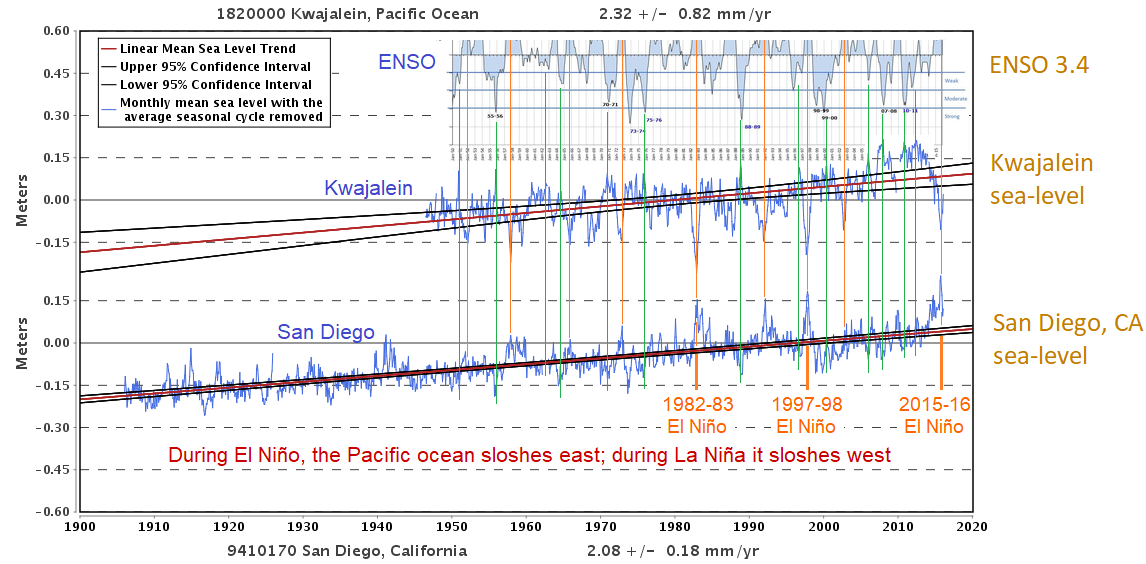
(One of the nice things about Honolulu is that it is near the ENSO "teeter-totter pivot point," so, unlike other long Pacific sea-level measurement records, Honolulu's is scarcely affected by ENSO.)
Another example of regional effects is the southeastern United States, where Gulf Stream variations are apparently the cause of well-known multi-decadal fluctuations in sea-level trends. For a discussion see Zervas (2009), NOAA Technical Report NOS CO-OPS 053, Sea Level Variations of the United States, 1854-2006. Here's a relevant excerpt:
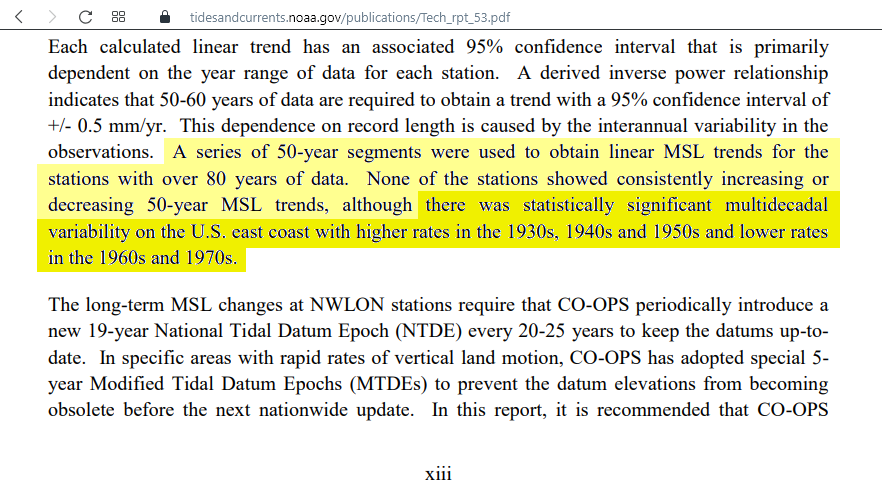
- Hansen predicted the West Side Highway would be underwater
daveburton at 07:39 AM on 6 July, 2023Rob wrote, "that greening is now turning into 'browning.'"
Well, here's what AR6 shows:
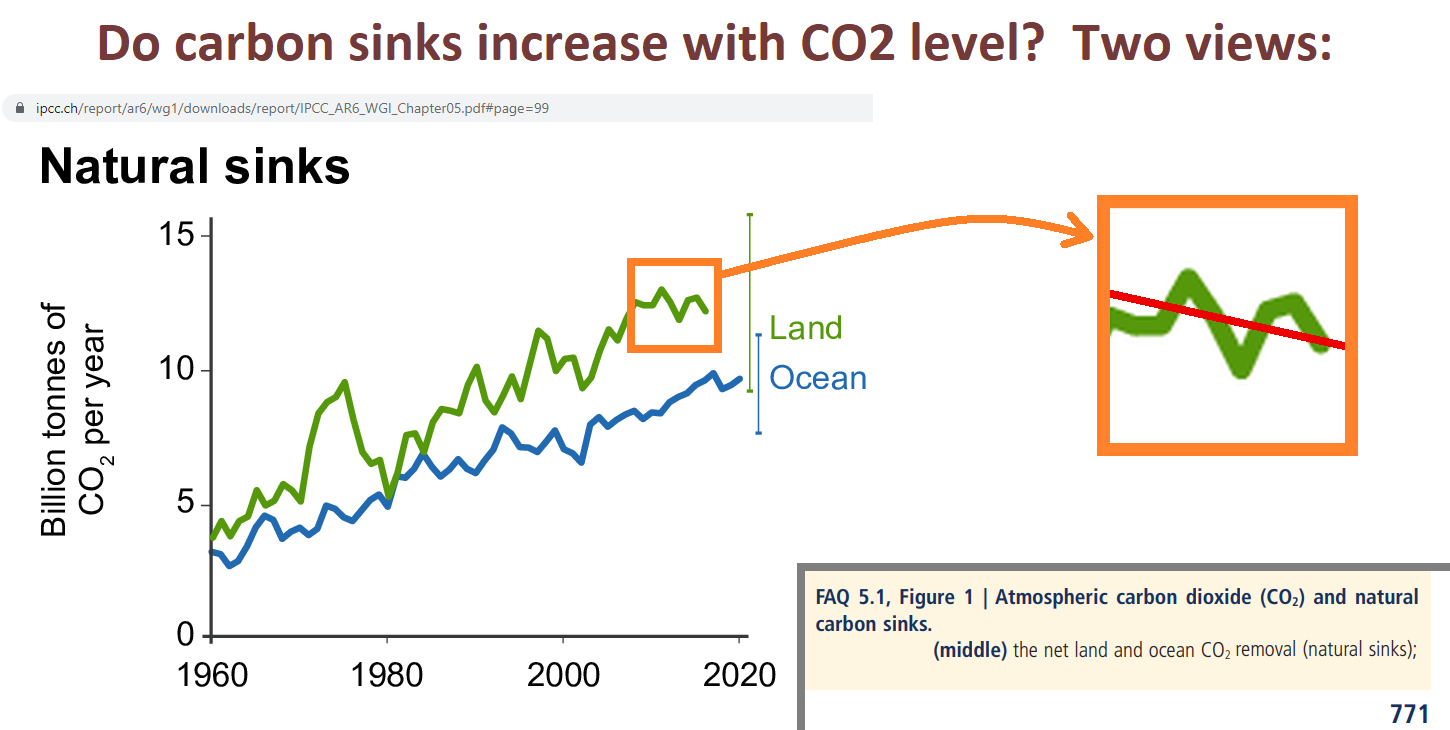
Some people point to that little orange box and say that greening has ceased. That reminds me of the folks who say that the it's not as warm as the 2015-16 El Nino, so warming has ceased.
Philippe wrote, "There is probably a better thread for this argument,"
I agree. I was just trying to address OnePlanet's remark about a "locked in" CO2 level.
Philippe wrote, "There is only one factor that truly controls how green any region can be: water availability."
That's a common misconception. Elevated CO2 levels greatly improve plants' water use efficiency (WUE) and drought resilience. That's why elevated CO2 is especially beneficial for crops when under drought stress. It has been heavily studied by agronomists. Here's a paper about wheat:
Fitzgerald GJ, et al. (2016) Elevated atmospheric [CO2] can dramatically increase wheat yields in semi-arid environments and buffer against heat waves. Glob Chang Biol. 22(6):2269-84. doi:10.1111/gcb.13263.
Philippe wrote, "The experiences that have shown a CO2 fertilization effect were done in very controlled conditions and involved extremely high concentrations (800 ppm and up)."
That's incorrect. All major crops have been studied, and all benefit from elevated CO2. It is true that the greatest benefits accrue at 1000 ppmv or higher, but even modest CO2 increases significantly improve crop yields.
This recent study quantifies the effect for several major crops. Their results are toward the high end, but their qualitative conclusion is consistent with many, many other studies. They reported, "We consistently find a large CO2 fertilization effect: a 1 ppm increase in CO2 equates to a 0.4%, 0.6%, 1% yield increase for corn, soybeans, and wheat, respectively."
This study evaluated pine trees:
Idso, S., & Kimball, B. (1994). Effects of atmospheric CO2 enrichment on biomass accumulation and distribution in Eldarica pine trees. Journal of Experimental Botany, 45, 1669-1672.
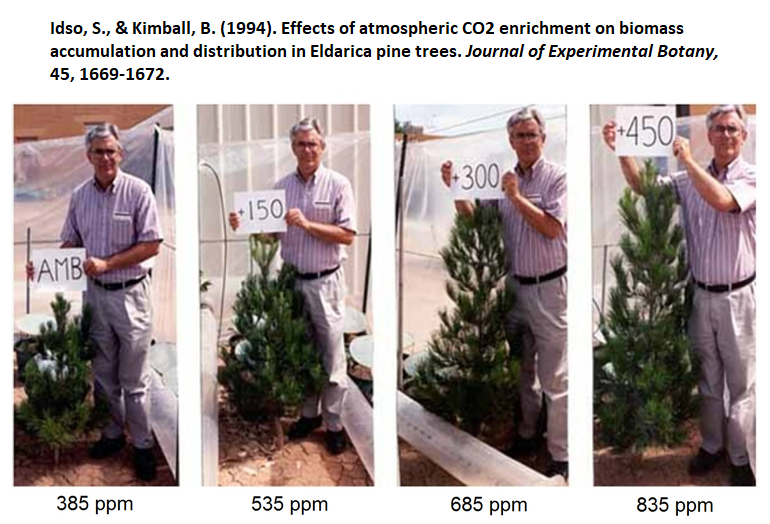
As you noted, the effect is greatest with CO2 >800 ppmv, but, as you can see, even a much smaller CO2 increase has a substantial effect.
Rob wrote, "This entire paragraph is patently absurd and completely fabricated."
It is 100% factual, Rob. I'm surprised that you didn't already know it.
These figures are from that same AR6 Table 5.1 excerpt which I already showed you:
average CO2 removal rate in the 2010s = 2.7707 ppmv/yr
average CO2 removal rate in teh 2000s = 2.3481 ppmv/yr
These figures are from Mauna Loa:
average CO2 level in the 2010s = 399.91 ppmv
average CO2 level in the 2000s = 378.84 ppmv
(399.91-378.84) / (2.7707-2.3481) = 49.86
So a 50 ppmv increase in CO2 level accelerates the natural removal rate by about 1 ppmv/year.
49.86 / 2.1294 = 23.42 ppmv increase yields a +1 PgC removal rate increase.
I encourage you to do the calculations yourself for any other time period of your choice.
If you have the natural removal rate as a function of CO2 level (which we do), it is trivial to simulate the CO2 level decline if emissions were to suddenly cease. I wrote a little Perl program to do it; email me if you want a copy.
Rob wrote, "if true, the oceans would just continue to suck up all the atmospheric CO2 and we'd live on a frozen planet."
That's incorrect. The system progresses toward equilibrium, which is below 300 ppmv, but not zero.
Rob wrote, "rather that starting from a prior where all the published science is getting it wrong, and making stuff up... you don't have the requisite training to fully grasp the topic"
Rob, it's not necessary to resort to ad hominem attacks. I'm happy to document things that are surprising to you. You need but ask. Everything I've written is well-supported.
Rob wrote, "take some time to fully familiarize yourself with Henry's Law."
Due to the temperature dependence of Henry's Law, a 1°C increase in temperature slows CO2 uptake by the oceans by about 3%. But a 50% (140 ppmv) rise in atmospheric CO2 concentration accelerates CO2 uptake by the oceans by 50%. That's the main reason that ocean uptake of CO2 continues to accelerate.
- Hansen predicted the West Side Highway would be underwater
michael sweet at 07:27 AM on 6 July, 2023Dave Burton:
I note that the last time Carbon dioxide was over 400 ppm the sea level was more than 20 meters higher than current sea level.
Your sea level graphs are obviously flawed. A simple eye ball look at the data from the Battery in New York shows that at the start of the time period the data is above the fit line and at the end of the time period the data is way above the fit line. That means that the line does not fit the data and some sort of curved line is needed because the rate of sea level rise is increasing over the time period you chose.
In addition, you have cherry picked two single locations to do your calculations without justifying your choice.
Fortunately, Tamino did an analysis of sea level rise before he stopped posting analysis. (Tamino is a professional statistical data analyzer who has published on sea level rise). He analyized "the data for every tide gauge station in region 3 which had at least 360 months’ data (at least 30 years), at least 120 months of which (10 years of which) are since the year 2000 — after all, we do want to know what’s happening now. That leaves 10 stations". Since he used all the available data his data is not cherry picked like yours is.
Here is one of his graphs of the rate of sea level rise on the East coast of the Gulf of Mexico:
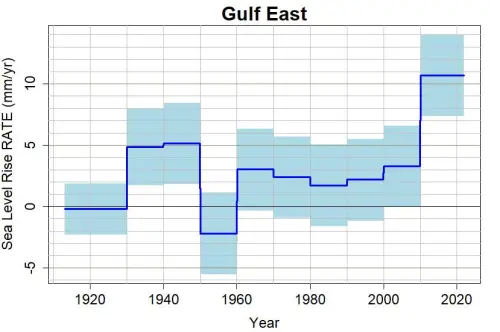
We see immediately that sea level rise does not follow a straight line but varies over the 100 year time from of analysis. Of particluar interest is the dramatic increase in sea level rise since 2010.
The dramatic increase in sea level rise observed since 2010 holds true for an analysis of the entire globe. Your analysis using a linear fit is simply incorrect and cherry picked.
I note that the rate of rise since 2010 is more than double all the previous rates.
We would expect that if the carbon dioxide content of the atmosphere remains above 400 ppm that the sea level will rise 20 meters plus. The question is only how fast the sea will rise. We see the rise is rapidly increasing every year now. Your linear fit deliberately hides the observed rise.
I note that the change in CO2 concentration in the atmosphere has rapidly increased over the past 50 years so one would expect the sea level change to rapidly increase over that time period. Including the data back to 1900 with a linear fit just hides the recent rapid increase in sea level rise.
Does anyone know how Tamino is doing?
- Hansen predicted the West Side Highway would be underwater
daveburton at 03:51 AM on 6 July, 2023Thanks for fixing those links, Rob. We were obviously typing simultaneously; you beat me to it by 7 minutes.
However, nothing I wrote was misleading. If you "follow the link to the actual IPCC page to read the full" table, you'll see that it shows exactly what I said it shows: as atmospheric CO2 levels have risen, the natural CO2 removal rate has sharply accelerated. (That's a strong negative/stabilizing climate feedback.)
The commonly heard claim that "the change in CO2 concentration will persist for centuries and millennia to come" is based on the "long tail" of a hypothetical CO2 concentration decay curve, for a scenario in which anthropogenic CO2 emissions go to zero, CO2 level drops toward 300 ppmv, and carbon begins slowly migrating back out of the deep oceans and terrestrial biosphere into the atmosphere. It's true in the sense that if CO2 emissions were to cease, it would be millenia before the CO2 level would drop below 300 ppmv. But the first half-life for the modeled CO2 level decay curve is only about 35 years, corresponding to an e-folding "adjustment time" of about fifty years. That's the "effective atmospheric lifetime" of our current CO2 emissions.
Moreover, it is not correct to say that "the ocean takes up about half of our emissions." Our emissions are currently around 11 PgC/year (per the GCP). The oceans remove CO2 from the atmosphere at a current rate of a little over 2.5 PgC/year, but they are not removing some fixed fraction of our emissions. If we halved our emission rate, natural CO2 removals would continue at their current rate.
Because human CO2 emissions are currently faster than natural CO2 removals, we've increased the atmospheric CO2 level by about 50% (140 ppmv), but we've increased the amount of carbon in the oceans by less than 0.5%, as you can see in AR5 WG1 Fig. 6-1. (It's not a problem for "sea dwelling creatures.")
In the oceans, biology generally trumps chemistry, and that is certainly true for CO2 uptake. Some people think that the capacity of the oceans to take up CO2 is limited to surface water by ocean stratification. But that's incorrect, beause the "biological carbon pump" rapidly moves CO2 from surface waters into the ocean depths, in the form of "marine snow."
The higher CO2 levels go, the faster that "pump" works. Here's a paper about it:
https://www.science.org/doi/reader/10.1126/science.aaa8026
Once carbon has migrated from the ocean surface to the depths, most of it remains sequestered for a very long time. Some of it settles on the ocean floor, but even dissolved carbon is sequestered for a long time. For instance, it is estimated that the AMOC takes about 1000 years to move carbon-rich water from high latitudes to the tropics, where it can reemerge. That is obviously far longer than the anthropogenic CO2 emission spike will last.
- 2nd law of thermodynamics contradicts greenhouse theory
Bob Loblaw at 11:19 AM on 13 June, 2023Continuing to look at likeitwarm's links.
As Rob Honeycutt points out, looking at peaks is not good practice. The second link provided in comment 1550 actually provides linear trends for all three datasets they display, and all are within agreement of climate model predictions. The temperature series with the greatest amount of short-term variation is the UAH one - which is not surface temperature. It is satellite-derived tropospheric temperature.
Looking at the peaks and seeing "flat spots" is a classic error. So classic that Skeptical Science produced a graph call The Escalator. It has recently been updated. You can read about that update on this blog post.
For convenience, here is the graphic in that post (and you can always see it in the right margin of each web page here.)
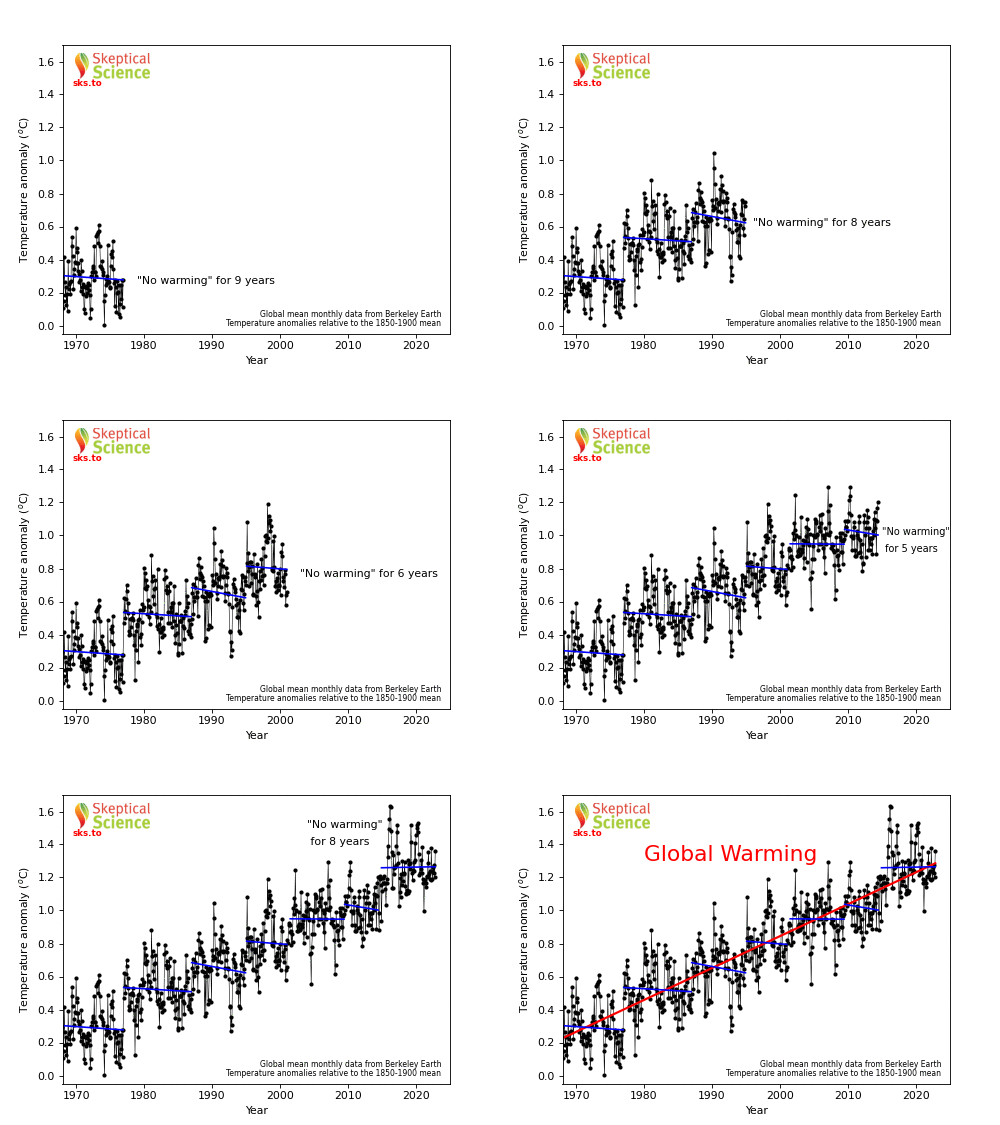
- Antarctica is gaining ice
scaddenp at 07:41 AM on 25 May, 2023Just for clarification for other readers, as I pointed out above, Bart's conjecture "reduced sea ice mean more snowfall" is not expected given very low sea surface temperatures. To demonstrate that, Bart would need to show that precipatation varies in sync with sea-ice (which has both increased and decreased in recent history). By contrast, there is evidence for variations being due to multiyear weather cycles.
As to ice loss (overwhelmingly calving since most of Antarctica is too cold for melt), while the SAM is positive then continued basal erosion of the ice shelves is expected from warm deep water (eg see "The circum-Antarctic ice-shelves respond to a more positive Southern Annular Mode with regionally varied melting" ) and a useful summary here.
Loss of ice shelves leads to increased calving (see here with its links to relevent papers) as does loss of sea ice. That is why my money is on continued ice loss despite some weather noise. Let's see what an El Nino will bring after three La Nina years.
- Antarctica is gaining ice
scaddenp at 12:51 PM on 24 May, 2023Before Bart was moderated, he made some speculative comments about the contribution from loss of sea ice. At first glance this doesnt sound like something that would have a big effect. The ocean surface temperatures are still very cold so not a lot of scope of increased evaporative water content, especially compared to incursions of moist air due to positive SAM. However, this seems a very testable hypothesis since different parts of Antarctica would have different response to changes in air circulation, whereas arctic seaice has varied a lot (up and down) over past 20 years and if it was a factor, then expect precipation to vary accordingly (and in the regions where change happens).
- Antarctica is gaining ice
Bart Vreeken at 18:50 PM on 20 May, 2023 After three months, there is another update of the gravitational measurements of the Antarctic ice sheet. The series now runs until February 13, which includes most of the Antarctic summer. Often in February there is a minimum in the amount of ice, but the pattern is not very tight.
We still see that Antarctica as a whole has a better period. Over the last three years, there has been no net decrease in land ice. The small amount of sea ice must play an important role in this. As a result, more snow falls. Apparently, that was enough to compensate for the increased melting and calving along the edge.
Changes to the floating ice shelves cannot be measured in this way. - At a glance - The greenhouse effect and the 2nd law of thermodynamics
Charlie_Brown at 03:30 AM on 9 May, 2023My next attempt. I hope this is getting better. I changed the first part quite a bit to emphasize that the key problem with G&T, often overlooked, is their assumption that the input solar and output IR radiation are balanced (see Fig 32). I think these are worthwhile revisions. The structure seems fact-myth-fallacy-fact because I wanted to begin by separating the 1st & 2nd laws, but bring back the 1st law facts to seal the deal. Please feel free to edit and use the input as you deem suitable.
The 1st law of thermodynamics is conservation of energy. The 2nd law describes limitations on how energy can be used in forms of heat and work. It is difficult to express without introducing the concept of entropy - a state of disorder that is hard to understand. Instead, the 2nd law can be expressed practically in the form of statements and corollaries. One translation of the Clausius statement is: “It is impossible to operate a cyclic device in such a manner that the sole effect external to the device is the transfer of heat from one heat reservoir to another at a higher temperature” (Wark, Thermodynamics, 4th ed., 1983). A key phrase is “sole effect external to the device.” A cyclic device can be a heat engine and the classic example is a refrigerator that requires adding external energy, electricity, to make it work. Gerlich & Tscheuschner’s paper describes modern global warming theory as a perpetual heat engine that transfers heat from the cold stratosphere and the warm surface. That would violate the 2nd law, but that is an incorrect description of global warming. They assume that the radiant energy input from the sun is equal to the radiant heat loss to space and the system is “radiatively balanced”. That would be true for the greenhouse effect before the industrial revolution but increasing greenhouse gases (GHG) upsets the balance and causes global warming.
Some take the myth even further to claim that thermal radiation cannot transfer energy from a cold body to a warmer one. Gerlich & Tscheuschner steer the discussion into distraction by emphasizing the technical distinction between heat and energy. Consider two walls facing each other. All objects above absolute zero radiate energy. The warm wall radiates more energy toward the cold wall, but the cold wall still radiates some energy toward the warm wall. The debate amounts to whether it is energy or heat that moves towards the warm wall.
Conservation of energy for any defined system is:
Input = Output + Accumulation
The global system can be defined as from the Earth’s surface to the top of the atmosphere. The input to the global system is the sun. The surface temperature is regulated by balancing heat input from the sun with heat loss from the top of the atmosphere toward space. When balanced, accumulation is zero. There are three output energy pathways: 1) Infrared (IR) radiation from the surface at wavelengths that are transmitted directly to outer space (the transparent range). 2) IR radiation from GHG in the colder atmosphere at wavelengths that are emitted by GHG, and 3) solar energy reflected by clouds and the surface. As the concentration of CO2 increases, energy output to space (path 2) is reduced. This upsets the global energy balance. Energy accumulates and the surface temperature rises. As the surface temperature rises, energy output from the surface through the transparent range (path 1) increases until the balance is restored. This is how global warming works. - Arctic sea ice has recovered
Albert22804 at 21:24 PM on 19 April, 2023"The NASA presentation of Arctic Sea Ice Extent from 1851 to 2017 does not show an 80 year cycle. It shows a fairly significant recent decline of extent of sea ice."
there is an abundance of evidence from newspapers and other sources that Arctic ice extent in the 1940s was low. If i did provide the evidence I suspect that you would just ignore it.
But I will if you request it.
- Arctic sea ice has recovered
One Planet Only Forever at 14:52 PM on 19 April, 2023Albert @126,
What is the evidence for an 80 year cycle of warm waters being brought to the Arctic?
The NASA presentation of Arctic Sea Ice Extent from 1851 to 2017 does not show an 80 year cycle. It shows a fairly significant recent decline of extent of sea ice.
- Veganism is the best way to reduce carbon emissions
Ron at 14:05 PM on 17 April, 2023I'm not an expert, so I don't know for sure. I do know that our closest genetic relatives, chimpanzees, are part-time carnivores too. I just wonder if it's not just a liking for eating meat, but through millions of years of evolution, has actually become a necessity of sorts as well?
They say we need protein for our larger brains. Are there other adaptations? I don't know. But the fact that we need to supplement with not readily available vegetarian foodstuffs (except with modern day markets), seems to indicate that it might be kind of necessity. Perhaps a generation or two can eat a vegan diet, but I wonder what the evolutionary implications will be to long term veganism?
Don't get me wrong. I'd love to not eat meat, but just vegetables tastes not great, especially if you're not a cook. But , then again, I think it's dishonest to only be concerned with mammalian life. If were doing it for ethical reasons, plants also want to be here. So it's a choice. But gotta eat to live.
https://www.bbcearth.com/news/plants-have-feelings-too
- Veganism is the best way to reduce carbon emissions
Ron at 04:58 AM on 13 April, 2023It always bugs me when Vegans (which seem to be more hateful and judgemental than Vegetarians) try to make people feel bad for being carnivores, or even drinking milk or having some butter.
It's not that I'm at all defending the meat industry, or the way in general animals are treated by them. And I hate the way some people in Asian countries are mistreating animals too. They're vicious and heartless (but I won't get into that right now). Also, about beef eating and the environment, I agree with Vegans. It is destructive and contributes to Climate Change, obviously, so should be phased out. And any fishing is overfishing these days, which is why I don't eat fish either.
But I think that Vegan's real issue is not about Climate Change. No, I suspect that their hostility and judgmentalism is actually about an enjoyment of telling people what to do! A hatred of people (there is reason to hate some people though).
Do Vegans eat plants? Of course. Yet, there's a whole field emerging that says that they, too, are sentient. Feel pain. Want to live. Use all kinds of tricks to foul up predators (like Vegans). What gives them the Right to take that life away just to feed their stomachs? Is it because plants can't say "STOP!" when they are eating them? Can't move out of the way to save themselves? Can't audibly scream? How arrogant of them! So thoughtless. But so human too. :/
Also, do Vegans have pet cats or dogs? Do they feed them plants? If so, they wont live long. I've seen it. Isn't it hypocritical of them not to call for us to stop owning them?
Are Vegans calling for only humans and their pets to stop eating meat? What about wild animals? Do they want the lion to lie down with the lamb? All meat eating to end, period? An environmental crash would soon follow. Some people eat insects now. Yech! But anyway, do they judge them too? Insects are animals as well. Want to live. Run when we come.
You know, they say whenever you point a finger at another person, four more are pointing back at you. Are Vegans perfect? They'd better be if they choose judge an otherwise good person. A great man once said not to judge others because with the measure you mete out to them, it will be meted out to you in return. A more modern way of saying that is that people who live in glass houses shouldn't throw stones. People can lay out their beliefs, and that's fine, but don't make it personal (except for real dicks) unless they themselves are utterly flawless. Are they? Only they know.
So I do eat poultry. You see, you gotta eat to live. That's just the way it works on this planet. But I try to find poultry that's raised humanely. Anyway plants, or animals, they ALL want to live as well. So you gotta make a choice. The alternative is to eat already dead things - or starve.
- Skeptical Science New Research for Week #11 2023
One Planet Only Forever at 06:35 AM on 23 March, 2023Regarding the perspective piece “Why focusing on “climate change denial” is counterproductive” by Christian Better and Felix Schulz:
Initial impressions may be that this perspective and the resulting recommendations are helpful. But some of the recommendations appear likely to be harmful from the perspective of pursuing Sustainable Development today for the benefit of Others, especially for the future of humanity.
The required actions will be divisive in most of the currently developed societies because those societies did not develop to be governed by learning about harm and aspiring to limit harm done and help others.
The required action is not ‘making sure that everyone is happy about how the required protection of Others from harm and the development of sustainable improvements occurs’. What is required is effective governing of the actions of all people, especially people who are motivated to resist learning what is ‘unsustainable and harmful and needs to be stopped’ like human climate impacts do.
The climate impact issue is not a case of limiting the harmfulness of developing behaviour. A lot of unsustainable and harmful activity has already become popular, profitable, desired and aspired to. The requirement is the ending of harmful popular and profitable harmful human activity and the related ‘denial of understanding that it needs to happen, and that everybody needs to fairly participate in ending the harm and repairing harm done’. It is not a choice. Self-govern responsibly, or be governed to limit harmfulness. Not allowing a person to be harmful, or harmfully misled into believing harmful misunderstandings, is not 'a harmful restriction of freedom.'
A related ‘hard reality’ is that ‘developing sustainable improvement requires thoughtful restriction of freedom based on the diligent pursuit of learning what is harmful and aggressively limiting the harm done and rapidly achieving reconciliation, and ideally full repair, of harm done’.
The developed reality is that people who would personally prefer to more slowly reduce their harmfulness will need to be disappointed. And some of the most powerful people will need to be the ‘most disappointed’. Individuals who want to benefit from increased harmfulness, except the desperate who are living less than basic decent lives, need to be disappointed even if they are middle class or lower status. The problem is primarily due to people who over-consume and whose ‘needed consumption to live a basic decent life’ is more harmful than it needs to be. And a related part of the problem is less harmful people developing an interest in being more harmful.
Attempting to avoid divisiveness, especially attempting to not disappoint individualists, is almost certain to result in more harm done. In the realm of climate change impacts it is likely to push things to a higher climate impact RCP than could would happen if the most harmful are the most disappointed (which is what should happen). It is also a pathway that makes it harder to develop sustainable improvements because ‘more harm needs to be dealt with’.
In addition, appeasing individualists has already resulted in the near certainty that the harm done to future generations by the current generation will exceed the robustly established 1.5 C limit (that probably should be 1.0 C but we are already well past that point). Those who benefited most from more harm done need to be responsible for the rapid removal of all that excess CO2. And individualists with personal prosperity and status interests are very unlikely to ‘choose’ to fairly participate in that unprofitable, but required, collective action.
The problem is ‘the harmful unsustainable beliefs and actions that have developed due to a failure to effectively collectively govern and limit human activity based on the pursuit of learning about what is unsustainable and harmful’. And part of the developed problem is the ‘development and promotion of positive perceptions of benefit’ governing over the need to learn about and limit harm done and make amends for harm done.
Poorly governed competition for popularity and profit created the problem. Continued freedom for individuals to evade learning to be less harmful and evade helping to repair damage done will result in more damage done, all justified by ‘Positive Perceptions of Benefits Obtained and other harmful misunderstandings’.
- The Big Picture
Bart Vreeken at 03:50 AM on 20 March, 2023Rob Heneycutt, back to your original remark @74. There you say
"Hang on. Am I missing something or is Bart actually thinking that the gravitational mass of Greenland is going to pull sea level away from The Netherlands, when it's 3000km away, making their impacts of SLR nominal? Surely not."
Yes, I am actually thinking something like that. But it's a little different. At the moment the gravitational mass of the ice is attracting mass. 3000km is no problem, the influence goes much further. So, because of the ice mass the sea level here is higher then it should be without the ice. When the ice melts a part of this effect is gone, and because of that the sea level will drop here. On the other hand, there's the meltwater that distributes over the ocean. That aspect makes the sea level rise. The sum of these to is slightly positive.
And now you say:
"They're talking about fractions of a millimeter per year. So, at maximum, they're saying the effect around Greenland (deep blue) over the course of the next century would be on the scale of 5 cm, out of a potential of 1-2 meters of SLR."
Yes I do agree with most of that, so whats the point? The 2 m SLR is a bit to wild, KNMI talks about max 1.2 m in 2100.
- The Big Picture
Gootmud at 01:05 AM on 20 March, 2023Eclectic and John Mason @104
We do need models to predict whether it will keep on warming. As CO2's absorption spectrum saturates, it can't trap more heat. Negative feedback effects like clouds might nullify any warming. Temperatures might drop due to independent effects like magnetic field changes much more influential than the greenhouse effect. We might be at 600ppm, freezing, and looking for ways to warm the Earth and slow the advancing ice.
Without models that account for all these effects, we.know nothing about future temperatures. We don't know ranges of likely changes. We don't even know the sign. A model need not be perfect--no model is ever perfect--but it must be representative of all the relevant physics if we are to trust its output.
- The Big Picture
Bart Vreeken at 04:22 AM on 19 March, 2023Hi Bob Loblaw, I'm afraid you don't understand the figure well.
Above a) you see the mass loss of Greenland where the calculation is based on. It says -166 Gt/yr. This causes a global sea level rise of something like 0,46 mm/yr. Due to the gravitation effect there are places on earth where the sea level rise is less then that, and places where it's more then that. The border between these two area's is the green line on the map between Africa and South America and in the Pacific. So, the Netherlands are in the area with less then 0,46 mm/yr sea level from Greenland, but it's more then zero. Then there is an other line, between yellow en blue. In the blue area there is no sea level rise by Greenland at all. Instead there is a drop of the sea level.

- The Big Picture
John Hartz at 02:17 AM on 19 March, 2023Speaking of Greenland, what is described in the following news article does not bode well for the future of the Greenland ice sheet...
Greenland temperatures surge up to 50 degrees above normal, setting records by Ian Livingston & Kasha Patel, Weather, Washington Post, Mar 8, 2023
The lede for this article:
The record-breaking warmth is raising concerns about melting summer ice.
- The Big Picture
Bart Vreeken at 22:30 PM on 18 March, 2023MA Rodger @82 your quote is about the global sea level rise, not the local SLR.
This is how it works. The Greenland Ice Sheet has a lot of mass, so it attracts sea water. Due to that, the sea level in a large area around Greenland is higher then it should be without the mass of the ice. When the ice starts to melt a part of this effect disappears. So, around Greenland the sea level will drop, not rise. Netherlands are close enough to Greenland to take profit of this effect, but not enough to avoid sea level rise from Greenland completely.
- The Big Picture
Bart Vreeken at 20:35 PM on 18 March, 2023Bob Loblow @75 you said:
"Another clue for you: losing ice at lower altitudes around the perimeter of the ice sheet, and gaining ice at the higher altitude is Business As Usual for continental ice sheets. There is this thing called "glacial flow" that moves ice from the accumulation zone to the ablation zone"
Well, that's great. Do you really think I would write about Greenland when I didn't know how it works?
My turn then. The mass change of Greenland by year. Cherry-picking? Maybe, but I use all the available data of GRACE. Over a longer period (altimetry data) there is an increase of mass loss. Don't pay too much attention to the trendline, for the data have a lot of noice. But there is a similarity with Antarctica: more snowfall in the last years, caused by less sea ice.

- The Big Picture
Bob Loblaw at 11:28 AM on 18 March, 2023Bart @ 62:
In addition to pointing out what Rob said to you at comment 64 about the error in using Surface Mass Balance, I note that you have also given a map of SMB for a single winter season. Do you not bother looking at the ful captions of the figures you pick up? This one does not need translation from Dutch - it is dated March 16, 2023, and states "Accumulated anomaly since Sep 1, 2022".
You're back to the same basic error that you made in your very first post here at SkS on March 9, regarding Antarctic ice. Treating a single year of data as if it represents a long term trend.
At least you honestly say "...how the Greenland Icesheet reshapes at the moment..." Now all you need to figure out is that "the moment" is not enough to make predictions about the future.
Another clue for you: losing ice at lower altitudes around the perimeter of the ice sheet, and gaining ice at the higher altitude is Business As Usual for continental ice sheets. There is this thing called "glacial flow" that moves ice from the accumulation zone to the ablation zone. You should read about it some time.
- The Big Picture
Rob Honeycutt at 01:46 AM on 17 March, 2023Jason @14... "That means pulling up above the canopy to a point of view where we can see the consensus faction and their beliefs alongside the other major factions and their beliefs."
The consensus is precisely an act of "pulling up above the canopy..."
The entire point of a scientific consensus is to measure the broad assessments of a wide range of experts. You know, people who have PhD's and study the subject matter every day of their working lives? Those people overwhelmingly accept that, it's real, it's us, it's bad, we need to act rapidly to fix it, and it's not "game over."
If you want to be inclusive of the minority position that this could all be wrong, that's fine. You know, the standard treatments for cancer could also be wrong and herbal medicine just might save Uncle Bob from an early grave. You can never fully eliminate that possibility.
There are definitely people out there who are going to vigorously try to convince your uncle to use herbs and not listen to his oncologist. They are non-experts in oncology. They have strong opinions on oncology. Bob is more that welcome to risk taking their advice. At the end of the day, the likelihood of the oncologist being wrong are substantially lower than the herbalist.
I peg you as the angry herbalist in this analogy.
- Antarctica is gaining ice
Bart Vreeken at 02:41 AM on 10 March, 2023Hi Bob @534
I don't see a clear rebound effect in my figure.
And of course the mass gain of last year shall be exceptional. But at least it's an interesting thing to notice. And maybe the increasing precipitation can offset the increasing discharge in the coming years as we can read in the article below. As you say, the average mass loss is now something like 114 Gt per year. That's much less then the 151 Gt we read about on the website of NASA (Vital Signs).
- Antarctica is gaining ice
Bart Vreeken at 23:07 PM on 9 March, 2023
It looks like the Antartican Ice Sheet had a very good year, as far as we can see. At least, the mass balance over the period november 2021 - november 2022 was far positive. This can be due to the very low extend of the sea ice. The Surface Mass Balance over the melting period of last year turned out very positive. I don't read much about this, the focus in de media is on the low extent of the sea ice. Any thoughts about this?
I did expect a new update of de GRACE data of December 2022, but it comes late again.
- Which state is winning at renewable energy production?
David-acct at 10:55 AM on 9 March, 2023to bob & Nigelj at 6 & 7
There is a lot of misunderstanding on tax credits and who benefits from those tax credits, Those misunderstandings persist simply because the general public has a poor grasp of the basics of micro economics and the supply and demand curves. Tax credits which buyer obtains a reduction of their income tax artificially shift the demand curve. The size of the shift is a function of both the size of the credit and the natural demand for the product without the tax credit. The shift of the demand curve effectively raises the market price of the product. The buyer is still paying at or near the natural market price ( which is the gross price less the tax credit or some portion thereof depending on the elasticity of the product). As such, most of the benefit of the buyers tax credit goes to the seller in the form of higher sales price. A reasonable estimate in the case of EV's and home renewable products is 70-90% of the benefit effectively goes to the seller.
- Methane emissions from Siberian sinkholes
DennisHorne at 08:11 AM on 8 March, 2023@scaddenp
https://uaf.edu/news/nova-episode-explores-arctic-methane-explosions.php
https://www.bbc.com/future/article/20201130-climate-change-the-mystery-of-siberias-explosive-craters
- CO2 limits will hurt the poor
PollutionMonster at 16:10 PM on 27 February, 2023"The main point is that the land loss will include a great amount of fertile farming land, including the particularly productive river delta regions."
"And gradual worsening & lengthening of heat waves in India and the Middle East and Central Africa." Eclectic
Do you have a source for that? I wish to improve my arguments and I don't think linking to say BBC is the best choice. The part about losing fertile soil worries me because people still die of starvation in the world.
Mostly the deniers use the myth of climate change is overblown and climate change solutions are super expensive. Which to be fair, I was reading that some solutions are infeasible Weekly Roundup.
The denizens are mostly atheists, so that is some common ground we have that lets me tailor the message. I could also use some advice for keeping it all organized. I hate it when I loose track of a really good source or argument.
- The Problem with Percentages
Doug Bostrom at 06:36 AM on 20 February, 2023Evan, to your particular needs and thinking in terms of "improve averages," hopefully you have solar DHW in the picture? I seem to remember we've discussed this elsewhere, maybe. Anyway, a new-build is a perfect opportunity for laying pipework suitable for a "drain back" system, which if at all possible should be first choice of implementation, it being the least complex and most reliable available. Can you get all your hot water from the roof? No, likely not. However, in the case of our home which is massively shade-challenged and at 47N in a famously cloudy location we derive about 50% of our water heat gain from our drain back system, which is 2 square meters in size, uses only two wearing parts (bog standard hydronic circulator pumps, cheap) and no glycol etc., and is at 12 years of age with zero service.
With regard to vehicle-to-grid, I'm thinking very much of "to grid" specifically, not "to home." Vehicle-to-grid (V2G) promises to replace the spinning mass advantages and overall rapid response capability of combustion thermal generation plant, with its capacity relatively easily scaled via voluntary subsidy of storage by vehicle owners, plant operators leaning farther into "make hay while the sun shines" with energy capture systems such as PV, wind.
V2G will not be as efficient in terms of loss and material input as centralized storage systems, but it carries the unique advantage of self-subsidy that is to some extent invisible in our economics.
(V2G is in fact an argument for continued subsidy of vehicle electrification, if public policy wants to put its thumb on the scale of an already advantageous emergence.)
Again, lest it be lost in the discussion, link to a paper penciling out where numbers on V2G may lead, quite swiftly. 2030? Probably not. 2040? Significant effects practically guaranteed, given the direction we're heading with vehicle electrification. This will result in retired combustion thermal plants, measurable retirement of the storage problem, leading to an accelerating process of improvement as depth of the resource grows, skill of use and confidence grows. Arguably it will help to bend the curves you've highlighted.
- It's the sun
Eclectic at 07:56 AM on 12 February, 2023MA Rodger @1310 , thank you for extracting some classic Curry.
I particularly liked :- "... huge amounts of [solar] variability ... a lot of issues related to UV and stratosphere and cosmic rays and magnetic fields and ... things that really aren't being factored in [to models] ..."
A quote so typical of Dr Curry. A bit of smoke & mirrors, vague handwaving, followed by more sciencey-sounding vagueness, plus the magic word Uncertainties uttered thrice. And at this point, every Denialist is nodding in agreement, with all critical abilities set in the OFF position. Her style is unique.
If Dr Curry were pressed on some of that nonsense, she would walk it back ~ by retreatiing into more vagueness. She outclasses Dr Peterson in that way ~ he at least can look slightly embarrassed when he is caught out in some of his own nonsenses (and he does, when caught, walk his mistakes back . . . temporarily).
Dr Curry's style of discourse reminds me somewhat of another speaker, but she has never actually suggested fixing solar problems by injecting bleach into the sun.
- Checklist: How to take advantage of brand-new clean energy tax credits
nigelj at 06:15 AM on 2 February, 2023Bob Loblow and others. New Zealand has an electricity market driven by a system of spot prices, and about 5 private sector competing generating companies and a state owned lines company.
For decades the provision of electricity was essentially a monopoly, and in the 1990s it was broken up into several generating companies in a competing market governed by complicated rules. This appeared to be driven by a neo liberal ideology that business competition is always best
I'm in favour of competition as a general rule with most products and services, but the provision of electricity looks to me like a "natural monopoly" and the attempts to break this up and create a market seems contrived and quite problematic in practice. Do you (and others) agree?
- 2023 SkS Weekly Climate Change & Global Warming News Roundup #2
Evan at 12:50 PM on 25 January, 2023Rob, rather than a long rebuttal, I refer you to a paper I published recently on this very subject titled "Climate Confusion." In it I deal with the very subject we're discussing, and reference the Hausfather paper.
There are only very special conditions where we don't have warming in the pipeline: all of humanity come together to do the right thing and nature plays nice. I will continue to point people to the Keeling Curve as the best assessment of how we're doing and what to expect. In the meantime, Hausfather's paper presents a result of a scientific modeling study, and is not an assessment of the likely trajectory of the Keeling Curve.
- 2023 SkS Weekly Climate Change & Global Warming News Roundup #2
Evan at 04:38 AM on 25 January, 2023Rob,
"Those are infinitely better challenges for humanity to face over a civilization ending 4°C+ planet."
Obviously I agree with this statement. But for the large voting population that still thinks climate scientists are being alarmists and feel that we can easily adapt, they will be more concerned about the supposed negative economic impact of taking action than they will be about the impact of a "small" amount of warming. I get this specific feedback from a lot of people whose opinions I respect.
I will change my view of the future when the upward acceleration of the Keeling Curve begins to slow. Not before.
Rob, you are making business analogies and projections which I respect, but businesses are usually selling things that people want. Getting to net zero requires an awful lot of negative emissions technologies that are effectively a tax, things that are likely to be strongly opposed.
My point is this. The more we sell to the not-very-well-informed people the idea that the future lies in our hands (i.e., future warming depends on future emissions and not past emissions), and the more we sell the idea that there is a renewable energy and EV revolution that will drastically cut our emissions, the more likely they will believe that all is well and no need to worry. We are effectively removing their impetus for revolutionary change and accepting evolutionary change as sufficient.
The Hausfather paper indicates that an immediate 70% reduction in emissions would get us to stabilizing atmopheric CO2 emissions, which effectively leaves warming in the pipeline (read here). That's 70% of emissions across the entire world and across every sector, including agriculture and deforestation. And that massive effort still leaves warming in the pipeline. Then year on year that 70% reduction has to grow to keep theatmospheric CO2 concentration from increasing.
Therefore, (repeating myself here) I continue to advise people to expect that the current atmospheric CO2 levels correspond to committed warming. If and when the upward accelerationg of the Keeling Curve begins to slow, I will modify that advice. Until then, I think it prudent advice.
- 2023 SkS Weekly Climate Change & Global Warming News Roundup #1
gerontocrat at 00:22 AM on 9 January, 2023The Antarctic sea ice area has behaved in a very different way in the last 10 years or so. You can see that from the 2022 annual average sea ice area graph which you can see at
https://forum.arctic-sea-ice.net/index.php/topic,1759.msg355482.html#msg355482
- How to save on winter home heating costs
David-acct at 11:05 AM on 31 December, 2022Liberator - actually less complicated micro economics. In each of the cases/examples you mentioned, the tax credit and/or subsidy artificially shifts the demand curve upward. ie the consumer is willing to pay a higher price for the product due the tax credit or subsidy. The real result, is the seller obtains the benefit of the higher sales price.
- We’ll keep tweeting (for now) but have also started tooting.
Bob Loblaw at 05:48 AM on 27 December, 2022Peppers @ 51: "Online is out in the street."
To begin, this is clearly wrong on several fronts.
- The Internet is not publicly-operated. People pay their ISP to get access, or get it for "free" from commercial establishments that build the cost into the products they sell.
- Most web sites, social media platforms, etc. are not publicly-operated. Each business or private entity that chooses to place information or a discussion forum on-line gets to choose what sort of open discussion they are willing to allow. They may choose to not allow any public commenting at all. They may choose varying moderation policies, such as "all comments will be moderated before being made visible". People may or may not have to register. SkS chooses a system where users must register, comments go live immediately, but are subject to moderation after the fact, as outlined in the Comments Policy.
- No "online" resource is forced to allow anyone to say anything they want, whenever they want. It's closer to "freedom of the press" - a freedom granted to anyone that has the money to own a press. Try walking into your local paper with your manifesto and demanding that they print it for you in tomorrow's paper. Please take a video of them laughing their heads off and post it to Youtube where we can all get a laugh.
Even if "online" was like "out on the street", nobody has the freedom to walk around saying anything they like to anyone they like wherever they like. I"ve previously mentioned libel and slander laws. I will now mention "public nuisance" laws. If your behaviour (even just spoken word) significantly affects the enjoyment of public spaces by others, you will be subject to legal restrictions.
I live in Canada. The relevant statue is in the Criminal Code, Causing disturbance, indecent exhibition, loitering, etc. Quoting in part:
Every one who
- (a) not being in a dwelling-house, causes a disturbance in or near a public place,
- (i) by fighting, screaming, shouting, swearing, singing or using insulting or obscene language,
- (ii) by being drunk, or
- (iii) by impeding or molesting other persons,
- (b) openly exposes or exhibits an indecent exhibition in a public place,
- (c) loiters in a public place and in any way obstructs persons who are in that place, or
- (d) disturbs the peace and quiet of the occupants of a dwelling-house by discharging firearms or by other disorderly conduct in a public place or who, not being an occupant of a dwelling-house comprised in a particular building or structure, disturbs the peace and quiet of the occupants of a dwelling-house comprised in the building or structure by discharging firearms or by other disorderly conduct in any part of a building or structure to which, at the time of such conduct, the occupants of two or more dwelling-houses comprised in the building or structure have access as of right or by invitation, express or implied,
is guilty of an offence punishable on summary conviction.
If Peppers truly believes that "free speech" gives people absolute freedom to speak, how would he react if he and his family went to a public park to have a picnic, and someone came up with a megaphone, started hurling insults and obscene taunts at him and his family, drowning out their attempts to have a nice family conversation, then followed them to the parking area as they tried to leave, followed them home, continued to hurl insults at them from public space in the street. etc?
To try to get back on-topic, the original post is about SkS considering its options with respect to participating in Twitter or not. Elon Musk paid $44B so that he could get to make the rules for his on-line social media site. Elon Musk has made claims about wanting a forum where "free speech" is allowed. What things has Elon done to make this so?
- Banning journalists for questionable reasons, and then imposing conditions for their return.
- Threatening to ban links to other social media sites.
It certainly sounds like Elon wants "free speech" for some, but not "free speech" for all. Well, it's his company, his rules. But Apple is not infringing on Elon's "free speech" rights if they decide they do not want to do business with him.
And it is perfectly reasonable for SkS to question whether they want to be part of Twitter.
- It's a natural cycle
Bob Loblaw at 05:25 AM on 16 December, 2022Long Knoll:
Note that the comment you refer to from MA Rodger was made 5 years ago.
Is this the figure you are referring to from the Carbon Brief article you mention? (I can only link to the image, not embed it here.)
https://www.carbonbrief.org/wp-content/uploads/2016/08/Walsh-et-al.-2016-Fig8.png
Note that the values in that figure are for sea ice extent. That is not the same as sea ice area.
- Sea ice area in the area that is actually ice.
- Sea ice extent is the are of ocean that has at least 15% ice cover. Up to 85% of that area is water, not ice. 1 million km2 of sea ice extent at 15% ice is only 150,000km2 of sea ice area.
Further explanation is available here.
So, you should not be comparing area and extent numbers. The area number will be much smaller.
As for Heller: yes, he is simply combining two different things: full year vs. late summer.
- Don’t get fooled: Electric vehicles really are better for the climate
Doug Bostrom at 10:21 AM on 18 November, 2022Per Eddie's remarks, we have an EV that does the vast bulk of our mileage. It can handle dimensional items up to 118" (~3m) with the hatch closed and can comfortably do a 190 mile (305km) roundtrip I routinely need to cover, in winter, mostly at 70mph (112kph) and without the driver freezing, w/~40 miles (64km) reserve range on returning to driveway. And it's a delight to drive, makes me feel a little bit too much like I'm 16 years of age again. So lots of bullet points covered there.
For other needs we have a 1997 Ford Ranger. It goes through about 40 gallons of gas per year, at about 25MPG (10km/l) for above trip case. I've not done the math, but I suspect the current embodied carbon in replacing it with the most plausible EPU candidate (Ford F150 Lightning) may be problematic; the choice would not necessarily be a win over the geriatric Ranger.
There are two other problems.
For us, $40k is not a dealbreaker. But as a practical matter and in the context where a lot of PUs are used (think solo operators running a yard care concern, etc.) that's a huge lift, essentially impossible.
But here's another dealbreaker: none of the current EPUs will hold a 6' (1.8m) dimensional item in the bed with the gate closed, the lowest bar of legitimate PU cargo specs*. All of them are centered as designer accessories first, tool second. This is like having to use a tack hammer where one needs a framing hammer, or (given the toy-like nature of such an implementation) a kid's plastic hammer instead of the real deal. And that's a shame, because for the legitimate use case of many PUs, EPUs otherwise offer distinct advantages, and have range more than ample for a typical day's work.
Eventually this will get sorted and we'll probably even see -proper- EPU models with what used to be the correct treatment: an 8' (2.4m) bed. But right now, conflicted objectives, still catering to urban cowboys having PUs with no scratches or dirt in the bed. A lot of cost and a lot of dead weight are concentrated on useless appurtenances, things that are completely irrelevant to the original use case of PUs, hardware as psychological reassurance, ending up with the worst possible analogy to designer handbag.
All that said, the more EVs, the better for the planet, with the stipulation that fewer vehicle miles of all kinds are also going to be necessary. We're habituated to automobiles, but in truth if we can't feed or house ourselves with jumping into a car, our "convenience" item is substantially a prosthetic device, a very large and inefficient wheel chair.
*"just leave the gate open" isn't responsive to how that actually unpacks in practice. As usual, "just" is way too economical.
- Don’t get fooled: Electric vehicles really are better for the climate
scaddenp at 06:31 AM on 16 November, 2022Eddie, it is a pain that technology and price points arent moving faster but for some there can be reasonable compromises. If you need the capabilities of Ranger on daily basis (eg you are farmer or contractor), then you need it and not much choice. But you may be able to use alternatives when those capabilities not needed. eg have very small car or an electric as second "go-to-town" vehicle. Other people buy Rangers for towing boat or caravan and in those situations, it can be far cheaper to own a small vehicle for daily use and hire when needed, than to take on cost of ownership (wtih depreciation) of something like a Ranger.
- Skeptical Science New Research for Week #43 2022
One Planet Only Forever at 13:10 PM on 30 October, 2022Doug Bostrom (and a bit for nigelj),
Regarding corrections to the use of GDP to measure ‘improvement’:
The Human Development Report 2020 does a pretty good job of presenting many of the ‘improvements’ to the currently obviously flawed GDP evaluations of improvement. The most glaring flaw is that GDP measurement does not subtract harmful unsustainable economic activity. As an example, when done simplistically, the costs of recovering and rebuilding from harmful climate events is a GDP Plus even though most of that Positive GDP only gets things back to where they were before. There is no improvement. The ability to improve was displaced by the need to recover.
Regarding the global population problem:
The following Lancet article “Fertility, mortality, migration, and population scenarios for 195 countries and territories from 2017 to 2100: ...” indicates that the peak population could potentially be less than 10.4 billion, especially if the Sustainable Development Goals are achieved and improved on more rapidly. The other benefit of achieving the SDGs is the reduction of the harm done by humans, especially by the most harmful consumers.
Harmful consumers are a more serious problem than total population.
Fewer harmfully over-consuming people (causing harmful lasting impacts including consuming renewable resources faster than they renew) allows the total sustainable population to be larger. Many studies indicate that if meat eating was reduced more food would be available for humans with less negative impact, or misery inflicted, on other life.
There are now many presentations regarding the merits of reduced consumption. An enlightening one is a study by sufficiency researcher Maren Ingrid Kropfeld mentioned in J. B. MacKinnon's book "The Day the World Stops Shopping". The study compared the amount of harmful impact of 4 different consumers:
- Environmentally conscientious about their consumption (but not limiting it)
- Frugal (seek out and buy bargains)
- Tightwads (dislike spending)
- Actively choose to consume less - pursuing limited consumption (only buying what is 'needed' and buying and repairing more durable things).
Consumers who 'Choose to consume less' and Tightwads had the lowest level of harmful impact. The Frugal and Environmentally conscientious had far more harmful impact because they did not limit their consumption.
A closing point about harmful actions:
Competition for status, with a lack of effective ‘constantly learning’ governing to limit harm done, can produce some very harmful and hard to correct results, including systemic injustice and inequity which includes the development of harmful laws (Florida officials ban the terms 'climate change' and 'global warming') and harmful enforcement of laws (The Supreme Court curbed EPA’s power to regulate carbon emissions from power plants. What comes next?)
Ibram X. Kendi, in his book “How to be an Antiracist” presents the understanding that Racism is unjustified excusing of harmful actions by making up and defending beliefs about undeniable harmful actions, inequity and injustice. It's useis recorded to have started centuries ago as European leaders tried to explain and excuse their harmful colonization and exploitation pursuits (the Doctrine of Discovery is a harmful part of it - ASSEMBLY OF FIRST NATIONS Dismantling the Doctrine of Discovery January 2018). And making up beliefs and excuses for benefiting from harmful injustice and inequity applies to far more than visible differences among humans.
- Permitting: America’s next big climate conundrum
michael sweet at 08:32 AM on 19 October, 2022David-acct,
Linking to an anonymous blog post on Judith Curries' blog does not support your argument here. here, here and here are three summaries of peer reviewed papers that document that renewable energy will work. I note that you have linked the same blog post twice. The last link that I posted is the most recent. In that paper, the last group that supported using nuclear power in the future concluded that renewable energy was cheaper and the way to go. Nuclear is too expensive. The first two references are now old. Their conclusions have stood the test of time although the costs of renewable energy have declined much more rapidly than expected. That means it will be much cheaper than they estimate in these old papers. Jacobson now uses a lot of batteries for storage since the cost of batteries has declined so much. I note that Jacobson's papers on renewable energy have been cited thousands of times by other peer reviewed sources. Not really comparable to an anonympous blog post on a denier blog that no-one reads for content.
The first reason the anonymous poster at Curries' blog gives for not liking renewable energy is that "Wind and solar do not readily supply essential reliability services." The large battery installed in Australia several years ago has proven to deliver higher quality reliability services to the grid than conventional generation at a cheaper cost. All the storage batteries currently being built can provide these higher quality services at very low cost. The anonyumous complaint has no merit.
Once you see that "Planning Engineer"'s first issue has no merit it is a waste of time to discuss the rest of his anonymous post. What are his qualifications anyway? Almost all of his citations are to his own blog posts on Curries' blog. He also cited a 10 year old Forbes article!
Renewable energy is the way of the future. All the issues listed by "Planning Engineer" have been considered in the links I have cited and cost effective ways of resolving them have been found.
You have still not described the basic logical flaw you think Jacobson made.
- Permitting: America’s next big climate conundrum
David-acct at 22:45 PM on 18 October, 2022michael # 6
Your response is easily rebutted by simply understanding the raw data. I have previously linked to EIA which should dispel many of the misconceptions.
I have attached the link which shows the volitility of electric generation in the MISO grid. The claim that increased wind and solar penetration wont increase grid instability is made by renewable advocates who dont have an understanding of the volitility of renewables.
I have also attached a link to a chief engineer who has considerable years of experience and knowledge of actual experience,. Its a great column to help understand and dispel many myths.
Please take the time to read and understand
thanks
Replacing conventional synchronous generating resources, which have been the foundation of the power system, with asynchronous intermittent resources will degrade the reliability of the grid and contribute to blackout risk. The power system is the largest, most complicated wonderful machine ever made. At any given time, it must deal with multiple problems and remain stable. No resources are perfect; in a large system you will regularly find numerous problems occurring across the system. Generally, a power system can handle multiple problems and continue to provide reliable service. However, when a system lacks supportive generation sources, it becomes much more likely it will not be able function reliably when problems occur.
More than 100 comments found. Only the most recent 100 have been displayed.
More than 100 comments found. Only the most recent 100 have been displayed.






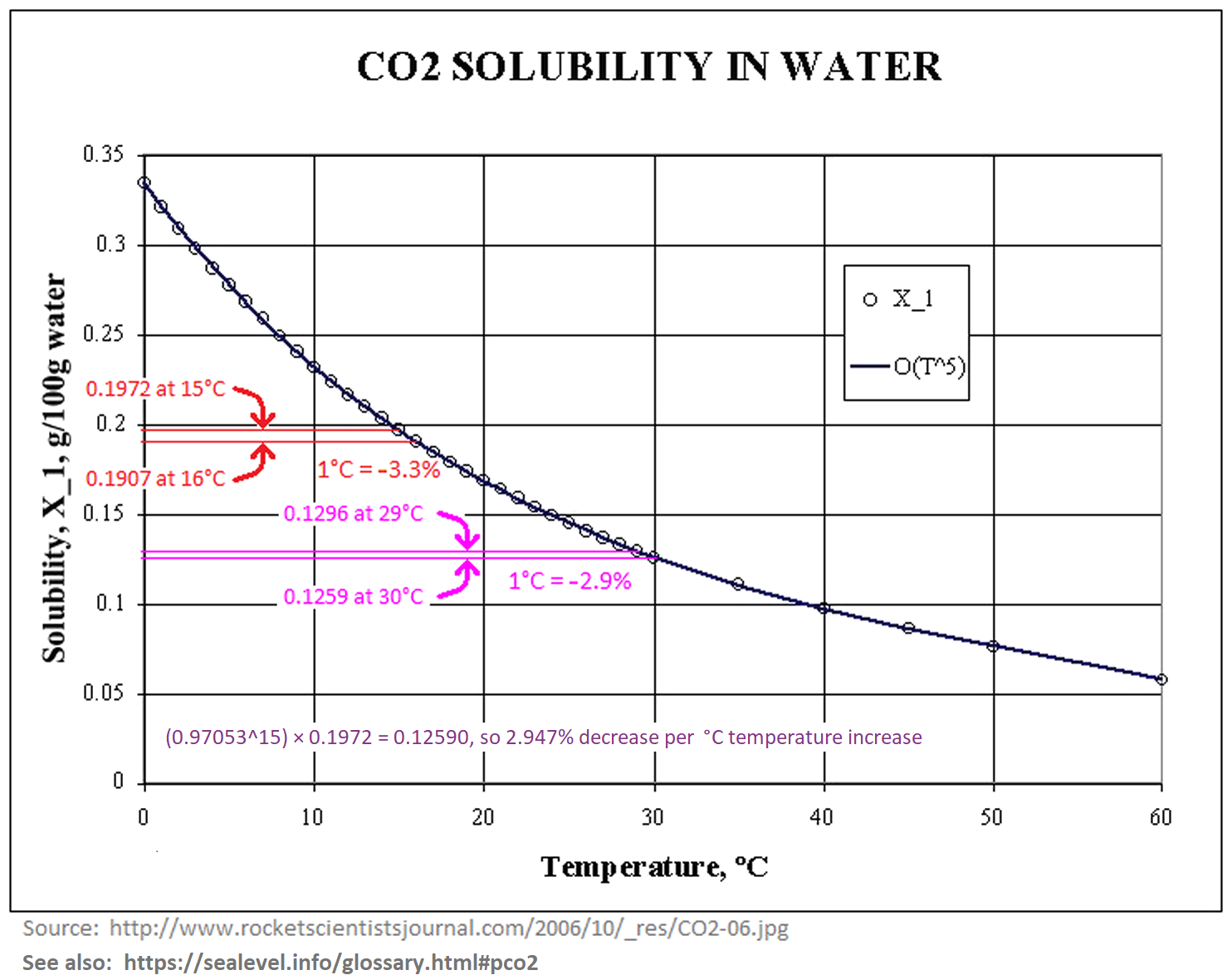
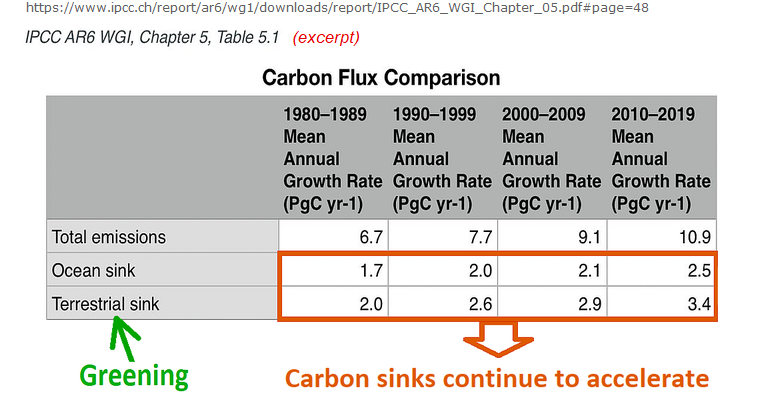
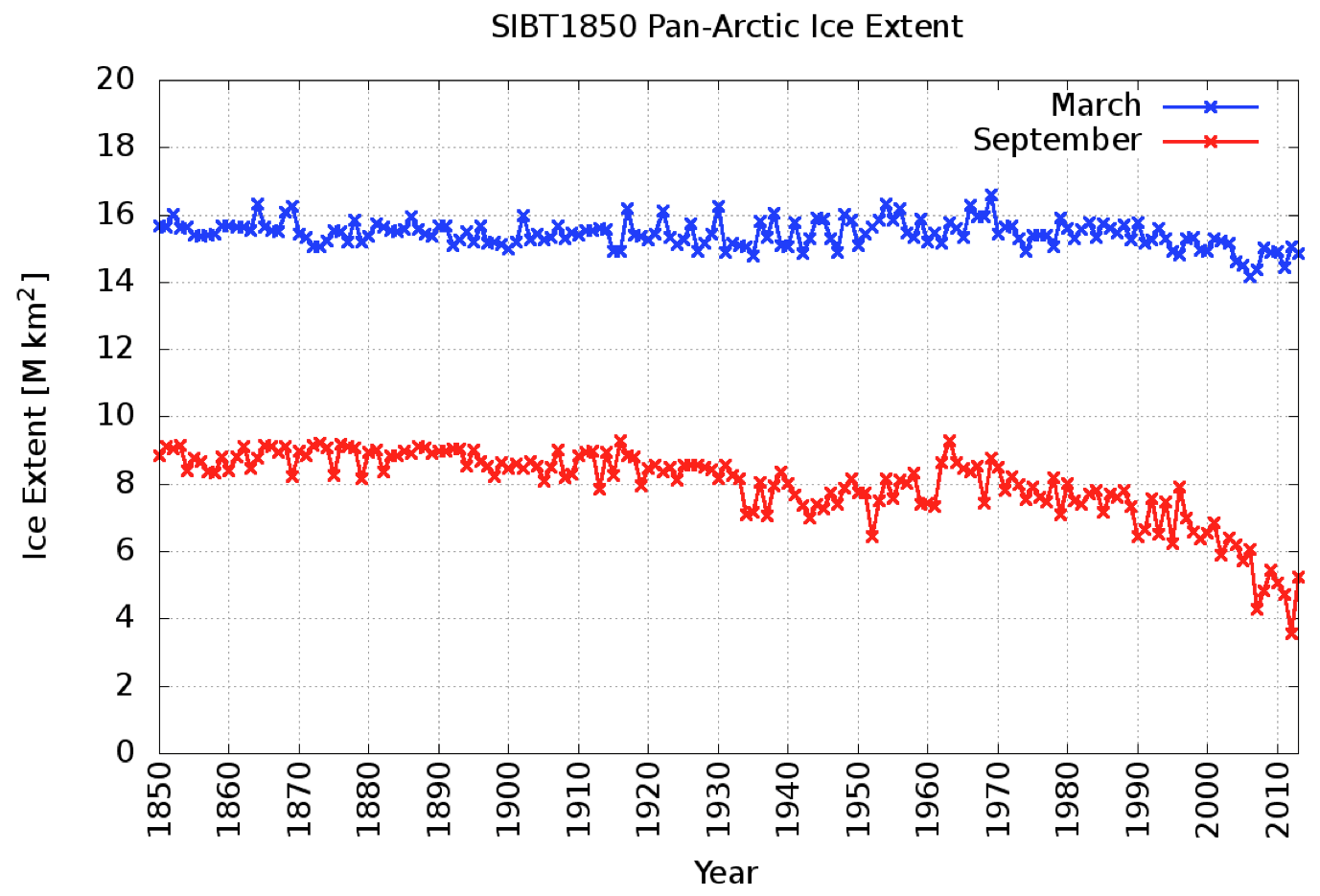
THE ESCALATOR

(free to republish)