



 Arguments









Comparing past climate change to recent global warming
What the science says...
It warmed just as fast in 1860-1880 and 1910-1940
“In fact, the rate of warming from 1975-2001, at 0.16 °C per decade, was the fastest rate to be sustained for more than a decade in the 160-year record, but exactly the same rate occurred from 1860-1880 and again from 1910-1940, when we could not possibly have had anything to do with it.” (Christopher Monckton)Let’s have a look at some warming rates of the periods of interest from several different temperature records:
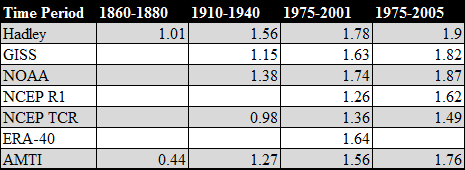
Table 1: Rate of warming for given indices in °C/century.
First we can conclude that Monckton's statement that 1975-2001 was the fastest warming rate for longer than a decade is absolutely wrong as a much higher rate is demonstrated for 1975-2005 in row 5. Secondly, to compare the three periods in Table 2, the only index which covers that period is Hadley, making his 1.6°C per century number wrong for 1975-2001 as it is actually much higher at 1.78°C per century.
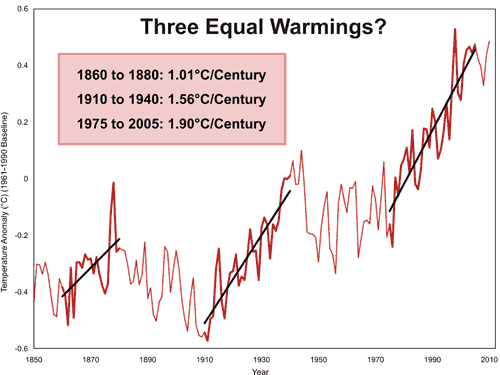
Based upon the evidence presented here, he cannot support his statement that 1860-1880 had a similar warming rate as it was demonstratively lower than the 1975-2001 warming rate and nearly half the 1975-2005 rate. Finally, regarding the 1910 to 1940 warm period, evidence presented here suggests that only 1 out of the 4 major indices indicates a rate of warming within 0.25°C per century and none within 0.2°C. His claim that the rates are similar is dubious at best.
Last updated on 31 January 2011 by robert way.
 I would contend that there is a clear signal when you compare the two trends. The only thing you can take from the Greenland data is that there is a much larger noise factor but you can clearly see that the overall trend for the 20th century is much greater than the global record, fully consistent with AGW theory.
 And again, for those hard of "hearing", it is not so much where we are now, but where we are heading under BAU.
 The Greenland data tracks the global anomalies reasonably well (mid century rise, drop until ~1970, increasing after that). The reason neither of these directly follow CO2 emissions is because CO2 is not the only driver of climate, as is discussed on that thread.
The current temperature rise, in particular post-1970, cannot be accounted for without anthropogenic greenhouse warming: factors involved in earlier climate changes are insufficient or of the wrong sign to cause recent temperature rises, rises which we expect to continue for quite some time. We're headed to mid-Pliocene temperatures, where the sea level was ~25m higher due to ice melt.
The concern is particularly strong since Greenland ice melt is increasing:
The Greenland data tracks the global anomalies reasonably well (mid century rise, drop until ~1970, increasing after that). The reason neither of these directly follow CO2 emissions is because CO2 is not the only driver of climate, as is discussed on that thread.
The current temperature rise, in particular post-1970, cannot be accounted for without anthropogenic greenhouse warming: factors involved in earlier climate changes are insufficient or of the wrong sign to cause recent temperature rises, rises which we expect to continue for quite some time. We're headed to mid-Pliocene temperatures, where the sea level was ~25m higher due to ice melt.
The concern is particularly strong since Greenland ice melt is increasing:
 As noted on the previous topic, there are a lot of different kinds of glaciers on Greenland, but many of them are subject to water temperatures in their melt rates, not just air temperatures.
So:
- You're mistaken in thinking that CO2 is the only driver of climate.
- Recent warming could not have happened without AGW; other forcings don't add up.
- Air temperature is not the only driver of glacial melt; rising sea temperatures (observed) are a huge influence.
- Current warming is expected to continue for quite some time, based on the science and current policies.
- This has nasty implications for sea level due to Greenland ice melt.
As noted on the previous topic, there are a lot of different kinds of glaciers on Greenland, but many of them are subject to water temperatures in their melt rates, not just air temperatures.
So:
- You're mistaken in thinking that CO2 is the only driver of climate.
- Recent warming could not have happened without AGW; other forcings don't add up.
- Air temperature is not the only driver of glacial melt; rising sea temperatures (observed) are a huge influence.
- Current warming is expected to continue for quite some time, based on the science and current policies.
- This has nasty implications for sea level due to Greenland ice melt.
 Albatross, the current Arctic climate is very difficult to be explained by co2, and shows a much better link to natural forcings.
Alabatross, the perfect correlation with changes in the sun, and the lack of any correlation with co2, surely support the argument that the Arctic climate is dominated by natural variability and not CO2.
Albatross, the current Arctic climate is very difficult to be explained by co2, and shows a much better link to natural forcings.
Alabatross, the perfect correlation with changes in the sun, and the lack of any correlation with co2, surely support the argument that the Arctic climate is dominated by natural variability and not CO2.
 Soon is not known for his quality of science, and appears to have neglected the last 30 years of data in his graph.
See again the CO2 is not the only driver of climate thread: by asserting that CO2 (and CO2 forcings only) don't match the temperature record, you're really pushing a Strawman argument. CO2 is part of the picture, not all of it, but it's become the dominant changing forcing causing recent warming.
Soon is not known for his quality of science, and appears to have neglected the last 30 years of data in his graph.
See again the CO2 is not the only driver of climate thread: by asserting that CO2 (and CO2 forcings only) don't match the temperature record, you're really pushing a Strawman argument. CO2 is part of the picture, not all of it, but it's become the dominant changing forcing causing recent warming.








Climate Myth...