



 Arguments









Does ocean cooling prove global warming has ended?
What the science says...
| Select a level... |
 Basic
Basic
|
 Intermediate
| |||
|
The most recent ocean measurements show consistent warming. |
|||||
Oceans are cooling
“Ocean heat touches on the very core of the AGW hypothesis: When all is said and done, if the climate system is not accumulating heat, the hypothesis is invalid.
[…]Now that heat accumulation has stopped (and perhaps even reversed), the tables have turned. The same criteria used to support their hypothesis, is now being used to falsify it.” (William DiPuccio)
In 2008, climate change sceptic Roger Pielke Sr said this: “Global warming, as diagnosed by upper ocean heat content has not been occurring since 2004”. It is a fine example of denialist spin, making several extraordinary leaps:
-
that one symptom is indicative of the state of an entire malaise (e.g. not being short of breath one day means your lung cancer is cured).
-
that one can claim significance about a four year period when it’s too short to draw any kind of conclusion
-
that global warming has not been occurring on the basis of ocean temperatures alone
So much for the hype. What does the science say about the temperature of the oceans – which, after all, constitute about 70% of the Earth’s surface? The oceans store approximately 80% of all the energy in the Earth’s climate, so ocean temperatures are a key indicator for global warming.
No straight lines
Claims that the ocean has been cooling are correct. Claims that global warming has stopped are not. It is an illogical position: the climate is subject to a lot of natural variability, so the premise that changes should be ‘monotonic’ – temperatures rising in straight lines – ignores the fact that nature doesn’t work like that. This is why scientists normally discuss trends – 30 years or more – so that short term fluctuations can be seen as part of a greater pattern. (Other well-known cyclic phenomena like El Nino and La Nina play a part in these complex interactions).
Looking at the trend in ocean heat, this is what we find:
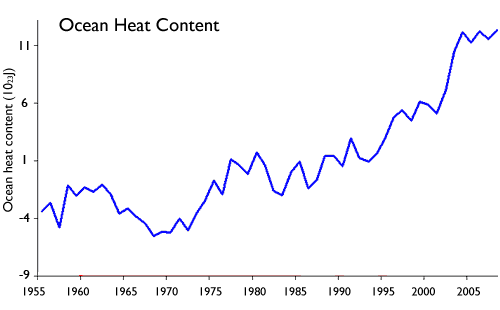
Source: Levitus 2009
There are, however, disputes about the accuracy of Argo buoys and expendable measuring devices dropped into the sea, and the reporting of temperatures down to only 700 metres. How do scientists resolve these kind of disputes – bearing in mind that such disputes are the very stuff of science, the essence of true scepticism? One way is to find more data sources – different ways of measuring the phenomenon in dispute. By using results from seven different teams of scientists, all using different tools and methods, we are able to see a clear trend. And while there is variation between team results due to the differences in technique and measurement methods, one thing they all agree on: long term, temperatures are going up.
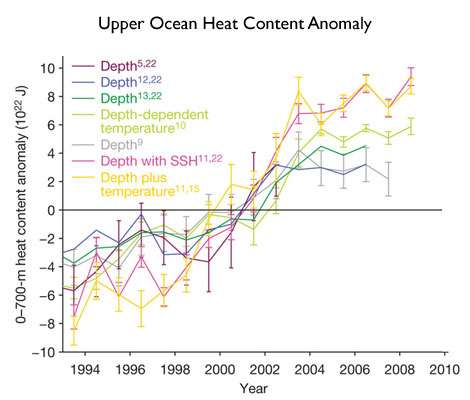
Source: Lyman 2010
The reaction of the oceans to climate change are some of the most profound across the entire environment, including disruption of the ocean food chain through chemical changes caused by CO2, the ability of the sea to absorb CO2 being limited by temperature increases, (and the potential to expel sequestered CO2 back into the atmosphere as the water gets hotter), sea-level rise due to thermal expansion, and the amount of water vapour in the atmosphere.
While there is a great deal we don’t know about how the oceans behave, we do however know that it’s safer to discuss all aspects of climate change using multiple sets of data, rather than just one, as Pielke Sr did. If ocean heat is a guide, then global warming is still on track to cause great disruption if we don’t modify our actions to reduce the release of anthropogenic CO2.
Claims that global warming is not happening on the basis of short-term ocean temperatures are not supported by the evidence.
Basic rebuttal written by GPWayne
Last updated on 1 August 2013 by gpwayne. View Archives
 Caption: Changing heat content of the global ocean. Black curve is changes in upper ocean heat content (0 to 700 metres). Pink line is trend in upper ocean heat content. Blue line is trend in ocean heat content down to 2000 metres (Trenberth 2010).
But then again it seems that you think that you know more about OHC than Palmer, Lyman, Trenberth, Levitus, Domingues, von Schuckmann, Good,Gouretski, Ishii, Komoto, Johnson, Smith, Haines, Murphy, Reseghetti, Antonov, Mishonov, Garcia, Locarnini, Boyer and Willis.
You are railing against an awful lot of grey matter, experience, expertise and training BP. Something else to consider, according to Palmer et al. (2009):
"Deep ocean warming may account for some of the missing energy (Johnson and Doney 2006; Johnson et al. 2007; Johnson et al. 2008a). Only with a truly global ocean observing system can we close fully the global energy and sea level budgets, so we must improve our observations of the ocean below 2000 m where Argo floats currently do not reach."
Caption: Changing heat content of the global ocean. Black curve is changes in upper ocean heat content (0 to 700 metres). Pink line is trend in upper ocean heat content. Blue line is trend in ocean heat content down to 2000 metres (Trenberth 2010).
But then again it seems that you think that you know more about OHC than Palmer, Lyman, Trenberth, Levitus, Domingues, von Schuckmann, Good,Gouretski, Ishii, Komoto, Johnson, Smith, Haines, Murphy, Reseghetti, Antonov, Mishonov, Garcia, Locarnini, Boyer and Willis.
You are railing against an awful lot of grey matter, experience, expertise and training BP. Something else to consider, according to Palmer et al. (2009):
"Deep ocean warming may account for some of the missing energy (Johnson and Doney 2006; Johnson et al. 2007; Johnson et al. 2008a). Only with a truly global ocean observing system can we close fully the global energy and sea level budgets, so we must improve our observations of the ocean below 2000 m where Argo floats currently do not reach."
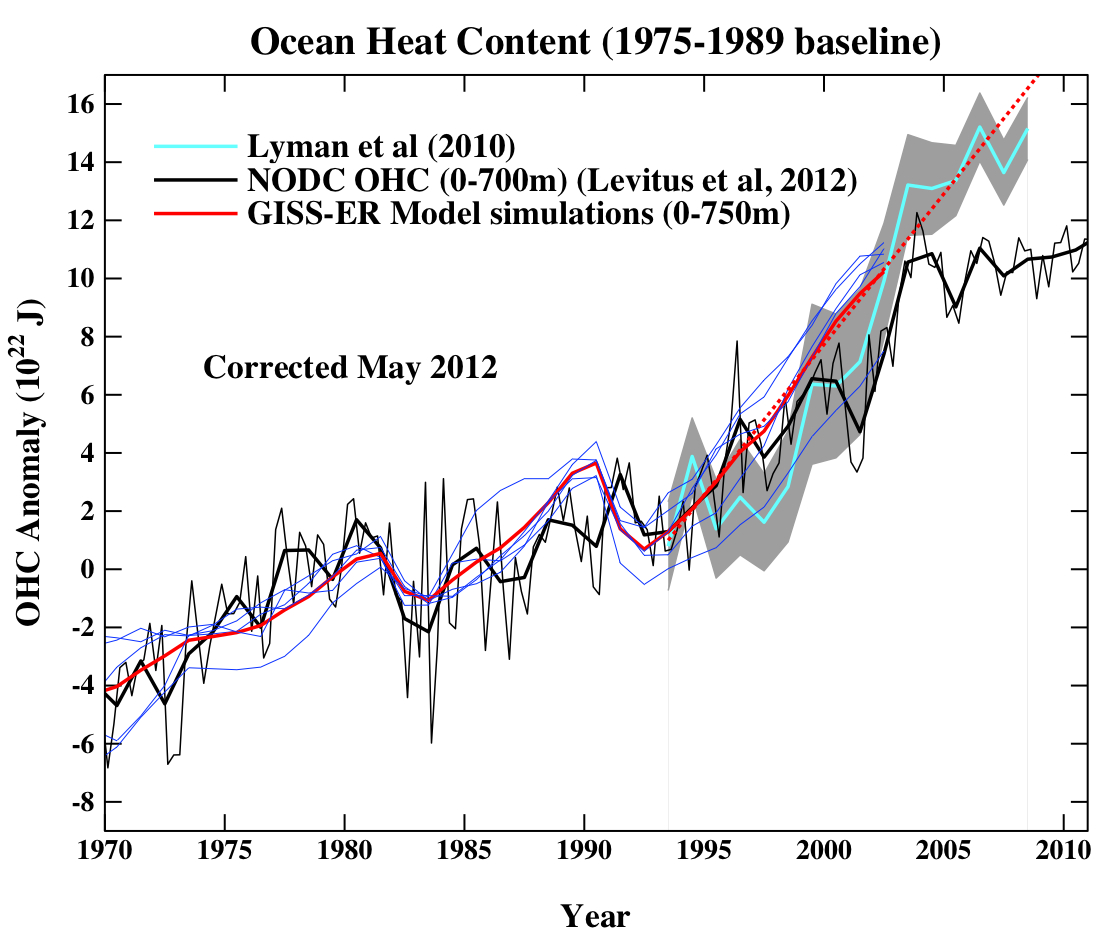 Source here
RC commentary on Lyman et al 2010 here
The Yooper
Source here
RC commentary on Lyman et al 2010 here
The Yooper
 Now. As you know science is never about pictures. It is about propositions, preferably with a truth-value attached to them or at least a not-known tag. Figures like the one above is only meant to be concise representations of complex propositions.
For example OHC history reconstruction according to Levitus can be translated to a proposition like "There is a constant c that if ohck is the sum of c and the true value of OHC measured in 1022 J units for year k, then 0.246 < ohc1993 < 1.122 and 0.764 < ohc1994 < 2.256 and 1.615 < ohc1995 < 2.913, etc., etc."
A similar proposition can be constructed for the curve in your figure which is Trenberth's representation of Lyman's finding.
If you put the two propositions together like I did above by making a joint representation, it is clear that they contradict each other. Therefore if they are supposed to be joined by the logical operation conjunction as the graphical representation suggests, what you get is a false proposition. As you know, from a false proposition anything follows with the force of logical necessity, and of course among the many possible consequences there is the one you are seeking. Or its negation.
The problem is the error bars do not overlap. If it happens for different measurements of the same quantity, it is a sure sign it was not a measurement just some pure guesswork. Based on guesswork (as opposed to measurement with proper error analysis) you can never say things like "OHC is increasing". Of course you can say "I guess OHC is increasing" or "the educated guess (using some as yet unspecified system of fuzzy logic) of Palmer, Lyman, Trenberth, Levitus, Domingues, von Schuckmann, Good, Gouretski, Ishii, Komoto, Johnson, Smith, Haines, Murphy, Reseghetti, Antonov, Mishonov, Garcia, Locarnini, Boyer and Willis is that OHC is increasing",. However, it is not a factual statement, but a proposition regarding the personal or community beliefs of a group of individuals. As such, it belongs to the field of social, not natural sciences.
Now. As you know science is never about pictures. It is about propositions, preferably with a truth-value attached to them or at least a not-known tag. Figures like the one above is only meant to be concise representations of complex propositions.
For example OHC history reconstruction according to Levitus can be translated to a proposition like "There is a constant c that if ohck is the sum of c and the true value of OHC measured in 1022 J units for year k, then 0.246 < ohc1993 < 1.122 and 0.764 < ohc1994 < 2.256 and 1.615 < ohc1995 < 2.913, etc., etc."
A similar proposition can be constructed for the curve in your figure which is Trenberth's representation of Lyman's finding.
If you put the two propositions together like I did above by making a joint representation, it is clear that they contradict each other. Therefore if they are supposed to be joined by the logical operation conjunction as the graphical representation suggests, what you get is a false proposition. As you know, from a false proposition anything follows with the force of logical necessity, and of course among the many possible consequences there is the one you are seeking. Or its negation.
The problem is the error bars do not overlap. If it happens for different measurements of the same quantity, it is a sure sign it was not a measurement just some pure guesswork. Based on guesswork (as opposed to measurement with proper error analysis) you can never say things like "OHC is increasing". Of course you can say "I guess OHC is increasing" or "the educated guess (using some as yet unspecified system of fuzzy logic) of Palmer, Lyman, Trenberth, Levitus, Domingues, von Schuckmann, Good, Gouretski, Ishii, Komoto, Johnson, Smith, Haines, Murphy, Reseghetti, Antonov, Mishonov, Garcia, Locarnini, Boyer and Willis is that OHC is increasing",. However, it is not a factual statement, but a proposition regarding the personal or community beliefs of a group of individuals. As such, it belongs to the field of social, not natural sciences.







Climate Myth...