



 Arguments







2012 SkS Weekly Digest #14
Posted on 9 April 2012 by John Hartz
SkS Highlights
Dana's Yes Happer and Spencer, Global Warming Continues started the week by rebutting another anti-science letter published in the Wall Street Jounal. Alex C posted Part I of Why David Archibald is wrong about solar cycles driving sea levels and Dana posted Part II of Monckton Misleads California Lawmakers - Now It's Personal .
Toon of the Week
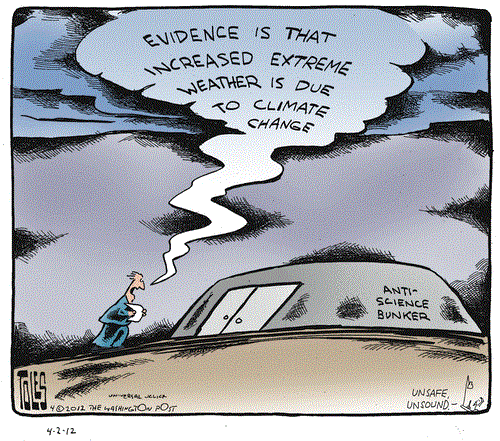
H/T to Joe Romm's Climate Progress
Quote of the week
"It follows from this that the radiation from the earth into space does not go on directly from the ground, but on the average from a layer of the atmosphere having a considerable height above sea-level. The height of that layer depends on the thermal quality of the atmosphere, and will vary with that quality. The greater is the absorbing powerof the air for heat rays emitted from the ground, the higher will that layer be. But the higher the layer, the lower is its temperature relatively to that of the ground; and as radiation from the layer into space is the less the lower its temperature is, it follows that the ground will be hotter the higher the radiating layer is."
From a paper presented to the Royal Meteorological Society at its Jubilee on April 3, 1900, by Nils Ekholm. Quarterly Journal of the Royal Meteorological Society, vol. XXVII, No. 117, pp. 1-61, 1901.
H/T to Riccardo.
Issue of the Week
How optimistic are you that the human race will get its act together in time to stave off catastrophic climate change?
The Week in Review
A complete listing of the articles posted on SkS during the past week.
- New Understanding of Past Global Warming Events by John Hartz
- Climate Scientists take on Richard Lindzen by Dana
- Submerged Forests off the coast of Wales: a Climate Change Snapshot by John Mason
- Eocene Park: our experiment to recreate the atmosphere of an ancient hothouse climate by Andy S
- Monckton Misleads California Lawmakers - Now It's Personal (Part 2) by Dana
- Why David Archibald is wrong about solar cycles driving sea levels (Part 1) by Alex C
- New research from last week 13/2012 by Ari Jokimäki
- Yes Happer and Spencer, Global Warming Continues by Dana
Coming Soon
A list of articles that are in the SkS pipeline. Most of these articles, but not necessarily all, will be posted during the week.
- Shakun et al. Clarify the CO2-Temperature Lag (Dana)
- New research from last week 14/2012 (Ari Jokimäki)
- DeConto et al: Thawing permafrost drove the PETM extreme heat event (Andy S)
- Data Contradicts Connection Between Earth's Tilt and the Seasons (ptbrown31)
- Global Surface Warming Since 1995 (Dana)
- Global Warming in a Nutshell (Larry M)
- Why David Archibald is wrong about solar cycles driving sea level (Part 1B) (Alex C)
- Linking Weird Weather to Rapid Warming of the Arctic (Daniel Bailey)
- Global Warming - A Health Warning (Agnostic)
- Advancing Climate Science, One Skeptic Talking Point at a Time (rustneversleeps)
- Methane - Part 1 (Agnostic)
SkS in the News
Dana's Monckton Misleads California Lawmakers - Now It's Personal was re-posted on Citizen's Challenge, and Yes Happer and Spencer, Global Warming Continues was re-posted on Climate Progress.
Simple Myth Debunking of the Week
The #12 most popular climate myth - that CO2 lags temperature, and therefore CO2 doesn't cause global warming - has been debunked in greater detail by Shakun et al. (2012). Although the initial global warming during glacial-interglacial transitions was triggered by orbital cycles, over 90% of the glacial-interglacial warming occurred after the CO2 increase. We will explore this finding in greater detail in Shakun et al. Clarify the CO2-Temperature Lag.
SkS Spotlights: CCAFS
The CGIAR Research Program on Climate Change, Agriculture and Food Security (CCAFS) is a 10-year research initiative launched by the Consultative Group on International Agricultural Research (CGIAR) and the Earth System Science Partnership (ESSP).
CCAFS seeks to overcome the threats to agriculture and food security in a changing climate, exploring new ways of helping vulnerable rural communities adjust to global changes in climate.


 The procedure used to generate the "Sparse Stations Index" is really quite simple:
Divide up the globe into 20 degrees x 20 degrees grid-elements (at the Equator; longitude dimensions adjusted as you go N/S to keep grid-element areas approximately constant). Search each grid-element for the rural station with the longest temperature record. Use one and only one station for each grid element.
About 85 stations were selected via this procedure. Because of varying station record lengths, data-gaps, etc., significantly fewer stations reported data for any given month/year. Over the 1880-2011 time-period, an average of about 50 of the selected stations reported data for any given month/year.
Compute the year/month temperature anomalies (relative to the standard NASA 1951-1980 baseline) for the selected stations, and just straight average the anomalies all together for each year.
2) A Google-Earth visualization of stations used to compute the NASA/GISS “Meteorological Stations” index. (If you have a bit of programming experience, getting the station lat/long metadata into Google-Earth readable format is pretty easy.)
The procedure used to generate the "Sparse Stations Index" is really quite simple:
Divide up the globe into 20 degrees x 20 degrees grid-elements (at the Equator; longitude dimensions adjusted as you go N/S to keep grid-element areas approximately constant). Search each grid-element for the rural station with the longest temperature record. Use one and only one station for each grid element.
About 85 stations were selected via this procedure. Because of varying station record lengths, data-gaps, etc., significantly fewer stations reported data for any given month/year. Over the 1880-2011 time-period, an average of about 50 of the selected stations reported data for any given month/year.
Compute the year/month temperature anomalies (relative to the standard NASA 1951-1980 baseline) for the selected stations, and just straight average the anomalies all together for each year.
2) A Google-Earth visualization of stations used to compute the NASA/GISS “Meteorological Stations” index. (If you have a bit of programming experience, getting the station lat/long metadata into Google-Earth readable format is pretty easy.)
 3) A Google Earth visualization of stations used to compute the “Sparse Rural Stations Index”.
 The results pretty convincingly demonstrate the following:
1) UHI is a non-issue (I used only rural stations).
2) Data "homogenization" is a complete non-issue (I used only raw temperature data).
3) The global temperature record is incredibly redundant and robust -- you can really throw away ~98 percent of the temperature stations and *still* confirm the NASA/GISS global temperature estimates.
The results pretty convincingly demonstrate the following:
1) UHI is a non-issue (I used only rural stations).
2) Data "homogenization" is a complete non-issue (I used only raw temperature data).
3) The global temperature record is incredibly redundant and robust -- you can really throw away ~98 percent of the temperature stations and *still* confirm the NASA/GISS global temperature estimates.
 1
1  0
0
 For what it's worth, feel free to pass the material that I've posted here around to friends/relatives/co-workers/etc... -- I hit one of my "fence sitting" relatives with it a couple of days ago, and it seemed to make a real impression on her. The fancy Google Earth "eye candy" does seem to help drive home the message.








Comments