



 Arguments







Even Princeton Makes Mistakes
Posted on 26 May 2011 by Chris Colose
In general, belonging to a respected department at a top institution (such as MIT, Princeton, Harvard, Cambridge, Oxford, etc) gives your word strong authority in the public eye. Richard Lindzen, for example, is known for his work in dynamics and what he has contributed to the referred literature amongst colleagues, but to a general audience he is "Alfred P. Sloan Professor of Meteorology at MIT." This, of course, is not an intrinsically bad thing-- we accept authority all the time on subjects we know little about. Just last night, I watched a movie called "Double Jeopardy" with Tommy Lee Jones, a film built somewhat around a constitutional law that forbids someone from being tried for the same crime twice. Afterward, I was curious enough to check the internet to see how well the film did at legal interpretation, and I found through wikipedia that a "Harvard law professor" said it was not entirely accurate (though I do recommend the movie, it was quite good). I'm sure he is right, his reasoning made sense to me, and I didn't have a particular interest in researching the matter further.
These respected institutions, in turn, must hire only the best to be the best, and in general to have a position of authority at these places means you have earned it. Nonetheless, they do make mistakes sometimes. Lubos Motl at Harvard comes to mind. Another example is William Happer, a Professor of Physics at Princeton. To me, the credibility of a scientist doesn't just come from what he publishes in the literature, but also what he publishes throughout the internet as well. In the case of many of the more prominent global warming skeptics who have actual publishing experience, much of what they say on the internet is done precisely because it would never get accepted into a journal document. Nonetheless, by placing themselves in a position of authority on the subject, they also position themselves to be criticized for what they say. The same is true of me, or many other climate bloggers who now try to "teach the science."
Just who is William Happer to someone who doesn't really care much? Well, he is "the Cyrus Fogg Brackett Professor of Physics at Princeton University", which probably makes him correct concerning a lot of physical phenomena he chooses to talk about. But then you come across an article such as this (which was then reproduced at Watts Up With That, presumably for the sole reason that it is a disinformation piece).
The outline of the article is to lay to rest the "contemporary moral epidemic" surrounding "the notion that increasing atmospheric concentrations of greenhouse gases, notably carbon dioxide, will have disastrous consequences for mankind and for the planet." As one would expect from such an opening, there are also the usual references to a climate crusade, money-hungry govermnemts, greedy scientists, etc. For the next 10 paragraphs or so, Happer uses a lot of words to say absolutely nothing, except that life needs carbon and it shouldn't be regulated as a "pollutant."
Personally, I have little interest in the legality of making CO2 a "pollutant" or not. I'm quite sure different people here have their own perspective on this, but to me whether we call it a "pollutant" or a "banana" doesn't change its physical properties: CO2 is a strong greenhouse gas, and it is important in impeding how efficiently our planet loses radiative heat to space. We don't often think of CO2 as a "pollutant" on Venus, yet it still allows the planet to support temperatures well above the melting point of lead or tin.
Happer then throws in a few classical straw man attacks such as:
"CO2 levels have increased from about 280 ppm to 390 ppm over the past 150 years or so, and the earth has warmed by about 0.8 degree Celsius during that time. Therefore the warming is due to CO2. But correlation is not causation. Roosters crow every morning at sunrise, but that does not mean the rooster caused the sun to rise. The sun will still rise on Monday if you decide to have the rooster for Sunday dinner."
This would, of course, be a perfectly valid counter-argument to would-be fallacious reasoning, yet it isn't the reasoning any real scientist uses, and is therefore a smokescreen. Naturally, the WUWT crowd has eaten it up without thinking twice. The causative mechanism is the underlying radiative physics of how a CO2 molecule interacts with infrared light, and also a wide variety of indirect signatures of climate change induced by agents acting on the longwave part of the spectrum, such as stratospheric cooling or the radiative imbalance at the top of the atmosphere.
Happer can't resist throwing in a few outdated one-liners about the Vikings in a "green" Greenland, how CO2 lags temperatures in ice cores, and other boring punchlines that most skeptics don't even bother with anymore. He implies that Earth cooled by about 10 C during the Younger Dryas, but actually the YD was a time of relatively little global temperature change, even though a large area of the planet was actually being affected (see here). There's a whole list of other quick talking points about climategate, the hockey stick, etc that readers here will be well familiar with. What is most surprising to me is that a distinguished physicist apparently has no original thoughts on the matter.
Happer's reasoning is well out of line throughout his entire article, yet that doesn't stop a Princeton physicist from declaring with such confidence that this CO2-induced global warming thing is all a sham. Throughout the article he shows his unambiguous mission to confuse the reader, and his own ignorance concerning the physics of climate. He makes a number of serious accusations against a very large community, something which if unfounded (as it is surely is) should ruin the reputation of any serious scientist. Indeed, for me at least, it has. It is possible his own area of research is so far removed from climate that none of his colleagues will bother to care.
In short, even Princeton can make mistakes in who they decide should represent their department.


 0
0  0
0 Having done so I noticed several things:
a) The trend line of actual measurements is greater than the trend line of the 17 model mean predictions;
b) Just two measured values (2000 and 2008) lie below the 17 model mean;
c) No measured value lies on or below the lowest predicted value for that year by any model; and
d) 4 out of 11 years lie on or above the highest model prediction for that year by any of the 17 models.
I find it difficult to reconcile these facts with a claim that measured warming has failed to be nearly as large as the predicted warming. In fact, on the contrary, I find it impossible to interpret this as being anything other than measured temperatures exceeding the model predictions both as to values and with regard to the trend. The Earth is warming faster than the models predicted, not slower.
In other words, Happer has stated the complete reverse of the truth.
Considering your spirited defence of Happer's inexactitudes, can you please explain just when it is that you are entitled to not just your own opinions, but your own facts - once you have a PhD? Or only after being appointed to a chair at Princeton?
PS: I apologise for the difficulty reading measured values in the area in which the graphs overlap, and unfortunate by product of the graphical method used. I'm sure one of the clever programming literate people around here would find it handy to reproduce the graphs from scratch for greater clarity.)
Having done so I noticed several things:
a) The trend line of actual measurements is greater than the trend line of the 17 model mean predictions;
b) Just two measured values (2000 and 2008) lie below the 17 model mean;
c) No measured value lies on or below the lowest predicted value for that year by any model; and
d) 4 out of 11 years lie on or above the highest model prediction for that year by any of the 17 models.
I find it difficult to reconcile these facts with a claim that measured warming has failed to be nearly as large as the predicted warming. In fact, on the contrary, I find it impossible to interpret this as being anything other than measured temperatures exceeding the model predictions both as to values and with regard to the trend. The Earth is warming faster than the models predicted, not slower.
In other words, Happer has stated the complete reverse of the truth.
Considering your spirited defence of Happer's inexactitudes, can you please explain just when it is that you are entitled to not just your own opinions, but your own facts - once you have a PhD? Or only after being appointed to a chair at Princeton?
PS: I apologise for the difficulty reading measured values in the area in which the graphs overlap, and unfortunate by product of the graphical method used. I'm sure one of the clever programming literate people around here would find it handy to reproduce the graphs from scratch for greater clarity.)
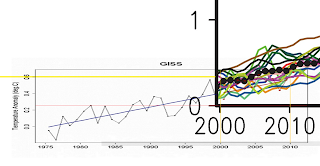 In light of this I have to amend my claims as follows:
a) The measured trend is slightly less than the trend of the 17 model mean;
b) Just three of eleven measured values lie on the 17 year mean with the rest lying below it;
c) Two measured values (2000 and 2008) lie below the lowest prediction by any model for that year; and
d) No measured value lies on or above the highest predicted value for any year.
Clearly I jumped the gun (and should probably have known better. The Earth is in fact warming slower than model projections. It is just marginally slower, slow enough that I needed to lay the full 35 year trend of measured valued along the mean to ascertain the trend was slower. Consequently I still consider Happer's claim unwarrented. But having gone in so hard rhetorically on a mistake, I hardly expect to convince anyone of that. Oh well ...
In light of this I have to amend my claims as follows:
a) The measured trend is slightly less than the trend of the 17 model mean;
b) Just three of eleven measured values lie on the 17 year mean with the rest lying below it;
c) Two measured values (2000 and 2008) lie below the lowest prediction by any model for that year; and
d) No measured value lies on or above the highest predicted value for any year.
Clearly I jumped the gun (and should probably have known better. The Earth is in fact warming slower than model projections. It is just marginally slower, slow enough that I needed to lay the full 35 year trend of measured valued along the mean to ascertain the trend was slower. Consequently I still consider Happer's claim unwarrented. But having gone in so hard rhetorically on a mistake, I hardly expect to convince anyone of that. Oh well ...







Comments