



 Arguments
Software
Resources
Comments
The Consensus Project
Translations
About
Support
Arguments
Software
Resources
Comments
The Consensus Project
Translations
About
Support







Latest Posts
- Skeptical Science New Research for Week #10 2026
- Will climate change bring more major hurricane landfalls to the U.S.?
- Just have a Think - The Primary Energy Fallacy finally laid to rest!
- The AI-Augmented Scientist
- 2026 SkS Weekly Climate Change & Global Warming News Roundup #09
- Skeptical Science New Research for Week #9 2026
- Fossil fuel pollution’s effect on oceans comes with huge costs
- Fact brief - Do solar panels work in cold or cloudy climates?
- After a major blow to U.S. climate regulations, what comes next?
- 2026 SkS Weekly Climate Change & Global Warming News Roundup #08
- Skeptical Science New Research for Week #8 2026
- Introducing the Climate Brink Dashboard
- Climate Adam - Climate Scientist Reacts to AI Overlords
- Trump just torched the basis for federal climate regulations. Here’s what it means.
- 2026 SkS Weekly Climate Change & Global Warming News Roundup #07
- Skeptical Science New Research for Week #7 2026
- These key strategies could help Americans get rid of their cars
- Fact brief - Can nearby solar farms reduce property values?
- Sea otters are California’s climate heroes
- 2026 SkS Weekly Climate Change & Global Warming News Roundup #06
- Skeptical Science New Research for Week #6 2026
- The future of NCAR remains highly uncertain
- Fact brief - Can solar projects improve biodiversity?
- How the polar vortex and warm ocean intensified a major US winter storm
- 2026 SkS Weekly Climate Change & Global Warming News Roundup #05
- Help needed to get translations prepared for our website relaunch!
- Skeptical Science New Research for Week #5 2026
- Climate Variability Emerges as Both Risk and Opportunity for the Global Energy Transition
- Fact brief - Are solar projects hurting farmers and rural communities?
- Winter 2025-26 (finally) hits the U.S. with a vengeance

Comment Search Results
Search for failed predictions
Comments matching the search failed predictions:
- Fact brief - Is there an expert consensus on human-caused global warming?
Bob Loblaw at 06:37 AM on 11 November, 2024Jess Scarlett @ 6:
You're going to have to put together a much stronger argument than that if you want to convince anyone that there isn't a strong expert consensus on human-caused global warming.
For starters, is your lead question ("Have you looked into all the climate scientists gagged...") a rhetorical gambit, or are you actually asking a serious question? Are you trying to imply that the studies that have looked at the scientific literature missed a few "gagged scientists", or many, or all? Are you trying to imply that this "gagging" has been so thorough that none of their opinions have every made it into print? Or that the few that have made it into print would be a much greater number "but gagging"?
The OP here links to the full SkS rebuttal on the topic. Here is the link to the basic tab of that rebuttal, but note that there are also advanced and intermediate tabs to read. The basic rebuttal links to the various papers that have been done on the subject, and those papers give details on just what sort of searches they did to obtain the list of papers that were evaluated. Feel free to look them over and come back with an argument as to why those searches will have missed the opinions of the "gagged scientists" you seem to think exist in large numbers.
...but before you start trying to make an argument that the review system won't let opposing opinions get published, I suggest that you read this SkS article on "pal review" that shows just where bad reviewing practices exist in the climate science literature. (Hint: it's the "gagged scientists" that have historically abused the peer review system.)
But let's entertain your argument that there are a whole bunch of 'gagged scientists" that can't get published, or have chosen to remain silent out of fear. You said "...all the climate scientists gagged..." That seems to imply a large number. I'll begin with a recollection of discussing climate science with someone at a conference about 30 years ago. He made the claim that lots of scientists had reversed their opinion from global cooling in the 1970s to warming in the 1990s. (This is debunked on this post at SkS.)
- I challenged him by saying "name one".
- He prattled on about there being lots.
- Again, I said "name one".
- He kept prattling on.
- I repeated "name one".
- I held my hand up about head high and started dropped it down to chest height, waist height, and below, saying "this is your credibility dropping".
- He still didn't give a name. He never did.
So that is my challenge to you: you claim that there are scientists at CSIRO and NASA that have been gagged because they disagree with the scientific consensus. Name One. And provide some sort of link to a reliable source of information supporting that position.
Second: in the advanced tab of the full rebuttal, under "The Self-Ratings", the Original Cook et al study obtained ratings of over 2100 papers from 1200 scientists, and 97.2% of those ratings agreed with the consensus. In the following paragraph, it states that the authors' review of over 4000 abstracts indicated a 97.1% agreement with the consensus.
- My second challenge is for you to do some elementary arithmetic (I won't call it math), and tell me how many papers do you think those "gagged scientists" failed to publish, and how would the 97% number have changed if they had succeeded in publishing those papers.
- I'll give you a hint. You'd have to find nearly 2100 papers or 4000 abstracts to get it to drop to a 50% consensus.
- Good luck finding that many papers.
- ...and before you try to link to PopTech's list of papers, please read "Meet the Denominator".
Please provide us with backup of your claim.
- Skeptical Science New Research for Week #43 2022
Doug Bostrom at 13:32 PM on 28 October, 2022Population might be termed the elephant in the room that is also a third rail, in terms of open, frank discussion in connection with public policy. Punters like us can talk about it here down in the weeds, but there's not much headroom for this topic in the world of government.
Not least because of China's clumsy, inhumane, failed experiment and now unfolding aftermath (better hurry up with the elder care robots, mechanized adult diaper-changing etc.). Especially as that policy as if not bad enough was freighted as well with all the optical baggage of China's other circumstances. The history so created is like a highly conductive chain to throw across the live wires of political discussion.
Erlich's predictions might be said to have failed in the sense that his modeling was too simple, uncoupled to other models which might well have better informed the speed of his model of population growth.
Meanwhile, does anybody sincerely believe we're having a truly easier time supporting 7.8 billion than we were with 3.7 billion? Everybody's fed, clothed, housed, educated? No? How about with our projected peak of 10.4 billion? We're assured of providing all of the basics before getting there? If not and we agree that it would be best to avoid adding more before catching up with present needs, our population is effectively out of control. Perhaps we could it a low-order detonation as opposed to a high-order explosion.
What would be helpful would be a reliable, well-constituted global misery factor, to apply to population figures. For instance, by some measures per capita improvements our quality of life are visible. Odds of death by violence is one such. But what's the net absolute total misery, given our expansion of population? That's where a global misery factor would be a helpful indicator of progress, or not. We can after all lower the global misery factor yet because it's multiplied by population end up with more total misery despite per capita improvements. Even as we reduce the per capita amount of misery, total misery can still increase, with a bulging population.
What's the point of making more misery? Maybe it would be better not to do that? Could we just nicely but consistently suggest and remind that 2 kids per parental pair is a good parking spot for steering our total population, until we get things better sorted?
Nope.
In any case, the article cited by the three nannies is unresponsive to the claim it's supposed to support.
- We're heading into cooling
Eclectic at 06:42 AM on 2 May, 2021ClimateBuddha @41 ,
your second-to-last sentence doesn't make much sense. Please be kind enough to correct whatever typo or jumbled thought produced your error.
PhilippeC @42 ,
it will be most interesting to see what (if any) evidence our friend ClimateBuddha can come up with. Unfortunately for denialists & pseudo-skeptics, their cherry tree has few (if any) cherries left that they can pick.
Philippe, you may be amused to go outside the scientific papers, and visit the Youtuber world ~ where 10 months ago, the science journalist Potholer54 produced a 5-minute video listing more than a dozen failed Global Cooling predictions. These failed cooling predictions were made in the last 20 years (since 2001) by various scientists and wannabe-scientists. [video title: A short chronology of failed 'ice age' predictions]
No, not the failed Global Cooling predictions of last century. Just some of the failures of this century. As always, Potholer54 puts a humorous touch on things.
- Skeptical Science New Research for Week #9, 2021
nigelj at 13:21 PM on 13 March, 2021Starburst @6
"I agree in that we would not expect perfectly uniform warming, but when temperatures show a downward trend in some regions that is equally as strong as the upward trend in other regions, it definitely raises doubts about global warming. As I stated in my first posting, global warming means warming over the entire global, which certainly isn't happening."
My understanding is most regions of the world show warming. The few regions showing cooling or no change do not have enough cooling to offset the warming in the regions with warming. This means the world as a whole is warming. This is commonsense. Scientists measure all these things and take it all into account because they are basic things. The heat energy content of the entire planetary system has also increased in the last several decades. Again scientists look into these things because its what they are trained to do.
If you still dont understand or agree, please provide a list of all countries in the world and its oceans as well, and their warming rates and cooling rates (if there are any) over the last 50 years and we shall see which dominates, - warming or cooling. Until you do this in detail, with links to all your data, and making sure you are comparing like with like, you have got nothing worth me considering.
"For people in these regions, global warming is not the problem and fossil fuels are necessary for making a living, or even just surviving. These people simply cannot afford governments imposing additional taxes (or "cap and trade") for their use of fossil fuels. "
I sympathise with the challenges people face, but these comments about what they can afford are just empty assertions. On what basis with what facts? What expert study says this? Even if they had difficulties affording this you can have carbon tax and dividend schemes which are financially gentle on people (google it).
Many expert reports like the Stern Report find we can mitigate the worst of climate change at a cost of approximately 2% of global gdp per year. This is very roughly equivalent to 2% of peoples incomes. I suggest all but very poor people can afford that, and poor people can be given finanical assistance by governmnet so they can cope or could be excluded from carbon tax schemes. At least some countries do this sort of thing. I dont have time to list them all but this sort of thing is eassily googled.
"Finally, with the failed prediction track records of Al Gore and other pro-AGW politicians,..."
You provide no evidence of these alleged failed predictions. But its not relevant anyway , because the IPCC reports about climate change are not based on anything Al Gore said. The IPCC and climate scientists make their predictions based on science, and so far warming trends are very close to predictions made decades ago. Refer:
www.realclimate.org/index.php/archives/2020/01/update-day-2020/
- Solar Cycle Model fails to predict the recent warming
Hans Petter Jacobsen at 23:53 PM on 20 February, 2021When I wrote this blog post in December 2012, the temperatures measured so far in solar cycle 24 were much higher than SSH (Jan-Erik Solheim, Kjell Stordahl and Ole Humlum) predicted with their solar cycle model in [1] and [2]. In 2014, I wrote about the failure of their model on a Norwegian discussion forum. Solheim, the lead author of the two articles, participated in the discussion afterwards. He defended his model. He stressed that we have to wait till solar cycle 24 has ended before we can evaluate the model's predictions for that cycle. It ended in November 2019, so now we have the answer. The average temperatures in solar cycle 24 became much higher than SSH predicted with their model.
In [1], SSH predicted that the average temperature on Svalbard in solar cycle 24 would be between 1.5 and 5.5°C colder than it was in solar cycle 23. According to the Norwegian Meteorological Institute, the average temperature at Svalbard Airport Longyearbyen increased by 1.7°C from solar cycle 23 to 24. According to Berkeley Earth, it increased by 1.0°C at a location inland, not far from Longyearbyen.
In [2], SSH predicted that the average temperature in a northern region including Iceland and Norway would drop by at least 1°C from solar cycle 23 to 24. According to Berkeley Earth it rose by 0.3°C on Iceland and by 0.7°C in Norway including Svalbard.
Figure 1 in the blog post shows how the HadCRUT3 temperatures in the Northern Hemisphere fit with the predictions of the solar cycle model. Then solar cycle 24 had just started, and the blue star for solar cycle 24 showed the temperatures measured so far in that cycle. Now the blue star can be replaced with a blue circle showing the average temperature in solar cycle 24. That is done in the Updated Figure 1.

Updated Figure 1: The observed and the predicted mean temperatures in solar cycles up to and including cycle 24.
The original Figure 1 used the HadCRUT3 temperatures in the Northern Hemisphere, just as SSH did in [2]. Met Office has replaced the HadCRUT3 temperatures with the HadCRUT4 temperatures. The Updated Figure 1 therefore uses the the HadCRUT4 temperatures in the Northern Hemisphere.
The Updated Figure 1 shows the same for the northern hemisphere as the examples do for Svalbard, Iceland and Norway. The temperatures in Solar Cycle 24 became much higher than they were in the previous cycle. Not colder as predicted by SSH.
See the blog post Solar Cycle Model failed totally when predicting colder temperatures for more information and more plots.
The lead author Jan-Erik Solheim and his two co-authors are members of the Scientific Advisory Board in an organization run by climate deniers in Norway. Some months ago Solheim wrote on their web site (in Norwegian) that solar cycle 25 has started. He did not mention his failed predictions for solar cycle 24. On the contrary, he wrote about the connection between solar activity and the climate, about the little ice age caused by low solar activity, and that it will be exciting to see if low solar activity in this century will cause a colder climate. He has obviously not learned from his failed predictions for solar cycle 24.
References
1. Solar Activity and Svalbard Temperatures
Jan-Erik Solheim, Kjell Stordahl and Ole Humlum.
2. The long sunspot cycle 23 predicts a significant temperature decrease in cycle 24
Jan-Erik Solheim, Kjell Stordahl and Ole Humlum.
- COVID-19 is the quiz, climate change the final exam
nigelj at 07:51 AM on 21 June, 2020Eclectic @2, thanks for that reference and I did skim through about 50 comments before my eyes glazed over and stomach soured. And the comments are indeed the usual absurdities about government climate conspiracies and rhetorical hand waving, that becomes so tedious to read. Hence I just stopped well before the bottom of the list. I could not go on. The nausea was too much.
Yes scientific modelling is sometimes revised. But I would say to people 1)look at the overall track record of science which is clearly pretty good and 2) who else would you prefer to listen to? Somebody with qualifications in law or astrology? Some self appointed unqualified guru who sells books for millions of dollars? Somebody nashing his or her teeth and going by instinct? Some media person like Rush Limbaugh? Surely science is preferable to these people.
But sigh, you cant reason with the WUWT supporters. Which is why I just dont much bother any more. IMHO they are the libertarian fringe, haters of governments especially left leaning ones. For them government is the source of all problems, even although testing for failed drugs like Thalidomyde was carried out by the private sector that the libertarians champion. Somehow all failures are blamed on someone in government.
These WUWT supporters are unable to apply their critical thinking skills in a objective and non emotive way and apparently unable to see how the dreadful covid 19 numbers in America largely substantiate the scientists predictions. Instead they nitpick about the precise numbers.
But then, from what some other chracter said apparently nobody is really dying, that is all another conspiracy by the hospitals to exaggerate the problem for god only knows what reason, your guess is as good as mine. No matter how much we might point out there is no credible motive, and no hard evidence, the fanatical crazy people remain unconvinced. You cant tell people stuff, but you cannot make them understand.
- Fox News made the US a hotbed of climate denial. Kids are the cure.
nigelj at 13:36 PM on 17 May, 2019Warend @10
Thank's for the comments, they include some fair questions. I post comments on this website sometimes and I'm interested in climate change.
"I thought this site was centered around scepticism."
And it is. Read the mission statement at the top of the page: "This website gets skeptical about global warming skepticism." !
This website is not dedicated quite so much to scepticism about climate science because there are plenty of other forums for that. Having said that, none of the regulars here take the science at face value, we always look for flaws in it and this is sometimes discussed here when new papers come out. But we look for real flaws in the maths and physics, we do not make sweeping claims that climate scientists are dishonest or part of some imagined conspiracy or the data is faked, as many sceptics do, and we know when to move on. For example its been well and truly demonstrated that urban heat islands are not distorting the temperature record, so we don't understand why people remain sceptical about this.
There is such a thing as rational scepticism, and just scepticism for the sake of it or to promote political agendas and vested interests. Not all sceptics do this but many do.
"The notion that climate is changing at a rate that is creating an emergency, and that human activity is the primary cause of the changes can easily be doubted. Just look at the record of atmospheric temp verse CO2 concentrations. "
A correlation doesn't have to be perfect to be statistically significant. Look at the 20th century and calculate a correlation coefficient and its still high even with the flat period of temperatures in the middle which are explained by industrial aerosols after the war. So there is no reason to doubt the relationship between CO2 and warming on the basis of this period of time, or any other period of time, because there is a decent correlation for the whole period and explanations for why the correlation breaks down in the middle: Particluate emissions masked but did not stop the greenhouse effect.
"Also looking at previous predictions illustrates that scientific understanding around climate change is still poor. "
What predictions? Predictions of warming and sea level rise have been pretty good. Look up model data comparisons over at realclimate.org. Here is an amazing list of other good predictions and a few bad predictions from the sceptical "community". Of course there have been some failed predictions, but not many when you look at them honestly and objectively.
"Similar to our understanding of the human genome we can see all the components but our understanding of how it completely works is still beyond us. "
But climate scientists are the first to admit our understanding isn't perfect. We dont fully understand how cancer works but we certainly know what causes it and whats most likely to happen. We have a good but not perfect understanding of the climate.
"But let's give up on reason, and blame Fox news, and use our kids instead of our own adult voices - very mature.
Where specifically have we given up on reason? I dont think we have. This website seems very well reasoned.
I certainly blame Fox news for induging in poor quality, misleading forms of scepticism. They should be called out over this.
Adults didn't 'use' these kids. The 'kids' organised these protests largely on their own volition. It all came as a surprise to me.
- Ivar Giaever - Nobel Winning Physicist and Climate Pseudoscientist
Ereman at 05:04 AM on 23 February, 2019It is impossible to predict a "theory" about the effects of people on climate >=50 years out. The variables are too high to make any concrete corolation. If you can't predict with any certainty 50 yrs out, how then can you ask the right question. In other words if it is impossible to predict with ANY certainty, about something as volitile as weather, how can you figure out the answer; how do we stop it? How do we change an outcome when we really don't know the cause, of that outcome (50 years from now). Especially when Gores predictions almost 15 years ago, have not come close to being true. No change in weather intensity, no underwater cities. Hell, even New Orleans (below sea level) is completely intact.
If we can't even predict 10 - 20 years out, (Gore failed miserably), how does anyone hold stock in a guaranteed prediction 50 years out?
For the moderator. In my opinion you can not separate politics and global warming, the green new deal (political) they exist for each other. The green deal , i think, came first. It is not realistic to think the two are not inextricably linked.
I digress, will not mix the two here.
- 2018 SkS Weekly Climate Change & Global Warming Digest #51
ThomasThorne at 20:29 PM on 24 December, 2018If the recent report from the Intergovernmental Panel on Climate Change is to be believed, humanity has just over a decade to get carbon emissions under control before catastrophic climate change impacts become unavoidable.
Why should this report be believed? The IPCC and several climate celebrities have been making these 10-12 year claims for almost 30 years now, and none of it has actually come to pass. How many more failed predictions is it going to take before the climate change community starts to rethink just who the climate experts really are?
- Climate impacts
One Planet Only Forever at 08:34 AM on 3 November, 2018Discussing economic predictions is a rather pointless distraction. As nigelj has mentioned, economic forecasting is poor because the forecasting is based on rather erroneous presumptions about the behaviour of the participants in the system.
What is needed is sustainable actions that eliminate poverty and actions that do no harm to future generations (do not reduce non-renewable resources, do not create challenges that future generations will have to attempt to deal with). The systems that have developed to date have failed to do that, because that was never their intended objective (it is not why they were developed). And the damage done to the natural resources and ecosystems of the planet are plenty of proof that all of the systems have been failures (not just capitalism), even the supposedly more advanced ones that proudly declare that their 'partial correction' of the damage done is brilliant testimony for the greatness of their way of developing wealth.
The best understanding of what has developed, and the required corrections, are the Sustainable Development Goals. And the Climate Action Goal has been an understood required correction of what has developed for a long time. In one form or another, the need to curtail the creation of CO2 from the burning of fossil fuels has been understood by global leaders since the early 1970s (when it was part of the many identified damaging developments addressed in the Stockholm Conference).
The economists who like to claim that free market capitalism is "The Greatest" fail to explain how that claim fits with the way things have gone related to fossil fuel burning (and all the other damaging economic developments) since the early 1970s. Only a few of those have been reluctantly sort of mitigated, and not because of the 'responsible' actions of people in the economic games (certainly not by the actions of the bigger winners). Responsible leaders have struggled to implement corrective actions, and have even lost power by attempting to do so.
The economic systems, including the ways a majority of the evaluators evaluate it, are badly broken. The only legitimate economic activities are the ones that future generations could continue to benefit from almost indefinitely on this amazing perpetual motion machine we live on. The SDGs make that clear. Correcting what has developed is the challenge.
Calling what has developed what it actually is "systems containing very unacceptable and unsustainable activity, systems needing lots of help to be corrected" is the first step (just like the first step of any damaging addiction correction program - admit the real problem, and admit that help is needed to learn how to correct and limit the harmful behaviour).
Expecting the corrections to occur from the actions of the biggest winners in the systems, without correcting the systems and how people can win in the systems, is the folly of many economists.
The SDGs are open to input for improvement. Any attempt to claim something that is contrary to the SDGs without providing a justification for it "improving" the SDGs needs to be corrected.
Economic growth can continue into the future. But the required first step is correcting the unsustainable developments that have occurred, removing them from the system, while changing the system to only allowing new activity that is almost certain to be sustainable to enter the economic competition. And even 'almost certain to be sustainable activity' will need to be monitored to ensure it is actually sustainable, with corrections made as required as soon as possible.
That will not 'please everyone', but 'pleasing everyone' is not the point. Compromises attempting to 'please everyone' have seriously compromised the development of a sustainable future for humanity.
- How to Change Your Mind About Climate Change
nigelj at 05:55 AM on 8 February, 2018Michael Shermer is a psychologist, and author of Skeptic and The Moral Arc, both interesting books. From his book he was apparently a climate sceptic and general environmental sceptic, because of the overly negative failed predictions of the book Limits to Growth. But this was an early book based on a lot of huge approximations of resources.
However Shermer changed his mind, and accepted agw climate change and other environmental problems were real, after reading various popular books by Tim Flannery, Jared Diamond, and seeing Al Gores presentation on agw science. He cited Gore as a significant influence.
So Al Gore converted at least one sceptic! And Shermer was converted by old fashioned factual information, and making the effort to read a few books, and there are great books out there.
John Key, the moderately conservative leader of one of our political parties, became a convert to AGW after seeing a graph of the last 70 years plotting solar irradiance against temperatures, and it was clear to him that solar irradiance was mostly flat in recent decades, so is obviously not a driving factor. He is a currency trader, and so possibly very data orientated.
This was something that also convinced me agw was real, because the sun is obviously such a powerful possible alternative theory. However not everyone relates to graphical information, and data on watts / sq m and things like this.
So some sceptics do change their minds simply through looking at the facts. They seem to be less strongly influenced by motivated reasoning and confirmation bias.
And there seem to be many different paths to how they decide agw is real because different people seem to connect with different aspects. For this reason as a general rule presentations on climate change might be best to include a mixture of human interest, natural world material, and more abstract material on ocean processes and graphical trends.
I do however agree with Knaugle that a certain group of deniers are very intransigent. They might never be convinced, even if sea levels rose 20 metres, or perhaps only then. I think the reason is that there are an overwhelming number of political, ideological and psychological issues combining together with this group. It's an additive thing. It's not just one thing.
No doubt the denialists look at both sides of the debate, but see only what they want to see. They get very invested in a position, or strongly tied to the influence of a peer group, and then its hard for them to back down, and pride wont let them admit they were wrong.
We all know that shifting political beliefs can be difficult. However most people also have some desire to know the truth, and understand that science is about getting at the truth.
- There once was a polar bear – science vs the blogosphere
Eclectic at 13:31 PM on 2 December, 2017FMeditor @25 , you cherry-pick a couple of "failed" comments [2007 Prof X said: Arctic summers ice-free by 2013 . . . Also 2002 Prof Y said: Regular summer trade ships within a decade] to imply that all of mainstream climate science is worthless. And then you cherry-pick summer polar sea-ice extents in 2008 and 2017 . . . while turning a blind eye [= not informing your readers] to the multi-year trend while at the same time ignoring the spectacularly-large decline in summer polar sea-ice volume ; and all the associated causations of these effects [i.e. ongoing AGW]. And then another non-sequitur : you imply that Dr Crockford's PhD in zoology would/could qualify her as a new C.R.Darwin or S.J.Gould or someone of similar weighty opinion.
FMeditor, your article was worthy of the British Daily Mail. What next : Al Gore said New York would be 20 feet under water by now?!?
You have a strange way of being "a strong — even dogmatic — supporter of the IPCC and major climate agencies". Hmm, with friends like you, why would science need enemies? ;-)
On the FabiusMaximus politics, I am eclectic. Some I agree with, and some I think are "unsupported". And I also perceive that the Shakespearean Lady protests too much, about the FM lack of bias. # But all this is irrelevant to the outlier position of Dr Crockford and her lack of objectivity.
"Full information" given on the FM website? Far from it, on Crockford/AGW. Half-truths may be presented as disinformation, or OTOH may be presented in a way that is truthful & useful to the reader. It's largely the editor's choice, don't you think?
As Popper would say if alive today : the mainstream scientists have done a fine job in gathering the climate science evidence of rapid Anthropogenic Global Warming, and their predictions so far have been good . . . while the predictions (and science) by Lindzen & other "contrarians" have been appallingly bad.
- There once was a polar bear – science vs the blogosphere
Matthew L at 10:57 AM on 2 December, 2017Jeff H. Please name the "deniers" you are referring to. The three names I put forward stress repeatedly that they fully buy into greenhouse gas global warming. However they do not agree with the established view that it is as rapid or likely to be as catastrophic as most articles on sites such as this. They put forward reasonable arguments and are far from extreme. So far the worst predictions of imminent catastrophe have failed to materialise. The longer the ice in the Arctic fails to melt away, the polar bears thrive, coral atols fail to sink and agricultural yields continue to grow the more convincing their arguments become and the less convincing are the predictions of disaster by the end of the century. I am still worried that the worst might happen and still read the science but am a lot less worried than I was 20 years ago when so many predictions of doom were made that have failed to come to pass. I notice you failed to respond to my comment on the tendancy towards self justification, and cognitive dissonance in the scientific community when predictions fail. Ever read the book "Mistakes were made (but not by me)"? I think you should. When you cry "wolf!" and predict catastrophe you had befter be very certain it will happen or you are not to lose all credibility. Professor Peter Wadhams was once a despected scientist...
- The Mail's censure shows which media outlets are biased on climate change
MA Rodger at 21:36 PM on 30 September, 2017nigelJ @39,
Note that within her spreading of doubt and denial about AGW, Curry is even happy to trash the temperature record. (This is perhaps odd as the temperature record is about the only thing she has to base her grand theory of there being a humongous natural climate wobble which has amplified the recent AGW over 1970-98 to create the present climate 'hysteria' with Wyatt's Unified Wave Theory being Judy's candidate for such an oscillation back in 2015.)Her stance in the temperature record is basically that 'there has been warming, but...' with the 'but' being followed by the buckets of doubt and denial. In many ways her comments about the temperature-record exemplifies her highly unscientific method. She will raises issues but almost always fails to set out clearly what she concludes from such issues. If she did, she would be slammed for promulgating serious denial with sky-high Monckton-ratings.
Consider her testemony about the temperature record in front of this 2015 Senate Committee:-
♠ Her citing of the hockeystick graph as showing "overall warming may have occurred for the past 300–400 years. Humans contributed little if anything to this early global warming," rather misrepresents the hockeystick. She is strongly suggesting that the possible 0.2ºC warming over a recent 300-year period (1600-1900) somehow brings into serious doubt the IPCC's attribution of the 1.2ºC warming since 1900.
♠ Her evidence on the relevance of the 'hiatus' never concludes. Rather it rambles on about "The growing discrepancy between climate model predictions and the observations", the raging debates over the recent Karl et al (2015), the 'hiatus' "clearly revealed" by satellite data (helpfully plotted by denialist Roy Spencer so the graph shows the now-superceded RSSv3.3 and the then-yet-to-be-released UAHv6.0 and with the RSS data re-based and curiously shorn of some of its maxs&mins and for good measure the graph stops short of the latest 2015 warmth), scientific disagreement over discrepancies between TLT & SAT records (and note where she stands on that with her oral testimony "we need to look at the satellite data. I mean, this is the best data that we have and is global"), convoluted statistical probability of 2015 becoming warmest-year-on-record, discrepancies amongst temperature data sets, a five years requirement to be sure the 'hiatus' has actually ended. It rambles on but the relevance of the 'hiatus', the message she is meant to be delivering, is never set out.
♠ Beyond her written testimony, Curry also expounds on SAT record adjustments, spreading yet more doubt:-"... And the adjustments, as you can see, are rather huge, OK?
So should we—so, to me, the error bars should really be much bigger if they are making such a large adjustment. So we really don’t know too much about what is going on in terms of, you know, it is a great deal of uncertainty. Yes, I do believe that we have overall been warming, but we have been warming for 200, maybe even 400 years, OK? And that is not caused by humans."After the digression onto the pet "warming for even 400 years,OK" Curry returns to adjustments but specifically ocean adjustments stating "I mean, the land datasets are sort of starting to agree, but there is a great deal of controversy and uncertainty right now in the treatment of the ocean temperatures." Poor Judy has failed to note that Chariman Cruz was asking for comment on USCHN data adjustments and her comment relevant to that data solely comprises "the land datasets are sort of starting to agree" and thus that the adjustments Cruz is complaining about are perfectly appropriate. Yet that is certainly not the take-away message she provides.
Curry gets away with talking this rubbish, even in written reports presented to a Senate Committe. She really should be taken to task for it.
- Temp record is unreliable
randman at 06:37 AM on 24 September, 2017MA Rodger, look it up if you don't believe me. Hansen's 1981 paper has the mean from 1950-1980 at 288 LINK
In 1988, he testified it was 59 degrees F. Same thing basically.
LINK
Jones also said it was 59 degrees which is the same as 15 degrees celsius.
Where are the papers to justify revising it MUCH LOWER to 14 degrees? Just looks very arbitrary to me and after the predictions of higher annual means over 15 degrees failed to materialize.
If you disagree, show me something from 1988 or earlier, meaning that was written and published then. - Why the Republican Party's climate policy obstruction is indefensible
nigelj at 07:55 AM on 12 July, 2017Norris M @56
You say "I do not know if you are able to do this but if you were to elimate both the 1998 El Nino and the 2015-2016 El Nino from the data, how would the models stack up to actual observations excluding those events?"
Look at figure 3 in this graph below. And also the article in general.
skepticalscience.com/foster-and-rahmstorf-measure-global-warming-signal.html
It removes all el nino and la nina events from the trend. It's from work by Foster and Rhamstorf. You can plainly see what is left is a roughly linear trend of clearly increasing temperatures, and quite steep. It's therefore clear el nino is not the reason for increasing temperatures.
A picture paints a thousand words, and when there are arguments and disputes its best to go back to the basic data as in a graph or table.
Unfortuantely it doesnt have model predictions grafted on, but you will find the models run in the early 1990s have predicted this trend pretty well, but are still slightly under in the last few years as I have said. They are not sufficiently under to be some huge concern, imho. It's certainly false and at least a huge exaggeration to say the models failed to predict the pause and / or dont predict temperature trends adequately.
It's believed models are slightly under, as oceans are absorbing more heat than first thought, and this is delaying warming slightly. But a delay is only a delay.
Regarding Santer and Held not talking up over discrepencies. I dont know why, and we may never know why and there could be many reasons, some people are a little shy by nature for a start, or just get side tracked by other issues they feel are more important. Dont read things into things.
- 2017 SkS Weekly Climate Change & Global Warming News Roundup #20
John Hartz at 10:41 AM on 23 May, 2017Joe: You state:
Haile is using a different methodology and assumptions, etc., yet the conclusions have a striking similarity to the Paul Ehrlich et al conclusions. Why is a re-hash of those failed studies and predictions any more valid?
If Haile uses a different methodology and assumptions than Erlich did, Haile's study cannot, by definition, be a rehash of Erlich's work.
- 2017 SkS Weekly Climate Change & Global Warming News Roundup #20
joe - at 09:42 AM on 23 May, 2017
"someone once made a bad prediction, therefore all predictions are wrong". Can you show that Haile et al are using the same methodology and assumptions that have proved erroneous in the past? This would be a useful contribution to the discussion which is otherwise a bit handwavy.
Rob - True - Haile is using a different methodology and assumptions, etc., yet the conclusions have a striking similarity to the Paul Ehrlich et al conclusions. Why is a re-hash of those failed studies and predictions any more valid?
- Increasing CO2 has little to no effect
Rudmop at 17:31 PM on 27 February, 2017275 ad hominem Rob. There is no benifit to have this in a scientific discussion; it comes across as an attempt at forcing a model that has failed on its predictions to fit in the true/true square of the truth table, when all along it was the false/true square. In the scientific truth table a true hypothesis will always give rise to a true prediction; whereas a false hypothesis may give rise to a true or false prediction. It could also be that the evidence coming from the experiment may either be true or false. In otherwords, you can get evidence that will seem to support your hypothesis, even though your hypothesis is wrong. I think it is well established that we all have the same hypothesis; carbon dioxide traps in IR photons and sets a new equilibrium for the rate of incoming solar radiation and emitted blackbody radiation from the surface. The disagreement is in the value for this equilbirium. For the past half century, Scientists have performed simple enough experiments that measure the differences in radiance of peak IR absorption for CO2 at the surface and at TOA. I think they forgot to include an effect similiar to compton scattering, only not with x-rays, rather with IR waves. Water molecules in the liquid state can absorb these rays. The liquid surface can absorb rays reflected to it, and liquid in condensation nuclei of clouds can absorb rays passed through them. Ignoring this feature can lead to the appearance that CO2 is trapping in more heat than it actually does. Of course time holds the answer, securely locked away behind the wizzards curtain, in a time capsual box. The box gets opened when predictions come true. We have not melted the Arctic, we have not risen the seas, we have not caused California to stay in a drought, we have not been able to maintain an ever increasing pattern in the temperature anomaly. There have been pauses and there is going to be a huge one this year. It has already started. So do observations support my results. YES! They even work well with Venus.
- Increasing CO2 has little to no effect
Tom Curtis at 01:37 AM on 25 February, 2017Rudmop @241 states:
"My model does not violate any of the laws, and it serves as an alternative answer to a model that has failed on its predictions."
The models (plural) that Rudmop claims to have failed are the Line By Line (LBL), or lower resolution radiation models (or the modules within GCMs that serve the same function). It is they, not GCMs as a whole that determine relative contribution to the Total Greenhouse Effect of various gases. These models have produced such obviously failed predictions as this one from 1969:
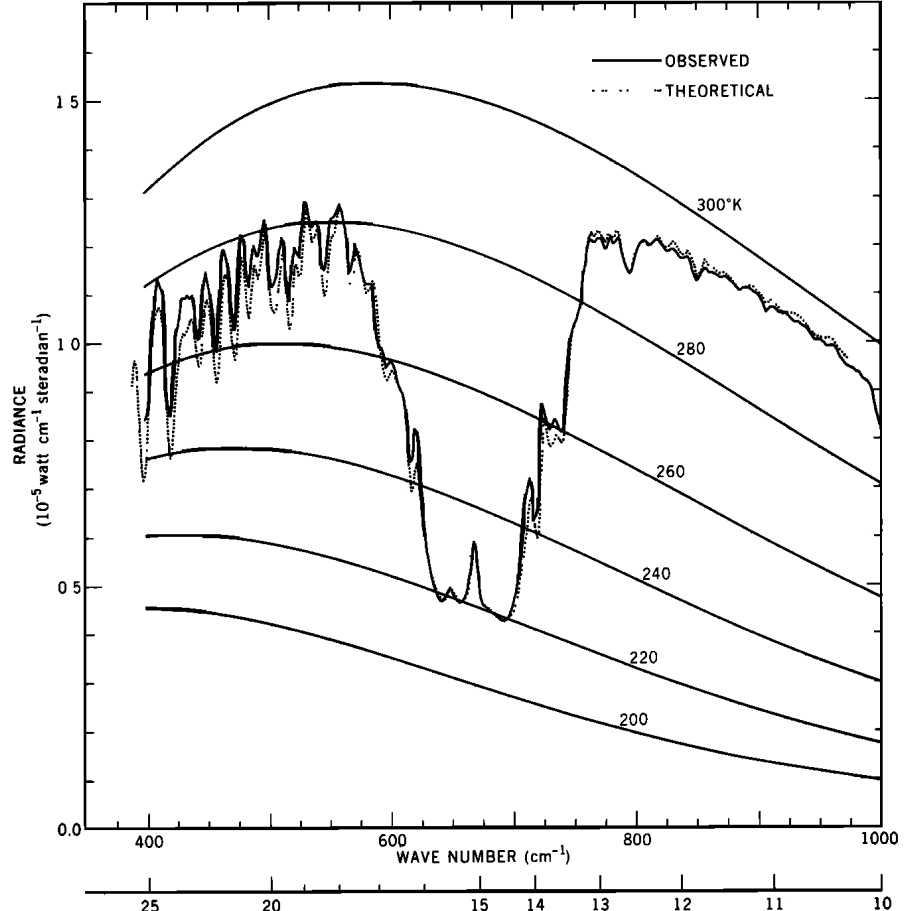
Or these (all 134,862 of them) from 2008:

Here is the preceding data binned by surface temperature (a) and latitude (b):

In contrast to the LBL models, which predict easilly discriminable data for clear comparison with reality, Rudmop's model does not predict any observable quantity. Rather, it only predicts a quantity that cannot be directly observed. That is, its only prediction is not falsifiable by direct observation.
It can be known to be wrong, however, because the LBL radiation models with their copious directly observable predictions, which are falsifiable but unfalsified, also make predictions about the value which is the sole prediction of Rudmop's model.
It is no wonder he wants to take his model before an uninformed public rather than to a group of experts in the field. It is hard to hoodwink those who know what they are talking about.
- Increasing CO2 has little to no effect
Rudmop at 00:09 AM on 25 February, 2017michael sweet,
In science, there is no benefit to be had by forcing the validity of a clearly presented model down the throat of other scientists. Science does not work by one scientist or a group of scientists forcing people to accept a clearly thought out model. My model is steeped in thermodynamics and KMT, as well as quantum mechanics. My model does not violate any of the laws, and it serves as an alternative answer to a model that has failed on its predictions. What is unique about it, is that it considers the climate soup we wallow in on the surface. It considers the direct and frequent measurements we take globally and precisely on our weather stations. My model has no need to consider downwelling and upwelling IR photons, because it uses the results of their influence on the climate to calculate the effect of CO2 as a greenhouse gas. So there is no need for me to give you two reasons or a hundred reasons of why I need to convince you to accept anything. I trust that you are a scientifically literate person. I trust if you know and understand the laws of Thermodynamics and Quantum Mechanics. You will be able to convince yourself of the validity of any scientific model that any scientist presents. When the science illiterates try to force their beliefs and views to force others to adopt these views, then they will lose any credibility they had hoped of having. True scientists don’t have beliefs and don’t have to force others to believe. True scientists also understand the potential of presenting a false model and expecting other scientists to dignify their credibility. As a scientist, all I have is a successful patent on a cleaner that is unique like no other, a science degree in Biology with a chemistry minor and a Master of Arts in Secondary Education. I am credentialed in the Life Sciences, Chemistry, Physics, the Geosciences and I have taught school for 26 years in subjects ranging from 7th grade life science to High School Advanced Placement Chemistry and Physics; Currently I teach Aerospace Engineering, 8th grade Physical Science, Physics and Advanced Placement Physics. Besides researching and learning the Standard Model of Particle Physics, and the probable working of Quantum mechanics, I enjoy reading science Journals that arrive from AAPT and ACS, of which I am a member. As well, I like to turn nuts and bolts in my free time. I enjoy fixing stuff when it breaks, like the plumbing, air conditioner and the mechanical stuff on my hybrid car. I’m simply saying besides being a professional in my field, I understand a bit about the world. - There's no correlation between CO2 and temperature
victorag@verizon.net at 05:34 AM on 22 August, 2016Before dealing with #95 I'd like to say that Tom Curtis's response is a good example of the sort of thing I am always hoping to find when discussing this issue, yet so rarely do. Tom sticks to his argument and his evidence with no need for sarcasm, condescension or ad hominems. That's much appreciated, so thank you.
"Saying that a "great many skeptics are in fact climate scientists", ie, that a large proportion of the class "AGW skeptic" are also members of the class "climate scientist" is absurd."
Sorry but that looks like a strawman. I never said anything about a "large proportion" — I said "a great many." Which is true. I'm sure you've seen this list before, but just in case. . .
"And even among the small number of climate scientists who are "skeptics", in most cases there exist clear evidence that suggests they are biased, ie, that they hold their "scientific" opinions for reasons that are primarilly political or religious."
My point regarding bias was that we are all biased to some extent. But as far as science is concerned, there is a powerful bias that must be acknowledged which can easily cause a researcher to overlook serious weaknesses in his own methods or arguments. While many skeptics have very obvious biases, if their arguments are sound, their bias can safely be ignored. So it's really better to focus on the arguments and go easy on the accusations of bias, as this really amounts to an ad hominem.
Do you really intend to assert that critics of a theory may assert any phenomenon to be contrary to the predictions of the theory they criticize with no burden of intellectual rigour placed on them to establish that fact? Seriously? If so, your use of a "burden of proof" argument amounts to intellectual legerdemain - a piece of rhetorical prestidigitation that allows you to declare circles are squares and darkness to be light.
No, not at all. Again you are setting up a straw man. Of course there is a burden of intellectual rigor. But that's not the same as burden of proof. In other words intellectual rigor is required, but it is not necessary for the skeptic to establish any fact. All that's needed is to demonstrate that there is a serious problem (a hidden assumption, an inconsistency, a misreading of data, etc.) with the theory being offered.
". . . logically, the claim that "GMST did not follow the predicted path given AGW" is also a theory." Again: no, not at all. A critique is not a theory. The critic may have a theory of his own, but that's beside the point. Peer review would be impossible if the reviewer needed to establish his own theory before critiqueing someone's paper.
Stephin Minhinnick's argume (which I do not accept in any event) specifically relates to the proposition of entities, and the ontologies of climate scientists and (at least well informed) "skeptics" is the same, at least as regards the climate. Neither proposes a distinct set of entities, be it form of radiation, or unusual subatomic particles, or whatever. The only way that you can take Minhinnick's argument to be relevant is if we count abstractions such as trends as being entities.
The passages I quoted are statements regarding basic principles of science that are universally applicable. The examples provided pertain to entities, but can obviously be extended to theories of any sort. In any case, the usual AGW argument can be understood as existential and I've read many times assertions that it "really exists," that "climate change is real" and so on. How is that different, in principle, from the assertion that leprechauns are real?
Specifically, AGW proponents propose an underlying linear trend over the period 1975-1997 which continues thereafter, while the "skeptics" propose the existence of a new trend from 1998 onwards. And on that basis, they have singularly failed the burden of proof of showing a new underlyng trend.
Skeptics need not show a new underlying trend. All that's required is to demonstrate the lack of continuity between the strong upward trend so evident from the late seventies to ca. 1998 and what followed during the following 15 years or so. If the first period appeared to demonstrate a correlation between CO2 and warming, the second period demonstrated the falsity of that assumption. CO2 levels continued to soar while the increase in temperatures slowed considerably. If the relationship is exponential, as has been asserted, then why wouldn't that relationship continue even more convincingly into the 21st century? There is a difference between questioning an assertion and developing a whole new theory that contradicts it. A new theory isn't necessary. The burden of proof is on the person insisting that the correlation is real in the face of what looks like contradictory evidence.
You appear to imply that because the "skeptic" rhetoric regarding the purported "pause" has been refuted multiple times, and in several different ways, that of itself refutes the multiple refutations.
The many papers attempting to explain away the pause were prompted largely by questions raised in the field of climate science itself, not as a response to skeptics. If the later papers managed to replicate the findings of the earlier ones then that would have constituted significant evidence that the mainstream view is sound. But that's not what happened. The later papers either discovered weaknesses in the earlier ones that they attempted to correct, or else simply ignored the earlier attempts in favor of some new wrinkle. Finally, after the adjustments made by Karl et al., many of the numbers used by the earlier researchers were no longer valid, apparently, thus undermining the earlier research. Now if that research were sound it could not have so easily been undermined, no?
- There's no correlation between CO2 and temperature
victorag@verizon.net at 02:35 AM on 22 August, 2016Before dealing with #95 I'd like to say that Tom Curtis's response is a good example of the sort of thing I am always hoping to find when discussing this issue, yet so rarely do. Tom sticks to his argument and his evidence with no need for sarcasm, condescension or ad hominems. That's much appreciated, so thank you.
"Saying that a "great many skeptics are in fact climate scientists", ie, that a large proportion of the class "AGW skeptic" are also members of the class "climate scientist" is absurd."
Sorry but that looks like a strawman. I never said anything about a "large proportion" — I said "a great many." Which is true. I'm sure you've seen this list before, but just in case. . .
"And even among the small number of climate scientists who are "skeptics", in most cases there exist clear evidence that suggests they are biased, ie, that they hold their "scientific" opinions for reasons that are primarilly political or religious."
My point regarding bias was that we are all biased to some extent. But as far as science is concerned, there is a powerful bias that must be acknowledged which can easily cause a researcher to overlook serious weaknesses in his own methods or arguments. While many skeptics have very obvious biases, if their arguments are sound, their bias can safely be ignored. So it's really better to focus on the arguments and go easy on the accusations of bias, as this really amounts to an ad hominem.
Do you really intend to assert that critics of a theory may assert any phenomenon to be contrary to the predictions of the theory they criticize with no burden of intellectual rigour placed on them to establish that fact? Seriously? If so, your use of a "burden of proof" argument amounts to intellectual legerdemain - a piece of rhetorical prestidigitation that allows you to declare circles are squares and darkness to be light.
No, not at all. Again you are setting up a straw man. Of course there is a burden of intellectual rigor. But that's not the same as burden of proof. In other words intellectual rigor is required, but it is not necessary for the skeptic to establish any fact. All that's needed is to demonstrate that there is a serious problem (a hidden assumption, an inconsistency, a misreading of data, etc.) with the theory being offered.
". . . logically, the claim that "GMST did not follow the predicted path given AGW" is also a theory." Again: no, not at all. A critique is not a theory. The critic may have a theory of his own, but that's beside the point. Peer review would be impossible if the reviewer needed to establish his own theory before critiqueing someone's paper.
Stephin Minhinnick's argume (which I do not accept in any event) specifically relates to the proposition of entities, and the ontologies of climate scientists and (at least well informed) "skeptics" is the same, at least as regards the climate. Neither proposes a distinct set of entities, be it form of radiation, or unusual subatomic particles, or whatever. The only way that you can take Minhinnick's argument to be relevant is if we count abstractions such as trends as being entities.
The passages I quoted are statements regarding basic principles of science that are universally applicable. The examples provided pertain to entities, but can obviously be extended to theories of any sort. In any case, the usual AGW argument can be understood as existential and I've read many times assertions that it "really exists," that "climate change is real" and so on. How is that different, in principle, from the assertion that leprechauns are real?
Specifically, AGW proponents propose an underlying linear trend over the period 1975-1997 which continues thereafter, while the "skeptics" propose the existence of a new trend from 1998 onwards. And on that basis, they have singularly failed the burden of proof of showing a new underlyng trend.
Skeptics need not show a new underlying trend. All that's required is to demonstrate the lack of continuity between the strong upward trend so evident from the late seventies to ca. 1998 and what followed during the following 15 years or so. If the first period appeared to demonstrate a correlation between CO2 and warming, the second period demonstrated the falsity of that assumption. CO2 levels continued to soar while the increase in temperatures slowed considerably. If the relationship is exponential, as has been asserted, then why wouldn't that relationship continue even more convincingly into the 21st century? There is a difference between questioning an assertion and developing a whole new theory that contradicts it. A new theory isn't necessary. The burden of proof is on the person insisting that the correlation is real in the face of what looks like contradictory evidence.
You appear to imply that because the "skeptic" rhetoric regarding the purported "pause" has been refuted multiple times, and in several different ways, that of itself refutes the multiple refutations.
The many papers attempting to explain away the pause were prompted largely by questions raised in the field of climate science itself, not as a response to skeptics. If the later papers managed to replicate the findings of the earlier ones then that would have constituted significant evidence that the mainstream view is sound. But that's not what happened. The later papers either discovered weaknesses in the earlier ones that they attempted to correct, or else simply ignored the earlier attempts in favor of some new wrinkle. Finally, after the adjustments made by Karl et al., many of the numbers used by the earlier researchers were no longer valid, apparently, thus undermining the earlier research. Now if that research were sound it could not have so easily been undermined, no?
- There's no correlation between CO2 and temperature
Tom Curtis at 21:58 PM on 21 August, 2016victorag @87:
"A great many skeptics are in fact climate scientists..."
Passing over the assumption that "skeptics" are in fact skeptical, rather dogmatically oppositional, surely you have mistated your position. First, and this should be very clear from any excursion to WUWT, the vast majority of "skeptics" have neither qualifications in, nor understanding of climate science. Saying that a "great many skeptics are in fact climate scientists", ie, that a large proportion of the class "AGW skeptic" are also members of the class "climate scientist" is absurd.
I assume you merely mispoke, and intended to say that "a great many climate scientists are 'skeptics'". Even there you are on very shaky ground. Based on surveys of climate scientists, at most 15% and more likely << 10% of climate scientists hold a "skeptical" position on AGW. Among publishing climate scientists, by self assessment only 2.4% of climate scientists thought there published work rejected AGW (see Table 4). So, at best, a very small minority of climates scientists are "skeptics" - sufficiently small that their views cannot be taken as representative of climate science.
And even among the small number of climate scientists who are "skeptics", in most cases there exist clear evidence that suggests they are biased, ie, that they hold their "scientific" opinions for reasons that are primarilly political or religious. A significant proportion of them, for instance, are employed by right wing political think tanks, or have published for or spoken at conferences for such think tanks. Indeed, one of the most noteworthy "skeptical" climate scientists has declared that, "I view my job a little like a legislator, supported by the taxpayer, to protect the interests of the taxpayer and to minimize the role of government", a declaration tantamount to saying that as a matter of principle he will distort the science for political ends.
"However, we must recognize that, as far as science is concerned, there is an asymmetric relation between someone who offers an hypothesis and someone who critiques it. The burden of proof is on the person offering the theory, not the critic."
My criticism of the "skeptic's" discussion of the "pause" was that they incorrectly stated the predictions of AGW, and that the responses that you considered to be akin to cherry picking merely established what AGW actually predicted over the relevant interval, and thereby showed that the actual temperature records followed what was expected from the theory. Given that I am flabberghasted by your response. Do you really intend to assert that critics of a theory may assert any phenomenon to be contrary to the predictions of the theory they criticize with no burden of intellectual rigour placed on them to establish that fact? Seriously? If so, your use of a "burden of proof" argument amounts to intellectual legerdemain - a piece of rhetorical prestidigitation that allows you to declare circles are squares and darkness to be light. Even if the " ...burden of proof is on the person offering the theory", that would be completely irrelevant to the case under discussion.
As it happens, even in more general contexts, your principle is useless. That is because, logically, the claim that "GMST did not follow the predicted path given AGW" is also a theory. If a burden of proof applies to those proposing theories, than a proponent of this view has a burden of proof to demonstrate to things, ie, the predicted GMST temperature trend given AGW; and that GMST did not follow that path.
You attempt to support your dictum with a quote @90 from comuter scientist, Stephen Minhinnick. Event there, however, you go awry. Stephin Minhinnick's argume (which I do not accept in any event) specifically relates to the proposition of entities, and the ontologies of climate scientists and (at least well informed) "skeptics" is the same, at least as regards the climate. Neither proposes a distinct set of entities, be it form of radiation, or unusual subatomic particles, or whatever. The only way that you can take Minhinnick's argument to be relevant is if we count abstractions such as trends as being entities. But if we do that, it is the AGW "skeptics" who are proposing an additional entitity. Specifically, AGW proponents propose an underlying linear trend over the period 1975-1997 which continues thereafter, while the "skeptics" propose the existence of a new trend from 1998 onwards. And on that basis, they have singularly failed the burden of proof of showing a new underlyng trend.
"To be perfectly clear: the theory in question is the theory that CO2 emissions due to the burning of fossil fuels have been warming the earth steadily over a long time period and as a result placing the world in grave danger. The so-called "hiatus" is an attempt to refute this theory by calling attention to a certain body of data that seems inconsistent with it. Promoters of the hiatus need not offer a counter-theory. All they need to do is demonstrate a serious inconsistency in the "climate change" theory."
(My emphasis)
And now, apparently, we are in aggreement, except you exempt the "skeptics" from actually having to make the demonstration of inconsistency, which requires not only demonstrating the post 1998 temperature record, but also demonstrating the actual prediction of AGW (not just the projections). And once again, demonstrating that the "skeptics" have not undertaken their task with any intellectual rigour is not akin to cherry picking.
"The most recent "pause buster," by Karl et al., adjusted the data in such a way as to render literally all these studies superfluous, which should have been a huge embarrassment to the mainstream climate science world, but has on the contraty been accepted with enthusiasm simply because it appears to do the job more convincingly."
First, and most obviously, Karl et al discusses just one temperature data set, and therefore cannot render analyses of other datasets superfluos. Second, you are not entitled to assume that a reworking of (for example), Foster and Rahmstorf using the latest temperature products would not show an accelerating temperature trend. All you can say from the update of the temperature series is that the former studies are not dated, not that they are superfluos (ie, that repeating the studies would not impact our understanding, or demonstrate any underlying trend greater than the revised temperature trends from Karl et al). Again your argument suggest to me rhetorical legerdemain. You appear to imply that because the "skeptic" rhetoric regarding the purported "pause" has been refuted multiple times, and in several different ways, that of itself refutes the multiple refutations. It is only conspiracy theorests and pseudoscientists who think there theory is confirmed by the mounting of evidence against it.
- CERN CLOUD experiment proved cosmic rays are causing global warming
MA Rodger at 21:14 PM on 2 August, 2016ArronS @12.
Do you not feel it is exceedingly presumptive of you to ask me, while examining your "abundant literature" on this subject of Svensmark's cosmic-ray conjecture, whether I have "addressed the new Nature paper"? Do you not realise that you had until now entirely failed to include this paper in your listing of "abundant literature"? And am I not disputing the existance of such an "abundant literature" and disputing your inclusion of papers you have so far listed? I am thus hardily the one who would know what you would or would not choose to include in your "abundant literature"!!
This particular paper Kirkby et al (2016) 'Ion-induced nucleation of pure biogenic particles' does follow on from papers addressed in the Original Post so comment on this new paper's relevance could be requested from the OP authors.
And if you do wish to include it in your list of "abundant literature", I would not go jumping to conclusions. In a Nature News item you will note Kirkby tells us of the results:-
"The latest experiments suggest that it may have been cloudier in pre-industrial times than previously thought. If this is so, then the masking effect, and in turn the warming effects of carbon dioxide, might have been overestimated, ... (but) ... itis too early to say whether this is true in practice, or by how much, because there are so many factors that play into such projections,"
And that comment is from one who in the past was supportive of Svensmark's conjecture. (The apperance in the paper's references of Kirkby (2007) 'Cosmic-rays & climate.' is indicative that the situation continues.) The other comment in the same Nature News item (from Knutti) says that the results will probably not affect the most likely projections of warming, as laid out by the Intergovernmental Panel on Climate Change. "Our best estimate is probably still the same," he says.
Regarding your various confusions w.r.t. Steinhilber et al (2012), you first confusion concerns quotes from the conclusions of their paper. Identifying how they reach such conclusions may be worth your consideration. Note that the word "significant" is used in a statistical sense & the word "remarkable" may be used more in its original less-sensational sense, meaning 'something worthy of remark'. Your second confusion appears to show you do not truly understand the first sentence of the Steinhilber et al (2012) abstract (You helpfully quote it @13.) which is perhaps clearer than my chosen quote from the paper. And just to be totally clear, the concensus view is that cosmic rays do not impact greatly on climate. The Steinhilber et al. position is that cosmic radiation proxies can be used also as proxies for solar magnetism and so in turn as proxies for TSI. Note this is the first three items in your causal chain @9 but backwards. Increase in solar activity-> stronger magnetic field -> less CR -> Less high albedo clouds -> more irradiance and warmer earth. The final two items are entirely absent (even by implication) from Steinhilber et al (2012) and thus their position represents a concensus position. The position presented by Tsonis et al (2015) is different: that a cosmic ray effect does exist which isn't yet addressed by climate modelling but that it is importantly not responsible for the recent global warming. A third position which is the one you appear presently signed-up to is the Svensmark conjecture that asserts that a major portion of the recent global warming results from cosmic-ray variations.
Concerning Tsonis et al (2015), the links @10 are presented for completeness & are in themselves of no great importance. Regarding Tsonis & Swanson, their seemingly-never-ending publications on what developed into their 'synchronised coupling' model of climate perhaps has apparently and thankfully ended with Tsonis & Swanson (2012). I feel that "dodgy" a reasonable description of it. If I address "character" it is the character of their writings not their persons so you high horse has no place here.
Concerning TSI since 1900, you wrote @9:-
"the last century stands out as one of 2 major increases in solar activity based on the isotope data, and is exceptional in the AA index, and SSN. You are probably confused about the duration of the trend becasue it is true that the last decade the sun's activity has dropped."
Unless you want to revise it, this statement very clearly implies you see a "trend" which is "one of 2 major increases in solar activity" lasting a century. You may not feel a century-long rise is much different to six decades of rise & four decades of slight decline, but the arbitor in this is the global climate and for the climate, the difference would be stark indeed.
- Republicans' favorite climate chart has some serious problems
Tom Curtis at 13:50 PM on 21 February, 2016FrankShann @3, in logical terms, a set of propositions, x, predicts another set of propositions, y, if and only if y can be logically deduced from x. This is the fundamental relationship that underlies all explanation. Of course, sometimes we are not able to predict events from a set of propositions, but only the statistical distribution in which the event lies, or in other words, the probability of its occurence. Being human, we will often claim that something "explains" something else, when it only explains why the event is highly probable - but that does not alter the fact that fundamentally, explanation is logical deduction.
The sole difference between prediction and retrodiction is that the former is explanation before the event, and the later is explanation after the event. Logically, this is irrelevant to how impressive the explanation is. One explanation is superior to the other based on simplicity (ie, the number of entities and relationships invoked), the preciseness of the conclusion of the successful deduction, and a priori probability of the premises. Nothing else, including the time it was made, enters into the fact. We are not less impressed by Newton's deduction of Galilean kinematics from his laws of motion, nor of Keppler's laws of planetary motion from his laws of motion plus the law of universal gravitation because they were after the event - and nor should we be.
The reason we are suspicious of retrodiction is the suspicion that they are ad hoc, ie, that they relly on premises added after the event to make the prediction fit, and at the cost of the simplicity of the premises used. However, the inclussion of ad hoc premises can be tested for either before or after the event. Therefore, provided we exclude ad hoc premises, prediction is no better in a scientific theory than retrodiction. Indeed, that is necessarilly the case in science. Otherwise we would need to preffer a theory that made correct predictions into the future but entirely failed to retrodict past observations over a theory that both predicted and retrodicted past and future observations with a very high degree of accuracy but occasional failures. Indeed, as we cannot know in advance future success, science is built on the principle that successful retrodiction in the best guide to successful prediction.
Given the above, your suspicions of CMIP5 models is based on an assumption that the change between them and earlier models is from the addition of ad hoc premises. That is in fact contrary to the case. The earliest climate models, due to lacking perfect resolution, needed ad hoc adjustments to close the energy budget. They needed ad hoc values for the rate of heat absorption by the ocean because they did not model the ocean. The very earliest models required ad hoc assumptions about the ratio of increase of different GHG because they did not have the capacity to model all GHG. As computer power has been improved, these ad hoc assumptions have been progressively removed. In terms of the elegance of prediction, CMIP5 models are vastly preferrable to the older models - but that is the crucial criteria.
If we prefer the predictions of Hansen (88) as a test of the validity of climate science - we are being unscientific. The model used in Hansen (88) did not include aerosols, did not include all GHGs, used a swamp ocean, did not include a stratosphere, and was not able to be run enough to generate an ensemble of predictions (a necessary feature for generating the probabilistic predictions of climate). In short, it was a massively ad hoc model, especially when compared to its modern incarnation. Therefore, if we are interested in science rather than rhetoric, the successful retrodiction by CMIP 5 models should impress us more than successful (or unsuccessful) predictions of Hansen (88).
Nor is the development from more use of ad hoc premises to less either unusual or a problem in science. In fact it is typical. Newton started predicting the motion of planets using the ad hoc premise that planets were point masses. Later that was improved upon by the ad hoc premise that planets were empty shells with all their mass distributed evenly at their surface. Only as computational power and mathematical techniques have improved has it become possible to model planets as genuine 3-D objects with variable mass concentrations in Newton's theory. This was not a basis of rational criticism of Newton's theory, and nor is the primitive nature of the model used in Hansen (88) a valid criticism of climate science. But just as we would not prefer continuing to use point masses in prediction in gravitation, nor should we preffer the predictions of Hansen (88) over the retrodictions of CMIP5.
- It's cooling
Tom Curtis at 10:35 AM on 31 October, 2015A Real Skeptic would note that if you wish to test a theory, you test whether the data falls within the uncertainty range of the prediction. If you did so for the last 18 years to date (Sept 2015) on GISTEMP, you would find a trend of 0.118 +/- 0.104 C/decade, giving an upper bound (0.222 C/decade) that includes the model predictions but a lower bound that excludes the possibility of a zero or negative trend. Ergo the model predictions have not been falsified.
It might be claimed that the HadCRUT4 trend (0.079 +/- 0.105 C/decade) falsifies the model predictions, but a Real Skeptic would realize that:
1) HadCRUT4 is not a global index, as it excludes the Arctic (plus parts of Africa and Asia), so the correct comparison would be with a HadCRUT4 mask of the model predictions (which I do not have available);
2) That cherry picking a year in which annual variations have lifted the temperatures well above the trend variation at the time as the start point (such as 1997 or 1998) distorts the statistics, so that the normal statistical test will generate a excess of false negatives relative to the standard case; and
3) That even apart from such distortions, 5% of "failed" statistical results will be false negatives (of which 2.5% will be false negatives showing to low a trend).
Therefore a Real Skeptic would always apply their test across a range of years and compare the resulting PDF to the prediction, rather than just using a small number of cherry picked starting points. Doing this clearly shows the predictions to have not yet been falsified.
Finally, a Real Skeptic would know that the shortest period referred to as a climate normal is 20 years, and the typical period is 30 years. Therefore they would never use less than a 20 year period to test a climate prediction. They would recognize the attempts to use 15 year periods (three years ago) growing up to 18 years (now, so as to carefully keep 1998 as the start year) represent carefull propaganda rather than actual analysis of the climate trend against the climate prediction.
- The UK winter of 2014-15: another Tabloid FAIL
One Planet Only Forever at 00:53 AM on 29 March, 2015The sensationalized regional forecasts of what could happen more than a few days into the future are indeed a problem. They lead some people to believe that the difficulty in predicting such things must mean there is no way anyone can reliably model the future global climate.
This potential to develop misunderstanding, or mistrust, of the ability to model forecasts of global climate may be the motive behind some of the Tabloid nonsense, especially by Tabloids owned by deliberate disbelievers of climate science like Murdoch.
Another consequence of the poorly substantiated sensationalized 'predictions' is the association of those 'failed' predictions with other important climate forecasting that has the potential to be correct and require preventative measures to be implemented 'just in case'. A good example was the recent potential massive Blizzard event predicted for New York city. The storm track was further east than it might have been and as a result Boston and other locations got walloped in the way that New York might have been. The fact that New York was spared was seen by many to be proof of unnecessary sensationalizing of what might have happened. That attitude in a population is what leads to tragedies like Katrina where many people were left at risk in a city that was at serious risk because of a lack of interest in making the changes and improvements identified the last time a big hurricane hit the region because "it might not really be all that bad again soon". In advance of Katrina the residents of New Orleans understood that the freeway system not being elevated all the way through the city was a major concern, and indeed they were correct. And the city did not have any plans to move the poor who had no where to go and no way to get there.
Not all of these sensationalized predictions will be failures. And New Orleans would have suffered worse if the eye of Katrina and tracked west of the track it actually followed, just as New York was fortunate the Blizzard storm track was not further west than it ended up.
It is important to differentiate between the reliability of near term regional forecasts, especially the potential variability of storm tracks as little as one day in advance, from the more absured claims made about the regional expected weather more than one week into the future. And whenever that clarification of understanding is presented the completely different reliablity of global climate forecasting of general conditions averaged over many years should be mentioned. More people need to understand that the average contitions in the future can be very reliably forecast, in spite of the variability of the accuracy of near term regional forecasts.
- Consensus and geoengineering - how to convince people about global warming
wili at 02:31 AM on 12 March, 2015Others more knowledgable than I can pitch in if they wish, but my understanding is that predictions of future GW are based on three things: Basic physics (the asborptions spectrum of CO2 and CH4...);
Paleo-climate studies (how the earth has responded to increases in GHG levels in the past); and
Climate Models of various sorts.
Pseudo-skeptics love to reduce this to the just the last, and usually just one of the last points, and then pick apart how one particular model has 'failed,' even though no model can be 100% accurate, or it wouldn't be a model--it would be reality.
- Climatology versus Pseudoscience book tests whose predictions have been right
BBHY at 23:39 PM on 25 February, 2015Thank you for writing this book. I have read so many, many predictions of the "coming mini ice age", etc from the like of Joe Bastardi and many others. They get a lot of play in the media, but it seems that nobody ever comes back later and confronts them with these failed predictions after we have yet another Earth's hottest year.
- 2014 SkS Weekly News Roundup #43B
Tom Curtis at 20:50 PM on 27 October, 2014nigelj @31, I think you have misunderstood what I was trying to say about ECS, although the fault lies in my poor expression. Consider the following Probability Density Function for ECS:

It is a log normal distribution with characteristics matched to fit the IPCC AR5 information for the probabilities of different values. That is, there is a less than 5% chance of an ECS less than or equal to 1 (actually, 3.71%), an at least 66% chance of an ECS between 1.5 and 4.5 (66.64%), and a less than 10% chance of an ECS greater than or equal to 6 (7.87%). It is very close to a best fit PDF for the IPCC values and may reasonably be taken as representing the IPCC AR5 PDF for ECS. Out of interest, it has a mode of 1.99 C per doubling, a median of 2.72 C per doubling, and a mean of 3.18 C per doubling. Its 95% range is 0.91-8.15, and its 90% range is from 1.08 to 6.83.
My point is that substantial evidence and carefull consideration of that evidence has gone into that PDF. A theory that proposes a PDF very greatly different from it, therefore, is likely to be in conflict with much of that evidence and hence not emperically supported. This does not rule out alternative estimates. Lewis and Curry (2014), for example, estimates a mode of 1.64 C per doubling, and a 90% range of 1.05-4.05 C per doubling. So while there are a number of indentifiable flaws in that paper, all (as it happens) lowering the estimated ECS, we cannot look at that estimate and say it is absurd because it differs too much from the IPCC estimate and "the science is settled".
In contrast, however, if we see estimates of 0.2 C per doubling (Eschenbach, WUWT), 0.67 C per doubling (Bjornbom 2013), or 0.39 C (Hockey Schtick misinterpretation of Levitus 2012), we can reasonably dismiss them on the grounds that the science of climate sensitivity is sufficiently settled to exclude such radical outliers. A specialist discussing the issues could not be so dismissive, needing to actually identify errors in the estimates (which is in general trivially easy to do). But for those estimates to be right, too many other reasonable estimates have to be too radically wrong. Ergo we would require something more than a blog post from somebody known to not understand the science (Eschenbach) or a misinterpretation of TOA net radiative flux with radiative forcing (Hockey Schtick) to reject that other evidence.
I note a similar issue applies with respect to Relativity, and Quantum Mechanics (a point you failed to note). Underlying theories can be radically revised, but the predictions of the new theory must almost exactly match the predictions of the old theory under the range of normal (for middle size organic being) conditions. If they did not, the new theory would be refuted by the very observations that were previously thought to support the old theory. Thus, while theories are always in flux, and may always be supplanted, they will always provide good approximations to the results of the supplanting theories accross the range of normal conditions. It is for that reason when NASA designed the grand tour of the solar system with Voyagers 1 and 2, they used Newtonian dynamics rather than General Relativity. In essence, for any well developed theory, the theory itself may be in flux, but its predictions, ie, its actual scientific content, to a close approximation and across the range of conditions under which it was first successfully tested, are settled. Ergo, if radiative physics were overturned tomorrow, we know that the new theory that supplanted it would still predict an atmospheric greenhouse effect.
- 2014 SkS Weekly Digest #39
Russ R. at 00:35 AM on 30 September, 2014Tom Curtis,\
Sticking to climate change related matters, you failed to notice the implied timeline... "a generation ago" implies < 50 years.
Even the most dire predictions of sea level rise for the next 50 years are in the order of centimeters.
- 97 hours of consensus: caricatures and quotes from 97 scientists
Tom Curtis at 10:58 AM on 16 September, 2014dhf @51, you have been caught out arguing from a clearly false premise, whose only support has been your mere assertion. It would be nice of you to acknowledge that your premise was in fact false, and has now been comprehensively refuted. Merely picking an isolated sentence as a bridge to an urelated rhetorical sally is evasive and shows further discussion with you to probably be unfruitful.
For what it is worth, while testing calibration is a useful test on theories, it often involves subtleties that require expert knowledge to understand, and hence it is not true that layman can check calibrations without detailed research. In particular, the nearest analog of "calibration" in climate science is validation of models, which is a very complex subject. In particular, it involves assessing the interplay of probabilities of multiple factors which are not independent; the ability to assess the significance of scale issues; and the ability to assess the relevance of timing of short term variable events such as ENSO (which because chaotic, can be reproduced statistically in models, but not with regard to exact timing and magnitude of particular events).
The denier strategy has been to simplify that complexity by focusing on just one variable (GMST) over a cherry picked interval (typically 1998 forward) and to declare the "instruments" to have failed because GMST almost drops out of the uncertainty range. They frequently claim that it has dropped out of the uncertainty range by treating 1998 (which almost exceeded the uncertainty range) as a mean value thereby offseting the temperatures relative to model predictions.
Further, nearly all of the purported model/observation discrepancy on GMST vanishes if models are contrained (either by selection or by constrained responses in the ENSO region) to match actual ENSO fluctuations. That is easilly demonstrable by a number of means, the simplest of which is simply taking trends of La Nina, neutral, and El Nino years seperately; and hence should not be subject to dispute. AGW deniers, however, simply ignore it as a factor in an approach best described as dishonest.
These approachs are not scientific. They are pseudo-scientific.
They are also not on topic on this thread.
What is on topic is your apparent claim that these "calibrations" can be easilly performed by laymen, but apparently have escaped the experts notice. Sorry, I see no point in debating such absurdities.
- Nigel Lawson suggests he's not a skeptic, proceeds to deny global warming
Ken in Oz at 12:15 PM on 29 July, 2014Two communications problems -
Surface air temperatures as the measure of global warming. I think heat content is a more direct measure of actual change to the climate system, with a trend showing less variability. I'm interested to know how much variability within heat content estimates and what physical processes drive it.
The broad misunderstandings tha projections/predictions based on an average of many models and model runs where reality will look like some of the model runs but will never look like that smoothed average. The expectation that failure of reality to follow that smooth average is portrayed as a failure of reality to follow prediction. I understand about short term variation vs longer term trend, but arguments such as Lawson use only work because it's not broadly understood.
I understand reality will look most like the model runs that put oscillations like ENSO in the right places but for most people, who get their information via media interpretations that may or may not include biases as well as simple failure of journalists to be well informed, the idea of "IPCC prediction" that has "failed" can look compelling. I like the analogy of the "prediction" of summer being warmer than winter based on an planetary tilt theory having a smooth transition, one day warmer than the one before, and a cool few weeks in spring 'proving' the prediction and theory is wrong... is clearly wrong - but analogy is less than best and only works in some contexts, such as a lecture without the media's requirements for brief (one or two lines) and clear and unambiguous content.
As an aside, how do models include oscillations like ENSO? Random but bounded by statistical likelihoods of strength, duration and change?
- Climate models accurately predicted global warming when reflecting natural ocean cycles
Mammal_E at 02:33 AM on 25 July, 2014What the comments on this post highlight is the difficulty in our brains coming to grips with two very distinct aspects of modeling climate (or any dynamic system):
1) The conceptual and quantitative understanding of mechanism
2) Assumptions about future states that contribute to the quantity being modeled.
Both have to hold true in order to make skillful predictions about future conditions, especially in the short term when essentially random factors can hold sway. Mismatch between predictions and observed conditions (assuming the observations are reliable — that's another topic) can derive from failures of 1) or 2), but 1) is the component that science is most interested in, and is most relevant to long-term prediction. Therefore, to assess the strength of our understanding, we need to figure out how much of the mismatch can be attributed to 2).
Here's an example:As I understand it, my bank balance changes according to this equation:
change in balance = pay + other income - expenses
I can predict how my bank balance will change in the future if I assume some things that are pretty well understood (my monthly paycheck, typical seasonal utility bills, etc.). However, some aspects of the future are random (unexpected car repairs, warm/cool spells affecting utility bills, etc.) — these cannot be predicted specifically but their statistical properties can be estimated (e.g., average & variance of car repair bills by year, etc.) to yield a stochastic rather than deterministic forecast. Also, I could get an unexpected pay raise (ha!), need to help my brother out financially, etc. All of these factors can generate mismatch between predicted changes in the balance and what actually happens.
But (and here's the important bit): that mismatch does not mean that my mechanistic understanding of the system is faulty, because it stems entirely from item 2). How can I demonstrate that? Well, if I plug the actual values of income & expenses into the equation above it yields a perfect match (hindcasting). Alternatively, (as was done by Risbey et al), I could select those stochastic forecasts that happened to get income and expense values close to what actually occurred, and find that the forecasts of those runs are close to the actual change in my balance.
Examining these runs is not "cherry picking" in any sense of the word, it is a necessary step to separate out the effects of items 1) and 2) on model-data mismatch. If these tests failed, that would imply that my understanding is faulty: some other source of gain or loss must be operating. Perhaps a bank employee is skimming?
Climate forecasts are necessarily much less precise than my personal economic forecasts, because the system is observed with error and because many more inputs are involved that interact in complicated, nonlinear, spatially explicit ways. But the logic involved is the same.
- Global warming and the vulnerability of Greenland's ice sheet
dr2chase at 22:29 PM on 31 May, 2014The problem with the IPCC reports is that they are biased to be too conservative. If they were literally, mathematically unbiased, half the time they would hit high, half the time they would hit low. We don't see that. Three obvious reasons are that humans tend to be biased in the conservative direction, the scientific process is biased in the conservative direction (default assumption is that nothing new is happening), and that for reasons of credibility in the face of "skeptics", I think the IPCC attempts to never overpredict. This sort of cascaded filtering is nothing new; there are examples of companies that failed because a CEO inclined to "shoot the messenger" successfully created his own little bubble of misinformation, till reality intruded.
But if the IPCC was literally and accurately unbiased, about half their predictions would fall short as new data arrived. There's things where we can look and say "that won't happen" — we know the ice caps won't melt quickly in place, because physics tells us so pretty directly. But otherwise, it would be nice to see predictions that were based on sound science, yet not artificially muted by pervasive conservatism. (I assume this is what we're getting from Hansen, which is why he sounds so much more alarmed than the IPCC.)
- Global warming theory isn't falsifiable
KR at 08:28 AM on 3 March, 2014PanicBusiness - You have been referring to GCMs and falsifiability; this is however an inappropriate terminology. Global circulation models are simulations of physics, evaluations of how those physics and the climate state might evolve over time, but they are not in themselves either hypotheses or theories.
GCMs are models, and models in general are always 'wrong' in that they do not contain the entirety of the physics, the details, and in that there will always be errors. The question with models is whether or not they are useful. It may very well be that the current generation of GCMs are incomplete in aspects of the climate that make them inaccurate - insufficient accounting for variability or modes thereof, or (as in the case of many models) run with inaccurate forcings or temperatures. There's certainly a significant literature pointing in that direction, as with England et al 2014 wrt variability or Contan and Way 2014 wrt temperature measures.
The only judgement you can make based solely on model output is whether or not they are accurate enough to be useful.
Global warming theory and the anthropogenic influence, on the other hand, is entirely falsifiable. Predictions include night warming faster than day, winter warming faster than summer, warming troposphere and cooling stratosphere, polar amplification, the changes in top of atmosphere forcings with changing GHGs, the sum climate energy increase as seen in ocean heat content, etc. If these predictions failed, there would be evidence against the theories.
Those predictions have, however, been validated within the limits of the data available - while falsifiable, they have not been. And you have not been discussing the theories themselves in any fashion whatsoever.
- Why rainbows and oil slicks help to show the greenhouse effect
joeygoze9259 at 08:56 AM on 5 February, 2014chriskoz@18
If you want to argue on who is parsing words, the predictions made in 2007, 2008, and 2009 I was taking from Al Gore so if he failed to use the words "if the trend continues", I would correct your statement to say it was "simple and primative distortion of the scientific literature by alarmists" That "moronic slogan" was repeated by Al Gore, John Kerry and even as late as March of 2013, Paul Beckwith from the Sierra Club when he wrote "“For the record—I do not think that any sea ice will survive this summer (2013). An event unprecedented in human history is today, this very moment, transpiring in the Arctic Ocean." Italics is added to refer to the year he is speaking about.
My issue with the above article is the characterization that the denial of a greenhouse effect existing at all is mainstream argument. That is simply not true. No one from any side of this discussion in the mainstream is arguing that CO2 can not trap heat or that No greenhouse effect exists. If there was NO greenhouse effect, then the Earth would be very inhospitable place to live.
- How to use short timeframes to distort reality: a guide to cherrypicking
Esop at 08:53 AM on 26 September, 2013The deniers have painted themselves into a corner, but the sad thing is that the can say/predict basically anything they want and the media will not report on it when denier predictions fail miserably, a year or two later. Remember all the hoopla over the sea level back in 2011? So when sea level rise accelerated again, could we read about failed denier predictions in the major papers? No. Same thing will happen when we beat the 2012 minimum, likely within 3 years from now. Deniers won't be questioned about the recovery that they were screaming about in 13'. Rather, they will be able to claim that the new record is due to a natural cycle and that they had predicted the record years ago. The major press won't ask a single difficult question. Sad state of affairs.
- Latest myth from the Mail on Sunday on Arctic ice
Esop at 04:35 AM on 19 September, 2013The deniers could not resist painting themselves into a corner with regards to this years uptick in minimum extent. The great thing about that is that the mainstream media will be all over them, exposing their failed 2013 predictions of lasting recovery when we break the 2012 record (likely some time before 2016). Then pigs will fly.
- Global Warming’s Missing Heat: Look Back In Anger (and considerable disbelief)…
Composer99 at 03:26 AM on 13 September, 2013hank_:
In the first place, the hard data is already widely available. No special effort need be made by anyone who wants to find it. NOAA/NCDC, here at Skeptical Science, Real Climate, IPCC reports, and so on and so forth. Frankly, going around making statements implying that scientists have yet to "bring forth the hard data" sounds far more like spin in that light. In fact, it strikes me as practically an accusation of malfeasance.
In the second place, "damage control from the AGW faithful"?? Please. Pointing out (correctly) that the oceans are taking up 90+% of additional heat content from global warming isn't "damage control". It's called being accurate. If you want damage control, there are many accounts by climate pseudoskeptics of how Arctic sea ice has been "in recovery" any time over the last decade (it hasn't), or how a not-quite-statistically-significant-yet-still-positive surface temperature trend since 1998 counts as "no warming" or even "cooling".
-----
josiecki:
The NOAA/NCDC link posted by BBD works just fine for me (perhaps a mod fixed it if it was actually broken?). In addition, there just so happens to be a link to the Levitus et al paper in the Skeptical Science post discussing it. (Fancy that.) On to specifics regarding your inquiries:
Surface Temps vs. Heat Content
With regards to the prior focus on surface temperature anomalies, it must be said that these are much easier to measure than ocean heat content, we have longer-term reliable networks of surface temperature measurements, and as far as I am aware finding/developing adequate proxies for historical/paleo measurement is also much easier for surface temperatures than for ocean heat content.
That being said, we are getting better at measuring present and past ocean heat content, and it is IMO irresponsible to leave it out of the discussion, since as discussed it does represent heat storage of nearly 2 orders of magnitude more energy from global warming than do surface temperatures.
The Hockey Stick
For it's part, the "hockey stick" is in reality just a small, minor piece of the global warming body of knowledge. Insofar as it is a cause célèbre, at least in the last ten years, it is because of extraordinary efforts by denialists to attack and discredit it (which they have manifestly failed to do). It is also instructive since it shows an important part of the picture: the rapidity of contemporary warming.
Why the Atmosphere & CO2?
You ask "why are we looking at the atmosphere?" Then you basically answer the question yourself with "Isn't the atmosphere where we experience climate [weather]? [correction mine]"
The changes in weather due to warming, and its attendant effects on agriculture and other socioeconomic activity, is a very good reason to look at the atmosphere.
As for CO2, well, the physics shows that the reason all this warming is occurring, in the oceans and atmosphere and cryosphere, is because of the extra CO2 in the atmosphere. (This is kind of a "Well, DUH!" thing.)
What's It All About, Anyway?
In your final post (as of this writing), you make what is IMO a very revealing comment:
If we didn't have warming, we would be like Mars or a floating chunk of ice. It is a question of whether we are in balance, out of balance or just fluctuating.
There are three major reasons why global warming is "kind of a big deal":
- Sea level rise. Sea level rise has consistently been at the high end of projections. Current expectations for sea level rise range from 50 cm to 2 m above preindustrial levels by the end of this century. The lower end projection entails an enormous cost to protect what coastal infrastructure we can and abandoning the rest. The higher end projection means the effective end of, say, entities such as the city of Miami, or the country of Bangladesh. Both represent severe economic and human crises.
- Ocean acidification. The "evil twin" of global warming, this is not caused by warming per se, but rather has the same source as warming: CO2 emissions from fossil fuels. Currently, ocean acidification is proceeding at a rate that is unprecedented in recent geological history, faster even than occasions known to be associated with, say, massive dieback of coral reefs.
- Other impacts, especially on agriculture, glacier melt, and (sub)-tropical regions. I won't go into too much detail here.
Suffice to say, the net consequence of these impacts severely impairs our ability as a species to continue to exist in the extraordinary state of physical affluence and numbers we currently possess. If we want to maintain something like what we have now, global warming must be dealt with.
As a final word, as I said to hank_, the data you are wondering about is out there, in great abundance. Start with the IPCC reports and work your way through the references. Browse posts here, or at Real Climate, and work through the references. The people who know their stuff and are regulars here are quite happy to help (although their reaction is strongly contingent on the perceived "adversarial" nature of the questions - many are the pseudoskeptics who have come and gone while "just asking questions").
- CO2 effect is saturated
StealthAircraftSoftwareModeler at 22:01 PM on 17 July, 2013KR @ 248: I get the impression that you do not understand physics; fudge factors are not an accusation of fraud in any way. The comment of “fudge factors” is from Dr. Freeman Dyson, a world renowned physicist -- I am certain he is qualified to speak to both physics and fudge factors. Fudge factors are values that are derived from observation or educated guesses. Often they are fit to curves in order to simplify an equation. As an example, in the CO2 forcing equation, ΔF = 5.35*ln(C/C0) W/m2, the 5.35 value is a “fudge factor”, and so is the natural logarithm function. Over a much larger sample of data, for example, a logarithm with a base of pi may fit better than one with a base of e.
The “laws of physics” are not something given to us from on high. They are simply a mathematical representation of what we think is happening, or a way to describe how something behaves. The laws of physics (i.e. equations with coefficients) are used to make predictions, not some ordained fact. Your statement of “They are full of physics” as a way to assert truth or correctness of the models, is both meaningless and ignorant.
Tom Dayton @255: I downloaded CCC, but it appears to be a model to reconstruct the global temperature anomaly from land and sea records in GISTEMP. While I did ask for “any model”, I was really looking for something like a GCM, and (drum roll) I have finally downloaded CMIP3 source code.
Tom Curtis @ 256: I’m glad you chimed in – I like your responses the best. You provide nice data, graphs, and explanations. Some of the other folks here are a little combative or condescending. That can get me whipped up and want to lash back, and I really try to avoid that because it is not productive.
Based on your explanation, it seems that the forcing function for CO2 is more complicated than stated, and I fully expected that to be true. The coefficient of 5.35 isn’t static, but a function of the amount of clouds (and probably other things). It may be 5.35 for conditions seen today, but if the amount of clouds changes over time (which they will), then that equation begins to break down. This is what I mean when I say “all models are wrong.” This doesn’t mean they are not useful, but it means they are limited in their effectiveness because of the underlying assumptions. How GCMs handle this effect is critical across every equation they use. My primary concern is that almost every equation in GCMs have various limitations or assumptions because they are calibrated to measurements made recently. How those equations, coefficients, and assumptions hold up over time is critical for accuracy.
Tom Curtis @257: What model, or models, produced the chart in your example? I see that it is an IPCC chart, so it might be an aggregation of many models -- if so -- do you know which ones?
If I am reading the chart correctly, even if CO2 emissions were stopped in 2000, then the models predict that temperature will continue to increase at a low rate for far into the future. If this is correct, then I think we’re about to have one heck of a big test relative to solar activity. As everyone knows, the sun is entering an exceptional quite spell, and something that may approach the Maunder Minimum and the Little Ice Age. Many people, and myself included, believe that the sun plays a fairly large role in the climate, whereas many people here and in the peer reviewed literature believe it doesn’t. If global temperature falls in response to the quite sun, and CO2 continues to rise, I think this will be proof that the models and peer reviewed literature are not accurate enough in order to take action about curbing CO2 emissions.
JasonB @258: I followed your instructions and still failed. Trying to extract the ModelE1 tarball using Windows and WinZIP fails. However, I did go to my Linux machine and tried there using the ‘tar’ command, and succeeded. So now I have actual Fortran code for a 10 year old model. That’s a start, I guess. I fully expected this to be hard, if only because model developers and their organizations tend to be protective of their code due to competitiveness.
- Distinguishing Between Short-Term Variability and Long-Term Trends
dwr at 21:17 PM on 6 May, 2013First paragraph below Fig 4. hyperlink 'McClean et al. (2013)' perhaps should be (2009)?
Funny how these failed predictions are seldom revisited by 'sceptic' blogs, isn't it.
- The Scientific Method
shoyemore at 21:14 PM on 1 April, 2013BillEverett @23
Denial fails at 1) because they rarely come forward with alternative hypotheses. Platt's procedure seems to me to be fair enough, but many of these procedures miss out on the "hidden hand" of science - there is a big dependence on replication by more than one experimental group, groups which are often fierce rivals, as much as commercial organisations are rivals.
Science does keep itself honest and self-correcting, though sometimes notorious cases slip through.
My opinion is that long-standing scientific theories are rarely simple enough to stand or fall on a single experiment. A great example is the "neutrinos-faster-than-light" controversy of last year. First of all, no one got over-excited, awaiting replication of the results. Secondly, no one suggested abandoning Einstein's major axiom overnight. Short-cuts through higher-dimensions and other contrivances were suggested to "save the theory". In the end, it turned out to be error in the apparatus.
A Richrd Feynman anecdote tells the same story. Feynman and Gell-Mann put forward a new theory of beta decay. They published and 6 months later, the first experimental test results came in - the theory failed.
Gell-Mann said to Feynmann: "What do we do now?"
Feynman shrugged. "We wait" was all he said.
Another few months, and more results came in - the experimenter admitted a technical hitch, and the new results were confirmatory. it all tends to show that overthrowing a scientific theory is not a simple matter of totting up experimental predictions.
- The Scientific Method
Climate4All at 07:45 AM on 1 April, 2013You write, "..what good is it if no one knows of the results?" The reality is the result.
The chief characteristic which distinguishes the scientific method from other methods of acquiring knowledge is that scientists seek to let reality speak for itself.
This specific attribute regarding the scientific method sets it apart from all the other sciences.
GCMs are the creations of necessity to prove the hypothesis of AGW. The results of those models fall short of actual reality, concluding in a less than certain hypothesis. If the GCMs can't accurately predict the resulting evidence of actuality, maybe the models need to take into consideration other phenomena previously omitted from them.
Climatologists, in defense of their models, either blame weather patterns for less than perfect predictions, or others simply confess that these weather anomalies is a result of a theory, despite their hypothesis.
In order to strengthen the predictions of their hypothesis, these anomalies previously omitted from GCMs, should be concluded.
Those anomalies are jet stream currents, ENSO, UHI, and possibly Illuminosity.
Climatologists need to change their hypothesis to allow predictions prove true, in order to mirror reality, rather than make excuses as to why their models failed in comparison to empirical data.
- Solar Cycle Model fails to predict the recent warming
Esop at 22:00 PM on 19 December, 2012
Excellent work, Hans Petter!
Great to see some sensible stuff coming out of Norway, pretty rare these days. I remember seeing a presentation of SSH's work in an article in the newspaper Aftenposten last year. I emailed the journalist and told her to do a follow up interview with SSH in 2014. We'll see if that happens. Could be interesting.
A record warm 2013 or 2014 (depending on ENSO) could mean big trouble for the deniers. I say could, because the science side has not been nearly good enough at highlighting the failed cooling predictions of the denial movement (going back to at least 2007) A failed prediction is something the average Joe understands, but so far, the deniers have been allowed to fail time after time without the public getting informed. - Nate Silver's Climate Chapter and What We Can Learn From It
Andy Skuce at 06:17 AM on 5 October, 2012
Having read Silver's chapter on climate science, I would agree with Dana's review. Silver says, correctly:"Uncertainty is an essential and nonnegotiable part of a forecast", yet in evaluating the forecasts he tends not to look at the uncertainties that were part of the forecast. Surely, looking at the uncertainties is also an essential part of evaluating a forecast.
There are a number of typos, one amusing one (from the Kindle edition) quoting somebody at NASA who supposedly said (with my emphasis): “At NASA, I finally realized that the definition of rocket science is using relatively simple psychics to solve complex problems”. No wonder the O-rings failed.
There are other strange statements, such as one claiming that the IPCC Arctic Ice shrinkage predictions "have done quite well", when they have, as is well known, greatly underestimated the rate of shrinkage. The book could have benefited from a critical reading by an expert.
As for the implication that scientists who stray into advocacy risk losing credibility, I would argue that the opposite is true: a scientist who has credible information that has implications for human welfare has a professional and moral obligation to speak out on matters of public policy. - The Continuing Denial of the Scientific Consensus on Climate Change
Tom Curtis at 13:15 PM on 17 August, 2012
Bodhod @8 touches on a very important point. Newspapers (and other news media) value stories only on the basis of how many readers they will attract. A story about the IPCC being wrong will interest people far more than, for example, a story about Anthony Watts being wrong. The former is a "Man bites dog" story, the latter is "Dog bites man". The result is that people whose only source of information will read detailed coverage of the few errors by the IPCC, but nothing about the innumerable errors by deniers. The picture they inevitably gain is of an inaccurate IPCC, and of deniers who make few or no errors - ie, the exact opposite of the truth. This institutional bias works to miseducate the public on climate change in a number of ways. Studies that can be construed as contradicting the IPCC will get more attention than those that confirm it (even if they have to be misconstrued to contradict the IPCC). Studies that confirm the IPCC will be ignored. Those studies that give results "alarmist" enough to generate controversy will have their "alarmist" conclusions exaggerated out of all proportion to make them more news worthy; and then the same reporters will happily run stories about failed predictions, never noticing that the failed predictions are not those of the scientists, but their own distortions.
The media make strong claims of the rights of freedom of speech, of the press, and to the right to protect their sources. There claims, however, are premised on the notion that a free press contributes to the strength of democracy. Repeated recent experience shows that a commercial press driven only by commercial considerations cripples democracy rather than strengthens it. - Models are unreliable
Jim Eager at 23:28 PM on 30 May, 2012
Clyde wrote: "I've never seen any credit given to computer modelers."
How would you know this? What, exactly, is your definition of a computer modeler? What is your expertise in determining who is a competent computer modeler?
"Would you want heart surgery done by a doctor who has performed say 100 successful operations or by a doctor who has used a computer to project/predict how to do the operation?"
Your analogy actually better applies to you. It seems you would trust the expert modeler who has no understanding of the physical climate than the climatologists who actually study the real climate. Where do you think climatologists working with computer modeling learn enough about the the physics and chemistry of the real climate to model it?
"Would you bet your life on the future global warming projections/predictions coming from computers?"
Yes, I would and I am. Would you bet yours, or more telling, your children's and your grandchildren's lives on going forward with business as usual without understanding the possible impacts of tampering with the atmosphere and greenhouse effect and ocean chemistry and without bounding the probability of those impacts by modeling them?
"Do you want me to post the links to the failed predictions/projections?"
Do you mean failures like successfully predicting...
... that global mean temperature would warm, by about how fast, and by about how much
... the rising of the tropopause and the effective radiating altitude
... that the troposphere would warm while the stratosphere would cool
... that night time surface temperatures would increase more than daytime temperatures
... that winter surface temperatures would increase more than summer temperatures
... that higher latitudes would warm faster than temperate and equatorial latitudes (polar amplification)
... that the Arctic would warm faster than the Antarctic because the two poles are physically and geographically quite different
... the magnitude (~0.3 C) and duration (~two years) of the aerosol cooling caused by the 1991 Mt. Pinatubo eruption
... that modeled hindcasts for Last Glacial Maximum sea surface temperatures was inconsistent with the paleo evidence, and then better paleo evidence showed that the models were right
... a trend significantly different and differently signed from the UAH satellite temperature record, and then a bug was found in the UAH satellite data
... a tropospheric temperature trend significantly different and differently signed from the balloon radiosond temperature record, and then it was found that the thermometers used on the balloons were not properly shielded from direct sunlight
... the ~4% increase in absolute humidity as the atmosphere warms (water vapor feedback)
... the increase in both number and intensity of record high temperature events
... the increase in both drought intensity and intense precipitation events
... the response of southern ocean winds to the ozone hole
... the northward expansion of Hadley cell circulation
... the expanded range of hurricanes and tropical cyclones, poleward movement of storm tracks, and the increase in average cyclone & hurricane energy intensity
It's "failures" like these that give me confidence that the models are useful. Not that they are right, but useful. - Models are unreliable
Bob Loblaw at 14:22 PM on 30 May, 2012
Clyde: you said "I know enough to understand a failed prediction. Do you want me to post the links to the failed predictions/projections?
Please do so, but keep in mind that here at SkS you will be expected to back your position up with references to real scientific literature (not just blog posts). Before you start to post your own stuff, though, you may want to review the series of posts found using the Lessons from Predictions search item. There is a button that will do this search for you near the top left of the SkS page (just above "Most Used Climate Myths"). - Models are unreliable
scaddenp at 14:04 PM on 30 May, 2012
Clyde, what on earth makes you think modelling teams dont include heavy-duty modelling folk?
As to "failed predictions" that pick up off blogs, there are a couple of things to check. First, check the source of the prediction. The usual denialist stuff is make claims about a prediction that are not actually made and since its a straw man, (take note of error bars) then its easy to demolish. All models are wrong, but some predictions are far more robust than others. A converse page of robust model predictions together with papers that do the prediction and papers that confirm it can be found here
Second, modellers usually judge models by skill. Ie the ability of models to make better predictions than some simpler method (ie that nothing is changing). Climate models have no skill for instance at decadal-level predictions. This is common "skeptic" ploy. As to Piekle, perhaps you should follow the discussion with the modellers at Realclimate?
In short, you cannot make naive comparisons of models and observations. If you still think there is clear case of model "being wrong" supported by papers, then by all means post links. - Models are unreliable
Clyde at 13:00 PM on 30 May, 2012
Jim Eager 506#
I've never seen any credit given to computer modelers. Would you want heart surgery done by a doctor who has performed say 100 successful operations or by a doctor who has used a computer to project/predict how to do the operation? Would you bet your life on the future global warming projections/predictions coming from computers? I read a few other blogs. As i said earlier the science is above my head. I know enough to understand a failed prediction. Do you want me to post the links to the failed predictions/projections?
From my brief time of reading this blog Rodger Pielke Sr is not one of the favorites around here. Why doesn't somebody ( you if your qualified) refute his claims on climate model predictions/projections? I'm not saying Rodger is right or wrong. He has an open challenge to prove him wrong & nobody has taken him up on it. He admits when he is wrong. He had to eat crow after a discussion he had with dana1981. You can input all the physics & chemistry you want into a computer. Doesn't mean what comes out is accurate.
Have a nice day - Solar Cycle Length proves its the sun
scaddenp at 06:08 AM on 29 March, 2012
Journal of Atmospheric and Solar-Terrestrial Physics? They also published Scafetta's climatastology paper. Did they publish Humlum's 2011 nonsense too?
What's intriguing here is the idea that a very small forcing in sun can account for temperature variation, yet much larger forcings do not. However, like Scafetta's curve-fitting, it makes predictions that can be quickly refuted. However, because of the nature of curve-fitting, I am sure some new and exciting other variable will found by skeptics when these have failed. - Declining Arctic sea-ice and record U.S. and European snowfalls: are they linked?
Esop at 04:27 AM on 15 March, 2012
True that there is some merit to it (Lockwood, etc), but this winter, the AO went very negative for a while, despite the much higher solar activity than the two previous winters. Interestingly, the NAO stayed positive when the AO went negative. They are normally closely linked.
The deniers long tem forecast for the coming years is strong cooling due to the proposed weak solar cycle, but when we break the global temp record in either 2013 or 2014, they will explain that by pointing to high solar activity. They can do this because the press rarely points out their failed predictions. When 2010 broke the record, hardly anyone asked for an explanation for the failed denier predictions from 2008 of rapid cooling from that year. - Wall Street Journal 'Skeptics' Misrepresent the IPCC
Tom Curtis at 21:08 PM on 3 March, 2012
Anteros @22, I am happy to concede that you used whatever method you claimed, but unless you are one of the authors of the WSJ article, or have received private communication from them, your conjecture about the method they used has no more standing than does Keith Pickering's conjecture. Never-the-less, let us assume that you are right. So, suppose we examine the IPCC FAR to see what their prediction of temperature rise was for the first few decades of the 21st century. From the executive summary of Chapter 6, we read:
"e) Based on the IPCC Business as Usual scenarios, the energy-balance upwelling diffusion model with best judgement parameters yields estimates of global warming from pre-industrial times (taken to be 1765) to the year 2030 between 1.3°C and 2.8"C, with a best estimate of 2.0°C. This corresponds to a predicted rise trom 1990 of 0.7-1.5°C with a best estimate of 1.1oC. Temperature rise from pre-industrial times to the year 2070 is estimated to be between 2.2°C and 4.8°C with a best estimate of 3.3°C This corresponds to a predicted rise from 1990 of 1.6°C to 3.5°C, with a best estimate of 2.4°C"
You will notice that:
1) The best estimate temperature rise from 1990 to 2030 is 1.1 degrees C, or 0.275 degrees C per decade. That is 11.3% less than the trend shown by the WSJ article (estimated as 0.31 C per decade by pixel count on the graph), so on your terms they have over estimated the IPCC FAR prediction by 12.7%. That is the very best that can be said for your,and the WSJ 16's case, and it isn't much.
2) The best estimate temperature rise from 1990 to 2070 is 2.4 degrees C, or 0.3 degrees C per decade. That is 9% greater than the projected trend per decade from 1990 to 2030. Therefore your frequently made contention that the IPCC FAR "predicted" a constant rate of temperature increase over the full century is false. Therefore you are not justified in using the stated average trend over the full 110 year period from 1990 to 2100.
3) The prediction comes with an error range, the low end of which is a 0.7 degree C rise from 1990 to 2030. That corresponds to a decadal trend of 0.175 degrees C per decade. This compares to the 0.185 degrees C per decade from the instrumental record (GISTEMP) over the period 1990-2011 (0.16 HadCRUT3, trends from woodfortrees.org).
The IPCC FAR clearly indicated that short term variability would prevent a monotonic increase, saying:
"Because of other factors which influence climate, we would not expect the rise to be a steady one."
Therefore to show that their "predictions" had failed, you would need to show that temperature increases had fallen outside error range on all temperature series. Clearly, neither you nor the WSJ 16 have done so. What is more, purporting that "... the projections exaggerate, substantially, the response of the earth's temperature to CO2 ..." while not showing the error bars on the prediction, when those error bars show the prediction has not yet been falsified is deceptive conduct.
So much can be said using your, and (as you claim) the WSJ 16's standard. That is, even if their approach was correct, they have significantly overstated the predicted trend, failed to acknowledge that the trend increases over time during the century, and failed to show error bars which would refute their primary claim in relation to the graph.
But their standard is not correct. It amounts to interpreting a conditional as a direct statement. In every location that the IPCC FAR makes a temperature "prediction", they actually make three or four, specifying a prediction under BAU, and then specifying the prediction for other forcing scenarios. Therefore they do not predict that temperatures will rise by 1.1 degree C by 2030. Rather,they predict the temperature increase on the assumption of one forcing scenario, and then specify it for other forcing scenarios. Therefore it is not true to say they predicted a given temperature increase without specifying the forcing scenario used. There predictions have the logical form of:
If forcing scenario A, temperature range A.
As is shown above, the actual forcing scenario followed was scenario D, and therefore the IPCC FAR prediction for events as they turned out is their prediction for scenario D.
A case can be argued that we should adjust the IPCC FAR predictions to account for their overestimate of the forcing of a doubling of CO2, which they overestimate by 110%. In that way you would make their "predictions" conditional on changes in GHG concentrations rather than on changes in forcings. Based on that, an actual forcing of +0.63 W/m^2 should be treated as a forcing of 0.7 W/m^2 in assessing their predictions. On that basis we should use their scenario C predictions (0.18 C/ decade) rather than their scenario D predictions. But there is no basis for using their scenario A predictions, because the projected changes in GHG concentrations did not come to pass.
This insistence that conditionals be treated as direct statements is bizarre. Done consistently, it literally allows you to infer anything you want, and hence is the sign of a fool. Done strategically it is the sign of a scoundrel who has no compunction in ignoring rational reasoning for rhetorical purposes. It is of a piece with your still unacknowledged, and still unapologetic misquotation of the IPCC FAR. - Wall Street Journal 'Skeptics' Misrepresent the IPCC
Albatross at 18:18 PM on 3 March, 2012
Anteros 29,
For the record I do not happen to agree with Dr. Bickmore's characterization of the FAR prediction.
You clàim "You also make the false assumption that my purpose is to defend Lindzen et al - you are very much mistaken"
That is not an assumption at all, it is based on your obsession with semantics while completely ignoring the multitude of errors, distortions and half truths made in the WSJ by Lindzen et al. I have yet to you on this thread take issue with the egregious errors made by Lindzen. How about you demonstrate for us that you are a true skeptic. Please list for us all here a list of the errors, distortions and problems in the two WSJ articles written by Lindzen et al. There are many to choose from so it should be fairly easy for you to spot them. Go for it.
This thread is about Keith's OP and Lindzen et al's failed attmept to claim that the models exaggerate climate sensitivity-- again the entire premise of their argument is false.
Also, you originally claimed that Keith never used the word "prediction" in the above OP, when you were shown that was wrong instead of conceding error you go ahead to make another false claim, "I found one example of the word prediction in the OP, and it didn't refer to the FAR predictions!!". Actually, it appears five times above, three times in relation to FAR.
So far you have misrepresented Gavin Schmidt's position on this issue, accused Keith of erasing/removing text from FAR, and have demonstrated that you are not amendable to reason. You are kidding yourself at this point if you still believe that you have any credibility or that you are behaving as a true skeptic would. - Wall Street Journal 'Skeptics' Misrepresent the IPCC
Albatross at 17:12 PM on 3 March, 2012
The indignant claim is made @10 that:
"The upper and lower uncertainty limits were, of course, model results from runs with 1.5 and 4.5 degC/2xCo2.
Now, my point was that you never mentioned ANY of this in your article. You never mentioned the word "prediction" once."
Someone clearly failed to read the OP. The emission scenarios and sensitivities (and various cominations) are listed in Table 1.
The word "prediction" or "predictions" appears five times in the post.
The fake skeptic also claims @10 that:
"On the Realclimate thread Professor Barry Bickmore called the predictions "way off" and Gavin said they were "wrong"."
This is what Gavin Schmidt actually said:
"[Response: Note that projections are a function of two things - the scenario and the model. What was wrong in FAR was the scenario (too fast growth rate of GHGs, no aerosols, no ozone, no BC etc.), not the model (though the projections were with simple emulators not GCMs). Indeed, models today have similar sensitivities and with the same scenario will give the same temperature rise. - gavin]"
So the claim in the WSJ made by Lindzen et al. that their graph demonstrates "that the projections exaggerate, substantially, the response of the earth's temperature to CO2" is pure and utter nonsense, and Gavin Schmidt does not buy it either.
Someone here is being disingenuous and it is not SkS.
Also, Lindzen et al. claim that "when one examines the historical temperature record throughout the 20th century and into the 21st, the data strongly suggest a much lower CO2 effect than almost all models calculate" is demonstrably false. See, for example, Hegerl et al. (2006). More recently Huber and Knutti (2011) who found looking by the conservation of energy over the instrumental record that:
"The resulting distribution of climate sensitivity (1.7-6.5 C, 5-95%, mean 3.6 C) is also consistent with independent evidence derived from palaeoclimate archives."
Lindzen et al. are wrong, so it is perhaps understandable why the fake skeptics continue to try and distract everyone from that inconvenient fact. - Wall Street Journal 'Skeptics' Misrepresent the IPCC
Anteros at 15:54 PM on 3 March, 2012
I don't know quite what to make of the fact that no-one has addressed my criticisms.
It seems you would all rather take the word of a sketchy, hand-drawn impressionistic graph than the specific written predictions of the FAR. And if anyone is playing at semantics, it is those people [like the original article] that substitute the word 'projection' for 'prediction'.
Tom Curtis @ 13
You say there is no justification for using the high sensitivity of graph A. Indeed - neither the WSJ article, or myself, did that. We used the 0.3 degrees per decade from the prediction of the FAR BAU. As I pointed out in my first comment, the error was in the SkS post above, suggesting that the [estimated from a graph] 0.32C was closest to the high climate sensitivity. It isn't - it is the 2.5C/2xCo2 best estimate.
The idea that 0.3C per decade was implied to only average out later in the century is firmly rebutted by the prediction that temperatures would rise one degree by 2025 (if steps were not taken etc etc)
To cut to the chase, this whole defence of a very poor prediction is that climate sensitivity is believed to be roughly what it was believed to be 20 years ago - and that this is the only way to judge whether the IPCC FAR prediction was accurate. Professor Bickmore, Gavin Schmidt and many others (including myself, obviously) disagree. The FAR predicted, specifically that the BAU scenario would eventuate if few or no steps were taken to limit emissions of GHG's. And for those people clutching at straws with the Montreal protocol, that was signed and sealed 3 years before the IPCC FAR.
194 countries signed the 1992 UNFCCC, on the basis of the predictions of the FAR. To even begin to learn lessons from the failed predictions, it is essential to accept and admit that the predictions were wrong.
It isn't complicated, and the first step is to use the words used in the FAR, particularly the word 'prediction'. - NASA scientists expect more rapid global warming in the very near future (part 2)
Esop at 22:28 PM on 6 February, 2012
#20: Excellent summary of denier excuses. One important thing to remember is that the deniers have painted themselves into a corner by predicting rapid cooling in the coming years/decades.
There will no doubt be an effort to delete webpages with such statements, etc, so it would be wise to save as much of this info as possible. I have adviced local journalists (who can't print enough denier drivel, it seems) to take note of these cooling claims and then follow up on them around 2014. When the next El Nino comes around and the new global record is set, being able to point to the science predicting that, and then pointing out that the deniers forecasted the opposite will cause at least reasonable folks to open their eyes a little.
Note that immediate cooling was the hot denier topic back in 2008 as well, and they could not wait until 09 and 10 rolled around with their predicted continuing cooling, proudly claiming the "La Nina excuse" could not be used anymore. It was the negative PDO that was the denier favorite back then.
We all know what happened in 09 and 10, but the deniers got away with it despite their prediction being dead wrong. This is the sort of stuff that even an illiterate public will understand when pointed out to them, so when the next record is being set sometime from 2013 to 2016 we can't put enough emphasize on the (once again) failed denier cooling predictions. - David Archibald Exaggerates the Solar Influence on Future Climate Change
Sapient Fridge at 20:09 PM on 29 January, 2012
Predictions of cooling have been made for years e.g. this article by Phil Chapman in "The Australian" predicting an ice age starting from 2008 which quite clearly has not come true as temperatures have continued to rise, not fall, since then.
It's a shame there isn't a way of forcing newspapers to print a retraction, or at least an update, when observations don't match their predictions.
BTW: The link to "John McLean's failed temperature prediction" doesn't work. - It's the sun
Tom Curtis at 11:23 AM on 3 December, 2011
Sphaerica @944, and interesting if vague set of rainfall hindcasts/forcasts for Australia. As noted in the text, the hindcast of 1982 failed emphatically. What is more, the purported explanation of the failure (the intensity of the cycle) sits uncomfortably with predicted "minor cycle". How catastrophically the hindcast failed is seen below:

Further, the 1991-1993 predictions also fail as a prediction for Australia (as opposed to Victoria), lining up as it does with the 1991 to 1995 drought:
"By late 1991/92, very dry conditions were developing over parts of eastern Australia, though the southeast had some very wet spells and flooding in the winter of 1991 and summer of 1991/92. The 1991/92 Wet season failed over most of northern Australia -it was the driest Wet season on record in the Northern Territory. Generally dry conditions persisted through the first half of 1992. But between late 1992 and late 1993, El Niño conditions waned, waxed, then waned again, with heavy rain and flooding over southeastern Australia during the two waning phases. Over Queensland, however, the drought continued unabated through this period, and extended south over eastern New South Wales, setting the scene for disastrous bushfires in January 1994."
Indeed, looking at a chart of Australian rainfall, it is very hard to see any evidence of Gaddes' cycles at all:

In more detail, here are the years covered by the predictions:
1978 wet 525.6 mm
1979 dry 455.6 mm
1980 np 433.0 mm
1981 dry 535.1 mm
1982 wet 421.4 mm
1983 dry 499.2 mm
1984 wet 555.2 mm
1985 dry 398.8 mm
1986 wet 391.9 mm
1987 wet 453.4 mm
1988 dry 459.8 mm
1989 wet 483.7 mm
1991 wet 469.2 mm
1990 dry 417.6 mm
1992 dry 452.4 mm
1993 wet 499.3 mm
The mean over that period is 465.7. I have indicated wet years under the mean, and dry years over the mean by bolding. As can be seen, by this 1/3rd of predictions are false, and some by very large margins. (The probability is slightly worse if 1980 was supposed to be a wet year, as is likely.) Assuming all years where predictions, the probability of achieving that result by chance was 9.2%, so the results are not statistically significant. Given that at least half the results are retrodictions, the performance is singularly unimpressive. - Is there a case against human caused global warming in the peer-reviewed literature? Part 2
Bob Lacatena at 15:53 PM on 10 November, 2011
31, Camburn,
Your summation of what AR four said:They do not have preditive ability.
is no where near the same as what you found in AR three:...that long-term prediction of future climate states is not possible.
But more importantly, you have taken that statement grossly out of context.
Specifically, the section is discussing the fact that computing needs as models become more intricate (i.e. finer and finer grid layouts with more detailed simulation of physical processes) were in danger of outstripping available computing power:These considerations must also recognise that the potential predictive capability will be unavoidably statistical, and hence it must be produced with statistically relevant information. This implies that a variety of integrations (and models) must be used to produce an ensemble of climate states. Climate states are defined in terms of averages and statistical quantities applying over a period typically of decades (see Chapter 7, Section 7.1.3 and Chapter 9, Section 9.2.2).
This also reflects a basic aspect of climate modeling, which is that there are multiple future paths and no one is necessarily correct. The solution is to use ensembles... multiple runs which will produce an average prediction of climate change, with error bars.Ensemble integrations yield estimates of the variability of the response for a given model.
Then comes your quote:In sum, a strategy must recognise what is possible. In climate research and modelling, we should recognise that we are dealing with a coupled non-linear chaotic system, and therefore that the long-term prediction of future climate states is not possible.
Which is followed by:The most we can expect to achieve is the prediction of the probability distribution of the system's future possible states by the generation of ensembles of model solutions. This reduces climate change to the discernment of significant differences in the statistics of such ensembles.
Which, when coupled with your statement, shows that it doesn't at all say what you want people to infer that it means. This is a simple description of the fact that multiple iterations are needed to produce a range of predictions rather than one specific, perfect prediction.
By way of analogy, imagine that I write a program that attempts to predict heads and tails in 1000 coin tosses. By your logic, I am unable to write such a program because I could never possibly, with any degree of certainty, predict the exact sequence of heads and tails that will actually come to pass. I can, however, run such a simulation multiple times and give good estimates, with ranges, of the likelihood of a certain number of heads and tails by the end of the run -- a prediction "defined in terms of averages and statistical quantities."
You, sir, are quoting statements out of context and playing games with words. I would put forth that you have failed to prove your case, and are still required to openly and publicly retract your statement. - Lessons from Past Climate Predictions: Arctic Sea Ice Extent
Michael Hauber at 11:00 AM on 6 October, 2011
The Search Outlook has been running since 2008 making sea ice predictions each year. The 2008 outlook predicted a minimum similar to 2007 with some above and some below. The actual 2008 sea ice ended in the upper range of these predictions, but not spectacularly so.
In 2009 the Search Outlook predicted sea ice conditions not too far off 2007, but more predictions were for above than below. However in the end every single prediction was too low. There was one prediction at 3.2m, the rest between 4.2 and 5, and the actual result was above 5.3m.
The 'skeptics' were quite pleased with this failure and I remember many comments about how incompetent the scientists were and that any average Joe could do better. And then next year the 'skeptic' side made the attempt and as you documented they mostly did fairly badly. However one success on that side was Joe Bastardi in 2010 predicting that the minimum that year would be quite low. But even back then he was predicting the recovery in 2011 would be very strong and that of course has failed badly.
Of note is that the scientists were overly pessimistic in 2008 and 2009, and seem to have learned from these mistakes and provided much more accurate predictions. The 'skeptics' mocked the initial mistakes, then preceded to make worse predictions of their own, and then come back next year to make exactly the same mistake again.
It will be interesting to see how the more aggressive predictions of mostly ice free by late this decade that have been around for a few years now go. PIOMAS has continued to decline on track with this prediction, but satellite measures of extent seem way behind and something like 2030 seems more reasonable based on extent. - Climate half-truths turn out to be whole lies
Kevin C at 23:07 PM on 1 July, 2011
dawsonjg@53: I got as far as your first point before finding a major misconception:
Absolutely right. For example, the 20 years and billions of dollars spent looking for a man made cause of climate change proves nothing until as much effort is exerted looking for alternative explanations.
So, your suggestion is that the scientific method demands that we assemble a list of every possible hypothesis, devoting equal time and funding to all of them, and then having done that we will be in a position to pick between them?
I have a few problems with that:- It's not how science has ever been done in the past. You are asking climate scientists to adopt a novel and untried approach to science on your unsupported advice.
- The universe of possible hypotheses is sufficiently large as to make science economically and practically un-viable if done according to your approach.
- Those who have offered credible opinions on how science should be done in the past (Bacon, Popper, Kuhn, Feyerabend and so on) have done so an the basis of years of study of the history of science, and have argued their case on the basis of that history. You have failed to do that.
Every time we do a test, we get a chance to show one of our hypotheses is wrong. The problem might be the most recent hypothesis. It might be one for a while back, which has had lots of other hypotheses built on top of it. But the more we build on a wrong hypothesis, the sooner we find it is wrong. So actually, it is rather rare to go too far along a false direction.
In other words, the way science is practised has several important features:
- It is self-correcting, since we keep going back to the data, and the more fundamental a hypothesis is, the more it gets tested.
- It is efficient, because we don't demand that a hypothesis be absolutely cut and dried before we start exploring possible consequences.
- It is economical, because testing a subsidiary hypothesis provides additional tests of all the parent hypotheses.
However your aim in suggesting how science should be done is a noble one. If you wish to pursue it further, then a good starting point would be to spend the next decade reading history and philosophy of science. I suggest you focus first on non-climate related areas, which are less clouded by political influences. - It's not how science has ever been done in the past. You are asking climate scientists to adopt a novel and untried approach to science on your unsupported advice.
- Lessons from Past Climate Predictions: Don Easterbrook
Riccardo at 16:28 PM on 29 June, 2011
Dana
"To be a good scientist you do not have to be right, the important thing is that you have reached your conclusions by sound reasoning with the concepts and observations available at the time you made them" (A.O. Persson).
I think it will be interesting to also look at wrong predictions by good scientists and understand why they failed. - Dispelling two myths about the tropospheric hot spot
Tom Curtis at 01:32 AM on 15 June, 2011
jonicol from here, you question the relevance of the 2007 IPCC AR4 because it, apparently post dated the controversy. Will you also question Santer et al, 1996. Santer et al identify the tropospheric hotspot along with the cooling stratosphere as a signature of enhanced warming found in the models. However, Santer et al conclude by saying:
"Although we have identified a component of the observational record that shows a statistically significant similarity with model predictions, we have not quantified the relative magnitude of natural and human-induced climate effects. This will require improved histories of radiative forcing due to natural and anthropogenic factors, and numerical experiments that better define an anthropogenic climate-change signal and the variability due to purely natural causes."
So, although Santer et al identify the hotspot as a feature of the model, they explicitly refuse to identify it as a unique feature of greenhouse warming. Indeed, the IPCC AR4. As near as I can identify, then, the difference between Santer et al 1996 and the IPCC AR4 (2007) is not that the IPCC conceals mention of the hotspot because of empirical failure. On the contrary they give it due prominence. Rather, the difference is that in 1996 (and in the 2001 TAR) it was not known whether the hotspot would be an effect of solar warming; whereas in 2007 it was known that it would be - at least according to the models. But neither in 1996 nor in 2007 was the hotspot claimed as a unique feature of greenhouse warming.
You claim in Quadrant that:
"The one modern, definitive experiment, the search for the signature of the green house effect has failed totally. Projected confidently by the models, this “signature” was expected to be represented by an exceptional warming in the upper troposphere above the tropics. The experiments, carried out during twenty years of research supported by The Australian Green House Office as well as by many other well funded Atmospheric Science groups around the world, show that this signature does not exist. Where is the Enhanced Green House Effect? No one knows."
That claim is now seen to be wrong on several counts. First and most importantly, the hot spot was never the "one modern definitive experiment" to establish that the greenhouse effect was responsible for most of the enhanced warming of the twentieth century. There were a variety of such "experiments". If you where ignorant of these "fingerprints", you had no basis to pretend to expertise by publishing the article, and if you where not ignorant of them, ... well, moderation policy forbids.
But not only was the hotspot not just the one signature, it was not even a signature of greenhouse warming. On the contrary, it is a signature of the lapse rate feedback, and expected negative feedback on warming. Modifying the models so that they no longer predict the hotspot would have little consequence on their predictions of greenhouse warming, but it would certainly reduce their prediction of one of the ameliorating factors.
Now, you may be able to find a scientific paper in which the hotspot is claimed to be a unique feature of a greenhouse warming - but I do not know of it. Nor has that been at any time the general view of the climate science community. Therefore, if you where an honourable man you would withdraw your Quadrant article because of a substantial, and fundamental factual error; and would post a retraction specifying that you has made an error and the nature of that error. I would certainly like to believe of you that you where honourable in that old fashioned way that thought truth was more important than reputation. We shall see.
Finally, I draw your attention to Part 2 of the article above. As you can see, the existence of the tropospheric hotspot remains an open question, and has certainly not been decided one way or the other. - Even Princeton Makes Mistakes
Tom Curtis at 21:34 PM on 27 May, 2011
Dr Jay Cadbury, Phd, consider Happer's claim that:
"The supposed reason for limiting it is to stop global warming—or, since the predicted warming has failed to be nearly as large as computer models forecast, to stop climate change."
Again, do you agree with Happer that measured warming has failed to be nearly as large as that predicted by computer models? And do you know, or can you obtain the citation for this claim?
For myself, I take a fairly simplistic approach to claims like this. Specifically, I took a magnified plot of the temperature predictions for the A2 scenario from the IPCC AR4. (Actual image taken from the PDF version for higher resolution.) I then took a plot of the Gisstemp global temperature index from Tamino. Noting that the predictions were relative to the 1980-1999 mean, I plotted that onto Tamino's graph (redline) and also added some additional lines (yellow) to aid alignment. Having aligned the to graphs to ensure correct scale, I then merged them, producing the following result:

Having done so I noticed several things:
a) The trend line of actual measurements is greater than the trend line of the 17 model mean predictions;
b) Just two measured values (2000 and 2008) lie below the 17 model mean;
c) No measured value lies on or below the lowest predicted value for that year by any model; and
d) 4 out of 11 years lie on or above the highest model prediction for that year by any of the 17 models.
I find it difficult to reconcile these facts with a claim that measured warming has failed to be nearly as large as the predicted warming. In fact, on the contrary, I find it impossible to interpret this as being anything other than measured temperatures exceeding the model predictions both as to values and with regard to the trend. The Earth is warming faster than the models predicted, not slower.
In other words, Happer has stated the complete reverse of the truth.
Considering your spirited defence of Happer's inexactitudes, can you please explain just when it is that you are entitled to not just your own opinions, but your own facts - once you have a PhD? Or only after being appointed to a chair at Princeton?
PS: I apologise for the difficulty reading measured values in the area in which the graphs overlap, and unfortunate by product of the graphical method used. I'm sure one of the clever programming literate people around here would find it handy to reproduce the graphs from scratch for greater clarity.) - Who Ya Gonna Call???
Michael Hauber at 09:10 AM on 16 May, 2011
Besides assessing an expert on their credentials, you can assess an expert on the quality of their past work. In climate science past work is the predictions made in previous decades, and these predictions can be compared to what happened.
Consider that a prediction that is often quoted by deniers is the Hansen 88 prediction. This is because it was one of the more extreme predictions on the warm side. However we have still have seen about 2/3rds of the warming predicted in this projection.
In contrast deniers rarely make predictions other than in general sweeping terms such as 'aren't those scientists going to be shocked when the cooling from the new Maunder type minimum kicks in'. Of the few specific predictions that I have seen they have always been predictions that it will get cooler, and aside from predictions that span a short period from a warm ENSO to cool ENSO event, all such predictions I have seen have failed. The failure was not just with 2/3 of the cooling predicted, or even 1/4 of the cooling predicted. The failure was that we saw warming instead of cooling, with the current La Nina well on the way to being the warmest La Nina ever. - Clouds provide negative feedback
Bob Lacatena at 21:30 PM on 21 April, 2011
82, RW1,
And you're accuse me of exaggerating things.
But my hyperbole is intended to poke fun at your hypoerbole. You've arbitrarily focused on the cloud feedback as uncertain, which is true, but it's not that uncertain, and very, very few people are arguing that it will be negative. The negative lapse rate feedback is also uncertain. What if that turns out to be wrong? The pace and extent of positive CO2 feedbacks are uncertain. What if they're faster, and greater? The pace of future anthropogenic CO2 generation is also uncertain, and with people like you trying to influence the debate, it's unlikely to go down, but very likely to go up. The rate of Arctic ice melt is exceeding predictions and increasing that positive feedback.
There are lots of uncertainties. Picking just one from the bunch, and then exaggerating the chance that the error is in the direction that you'd like it to be, is not logical, especially when the aggregate of all uncertainties has more chance of being net positive than negative....a significant area of uncertainty...
Exaggeration, in particular in the wrong direction... it is uncertain both ways, and unlikely to deviate so far from expectations as to make a that large of a difference. I would point out that your cherished 1.9˚C sensitivity, the lowest you claim one could reasonably get, is still dangerously high.
...on a critical examination of the evidence, data and logic - much of which I've presented here...
To me you've completely failed to present your case, but I'll give you the benefit of the doubt and think that the failing lies only in your presentation and not your numbers, because as I've already said, trying to sort through your steps is like trying to read a Chinese assembly manual for a nuclear reactor, translated by a Swede into Slavic using a base 9 number system.
I hate to suggest it, but perhaps if you went through the numbers again, but in less of a jumble, one could sort out what you are doing, and where you are going. It is almost impossible to see where you have made inappropriate assumptions (such as assuming the cloud reflectivity for SW radiation is the same as for LW radiation) with the way you've written it up. When you introduce a new number, be clear about where you've gotten it. When you come up with a result, be clear about what it represents. Most importantly, when you come up with something that somehow supports your assertions, point it out. Before you even start, state what you are trying to derive.
I still cannot figure out which numbers support your position, or how and why, and which ones are just intermediate steps.
Is it just a coincidence that...
Is it also it yet another coincidence that...
And what is this supposed to be implying? - It's the sun
JMurphy at 07:09 AM on 17 February, 2011
Johngee, it seems to me that Mr Corbyn is always predicting freezing, Arctic-like conditions and so, like a broken clock telling the correct time twice a day by accident, so does Mr Corbyn.
However, he hasn't been doing so good this year, as the following forecasts show :
December 09: Wet and windy start giving way to severe
Arctic blasts with heavy snow and blizzards in parts.
Turning mild or very mild later – a ‘green’ Christmas
before colder year end.
I recall December being very cold, the coldest in a hundred years or something, but still he got it wrong.
Ferocious and dangerous winter weather [for January 2011]
Um, quite the opposite actually.
[February] Overall much colder than normal with snowy Northerly / Easterly blasts at times
Well, not so far, anyway but who is going to rely on that being correct...except by accident !
Jan AND Feb will be unusually cold in Britain, Ireland, & Europe
Maybe I've been lucky not to have experienced any of that here in London ?
Generally, the tone of his 'scientific predictions' and his website can be surmised from the following text, taken directly from the source :
Constant references to 'ClimateGate News'
● ‘Global Warming’ forecasts will fail AGAIN.
● ‘Man Made Climate Change’ is failed science based on fraudulent data
● Gordon Brown & all politicians, please, PROVE IT or DROP IT
● 2010 is the year of the fight for evidence based science & policy
● Carbon Trading & all CO2 reduction schemes must stop.
● ‘Warmers’ flee from challenge to present evidence for CO2 case.
● CO2 theory lies refuted by science fact
● ‘Man Made Climate Change’ scam now ignominiously doomed
Hmmm... - Could global warming be caused by natural cycles?
Anne-Marie Blackburn at 02:51 AM on 14 January, 2011
apiratelooksat50
The problem you have is that if the scientists you mention base their assertions on 'beliefs', they would very quickly be found out. The fact remains that there is no competing theory to explain current warming. On one hand we have a theory which has made predictions that have been verified and which is supported by a large body of independent evidence from many disciplines. On the other, we have no competing theory, only a few hypotheses which are not supported by available data.
You and others may well think that ACC is wrong but you have failed to support this with evidence, and you have failed to provide evidence that strongly suggests that another mechanism is responsible. If I have to choose between experts who dedicate their working lives to understand current climate change, with a theory that makes sense and is supported by evidence, or people who simply claim the theory is wrong without substantiating their position, I know who I think is more likely to be correct. I'm surprised that any scientist would think that there's no problem with a lack of evidence. - Understanding the CO2 lag in past climate change
apiratelooksat50 at 01:47 AM on 7 January, 2011
This article and subsequent threads have been very informative and do a good job of linking orbital changes to warming and cooling phases in Earth's history. The AGW theory failed to explain historically-known phenomena. The earth has experienced many periods of cooling and warming without the help of mankind.
While it does appear that increasing CO2 levels, whether from anthropogenic sources or not, are having a documentable affect on the climate, it is also not clear how great these affects are, or may be. Label me a skeptic or denier, but I am not convinced that anything we are experiencing now cannot be explained by historical scientific observations that are completely validated (El Nino, La Nina, orbital variations, solar activity, PDO, volcanic eruptions, etc...). And, before you say I am "just a teacher", I have a B.S. degree in Biology and an M.S. degree in Environmental Engineering, and worked for 20 years in research, consulting, industry and environmental enforcement/compliance. Initially I was pro-AGW, but over the years as I've witnessed the shouting down and negative labeling of legitimate scientific inquiry that questioned components of the AGW theory, my position changed. Real science is always open to refutation and revision.
In addressing man-made global warming, it is far more prudent and cost-effective to adopt a wait-and-see approach than to spend trillions now on what may or may not be a problem. Even if global warming becomes a problem, it’s going to be a problem regardless of how much we spend. Man-made contributions to atmospheric CO2 concentration total 15 percent and natural sources the remaining 85 percent, according to the U.S. Department of Energy.
According to data from the National Oceanic and Atmospheric Administration’s Earth System Research Laboratory, between 1980 and 2006, the average global temperature increased 0.7 degrees F while atmospheric CO2 levels rose 48 parts per million by volume (ppmv). Fifteen percent of 0.7 degrees F equals 0.11 degrees F from man-made sources.
Using United Nations climate-panel numbers, the atmosphere gains 2 ppmv a year of CO2 annually. After 10 years of a “do-nothing” approach, there would be an increase of 20 ppmv correlating to 0.3 degrees F. Of that increase, 0.05 degrees F would be man-made.
To avert a miniscule amount of potential man-made global warming, according to some research, it would be necessary to shut down the entire global economy for a decade.
By adopting a wait-and-see approach, we still have plenty of time to address even the worst-case predictions of climate change. Since it’s unlikely that we could do much to avert it, why not spend that money fighting the changes? Or, we could feed and educate everyone in the world. - The Grumble in the Jungle
JMurphy at 04:12 AM on 4 November, 2010
Shub, have you read the Intermediate version of this argument ? There, you can read the following :
The WWF correctly states that 630,000 km2 of forests were severely drought stressed in 1998 - this figure comes from Nepstad 1999. However, the 40% figure comes from several other papers by the same author that the WWF failed to cite. A 1994 paper estimated that around half of the Amazonian forests lost large portions of their available soil moisture during drought (Nepstad 1994). In 2004, new rainfall data showed that half of the forest area of the Amazon Basin had either fallen below, or was very close to, the critical level of soil moisture below which trees begin to die (Nepstad 2004). The results from these papers are consistent with the original statement that 'Up to 40% of the Brazilian forest is extremely sensitive to small reductions in the amount of rainfall'
To really see the connection, you have to differentiate between "Amazonian forest", "Amazon basin" and "Brazilian forest". - There is no consensus
archiesteel at 06:17 AM on 25 October, 2010
@mistermack: "Archie, if the evidence was as overwhelming as you say, I wouldn't waste my time looking."
The fact you are "still looking" doesn't affect the quality of the evidence in now way. I'll surmise that the reason you are still looking is that you have failed to understand the science, probably because you're too biased towards your preconceived notions to be receptive to it.
Again, the evidence is there, and you have yet to present a convincing claim against it.
"I know for a fact that the evidence is debateable, because I've done a lot of looking, much more that the average student intake."
That's argument by assertion: "I'm right because I say I am." Sorry, but that logical fallacy won't cut it here.
"I think I am therefore well justified in my conclusion that most people are initially convinced by the "consensus" rather than evidence."
No, you're not. You haven't presented a shred of evidence to support your accusation. Therefore, the only think we can conclude is that you don't seem to know what you're talking about.
"You mention doctors, but many doctors are also homeopaths, and many are "experts" in homeopathy."
That's an attempt at changing the subject, and in fact *very few* medical doctors are homeopaths. Medical experts, and the current state of medical science, condemns homeopathy as the hoax it is.
"The concencus of experts in homeopathy would be overwhelmingly supporting the effectiveness of homeopathic remedies."
Homeopathy is not empirical science, and the vast majority of medical experts do not accept homeopahty and its alleged remedies are effective. So your example fails.
"Same applies to Chirpractic."
Again, that is not a valid examples, because chiropractors are not necessarily experts in medical science (and in fact I suppose very few do). These examples fail to support your anti-intellectual attack on experts.
"I'm not saying that climate science is as silly as these,"
No, but you're certainly implying they are similar.
"I'm just pointing out that a consensus is naturally self perpetuating, till it's disproved."
Again, there is no indication that people who study climate believe in AGW because of the consensus. Rather, the consensus exists because the evidence (which you *choose* to ignore) indicates AGW is very likely true.
"That's why the consensus on AGW is totally valueless, as evidence."
Well, that's right in an of itself. Note that the article isn't claiming that the consensus is evidence AGW is true - it doesn't. Rather, it is a rebuttal of the contrarian argument that "there is no consensus," when in fact there is (as you yourself have admitted a few times in this thread already).
So, again, the contrarian argument is that there is no consensus (hence such farces as the Oregon petition project), the rebuttal is that there is. You arguing that the consensus is meaningless is off-topic (and wrong in your characterization of the consensus).
Please stop insinuating that people who study the climate are motivated by groupthink rather than rational thought. It's insulting, and goes against site policy (as it suggests a conspiration of dunces).
"In climate science, you can't even predict next year's trend. But you can grandly predict the trend for the next century."
Indeed.
"Without the slightest risk of being proved wrong."
So far, they haven't as temperatures are quite close to predictions - but I'm sure you'll change the subject and start attacking the quality of temperature records next. Contrarians are *so* predictable... - Do the IPCC use alarmist language?
Roger A. Wehage at 13:09 PM on 14 October, 2010
"Montecarlo methods are more common in complex model uncertainty estimation."
I have been in the computer-based modeling and simulation business for over thirty years. I invented the acronym GIGOSIM, which stands for Garbage In, Garbage Out SIMulation. When using computer-based models to analyze highly complex, nonlinear systems whose accurate response predictions depend on many nonlinear topological relationships, parameters, and input data, it is absolutely necessary to identify and include all significant topological, parametric, and boundary data. Montecarlo methods may have some utility if a model's topological and boundary relationships are fairly well established, otherwise they could "verify" erroneous models whose output may appear to give the expected results. Nonlinear systems can do that.
Yvan Dutil said, "I did used to calculate failure risk in space mission. This is not that difficult. All you need is decent estimate of the component reliability."
If it is not so difficult, then why has NASA spent $Billions on it and failed? Because the space shuttle is a nightmare. A little O-ring failure here a little insulation impacting a tile there. A gas leak here a stuck valve there. I've a feeling Earth's climate is no different. Just as one can't model part of a space shuttle without knowing thousands of boundary conditions, one can't model part of Earth's environment without knowing thousands of boundary conditions. Too many scientists zoom in on one or a few critical factors while ignoring others in the name of simplifying down to manageable levels at the risk of biased or even incorrect projections. This could lead to GIGOSM, and let the reader beware. - Models are unreliable
scaddenp at 07:36 AM on 28 July, 2010
" than quote Vincent Gray “they have failed to predict the temperature in the Lower Troposphere and any future climate event .. “ and “ .. climate models have never been validated in the manner I have stated ..”."
I can only assume you mean the denialist canard about tropospheric hot spot because models predict lower tropospheric temperatures very well. For some real information, try tropospheric hot spot
As to Gray's validation. Since you apparently understand what he means, can you enlighten the rest of us? And can you please read the Hansen 2006 paper that has been repeatedly pointed out to you.
"a) can only be achieved through making adjustments to parameters until the desired result is achieved (as you acknowledge “The actual pattern of temperature rise that you get in the model depends on how the model is initialised.”),"
No - you are completely misunderstanding what is meant by 'initialisation of models'. How can you be so critical of models when it appears you know so little about them? This is discussed in depth in IPCC WG1 and in the text of the Keelyside et al paper has more. This Keenlyside paper is criticized and the matter discussed further here
You also seem to stubbornly refuse to accept that predictions, accurate to level within the prediction, have been made. Any prediction of any scientific value has error limits associated with it. Demanding a prediction be better than those internal limits is pointless. - Models are unreliable
Pete Ridley at 06:46 AM on 28 July, 2010
I did post a longer comment prior to my #219 but it looks as though admin removed it. I’ll E-mail it to Phil instead, meanwhile this bit may be allowed.
Phil, ref. #206, You ask “Where have the models failed?” and I can do no better than quote Vincent Gray “they have failed to predict the temperature in the Lower Troposphere and any future climate event .. “ and “ .. climate models have never been validated in the manner I have stated ..”.
Jmurphy. in #217 you ask of my use of The (..) Hypothesis" “.. doesn't Anthropogenic Global Warming [AGW] do it for you ? .. ”. Like you, I and many other sceptics accept “ .. the scientific facts behind AGW ..” but what we don’t accept are the assumptions made about its significance or other assumptions made in the face of the enormous uncertainties about the processes and drivers of global climates. I use my alternative “ .. .. rather convoluted and bizarre term -.. “ to highlight the distinction between “DAGWers” and “Deniers” – that word “significant”.
KR, ref. #203/205/218, using your criteria in #203:
a) Ability to match previous observations (historic data)
b) Ability to predict future observations
c) Ability to estimate different future states based on different inputs (Given 'A', predict 'B')
d) Match of model internal relationships to known physical phenomena
e) Simplicity (no nested 'crystal spheres' for epicycles)
my understanding is that because no independent validation has ever been undertaken there is no evidence to refute the argument that:
a) can only be achieved through making adjustments to parameters until the desired result is achieved (as you acknowledge “The actual pattern of temperature rise that you get in the model depends on how the model is initialised.”),
b) no dependable predictions have ever been made,
c) estimates are not dependable predictions,
d) it is the significant unknowns that make the models incapable of making dependable predictions,
e) it is their simplicity which renders them little more reliable than crystal balls.
If you have evidence to the contrary then it would help if you provided a link to it.
Regarding the attempt to estimate mean global temperature, your “ .. argument really doesn't hold water .. ”. Reading “The Elusive Absolute Surface Air Temperature” (Note 7) and “NASA GISS Inaccurate Press Release On The Surface Temperature Trend Data” (Note 8) may be of assistance to you.
NOTES:
1) see http://data.giss.nasa.gov/gistemp/abs_temp.html
2) see http://pielkeclimatesci.wordpress.com/2010/01/16/nasa-giss-inaccurate-press-release-on-the-surface-temperature-trend-data/
Best regards, Pete Ridley - Models are unreliable
Pete Ridley at 19:52 PM on 26 July, 2010
Jmurphy, ref. comment #210, I suspect that you aren’t aware of a relevant statement by a senior executive of the Met. Office during the first of the UK’s whitewash enquiries into the Climategate scandal. The question put by a member of the Science and Technology Select Committee was “Is there a problem with scientific software? We have had emails from Professor Darrel Ince and from Professor Les Hatton saying that there are severe problems with scientific software. Do you think that is a general problem in UK or world science?”. Met Office Chief Scientist Professor Julia Slingo (Note 1) said “At least for the UK the codes that underpin our climate change projections are the same codes that we use to make our daily weather forecasts, so we test those codes twice a day for robustness”(Note 2). So the “codes” used for UK weather forecasting are the same as those used for global climate projections - shortly after that that the Met. Office discontinued its long-range forecasts because they were so useless. (The rest of that testimony is worth reading.)
It is worthwhile listening to what Professor John Beddington had to say in January (Note 3), which included the gross understatement “..that scientists had perhaps not been as good at communicating the value of uncertainty to the general public .. ”. Professor Barry Brook of Adelaide University and scientific advisor to the Australian Government on climate change was less reticent when saying over a year ago (Note 4) “There are a lot of uncertainties in science, and it is indeed likely that the current consensus on some points of climate science is wrong, or at least sufficiently uncertain that we don’t know anything much useful about processes or drivers”. Brook is a staunch supporter of The (significant human-made global climate change) Hypothesis so then goes on to try to imply that 95% of the science is understood.
As Boddington said in January (Note 5) “I don’t think it’s healthy to dismiss proper scepticism. Science grows and improves in the light of criticism. There is a fundamental uncertainty about climate change prediction that can’t be changed”.
Phil (Scadden), ref. comment #212, I am not enquiring here into the validity the design of the software or the validity of the underlying science of those climate models. What I am questioning is the extent to which the models have been validated and their starting parameters are “tweaked” and “re-tweaked” before a run produces an output that resembles reality. I do not have enormous confidence that those with a vested interest in convincing others that their research findings or software development skills produce useful models will present an unbiased opinion on the validity of any model forecasts. There are plenty examples in areas where the underlying sciences are much better understood than are those involved in unravelling the complexities of global climate processes and drivers where vested interest has resulted in false claims. There is no good reason to think that things are different for climate forecasting.
Let’s not overlook the fact that scientists and software engineers not saints but humans with human failings. As the late Stephen Schneider said
Your opinion of me is irrelevant and is bound to differ from mine. You are a staunch supporter of The (significant human-made global climate change) Hypothesis whereas I am a sceptic.
Ref. comments #41/48 & 50 on the “Rebutting skeptic arguments in a single line” thread, you (and others here) ought to be aware by now that the IPCC shares Dr. Gray’s opinion that those models do not provide predictions of future global climates, merely projections (based upon that unsound science). If the global mean temperature estimates produced by the Hadley Centre etc. are to be trusted (“lies, damned lies and statistics”) we may have already had over 10 years of “flat or negative temperatures while GHGs rise” so may not have much longer to wait in order to “clearly invalidate AGW”. In your humble opinion “Hansen 1988 did very well for a model so primitive.”. In mine he hit lucky to get closeish with one of his scenarios for 10 years then failed miserably after that.
actually (thoughtfull?). does that answer your questions in comment #195?
NOTES:
1) see http://www.nerc.ac.uk/about/work/boards/council/biographies.asp
2) see http://www.publications.parliament.uk/pa/cm200910/cmselect/cmsctech/387b/38724.htm
3) see http://www.actoncopenhagen.decc.gov.uk/en/ambition/achievements/february/john-beddington-audio
4) see http://bravenewclimate.com/2009/04/23/ian-plimer-heaven-and-earth/
5) see http://www.timesonline.co.uk/tol/news/environment/article7003622.ece
That’s enough for now. I’ll respond to others soon.
Best regards, Pete Ridley - The Missing Link, Creationism and Climate Change
tobyjoyce at 23:36 PM on 19 July, 2010
Berenyi Peter wrote:
"Yes. Don't forget the the cooling world, about to cause epic crop failures in the great wheat-producing lands of Canada and the U.S.S.R. in ten years with soaring food prices and world wide famine."
The man who made the cooling prediction was Stephen Schneider, though it was somewhat less apocalyptic. In his recent book he writes (p. 43): "By 1973, I was convinced that the Rasool-Scheidner calculation couldn't be right ... in my opinion the best guess of climate sensitivity was between 1.5 and 3.5 degrees Celsius, which I published in the Journal of Atmospheric Science in a paper called "On the Carbon Dioxide Climate Confusion"."
So by 1975, scientists knew that the global cooling prediction was based on false premises. So like good scientists, they altered their predictions in accordance with the developing facts. It may have taken a bit longer to percolate through the media, but that is not "science".
There was plenty of other reason to be concerned about the Soviet Union in the early 1970s. Communist agriculture having failed miserably, the Soviets were buying up grain all around the world, driving up grain prices. Another tip in Soviet grain production would worsen things considerably.
These problems eased over time, along with concerns about nuclear winter, another worry of the later 1970s, when there were those arguing that a nuclear war was "winnable".
And who exactly is plunging the world into economic chaos? BP, isn't that a bit apocalyptic? The longer the delay before reasonable action is taken the greater the chaos will be. The delayers and deniers are the guilty ones, the same ones who tried to prevent action on ozone layer depletion. - How climate skeptics mislead
Berényi Péter at 00:38 AM on 18 June, 2010
#185 e at 15:04 PM on 17 June, 2010
We are not born with this knowledge implanted in our minds, we have no choice but to construct that knowledge from our senses and our ability to apply logic. When that application of logic is used to derive general principles from given observations, that logic is by its very nature inductive, and thus can never give us a truly binary answer.
Except it usually does not happen that way. What we actually do is to postulate universal principles very early in the process, based on little observational data. This step can be called inductive if you will, but it goes far beyond what is strictly necessary to explain the set of observations available at the moment.
Ancient Greeks postulated circular motion for the Heavenly Bodies this way, because the Circle is the only perfect closed curve (whatever "perfect" means) and the behavior of the Heavens certainly looked like somewhat cyclic even at a first glance. The theory was extremely successful, had considerable predictive power, Ptolemaic cosmology has prevailed for one and a half millennia.
As soon as the conceptual framework is given, we can happily rely on deductive reasoning using perfectly binary logic. Observation is still necessary to fine tune model to reality (you still need to determine the number, sizes, positions, orientations, orbits, periods of epicycles), but otherwise all you do is to calculate projections of these motions to the sphere of Heavens (which needs quite a bit of spherical geometry).
Even its demise is enlightening. From retrospective analysis we know any quasi-periodic motion can be approximated by a sufficient number of epicycles with arbitrary precision. The proof goes something like the one for Fourier series. Therefore there was no way observation could falsify the theory provided of course the challenge was the accurate description of kinematic behavior of projections of Heavenly Lights to the Celestial Sphere. The model could be refined ad infinitum, with an ever increasing number of epicycles. Unfortunately during this process it became less and less understandable, and that was the real problem with it.
With our vast computing power we could do even better on Ptolemaic calculations than medieval thinkers, there would be almost no limit to increasing the number of epicycles recursively.
In reality came Nicolaus Copernicus and failed miserably. His model was much more transparent, than Ptolemy's (after all those epicycles added), but he was sill sticking to circular motion (this time around the Sun). Initially his theory was rejected not because of theological objections of the Catholic Church (those came later, preceded by early expression of distaste by Luther), but because it was all too easy to falsify it. Parallax predicted by his theory was unobservable and on top of that, with simple circular orbits its performance was much inferior to improved Ptolemaic predictions. One could of course add epicycles to planetary orbits around the Sun, but in that case what's the point of the whole exercise? Just to leave poor birdies behind in empty Air as Earth orbits the Sun?
It was only after Johannes Kepler discovered elliptic orbits that the system got actually simpler. At least in a conceptual sense, if not computationally. By the way, the first two laws of Kepler were derived from a single case (Martian orbit), not from some induction on a wide sample of orbits.
The pattern is the same even much later. Albert Einstein in developing his theory On the Electrodynamics of Moving Bodies didn't have to do inductive inferences on vast observational databases. He only used a single experiment (Michelson & Morley, 1887, not even citing them by their name, but just as unsuccessful attempts to discover any motion of the earth relatively to the ``light medium,'') and some symmetry properties of the Maxwell equations discovered earlier by Lorentz. Compared to this the inductive step he took was enormous.
Ten years later he repeated the performance with his Geometrodynamics, this time only using the Eötvös experiment, geometrization of Electrodynamics by Minkowski along with some more symmetry speculations.
I could go on with this ad nauseam from QM to String Theory. The general pattern is that very little empirical data is used for huge inductive leaps and most of the induction is done at rather high level by introducing some invariance principle, transforming the mathematical form of existing laws or even better, by finding mathematical structures that include the description of several unrelated fields as limit cases.
The role of induction is more like a heuristic principle here, rather than a systematic tool working on many instances of observation.
The bulk of work goes into derivation of specific cases from general equations obtained this easy and reckless way on the one hand and performing experiments to check these consequences on the other hand.
Mathematics seems to play a central role in this process. Already Galileo has noted the great Book of Nature was somehow written in the language of Mathematics. It means even induction can be performed mainly on the symbolic level, as with quantization of certain representations in classical physics that are directly transformed to QM equations.
Wigner's fifty years old essay, The Unreasonable Effectiveness of Mathematics in the Natural Sciences still ponders on this question.
We can never be sure if these signs give us truth or not. However we have no choice but consider them true until proven false (by experiment or observation). With fuzzy truth-values assigned to propositions, even proper falsification becomes impossible. If something is 95% true, it may take quite a lot of counterexamples to get one convinced it must be false after all. Even then only a lower certainty might be claimed, 90% perhaps - still very likely. If even falsifiability is abandoned, we are left in the outer darkness.
Binary logic is not for all. Spouses, not driven by logic, can perfectly well love and hate each other at the same time and one still have to deal with situations like this somehow.
But right now we are not doing zen, we are doing science and in this fine tradition you should let your communication be, Yea, yea; Nay, nay: for whatsoever is more than these cometh of evil. - How climate skeptics mislead
e at 10:20 AM on 16 June, 2010
BP: >Probabilistic reasoning at the meta-level has no place in science whatsoever.
False. Absolutely and categorically false. I suggest you read up on the philosophy of science, particularly the work of Karl Popper and the problem of induction. In summary, because positive formal proof cannot exist in empirical science, the best we can ever do is claim that a current theory is more probable than any other competing theory. Popper explains why this is sufficient to place trust in the scientific method, where previous philosophers cast doubt.
A good high level discussion of the topic can also be found here (the references cited on that page are also worth looking at). I quote: "A crucial related point is that modern scientific theories are probabilistic. This means that all testing of scientific predictions is carried out in a statistical framework. Probability and statistics pervade modern scientific theories, including thermodynamics (statistical mechanics), geology, quantum mechanics, genetics, and medicine."
>Science uses binary logic. A proposition is either true or false.
False again. Much of this is addressed in the works cited above. My favorite take on this subject though is Isaac Asimov's essay The Relativity of Wrong. I strongly suggest you take a look, it is an interesting and illuminating read.
>I would really be happy to see a single attempt to discuss the problem itself in detail on its own merit instead of casting doubt from the twilight.
As this is a blog about AGW skepticism, the most relevant question to ask is "does your speculative hypothesis cast doubt on the science in its current state"? You have thus far failed explain why it should. - It's cooling
Esop at 22:59 PM on 12 June, 2010
It has been unusually quiet from Mr. Svensmark and the rest of the "it's the sun" fraction of the denialist movement over the last six months. For good reason. Instead of continuing cooling as they predicted in 2008 and early 09, temperatures bounced back with a vengeance once the La Nina calmed down. The last 12 months is the hottest 12 months in recorded history, with even the skeptic run UAH dataset setting records, despite continuing tweaks to bring the anomalies down. With all time high temperature records being set when the cooling effect from the deepest solar minimum in more than a century is at its peak, Svensmarks hypothesis has failed in a spectacular fashion. It would be good if the MSM would start focusing their attention on the massive failures of the denialist predictions instead of harassing the real scientists. - Has Arctic sea ice returned to normal?
Eric (skeptic) at 20:34 PM on 19 May, 2010
Re 54: the PIOMAS model is already falsified by the failed predictions in GRL "Ensemble 1-Year predictions of Arctic sea ice for the spring and summer of 2008" by Zhang et al. Of course there were uncertainties such as initial conditions, weather patterns changes, weather chaos and water temperatures, but some of those were controllable within the model (some like weather are not). Is there a follow-on paper to this? Don't know, I am still looking. - Global warming and the El Niño Southern Oscillation
thingadonta at 22:28 PM on 14 August, 2009
re 50:
You shouldn't automatically dismiss something you dont immediately understand. You have also misrepresented what I said.
This issue was discussed in the previous post (climate time lag).
You are right, we are getting off the topic.
But I mention the issue of ocean heat and long term T changes in relation to the McLean et al 2009 paper, becuase the arguments used here against Mclean 2009 refer to long term T trends.
I didn't say that he said 'the sun had nothing to do with it', he merely failed to address, in any way, long term (and short term) solar changes in his 2005 paper.
Hansens 2005 paper failed to address the increase in solar output from ~1750-1950 with solar heat lag effects on measured increases in ocean heat content between 1955-1998.
His argument concerning an inferred climate disequilibrium, which derives from his inferred heat imbalance, could both be entirely wrong, as for one thing he did not model or factor, in any way, solar activity 1750-1950s+ with regards to the increase in ocean heat content 1955-1998 and his subsequent inferred 'imbalance'. Oceans are known to exhibit long time lags. How he failed to factor the suns effects over this time baffles me.
Hansen 2005, in making the 2nd major inference about climate 'disequilibrium', solely uses greenhouse gas modelling, and there is no mention or address of solar effects in either his paper, or his press release, on this second inferance.
He also has failed in his predictions of T since that time (a 3rd inference!-note the self- perpetuating style: inferance on inference on inference =a gross exageration, which the greens and some academics love), which were based on these 2 inferences in his 2005 paper. Doesn't say much for the value of the paper does it?
As for Mclean et al 2009 and back to reality, he simply says that short term variability is driven by natural internal factors; as far as I can see, there is no '3 inferances strike and your out' here (unlike Hansen 2005). - Global warming and the El Niño Southern Oscillation
thingadonta at 22:27 PM on 14 August, 2009
re 50:
You shouldn't automatically dismiss something you dont immediately understand. You have also misrepresented what I said.
This issue was discussed in the previous post (climate time lag).
You are right, we are getting off the topic.
But I mention the issue of ocean heat and long term T changes in relation to the McLean et al 2009 paper, becuase the arguments used here against Mclean 2009 refer to long term T trends.
I didn't say that he said 'the sun had nothing to do with it', he merely failed to address, in any way, long term (and short term) solar changes in his 2005 paper.
Hansens 2005 paper failed to address the increase in solar output from ~1750-1950 with solar heat lag effects on measured increases in ocean heat content between 1955-1998.
His argument concerning an inferred climate disequilibrium, which derives from his inferred heat imbalance, could both be entirely wrong, as for one thing he did not model or factor, in any way, solar activity 1750-1950s+ with regards to the increase in ocean heat content 1955-1998 and his subsequent inferred 'imbalance'. Oceans are known to exhibit long time lags. How he failed to factor the suns effects over this time baffles me.
Hansen 2005, in making the 2nd major inference about climate 'disequilibrium', solely uses greenhouse gas modelling, and there is no mention or address of solar effects in either his paper, or his press release, on this second inferance.
He also has failed in his predictions of T since that time (a 3rd inference!-note the self- perpetuating style: inferance on inference on inference =a gross exageration, which the greens and some academics love), which were based on these 2 inferences in his 2005 paper. Doesn't say much for the value of the paper does it?
As for Mclean et al 2009 and back to reality, he simply says that short term variability is driven by natural internal factors; as far as I can see, there is no '3 inferances strike and your out' here (unlike Hansen 2005). - Global warming and the El Niño Southern Oscillation
thingadonta at 14:40 PM on 14 August, 2009
re 50
You shouldn't automatically dismiss something you dont immediately understand. You have also misrepresented what I said.
This issue was discussed in the previous post (climate time lag).
Hansens 2005 paper completely failed to address the increase in solar output from 1750-1950 with solar heat lag efects on measured ocean heat content between 1955-1998.
His argument concerning an inferred climate disequilibrium, which derives from his inferred heat imbalance, could be entirely wrong, as for one thing he did not model solar activity 1750-1950s+ with regards to the increase in ocean heat content 1955-1998. Oceans are known to exhibit long time lags.
Hansen 2005, in making his inference about climate disequilibrium, completely failed to address the effects of changes in solar activity 1750-1950 on hte oceans. He solely uses greenhouse gas modelling to make this inferance of climate disequilibrium, and there is no mention or address of solar effects in either his paper, or his press release.
I didn't say that he said 'the sun had nothing to do with it', he merely completely failed to address long term (and short term) solar changes in his 2005 paper.
He also has completely failed in his predictions of T since that time, which were based on the inferences in his 2005 paper.
This doesn't directly relate to the PDO, ENSO and McLean 2009 other than the oceans heat changes being important in both short term and long term T trends. The cause of their long term heating, and recent T flattening (not predicted by Hansens 2005 paper) is another matter. - Global warming and the El Niño Southern Oscillation
NewYorkJ at 16:10 PM on 13 August, 2009
Wow. I can't believe there's still someone clinging to McLean et al. after such a thorough debunking. Old habits die hard. Wattsupwiththat?
thingadonta,
Solar variation has been addressed on many occasions in the peer-reviewed science. The contribution in recent decades is negligible or that of cooling. The "long lag" assumption (Scafetta) doesn't hold water.
http://www.realclimate.org/index.php/archives/2006/03/solar-variability-statistics-vs-physics-2nd-round/
Recent study that exposes some of these assumptions:
http://www.agu.org/pubs/crossref/2009/2008JD011639.shtml
Others:
http://www.gfy.ku.dk/~kaas/forc&feedb2008/Articles/Lockwood&Froehlich2007.pdf
http://www.pnas.org/content/104/10/3713.full.pdf
"He also has completely failed in his predictions of T since that time, which were based on the inferences in his 2005 paper."
You're seriously attempting to evaluate climate predictions based on 3-4 years? - Is Pacific Decadal Oscillation the Smoking Gun?
tbandrow at 02:13 AM on 7 May, 2008
I don't think anyone doubts that global temperatures will continue to rise. After all we're continually enhancing the levels of atmospheric greenhouse gas levels, and temperatures are already on their way up to a new equilibrium level "set" by the enhanced greenhouse gas levels already up there.
Some people do have that doubt.
So, what I'm trying to do is set up an actual conditions of a simple experiment. John's been super enough to basically describe his view of things and its certainly mainstream enough. La Nina ends, and global temperatures will rise for it through the year.
If the temperatures rise, then, yeah for Hansen and friends. current models are more validated and the sunspot people made a prediction that failed. we have a weak solar cycle, low flux and sunspots, and the earth's temperature still goes up. That would pretty much do it.
If the temperatures fall, though, then yeesh, there's work to do. If there is some sort of mechanism driving the climate than a lot more science needs to be done. But, at least there is a, double yeah for Hansen and friends because they at least have some software base that will need to be adjusted to reflect new things learned.
I am skeptical of global warming per se, but that doesn't mean I oppose the use of computer models as a means of encoding scientific knowledge. Rather, I just think the current models suck. It's been my experience that most experts in some other field are horrible programmers, and I'm a computer programmer. I had a look at Hansen's GCM, and although my FORTRAN is very rusty, what they have in there just seems absurd. Some other climate models seem to use the same sort of analytical and modelling techniques used by the finance industry, and that's been a 200 billion dollar fiasco -so far-. I have a sort of a dream that I'm going to write a GCM that doesn't suck and so this immediate experiment interests me. So, I'm not coming from the perspective of denial because a lot of people of a left wing ilk are pushing it. Rather, I see an opportunity for my capitalist friends to really cash in on climate by offering someday a -better model-.
So, to other skeptics, I would say, if you don't like the model that is out there kicking out global warming predictions, make one that is more accurate. If you can't, then get out of the climate business and let the pros do their jobs. - Is Pacific Decadal Oscillation the Smoking Gun?
chris at 05:43 AM on 6 May, 2008
Some general comments and questions about this thread. There are a number of things that I'm confused about:
(i) All of these ocean oscillations (El Nino's, La Nina's and the Pacific Decadal oscillation) act to modulate the global surface temperature through the redistribution of solar energy with respect to the ocean surface and depths. In El Nino years, for example, warm surface waters spread across large parts of the equatorial Pacific with a suppression of cold water upwelling of the West coast of S. America. So the Earth's surface temperature rises a tad during the period of this phenomenon....however the contribution to any long term trend (e.g. drien by greenhouse-warming) is close to zero.
However, according to your Figure 2, the warm phase of the PDO seems to be associated with reduced sea surface warmth overall. Apparently the PDO is identified with respect to the pattern of sea surface temperatures near the NW coast of the US and Canada. But this seems a highly localized affair! Unless something untoward is happening on the other half of the globe (hidden in Figure 2), I don't understand what's going on. I actually assumed that you might have mislabelled Figure 2 a and b, but apparently not. It does look a bit odd to me...much larger areas of red and dark red in the "cool" phase of the PDO..
(ii) What are the predictable elements of the PDO in the analysis of Keenlyside et al? I had a quick read through their paper and it doesn't seem obvious to me. In other words what is it about the PDO that is sufficiently predicatble that Keenlyside are basing their projections on its future behaviour? It's not particularly cyclic (see your Figure 1), so what is it? Anybody got a simple explanation?
(iii) Keenlyside et al [Nature 453, 84-88, 2008; link in Johns summary at the top of the thread] seems slightly problematic to me. In their Figure 4 (top of page 87), their "hindcast/forecast" shows zero global warming between 1985 and 2000. They consider the latter parts of this period as "verification". I would conclude that their "verification" has failed somewhat! Their "forecast" indicates that the period between 1985 and 2005 should give a temperature increase of around 0.1 oC. That's much smaller than the measured global temperature rise during this period... again that might be taken to indicate that their "forecast" isn't actually that good.
(iv) A general point. I wonder whether the efforts at short-medium term "forecasting" are premature, or if not premature, might be being taken out of context. If there are stochastic elements of the climate system that are not well-defined [see point (ii)], aren't these "forecasts" similar to "guesses"? Modelling seems a rather good way of assessing the equilibrium temperature increase in response to various greenhouse gas emission scenarios, and giving us some indication of the time scale of temperature increase and the geographical distribution of excess warmth. But rather detailed forecasts of the Earth's temperature evolution over periods of a few years to decades seems problematic to me. I can understand the value of these efforts in (a) the continuing development of modelling efforts and (b) as a test of our understanding of the various elements of the climate system and their interactions, and so on...but they really need to be understood in those terms I would have thought. I don't think they should be considered as "true forecasts" in the wider sense. They're certainly not "predictions", although unfortunately many will consider them to predictions, and will no doubt be ready to jump on them when the forecasts turn out not to be correct...
More than 100 comments found. Only the most recent 100 have been displayed.
More than 100 comments found. Only the most recent 100 have been displayed.







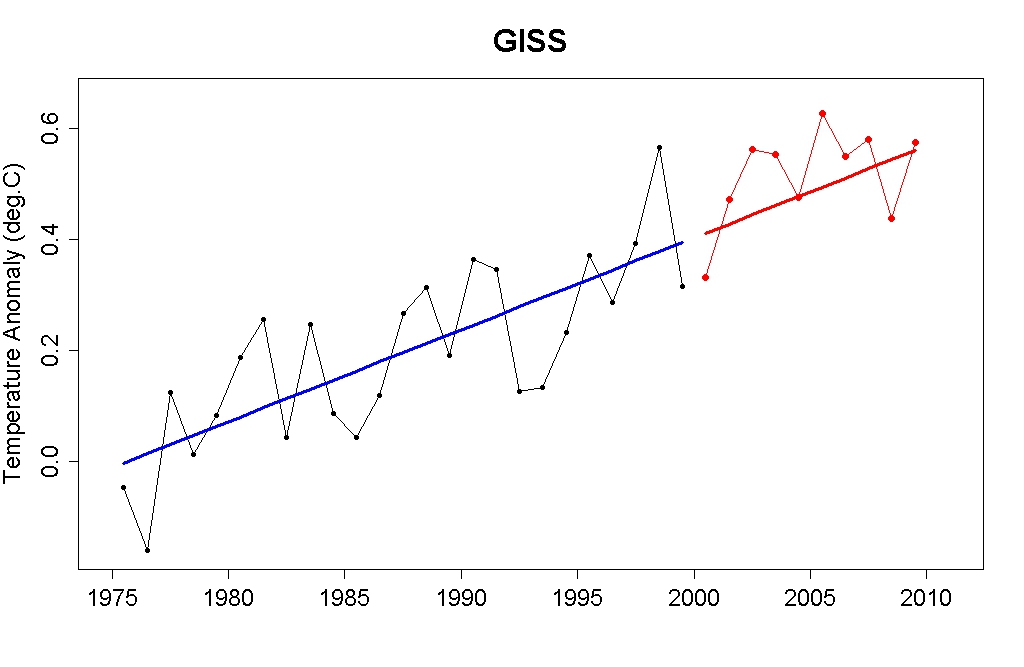
THE ESCALATOR
(free to republish)