



 Arguments
Software
Resources
Comments
The Consensus Project
Translations
About
Support
Arguments
Software
Resources
Comments
The Consensus Project
Translations
About
Support







Latest Posts
- Zeke's 2026 and 2027 global temperature forecasts
- 2025 SkS Weekly Climate Change & Global Warming News Roundup #51
- Skeptical Science New Research for Week #51 2025
- What are the causes of recent record-high global temperatures?
- Fact brief - Are toxic heavy metals from solar panels posing a threat to human health?
- Emergence vs Detection & Attribution
- 2025 SkS Weekly Climate Change & Global Warming News Roundup #50
- Skeptical Science New Research for Week #50 2025
- The rest of the world is lapping the U.S. in the EV race
- Fact brief - Are electromagnetic fields from solar farms harmful to human health?
- Comparing climate models with observations
- 2025 SkS Weekly Climate Change & Global Warming News Roundup #49
- Skeptical Science New Research for Week #49 2025
- Climate Adam & Dr Gilbz - Paris Climate Agreement At 10: Did It Do Anything?
- Fact brief - Does the recent slowdown in Arctic sea-ice extent loss disprove human-caused warming?
- Why the chemtrail conspiracy theory lingers and grows – and why Tucker Carlson is talking about it
- 2025 SkS Weekly Climate Change & Global Warming News Roundup #48
- Skeptical Science New Research for Week #48 2025
- Consensus machines
- Just have a Think - How an African energy revolution could save ALL of us.
- A girl’s grades drop every summer. There’s an alarming explanation.
- 2025 SkS Weekly Climate Change & Global Warming News Roundup #47
- Fact brief - Are changes in solar activity causing climate change?
- Skeptical Science New Research for Week #47 2025
- Exploring newly released estimates of current policy warming
- Climate Adam - Why the Climate Crisis is a Health Crisis
- Super pollutants are trendy, but we should be careful how we use them
- 2025 SkS Weekly Climate Change & Global Warming News Roundup #46
- Skeptical Science New Research for Week #46 2025
- On the Gates climate memo

Comment Search Results
Search for ice
Comments matching the search ice:
- Emergence vs Detection & Attribution
Bob Loblaw at 04:52 AM on 17 December, 2025Wild:
The most common (and probably the most familiar) example of a descriptive approach to climate is the Koppen Climate Classification system. It uses seasonal observations of temperature and precipitation to classify a regions using qualitative terms. This system aligns with our common concepts of tropical, arid, temperate, polar, continental, coastal climates, etc.
Attribution studies need some sort of model that allows an estimate of the likelihood of events (e.g. severe weather) under two different regimes (with greenhouse gases, and without). The Koppen system is a model - but largely a descriptive model. It uses numerical results, but those are descriptive statistical models.
Attribution requires a much more quantitative model - a physical model. The model simulates climate under one set of controlling conditions, and then it is run under a different set (greenhouse gases, in this case). It can be a bit hard to see the physics behind that, though, as physical model outputs are often interpreted using a descriptive model. The statistics with and without greenhouse gases help determine the probability of an event of a particular intensity, with or without climate change. But keep in mind that those descriptive statistics of the physical model output are just as complex as doing descriptive statistics of actual weather observations.
In the case of the "juiced athlete", the attribution to performance-enhancing drugs (PEDs) is difficult, for very similar reasons. You can't claim "this home run was caused by PEDs" for the same reason you can't claim "this severe weather event was caused by climate change". Arguing that a particular drug is a PED needs to be based on detailed physiological studies, as you suggest.
...but that level of detail isn't going to get a message across to the general public very well - it will go "whoosh" over their heads. "He was on steroids" is the short form. Just as "the climate has changed" is the short form for all the things that have happened due to our release of greenhouse gases and other human activities that have altered the climate.
- Emergence vs Detection & Attribution
wilddouglascounty at 01:42 AM on 17 December, 2025Thank you, @8 Bob, for sharing your perspective on this issue and the climate as a causal factor. I guess I'm not sure whether its descriptive or physical when you are doing attribution of a hurricane's intensity as being caused by climate change as it seems that it has elements of both.
That aside, what I'm saying, once again to use the analogy of the juiced athlete, is that if there is a change in the constellation of factors that make them a professional athlete including years of strength and endurance training, strategic coaching, genetic predisposition, etc., along with the performance enhancing drugs, as contributing to the increased frequency of home runs, does it make sense to to talk about the athlete in general terms that includes the entire cluster of factors (physical), or the performance statistics (descriptive); OR rather does it make sense to focus on the relevant causal factor of the practice of using performance enhancing drugs as causing the changes in the athlete's performance? For clarification's sake, the changing performance of athletes in general could not really be addressed until the key causal factor, performance enhancing drugs, was identified, after which people "got it" and took actions that penalized their use.
In a similar way, yes, physical climatology has causality in a general, collective way that clusters the real causal factors "under the hood". Since there is an identifiable subset of those "under the hood" factors called "greenhouse gases," "human activity emissions," "carbon emissions from human activities, primarily fossil fuel use" or what have you, it's time to start focusing on those "performance enhancing chemicals" we're emitting as the cause of the observed changes, so that people "get it." Otherwise vested interests will just continue to spread misinformation about the other factors, such as the sunspot cycle, cosmic rays, the end of the ice age and other things they can point to also under that hood. They are not incorrect in pointing to other factors that contribute to the climate; it's just that the science is clearly pointing to the changes in the climate as being linked to the changes in the atmospheric and oceanic chemistry caused by carbon emissions.
- Emergence vs Detection & Attribution
wilddouglascounty at 06:59 AM on 16 December, 2025I think one of the main reasons we seem to be stalling out on the climate change topic is that we've been burying the lead. Climate change is NOT a causal factor for increasingly frequent severe weather, IT'S THE OTHER WAY AROUND. Climate is a summary abstraction of individual weather events, so the way the climate changes is by increasing the frequency of extreme weather events. Saying climate change is causing more severe weather is like saying Sammy Sosa's improved batting average is causing him to hit more homeruns--ignoring the REAL cause, which is performance enhancing drugs, right?
In exactly the same way, fossil fuel emissions and other greenhouse emitting human activities have changed the atmospheric and oceanic chemistry, enabling more frequent, severe weather events, in exactly the same way Sammy Sosa's performance enhancing drugs enabled him to hit more frequent homeruns. People can understand that a juiced atmosphere is the problem here, in the same way we understand the effect of juiced athletes.
Even the attribution studies don't point back to the real causes: they point back to the "increased probability" that "climate change" has made it 300 times more likely that a hurricane grew that fast and so on, when in reality the attribution studies need to be saying that the increased carbon in the atmosphere and oceans, caused by human activities, has made it 300 times more likely that a hurricane grew that fast and so on.
We need to stop hiding behind the phrase "climate change" and start putting our human greenhouse gas emissions as causing all of this. The science is settled on this, right? Then why not start putting that front and center every time we talk about these increasingly frequent severe weather events: human activities with fossil fuel emissions being at the top of the list, is CAUSING the floods, hurricanes, droughts, heat waves and other extreme weather events to get worse. To say "climate change" is causing these things is reifying the phrase and giving it causality when none exists!
We don't have time to pass this issue onto younger folk. It's time to call a spade a spade.
- Ice age predicted in the 70s
angusmac at 13:35 PM on 3 December, 2025BL@173, 177 and 178
Before responding to your challenge, I note that the points you raise would not normally be part of the guidelines that a publication would provide for an independent reviewer. Instead, they appear to be points derived by someone who has studied the paper at university and wishes to arrive at preconceived conclusions regarding my ability to carry out an independent review.
I now reply as follows.
Why did he do the work?
- He developed a one-dimensional climate model based on a steady-state energy balance approach to analyse temperature and ice distribution by latitude.
- The study was motivated by the need to understand how variations in solar radiation and atmospheric properties influence global surface temperature and ice coverage, with particular focus on the roles of solar input, surface albedo, and meridional heat transport.
- His work represents an early application of energy balance modelling to demonstrate how changes in climate variables can drive significant shifts in Earth’s temperature and ice extent
What aspects of climate science does he attempt to address?
The paper addresses some aspects of climate science, including:
- The planetary energy budget, focusing on the balance between absorbed solar radiation and outgoing longwave radiation by latitude.
- The role of ice–albedo feedback and the existence of multiple stable climate states, demonstrating how changes in high-latitude ice extent can lead to either warmer climates or near-complete ice coverage.
What part of his paper represents "original work"?
He appears to have made several original contributions, including:
- Developing a zonally averaged, one-dimensional energy balance model structured by latitude, which calculates mean annual sea-level surface temperature for each latitude band. The model incorporates key parameters such as solar radiation, surface albedo, infrared emission, and meridional heat transport.
- Conducting systematic numerical experiments by varying parameters such as the solar constant, albedo, and transport coefficients. This enabled the exploration of climate sensitivity and the identification of distinct equilibrium states, including both warmer climates and scenarios approaching global glaciation.
What part of his paper provides useful guidance to future work in climate science?
Part 2 “The Model” and Part 3 “Applications” provide particularly useful guidance for future climate science research for two main reasons:
- Conceptual: These sections demonstrate that even highly simplified energy-balance models can produce multiple stable climate states. This insight has motivated more detailed investigations into climate feedback mechanisms, such as ice–albedo feedback, and their role in glacial–interglacial transitions.
- Methodological: The modelling framework introduced is straightforward and transparent and has been adopted in subsequent research. It enabled systematic evaluation of climate sensitivity, heat capacity, and meridional heat transport.
Interestingly, Sellers (1973) is classified as neutral, and Sellers (1974) is classified as warming by both PCF-08 and me.
- Why the chemtrail conspiracy theory lingers and grows – and why Tucker Carlson is talking about it
osbornll at 09:18 AM on 3 December, 2025I have noticed a trend in conspiracy theories (chemtrails as well as climate denying, anti-vax, etc.) is that they push the solution to who must change to someone else. I am over 60, an applied physicst who has studied Wellness Coaching, and I cannot remember at time where science was telling us so much bad news and that we must change our ways! It is a common reaction, even amoung highly educated people, to blame others or deny the science instead of changing. I.e. Climate change is caused by a cabal of evil people using chemtrails and therefore I do not have to change. Does anyone know of papers addressing the issue from this angle? Thanks.
- Ice age predicted in the 70s
angusmac at 09:51 AM on 30 November, 2025BL@177.
Oh dear. Now you are playing the semantics game
[Snip]
with “conclusions” versus “concluding remarks” in your statement that:

If it were just a summary, then I reiterate that your alleged summary states that, “Some years from now man will control his climate...”, either by warming from “the increase of carbon dioxide” or by cooling from “particulate pollution”.
However, I disagree that “concluding statements” are just “final words”, and I reply below.
Conclusions tend to be more formal than concluding remarks, but in practice, they tend to be very similar.
Conclusions usually include (but are not limited to) the following:
- Providing definitive, evidence-based judgment directly answering the questions raised in the paper.
- Interpretations are drawn from the paper's data, and recommendations are usually provided.
- Perhaps including a call for further research and/or a call for action.
Whereas, concluding remarks usually include (but are not limited to) the following:
- Summarizing the paper, providing final thoughts, perhaps discussing broader context and/or future implications.
- Incorporating reflections, acknowledging limitations, and possibly providing recommendations.
- Perhaps including a call for further research and/or a call for action.
Furthermore, you have worked in academia and will be aware that the use of either conclusions or concluding remarks tends to be journal specific. In practice, the terms are often used interchangeably, and the specific requirements for their use can depend on the journal, discipline, and/or publication guidelines.
It is evident from the above that “concluding remarks” are not just “final words”, but no doubt you are already aware of this having worked in academia. However, in your reply, you chose to play the semantics game by pretending that they are just “final words”.
[End snip]
P.S. You seem to be very keen on my response to your challenge at BL@173, and I have already confirmed that I will respond in due course. However, I do have a daytime job and, firstly, I would rather respond to your other allegations.
- Climate skeptics have new favorite graph; it shows the opposite of what they claim
Philippe Chantreau at 04:06 AM on 28 November, 2025The planet was lush and green very shortly after the end of the last ice age, when CO2 was less than 300ppm. In every region where the avilability of water made their existence possible, forests grew. They covered an immense area of the globe before humans started cutting them down and slashing/burning. Megafauna existed also and was in fact richer than now, even during the ice age: Mammoths, whooly rhinos, dire wolves, cave lions, megacerops, smilodon, cave bears, etc, etc.
Humans are an enormously powerful factor constraining the existence, abundance and diversity of life. Humans precipitated the disappearance of the megafauna of the late quaternary. Currently, life is subjected to all the "normal" natural stressors and all the human made ones as well. Without humans, it is very likely that after a few tens of thousands of years, life would be green and lush, rife with megafauna, under the future climatic conditions afforded by 500ppm of CO2. There is absolutely no chance of that happening with 8 to 10 billions of humans inhabiting the planet. None whatsoever.
- Climate skeptics have new favorite graph; it shows the opposite of what they claim
Bob Loblaw at 03:21 AM on 28 November, 2025RegalNose @ 26:
The OP mentions the concern about rapid changes. Do not dismiss that concern lightly.
...but with regard to the long-term record, and the Mesozoic period in particular:
- What evidence exists that human civilization in its current form was doing well in those warmer Mesozoic climates? Will our agricultural systems work for us?
- Temperatures similar to the Mesozoic would result in major reductions in land-based ice (especially Greenland and Antarctica). That will lead to sea level rise.
In the next 75 years or so, a metre of sea level rise is a reasonable expectation. That will lead to a lot of new coastal flooding (already beginning), at significant cost (either to prevent, mitigate, or move away from).
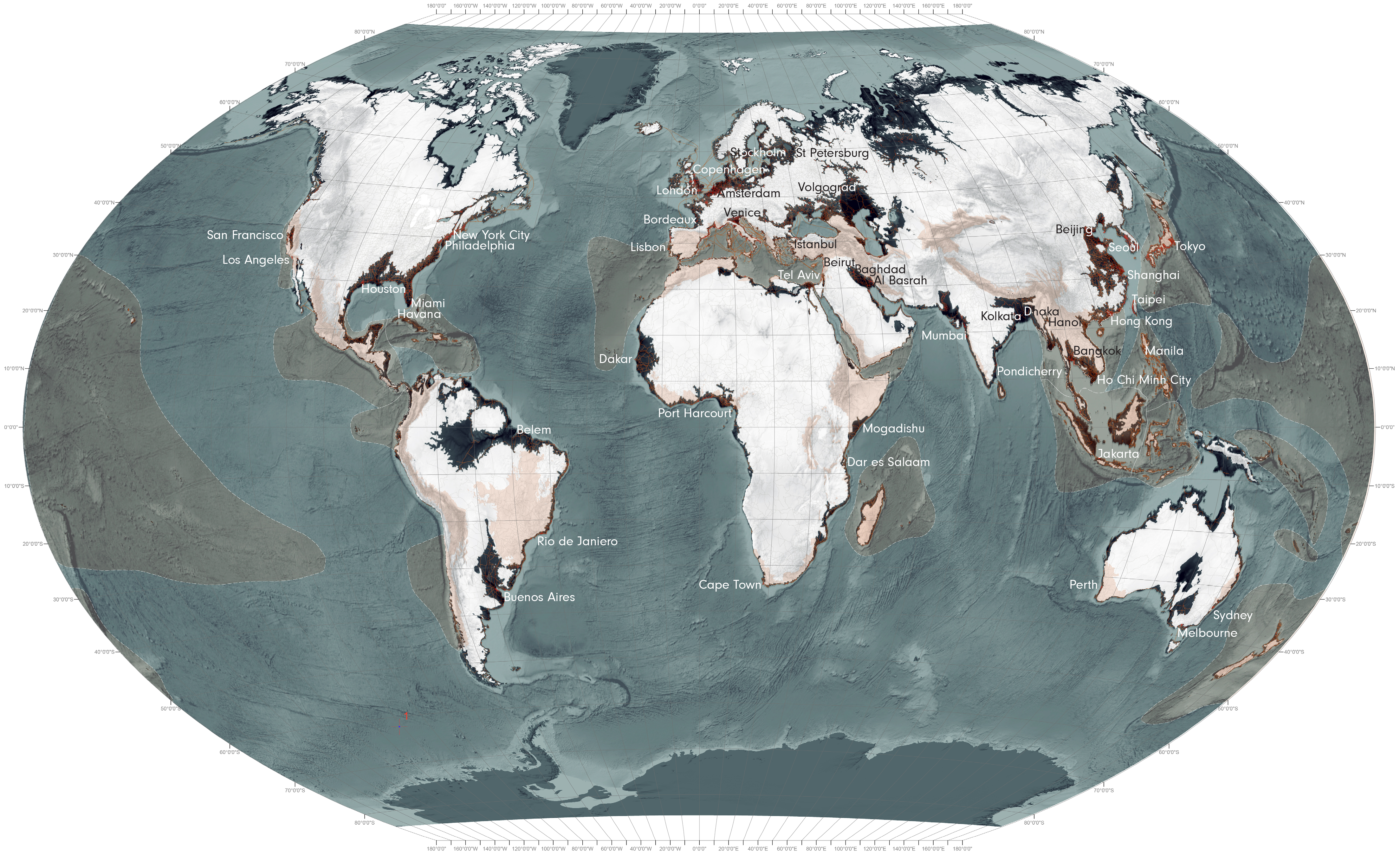
In the longer term (centuries), a complete loss of land ice in a Cenozoic-like climate would lead to an 80m rise in sea levels. Here is a map (from this web site, where you can see a larger image) of how much flooding is likely. Are there any portions of that flooded coastal zone that you would like to see preserved?
- Ice age predicted in the 70s
angusmac at 14:15 PM on 16 November, 2025One Planet Only Forever @167
Thank you for your sensible comments on the red team/blue team approach, and also without the animus of many of the other comments on this thread. I now reply as follows.
Yes, Wikipedia describes this approach as the red team (challengers) conceptualize attacks on the system and the blue team (originators) respond with measures that counteract the attacks. However, the Wikipedia description only deals with computer systems and potential cyber threats. It does not deal with this approach being used in other disciplines, where the term attacks are replaced by challenges.
Regarding your statement that you, “would argue that Structure designs are not ‘regularly’ subjected to Red Team attacks.” I did not state that structural designs are regularly subjected to red team attacks. What I did state was that [emphasis added], “…using a red team/blue team methodology is normal practice in major engineering projects worldwide. In fact, on exceptionally large projects, a third team is often tasked with independently reviewing and validating the results of the red and blue team process.”
Perhaps our difference of opinion is due to the size of the project and its jurisdiction, as I explain below.
I have worked on many major structural projects in the Middle East, Asia, and Australia, in which the red team/blue team approach was used, and when I asked perplexity.ai about its use in Australia, the response was the following:

Furthermore, I summarise an example of one of my projects – the Burj Khalifa (BK) in Dubai in which I was Structural Director:
- BK was designed by Skidmore, Owings & Merrill in Chicago (SOM), IL, the originators (or blue team).
- My company Hyder (now Arcadis) were appointed as the Engineer of Record to review, validate, challenge, and improve the design, and then adopt the design as their own.
- Hyder made many changes to the original SOM design and incorporated many value-engineering improvements. This is a typical challenger (red team) role. In fact, my on-site team (where all of the redesign work took place) actually called ourselves the red team.
- Because there were very many changes to the original design, the client also appointed a third team to independently review and validate the results of the red team/blue team process. I suppose you could refer to this third team as the purple team. However, in my experience, having a purple team is unusual.
The process outlined for BK is much more detailed and complex than a simple peer review – it is evaluating and eventuating a solution that is much better than the original design. It is challenging (and improving) the original design – not attacking it.
Additionally, The Line in Saudi Arabia is another project in which I am working as part of the red team. However, in this project (due to the considerable number of design consultants) there is not just one blue team, but many blue teams.
I hope that the above is a reasonable explanation of the red team/blue team approach in major structural engineering projects.
Finally, regarding climate science, I am of the opinion that “saving the planet” constitutes a major project, and consequently, it should be subjected to the red team/blue team approach.
- Ice age predicted in the 70s
One Planet Only Forever at 13:37 PM on 14 November, 2025angusmac @164:
I am a retired, quite successful, Canadian Registered Professional Engineer (Structural) with an MBA. I have participated in the successful design of a diversity of structures using a diversity of materials and structural systems in a diversity of nations to a diversity of national standards. I feel obligated to respond to the following part of your comment.
Additionally, as a structural engineer, I am appalled that climate scientists resist a red team/blue team approach to the discussion of The Science™, because using a red team/blue team methodology is normal practice in major engineering projects worldwide. In fact, on exceptionally large projects, a third team is often tasked with independently reviewing and validating the results of the red and blue team process.
Of course, if engineers get it wrong, they can be sacked or fined, many people’s lives could be lost, and the engineers may go to jail.
The Wikipedia description of Red Team also covers the idea of Blue Teams. The Red Team (challengers) conceptualize attacks on the system and the Blue Team (originators) respond with measures that counteract the attacks.
I would argue that Structure designs are not ‘regularly’ subjected to Red Team attacks. I am familiar with an independent group of people with expertise related to the design being reviewed doing a detailed assessment of the developed design. I have been on many of those review teams. What is done is similar to Scientific Peer Review, not a Red Team attack.
A structure design must be safe. Engineering work should always be checked by a competent reviewer to ensure that the evaluation and design decisions fully meet the established minimum safety standards of the relevant regional building/structure design Codes. This is sort of like Scientific Peer Review ensuring the methodology and evaluation were done in a way that makes the results defendable. It is not a Red Team attack.
The engineer’s job is to knowledgeably rigorously think about and evaluate the performance of the structure they are designing, or any of its parts, in response to any potential condition or combination of conditions the structure could experience. An engineer’s design should be checked by a sufficiently capable review engineer. And a responsible professional engineer would not take on a design challenge that they lack the experience to properly perform. They would learn what they need to know from someone who has a better understanding (like good scientists learn from good peer review).
It would be irresponsible for an engineer to rely on a reviewer (Red Team attacker) to identify any weaknesses of their design. The majority of designs completed by an engineer should completely stand up to detailed expert review. A good engineer would be expected to occasionally make an error or miss a consideration, hence the importance of every design being adequately independently checked. The good engineer would learn from the experience of having weaknesses of their work discovered by an expert reviewer. And a responsible engineer would not attempt to perform a design task they lacked experience in. They would seek adequate education before doing the ‘new to them’ design task.
If an engineer does not learn to do better work in-spite of having the weaknesses of their work pointed out then they should not continue doing engineering work. The same should apply to scientists.
One comment in closing. I have no knowledge of the engineering work you do. But I would caution you that how you have been responding to having the weaknesses of your ‘non-engineering’ ‘new to you’ evaluations of climate science literature pointed out raises Red Flags. You should be careful and reflective to ensure that you do not have a similar ‘motivation that keeps you from learning’ compromise your ability to be a good, constantly improving, responsible structural engineer.
- Ice age predicted in the 70s
angusmac at 20:34 PM on 13 November, 2025BL@159 and BaerbelW@161
I had contemplated submitting my paper to a climate journal for (what you call) a “proper peer review”. However, I chose not to submit it because I thought that it wouldn’t get published – not because my review was inaccurate, but because current climate journals do not countenance a red team/blue team approach.
Current climate journals only allow blue team opinions, whist banning any red team opinions that the question the current climate consensus, aka, The Science™. Furthermore, climate science appears to be the only branch of science and engineering that does not allow a red team/blue team approach. Indeed, the history of science shows that our scientific knowledge has mainly increased by those who chose to challenge the prevailing consensus.
Additionally, as a structural engineer, I am appalled that climate scientists resist a red team/blue team approach to the discussion of The Science™, because using a red team/blue team methodology is normal practice in major engineering projects worldwide. In fact, on exceptionally large projects, a third team is often tasked with independently reviewing and validating the results of the red and blue team process.
Of course, if engineers get it wrong, they can be sacked or fined, many people’s lives could be lost, and the engineers may go to jail. However, when climate scientists get it wrong, they usually just move their prediction(s) out by a few years and carry on as if nothing had gone wrong with their earlier prediction(s).
To sum up, I believe that my paper would have been declined by a climate journal because it would have been considered to be part of the (banned) red team.
- Five ways Joe Rogan misleads listeners about climate change
nigelj at 05:06 AM on 11 November, 2025Very informative and accurate commentary, except I have one nit pick:
Commentary says: "Rogan’s fake experts. Rogan’s podcast tends to invite fringe, unqualified climate contrarians who dispute the expert consensus. Happer is a retired physicist with a scant publication record in the field of climate science. Lindzen has an extensive list of climate publications, but his contrarian claims have been consistently proven wrong. In other words, they have not withstood scientific scrutiny or the test of time."
This is wrong about Lindzen and conflates a whole lot of things. Lindzen cannot be classified as a fake expert. Lindzen is certainly a well qualified in climate science. His CV and publishing record shows this. The fact he has been proven wrong on various issues doesn't make him non qualified. Experts are sometimes proven wrong. The fact hes a contrarian doesn't make him a non expert or non qualified. Hes not a fringe scientist. IMHO Lindzen is a very bad choice to use as an example of a fake expert. However several of his reasonings fit the examples of cherry picking and logical fallacies etc,etc.
Happer is arguably a fake expert but not an ideal expample because at least he has a physics degree. Someone like Christopher Moncton would be much better example of a fake expert, because he is interviewed as if he's an expert, but he has no climate science related qualifications at all. He has a BArts degree in classical studies and a journalism diploma.
- Ice age predicted in the 70s
Philippe Chantreau at 00:10 AM on 9 November, 2025The motivation is simple and as crude as it gets in the denialist bag of tricks: Scientists predicted an ice age in the 70s and it didn't happen, so there is no reason to believe what they are predicting now. The funniest thing is that it no longer is a prediction, it is happening right in front of us.
Now, Angusmac is only increasing word count, throwing smoke and mirrors to try to hide the abysmal shortcomings of that little list. A first step would be to make sure that every link actually leads somewhere. I'm not holding my breath. The whole thing is a pitiful attempt at twisting reality.
- Ice age predicted in the 70s
Eclectic at 19:32 PM on 8 November, 2025Angusmac @159 :
No ~ my query was with regard to your motivation for pursuing this long-out-of-date topic.
This thread was started in 2007. That is 18 years ago. Even then it was rather outmoded, and, as I point out ~ the science has moved on, well and truly. And as you look through the thread's posts, you will find several oddball commenters ~ but overall, the topic has not received much attention. Rightly so. The whole topic subject is of only minor (dare I say, trivial?) historical interest, and is of almost zero relevance to today's climate problems.
So that is why I ask for you to explain your motivation. Are you a fervent amateur historian? Have you discovered a Nobel-Prize-eligible factor of critical value to the world? Have you looked inside yourself, and reflected [as we all should] on your internal processes of thought, to understand yourself? I am sure that other readers also would benefit from understanding your motivation here.
If you have a Quixotic mindset, then SkepticalScience has at your choice many threads on the modern relevance of wind turbines (or windmills, as our respected leader calls them).
- Ice age predicted in the 70s
angusmac at 17:27 PM on 8 November, 2025Eclectic@158
Regarding your comment that, “Looking at the Bigger Picture, why is it that you are bothering to argue about the exact percentage of scientific papers that were classed in cooling/neutral/ warming?”, since science (and technology) have moved on.
My answer is simple: both SkS and PCF-08 have stated that there was an overwhelming consensus for warming in the 1970s. To the contrary, I have shown that this is untrue. PCF-08 (and SkS) have ignored the 86 cooling papers that my literature survey found in major scientific journals.
Therefore, I recommend that the SkS 1970s ice age web page should be amended to represent the actual scientific facts (i.e. 86 cooling papers) and, as I have stated @146, PCF-08 should be either withdrawn or subjected to a detailed corrigendum to correct its obvious inaccuracies.
I hope that this answers your query. - Debunking Joe Rogan, Dick Lindzen, and Will Happer
Eclectic at 21:58 PM on 7 November, 2025Nick Palmer :
A lengthy PART TWO of the religious component of Lindzen's climate science denialism.
While we see where the typical Denialist (e.g. to be found in the street or @WUWT website) harbors anger / selfishness / deficiency in empathy . . . . there is IMO an additional fundamentalist religious component in the Motivated Reasonings of some prominent Denialists. You yourself could name a few of those luminaries, I am sure.
IIRC, there was an interview with a very relaxed, laid-back Lindzen sitting in a chair in his garden, while being interviewed by a "sympathetic" interviewer. My perhaps-faulty memory was that the occasion was 2006 ~ but perhaps that date is wrong. My googling this week turned up youtube: "Interview with Professor Richard Lindzen" on the "Rathnakumar S" channel. I am unclear on its date ~ maybe 2014 or 2015. Hard to be sure, since youtubers tend to recycle and re-post stuff from years earlier from other sources. But the exact date is a trivial matter. And please do not bother to view the video, unless you are in a masochistic mood.
# The "Rathnakumar S" channel is new to me, and I have not viewed any of the rest of the playlist. But the playlist does include interviews (originals or re-posts?) of people such as :- W.Soon; W.Happer; H.Svensmark; M.Salby; P.Michaels; S.Baliunas; Bob Carter; et alia. And including that paragon of ethical public education, Marc Morano. Plus there appears to be a flirtation with anti-vax. Of course.
Video with approximate time-stamps :
Lindzen seems to favor a degree of Intelligent Design ~ the World is well-designed. 3:05 "Oh I think the case is pretty strong that it is in fact better designed, and there are strong negative feedbacks that will instead of amplifying, diminish the effect of man's emissions."
Lindzen keeps minimizing the Global Warming: "Only half a degree in a century ... [and] the temperature is always flopping around."
Lindzen opines that CO2 can have a warming effect, but most of it is not due to humans . . . though yes, water vapor and clouds "worsen what we do with CO2." [Note that Lindzen's "Iris Hypothesis" has been a dud.]
22:20 "We still don't know why we had these ice age cycles. We don't know why 50 million years ago we could have alligators in Spitzbergen."
27:00 "Ever since we invented the umbrella, we've known how to deal with climate, up to a point."
37:20 "Nothing in this [climate] field is terribly compelling. The data is weak. ..."CO2 will contribute some warming : not much. ..."It is then claimed that recent changes are due to man : I don't think that's true."
46:13 He returns to Intelligent Design : "A well-engineered device tries to compensate for anything that perturbs it."
So ~ not much particularly explicit denialisty statements . . . but a great deal of implicit statements. Including, throughout the video, a great deal of "Cornwall" wording.
- Ice age predicted in the 70s
angusmac at 13:19 PM on 7 November, 2025@152 & @153
BL, you state that, “To claim that PCF-08 is wrong, angusmac needs to evaluate using the same criteria: a time scale of decades to centuries. If he is to gain any credibility, he needs to outline where in Sellers (1969) he finds support to argue that Sellers thought that the solar constant would decrease by this amount (or any amount) over the next century.”
In response, I now enclose an image of a paragraph from p.399 of Sellers (1969).

Note that Sellers (1969) states that "...in as little as 100 years…it is not inconceivable that the solar constant will change”. Consequently, it is obvious that my classification of Sellers (1969) is based on "time scales from decades to a century".
Notwithstanding the above, he does state that such a change in the solar constant for an extended period is, “on the fringe of being highly unlikely”. Furthermore, I would suggest that “on the fringe” means that the possibility cannot be discounted. Additionally, nowhere in Sellers (1969) is a change to the solar constant ruled out. Indeed, he includes such a possibility of solar change as one of his "major conclusions" (as highlighted below).

I contend that all of the Sellers (1969) conclusions are valid because all of them “were specified to be physically realistic” (although some outcomes may be more likely than others).
Consequently, I still maintain that my change to the PCF-08 classification of Sellers (1969) from warming to neutral is valid because he did state that there was a possibility of another ice age and that it was specified to be "physically realistic” .
- Debunking Joe Rogan, Dick Lindzen, and Will Happer
One Planet Only Forever at 07:03 AM on 7 November, 2025Because of Lindzen's past history of contributions to climate science, I find it very difficult to grant him any benefit-of-doubt regarding his statement in the first point raised (repeated below):
Lindzen @ 6:02: “global mean temperature doesn't change much, but you know you focus on one degree, a half degree, so it looks like something”
Lindzen @ 22:06: “Gutierrez (sic) at the UN says the next half degree and we're done for. I mean, doesn't anyone ask, a half degree? I mean, I deal with that between, you know, 9:00 a.m. and 10:00 a.m [laughs]. Rogan: "it does seem crazy. It's just that kind of fear of minute change that they try to put into people.”
To start, Lindzen seriously misrepresents what Gutierres has said. A quick internet search finds the following UN News item: There is an exit off ‘the highway to climate hell’, Guterres insists. It includes the following selected quotes:
“It’s climate crunch time” when it comes to tackling rising carbon emissions, the UN Secretary-General said on Wednesday, stressing that while the need for global action is unprecedented, so too are the opportunities for prosperity and sustainable development.
...
Question of degrees
He said a half degree difference in global warming could mean some island States or coastal communities disappearing forever.
Scientists point out that the Greenland ice sheet and West Antarctic ice sheet could collapse and cause catastrophic sea level rise. Whole coral reef systems could disappear along with 300 million livelihoods if the 1.5℃ goal is not met.
Extreme weather from East Asia to the western seaboard of the US has been turbocharged by climate chaos, “destroying lives, pummelling economies and hammering health”, said the Secretary-General.
It is very challenging to excuse someone like Lindzen saying those types of things (and all the other cases of misleading manipulative messaging by him and Happer that have been pointed out).
Rogan can be excused for being a gullible desperate pursuer of popularity who is easily impressed and therefore potentially is unwittingly massively harmfully misleading. No such excuse comes to mind for Lindzen (or Happer).
I look forward to the follow-up mentioned by Dana that will "...look at the underlying psychology in a separate article in the near future."
- Ice age predicted in the 70s
angusmac at 15:46 PM on 5 November, 2025I will attempt to work through your comments but, firstly, I reply that the Sellers (1969) paper should be considered to be neutral because it states that the "major conclusions" are:
- “…that a decrease of the solar constant by 2-5% would be sufficient, to initiate another ice age”.
- “and that man's increasing industrial activities may eventually lead to the elimination of the ice caps and to a climate about 14C warmer than today”.
I fail to se why any rational person could not view the Sellers paper as being anything except neutral since it concluded that its model could be either “another ice age” or “14C warmer than today”. Both of these outcomes were “specified so as to be physically realistic”.
Consequently, I contend that I have not mischaracterized Sellers (1969).
- It's the sun
kootzie at 04:32 AM on 4 November, 2025I am semi-active on Research Gate and elsewhere and doing my bit to [snip]
swat and bitch-slap denialists as they emit their oral-methane emissions to contaminate the discussions and spread anti-science drivel
I notice that the likes of
D*n P*rn
H. D*s L*oot
J*k Br*n
and others regularly engage in denialist mis-information
I notice that none of them appear to be significant enough to
merit (or dis-merit) inclusion in your rogues gallery
Their latest drivel stream purports that not only does increased atmospheric CO2 concentration not contribute ANY increase in global average temperatures, that CO2 does not have any effect on GAT at all.
They claim that WV aka Water Vapour, is a far more potent GHG
(which is arguably a defensible proposition) but that WV is the ONLY
GHG which has ANY effect on temperature, and ipso-facto ergo QED
anthropogenic Global Warming does not exist - its all on the natch.
They regularly mis-interpret mis-comprehend mis-represent physics.
They fundamentally deny that CO2, a non-condensible GHG with a long lifespan drives global temps and insist that WV, a condensible GHG with a short lifespan is not merely a feedback / feedforward mechanism but the fundamental / ONLY driver.
https://www.perplexity.ai/search/analyze-and-critique-vol-20-20-wis.z78fQn.WeNzqnj5Kkg#0
https://www.perplexity.ai/search/analyze-and-critique-the-error-7ZbX2nqyRgGc19k2y45u_Q#0
https://www.perplexity.ai/search/analyze-and-critique-paraphras-Lrr7UYOjQAitC93qUR10EA#1
https://www.researchgate.net/post/How_can_environmental_protection_and_biodiversity_be_improved_by_using_current_ecological_technologies#view=6908dd880ea281189c0a137f/312/313/312
- Ice age predicted in the 70s
Philippe Chantreau at 03:34 AM on 3 November, 2025To elaborate on the previous post, I'll add that I was somewhat lucky in being able to access that "paper" at my first try. Multiple other attempts on different pieces led to broken links or paywalls. One paywalled let me read a first page that did not suggest it was taking a strong position on forecasting future trends.
Another one was accessible but hardly relevant: "Summary of Soviet publications on weather modification." It nonetheless contained this bit: "Budyko, Drozdov and Yudin (1966) stated that in
less than 200 years the heat released by man's activities will have a greater influence on climate change than solar radiation changes." I recommend reading through it so that nobody accuses me of cherry picking. The bulk of it is about cloud seeding for agricultural purposes. Some parts reflect the insane arrogance of the Soviet approach to inhabiting this planet, especially the getting rid of Arctic ice ideas near the end. A fun read, but it's still hard to see how it could be construed as a research paper forecasting cooling of the Earth climate.
I am not sure I will have the patience to continue wading through this. So far, I am profoundly unimpressed with this "57 cooling papers" claim.
- New Book - Climate Obstruction: A global Assessment
One Planet Only Forever at 04:03 AM on 26 October, 2025prove we are smart @4,
Mallen Baker’s presentation definitely helps understand ‘The Problem’. Developing sustainable improvements requires a proper thorough understanding of ‘The Problem’.
However, I think the ‘Right to Lie and related claims that it is justified Free Speech’ is just a more extreme version of Doublespeak. And Doublespeak has been a Problem, of varying degrees of severity, for as long as humans have been competing for perceptions of superiority and related pursuits of leadership influence. (links to Wikipedia items for Doublespeak and Doublespeak Awards - note that the 2005 Award was given to "Philip A. Cooney, for editing scientific reports to deceive the public about the nature of global warming and climate change and of the Bush Administration's negligence in dealing with these issues.")
The efforts of misleaders to benefit from Doublespeak amp-up in absurdity as the general population gains increased awareness and improved understanding regarding matters. Those who unjustifiably obtained perceptions of superior status via harmful unsustainable misleading actions have to double-down on their Doublespeak.
An example of the doubling-down of Double-speaking is the following (related to my comment @6):
CBC News item: Danielle Smith affirms Alberta's 2050 net-zero goal at testy committee appearance.
The following is a selected quote from the article:
“Her virtual appearance included testy exchanges as Bloc Quebecois MP Patrick Bonin repeatedly demanded to know whether Smith believes in climate change. She suggested that as a Quebecer, he could not grasp the substance of one of Canada's biggest industries.
Bonin repeatedly asked the premier whether she agreed the climate is warming up, and if human activity is primarily the cause.
Smith initially dodged the questions — first by talking about forest management practices, then by diving into Alberta's 2050 emission reduction plan. She and Bonin continually talked over each other as she repeated her points and he continually insisted she was not answering his question.
The exchange got so boisterous, Liberal chair Angelo Iacono was forced to interject to bring things back under control.
Bonin finally got an answer when he asked Smith to state "yes or no" whether she believes the climate is warming.
"Yes," she said.
Smith then said she agreed humans are contributing to climate change but wouldn't say it's the main factor driving it.
"I don't know the answer to that. I'm not a scientist. But we do know we need to get to carbon neutral by 2050 and we have a plan to do that," Smith said.
Later, after Bonin asked Smith if Alberta knew whether its plan to double oil and gas production would affect its 2050 net-zero target, Smith questioned his knowledge of the sector.
It is important to understand that although the need to reduce global warming emissions from Alberta, ultimately having no impact by 2050, was understandable well before the 2015 Paris Agreement, there has been no measurable action by the industry in Alberta towards that reduction (there has been limited government subsidized carbon capture).
It is also undeniable that wealthier portions of the current global population, like the portion benefiting from extraction and export of Alberta’s fossil fuels, need to minimize how harmful their actions are as they transition towards ending their harmfulness. The total amount of harm done is the important measure, not a promise to maybe-end the harmfulness at some ‘Future date’ like the claim to be ‘Net-Zero by 2050'.
Net-Zero may not actually be ‘harmless’. Double-speakers will just claim they are harmless, claim that they are not the problem, and/or claim that others are the problem.
Also reduction of impact now is more beneficial than reduction later.
As a worst case example, rapidly doubling the rate of Alberta oil and gas export but doing nothing to reduce the emissions, then shutting it all down in 2050 would theoretically meet the promise (the Promise is not a Lie).
The worst case for the future of humanity is Doublespeak continuing to be successful. Hopefully, the Welsh Senedd will act in a way that triggers the beginning of significant action to sustainably limit the success of Double-speakers trying to maximize their benefit from being harmful.
- Is this the most embarrassing error in the DOE Climate Working Group Report?
Bob Loblaw at 04:35 AM on 17 October, 2025History suggests that the authors of the DOE report are largely incapable of being embarrassed. Their determination to spread their message, in spite of numerous criticisms and corrections, is quite remarkable.
Charlie Brown @ 4:
That is an interest take: that they argue 3 W/m2 is small compared to the total radiative flux. It seems that they are using the "it's a trace/small amount compared to [X]" template that has been used in a variety of poor contrarian arguments; vis a vis:
Anthropogenic emissions are small compared to natural cycles
Are there any other arguments that fit this same template?
DenialDepot had a fun post (15 years ago!) on how to cook a graph by playing with the Y-axis. Of course, in its standard mocking of the contrarians, DenialDepot accuses Skeptical Science of cooking the graphs by not expanding the Y-axis to make the change look minuscule. (DD looked at sea ice.) DD shows the "proper" method should be to compare the lost sea ice area to the total area of the earth. In DD's words, "That's far more clear. Immediately I am having trouble seeing the sea ice. This is good. If you can't see it, it's not a problem."
It's like a defendant in court arguing "how can it be grand larceny? I only took $100,000. He has billions."
- Is this the most embarrassing error in the DOE Climate Working Group Report?
prove we are smart at 09:45 AM on 10 October, 2025I have to use simple breathing techniques to read/listen to anything from this Trump regime! Enabled by a political party of grifters and cowards with little conscience and no mirrors in their many houses.
Generations of this countrys populous fed on years of media stereotyping dumbing most down and culminating in electing a malignant man not once but twice. A mob boss,whose arsehole has swapped places with his mouth.
Indeed, Wikipedia on their "false and misleading statements by Donald Trump" page, have trouble deciding whether to split the narrative into 2 pages! en.wikipedia.org/wiki/False_or_misleading_statements_by_Donald_Trump
I guess it is about people voting against their own best interests. Seeing the big picture without the baggage you have grown up with or picked up along lifes journey. It seems not becoming a fatalist is much harder now and giving in to such is a guarantee of a dismal future for those generations to come.
- Is this the most embarrassing error in the DOE Climate Working Group Report?
Charlie_Brown at 10:28 AM on 9 October, 2025An excellent description of proper use of statistics for data evaluation. I thank Dr. Dressler for the illustrative graphics.
My choice for most embarrassing would be something simpler because it is obvious once identified. Then it is revealed as an undergraduate level misrepresentation by irrelevant comparison. Here is an excerpt of my submitted comments.
On p. 13, Section 3.1.1 Historical radiative forcing
“Figure 3.1.1 shows that the anthropogenic forcing component was negligible before about 1900 and has increased steadily since, rising to almost 3 W/m2 today. However, this is still only about 1 percent of the unperturbed radiation flows, making it a challenge to isolate the effects of anthropogenic forcing; state-of-the-art satellite estimates of global radiative energy flows are only accurate to a few W/m2.”
Comparing 3 W/m2 to 240 W/m2 is misleading and diminishes the significance of 3 W/m2. It is an example of science denialism by distraction, obfuscation, and omission. Straightforward, fundamental physics including conservation of energy and radiant energy calculations combined with atmospheric properties allow the effects of anthropogenic forcing to be isolated by calculation. The calculated spectra of energy loss to space is verified by satellite measurements (Hanel, et al.,1972) (Brindley & Bantges, 2015). 3 W/m2 is sufficient to cause and continue observed global warming. The anthropogenic forcing is not determined by difference of two large, measured numbers and does not rely on just satellite estimates of radiative energy flows. There is very little uncertainty about the effects of increasing gas concentrations.
Even a relatively simple radiant energy model can isolate the effects of anthropogenic forcing that are used for changes in energy flux at the top of the atmosphere caused by changing conditions. Sophisticated climate models use the same approach for radiant energy calculations.
References:
Brindley & Bantges, “The Spectral Signature of Recent Climate Change,” Current Climate Change Reports, 2, July 2016. doi.org/10.1007/s40641-016-0039-5
Hanel, et al., “The Nimbus 4 infrared spectroscopy experiment: 1. Calibrated thermal emission spectra,” Journal of Geophysical Research, 77(15), May 1972. - Is this the most embarrassing error in the DOE Climate Working Group Report?
wilddouglascounty at 22:57 PM on 8 October, 2025Thank you for putting this together and sharing this important document, a concise response to all of the information distortions and misinformation circulating. By putting it out here and in Climate Brink, folks will surely disseminate it far and wide.
My request is that even though public hearings have closed for responses to this deeply flawed document, composed by a "flash committee" that disappeared almost as quick as it was created, I hope that efforts will be made to place this in the hands of relevant Senate and House Committe members as well. Namely, members and staff of the House of Representatives Energy and Commerce Committee (Bret Guthrie chair), the Office of Congressional and Intergovernmental Affairs Committee and on the Senate side: members of the Senate Committee on Energy and Natural Resources.
Objections to this flawed rationale for gutting coordinated efforts to reduce carbon emissions, conserve energy, incentivize renewables while removing fossil fuel subsidies should continue to be challenged and protests and objections should be mounted at every step of the way. The current Administration's push to replace a sane energy strategy for the future with short sighted attacks on that strategy in the name of short term gains for the well positioned financial interests should be exposed for what it is at every turn. Trump's handlers need to know that ignoring physics and biology is like tearing up a parking ticket in a big city: the cost only goes up!
- Koonin providing clarity on climate?
Evan at 06:31 AM on 28 September, 2025Charlie Brown@3. Yes, I understand the Milankovitch cycles well. Yes, warming starts a very complicated feedback cycle, but CO2 is a magnifier. CO2 is a primary cause of the temperature fluctuations through complex feedback cycles.
But my point is that we live in an ecosystem that is very delicately balanced, and just 100 ppm of CO2 is enough to cause huge swings in sea level and temperature. This time around, regardless of the cause, we are pushing the system way beyond anything experienced during the ice age cycles.
- Koonin providing clarity on climate?
Charlie_Brown at 05:09 AM on 28 September, 2025Ken Rice is lenient with the authors of the DOE Climate Impacts report and with Secretary Chris Wright. Chris Wright states in the Foreword: “I chose them for their rigor, honesty, and willingness to elevate the debate. I believe it faithfully represents the state of climate science today.” I care more about substance than credentials. My public comments included: “The Foreword highlights that the purpose of the Critical Review is to challenge and counter mainstream science. It certainly does not represent the state of climate science today. Rather, it provides a rationalization for weakening current policies for combatting climate change. The authors are neither representative of the scientific community nor diverse.”
The science is not that complex. The report is full of misrepresentation, distraction, and obfuscation. It is not worthy of an undergraduate term paper let alone a critical review of science by PhDs. Many points have been thoroughly discussed and debunked here on the SkS website. My comments included:
1) “Section 2.1 is oversimplistic. CO2 is rarely the limiting nutrient. It discusses photosynthesis as a benefit but ignores adverse effects resulting from CO2 as the primary cause of climate change including drought, extreme temperatures, excess rain, and cropland relocation.”
2) “CO2 below 180 ppm is an irrelevant distraction to the discussion of modern global warming.”
3) “Changing ‘ocean acidification’ to ‘ocean neutralization’ is semantic posturing that does not change the effects. To say that pH reduction is not acidification until the pH drops below 7.0 it is not meaningful.”
4) “Implying that the IPCC uses data manipulation to satisfy preferences is baseless accusatory language. The change in radiative forcing due to the Earth’s orbit around the sun is negligible within the period of modern global warming. The change due to sunspot activity is measured and found to be negligible.”
5) “Comparing 3 W/m2 to 240 W/m2 is misleading and diminishes the significance of 3 W/m2. It is an example of science denialism by distraction, obfuscation, and omission. Straightforward, fundamental physics including conservation of energy and radiant energy calculations combined with atmospheric properties allow the effects of anthropogenic forcing to be isolated by calculation. The calculated spectra of energy loss to space is verified by satellite measurements (Hanel, et al.,1972) (Brindley & Bantges, 2015). 3 W/m2 is sufficient to cause and continue observed global warming. The anthropogenic forcing is not determined by difference of two large, measured numbers and does not rely on just satellite estimates of radiative energy flows. There is very little uncertainty about the effects of increasing gas concentrations.
The effect of clouds is the largest uncertainty in climate models. However, average cloud cover does not change without a driving force. Therefore, the effect of increasing GHG can be isolated by holding clouds constant. Specific humidity will rise with increasing surface temperature, resulting in positive water vapor feedback. This can affect clouds."
Others have submitted many more excellent comments, but I have made my point. The science can be explained and understood by most scientific-minded people who are interested in learning. One does not need a PhD in climate science to understand the flaws in the DOE report.
Disbanding the CWG may not be a sign of progress. It may be a way to avoid the lawsuit by the Environmental Defense Fund and the Union of Concerned Scientists that would restrict the use of the report.
- Koonin providing clarity on climate?
Charlie_Brown at 01:43 AM on 28 September, 2025Evan @ 1 100,000 year cycles are caused by the Milankovitch cycles of the Earth’s orbit around the sun. CO2 fluctuations were the result of ocean temperature changes. It is hypothesized that at the beginning of ice ages increased dissolution of CO2 in cold water, the result of the temprature dependence on Henry's Law, slows cooling by reducing CO2. Evolving CO2 from warm water at the end of an ice age enhances the rate of warming.
This time is different. This is the first time in the history of the planet that CO2 and other GHG concentrations are increasing rapidly due to emissions from human activities.
Everyone dies. That is natural. When someone causes someone else to die, that is immoral.
- Sea level rise is exaggerated
Paul Pukite at 00:35 AM on 21 September, 2025
radman365 asked:
"So what do people think of this recent article"
Since you asked, I thought the article had some interesting insight, not necessarily related to trends, but to the nature of local sea-level variability.
I posted comments on the aforementioned RC thread
Much has been written on sea-level variability, especially in the Baltic sea, where there are scores of sites with records longer than 100 years. Consider Stockholm sea-level which shows synchronization with long-period tides and their aliased harmonics. Notice that these aren't the classical diurnal or semi-diurnal tides, but those related to monthly lunar cycles (T, D, etc) interacting with the annual cycle.

https://www.tandfonline.com/doi/pdf/10.3402/tellusa.v67.25642
- It's only a few degrees
Eclectic at 07:22 AM on 16 September, 2025A follow-up.
"Professor" Dave's video has now passed 200,000 views in 12 days. In the words of James Bond : "Not too shabby".
Readers who dip into the voluminous comments below the video, will be amused by the contrast between Prof Dave's engagement style when dealing with morons & obnoxious trolls ~ versus the engagement style of Potholer54 within his own climate videos on YouTube.
Potholer54's style is educative and nicely suave, almost bordering on excessive politeness. Prof Dave's style is a tad more pugnacious, New-York-style ~ a lot of "Wham-Bam-FU-mam" . . . a torrent of ad-hominems (which the trolls richly deserve, of course).
Which of the two approaches is better, I am not sure. But I recall a quote by Oscar Wilde, to the effect of : "A gentleman never offends anyone unintentionally".
- Climate Adam - The Dumbest Climate Denial Ever?
Paul Pukite at 03:38 AM on 5 September, 2025True that climate scientists obviously have a grasp of seasons, and true that many people use seasons as a strawman argument to bash climate change, but it's also the case that climate science hasn't figured out non-seasonal natural climate variability — for example, being able to predict the next El Nino more than a few months before it happens. Yet, there may be a seasonal interaction with another factor that will unlock the mystery behind the erratic natural climate cycles. It's all related to nonlinear interactions of the seasonal cycle with lunar tidal forces. Go to the github site pukite.com and see how well a model works to fit various climate indices — it also works on monthly extreme tidal levels on various coastal sites around the world — there are 130 of these spanning around 100 years each. The caveat is that a long interval of data is required to avoid over-fitting. The basic physical mechanism is simple — the ocean's thermocline is very sensitive to tidal forcing and because the thermocline varies seasonally, the math of tidal effects is much more complicated than that used for conventional tidal analysis. Climate scientists have simply overlooked this kind of analysis all these years. I published this approach in late 2018, so please dive in if you are interested. A reminder that this is not a contrarian argument but a peer-reviewed explanation of natural climate variation.
- Climate Sensitivity
John Hartz at 03:09 AM on 3 September, 2025Ken Rice:
How many articles containg "Clime Sensitiyity" in their titles have you posted on your And There'e Phusics website?
- 2025 SkS Weekly Climate Change & Global Warming News Roundup #35
One Planet Only Forever at 02:12 AM on 1 September, 2025The link to "5 easy ways college students - ..." iink the Climate Change Mitigation and Adaptation section is not correct.
Here is the correct link to the CNN Health item by Gina Park, Aug 29, 2025: The 5 easy ways college students — and everyone else — can practice sustainability
I like that the majority of the recommendations are about deliberately limiting energy consumption. That is a significant immediately achievable action to limit the magnitude of climate change impact while the transition to end all human impacts causing climate change is pursued.
Note that the reduction of energy demand due to deliberate ending of unnecessary energy consumption by the portion of the population that cares to be responsibly less harmful and more helpful to Others must not be allowed to excuse delaying the rest of the required transition of human ways of living. The examples of wealthy people living less harmfully than their wealth-peers should be the basis for penalizing those who care less about learning to be less harmful and more helpful to Others.
- Getting climate risk wrong
wilddouglascounty at 01:53 AM on 24 August, 2025Thank you, nigelj, for exposing the BTI as a kind of apologist aggregator, which, upon a visit to their web page, I'd have to draw that conclusion. It not only downplayed renewables, I noticed several bizarre articles about how we needed to eliminate wilderness because it is so damaged that it causes undue suffering for animals living there, and how energy conservation/efficiency measures cause the famous Jevons rebound effect without looking into how this is a product of the capitalist endless growth pressure, which should be addressed at the same time.
Seems that the line has been crossed from a throughtful consideration of assumptions to an apologist site with an agenda. Pay no attention to that man behind the curtain.
- Have renewables decreased electricity prices: European edition
michael sweet at 02:13 AM on 23 August, 2025Cesar Madrid at 16:
In general the cost of transmission is a small fraction (say 10%) of the cost of building out new renewable infrastructure. In practice, the cost of renewables to the grid includes the costs that were paid to transmit the energy. It seems to me that the wholesale price of electricity would include the cost of transmission, although the OP does not state that. If you were buying PV electricity from Morocco in England (which has been proposed) you would look at the delivered price, not the price in Africa. Can you provide a reference that contains data that the cost of renewables does not include the cost of transmission?
In the USA most long distance transmission lines were built decades ago. The cables in the lines can be replaced at very low cost, and no new permits. The lines will then be able to transmit much more power than currently. My understanding is that upgrading the transmission cables will provide half of the transmission capacity required by an all electrical power system.
- Is Nuclear Energy the Answer?
michael sweet at 01:54 AM on 23 August, 2025The most recent report by the National Infrastructure and Service Transformation Authority (Nista) in England has concluded:
"Plans to dispose of the UK’s high-level nuclear waste in an underground repository – a Geological Disposal Facility (GDF) – have been described as “unachievable” by a Treasury unit."
While nuclear supporters claim that it is simple to build underground storage facilities for high level nuclear waste it is proving difficult in practice. The USA currently has no proposed facilities. The current practice world wide is to store the waste in temporary casks on the grounds of existing reactors. Sometimes the waste is moved to another site.
Apparently FInland has a repoisitory near completion and Sweden has just started building a repository expected to begin taking waste in about 2040.
- Getting climate risk wrong
nigelj at 06:43 AM on 22 August, 2025Ted Nordhaus talks about climate issues. Its important to understand his background and involvement in certain organisations. He has a BA degree in history, and was a founding member of the Breakthrough Institute. Wikipedia has a good page on the Breakthrough Institute. Some key excerpts:
The Breakthrough Institute is an environmental research center located in Berkeley, California. Founded in 2007 by Michael Shellenberger and Ted Nordhaus,[5] The institute is aligned with ecomodernist philosophy.[6][7] The Institute advocates for an embrace of modernization and technological development (including nuclear power and carbon capture) in order to address environmental challenges. Proposing urbanization, agricultural intensification, nuclear power, aquaculture, and desalination as processes with a potential to reduce human demands on the environment, allowing more room for non-human species.[8][9][10][11]
Since its inception, environmental scientists and academics have criticized Breakthrough's environmental positions.[12][13][14][15][16] Popular press reception of Breakthrough's environmental ideas and policy has been mixed.[17][18][19][20][21][22][15][23][24][25]
Programs and philosophy:
Breakthrough Institute maintains programs in energy, conservation, and food.[33] Their website states that the energy research is “focused on making clean energy cheap through technology innovation to deal with both global warming and energy poverty.” The conservation work “seeks to offer pragmatic new frameworks and tools for navigating" the challenges of the Anthropocene, offering up nuclear energy, synthetic fertilizers, and genetically modified foods as solutions.
Criticism:
Scholars such as Professor of American and Environmental Studies Julie Sze and environmental humanist Michael Ziser criticize Breakthrough's philosophy as one that believes "community-based environmental justice poses a threat to the smooth operation of a highly capitalized, global-scale Environmentalism."[12] Further, Environmental and Art Historian TJ Demos has argued that Breakthrough's ideas present "nothing more than a bad utopian fantasy" that function to support the oil and gas industry and work as "an apology for nuclear energy."[13]
Journalist Paul D. Thacker alleged that the Breakthrough Institute is an example of a think tank which lacks intellectual rigour, promoting contrarianist reasoning and cherry picking evidence.[15]
The institute has also been criticized for promoting industrial agriculture and processed foodstuffs while also accepting donations from the Nathan Cummings Foundation, whose board members have financial ties to processed food companies that rely heavily on industrial agriculture. After an IRS complaint about potential improper use of 501(c)(3) status, the Institute no longer lists the Nathan Cummings Foundation as a donor. However, as Thacker has noted, the institute's funding remains largely opaque.[15]
Climate scientist Michael E. Mann also questions the motives of the Breakthrough Institute. According to Mann, the self-declared mission of the BTI is to look for a breakthrough to solve the climate problem. However Mann states that basically the BTI "appears to be opposed to anything - be it a price on carbon or incentives for renewable energy - that would have a meaningful impact." He notes that the BTI "remains curiously preoccupied with opposing advocates for meaningful climate action and is coincidentally linked to natural gas interests" and criticises the BTI for advocating "continued exploitation of fossil fuels." Mann also questions that the BTI on the one hand seems to be "very pessimistic" about renewable energy, while on the other hand "they are extreme techno-optimists" regarding geoengineering.[16]
- Welcome to Skeptical Science
Bob Loblaw at 05:33 AM on 22 August, 2025Curtis @ 125:
What Eclectic said at #126. You really have not expressed clearly just what point you want to make.
You start by claiming that science (climate science?) is "blind to temperature". Given that a large part of the concern about climate change is focused on rising global temperatures, this seems to be a rather odd argument to make.
Most of your discussion seems to focus on buildings in urban areas. If your argument is that global temperature records are unreliable due to urban influences, then there are two threads here at SkS where you can read and learn about this, and discuss the science.
Are surface temperature records reliable?
Does Urban Heat Island effect exaggerate global warming trends?
What you have posted here (including your link) kind of looks like you are just advertising a service that is available.
- Have renewables decreased electricity prices: European edition
Cesar Madrid at 01:35 AM on 22 August, 2025Hi Andrew. Nice post! Just a sugestión. Would not be better to include transmission and supply costs in order to get a more precise comparison. It is true that a more renewable system needs more network infraestructure in order to get all the electricity suplied to final consumption points. It is logical to eliminate tales but O jave my doubts when eliminating network costs. Regards!
- The coolest new energy storage technologies
Riduna at 11:39 AM on 19 August, 2025I thought fire in Lithium-ion batteries was was caused by short-circuit resulting from growth of dendrites - so the older a battery the more likely the risk of fire. This risk had been significantly reduced by including sensors in each battery cell which detects risk of short-circuit, isolates the cell and warns of the defect. The ‘fire’ problem has been significantly reduced - except in older batteries manufactured before these sensors were introduced.
Laboratory work on solid state Lithium-ion Batteries shows that replacement of the liquid buffer between cathode and anode with a solid one eliminates the risk of fire. It also shows that Solid State Lithium -ion batteries also have the following advantages over batteries presently in use:
- Risk of fire removed,
- 10 -15 minute re-charge time,
- Twice the density, holding a lager charge,
- Much reduced weight,
- Operation over wider temperature range,
- Longer battery life,
- Increased utility.
These make commercial development of solid state batteries an all important goal but one which is fraught with manufacturing com plexities which have yet to be overcome and which could increase battery price.
Could AI have a role to play on overcoming design and manufacturing problems?
- The coolest new energy storage technologies
nigelj at 07:06 AM on 18 August, 2025The issues of EV's lithium batteries catching fire. I wonder if this battery issue explains some of the slowing of EV sales recently. This battery issue has been in our media over the last few years. What gets lost in the fine print well down the commentary is EVs are less likely to catch fire than ICE cars, and that the fires are generally where a battery has been damaged in some way, perhaps a crash. Sometimes people only read the headlines and first couple of paragraphs.
I agree with Eclectics comments on the downsides of referenda. The public just don't know enough about economics to make a sensible judgement on something like Brexit. However I do think referenda have their place for contentious social issues and if changing something like a constitution. These issues are easier to evaluate. Eg things like gay marriage, when people should be able to vote, drug legalisation. Of course you still get misinformation on such issues, the scourge of our internet age.
- The coolest new energy storage technologies
Eclectic at 05:10 AM on 18 August, 2025Philippe Chantreau @8 :
The forming of perceptions is indeed crucial in democratic governance. An equally important factor is the final process of decision-making.
The ancient Greeks had problems with the way that the citizens gathered in the agora would easily flip-flop in their decision-du-jour, depending on the day of the assembly and the rhetoric of the best speaker that day.
In modern times, the UK Brexit decision was made "poorly". #A few years ago, I heard an excellent speech by a British Lord Someoneorother, to the effect that Brexit would have been avoided if the decision-making had been left to the elected Members of Parliament. His point was that ~ though often imperfect ~ we are rather more likely to get a "good" decision on any topic, when the discussions get slowed down to a gradual pace (through committees, compromises, "horse-trading", and cooling-off periods, and even the receiving of expert advices! ). In other words ~ using Representative Democracy instead of plebiscites.
As Bob Loblaw shows, it's difficult to balance NIMBY + reasonable.
- The coolest new energy storage technologies
Bob Loblaw at 04:17 AM on 18 August, 2025There are parts of rural Ontario that have also voted against wind turbines.
We recently had an EV charging station installed at our house (in Ontario). The Electrical Safety Authority is pretty serious about inspecting such installations (which require a permit), as they have been running into a lot of poor quality installations. The high amperage (ours is 40A) is similar to that of a clothes dryer or kitchen range but it often can run for hours on end. The risk of overheating is higher - but manageable by proper installation.
The fear that Phillippe mentions probably also does not extend to house fires caused by electrical faults - nobody is calling for electricity-free communities to prevent such fires.
Near us there are new suburbs being built that have long linear sections of open land that look a lot like parkland. To most residents, it probably looks like a nice, wide boulevard that is much wider than you would think was needed for that road. Very few are likely aware that it is a major pipeline route. The developers could build houses on either side of the pipeline ROW, but not directly on top of it. I'll bet that if the houses were built first, and then the energy company applied to build the pipeline through the middle of the development, the residents would have voted against that, too.
- The coolest new energy storage technologies
Philippe Chantreau at 03:24 AM on 18 August, 2025John Wise says "A 200Mw battery storage project was proposed in my rural Ontario municipality, but was almost unanimously rejected by residents because of fear of fire."
It goes to show that fear is a great lever to manipulate people's perceptions. It also shows that modern ways to disseminate information are the most important mean to control and manipulate said perceptions, and therefore people. The fact that it was "almost unanimously" rejected suggests that virtually nobody applied critical thinking to the question.
If the town had been asked the question about a natural gas pipeline or plant, would there have been a similar consensus about fire risk? If these same town folks were asked about EV fires, would they tend to overestimate the risk compared to ICE car fires? Fire remains a significant safety concern in vehicles carrying over 100 liters of highly flammable liquid but are people worried about it? How is their perception formed?
- The coolest new energy storage technologies
Bob Loblaw at 01:55 AM on 17 August, 2025John Wise does not provide a link to explain exactly what storage project was rejected in his Ontario municipality, but Ontario overall is going ahead with a number of storage projects. The following link discusses an RFP (Request for Proposals) that has resulted in "...contracts with 13 selected proponents, acquiring 2,194.91 MW of new capacity scheduled to come into service between 2026-2028."
The RFP page above does not talk directly about the storage technologies, but if you follow the link labelled "E-LT1 RFP" in the paragraph under the grey box, it leads to the following PDF. In that PDF, several of the selected suppliers refer to battery technology.
- The coolest new energy storage technologies
One Planet Only Forever at 02:16 AM on 14 August, 2025Nice summary of the many existing and developing methods of storage excess renewable energy for use when the renewable generation is less than the demand.
A minor clarification is required regarding the presentation on Hydrogen. The planned project in Utah is better than the way it is summarized. The project in Utah is intended to ultimately burn pure Green Hydrogen, as explained in “Hydrogen is transforming a tiny Utah coal town. Could its success hold lessons for similar communities?” (Emma Penrod, Utility Dive):
"Because the original IPP plan called for the construction of two additional coal units that were never built, the cooperative had room on site for a new set of generators — two natural gas units totaling 840 MW. These will start running a 30% hydrogen blend as early as this summer, with a goal of using 100% carbon-free hydrogen by 2045.
I would add one more important point that seems to always be missed when discussing the future of renewable energy systems. There is something that can happen immediately, needing no new technology or systems to be developed or built.
The transition to a net-zero climate impact energy system will happen quicker and produce less total harmful impact if people who currently are over-consumers of energy rapidly transition to living without the excessive 'convenient and enjoyable' but unnecessary energy use.
- Is Nuclear Energy the Answer?
michael sweet at 03:46 AM on 6 August, 2025Responding to David-acct's off topic comment here:
Your claim that the data from your linked site does not support my statement that French nuclear power plants do not shut down is false on its face.
This data showed that reactors were shut down on the weekend:
date time Power MW
8/10 2:45 31645 Thursday 2023
8/10 13:45 30424
8/5 4:15 28489 Saturday 2023
8/5 16:15 25548
On Saturday at 16::15 6,097 MW less power was generated than on Thursday at 2:45. On 8/14/2023 I posed these questions to you:
"Several question about this raw data occured to me.
1) You state clearly that the data shows no nuclear power stations were shut down. Please explain why the power generated on the weekend is so much less than the power generated on Thursday. How does this show that no power stations were shut down over the weekend? It appears to me that about 6 of 31 power stations (20%) were turned off.
2) On both days they are generating more power at night when power is generated at a loss than they are generating during the day when the price of electricity is much higher. Can you explain why the "always on" nuclear plants generate less power during the most expensive part of the day than they do when electricity is cheapest?
This example proves beyond doubt that examining cherry picked factoids without any analysis is a complete waste of time. Please do not cite raw data any more. You need to cite analysis of data that filter out gross errors."
You refused to answer and stopped posting at SkS for several months. Please answer those questions now.
Looking at the French power link again I found this data for the weekend of August 2 (Saturday) and August 4 2025 (Monday).
date time Power MW
8/2 05:00 39717
8/2 14:15 25091
8/4 04:00 39722
8/4 13:45 24128
On this weekend reactors were shut off during the day. On 8/4 15 MW less power was being generated at 13:45 than at 04:00. Please explain why so many reactors were turned off. Other posters have suggested that they might shut down the reactors because there is not enough cooling water or because they cannot compete with cheaper solar power. In any case, the reactors are turned off since no one wants to purchase their power.
I note that since France has 63 GW of nuclear power the highest capacity factor last weekend was 63% and the lowest was 38%.
If they wasted the nuclear power by turning down the power output that counts as shut down. We cannot tell from the data if 15 reactors were shut off or if 30 reactors were run at half power.
I note that you said here "It would seem the cost of doing so would be prohibitive given the costs of restarts,"
I found this on Bloomburg French power slumps as surging renewables push out atomic plants which suggests that nuclear plants cannot compete with renewables even when they are owned by the government.
I do not care if you are not skilled enough to find resources that state France does not shut down reactors on the weekends. I linked a site that specifically stated that plants close on weekends and provided data (from your link) that showed without doubt that several reactors were closed on the weekend.
Apparently now they are shut down on sunny and/or windy days, in addition to weekends, because they cannot compete with cheaper renewables.
- Have renewables decreased electricity prices: European edition
David-acct at 08:54 AM on 2 August, 2025The OP makes a valid point with this point -
"A better analysis would use the cost of generating power in order to isolate the impact of renewables. We can get a better estimate of that by using the wholesale price of electricity."
That is absolutely true if you are only measuring the cost of generation.
" Beyond LCOE : A systems oriented perspective for evaluating electricity decarbonization pathways which was published here at SkS on June 12, 2025. The study provides a very comprehensive explanation for the total costs of electric generation, transmission, etc.
" While LCOE is a good metric to track historical technology cost evolution, it is not an appropriate tool to use in the context of long-term planning and policymaking for deep decarbonization. This report explains why LCOE fails to reflect the full complexity of electricity systems and can lead to decisions that jeopardize reliability, affordability, and clean generation."
https://www.catf.us/resource/beyond-lcoe/
The PDF attached is at the link
- Have renewables decreased electricity prices: European edition
tder2012 at 20:01 PM on 1 August, 2025In comment 4. it states "The French electric company is bankrupt since they lose money on their nuclear electric sales. They close many reactors on the weekends since their electricity is too expensive to sell. They have artificially low retail prices to make voters think nuclear power is a good deal." Is there a suitable form of evidence for these statements?
- Have renewables decreased electricity prices: European edition
tder2012 at 01:33 AM on 1 August, 2025Sorry "Meanwhile energy transition to renewables has cost $750 billion euros with steadily increasing electricity costs and negligible decarbonization"
[snip]
"> In 2000 German Chancellor Gerhard Schroder began a phase-out of nuclear power in coalition with the Green Party
> 2005 Gerhard leaves office and gets a position at a Russian gas company
> Decline in Nuclear power capacity almost exactly matched by increase in gas generation
> 2016 Trump criticizes Germany for dependence on Russian gas
> 2021, natural gas accounts for 30% of German power production with half coming from Russia
> Meanwhile energy transition to renewables has cost $750 billion euros with steadily increasing electricity costs and negligible decarbonization
> 2022 Ukraine war breaks out
> Electricity prices in Germany skyrocket
> Massively accelerates decline of energy intensive industries in Germany
> Meanwhile France has 10x cleaner energy for 40% cheaper than Germany
> Renewables energy transition abysmal failure, dirtiest energy in Europe and among the most expensive, overall industrial decline and energy insecurity
Just so everyone knows how completely self inflicted Germanys dire energy predicament was" source
- Have renewables decreased electricity prices: European edition
michael sweet at 07:06 AM on 31 July, 2025Tder2012:
The OP shows that wholesale electric prices are similar in Franch and Germany. This shows that renewable energy is not more expensive than fossil and nuclear energy. Did you read the OP?? The OP provides data that show your claims are completely false.
The French electric company is bankrupt since they lose money on their nuclear electric sales. They close many reactors on the weekends since their electricity is too expensive to sell. They have artificially low retail prices to make voters think nuclear power is a good deal.
- Have renewables decreased electricity prices: European edition
tder2012 at 23:26 PM on 30 July, 2025Since natural gas is so expensive, then why doesn't Germany use less natural gas (and coal for that matter)? France uses hardly any fossil fuels and their electricity rates are cheaper than Germany. See Germany electricity production for the last 12 months here. See France electricity production for the last 12 months here. See EU electricity prices here. Annalisa Manera, prof at ETH-Zurich comments on German electricity pricing here.
- 2025 SkS Weekly Climate Change & Global Warming News Roundup #29
One Planet Only Forever at 23:58 PM on 24 July, 2025This new NPR story: Trump's EPA now says greenhouse gases don't endanger people, appears to be an attempt to mislead people about the reality of the climate change harm done by using fossil fuels. It contains the following:
Already, environmentalists, climate advocates and others are bracing for what could be a fundamental shift away from trying to address the problem of a hotter climate. And the Trump administration is celebrating the proposal as a potential economic win.
"Today is the greatest day of deregulation our nation has seen," EPA Administrator Lee Zeldin said in announcing the proposal in March. "We are driving a dagger straight into the heart of the climate change religion to drive down cost of living for American families, unleash American energy, bring auto jobs back to the U.S. and more."
The economic wins cause others to pay the price. It taxes those who are harmed. The International court ruling pointed to in my comment @5 exposes this as just another example of how harmfully misleading the likes of Trump are.
That is the harmful belief that vicious competition for superiority - reduced taxes and more personal benefits - is the only option. That is the current rage on the right. They believe that - Things would be Greater if people wanting to benefit from being more harmful and vicious are freer to do as they please and are excused for any harm they cause because of the perceptions of benefits obtained.
- 2025 SkS Weekly Climate Change & Global Warming News Roundup #29
One Planet Only Forever at 08:57 AM on 24 July, 2025People who deliberately fight against increased awareness and improved understanding of how to be less harmful and more helpful to others deserve to face questions and criticism they dislike. They deserve disrespect and ridicule.
The UN News report “World Court says countries are legally obligated to curb emissions, protect climate” makes it abundantly clear that regional governments with histories of acting in ways that delay the transition from undeniably harmful fossil fuels to less harmful alternatives deserve to face serious penalties. The UN News report includes the following "Reasoning of the Court":
The Court used Member States’ commitments to both environmental and human rights treaties to justify this decision.
Firstly, Member States are parties to a variety of environmental treaties, including ozone layer treaties, the Biodiversity Convention, the Kyoto Protocol, the Paris Agreement and many more, which oblige them to protect the environment for people worldwide and in future generations.
But, also because “a clean, healthy and sustainable environment is a precondition for the enjoyment of many human rights,” since Member States are parties to numerous human rights treaties, including the Universal Declaration of Human Rights, they are required to guarantee the enjoyment of such rights by addressing climate change.
So, in addition to the good questions proposed by wilddouglascounty @2, the fundamentals of the ruling raise questions about US government actions that have harmful impacts other than climate change impacts. An example would be Trump administration shuts down EPA's scientific research arm as reported by NPR which includes the following:
The agency is closing the Office of Research and Development, which analyzes dangers posed by a variety of hazards, including toxic chemicals, climate change, smog, wildfires, indoor air contaminants, water pollution, watershed destruction and drinking water pollutants. The office also manages grant programs that fund universities and private companies.
Under President Trump's leadership, EPA has taken a close look at our operations to ensure the agency is better equipped than ever to deliver on our core mission of protecting human health and the environment while powering the great American comeback," said EPA Administrator Lee Zeldin in a statement announcing the plan Friday. "This reduction in force will ensure we can better fulfill that mission while being responsible stewards of your hard-earned tax dollars.
The US government has also stopping funding NPR (Recently completing an action demanded by Trump in May of this year - NPR report: President Trump has issued an executive order to pull federal funds from NPR and PBS) to ‘selectively save tax dollars’.
The choice to stop supporting NPR is likely because NPR has a News section dedicated to Climate Change and it also reports many things like the above report.
An interesting related item is the CBC report “Green energy has passed 'positive tipping point,' and cost will come down, UN says”. That story about the UN report on renewable energy systems includes the following:
Renewables are booming despite fossil fuels getting nearly nine times the government consumption subsidies as they do, Guterres and the reports said. In 2023, global fossil fuel subsidies amounted to $620 billion US, compared with $70 billion US for renewables, the UN said.
A clear understanding of Taxes is important. I would argue that any negative consequences of government actions, and lack of action, are “Taxes’ (someone somewhere sometime pays a price). The massive subsidies for fossil fuels are clearly “Taxes”. But the harms resulting from insufficient investigation into and regulation of the harm done by economic pursuits are also Taxes.
One of the most damaging misunderstandings today is the belief that competition for perceptions of superiority will effectively self-regulate to minimize the harm done (limit the Taxes caused) by competitors and make harmful competitors adequately make amends for harm done.
It is clear that more freedom for competitors for perceptions of superiority results in dominance by people who believe they are the winners if they can be more threatening and more harmful to Others than Others can be to them.
There are no winners in a competition that allows perceptions of superiority to be obtained by ‘being more harmful or more unjustifiably threatening'.
People pursuing more benefit by being more harmful are the only ones who deserve to feel, and actually be, threatened with serious negative consequences.
- 2025 SkS Weekly Climate Change & Global Warming News Roundup #29
John Hartz at 13:32 PM on 23 July, 2025SueEllen Campbell's article, These must-read story series explore our climate-changed world, published on the Yale Climate Communications' website today, includes a nice blurb about our Weekly News Round-Up.
I suspect there will be an uptick in the number of people viewing the SkS Facebook page. Ditto for the SkS website.
- 2025 SkS Weekly Climate Change & Global Warming News Roundup #29
wilddouglascounty at 23:55 PM on 21 July, 2025By passing the Trump bill, the Republicans have cemented themselves as being Climate Change CHEERLEADERS. Everything they promote is knowingly PROMOTING increasingly frequent and severe weather events and they should be held accountable at mid-terms. The scientific community has laid out the evidence of the consequences of these policies as clearly as possible and the response is to shut down that science and enact policies that will only make things worse. This should be pointed out at every opportunity: why are you promoting more wildfires, worse flooding, longer hotter droughts, and cutting our ability to monitor, predict and understand these destructive events? Why are you promoting activities that will INCREASE carbon emissions, not decrease them, when the consequences of such policies are so clear? Do you think cleaning up after natural disasters is a better economic activity than installing home insulation and more efficient appliances to reduce people's bills? Why is incentivizing more fossil fuel production and decreasing National Weather Service funding a better response than the opposite, when the opposite will reduce the costs of natural disasters that have a much bigger impact on our nation's economy? Why is exporting Climate Change a better policy for foreign aid than building health care capacity in developing countries? The list is endless and we need to demand answers to all of them.
- Is Nuclear Energy the Answer?
michael sweet at 01:09 AM on 1 July, 2025tder2012
You have simply not looked for renewable grids that have low CO2 emissions. You require me to do all of your homework. Your claim that no grids that are more than 30% wind and solar have low CO2 emissions can be easily checked at the website you linked.
I find that while Lithuania has too few people to meet your cherry picked standards (after you moved the goalposts twice), the regional grid of Lithuania, Latvia and Estonia generate all of their electricity using wind and solar and have less than 100 g CO2/kWh. North-east Brazil generates about 80% wind and solar, 20% hydro. Uruguay generates about 50% of electricity with wind and solar, the remainder hydro. Central Brazil generates primarily with wind and solar, no hydro or nuclear, at 107 gCO2/kWh.
Searching your previous posts on SkS here (offtopic) you previously claimed the five grids of France, Ontario (not a country), Switzerland, Finland and Sweden as "nuclear sucesses". According to your website in 2024:
country
nuclear
renewable
France
67
29
Ontario
51
33
Switzerland
32
65
Finland
37
56
Sweden
31
69
I note that three of the five "nuclear successes" generate way more electricity using renewable power than nuclear and one is not a country. Canada as a whole generates only 14% nuclear and 61% renewable. Both Switzerland and Sweden generated less than 30% nuclear in May, 2025 and are disqualified by your 30% standard. I would count Finland, Sweden and Switzerland as renewable successes and not nuclear successes. None would meet the standard without renewables.
Meanwhile, I have named two grids that meet your standards using only wind and solar just 5-10 years after they became economic to install. In 20 years essentially the entire grid will be renewable since they are the cheapest electricity.
Since you keep changing the goal posts I will set them at over 75% of the successful generating strategy. By that standard my two grids using only wind and solar without hydro are successful and no grid worldwide is successful using nuclear. Adding hydro makes about 25 grids worldwide successful using only renewable sources of electricity. About 20 renewable grids are close to 100g/CO2-kWh and no nuclear grids.
After 70 years building out nuclear only one country in the entire world, France, generates enough nuclear power to claim success (unachievable without renewables) and they lose money on nuclear power.
Your claims about "nuclear success" while wind and solar fail are simply ignorant ranting.
All pro nuclear arguments are based on false claims and fall apart when they are carefully exmained.
I have already told you that it is a waste of my time lobbying against nuclear, these are all paper schemes that will fall apart on their own. I note that there has never been a nuclear plant built worldwide without enormous government subsidies.
You have still not provided any any data or references to support your wild claim that a renewables plus nuclear grid can be built out faster than a renewables only grid. As you demanded, I provided several peer reviewed papers to support my position. When you demand data you must provide data to back up your position.
Nuclear is too expensive, takes too long to build and there is not enough uranium to build a significant amount of nuclear power.
- It's too hard
tder2012 at 22:28 PM on 27 June, 2025Since this article was written in 2010, we see minimal change in fossil fuel production, slight growth and minimal percentage change. This chart shows shows the years 2010 to 2023 on the horizontal axis and TWh of energy on the vertical axis, from ~153,000TWh in 2010 to ~183,000TWh in 2023.
This map from Our World in Data is "Energy Use per person, 2023". For example, Chad's 2021 number is 361kwh/person, India is 7,586, UK is 28,501, Canada is 100,000, Bolivia in 2021 was 7,062, Bangladesh 2,940, Germany 38,052. There are many people who use too much energy, but there are so many more that need additional energy. If all 8.2 billion of us lived a lifestyle of a typical European, we would need 4x as much energy as we consume today.
This chart "Remaining carbon budget" has on the vertical axis CO2 emissions per year in gigatons and the horizontal axis has years from 2000 to 2100. It shows our emission need to be at zero by 2036 to keep global warming to 1.5C, at zero by 2052 to keep global warming to 1.7C and at zero by 2077 to keep global warming to 2C. We can see that 1.5C is essentially impossible, 1.7C will be very difficult and 2C is doable if we all get on the same page and agree it must be done.
The reality is "it's too hard" is likely true, but we have no choice, we must do it. We no longer have the luxury of picking and choosing energy sources, we have to throw everything we got at it as fast as we can.
You can read two X threads by Ebba Busch (Deputy Prime Minister of Sweden, Minister for Energy and the Minister for Business and Industry) about nuclear energy announcements on May 9 and June 13 . What is not included is "Nuclear Dawn: Africa’s $105 Billion Energy Revolution" and "Philippines Senate Passes Nuclear Bill"
- Sabin 33 #33 - What is the effect of hot or cold weather on EVs?
Bob Loblaw at 00:49 AM on 18 June, 2025I used to live in the Canadian prairies (north-west of Evan's Minnesaota location, and I can attest to the problems that extreme cold can have on ICE-powered vehicles. (We saw lows as cold as -40C ...or -40F, if you prefer...)
At such cold temperatures, oil does not flow easily, batteries lose power, and engines often do not want to start. A standard "optional" extra was a block heater: an electric heating element inserted in the engine block, which would be plugged into a standard 120V electrical outlet when the car was parked. Building electrical codes required that each parking spot in a residential garage be equipped with an outlet for a block heater, on its own circuit. When away from home (e.g., at work), finding parking with an electrical outlet for your block heater was an added bonus. Or even at home, if you rented an apartment and parked outside.
At colder temperatures, air is more dense, which increases air resistance regardless of the source of propulsion. This reduces energy efficiency (mileage) for all vehicles. We have not had our BEV long enough to see summer-winter differences (and we don't see the same extreme cold where we live now), but when I lived in colder climates a 20% drop in efficiency in winter was not unusual.
- Sabin 33 #32 - Is range restriction a problem for EVs?
nigelj at 06:29 AM on 17 June, 2025tder2012
"As Gilboy pointed out, “Operating an F-150 Lightning may generate less than a third of the CO2 emissions of a gas F-150, but each one hoards 98 kWh of battery, most of which will be used only on the rare, prolonged drive. Meanwhile, an F-150 Powerboost hybrid battery is just 1.5 kWh. It doesn’t achieve nearly the emissions reduction the Lightning does, but Ford could make 65 of them with the batteries that go into a single Lightning.”
This is weak argument. Firstly having substantial energy capacity that is not often fully used is part of all technology with energy storage, for example EV cars, ICE cars, Hybrid cars (the big petrol tank) and battery operated appliances using recharble batteries. The spare capacity issue isnt really a big problem, and is better than having to constantly replenish a small storage system.
Secondly your preferred hybrid option just shifts the large capacity issue from a big battery to a large fuel tank and a small battery. You haven't SOLVED the capacity issue in any significant way.
"Gilboy noted, “That adds up, because if Ford sells one Lightning and 64 ICE F-150s, it’s cutting the on-road CO2 emissions of those trucks as a group by 370 g/mi. If it sold 65 hybrids—spreading the one Lightning’s battery supply across them all—it’d reduce aggregate emissions by 4,550 g/mi. Remember, this uses the same amount of batteries; the distribution is different.”"
This is a weak argument because it would be lower emissions overall to just build EVs and no ICE or Hybrid automobiles. Therefore its better to build EVs, and try to convince the public to buy them. The argument also takes no account of the fact hybrids still have very significant emissions, and are inefficient, because they have two complete motor systems and energy storage systems, with all the extra materials and servicing costs and complexities. They are at best a form of bridge technology.
- Sabin 33 #32 - Is range restriction a problem for EVs?
tder2012 at 05:36 AM on 17 June, 2025Should we be promoting hybrids, at least for the short term, as today's BEVs seem to use battery materials inefficiently?
"As Gilboy pointed out, “Operating an F-150 Lightning may generate less than a third of the CO2 emissions of a gas F-150, but each one hoards 98 kWh of battery, most of which will be used only on the rare, prolonged drive. Meanwhile, an F-150 Powerboost hybrid battery is just 1.5 kWh. It doesn’t achieve nearly the emissions reduction the Lightning does, but Ford could make 65 of them with the batteries that go into a single Lightning.”
Gilboy noted, “That adds up, because if Ford sells one Lightning and 64 ICE F-150s, it’s cutting the on-road CO2 emissions of those trucks as a group by 370 g/mi. If it sold 65 hybrids—spreading the one Lightning’s battery supply across them all—it’d reduce aggregate emissions by 4,550 g/mi. Remember, this uses the same amount of batteries; the distribution is different.”"
https://energymusings.substack.com/p/energy-musings-june-5-2025
- Sabin 33 #32 - Is range restriction a problem for EVs?
Bob Loblaw at 00:35 AM on 12 June, 2025Michael:
Our car came with a portable charger that can plug into a standard 120V 15A wall socket, but that only charges at 1.2 kW, which is a slow charge indeed. The charger itself can have 240V cables (extra cost) attached to it that plug into a variety of 240V outlets, but that still would have required us to install a 240V outlet in the garage.
As part of the negotiations, we got the car dealership to include a wall-mounted permanent charging box at reduced price. We then had our electrician install it. (I did the work of preparing the route for the cable run through our finished basement from the main panel to the garage.)
The 1.2 kW charger would still be able to easily handle the daily commute needs with only a few hours of plug-in time. Our electricity rates drop after 7pm, so we wait until evening to plug the car in. We do not need to plug it in every night, but we usually do. My wife's commute is about 40km round trip, but we're averaging about 60km between charges with extra short trips thrown in. On average, we put in about 12 kW each charge cycle, so just 10 hours if we used the slower 1.2 kW 120V charger.
...but as you say, the actual human resources time to do the charging is less than a minute in the evening to plug it in, and less than a minute in the morning to unplug it. With zero travel time.
- Sabin 33 #32 - Is range restriction a problem for EVs?
michael sweet at 21:42 PM on 11 June, 2025Bob,
I find the same thing with my EV which I have had for two years.
If you own a home almost everyone Installs a home charger. I drive 100 miles a day so I plug in every night. If you drive less than 40 miles a day an extension cord to a regular outlet will work. My brother, who drives less than me, charges twice a week.
People often ask how long it takes to fill my battery. This is really a question about ICE cars. In a gas car it is a pain in the neck to fill with gas. With an electric car you charge overnight at home and the car is always full. I spend a few seconds a day charging . When more people have electric cars rental units will have chargers.
I have only used a public charger twice in the last 8 months.
- Renewables allow us to pay less, not twice
Jeff Cope at 14:16 PM on 7 June, 2025The prisoner's dilemma
Pointing out that it makes sense to build slowly and wait for prices to fall calls to mind the prisoner's dilemma thought exercise. Everybody acting selfishly (in a very limited, short-term way), thinking (incorrectly) that this is a zero-sum contest (essentially the core conservative belief (GeorgeLakoff, Don't Think of an Elephant and other works)) and delaying implementing solutions such as efficiency, renewable energy, organic permaculture, EVs, heat pumps, etc. until the price is lower, makes it all turn out very badly for everyone, as we see playing out in the real world, as actors try to compete by NOT solving the greatest existential crisis in history. Because that delay is the strategy for most countries, even more corporations, and many people, climate catastrophe will destroy quadrillions of dollars worth of civilization and nature (by which I mean mostly ecosystem services, alone worth more than the entire human economy, since it's quite insane to try to put a price on extinction or ecological degradation).
Taking this to its logical conclusion, everybody would do nothing, ever, and civilization and most life on Earth would be doomed. We see that that is almost the case in reality, except some people and countries are
1) being deceitful, with lies like "net zero 2050", essentially an excuse for people in power now to do nothing, but to pretend they are or will, so others implement solutions now and bring the price down; or
2) acting more enlightened and altruistic. So we see that it's not even in anyone's short term interest to delay, as they are saving money on cheaper energy, or as China seems to be doing, reducing its burden of expensive energy and externalities to compete better and take over the world.
- Fact brief - Was 'global warming' changed to 'climate change' because Earth stopped warming?
Charlie_Brown at 06:57 AM on 2 June, 2025There are, or at least there should be, technical differences between the terms. The greenhouse effect results from the presence of greenhouse gases and natural concentrations keep the Earth from being an ice rock planet. Global warming results from increasing the concentration of greenhouse gases. It upsets the global energy balance and results in accumulated energy. Climate change results from an uneven distribution of accumulated energy around the globe. Major atmospheric and oceanic circulation patterns are changed. There have been large climate changes in history from natural causes, but this time the cause is emissions from anthropogenic use of fossil fuels and fossil rock. Severe weather results from localized and sudden changes in the uneven distribution of energy.
Depending on the message, the terms global warming and climate change might be used interchangably, but I prefer being clear with the technical distinction. Sometimes it seems appropriate to use them together, as in increasing GHG concentrations cause global warming and climate change.
- Electric vehicles have a net harmful effect on climate change
Charlie_Brown at 02:36 AM on 29 May, 2025Unfortunately, a key phrase was dropped from the source reference footnote [4] which makes the sentence in the green box for “What the Science Says” misleading. The reference says “EVs convert over 77% of the electrical energy from the grid (underline added) to power at the wheels. Conventional gasoline vehicles only convert about 12%–30% of the energy stored in gasoline to power at the wheels.” The source of power for EVs is not included in Eisenson, et al. “Electric vehicles have lower lifecycle emissions than traditional gasoline-powered cars because they are between 2.5 to 5.8 times more efficient.” Larson, et al., Final Report, p. 40, also compares units of electricity to units of gasoline. Furthermore, the articles do not define efficiency, whether it is g CO2/mile, g CO2(eq)/mile, or BTU/mi. Where coal is the power source for the grid, CO2 g/mi is about the same for EV and ICE. Where natural gas is the source, CO2(eq)/mi is close to the same after accounting for methane leakage from production and transport. Most simplified analyses use the source power mix from the regional grid. When the incremental power source to meet added demand for EVs (and other demands such as AI and growth), the situation is much more complex.
I am a strong supporter of EVs and I love my new car. To meet greenhouse gas emission reduction goals, transition to EVs is needed. The electric power grid also needs to reduce fossil fuel generation.
- Sabin 33 #28 - How reliable is wind energy?
michael sweet at 07:28 AM on 18 May, 2025tder2012:
We agree that decarbonizing as rapidly as possible is the target.
Oil is primarily used for transportation. As cars are switched to electric oil use will start to go down. Trains are already switching to electric (except in the USA). Electric trucks are being tested on the road. The cost savings for trucks switching to electric are substantial.
I understand electric freighters are economic up to about 1500 miles and some are being manufactured in China. Google says that some river freighters and ferries are the largest currently in service. Additional batteries can be loaded as containers on the freight deck and connected to the ships power, then switched at the next port.
Small planes have been built that are electric.
The key is to build out carbon free electricity as rapidly as possible and tax carbon emissions. As cheap electricity becomes more widely available and carbon more expensive, more users will switch to electric.
Vote for politicians who support more carbon free electricity!!
- Sabin 33 #28 - How reliable is wind energy?
tder2012 at 11:03 AM on 17 May, 2025I don't care how grids get decarbonized, just get it done NOW. France did it 40 years ago by accident, only because they wanted energy security and independence, no fossil fuels to extract in France. Australia wants to do it with wind, solar, batteries, synchronous condensors, etc. I say go for it, get 'er done! Here are a few sites you can watch AUS grid generation mix, import, export between states, prices, etc (you can find sites like this for many other countries, states, etc but I like electricitymaps best as I am very concerned about CO2 and ghg emissions and I find its the best for showing that data. Also, it is a "one stop shop"). https://aemo.com.au/energy-systems/electricity/national-electricity-market-nem/data-nem/data-dashboard-nem & https://explore.openelectricity.org.au/energy/nem/?range=7d&interval=30m&view=discrete-time&group=Detailed & https://www.nem-watch.info/widgets/RenewEconomy/
Clean energy hits many roadblocks, often people ideologically opposed to them, we see this with solar, wind and also with nuclear. The No Nukes in the USA in the 70's were successful at blocking the build of nuclear power plants, but look at this article from US Energy Information Administration and see how much coal was built after 1980, fortunately they haven't build much since 2013. https://www.eia.gov/todayinenergy/detail.php?id=50658
We are only really talking about electricity here, which is 20-25 % of global energy production. Oil is barely a blip in global electricity production (mostly diesel generators in small remote communities and islands). New England in USA uses oil occasionally, they seem to encounter natural gas supply issues more than typical, this is an article on the New England Independent System Operator (NEISO) website. "Nuclear, oil, and coal generators are critical on the coldest winter days when natural gas supply is constrained (as shown below). Coal- and oil-fired resources also make valuable contributions on the hottest days of summer when demand is very high or major resources are unavailable".
Anyway, the point I want to make is that oil is barely a blip in global electricity generation, yet it is the number one source of energy generation in the world, as you can see on this Our World in Data website https://ourworldindata.org/grapher/global-energy-substitution?time=1970..latest Much decarbonization all over the world needs to be done in very short order.
- Sabin 33 #28 - How reliable is wind energy?
tder2012 at 12:28 PM on 16 May, 2025"Don't panic" good to know, I wasn't aware of anyone panicing, but spendid advice nonetheless. So also no need to panic about the Paris target for electricity grids to emit less than 100 grams of CO2 per kilowatt-hour, averaged on an annual basis, correct? See all electricity grids here https://app.electricitymaps.com/zone/DE/12mo/monthly this link specifically highlights Germany at 344, China is at 489, India varies from 560 to 750, Indonesia is at 640.
- Is Nuclear Energy the Answer?
michael sweet at 00:23 AM on 14 May, 2025tdder2012 at 410:
Regarding The Solutions Project claiming that in 2050 societies will use much less energy and you being unwilling to use less energy.
Nuclear power plants waste 70% of the energy they generate as thermal pollution of the environment. This pollution is very distructive to the environment. If we switch to renewable energy no waste heat is generated. That means if we switch from nuclear to solar power we reduce energy usage by 70%.
Likewise electric cars save 80% of the energy since ICE engines are so inefficient that most of the energy goes out the tailpipe. Heat pumps are 3-4 tmes more efficient than thermal furnaces saving 60-70 percent of the energy. Overall energy savings from more efficient renewable energy are about 40% when you count the storage costs of renewables.
I think it is interesting that you prefer to pollute the environment with heat than to save money.
- How to deny climate change using the IPCC report
Jim Hunt at 04:23 AM on 13 May, 2025Eclectic @2
My apologies. I've had a busy day and only just popped back in here again. What's more I forget that you can see BlueSky without having an account, but the same does not apply to Elmo's shiny new X.
Tder has summarised the modus operandi of the typical troll nicely.
Here's a typical example of TC's compelling "argument by image": - Is Nuclear Energy the Answer?
tder2012 at 04:12 AM on 13 May, 2025Indeed, this post is mistitled, obviously no energy source is THE answer. I believe nuclear energy can be part of the solution. Please take less than 10 minutes to check out these six slides and provide comment. Also, consider obtaining a copy of "The LNT Report" when it is published in August, 2025, see cover and back of the book here. "For decades, the notion that any amount of nuclear radiation is hazardous to human health has been perpetuated by flawed science, ideological agendas, and misinformation. The LNT Report reveals the shocking truth behind this myth, exposing the bad faith, muddled thinking, and prejudice that have fueled unnecessary fears about nuclear power", if we overcome this fear and instead support nuclear power, maybe we could build fast breeder reactors, high temperature gas reactors, etc.
- Medieval Warm Period was warmer
Dick van der Wateren at 21:23 PM on 12 May, 2025Another paper by some of the same authors shows evidence of MCA warming in Antarctica. See https://www.sciencedirect.com/science/article/abs/pii/S0031018219303190.
A more problematice paper stating evidence of Antarctic medieval warming appeared in Nature https://www.nature.com/articles/s43247-025-02259-4. It has already been picked up by denialists.
So, where does that leave us? Are there any good recent reports of the global temperature distribution during the MWP?
- Is Nuclear Energy the Answer?
tder2012 at 08:32 AM on 11 May, 2025I say tapped out for hydro because we cannot build much more to assist in permanently displacing fossil fuel production.
Of course nuclear is composed of various materials, concrete, steel, etc. Over its lifetime (up to 80 years, 6 reactors in USA have been licensed for 80 after their 60 year licenses were coming up for renewal) and high capacity factor and amount of kWh it produces over its lifetime, the material requirements are small in relation to kWh produced. "If your true argument was full life cycle analysis.." I'm surprised this would even need to be stated, why would it be anything else?
Nuclear needs power lines, but hydro is more geography dependent. The link I shared was five longest HVDC transmission lines all over 2,000km and all for hydro. I live in MB where we had to spend $5 billion for a 1000km HVDC transmission line, that's a lot for a population of 1.4 million. Look at Bruce, Darlington and Pickering nuclear plants in Ontario, not very far from Toronto. Palo Verde nuclear plant is 56 miles from Phoenix, AZ
- Sabin 33 #13 - Is solar energy unreliable?
tder2012 at 09:47 AM on 9 May, 2025You are correct, I didn't include Lithuania because I made a spelling mistake, apologies "Lithunania has a population of under three million and their CO2 emission are still above 100, averaged on an annual basis, so they shouldn't be on your list". How about we keep it extremely simple. Focus on any grid that meets the Paris climate target of <100grams of CO2 emitted/kWh, averaged on an annual basis that does not include any nuclear, at least 50% of electricity is generated by wind, solar, batteries on an annual basis and high emitting, high polluting, stinky biomass (IPCC says its lifecycle emissions range from 230 to 740 grams of CO2 emitted/kWh) and population is at least 2 million. I notice you don't discuss at all CO2 or GHG emissions, why?
- Sabin 33 #13 - Is solar energy unreliable?
michael sweet at 05:59 AM on 9 May, 2025tder2012: I noticed that you did not include the country I identified which was Lithuania. An interesting mistake.
According to your link in April 2025 Lithuania got got 26.1% of electricity from wind, 16.6 % from solar and 6.9% from biomas for a total of 49.6% renewables not including hydro (hydro is small in Lithaunia). Eyeballing their yearly data I see that April had an unusualy large amount of gas usage and the entire yearly percentage of renewables was over 60%.
From the data at Our World in Data Lithuania produced 76% of electricity from renewables including hydro in 2023. They produced 3.8 TW from renewables and 0.5 TW from hydro so about 67% of all electricity was from renewables not including hydro in 2023. Undoubtedly that went up in 2024 as more renewables were installed.
They got zero nuclear. Most countries in the world get zero nuclear. Most countries get a significant amount of electricity from renewables.
- Sabin 33 #13 - Is solar energy unreliable?
tder2012 at 04:51 AM on 9 May, 2025I stated "Name one country that has 50-80% RE, other than hydro, averaged on an annual basis and has achieved the Paris target of <100gramsCO2emitted/kwh, averaved on an annual basis". Sorry I should have stated "other than hydro AND nuclear" and services at least 5 million people. Norway is mostly hydro, so they shouldn't be on your list. Sweden gets electricity from hydro and way too much nuclear for you liking, so they shouldn't be on your list. Finland is way too much nuclear, so they shouldn't be on your list. Denmark's CO2 emission are too high, so they shouldn't be on your list. England's emissions are way too high and they get too much from nuclear, so they shouldn't be on your list. Germany's emissions are way too high (345, instead of 100, grams of CO2 emitted / kwh), so they shouldn't be on your list. Spain gets way too much from nuclear and is still over 100, so they shouldn't be on your list. Lithunania has a population of under three million and their CO2 emission are still above 100, averaged on an annual basis, so they shouldn't be on your list. Maybe pay far less attention to %renewables (ideally none) and instead of focusing on GHG emissions. So all the countries you listed actually don't qualify, but you did say "I could go on and on but it's becoming clear that the numbers from Michael Sweet were not fantasy." So you should go on and on, that is, unless you care more about %RE than GHG emissions. And use a proper source. https://app.electricitymaps.com/zone/LT/12mo/monthly
- Sabin 33 #13 - Is solar energy unreliable?
Philippe Chantreau at 03:42 AM on 9 May, 2025I agree with the "do your own homework" part, but since this was so easy to do, I actually shouldered some of tder2012 homework:
From North to South:
-Norway: over 99% of electricity production from renewable, mainly hydro
-Sweden: more than 60% of electricity production from renewables, according to their official site
-Finland is not as performant but they are making progress, 43% production from renewables
-Denmark does well with between 79 and 81% in recent years.
- England lags a little but has made progress, reaching 51% of renewable electricity generation in 2023.
-Germany continues to progress 52.4 % in 2023
-Spain does surpirsingly well with 56% in 2024.
I could go on and on but it's becoming clear that the numbers from Michael Sweet were not fantasy. The E.U. as a whole has reached 50% in the first half of 2024. That is in spite of heavy reliance on fossil fuels from some members, especially the former soviet satellite nations. I'll add that I am not fundamentally opposed to nuclear, but the problems it poses must be acknowledged.
- Is Nuclear Energy the Answer?
michael sweet at 02:45 AM on 9 May, 2025tder2012 posted on the solar energy thread:
"Over that time nuclear supporters like you have generated many false claims." Point out any false claims I have made and back it up with numbers, data and evidence in full context.
"Why analyze Germany alone when they currently are in a grid with the rest of Europe? Because you know in advance that it will be more expensive." France is also on this same grid and their residential electricity prices are half that of Germany.
tder2012 at 23:
You have made way too many false claims for me to list them all.
You claimed at post 16 "As I stated previously, breeder reactors are in operation today in China, India, Japan and Russia"
I showed that the reactor in Japan closed in 2010 clearly showing your post false. I note that none of the four sodium cooled reactors world wide are running as breeder reactors. One primarily generates weapons grade plutonium, one has not started yet and one is a burner reactor.
I showed that your claim of a maximum of 30% renewables is completely false.
- Sabin 33 #13 - Is solar energy unreliable?
tder2012 at 07:36 AM on 8 May, 2025"Over that time nuclear supporters like you have generated many false claims." Point out any false claims I have made and back it up with numbers, data and evidence in full context.
"Why analyze Germany alone when they currently are in a grid with the rest of Europe? Because you know in advance that it will be more expensive." France is also on this same grid and their residential electricity prices are half that of Germany.
- Sabin 33 #13 - Is solar energy unreliable?
tder2012 at 01:41 AM on 8 May, 2025I don't read Jacobson. He gets debunked and stops with the scientific debate and then takes it to court and loses that as well. https://retractionwatch.com/2024/02/15/stanford-prof-who-sued-critics-loses-appeal-against-500000-in-legal-fees/ Bryer works closely with Jacobson, so I don't bother with him either. I have read their material over the years, for example, here is one on my blog from 2016 that my friend wrote https://tditpinawa.wordpress.com/2016/09/17/tim-maloneys-analysis-and-critique-of-100-wws-for-usa/. I believe science debates should stick to science debates. There are nine grids today that have achieved <100 grams of CO2 emitted per kilowatt hour, averaged on an annual basis that service at least 5 million people. They are Canadian provinces of British Columbia, Ontario, Quebec and then there is Norway, Finland, Sweden, Switzerland, France and Brazil. They have achieved this with either mostly hydro, mostly nuclear or mostly a combination of the two. "Your post claiming high cost of LFSCOE (made on another thread) is simply fossil fuel propaganda. It has been known for years that the last 10-20% of renewable energy will be the most expensive." You can state your opinions about propaganda all you like, how about showing the evidence in the real world, not just in Jacobson's spreadsheets, about the last 10-20% being the most expensive. Lazard didn't make changes, instead they are open about their limitations, as I quoted in a previous comment. Will Lazard scrap their limitations and instead do a complete study, as opposed to just points in time. I don't care so much about % of renewable energy, I care about CO2 emissions. Once Texas and Spain have achieved <100grams/CO2 emitted per kilowatt-hour, averaged on an annual basis, then we'll talk. Texas is 292 and Spain is close at 112, but they are planning to shut down nuclear so their emissions are likely to rise, just like everywhere else that shuts down nuclear. https://app.electricitymaps.com/zone/DE/12mo/monthly Jacobson is a big proponent of Germany, but 345 for the last 12 months, their energy system is really struggling and due to high prices, their industrial and manufacturing are slowing down. "Let’s dive into one of the most ambitious (and chaotic) energy transitions in the world" Amory Lovins was awarded the German Order of Merit in 2016 for his influence on the German "Energiewende", maybe they jumped the gun a bit with this award.
- Sabin 33 #13 - Is solar energy unreliable?
michael sweet at 00:57 AM on 8 May, 2025tder2012:
You need to find a more reliable source of information. In post 2 you claim:
"Electricity generators need to provide ancillary services such as black starts and synchronous inertia. Wind and solar are not capable of doing these on their own. BESS can do fast frequency response, but cannot assist with synchronous inertia."
Solar systems and batteries can be used for black starts already and can be used for synchronous inertia with proper inverters. In the past they have not been built with such inverters because they were not needed. As more wind and solar are implemented capable inverters will be deployed. It is deliberately misleading to claim that renewable energy cannot do something that was not needed in the past but where currently available inverters are capable of providing that service. The cost will be trivial.
It appears to me that your references completely leave out the cost of existing hydro. Hydro provides a significant source of on demand electricity and is the most flexible energy. Looking at the cost of 100% solar alone without taking into account existing hydro does not give an accurate idea of complete system costs.
Both Spain and Texas generate way more than 30% renewable energy. Many other countries generate as much as 100% renewable energy. Claiming that is not possible in your post 2 when it is already widely done is beyond misleading. It has been widely documented that Texas would have had blackouts in the past two summers without renewable energy.
Your post claiming high cost of LFSCOE (made on another thread) is simply fossil fuel propaganda. It has been known for years that the last 10-20% of renewable energy will be the most expensive. My link at post 1 of this thread documents how renewables save large amounts of money for the first 80% of generation and addresses the last 20%. It also demonstrates that fossil fuel interests lie and pay think tanks to produce "papers" that are simply false. Perhaps you would be interested in reading it.
We will see if LFSCOE is considered useful by anyone besides fossil fuel interests. The paper you linked was published in 2022 and Lazard has not implemented their analysis. Presumably Lazards experts would have made changes if they thought LFSCOE was a more accurate measure. I note that your link also claimed nuclear provides four times the financial benefits of renewables. It did not discuss the fact there is not enough uranium to generate a significant amount of power world wide.
I suggest you read Bryer et al 2022 and the references theirin for more accurate information. These papers actually calculate the full system costs of completely renewable systems. For example, Jacobson et al 2022 details all the solar panels, wind generators, batteries and other needed materials to generate 100% renewable energy. Jacobson does not find the cheapest route to 100% renewables since he does not use any thermal sources (like waste incineration). Since he considers all sources of renewable energy he does not grossly overestimate the cost of the last 20% of energy (although that is the most expensive energy).
I note that wind and solar compliment each other in 100% systems and result in much lower costs that wind or solar only. LFSCOE costs of solar only or wind only do not reflect 100% renewable system costs. Thermal baseload like nuclear do not compliment renewables and result in higher system costs.
- Skeptical Science New Research for Week #18 2025
tder2012 at 23:26 PM on 7 May, 2025I find LCOE, as Lazard is open and transparent about, leaves out too many factors to be of much use to me. I have read and researched on this topic extensively. Lazard state it is prices at a moment in time, which is of no value, IMHO. Modern electricity grids need to produce 1. 24x7x365, 2. needs dispatchable generators and 3. generators that provide ancillary services and now a fourth should be added, low GHG emissions and air pollution. Lazard does not account for any of these, LFSCOE at least accounts for the first three. I often see Lazard quoted, but when it is done, it is seemingly done without accounting for the limitations that Lazard openly acknowledges. The originl LFSCOE paper is here https://papers.ssrn.com/sol3/papers.cfm?abstract_id=4028640
- Skeptical Science New Research for Week #18 2025
tder2012 at 14:01 PM on 7 May, 2025I asked the following of Dr. Romm when he posted this on his LinkedIn, he never responded to me, perhaps you could? He quotes WoodMac's LCOE
"Hi Dr. Romm. I asked the following question on Woodmac' LinkedIn page from 5 months ago https://www.linkedin.com/posts/wood-mackenzie_our-five-regional-levelised-cost-of-electricity-activity-7258040109122338816-hJN0/
Do you publish your LCOE assumptions, if any? I ask because I see Lazard's, but I am unable to locate Woodmac's LCOE assumptions. Lazard's assumptions are outlined at the bottom of page 8 here https://www.lazard.com/media/xemfey0k/lazards-lcoeplus-june-2024-_vf.pdf
Any assistance would be greatly appreciated, Dr. Romm"
Here are the limitations of Lazard's LCOE, which they openly acknowledge:
"Other factors would also have a potentially significant effect on the results contained herein, but have not been examined in the scope of this current analysis. These additional factors, among others, may include: implementation and interpretation of the full scope of the IRA; economic policy, transmission queue reform, network upgrades and other transmission matters, congestion, curtailment or other integration-related costs; permitting or other development costs, unless otherwise noted; and costs of complying with various environmental regulations (e.g., carbon emissions offsets or emissions control systems). This analysis is intended to represent a snapshot in time and utilizes a wide, but not exhaustive, sample set of Industry data. As such, we recognize and acknowledge the likelihood of results outside of our ranges. Therefore, this analysis is not a forecasting tool and should not be used as such, given the complexities of our evolving Industry, grid and resource needs. Except as illustratively sensitized herein, this analysis does not consider the intermittent nature of selected renewables energy technologies or the related grid impacts of incremental renewable energy deployment. This analysis also does not address potential social and environmental externalities, including, for example, the social costs and rate consequences for those who cannot afford distributed generation solutions, as well as the long-term residual and societal consequences of various conventional generation technologies that are difficult to measure (e.g., airborne pollutants, greenhouse gases, etc."
Instead of using LCOE, we should be using Dr. Robert Idel's work at Rice University, Levelized Full System Cost of Electricity Move over, LCOE. LFSCOE is the new metric in town
- Sabin 33 #13 - Is solar energy unreliable?
tder2012 at 09:07 AM on 7 May, 2025I agree, when will wind, solar and batteries be ready to be deployed and be able to readily supply their share of critical and required services such as synchronous inertia is completely unknown, therefore extremely risky to go down this path, considering we are in a climate and energy crisis and emergency. I am curious why you would ask about my assessments of future developments, as I am not an expert and predictions are difficult, especially about the future. However, I will share some links, one by Nate Hagens youtube channel Net Zero and Other Delusions: What Can't, Won't and Might Happen and from Fourth Energy Transition, About and The Energy Seneca.
- Medieval Warm Period was warmer
Eclectic at 08:29 AM on 7 May, 2025Dick van der Wateren @ 273 / 274 :-
Your third reference (the Nature paper) leads off by saying: "The Antarctic landscape is one of the most stable environments on Earth ... [for] approximately 14 million years"
Which is what you would rather expect, seeing that the Antarctic ice-sheet is simply a super-colossal block of ice. The 14 million year period is not an intuitive matter ~ but the task of finding a slight variation of temperature (probably less than 1 degree) occurring at some stage during recent millennia . . . would be a daunting and ultimately pointless task.
I ran into a "blockage" seeking your earlier references, and will therefore fall back on my old memories of a study of coastal temperatures on a portion of (eastern) South America. That study was (IIRC) rather unimpressive in validity ~ especially since it covered only a tiny part of the planet. Can you supply a detailed discussion of those earlier papers you mentioned?
- Sabin 33 #13 - Is solar energy unreliable?
tder2012 at 02:29 AM on 7 May, 2025I've heard flywheels, synchronous condensers and grid forming inverters could be solutions, but I don't know how much we would need, how much they would cost, etc. for the critical service on the grid of synchronous inertia, see this post. Do you know the quantities and costs? This professional power engineer recommends to not exceed 30% of wind, solar and batteries for electricity generation on a grid https://www.linkedin.com/posts/cristian-paduraru-p-e-3434b23a_impact-of-ibrs-over-cct-study-by-gridx-activity-7324915294445936640-lx_r
Electricity grids must operate reliably 24x7x365 for modern societies to function. Electricity generators need to provide ancillary services such as black starts and synchronous inertia. Wind and solar are not capable of doing these on their own. BESS can do fast frequency response, but cannot assist with synchronous inertia. In 2021, Bloomberg New Energy Finance reported they expect BESS to provide 1 terawatt-hour of electricity generation globally by the year 2030 at a cost of $262 billion over this nine year period. The Volta Foundation reported that in 2024, BESS generated 0.363 terawatt-hours globally. In 2024, 30,000 terawatt-hours were consumed globally.BESS contributed 0.00121% of global electricity consumption in 2024. When can we expect for BESS to make a meaningful contribution, for example, at least 1% of global electricity consumption?
- Medieval Warm Period was warmer
Dick van der Wateren at 21:29 PM on 6 May, 2025Another paper by some of the same authors shows evidence of MCA warming in Antarctica. See https://www.sciencedirect.com/science/article/abs/pii/S0031018219303190.
A more problematice paper stating evidence of Antarctic medieval warming appeared in Nature https://www.nature.com/articles/s43247-025-02259-4. It has already been picked up by denialists.
So, where does that leave us? Are there any good recent reports of the global temperature distribution during the MWP?
- Skeptical Science New Research for Week #18 2025
One Planet Only Forever at 07:24 AM on 5 May, 2025This week I read a few news items that were related to the problem presented in this week’s introduction regarding Silencing Science Tracker. Only one of them, White House dismisses authors of major climate report, from NPR, by Rebecca Hersher, Apr 29, 2025, was directly related to climate science (I submitted it to SkS and it is shared in 2025 SkS Weekly Climate Change & Global Warming News Roundup #18). The others are not about climate science, nor are they regarding ‘Research Reporting’. But I think they supplement the point about the escalation of efforts in the US by the Trump Republicans to silence science.
Scientists reel as turmoil roils National Science Foundation – NPR includes the following:
Eliminating so much of this agency's budget would be "a crisis, just a catastrophe for U.S. science," says Sudip Parikh, chief executive officer of the American Association for the Advancement of Science, one of the largest scientific societies in the world.
He's optimistic that Congress wouldn't go along with it, but the budgetary process would likely take months.
Meanwhile, the uncertainty would leave scientists fretting over how to support their labs and the students and early-career researchers who work there.
"That's created this paralysis that I think is hurting us already," says Parikh, who says that when he talks to scientists, he's starting to hear them express an interest in having an "exit plan from these jobs."
Medical journals hit with threatening letters from Justice Department – NPR includes the following quote:
"It's pretty unprecedented," says J.T. Morris, a lawyer at the Foundation for Individual Rights and Expression, a free speech advocacy group. He says the First Amendment protects medical journals.
"Who knows? We've seen this administration take all sorts of action that doesn't have a legal basis and it hasn't stopped them," Morris says. And so there's always a concern that the federal government and its officials like Ed Martin will step outside and abuse their authority and try to use the legal process and abuse the court system into compelling scientific journals and medical professionals and anybody else they disagree with into silence."
Trump says he's ending federal funding for NPR and PBS. They say he can't – NPR includes the following:
President Trump issued an executive order late Thursday directing the Corporation for Public Broadcasting's board of directors to "cease federal funding for NPR and PBS," the nation's primary public broadcasters, claiming ideological bias.
"Neither entity presents a fair, accurate or unbiased portrayal of current events to tax-paying citizens," the order says. "The CPB Board shall cancel existing direct funding to the maximum extent allowed by law and shall decline to provide future funding."
It is not clear that the president has the authority to make such orders to CPB under the law.
PBS President and CEO Paula Kerger called it a "blatantly unlawful Executive Order, issued in the middle of the night."
A common theme is the Trump Republican claims of bias (against them). It is becoming increasingly certain that ‘learning’ is biased against the interests of the Trump Republican misleading marketing machinery.
The Trump Republicans are attempting to restrict ‘research and reporting funding’, especially if it contradicts ‘their interests’. That will not produce lasting improvements. Increased awareness and improved understanding is not achieved by ‘restricting the pursuit of learning’. Lasting improvements are actually achieved by people being ‘more woke’.
Some people undeniably try to keep other people from learning. People who are less aware and misunderstand things are the basis for the popularity of unjustified beliefs supporting and excusing undeserved perceptions of superiority. Less awareness and more misunderstanding is ‘never a good thing for any group’, regardless of how beneficial it can be for people who are perceived to be the ‘winners – leaders’.
- Sabin 33 #26 - Is wind energy good or bad for jobs?
Bob Loblaw at 00:17 AM on 5 May, 2025One follow-up to my comment #12, talking about costs. Economic theory includes the concept of opportunity cost. This is a hidden cost, that will not show up on the accounting statements. To quote the Wikipedia link I gave,
The opportunity cost of a choice is the value of the best alternative forgone where, given limited resources, a choice needs to be made between several mutually exclusive alternatives.
The "cost" need not be financial, but it is easiest to illustrate using a financial example. If I decide to invest $1000 in a GIC that returns 2% for a year, simple accounting says "great! I'm up $200 by the end of the year!" But if I also had an opportunity to put $1000 into a bond that returned 4%, that investment would have returned $400 at the end of the year. Making the choice to buy the GIC has cost me $200.
The choice between capital costs and labour costs, discussed in several comments here, is an obvious example where "opportunity cost" is relevant. Eclectic's comment 9 and nigelj's comment 10 touch on more intangible costs at a society level. From a society viewpoint, there are "opportunity costs" involved in choices to follow one path or another (e.g., renewables vs. fossil fuels).
- Sabin 33 #26 - Is wind energy good or bad for jobs?
Bob Loblaw at 23:58 PM on 4 May, 2025Eric @ 14:
Any offshore project involves different, and often more difficult, conditions and operation.
One major Canadian oil field is the offshore Hibernia field, east of Newfoundland. Considerable difficulties from the beginning, including exploration, drilling, and production. During drilling, a semi-submersible rig named the Ocean Ranger was lost during a storm in 1982, with 84 lives lost. The oil field came into production in 1997. The Hibernia production platforms are serviced by helicopters. Mechanical failure on one flight in 2007 resulted in the loss of 17 lives.
Even the "benign" offshore environment of the Gulf of Mexico has its issues. They have figured out how to deal with hurricanes, but the Deepwater Horizon oil spill demonstrated the difficulties of dealing with problems in an offshore environment.
You don't even have to go offshore to get more difficult working environments. I spent several years working in the area of permafrost and pipeline design in the north. The Trans-Alaska oil pipline was a much more difficult planning, construction, and operating task than pipelines in more hospitable environments. For natural gas, there have been a couple of proposals for pipelines to bring the Beaufort Sea gas reserves to the south: the Alaska Highway route, and the Mackenzie Valley route. Neither has been constructed, in large part because of the expense and technical difficulties. (I worked on both of these. I don't think that explains why they failed, though.)
To try to get back to the OP, which deals with job creation in a very general sense, it is clear that different projects, in different working environments, will have different work skills and requirements at all stages of exploration, planning, design, construction, and operation. Just counting "jobs" is a very simplified view of things. The devil is in the details. Once more, the myth that is being rebutted is the "wind and solar destroy far more jobs than they ever create" argument. The OP does that.
One can then argue about the quality of jobs, etc. But positions taken in that argument will probably depend on whose ox gets gored.
- John F. Clauser: the latest climate science-denying physicist
Patricio Martinez B. at 02:11 AM on 4 May, 2025[Snip]
Dentro del contexto de la evolución de la Tierra, como parte del fenómeno natural que representa su cambio, muchos efectos son propios de ella y de ese cambio que acompasa la naturalidad de los hechos propios de la madre tierra.
El cambio climático que se cita en este artículo es parte de ese proceso evolutivo, efecto sobre el cual los seres humanos no podemos tomar control, al igual que intentar predecir un temblor o terremoto. Que la falta de sensatez humana en alguna medida ha sido cómplice de acelerar el fenómeno es quizá una hipótesis sujeta a evaluación. Y aún siendo así, seguimos necios fomentando guerras o conflictos de diversa naturaleza que restringe la capacidad de buscar alternativas para detener este proceso.
¿Por qué no detenemos esto? La respuesta es sencilla, grandes corporaciones militares, grupos de poder empecinados en destruir a poblaciones enteras, NO PUEDEN PERDER EL PRIVILEGIO QUE ECONOMICAMENTE TODO ESTO LES GENERA.
Deben seguir manteniendo la CULTURA DEL MIEDO lo que somete al ser humano y lo convierte en títere de sus mezquinos intereses. Cualquier país que de una respuesta diferente a la que ellos dictan se considera negacionista, tal cual el Dr. Clauser. Aún cuando sus investigaciones, por algo es premio nobel de física, podrían demostrar que este tiene razón, deben ser censuradas, evitar que sean públicas y en algún modo desprestigiarlo para que esto no transcurra.
Quienes defienden el cambio climático reciben una remuneración elevada que no puede ser alterada por la VERDAD y debe mantenerse la MENTIRA de sus afirmaciones, sus privilegios no son sujetos de atentado. No importa lo que debe hacerse, quien tenga que sufrir las consecuencias, que países deban extinguirse, han generado una cultura, como lo mencioné, sujeta a la voluntad de personas que tienen la mayor cantidad de riqueza almacenada en sus alforjas.
Un mundo apagado, que pierde el dinamismo de la vida, que cree sin fundamento lo que se le diga, esclavizado a las tecnologías de las masas, producto de una Ingeniería Social colectiva, es un mundo que no aportará al futuro y es donde ha ganado la soberbia, el orgullo y la falta de dignidad de grupos de poder hegemónico cuya agenda 2030 y sus ODS están en marcha y van "muy bien".
- Sabin 33 #26 - Is wind energy good or bad for jobs?
Bob Loblaw at 01:28 AM on 4 May, 2025David-acct @ 8:
You say "Under every economic theory, labor is a cost...". I'd disagree with nigelj @ 10 and say that you are only half-right. As I pointed out in comment 2 (which nigelj mentions in #10), every financial or economic transaction has two sides. One will consider labour to be a cost, and the other will consider that transaction to be a financial gain. To the worker, their labour is a product that they are selling, not buying.
I challenge you to point to the post and wording that you have characterized as a "...claim that Jobs / labor is not a cost..." or ..."to justify increased labor as a reduction in costs...".
With your extensive accounting background, I am sure that you are familiar with Double-entry bookkeeping. To those that are not familiar with it, the Wikipedia entry I link to says this:
The double-entry system has two equal and corresponding sides, known as debit and credit; this is based on the fundamental accounting principle that for every debit, there must be an equal and opposite credit. A transaction in double-entry bookkeeping always affects at least two accounts, always includes at least one debit and one credit, and always has total debits and total credits that are equal.
This double-entry principle can be applied on the level of a single corporate (or home budget) level, but it applies even more when you look at basic economics and the economy as a whole. For every employer, there will be one or more employees. For every purchaser of a good or service, where the transaction is a cost, there will be a seller, where the same transaction is income.
You (David-acct) also state "...labor is a cost , just the same as capital is a cost." And then you completely ignore capital costs when you state "...higher labor costs and/or higher number of jobs per units of production are classic signs of less economic efficiency, not greater efficiency." This is wrong. Higher labour costs would be associated with less labour efficiency". Just as higher capital costs would be associated with less capital efficiency. Economic efficiency requires looking at both labour and capital costs.
Please don't counter what you call "superficial understanding" with your own superficial explanation.
- Sabin 33 #26 - Is wind energy good or bad for jobs?
nigelj at 07:25 AM on 3 May, 2025David-acct
"A) Under every economic theory, labor is a cost , just the same as capital is a cost. "
Correct. Good to be reminded of basic accounting, not my area of expertise that's for sure.
"Attempts to claim that Jobs / labor is not a cost is simply inane."
Nobody here has claimed that jobs are not a cost. BL said "Jobs are not a "cost" to the people that do the work. It is a source of income, which allows them to purchase goods and services. Like food, housing, clothing, etc." Emphasis mine.
"While the op is whether more jobs are gained than lost, the more important question is whether total costs are increased or decreased. "
Total costs of wind and solar power seem to be decreased compared to coal fired power. Wind power and solar power appear to now be cheaper than coal power using the Lazard Energy Analysis. Total costs using such analysis are a function of capital +labour + running costs. Although renewables have higher labour costs than coal and possibly higher capital costs they have a big advantage in low running costs that gives them an edge.
But such an analysis is narrow. There are the other costs to consider such as health and stability of society that Eclectic mentions Eclectic is right that renewables job creation while reducing efficiency in certain cases by requiring more labour than the alternatives, can add other benefits. The health costs of renewables are considerably lower than with burning coal with its nasty particulate emissions. Studies attest to this. Then there are the environmental costs of renewables are considerably lower overall than coal because it reduces the global warming problem. Add all this into the equation and total costs of renewables are considerably less than costs of burning coal. I know there are other minor factors and renewables do have some downsides but renewables look very cost effective in the wider sense of the term.
- Sabin 33 #26 - Is wind energy good or bad for jobs?
Eclectic at 22:59 PM on 2 May, 2025David-acct @8 :
You are in a narrow sense perfectly correct, in stating that :-
"... higher labor costs and/or higher number of jobs per units of production are classic signs of less economic efficiency, not greater efficiency.
While the op is whether more jobs are gained than lost, the more important question is whether total costs are increased or decreased." [unquote]
Nevertheless, you make a circular argument.
The weasel word is cost. Cost in dollars is one thing, and yet overall cost is another. More importantly, overall cost (long term cost) is best measured by the health & stability of society ~ the Common Good (as per Adam Smith).
While I would not advocate for a return to the un-mechanized Age of Adam Smith, where (by necessity) more than half the village went out to bring in the annual harvest ~ still, the harvest work was in one sense a "good" for the village community, in fostering mutual respect & comradeship / healthy feeling of togetherness. # Despite any "economic" or dollar-cost inefficiency.
One danger nowadays, is the rapid movement towards even greater dollar-cost efficiency, through the use of Artificial Intelligence. Less cost, but more unemployment. But how to find a healthy societal balance?
( For myself, I would prefer to pay the extra dollars, to have real flesh-and-blood actors in a movie or advertisement; and real human actors reading the voice-overs in other productions of podcasts & documentaries, etc. Wouldn't you? ~Or would you prefer an AI-generated Prince Hamlet image ? )
Anecdote : the AI "readers" can be anodyne and/or irritating . . . and yet sometimes sourly amusing in their bloopers. # My recent favorite was an AI repeatedly reading the text of the religious "St. Catherine" as "Street Catherine". (It seems there is no soul or ghost in the machine ! )
- Sabin 33 #26 - Is wind energy good or bad for jobs?
Eric (skeptic) at 20:07 PM on 30 April, 2025IG's main point is correct: the fewer jobs per amount of energy, the better. Bob's response that reductions in labor require raising other expenses has very limited applicability currently. Perhaps it will have more applicability when robotics is applied to wind power construction and maintenance. That will be especially true when robotics is self-recycling and repairing and all electric. But by then I expect wind to be 90% obsolete, only used where there's no solar with cheap (embedded or intrinsic or standalone) energy storage.
The offshore wind industry in the US (via captured government enablers) brags about jobs: www.boem.gov/boem-announces-environmental-review-proposed-VA-wind-energy-facility-offshore At a generous 45% capacity factor that's 118 million MWh / year. At $100,000 / year for each job that's $67 per MWh. With just labor (no capital expense) the energy produced costs twice as much as solar or wind on land.
Offshore wind jobs are dangerous and grueling jobs. That's why I set a conservative $100k loaded cost per year. Women need not apply apart from a handful of strong women. The fatality rate will be similar, if not higher, than fishing: pmc.ncbi.nlm.nih.gov/articles/PMC5958543/ This study found fatality rates in fishing fleets during 2010–2014 ranging from 21 to 147 deaths per 100,000 FTEs, many times higher than the rate for all US workers.
The labor productivity will be low due to many factors: remoteness of work, storm delays, coordination delays where workers will have nothing to do. The numbers given in my first link may have originated here: www2.nrel.gov/wind/offshore-workforce in which case a portion of the jobs are on land, less dangerous, more productive or co-productive.
But my point stands: offshore wind as a jobs program is ludicrous. I am fighting against offshore wind here in Virginia as much as I possibly can, since as a co-owner of Old Dominion (because of where I reside) I will pay for it.
- Sabin 33 #26 - Is wind energy good or bad for jobs?
Bob Loblaw at 02:20 AM on 30 April, 2025IG @ 1:
You got "flamed"? And you expect to get "flamed" again?
No, you didn't get "flamed". You had people disagree with you. And you did not respond to any of their criticisms. Here is the comment you made four years ago (on another wind and solar energy thread).
Jobs are not a "cost" to the people that do the work. It is a source of income, which allows them to purchase goods and services. Like food, housing, clothing, etc.
Unemployed people are not an "asset" to those that are unemployed. They represent part of society that has no source of income, and cannot purchase any of the necessities of life. Unless they have savings they can dig into because they were, at some point in the past, employed. If they do not have savings, then they become a liability to society - where society either has to pay them for not working (unemployment insurance, some other form of social security payments, etc.), or has to deal with the poverty-stricken individuals that resort to crime to feed themselves or their families.
In any economic transactions, there are two sides. Money moves from one set of hands to another set of hands. Hint: banks like "debits" and dislike "credits". "Debits" are money moving from someone else's account into the bank's account. "Credits" are money moving from the bank's account into someone else's account. The bank's customer has the opposite view: credits are to the customer's favour, and debits make the customer poorer.
Reductions in labour costs usually require investments in tools, facilities, automation, etc. In Economics, these are called "capital costs". They don't come free. Businesses need to balance long-term capital costs with labour costs. Labour costs are easy to shed when business slows down. Capital costs are often called "fixed costs", because once you've paid to build a factory or buy equipment, you don't save that money by shutting the factory down. Loans still need to be paid; investors money can't go back to the investors (unless the capital items are sold). In fact, sometimes a company will continue operate a facility that is losing money because operating it loses less money than not operating it. At least the operating facility generates some revenue - even if it is not enough to cover labour+capital costs. A closed facility generates no revenue, because it produces no product to sell.
Your strawman arguments about people having jobs digging and filling holes is a red herring. There is nothing in the OP that suggests that the jobs in renewable energy will be non-productive. The fossil fuel industry is a high-capital-cost system, with relatively low ongoing labour input. That is only "efficient" if you ignore the capital costs. Renewable energy, by comparison, is low capital costs and higher labour input. That does not automagically make it economically less efficient.
- Sabin 33 #26 - Is wind energy good or bad for jobs?
Ignorant Guy at 17:35 PM on 29 April, 2025The angle here is that wind power is good because it "creates jobs".
I have to speak up on this. I have done before and I was flamed. I will try again and I expect to be flamed again.
But let me try to explain this. It will be a bit lengthy. Please bear with me.
I really like wind power. Wind power is good for a lot of reasons. But that it 'creates jobs' is not one of them.
Jobs, work, is not an asset. It's a cost.
If we could get all the goods and services we wanted without any work then the goods and services would have been free. But we can't. We pay with work to get it.
Imagine that the problem for the jobless was only that they had no work to do. Then we could solve that easily by marching all the jobbless out to a field, giving each a shovel, lining everyone up on two lines, let the first line dig a hole in the ground and take a step forward, then letting the second line fill in those holes and so on until everyone has reached the edge of the field. Then everyone turns around and starts over. This is of course totally useless. But we have 'created jobs'.
So work is a cost. If the work can produce something valuable then that value can compensate for the cost. If the product is worthless then the work is just a total loss. If the product is more valuable than the work then we have made a profit. So we should not maximize the amount of work done. We should maximize the value of goods and services produced.
A number of unemployed people is not a cost. That is an asset. Unemployed people means available work force if some need should pop up that needs work to be done.
The problem for the unemployed is not that they have no work to do. The problem they see is that they are punished for being unemployed - by getting no money. I was in that situation long ago, when I was a lot younger. I was long-time unemployed and I was punished for it and I resented that. But finally I got a job and then I was continuosly employed for 38 years. But when I did have a job, more than half of the time I was supposed to produce worthless junk. (And I did.) Some work I had to do was even not only useless but harmful. It would have been better to pay me for doing nothing. I resented that too. Now I am unemployed because I have retired and have a pension. I am very much OK with that.
So, wind power is good and it takes a certain amount of work to get it. But if we could get the same amount of wind power with less work it would be better because the wind power would be cheaper. If only half the number of new jobs was needed then the labor cost would be half. That would be good. If only a tenth the number of new jobs was needed then the labor cost would be a tenth and that would be a lot better. And if I am wrong then we might just as well get some shovels and find a field.
Now, I know that I'm just an ignorant guy, a bum with absolutely no credentials. Specifically I am not an economist. But maybe there is some economist out there who can comment. - 2025 SkS Weekly Climate Change & Global Warming News Roundup #14
One Planet Only Forever at 10:22 AM on 9 April, 2025nigelj,
Though we substantially agree, I need to respond to the part of your comment @23 (on the SkS re-posting of “Climate skeptics have new favorite graph; it shows the opposite of what they claim”)
You said: “For example the Democrats proposed some truly stupid ideas like defunding the police. I guess it was an emotive reaction to police abuses but its still stupid.”
That is a commonly claimed criticism. And it is as valid as claiming that “Tax is evil and Socialist– and imposing a Carbon Price is a tax - therefore Carbon Pricing is Socialist evil” which is the product manufactured by the misleading marketing efforts of people who resist learning to be less harmful and more helpful to Others. Taxes are not evil (or Socialist). And a lack of a Carbon Price that funds full neutralization of the impacts of fossil fuel use is the reason that so much harmful activity became so popular, profitable and powerful - bad enough that many of the more informed and smarter minds are protecting their interests rather than fighting to limit the climate change harm done.
For the police issue, Defund he Police was a punchy poster statement promoting a more involved matter. The real problem was paying to have the police try to do things they did not have proper training to do – like deal with cases of homelessness, mental health, drug use, and domestic abuse. Shifting some police funding to employ specialists in those non-police realms was the objective. “Defund the Police” was the punchy poster that became the basis for unjustified misleading marketing.
See the following Brookings Institute presentation on the topic “7 myths about “defunding the police” debunked”
More than 100 comments found. Only the most recent 100 have been displayed.
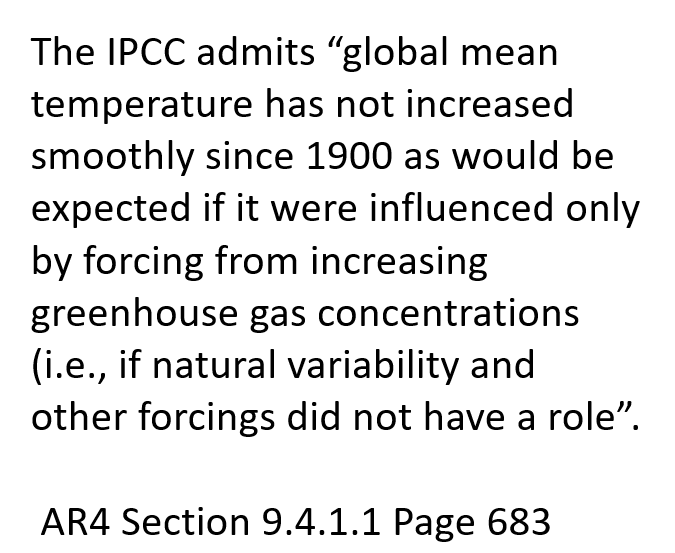
More than 100 comments found. Only the most recent 100 have been displayed.






THE ESCALATOR

(free to republish)