



 Arguments









What does Solar Cycle Length tell us about the sun's role in global warming?
What the science says...
The claim that solar cycle length proves the sun is driving global warming is based on a single study published in 1991. Subsequent research, including a paper by a co-author of the original 1991 paper, finds the opposite conclusion. Solar cycle length as a proxy for solar activity tells us the sun has had very little contribution to global warming since 1975.
Solar Cycle Length proves its the sun
In 1991, Eigil Friis-Christensen and Knud Lassen published an article claiming "strikingly good agreement" between solar cycle lengths (the fluctuating lengths of cycles undergone by sunspot numbers) and northern hemisphere land temperatures over the period 1860–1990 (Friis-Christensen 1991).
Solar cycle length is a useful indicator of long term changes in solar activity. When the sun gets hotter, we observe shorter solar cycles. When the sun shows a long term cooling trend, solar cycle length is longer. A 1991 study by Friis-Christensen and Lassen smoothed out data on solar cycle length and compared it to Northern Hemisphere temperature (Friis-Christensen 1991). The authors suggested the close correlation between solar cycle length and temperature supports the direct influence of solar activity on climate over the past 130 years. Note in particular the close correlation after 1980 during the modern global warming trend.
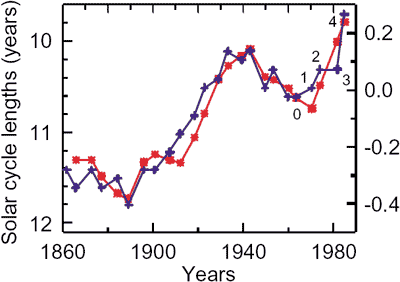
Figure 1: Changes in solar cycle length (blue crosses) versus change in Northern Hemisphere temperature (red *).
However, the solar cycle data presented in Figure 1 consists of two incongruous sets of data. The first 20 points of the graph are smoothed using a 1-2-2-2-1 running average. However, the last 4 points (marked 1 to 4 in the figure below) are not filtered in the same manner. Points 1 and 2 are only partially filtered. Points 3 and 4 are not filtered at all. In effect, it's like marrying two separate sets of data. When the latest data points are properly filtered using the latest solar data, the decrease in solar cycle length from 1980 disappears (Laut 2003).
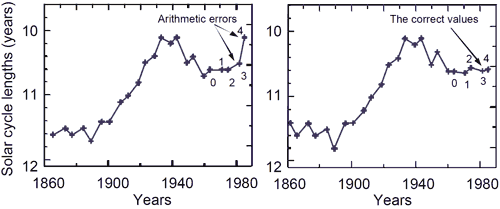
Figure 2: Left: Original solar cycle length data from Friis-Christensen 1991. The last two points, 3 and 4 are due to errors in the authors’ arithmetic. Right: Updated solar cycle lengths using latest data from Thejll 2000.
In 1999, one of the co-authors of the original 1991 paper updated their analysis with the latest data (Lassen 1999). They found that the solar cycle length showed no trend in the last few decades of global warming. They concluded that "since around 1990 the type of Solar forcing that is described by the solar cycle length model no longer dominates the long-term variation of the Northern hemisphere land air temperature".
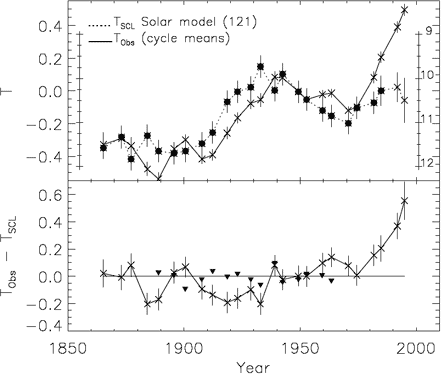
Figure 3: the top figure compares temperature to solar cycles. The bottom figure plots the difference between temperature and solar cycle length, showing a strong divergence in the mid 1970s (Lassen 1999).
Other studies confirm Lassen's conclusion:
- Kelly 1992 models the effects of a combination of greenhouse and solar-cycle-length forcing and compare the results with observed temperatures. They find that "even with optimized solar forcing, most of the recent warming trend is explained by greenhouse forcing".
- Laut 1998 analyses the period 1579–1987 and finds "the solar hypothesis—instead of contradicting—appears to support the assumption of a significant warming due to human activities".
- Damon 1999 uses the pre-industrial record as a boundary condition and finds the SCL-temperature correlation corresponds to an estimated 25% of global warming to 1980 and 15% to 1997.
- Benestad 2005 concludes "There have been speculations about an association between the solar cycle length and Earth's climate, however, the solar cycle length analysis does not follow Earth's global mean surface temperature. A further comparison with the monthly sunspot number, cosmic galactic rays and 10.7 cm absolute radio flux since 1950 gives no indication of a systematic trend in the level of solar activity that can explain the most recent global warming".
Claims that solar cycle length prove the sun is causing global warming are based on a single paper published nearly 20 years ago. Subsequent research, including a paper by a co-author of the original 1991 paper, finds the opposite conclusion. Solar cycle length as a proxy for solar activity tells us the sun has had very little contribution to global warming since 1975. In fact, direct measurements of solar activity indicate the sun has had a slight cooling effect on climate in recent decades while global temperatures have been rising.
Last updated on 26 October 2016 by John Cook. View Archives
 The first thing you should notice is that it looks nothing like the solar cycle lengths from 1860 as shown in Friis-Christensen 1991, particularly in the early part of the 20th century. One or the other of these papers has got the solar cycle lengths wrong, and possibly both. Given the central role of solar cycle length in this theory, that does not inspire confidence.
The second thing to do is to assume that the theory is not simply astrology. By that, I mean that the theory must postulate some causal connection between solar cycle length and global temperatures. The connection may be indirect. It may be that some factor causes the changes in solar cycle length and also through an extended causal chain causes the changes in global temperature, but it must exist.
Given that, we expect temperatures to significantly track solar cycle length if the theory is true. That would mean that global temperatures peak for the 20th century in 1930 (remembering to allow for the lag). They would then have remained almost constant with only a slight downward trend until a very sharp dip in the 1980's, followed by a sharp rise, although not to temperatures experienced in 1930.
Now, we can allow that there is some general trend on top of that pattern, and some noise disrupting that pattern, but the pattern should still be discernible. So what do we get?
The first thing you should notice is that it looks nothing like the solar cycle lengths from 1860 as shown in Friis-Christensen 1991, particularly in the early part of the 20th century. One or the other of these papers has got the solar cycle lengths wrong, and possibly both. Given the central role of solar cycle length in this theory, that does not inspire confidence.
The second thing to do is to assume that the theory is not simply astrology. By that, I mean that the theory must postulate some causal connection between solar cycle length and global temperatures. The connection may be indirect. It may be that some factor causes the changes in solar cycle length and also through an extended causal chain causes the changes in global temperature, but it must exist.
Given that, we expect temperatures to significantly track solar cycle length if the theory is true. That would mean that global temperatures peak for the 20th century in 1930 (remembering to allow for the lag). They would then have remained almost constant with only a slight downward trend until a very sharp dip in the 1980's, followed by a sharp rise, although not to temperatures experienced in 1930.
Now, we can allow that there is some general trend on top of that pattern, and some noise disrupting that pattern, but the pattern should still be discernible. So what do we get?
 We get an early temperature peak a decade too late, 1980's temperatures above that early peak and a continuing sharp rise in temperatures. That pattern is almost completely dissimilar, with the only thing in common being a rising trend over the 20th century.
In other words, this paper is arguing a connection between temperature and solar cycle length on a basis which would equally well establish a connection between global temperatures and the hemlines of skirts. We better hope we have no return to Victorian mores, or else we'll have a little ice age again ;)
We get an early temperature peak a decade too late, 1980's temperatures above that early peak and a continuing sharp rise in temperatures. That pattern is almost completely dissimilar, with the only thing in common being a rising trend over the 20th century.
In other words, this paper is arguing a connection between temperature and solar cycle length on a basis which would equally well establish a connection between global temperatures and the hemlines of skirts. We better hope we have no return to Victorian mores, or else we'll have a little ice age again ;)
 Note the rate of temperature increase at this location: 0.36 deg C per 100 years. Most of the following figures are locations that show similar temperature increases. However, we see rates of 0.18 deg C per decade in much of the northern hemisphere. In other words, the authors have selected locations that show minimal warming. They are effectively analyzing the noise, rather than the signal.
However, figure 13 (Archangel, Russia) shows the most significant warming, at 1.4 deg C per century.
Note the rate of temperature increase at this location: 0.36 deg C per 100 years. Most of the following figures are locations that show similar temperature increases. However, we see rates of 0.18 deg C per decade in much of the northern hemisphere. In other words, the authors have selected locations that show minimal warming. They are effectively analyzing the noise, rather than the signal.
However, figure 13 (Archangel, Russia) shows the most significant warming, at 1.4 deg C per century.
 In the upper panel, the temperature is 'corrected' for this sunspot cycle length. Despite that 'correction,' the upper panel clearly shows additional warming of more than 1 degree C since the 1970s. In that time period, figure 1 (posted by Tom C above), sunspot cycle length has no discernible trend. How, then does cycle length explain away that warming?
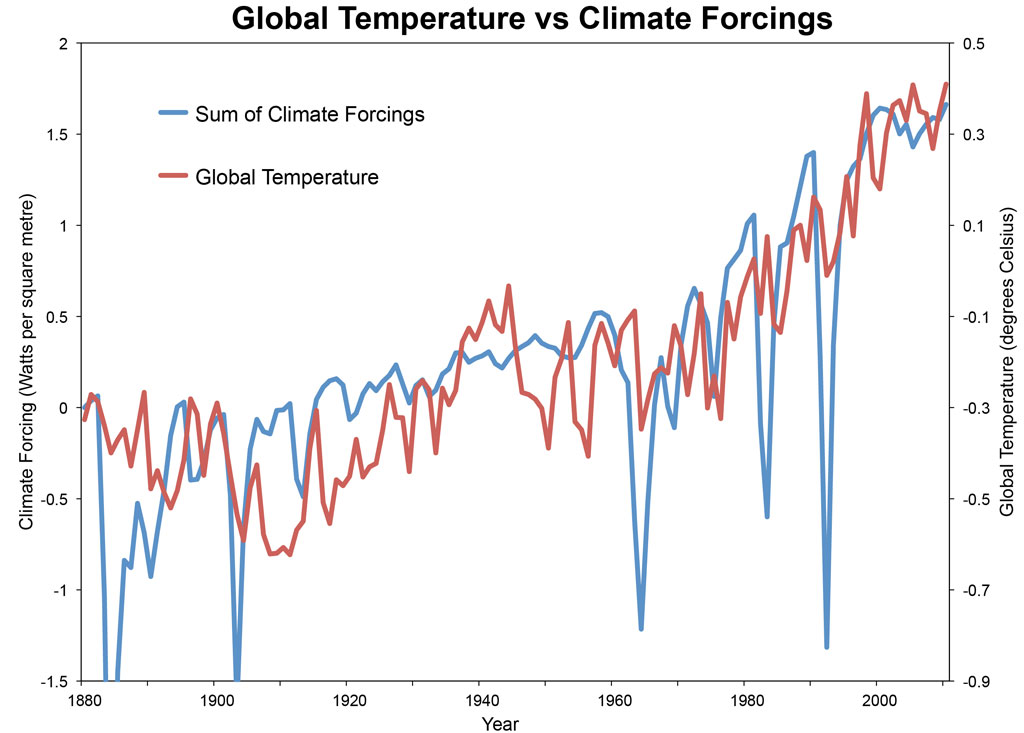 To further reinforce the point, here is a direct comparison between solar cycle length as determined by Solheim et al and global temperatures lagged by approximately one solar cycle (as required by their theory):
 Solheim et al (and tompinlb) want us to believe that the changes in solar cycle length are responsible for 40% of the trend in global temperatures. They think that is a better theory than that the temperature increase is explained by known forcings. I suggest that represents desperation (anything but CO2), not analysis.
(Unfortunately my longer response covering a number of additional points got eaten by the gods of the web. I may bring up some of those additional points in a later post.)
Edited: 5:41pm to show corrected image.
Solheim et al (and tompinlb) want us to believe that the changes in solar cycle length are responsible for 40% of the trend in global temperatures. They think that is a better theory than that the temperature increase is explained by known forcings. I suggest that represents desperation (anything but CO2), not analysis.
(Unfortunately my longer response covering a number of additional points got eaten by the gods of the web. I may bring up some of those additional points in a later post.)
Edited: 5:41pm to show corrected image.







Climate Myth...