



 Arguments









Positives and negatives of global warming
What the science says...
| Select a level... |
 Basic
Basic
|
 Intermediate
|
 Advanced
| ||||
|
Negative impacts of global warming on agriculture, health & environment far outweigh any positives. |
|||||||
Climate Myth...
It's not bad
"By the way, if you’re going to vote for something, vote for warming. Less deaths due to cold, regions more habitable, larger crops, longer growing season. That’s good. Warming helps the poor." (John MacArthur)
At a glance
“It's not going to be too bad”, some people optimistically say. Too right. It's going to be worse than that. There are various forms this argument takes. For example, some like to point out that carbon dioxide (CO2) is plant-food – as if nobody else knew that. It is, but it's just one of a number of essential nutrients such as water and minerals. To be healthy, plants require them all.
We know how climate change disrupts agriculture through more intense droughts, raging floods or soil degradation – we've either experienced these phenomena ourselves or seen them on TV news reports. Where droughts intensify and/or become more prolonged, the very viability of agriculture becomes compromised. You can have all the CO2 in the world but without their water and minerals, the plants will die just the same.
At the same time, increased warming is adversely affecting countries where conditions are already close to the limit beyond which yields reduce or crops entirely fail. Parts of sub-Saharan Africa fall into this category. Elsewhere, many millions of people – about one-sixth of the world’s population - rely on fresh water supplied yearly by mountain glaciers through their natural melt and regrowth cycles. Those water supplies are at risk of failure as the glaciers retreat. Everywhere you look, climate change loads the dice with problems, both now and in the future.
Please use this form to provide feedback about this new "At a glance" section. Read a more technical version below or dig deeper via the tabs above!
Further details
Most climate change impacts will confer few or no benefits, but may do great harm at considerable costs. We'll look at the picture, sector by sector below figure 1.
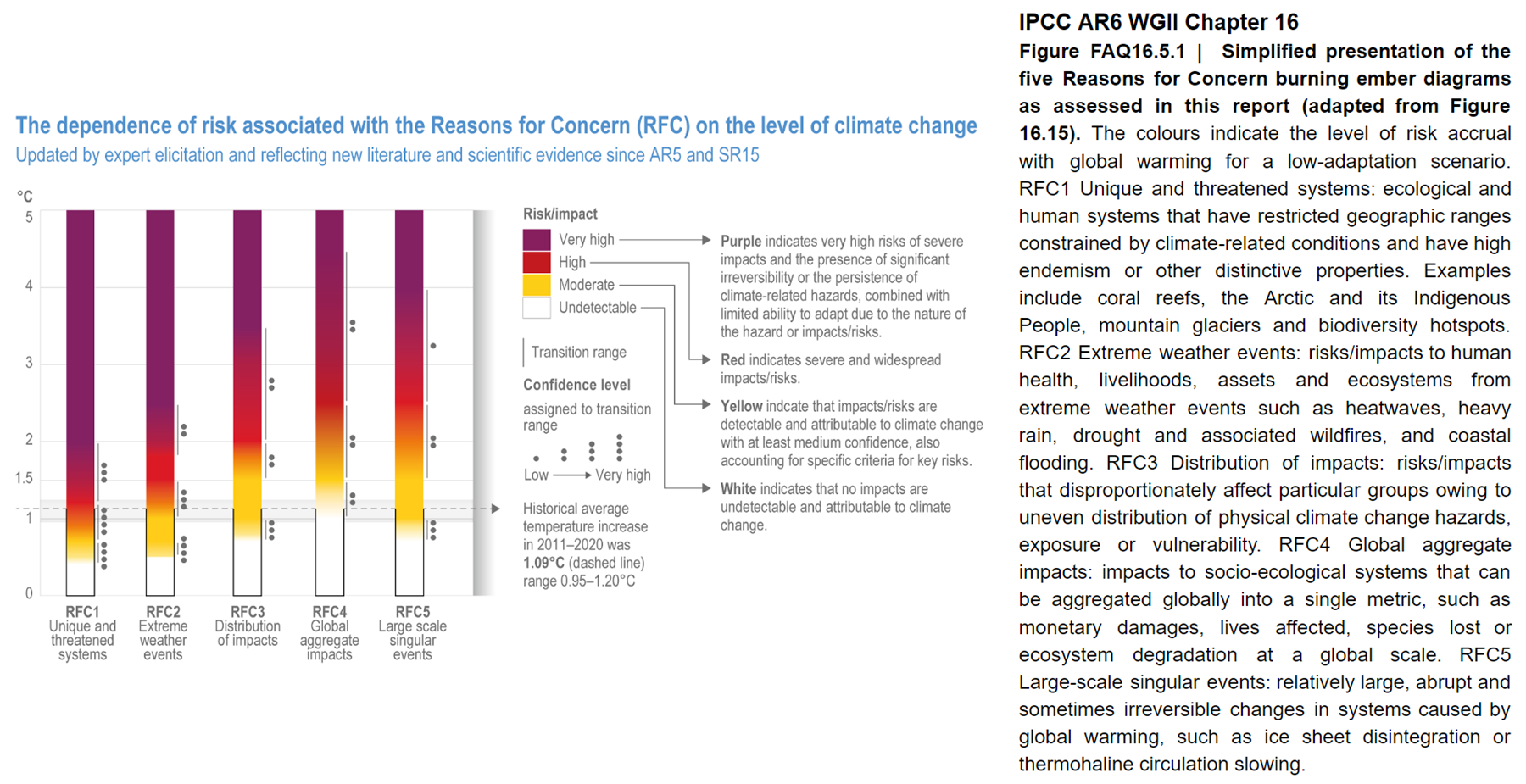
Figure 1: Simplified presentation of the five Reasons for Concern burning ember diagrams as assessed in IPCC AR6 Working Group 2 Chapter 16 (adapted from Figure 16.15, Figure FAQ 16.5.1).
Agriculture
While CO2 is essential for plant growth, that gas is just one thing they need in order to stay healthy. All agriculture also depends on steady water supplies and climate change is likely to disrupt those in places, both through soil-eroding floods and droughts.
It has been suggested that higher latitudes – Siberia, for example – may become productive due to global warming, but in reality it takes a considerable amount of time (centuries plus) for healthy soils to develop naturally. The soil in Arctic Siberia and nearby territories is generally very poor – peat underlain by permafrost in many places, on top of which sunlight is limited at such high latitudes. Or, as a veg-growing market gardening friend told us, “This whole idea of "we'll be growing grains on the tundra" is just spouted by idiots who haven't grown as much as a carrot in their life and therefore simply don't have a clue that we need intact ecosystems to produce our food.” So there are other reasons why widespread cultivation up there is going to be a tall order.
Agriculture can also be disrupted by wildfires and changes in the timing of the seasons, both of which are already taking place. Changes to grasslands and water supplies can impact grazing and welfare of domestic livestock. Increased warming may also have a greater effect on countries whose climate is already near or at a temperature limit over which yields reduce or crops fail – in parts of the Middle East and sub-Saharan Africa, for example.
Health
Warmer winters would mean fewer deaths, particularly among vulnerable groups like the elderly. However, the very same groups are also highly vulnerable to heatwaves. On a warmer planet, excess deaths caused by heatwaves are expected to be approximately five times higher than winter deaths prevented.
In addition, it is widely understood that as warmer conditions spread polewards, that will also encourage the migration of disease-bearing insects like mosquitoes, ticks and so on. So long as they have habitat and agreeable temperatures to suit their requirements, they'll make themselves at home. Just as one example out of many, malaria is already appearing in places it hasn’t been seen before.
Polar Melting
While the opening of a year-round ice-free Arctic passage between the Atlantic and Pacific oceans would have some commercial benefits, these are considerably outweighed by the negatives. Detrimental effects include increased iceberg hazards to shipping and loss of ice albedo (the reflection of sunshine) due to melting sea-ice allowing the ocean to absorb more incoming solar radiation. The latter is a good example of a positive climate feedback. Ice melts away, waters absorb more energy and warming waters increase glacier melt around the coastlines of adjacent lands.
Warmer ocean water also raises the temperature of submerged Arctic permafrost, which then releases methane, a very potent greenhouse gas. The latter process has been observed occurring in the waters of the East Siberian Arctic Shelf and is poorly understood. At the other end of the planet, melting and break-up of the Antarctic ice shelves will speed up the land-glaciers they hold back, thereby adding significantly to sea-level rise.
Ocean Acidification
Acidity is measured by the pH scale (0 = highly acidic, 7 = neutral, 14 = highly alkaline). The lowering of ocean pH is a cause for considerable concern without any counter-benefits at all. This process is caused by additional CO2 being absorbed in the water. Why that's a problem is because critters that build their shells out of calcium carbonate, such as bivalves, snails and many others, may find that carbonate dissolving faster than they can make it. The impact that would have on the marine food-chain should be self-evident.
Melting Glaciers
The effects of glaciers melting are largely detrimental and some have already been mentioned. But a major impact would be that many millions of people (one-sixth of the world’s population) depend on fresh water supplied each year by the seasonal melt and regrowth cycles of glaciers. Melt them and those water supplies, vital not just for drinking but for agriculture, will fail.
Sea Level Rise
Many parts of the world are low-lying and will be severely affected even by modest sea level rises. Rice paddies are already becoming inundated with salt water, destroying the crops. Seawater is contaminating rivers as it mixes with fresh water further upstream, and aquifers are becoming saline. The viability of some coastal communities is already under discussion, since raised sea levels in combination with seasonal storms will lead to worse flooding as waves overtop more sea defences.
Environmental
Positive effects of climate change may include greener rainforests and enhanced plant growth in the Amazon, increased vegetation in northern latitudes and possible increases in plankton biomass in some parts of the ocean.
Negative responses may include some or all of the following: further expansion of oxygen-poor ocean “dead zones”, contamination or exhaustion of fresh water supplies, increased incidence of natural fires and extensive vegetation die-off due to droughts. Increased risk of coral extinction, changes in migration patterns of birds and animals, changes in seasonal timing and disruption to food chains: all of these processes point towards widespread species loss.
Economic
Economic impacts of climate change are highly likely to be catastrophic, while there have been very few benefits projected at all. As long ago as 2006, the Stern Report made clear the overall pattern of economic distress and that prevention was far cheaper than adaptation.
Scenarios projected in IPCC reports have repeatedly warned of massive future migrations due to unprecedented disruptions to global agriculture, trade, transport, energy supplies, labour markets, banking and finance, investment and insurance. Such disturbances would wreak havoc on the stability of both developed and developing nations and they substantially increase the risk of future conflicts. Furthermore, it is widely accepted that the detrimental effects of climate change will be visited mostly on those countries least equipped to cope with it, socially or economically.
These and other areas of concern are covered in far more detail in the 36-page Summary for Policymakers from the IPCC AR6 Synthesis Report, released in March 2023. The report spells out in no uncertain terms the increasingly serious issues Mankind faces; the longer that meaningful action on climate is neglected, the greater the severity of impacts. The report is available for download here.
Last updated on 21 April 2023 by John Mason. View Archives








Hi,
To add a bit to my comments from a couple of years ago:
https://www.bloomberg.com/news/features/2021-10-07/how-climate-scientists-do-extreme-weather-attribution
Climate Scientists Created a SWAT Team for Weather Disasters
Friederike Otto and her colleagues jump into action during heat waves, floods, and fires to pinpoint if global warming is to blame.
By Eric Roston
October 6, 2021 at 10:00 PM MST
"...WWA’s success has come in part from using a peer-reviewed process—even if the rapid analyses themselves aren’t formally published for a year. A 2012 workshop at Oxford introduced the field to a broad range of professionals. “They asked user groups whether they would be interested in attribution results, and pretty much all of them said no,” Van Oldenborgh says. There were two notable exceptions: lawyers and journalists...."
"...World Weather Attribution earns the biggest and most regular headlines, but other groups are also at work analyzing “angry weather”—the title of Otto’s 2020 book. The climate science and policy website CarbonBrief.org counted more than 350 peer-reviewed studies earlier this year. Since 2012, Stott and colleagues have edited an annual research collection called Explaining Extreme Events From a Climate Perspective...."
-----
Basically it appears to me that the science of attribution is further along than I realized when we first had this discussion. Would it be possible for skepticalscience.com to take a second look at this and consider explaining to readers that while there is dispute over methods and results when attribution is attempted, it does appear that scientists have made progress in this area?
This seems to be the website of world weather attribution.
https://www.worldweatherattribution.org/
Jlsoaz @426 :
quite possibly it would be hard to justify the effort of delving into & explaining the various aspects of "Attribution".
As you say, the question of Attribution is of interest to some ~ but it is rather difficult to handle such a fuzzy field. Calamitous weather events are multi-factorial in origin, and with a large percentage of chaos (as is all weather).
Maybe one could point to a 10% through to 50% causation coming from Global Warming . . . but even those percentages would have little influence on climate-change Deniers, and probably little persuasive effect on the average Politician or the Man-in-the-street.
The long-term effects of sea level rise, plus the bogeyman of increased migration of Third World refugees (from increasingly distressed regions) would ~ I strongly suspect ~ be more likely to stimulate public demand for greater action in tackling our Global Warming problem.
Eclectic at post number 427:
In my opinion,
it could be useful to do some thinking around the wording of the myth that needs busting here. Is it "Myth: Nobody has died from global warming."? Or perhaps it is something like:
Myth: Under strict defensible peer-reviewed scientific methods, deaths, health impacts and property damage cannot be attributed to global warming.
Reality: Under strict defensible peer-reviewed scientific methods, deaths, health impacts and property damage are difficult to attribute to any one cause such as global warming, but probability estimates can be made, and over time it becomes more clear whether a given cause is having certain impacts, even when there are many other possible factors. We have seen this with smoking and other killers where it was difficult for scientists to attribute deaths at first, but after much research and careful following of established epidemiological methods, attribution was possible.
As to whether it would be useful for skepticalscience.com to put forth the resources to get this one my busted, I'm assuming that all myths busted require some effort, including possible consultation with relevant scientific experts or at least careful study of their publications, and I do not recall a single instance of skeptical science indicating that they would refrain from busting a myth because a member thought it would not be that helpful.
As a side-note, I disagree with your strong opinion. I can't think of anything that (in my own fallible opinion) is more likely to upset denialists more than attribution of (and discussion and debate of attribution of) deaths to Anthropogenic Climate Change. Ideally, we will eventually see counters (similar to the atomic bombs of heat counter on skepticalscience.com) which will show range estimates for how many deaths are attributable to ACC.
Jlsoaz @ 428 :
Not to be argumentative ~ which I never am . . . well, hardly ever ~ and I never say a big big D-—
[unlike in the days of Gilbert & Sullivan, a big big D- nowadays stands for Denier ]
.... Though to reply to you seriously :
~ My opinion is not strong, but merely ordinary.
~ SkepticalScience is a volunteer website, and thus suffers from limitation in time & resources to tackle/review any issue . . . and so prioritization should always be front-of-mind. All of which is a way of suggesting that it would be most welcome if you yourself submitted (to the Editorial Board) a cogent analysis of the Attribution current status.
~ Yes, I agree with you that "attribution" of property damages & deaths does upset denialists. But denialists are delicate creatures, and are sensitive to all sorts of issues. And upsetting denialists does not change their opinions. They simply carry on digging in deeper with their Motivated Reasoning.
~ It is the politician and the Man-in-the-street who can be influenced by occasional headlines pointing out the Attribution component. Yet the cry of Attribution is like the Boy-who-cried-Wolf . . . the result can easily be a public numbness as (in the years between major hurricane and flood damage) the public's life returns to normal or normal-ish. Especially since it is so easy for denialists to publicly cloud the issue by pointing out the fuzziness of the data . . . and how the local flood/hurricane was ever-so-much worse in Grand-pappy's time back in 1920 or 1880 or whatever.
~ My ordinary opinion is that you will have greater success by using arguments related to pocket-book issues (and perhaps: refugee migration increase). Priorities !
Jlsoaz @ 428:
As Eclectic notes in his response, SkS is a volunteer effort.
In addition, the idea that there can be a specific attribution of a single death, a single health outcome, a single item of property damage that can be attributed to climate or weather is pretty much impossible, as you state.
Epidemiological methods are appropriate, but as you state, these are statistical methods, applying to defined populations - not single events.
Those denying the science (be it climate change, tobacco use, whatever) essentially commit two fallacies in this area:
I doubt that denialists will be bothered by attribution studies - they'll just block them out by applying their Morton's demon.
Hi Bob and Eclectic,
Thanks for your constructive responses from half a year ago.
Also, I just stumbled across this "cross-sectional study" from February 2024.
https://pmc.ncbi.nlm.nih.gov/articles/PMC10862342/
BMJ Med
. 2024 Feb 10;3(1):e000627. doi: 10.1136/bmjmed-2023-000627
Published research on the human health implications of climate change between 2012 and 2021: cross sectional study
Victoria L Bartlett 1, Harry Doernberg 1, Maryam Mooghali 2, Ravi Gupta 3, Joshua D Wallach 4, Kate Nyhan 4,5, Kai Chen 4, Joseph S Ross 2,6,7,✉
PMCID: PMC10862342 PMID: 38352020
--------
Some useful looking quotes:
"What is already known on this topic.
"Climate change is one of the most pressing public health threats of the 21st century, contributing to more than 250 000 deaths each year."
and
"...Eligibility criteria
"Inclusion criteria were peer reviewed, original research articles that investigated the health effects of climate change and were published in English from 2012 to 2021. After identification, a 10% random sample was selected to manually perform a detailed characterisation of research topics and publication information.
Results
"10 325 original research articles were published between 2012 and 2021, and the number of articles increased by 23% annually...."
------
My additional comments to this study and to your comments:
Bob, thanks for the points about the logical fallacies, that helps put this in perspective.
Both, I didn't realize it was a volunteer effort exactly.... though that makes some sense now.
As to the 250,000 deaths per year number they cite, I am not sure where they are getting that (I have only stumbled across the summary today and haven't read the study itself, and doubt I will understand much of it if I do).
Still, the optimistic main thing that I get from this study is that there have been many peer-reviewed studies by now, and taken together, there is growing strength in the claims that have been made as to how many deaths scientists are telling us climate change is "contributing to". I'd have to get to it later to see what exact wording is used in the report.
Jlsoaz @431 :
Figures like 250,000 deaths are a distraction.
They may, or may not, be true . . . and anyway may rely on a very rubbery basis of disputable semantics or on disputable interpretations of overlapping causations.
Also, they sound "alarmist" enough to raise doubts & suspicions within the minds of ordinary citizens ~ who in general are not seeing people dying in the streets, nor seeing everyday news reports of devastated & depopulated villages. The attenuating effects of distance has a large influence on politics & psychology. [e.g. Looking from the Anglophone world, the "news impact" of 500 deaths in a major train wreck in northern India . . . is probably much less than that of 5 deaths occurring in Euston Station, London, or occurring in Penn* Station, New York.]
( * At time of writing, "Penn Station" is correct: though next week it might be "Trump Station".)
For those who take AGW seriously, it is the slow long-term build-up of consequences which is the real threat. Namely the gradual loss of rich productive farmland in the deltas and other coastal areas of the world ~ and for the wealthy temperate regions, getting the "in-your-face" pressure of immigrant refugees who are fleeing from the increase of damaging heatwaves in the more tropical parts.
Eclectic's point about how people respond to death numbers is a good one.
For example let's say that I have a new invention that will give people greatly increased personal mobility and freedom to travel long distances at considerable speed. It would cost them a fair amount of money as an initial outlay, plus perhaps a few thousand dollars per year in annual costs, but it would save them many, many hours per week/month/year compared to other forms of travel. Time they can spend with family, friends, working to earn a living, etc. The investment in $ seems a good trade-off to many people.
...but my invention has a slight flaw. Every five years, on average, something goes horribly wrong, and a city of 200,000 people gets completely obliterated and everyone dies. Would that invention of mine still be worth it, given that cost of lives?
Now, compare that to the modern automobile. It does not obliterate cities in one fell swoop, but in the US there are roughly 40,000 traffic fatalities per year. Is the emotional reaction to vehicles killing people off in ones and twos the same as the emotional reaction to killing off the same number of people in a single devastating event at occasional intervals?
Society has made an effort to reduce traffic fatalities, and the rate of fatalities per vehicle miles travelled has dropped substantially over the past century (see the Wikipedia link I gave earlier). But a lot of that has come as the result of regulation of vehicle design and driver training. (Note that fatalities per capita has not dropped anywhere near as much as fatalities per mile - people are obviously driving a lot more than they used to.)
Certain parts of society seem to be unwilling to make any changes to lifestyle to avoid fatalities occurring in dribs and drabs due to climate change. It would seem that they might not be willing to act unless we start losing people a city at a time.
which leads to here from a couple of months ago:
which leads to here from a couple of months prior to that:
Anyway, it looks like useful research in this area, and I think can help laymen such as myself, along with scientists, have more uniform and intelligible metrics to understand what is happening, and talk it over with our representatives where appropriate to see if they can understand how deadly this whole climate change crisis is.
I can't seem to edit my post, but actually I'm not sure who the guest author was who posted this, but thanks to them for doing it.