



 Arguments
Software
Resources
Comments
The Consensus Project
Translations
About
Support
Arguments
Software
Resources
Comments
The Consensus Project
Translations
About
Support







Latest Posts
- Skeptical Science New Research for Week #37 2026
- Climate Trunk - Political Economy
- Fact brief - Does hosting wind turbines provide farmers with additional income?
- Fixing one of climate’s worst plots
- 2026 SkS Weekly Climate Change & Global Warming News Roundup #36
- Skeptical Science New Research for Week #36 2026
- 10 things athletes, fans, and outdoor advocates can do about climate change
- Forget more reservoirs; should the UK just build desalination plants instead?
- What we can and cannot say about climate change and the Nepal disaster
- 2026 SkS Weekly Climate Change & Global Warming News Roundup #35
- Skeptical Science New Research for Week #35 2026
- Trump’s Iran war supercharged EV sales everywhere except the U.S.
- Fact brief - Do wind turbines release more emissions than burning fossil fuels?
- Climate Adam - Emissions are Flatlining. So Why’s CO2 Rising at Record Speed?
- 2026 SkS Weekly Climate Change & Global Warming News Roundup #34
- Skeptical Science New Research for Week #34 2026
- Is this El Niño a glimpse of a future, hotter Earth?
- Climate Trunk - Science
- Raw Data, Wrong Answers
- 2026 SkS Weekly Climate Change & Global Warming News Roundup #33
- Skeptical Science New Research for Week #33 2026
- The real energy use of agentic AI
- Fact brief - Are there enough minerals for solar power expansion to help mitigate climate change?
- The floods of the future won’t come one at a time
- 2026 SkS Weekly Climate Change & Global Warming News Roundup #32
- Skeptical Science New Research for Week #32 2026
- New Mexico’s clean energy success story
- Is Europe having a bad wildfire year?
- Why Hansen may end up being right about 2026
- 2026 SkS Weekly Climate Change & Global Warming News Roundup #31

Comment Search Results
Search for climate gate
Comments matching the search climate gate:
- Wildfires are not caused by global warming
Cedders at 08:15 AM on 17 August, 2026Bob. Thanks for that and pointing to the recent OWID/Hannah Ritchie explanation, which I'd missed. One other problem with the OWID charts is that they only go back to 2012, and there being a lot of interannual variability, trends in eg Greece may be unlikely to show up.
I'm afraid I didn't see any definition of wildfire in the 2016 Doerr and Santin, but imagine it is fairly broad and based on the EM-DAT database it references (but would exclude deliberate agricultural burning)?
The main point it seemed worth emphasising in a rebuttal, from your earlier post, and from Ritchie and from the Sadegh et al article I linked to earlier (see also Seydi et al. 2025 Increasing global human exposure to wildland fires despite declining burned area ) and also this news item ( "How does global burning show a decreasing trend as Europe and North America continue to grapple with wildfires? Scientists explain" ) is that Africa dominates global fire.
As you say, it would help understanding to disaggregate grass and forest and farmland (Carbon Brief says EFFIS can do this), but also different continents as different things are happening there. I don't see how it would be possible to discount a climate element in Canada's forest fires.
(The dialogue in my bulleted list was meant to be a conversation with someone contrarian relying on the global stats, probably not for a rebuttal article.)
- Dangerous and historic wildfire smoke pollution event engulfs the U.S. and Canada
wilddouglascounty at 00:23 AM on 24 July, 2026Bob @ 7:
Actually I had read Zeke's article from his Climate Brink posts, and I also suggested to him that he read over the article I linked to. The very same figure you linked from that article shows that the native populations were well placed to indeed manage the boreal forests through the use of local, small scale burns that created buffers in much the same way as is being documented in Australian aboriginal fire management practices, most vividly described in Victor Steffensen's excellent book "Fire Country." The goal is not to burn over the entire boreal forest as you suggested in your calculations of hectares/person, but rather to create and mantain a mosaic of burned areas that stimulates biodiversity, breaks up the potential for megafires, protects villages, etc. The nomadic nature of the communities, particularly the seasonal hunting and gathering cycle, is conducive to and consistent with such management practices and there is evidence that such practices covered more land than you might expect. All of this is not to say that the megafire problem exacerbated by climate change is not a huge problem, but as in Australia, the indigenous fire management practices that were practiced for thousands of years, then suppressed, offers an excellent tool for the future in regards to optimizing biodiversity, strengthening the links of human communities to the surrounding boreal forests, and helping mitigate some of the threats of megafires to those communities. Nothing short of reducing our fossil fuel emissions will truly mitigate the mess we're in, but it's a both/and situation that is possible here!
- A look back at ‘An Inconvenient Truth,’ 20 years later
nigelj at 08:00 AM on 17 May, 2026Evan @13, thanks for your comments. I feel there is some grounds for some limited optimism that we have made real progress with the climate issue. You correctly analyse the keeling curve that theres no sign of the keeling curve flattening off. Its depressing to be sure. However I think its hard to see a change, because we haven't done enough yet to make an impact that would appear above the noise in the system.
And I would contend its highly likely that the building of renewables has reduced the rate of growth of the keeling curve. Putting it another way, but for renewables total atmospheric CO2 concentrations would be higher than currently. Obviously we cant be certain of this, but basic evidence and logic points that way.
So as I previously suggested, I think we have some grounds for limited optimism, and should spread a message that we are making some progress but its not nearly enough.
I agree that some commentators over hype the progress we have made. That is definitely neither accurate or helpful. But if we scare people too much so that the problem looks huge and insurmountable, this will discourage climate action.
-------------------------------------------
Prove we are smart @14
"Nigelj@11, I would rather scare them awake than a little uncomfortably numb."
That has generally been my preference. But if you scare people too much, especially if you exaggerate the dangers, or spread a message we are doomed, then you discourage people form taking any climate action.
If I felt we really were doomed, I would say so, and obviously theres no point promoting action to mitigate the problem. We would be stuck purely with adaptation. But I do have some limited optimism we have made a difference, and can make more of a difference. Therefore I think the message should be we have made some progress but not enough, and if we dont make more progress the outcomes will be very serious, etc,etc.
- A look back at ‘An Inconvenient Truth,’ 20 years later
prove we are smart at 18:13 PM on 12 May, 2026From this self explanitory link here, theconversation.com/ten-years-on-how-al-gores-an-inconvenient-truth-made-its-mark-59387 "While most of the research into the impact of AIT investigates the direct effect on viewers, a potentially more significant impact is the film’s role in inspiring others to follow Gore’s example in communicating the issue of climate change to others.
Personally, I can attest to this influence. Before 2006, I hadn’t given much thought to the climate change issue. Watching AIT raised a number of questions about the human role in global warming.
With the issue salient in my mind, I got into conversations with family members who happened to reject the scientific consensus on climate change. This precipitated the founding of Skeptical Science, which led to me becoming a researcher in climate communication at the University of Queensland.
I’ve spoken to or know of many other climate communicators whose awareness of the issue dawned with their viewing of AIT. While the direct effect of the original screening of the film may have dissipated, the impact of those inspired to communicate the realities of climate change persists."
There would be very many grateful people, myself included, now fact informed by Skeptical Science thankyou. We all know it will need global cooperation to halt global warming. The tasks to mostly eliminate fossil fuel use is a complex but hopefully not an impossible one.
Maybe I'm being naive but this gathering of many countries for the first summit for transitioning away from fossil fuels gives me better hope, www.carbonbrief.org/santa-marta-key-outcomes-from-first-summit-on-transitioning-away-from-fossil-fuels/
- Human-caused climate change is unmistakably distinct from Earth’s natural climate variability
Just Dean at 06:51 AM on 24 April, 2026MA Rodger @ 10 — thank you for the careful and substantive engagement. A few clarifications and responses:
On the Judd data points and the plot window: the standard version of my diagram is zoomed to 100–700 ppm for visual clarity, which means the seven higher-CO₂ Cenozoic points aren’t shown. However, the York regression that gives S=8.24 K/doubling, R=0.97 is computed on all 22 Cenozoic stages (LowerAge ≤66 Ma) including those high-CO₂ points — they’re in the regression even when they’re outside the plot window. I’ve recently produced a full-range version (0–1400 ppm) that shows the complete Cenozoic extent including the Eocene hothouse points, and the fits extrapolate correctly to those higher points despite being derived primarily from the ice-age data. That’s actually one of the more remarkable features of the diagram: LINK
The discrepancy between my 8.24 and Judd’s published 7.7 K/doubling is that 7.7 is their full Phanerozoic value (485 Ma), while 8.24 is the Cenozoic-only (66 Ma) subset — both reported in their paper. I use the Cenozoic value because the Cenozoic is the most relevant period for today’s climate state.
Your point about the Judd vs Rae et al CO₂ reconstruction discrepancy at 50 Ma is well taken — that uncertainty propagates into any ESS estimate derived from deep-time data, including mine. On your suggested range of +5 to +9°C however, I’d note that the convergence of five independent fits between 8.24 and 9.91 K/doubling — across different archives, methods, and timescales — suggests the data favors the upper portion of that range rather than the lower end. The lower end would require the Rae et al CO₂ reconstruction to be correct and Judd to be systematically wrong, and would require all five fits to be biased upward — which is difficult to sustain when they converge from completely independent starting points.
Your post-net-zero CO₂ drawdown point is important and consistent with my framing. I describe the equilibrium curve as where the physics “ultimately points given enough time.” The natural drawdown means the system will tend back toward the curve at a CO₂ level determined by where emissions peak and how much natural drawdown occurs subsequently — not necessarily at the peak concentration itself. That’s precisely why the timing of net-zero matters — earlier net-zero means lower peak CO₂, lower eventual equilibrium, and a lower landing point on the curve.
Dean Rovang
justdean.substack.com - 2026 SkS Weekly Climate Change & Global Warming News Roundup #14
One Planet Only Forever at 08:54 AM on 8 April, 2026Recent SkS posted items raise important awareness and understanding related to the historic challenge of dealing with the damage done by people who choose to fail to responsibly learn to self-regulate their actions. Thank you to Doug and Marc for curating and sharing the Weekly New Research, and to Baerbel, John, and Doug (again) for curating and sharing the Weekly News Roundups.
A related item in this week’s Climate Policy and Politics list is, Vermont Hits Back at Trump’s Effort to Block ‘Climate Superfund’ Law. It is about responsible leaders struggling to use the powers they have, State powers in Vermont, to penalize and limit the climate change harm done by the global team of undeserving economic winners.
Responsible leadership struggles to effectively discourage and disappoint people who want to benefit from being: less accepting of diversity, more harmful, and less helpful. Humanity, especially its leaders, has a history of struggling regionally and globally to collectively correct and recover from results of harmful pursuits of benefit and get the beneficiaries of the harm done to make equitable and adequate reparations. It is more challenging when members of a regional or global club of harmful unhelpful people Win positions of power that enable them to make-up inequitable rules and harmfully enforce rules to avoid being penalized and to threaten, penalize and punish everyone they believe is a potential threat to their undeserved perceptions of superiority.
People passionately pursuing being perceived to be “The Winners” are most likely “The Problem”.
Restricting a person’s freedom to continue to benefit from understandably unsustainable harmful actions - does not harm them.
Penalizing a person for benefiting from understandably harmful actions and making their penalty help those who have been harmed - does not harm them.
An earlier related item is the study The political economy of leaving fossil fuels underground: The case of producing countries, listed in Open Access Notables in Skeptical Science New Research for Week #13 2026.
The study discusses the challenging temptation to pursue ‘Private Profits and Rents’ while creating ‘Public Problems’ by extracting and exporting non-renewable resources, especially challenging for developing nations.
The developed economic system is fatally flawed in many ways. One of the major flaws is that it values the removal and use of non-renewable resources, and ignores the harm done (it also encourages more harm to be done because it is easier and more profitable to be more harmful). Non-renewable resources have no value when they are left in the ground.
And the challenge is made worse by unjust made-up rules like the 1994 Energy Charter Treaty (Wikipedia link) (ECT). The EU formally withdrew from the ECT in June 2024. But the ECT rules were include ‘protection’ of Fossil Fuel investment rewards for 20 years after withdrawal (to 2044).
Another recent related item is Quantifying climate loss and damage consistent with a social cost of carbon, the first item listed in Open Access Notables in Skeptical Science New Research for Week #14 2026, (which was the basis of news item, Past CO2 emissions may drive far bigger future economic losses, in 2026 SkS Weekly Climate Change & Global Warming News Roundup #13). The study explains that calculating the penalty owed today for fossil fuel harms of emissions-to-date should begin as early as 1980 and extend far into the future.
The following quote is regarding the earliest date it would be reasonable to say leaders would struggle to deny understanding the harmfulness of fossil fuel use:
To estimate when to begin counting emissions, we set our baseline ‘year of knowledge’ as 1990, or a year after the establishment of the IPCC. This is perhaps conservative: using text-based analysis of United Nations documents, other analyses set the date a decade earlier, and internal company documents reveal that some major emitters were aware of climate risks beginning around 1980.
Any pursuer of profit from fossil fuel use since 1990, and potentially since 1980, would struggle to credibly claim that they were unaware of the harm done by fossil fuel use. This reinforces the understanding that the Energy Charter Treaty was an unjust rule made-up by undeserving wealthy people.
Both studies also relate to Don Gillmore’s 2025 book, On Oil that I recently commented about (here @ comment 25 on the SkS post, After a major blow to U.S. climate regulations, what comes next?). In addition to presenting the general understanding that Alberta and other regional populations are easily tempted to pursue benefit from harmful fossil fuel use, and things really took off in about 1980, the chapter titled The Battle Begins opens with the following reinforcement of 1980 as a legitimate start date for evaluating penalties to apply to beneficiaries of harmful fossil fuel use:
In 1980, Ronald Reagan became president of the United States and appointed James Watt, a determined anti-environmentalist, as secretary of the Department of the Interior. Watt described environmentalists as “a leftwing cult dedicated to bringing down the type of government I believe in,” and refused to meet with them. Watt was a devout Christian who believed the End Times were near. “I do not know,” he said to Congress in 1981, “how many future generations we can count on before the Lord returns.” In the meantime there wasn’t much point in preserving the environment. Reagan concurred, telling television evangelist Jim Bakker, “We may be the generation that sees Armageddon.”
Anne Gorsuch, a lawyer who was scornful of climate science (and whose son Neil sits on the Supreme Court), was given the role of Administrator of the Environmental Protection Agency, and cut the EPA budget by 22 percent and staff by almost 30 percent. Enforcement declined by 79 percent during her first year. She hired people from the industries the EPA was supposed to be regulating, tried to weaken pollution standards, and facilitated the use of restricted-use pesticides. She resigned in 1983 amid scandal, ... Her most lasting legacy may have been to solidify political battle lines around oil and the environment: If you were a Republican, you were pro-development and, if not anti-environment, at least anti-environmentalist. It began as a corporate issue, then became a political issue and to some extent a generational issue, and finally, like so much these days, it became a tribal issue.
The formation of the ECT in 1994, 14 years after 1980, should be understood to be a misleading attempt to unjustifiably obtain benefit and protect against the loss of undeserved perceptions of superiority. And since 1980 it has continually become clearer that investments in new fossil fuel pursuits should be considered to be bets in the marketplace that deserve whatever ‘penalties or losses of opportunity for benefit’ happen. The people who benefited from the delay of transition away from fossil fuel use since 1980, particularly business leaders and investors, could and should be penalized rather than be protected and rewarded. ‘Legal creations’ like the ECT should not be able to be used to evade penalty for past ‘bad bets made on benefiting from fossil fuel use’.
There is a long diverse history of harmful pursers of personal benefit seriously damaging and delaying the development of sustainable improvements for the future of humanity. The, now officially discredited, Doctrine of Discovery developed as Papal Bulls in the 1400s (Link to Canadian Museum for Human Rights) and was formally brought into American Law by US Supreme Court Justice John Marshall in 1823 (Link to Wikipedia). It was misleading marketing to excuse undeniably harmful colonialism, racism, and slavery. The incorrect beliefs about the ‘fundamental superiority of a sub-set of humanity’ persist in the supposedly most advanced societies today, and contaminate the thoughts and actions in many developing societies, allowing neocolonialism (link to Wikipedia) to flourish.
People passionately pursuing being perceived to be “The Winners” are most likely “The Problem”.
I have also been re-reading Thomas Piketty’s 2021 book, A Brief History of Equality (first english translation 2022). The following are selected related quotes:
From Chapter 9, Exiting Neocolonialism, which includes a sub-section with the heading, The Pretenses of International Aid and Climate Policies.
The battle for equality is not over. It must be continued by pushing to its logical conclusion the movement toward the welfare state, progressive taxation, real equality, and the struggle against all kinds of discrimination. The battle also, and especially, involves a structural transformation of the global economic system [including reparations (penalties) for harms done by past emissions, and no compensation for people claiming to be harmed by restrictions of their harmfulness and penalties for being harmful] .
…
Our current economic organization, which is founded on the uncontrolled circulation of capital lacking either a social or environmental objective, often resembles a form of neocolonialism that benefits the wealthiest persons. This model of development is politically and ecologically untenable. Moving beyond it requires the transformation of the national welfare state into a federal [multi-national] welfare state open to the global South, along with a profound revision of the rules and treaties that currently govern globalization.
...
We must also emphasize the extreme hypocrisy that surrounds the very notion of international aid. First, public aid for development is much more limited than is often imagined: in all, it represents less than 0.2 percent of the global GDP (and scarcely 0.03 percent of the global GDP for emergency humanitarian aid). In comparison, the cost of climatic damage inflicted on poor countries by past and current emissions from rich countries amounts by itself to several points of the global GDP. The second problem, which is not a detail [not a minor technicality], is that in most of the countries supposedly “aided” in Africa, South Asia, and elsewhere, the amount of outflow in the form of multinationals’ profits and capital flights [evading taxation] is in reality several times greater than the incoming flows from public assistance, …
Chapter 10 sub-section with the heading, Climate Change and the Battle Between Ideologies.
All the transformations [sustainable improvements reducing harmful inequality] discussed in this book, whether the development of the welfare state, progressive taxation, participatory socialism, electoral and educational equality, or the exit from neocolonialism, will occur only if they are accompanied by strong mobilizations and power relationships. There is nothing surprising about that: in the past, it has always been struggles and collective movements that have made it possible to replace old [harmful unsustainable] structures with new institutions.
…
Environmental catastrophes are, of course, among the factors that may help accelerate the pace of change. In theory, we could hope that the mere prospect of these catastrophes, whose future occurrence scientific research has increasingly confirmed, might suffice to provoke adequate mobilization. Unfortunately, it is possible that only tangible concrete damage greater than we have already seen will manage to break down conservative attitudes and radically challenge the current economic system.
…
In the darkest scenario, the signals will come too late to avoid conflicts between nations over resources, and it will take decades to realize possible, as yet hypothetical reconstructions [sustainable developments like Diversity, Equity and Inclusion pursuits to mitigate and correct high levels of inequality] [we are potentially already experiencing that Darkest Scenario].
…
We can also foresee hostile reactions towards countries and social groups whose ways of life have contributed most to the disaster, starting with the richest classes in the United States, but also in Europe and the rest of the world.
…
the global North, despite a limited population (about 15% of world population for the United States, Canada, Europe, Russia, and Japan), has produced nearly 80% of the carbon emissions that have accumulated since the beginning of the Industrial Age.
…
However, we have to qualify the idea that a green Enlightenment will be likely to save the planet. In reality, people have suspected for a long time – indeed almost since the beginning of the Industrial Revolution – that this accelerated burning of fossil fuels might have harmful effects. If reactions have been slow and remain so limited even today, that is also and especially because the economic interests at stake are considerable, between countries as well as within them. For the countries most affected (in particular in the global South), the attenuation of the effects of a warming climate and financing for measures to adapt to it will require a transformation of the distribution of wealth and the economic system as a whole, and this in turn will involve the development of new political and social coalitions on a global scale. The idea that there might be only winners is a dangerous and anesthetizing illusion that must be abandoned immediately.
It all closes back to the SkS items that this comment started with.
People passionately pursuing being perceived to be “The Winners” are most likely “The Problem”.
- The El Niño cometh
prove we are smart at 11:51 AM on 26 March, 2026Climate change is increasing the natural chaos of the air masses that move around our tilted planet. In near twelve months,one hemisphere then the other, take its turn, absorbing the more perpendicular radiation from our star.
The current and ever increasing unprecedented weather catastrophes will surely be amplified by the Enso phases. All countries really need and especially in this climate, leaders and government with foresight and empathy and using qualified people to navigate. Sometimes it is obvious how poorly gov perform and sometimes you need to look up and be an unsilent majority-make science great again. www.nokings.org/
- Is Nuclear Energy the Answer?
michael sweet at 06:18 AM on 20 March, 2026Pollution Monster:
Your reference Nuclear Energy Decarbonization seems to me to be simply a regurgitation of nuclear industry propaganda. It has too many false claims for me to begin to list them all. For example it claims:
"For example, in hybrid systems for island economies such as the Canary Islands, SMRs have proven to be a viable solution, achieving competitive levelized costs of electricity (LCOE) ranging from EUR 46 to EUR 84/MWh when integrated with renewables and hydrogen production." my emphasis
How can they possibly have "proven" that SMRs can do anything when no designs for non military SMRs have been approved and none have been built? This is just accepting industry propaganda. Renewable energy costs less that EUR 40 today.
Later they say:
"Finally, there are structural and economic limitations that challenge the sustainability of nuclear energy. The inherent risk of nuclear safety is so high that coverage in free markets is unfeasible without state subsidies, which undermines the principles of just sustainability and intergenerational responsibility. Moreover, the full life cycle of the technology (from uranium mining to plant decommissioning and waste management) entails an emissions footprint and environmental impacts that contradict its claimed climate benefits. In the face of increasingly competitive and safer renewable technologies, the continued relevance of the nuclear sector demands radical transformations in its governance and a structural reduction in risk in order for it to be considered a truly sustainable option." my emphasis
So I should accept an industry that is so risky they cannot provide insurance for their accidents and taxpayers will have to pay to clean up their mistakes? While they take all the profits?
They cite an economic analysis that claims nuclear is cost and materials effective compared to solar and wind that was published in 2007 (their ref 110)? Do you realize that the cost and materials of solar and wind have declined immensely since 2007 while nuclear has increased in cost? It is dishonest to use completely outdated information when up to date information is readily available.
The journal Processes does not seem to me to be a good place for an analysis of energy when many other more suitable journals exist.
You are selectively quoting Abbott 2012. He says "It can also be argued" not that he supports that opinion. Obviously your cite makes that argument. In Abbott's conclusion he states:
"There are fundamental engineering and resource limits that make the notion of a nuclear utopia impractical. It can be argued [Abbott does not agree with this argument] that a nuclear nirvana supplemented by renewables may mitigate the need to reach 15 terawatts by nuclear alone (Manheimer, 2006). However, a reduced goal of several terawatts of nuclear power would still run into many of the limitations described above. Even for a more modest goal of 1 terawatt, one only has to divide the numbers above by 15 to see that a single terawatt still stretches resources and risks considerably." my emphasis
Nuclear supporters have never responded to Abbott. They cannot now claim that his objections are null because they have not countered them.
Keep reading about renewable power. In the last day more renewable energy was installed than nuclear in the last year. Don't believe all the nuclear propaganda that nuclear supporters accept as gospel. Remember that SMR developers promised in 2006 that they would have running reactors by 2020. It is impossible for them to manufacture significant numbers of reactors before 2040. Renewable energy will generate all current electricity and transportation by then. Nuclear cannot compete on price.
With the war in Iran showing how economically risky fossil fuels are many countries are increasiing their uptake of renewables to protect their economies.
Nuclear power is too expensive, takes too long to build and there is not enough uranium.
- Why Science Communication Fails: How to Break Down Misleading Arguments and Inoculate Against Misinformation
Eric (skeptic) at 09:19 AM on 15 March, 2026Just Dean, the dashed black line in the diagram in justdean.substack.com/p/how-one-diagram-reveals-the-climate comes from geographic changes that drive both temperatuire and CO2. CO2 is an amplifier of temperature and temperature is an amplifier of CO2, but geography dictates global temperature. Prominent examples are Antarctica cooling with opening of Drake Passage www.researchgate.net/publication/256822123_Influence_of_the_opening_of_the_Drake_Passage_on_the_Cenozoic_Antarctic_Ice_Sheet_A_modeling_approach Arctic glaciation with closing of Isthmus of Panama: www.sciencedirect.com/science/article/pii/S0012821X05004048 There are others.
The steepness of the purple dots is due to the combination of CO2 and temperature mutual feedback added to albedo feedback from the forming and retreat of the continental ice sheets.
So we are left with the green and red lines. In the text they assert that CO2 stays high centuries after net zero (" even 700 years after emissions cease, roughly 85–99 percent of peak warming persists. Atmospheric CO₂ remains at more than half its peak value") I beat up the AI to get current numbers:
"Thus, the ocean absorbs ~9.2 Gt of CO₂ per year from the ~1,191 Gt excess currently in the atmosphere." or 0.77% per year. That 0.77% per year will drop as the excess atmospheric CO2 drops and the ocean saturates, but it suggests less than a century to drop to half, not multiple centuries. All hypothetical of course, but it also suggests we can start to see a drop before net zero.
- After a major blow to U.S. climate regulations, what comes next?
John Hartz at 21:33 PM on 4 March, 2026Here's another in a series of recent commentaries about the repeal of the Endangerment Finding authored by academicians with extensive experience in environmental law and policy making. The author of this analysis, Jody Freeman, is the Archibald Cox Professor of Law at Harvard Law School and founder of the Harvard Environmental and Energy Law Program. She previously served as counselor for energy and climate change in the Obama White House.
Beyond ‘Endangerment’: Finding a Way Forward for U.S. on Climate Environmentalists are challenging the EPA’s repeal of the “endangerment finding,” which empowered it to regulate greenhouse gases. Whether or not the action holds up in court, now is the time to develop climate strategies that can be pursued when the political balance shifts., Opinion by Jody Freeman, Yale Environment 360, Mar 3, 2026
Excerpt:
"The Clean Air Act is the bedrock of U.S. climate regulation, but it cannot do the job alone. Addressing climate change requires tools to mitigate emissions, spur clean energy adoption, and manage the impacts already underway. The EPA’s effort to repeal the endangerment finding is unlikely to survive legal challenge. But regardless, we should be planning, developing, and building bipartisan support now for effective climate strategies that Congress and the states can take up when a window opens."
To access the entire article, go to:
- Trump just torched the basis for federal climate regulations. Here’s what it means.
nigelj at 10:48 AM on 2 March, 2026OPOF was talking about people who ignore the best interests of future generations. The expert interview below is relevant and important and does it related to climate change. Its a long read but worth it. Its from NPR. Ive made a few of my own comments at the end. The article:
Harvard psychology professor Daniel Gilbert argues that humans are exquisitely adapted to respond to immediate problems, such as terrorism, but not so good at more probable, but distant dangers, like global warming. He talks about his op-ed piece which appeared in Sunday’s Los Angeles Times.
The interview:
NEAL CONAN, host:
In an op-ed in Sunday’s Los Angeles Times, Harvard psychologist Daniel Gilbert argues that human brains are adapted to respond to some threats more than to others. For example, he says, we take alarm at terrorism, but much less to global warming, even though the odds of a disgruntled shoe bomber attacking our plane are, he claims, far longer than the chances of the ocean swallowing parts of Manhattan.
And the reason is biology, the human brain evolved to respond to immediate threats but may completely miss more gradual warning signs. If you have questions about how and why our brains got wired this way or about its implications, 800-989-8255, or e-mail us, talk@npr.org.
Daniel Gilbert is a professor of psychology at Harvard University, author of the book Stumbling On Happiness. You can link to his op-ed and to all previous Opinion Pages at the TALK OF THE NATION page at npr.org.
Daniel Gilbert joins us now from his home in Cambridge, Massachusetts. Nice to have you on the program today.
Professor DANIEL GILBERT (Psychology, Harvard University): Thanks so much for having me.
CONAN: Now, you say that we need to put a threat, a face on a threat, in order to truly perceive it.
Prof. GILBERT: Well, that’s true. I mean, you know, look, if alien scientists were trying to design something to exterminate our race, they would know that the best offense is one that does not trigger any defense. And so they would never send little green men in spaceships. Instead, they would invent climate change, because climate change has four properties that allow it to get in under the brain’s radar, if you will.
There are four things about it that fail to trigger the defensive system that so many other threats in our environment do trigger.
CONAN: As you point out in your piece, our brains are exquisitely tuned to, if we see a baseball coming at our head, get out of the way.
Prof. GILBERT: Exactly so. So that’s one of the features of climate change that makes it such an insidious threat, is that it’s long-term. It’s not something that threatens us this afternoon, but rather something that threatens us in the ensuing decades. Human beings are very good at getting out of the way of a speeding baseball. Godzilla comes running down the street, we know to run the other way. We’re very good at clear and present danger, like every mammal is. That’s why we’ve survived as long as we have.
But we’ve learned a new trick in the last couple of million years – at least we’ve kind of learned it. Our brains, unlike the brains of almost every other species, are prepared to treat the future as if it were the present. We can look ahead to our retirements or to a dental appointment, and we can take action today to save for retirement or to floss so that we don’t get bad news six months down the line. But we’re just learning this trick. It’s really a very new adaptation in the animal kingdom and we don’t do it all that well. We don’t respond to long-term threats with nearly as much vigor and venom as we do to clear and present dangers.
CONAN: So a lot of us thought evolution would reduce us to four toes or maybe four fingers. You say what it in fact has meant is that we’ve developed delayed gratification.
Prof. GILBERT: Well, yes indeed. I mean, evolution has optimized our brain for the Pleistocene. I mean, you’d be, you know, if we put you back three million years, you’re going to be the most adapted animal walking the earth. The problem is that our environment has changed so rapidly because we’ve got this great big brain so we could navigate our ancestral environment, and lo and behold, what did we do? We created an entirely new environment to which our brain is not perfectly adapted.
CONAN: We’re talking with Daniel Gilbert, a psychologist at Harvard University, on the TALK OF THE NATION Opinion Page. If you’d like to join us, 800-989-8255, e-mail, talk@npr.org. And this is TALK OF THE NATION from NPR News.
Another requirement for that human response, that triggered response, is some sort of moral outrage, you say.
Prof. GILBERT: You’re right. And so I started by saying there were four, and then I talked about one, so what are the other three? The other three are, A) the source of the threat should be human rather than inanimate; B) there should be a moral component; C) as we just talked about, it should be short-term rather than long-term; and D) if you want the human brain to respond, you really want to make sure that the threat is sudden rather than gradual.
So you asked about the moral component. There’s a lot of energy these days in our Congress, and indeed in our nation, devoted to what really our strictly moral issues. There’s very little doubt that many people will be injured by burning flags or gay sex, and yet we are up in arms about flag burning and gay marriage. And the reason is that these offend many people at the moral level. We’re very good at taking umbrage. We’re just not very good at taking action against things that don’t create – that don’t arouse moral emotions. And you know, climate change just doesn’t.
As I say in my essay, if, you know, if eating, if the practice of eating kittens were the thing responsible for climate change, we’d have people massing in the street in protest right now, because eating kittens is such a morally reprehensible action.
CONAN: Yet we see things like, obviously a terrorist attack, a human action, really centers everybody’s attention. Tens of thousands of people die on American highways every year and nobody notices.
Prof. GILBERT: Well, you’re exactly right. I mean, one of the things that the human brain is specialized for is other human beings. They are the greatest source of reward and punishment in most of our environments. We’re a highly social mammal, and our brains are awfully good at looking for, thinking about, and remembering any sign of other people and their plans and their intentions. That’s why we see faces in the clouds but we never see clouds in peoples’ faces. If you play people white noise for long enough, they begin to hear voices in it. But they never hear white noise in voices.
So we’re looking. It’s as if the brain is tuned in to the signal of other human action. And that’s why when other people do things to us, we’re very, very quick to respond. We respond to terrorism with unrestrained venom and with great force, just as our ancestors would have responded to, you know, a man with a big stick. The problem is climate change doesn’t have a human face. It’s not an Iraqi with a big mustache. It’s not somebody we can villainize. It’s not a man with a box cutter. And so if there’s no one to vilify, there’s no face to put it to, it’s hard for human beings to get very excited about it.
CONAN: Let’s get a call in from Guillermo, Guillermo calling from Raleigh, North Carolina.
GUILLERMO (Caller): Hi.
CONAN: Hi.
GUILLERMO: I guess my point is similar along the lines – somewhere along the way in school I heard a story basically along the lines of more complex issues humans don’t process that well yet. So, for example, if a person had to hear all of the news events that occurred on the planet earth in a single day, your brain wouldn’t be able to take it. And I just wanted him to see if there’s any truth in this, or…
CONAN: Does quality relate to our quality of alarm?
Prof. GILBERT: Well, you bet it does. I mean, climate change in some ways is a very simple issue. But those who profit from not taking action against global warming have turned it into a complicated issue. Why have the opponents – and believe it or not, there are opponents of action against global warming – why are the opponents turning it into a complicated issue? Well, as our caller well knows, if we can make this complicated, enough people will throw up their hands and say, you know, scientists, they all disagree. Who knows what we can really do about this?
You know what? Scientists don’t disagree about this, and what we can do is very, very clear.
CONAN: Scientists don’t necessarily agree on the cause of it. They do agree that it’s happening. Anyway, Guillermo, thanks very much for the call.
GUILLERMO: Thank you very much.
Prof. GILBERT: Well, scientists agree to an enormous extent on the cause of it. You know, it’s interesting, when you look at scientific articles on global warming, there’s enormous consensus. When you look at news articles on global warming, about half of them mention that there isn’t much consensus. It really just isn’t so. Scientists are in vast agreement about the causes of global warming, as much as they’re in agreement about the dangers of cigarette smoking. You could say scientists don’t all agree, and I’m sure there’s somebody out there who’s still saying it doesn’t cause cancer, but by and large…
CONAN: So there you have an evil human face you can put on this. Those who are dastardly working towards profit 50 years hence.
Prof. GILBERT: You see, that’s how I’m getting myself to respond.
CONAN: Thanks very much for being with us, Daniel Gilbert. We appreciate your time today.
Prof. GILBERT: My pleasure. Thanks.
CONAN: Daniel Gilbert’s op-ed was this week in the Los Angeles Times. It’s Why Americans are Afraid of the Wrong Threats.
Again, if you’d like to read the piece, there’s a link to it at our webpage. Just go to npr.org and go to the TALK OF THE NATION page. Also there, all of the other previous Opinion Pages on TALK OF THE NATION.
I’m Neal Conan. This is TALK OF THE NATION from NPR News, in Washington.
Copyright © 2006 NPR. All rights reserved. Visit our website terms of use and permissions pages at http://www.npr.org for further information.
https://www.npr.org/2006/07/03/5530483/humans-wired-to-respond-to-short-term-problems
My comment: I’m not a doomer. I dont think such findings mean we are locked into inaction, or that we are doomed. Perhaps we can overcome these impediments, and renewable energy is gaining traction on its merits and low costs anyway. But its just something we need to understand. And I think some of us are more reactive to distant future events that others, for some reason that seems deeply seated. Like personality differences.
- Trump just torched the basis for federal climate regulations. Here’s what it means.
nigelj at 07:20 AM on 25 February, 2026OPOF @26 talks about how structural design codes are formulated. In New Zealand we have a building code which deals with structure, waterproofing, plumbing etc,etc. Its focused on issues of safety and durability only not aesthetics etc,etc. Its essentially a set of regulations on what you can, and cant do.
The building code is prepared by the Ministry of Business, Innovation and Employment (MBIE) . The building code sets objectives and performance criteria. The code allows for acceptable solutions to these criteria and objectives. These can be provided in different ways. One way is for an engineer or other expert to do a design from first principles and submit this to a local government council for approval by their technical people.
Another way is to base the design on prescriptive rules contained in the NZ Standards. Standards New Zealand are part of MBIE. Standards are written by technical committees of engineers, industry experts, councils, and other stakeholders. So there is industry input which is a little bit worrying but theres also something to be said by getting all stakeholders involved and this is a consultation issue. MBIE don't have to do what industry want.
The final building code is signed off by the Governments Cabinet. Which is essentially an executive body. It is not signed off by Parliament. We have a Building ACT which is quite general in nature, and voted on in parliament. The ACT ultimately requires a detailed building code.
If people hate what the government is doing with the building code they can of course elect another government.
Not wanting to restart my comments on the regulations related to the CO2 issue, but its just the huge implications of this issue that made me wonder if some sort of sign off of regulations should be done by parliament / congress. The Republicans talk about the major questions doctrine. But I can certainly see the arguments against all this and I dont have a firm view either way on the issue. One thing I think we all agree on and have firm views on is the details have to be left to the experts.
Given the endangerment finding is in considerable danger, fortunately with the climate change issue there are other ways to regulations of mitigating the problem such as carbon taxes, cap and trade and subsidies. I've always thought the regulatory approach to mitigate the climate problem, would become a complicated nightmare, and bogged down in arguments about who gets to sign off the regulations.
- Trump just torched the basis for federal climate regulations. Here’s what it means.
Bob Loblaw at 11:50 AM on 22 February, 2026nigel: you say "... then defer major decisions on what becomes law..."
...but as I explained earlier at least in the Canadian sense, is that the technocrats (I don't really like that term, but "executive branch" or "administrative branch" doesn't really cover it, either) don't make law writ large. They just apply the law to create rules and regulations in a manner clearly delegated by the elected legislative branch.
It's not a case of "well, we're not going to deal with that; let's let the bureaucracy deal with it". It's more a case of "we've thought about it, and we've established the way we want it dealt with, but we will leave the details to the technocrats". The legislature is still responsible for what happens (you can't delegate responsibility), but the subordinate administration is given the authority (which you can delegate) to act.
In the case of the endangerment finding, the earlier legislation (Clean Air Act) determined that the EPA was responsible for regulating air pollution that had detrimental effects on people or the environment. AFAIK, the original legislation did not list every chemical that was considered a pollutant - it left that as a determination for the EPA. Then came the question of whether CO2 needed to be included on that list, and after several levels of court cases, the USSC said "yes, the science says CO2 is an air pollutant, and the EPA must take steps to review it and regulate it if necessary". The recent EPA position is that it is not a pollutant that is causing any harm. (I'm sure that lawyers will make more money out of this.)
So, it is not a case that the EPA decided that regulating air pollutants was something it needed to do - that decision was made in the legislative branch when the Clean Air Act was passed. The legislative branch delegated the authority to the EPA to determine what (or what not) is an air pollutant (with a little help from the courts).
What I am sure will be the legal process moving forward is questions as to whether the current EPA decision actually followed all the legal obligations set out in various legislation. The EPA was not told via the Clean Air Act to "do whatever you want". The EPA was told "you can make some decisions, but this is the process you need to go through to make your decisions".
In the case of last year's Climate Working Group (the gang of five that produced the hugely biased report), there were legal challenges in the works that took the EPA to task for ignoring the various aspects of the process that the various laws required. The EPA decided to withdraw the report and pretend it never happened - undoubtedly to try to avoid having their new decision challenged in court as a violation of process.
You can argue whether the Clean Air Act and other legislation gave too much discretion (or not enough) to the EPA, but the EPA is expected to act according to the directions it was given by legislation. The cabinet member at the top of the executive branch (Minister in Canada, or the Secretary in the US) can guide how the bureaucracy works, but he or she does need to work within the framework specified in legislation.
If you needed to get new legislation passed to decide if every new pollutant was indeed a pollutant, you'd never get anything done. (That's the current goal in the US, I think.) That's where delegating the decision to some form of expert review process provides flexibility.
- Is Nuclear Energy the Answer?
One Planet Only Forever at 06:52 AM on 22 February, 2026A followup to my comment @460,
The US leadership-of-the-moment’s push to deploy massive amounts of small nuclear reactors without rigorous proof that it will be safe continues as described in the following report:
US military airlifts small reactor as Trump pushes to quickly deploy nuclear power, reported in NPR, by Associated Press, Feb 21, 2028.
This is an example of misleading marketing abused by gamblers (inventor/investors) who will try to harmfully maximize their benefit from potentially bad bets (or bad ideas). The harm will be discovered in the future (because the innovator is not required to rigorously investigate potential for harm). And it is likely that the promoters of the ‘innovation’ will obtain benefits that cannot be taken away from them in the future when the harm they benefited from causing becomes undeniable – like the fossil fuel climate impact issue.
Selected quotes from the article:
Energy Secretary Chris Wright and Undersecretary of Defense Michael Duffey, who traveled with the privately built reactor, hailed the Feb. 15 trip on a C-17 military aircraft as a breakthrough for U.S. efforts to fast-track commercial licensing for the microreactors, part of a broader effort by the Trump administration to reshape the country's energy landscape.
...
Skeptics warn that nuclear energy poses risks and say microreactors may not be safe or feasible and have not proved they can meet demand for a reasonable price.
Wright brushed those concerns aside as he touted progress on Trump's push for a quick escalation of nuclear power. Trump signed a series of executive orders last year that allow Wright to approve some advanced reactor designs and projects, taking authority away from the independent safety agency that has regulated the U.S. nuclear industry for five decades.
...
The minivan-sized reactor transported by the military is one of at least three that will reach "criticality" — when a nuclear reaction can sustain an ongoing series of reactions — by July 4, as Trump has promised, Wright said.
"That's speed, that's innovation, that's the start of a nuclear renaissance," he said.
...
Edwin Lyman, director of nuclear power safety at the Union of Concerned Scientists, said the transport flight — which included a throng of reporters, photographers and TV news crews — was little more than "a dog-and-pony show" that merely demonstrated the Pentagon's ability to ship a piece of heavy equipment.
The flight "doesn't answer any questions about whether the project is feasible, economic, workable or safe — for the military and the public," Lyman said in an interview.
Rapid scale-up to power AI data centres could see 1000s of these ‘potential disasters’ in operation by 2030. The expected global power demand for AI data centres by 2030 is over 1000 TWh. Assuming a 5 MW generator, like the one reported to have been shipped by the military on Feb 15, 2026, operates at full power 24 hrs a day every day it would produce 5 x 24 x 365 = 43,800 MWh = 0.0438 TWh. (Also note that a typical AI data centre requiring 100 MW would need twenty 5 MW generators).
Poorly regulated, unrestricted, innovation in pursuit of personal benefit has a history of producing harmful results that Others have to deal with. New Nuclear appears to be rapidly becoming a New Future Disaster promoted by Master Misleading Marketers.
- Trump just torched the basis for federal climate regulations. Here’s what it means.
Eric (skeptic) at 23:07 PM on 17 February, 2026This article or another article should discuss the legal basis for the endangerment finding or its rescission. Regardless of opinions of scientific merit it is worth going over the history.
The current administration's EPA states "The agency concludes that Section 202(a) of the CAA does not provide EPA statutory authority to prescribe motor vehicle emission standards for the purpose of addressing global climate change concerns". Is that correct?
In 2009 the EPA based their endangerment finding on this 2007 Supreme Court case: Massachusetts v. EPA, 549 U.S. 497 (2007) that ruled 5-4 on the merits of GHG regulation, that in fact GHG were an "air pollutant" causing actual harm to the litigants, including the state of Massachusetts. The ruling also maintained that GHG fell into Congress's definition of "air pollutant" due to the wording "including" in the statute. But the CAA or amendments through 1990 did not "include" GHG. The IRA passed in 2022 amended the CAA to give EPA authority to regulate GHG under the CAA. The BBB in 2025 reduced that authority through funding cuts and and a rescission of the GGRF authority. Also in 2025 Congress rescinded the authority of EPA to grant waivers to California. That is being litigated. Congress probably did not have Congressional Review Act authority over waivers.
The recent rescission of the endangerment finding will also be litigated and the inclusion of EPA regulatory authority over GHG by the 2022 IRA will be weighed against some reduction in that authority by the "Big Beautiful Bill" in 2025.
It's fair to say that looking at both of those purely partisan bills, that Congress needs to write GHG laws that are unambiguous to avoid the major problem the 2007 decision, namely USSC justices opining on science. Science is not in their jurisdiction as the 5-4 decision shows. Congress also has to include laws on limits to GHG authority for states to preempt federal law in either direction. Science can inform Congressional action and all the details can be left to the regulators, but obviously the outlines of the scientific mandate and specific scope of regulation must be part of the law.
Otherwise we end up with what we just saw which is the executive branch bouncing between extremes on regulatory questions. Legally the executive branch controls the EPA and has the authority to make those regulatory decisions, unless the regulations are clearly specified in law.
- It's not bad
jlsoaz at 08:10 AM on 13 February, 2026Hi Bob and Eclectic,
Thanks for your constructive responses from half a year ago.
Also, I just stumbled across this "cross-sectional study" from February 2024.
https://pmc.ncbi.nlm.nih.gov/articles/PMC10862342/
BMJ Med
. 2024 Feb 10;3(1):e000627. doi: 10.1136/bmjmed-2023-000627
Published research on the human health implications of climate change between 2012 and 2021: cross sectional study
Victoria L Bartlett 1, Harry Doernberg 1, Maryam Mooghali 2, Ravi Gupta 3, Joshua D Wallach 4, Kate Nyhan 4,5, Kai Chen 4, Joseph S Ross 2,6,7,✉
PMCID: PMC10862342 PMID: 38352020
--------
Some useful looking quotes:
"What is already known on this topic.
"Climate change is one of the most pressing public health threats of the 21st century, contributing to more than 250 000 deaths each year."
and
"...Eligibility criteria
"Inclusion criteria were peer reviewed, original research articles that investigated the health effects of climate change and were published in English from 2012 to 2021. After identification, a 10% random sample was selected to manually perform a detailed characterisation of research topics and publication information.
Results
"10 325 original research articles were published between 2012 and 2021, and the number of articles increased by 23% annually...."
------
My additional comments to this study and to your comments:
Bob, thanks for the points about the logical fallacies, that helps put this in perspective.
Both, I didn't realize it was a volunteer effort exactly.... though that makes some sense now.
As to the 250,000 deaths per year number they cite, I am not sure where they are getting that (I have only stumbled across the summary today and haven't read the study itself, and doubt I will understand much of it if I do).
Still, the optimistic main thing that I get from this study is that there have been many peer-reviewed studies by now, and taken together, there is growing strength in the claims that have been made as to how many deaths scientists are telling us climate change is "contributing to". I'd have to get to it later to see what exact wording is used in the report. - Fact brief - Does clearing trees for solar panels release more CO2 than the solar panels would prevent?
David-acct at 04:39 AM on 15 January, 2026Nigelj - It remains a legitimate question. The article specifically compared.
"Clearing trees to build solar farms does not negate their climate change benefits, because one acre of solar panels prevents far more CO2 emissions than an acre of forest absorbs."
Comparing apples to apples remains a valid question, even if one doesnt like the applicable comparison.
- Zeke's 2026 and 2027 global temperature forecasts
nigelj at 04:39 AM on 25 December, 2025Prove we are smart @1
Regarding a possible acceleration of global warming since around 2015. The following might be of interest and looks to me like a reliable analysis of the situation.
Grant Foster and Stefan Rahmstorf
Orono, ME, USA 3
Potsdam Institute for Climate Impact Research, Potsdam, Germany
Abstract. Recent record-hot years have caused a discussion whether global warming has accelerated, but previous analysis found that acceleration has not yet reached a 95% confidence level given the natural temperature variability. Here we account for the influence of three main natural variability factors: El Niño, volcanism, and solar variation. The resulting adjusted data show that after 2015, global temperature rose significantly faster than in any previous 10-year period since 1945.
www.researchgate.net/publication/389855619_Global_Warming_has_Accelerated_Significantly
There is a pdf file of the complete paper.
Basically they are saying the surface temperature record shows strong signs of an acceleration since around 2015, but it hasn't quite reached a 95% statistically significant level but if you separate out the underlying anthropogenic warming trend by ignoring el nino, the solar cycle and volcanic activity the underlying anthropogenic warming trend has definitely accelerated with good statistical significance:
- Zeke's 2026 and 2027 global temperature forecasts
MA Rodger at 18:42 PM on 24 December, 2025prove we are smart@1,
Your request for "proof" is a bit off the subject of climate..
This Steven J. Newbury describes himself as an "Amateur Anthropogenic Entropy Theorist and Free Software developer." His (latest?) web presence dates back a month and sports 41 posts allegedly of non-trivial substance. These are not good signs.
He cannot write for nuts: another bad sign.
The particular post you link-to manages to tell us he:-
argued that to avoid the “Resource Entropy Singularity”—the point where the energetic cost of maintaining our society exceeds the energy available to it—we must transition from an economy based on Exchange-Value (financialisation, infinite growth) to one based on Use-Value (utility, biophysical reality).
Readers, quite naturally, have asked the follow-up question: “How do we get there?”
He then deigns to provide his "uncomfortable truth" that "we cannot 'manage' our way to survival" and that the "best case" would be that we initiate a human catastrophe to stop us "strip-min(ing) the biosphere down to the bedrock."
The employment of thermodynamical principles within non-thermodynamical circumstances is not a robust use of the physics. Such use is pure analogy and prone to the usual panoply of pitfalls for analogies. Talking 'energy use' simply dresses such analogy in pseudo-science.
His argument is really simply that the current trajectory of mankind is pointing to some really bad outcomes. You could use such projections to point to, say, pre-industrial mankind drowning in horse shit. Or perhaps to consider that the increasing ability of humanity to wage destructive war and the use of such war over ideological differences would reach the point where we can and thus eventually will inevitably destroy ourselves.
Or you could argue that humanity is today gaining access to new technologies that are exceedingly dangerous which our societies are entirely ill-equipped to harness in any way safely. Or you could argue that the nation states around the world will be unable to mitigate the emerging climate crisis and then be unable to cope with that climatic crisis and instead resort to military force precipitating an even worse crisis. And if not the emerging climate crisis, how about the emerging ecological crisis? Or one of the multitude of resource crises (of which 'energy' is but one)? And maybe a future malthusian crisis could yet reappear despite the passing of 'peak-baby'.
I'm sure Steven J. Newbury could happily invoke such threats into his "Grand Agency" bad and "Ground Agency" good. But really? Is this idea that we can chill out and be good if only we could precipitate the revolution which allows a utopian society to appear and flourish on the bones of today's world. Is there in some manner a metaphorical island we can inhabit and grow, fat like the Kākāpō, a species which only had laughing owls to fear as long as they stayed nocturnal? And in that analogised setting, was suddenly nature actually no longer red in tooth and claw?
You've probably guessed by now, I'm of the opinion that this little essay of
Steven J. Newbury is pretentious twaddle. - Climate skeptics have new favorite graph; it shows the opposite of what they claim
Bob Loblaw at 03:21 AM on 28 November, 2025RegalNose @ 26:
The OP mentions the concern about rapid changes. Do not dismiss that concern lightly.
...but with regard to the long-term record, and the Mesozoic period in particular:
- What evidence exists that human civilization in its current form was doing well in those warmer Mesozoic climates? Will our agricultural systems work for us?
- Temperatures similar to the Mesozoic would result in major reductions in land-based ice (especially Greenland and Antarctica). That will lead to sea level rise.
In the next 75 years or so, a metre of sea level rise is a reasonable expectation. That will lead to a lot of new coastal flooding (already beginning), at significant cost (either to prevent, mitigate, or move away from).
In the longer term (centuries), a complete loss of land ice in a Cenozoic-like climate would lead to an 80m rise in sea levels. Here is a map (from this web site, where you can see a larger image) of how much flooding is likely. Are there any portions of that flooded coastal zone that you would like to see preserved?
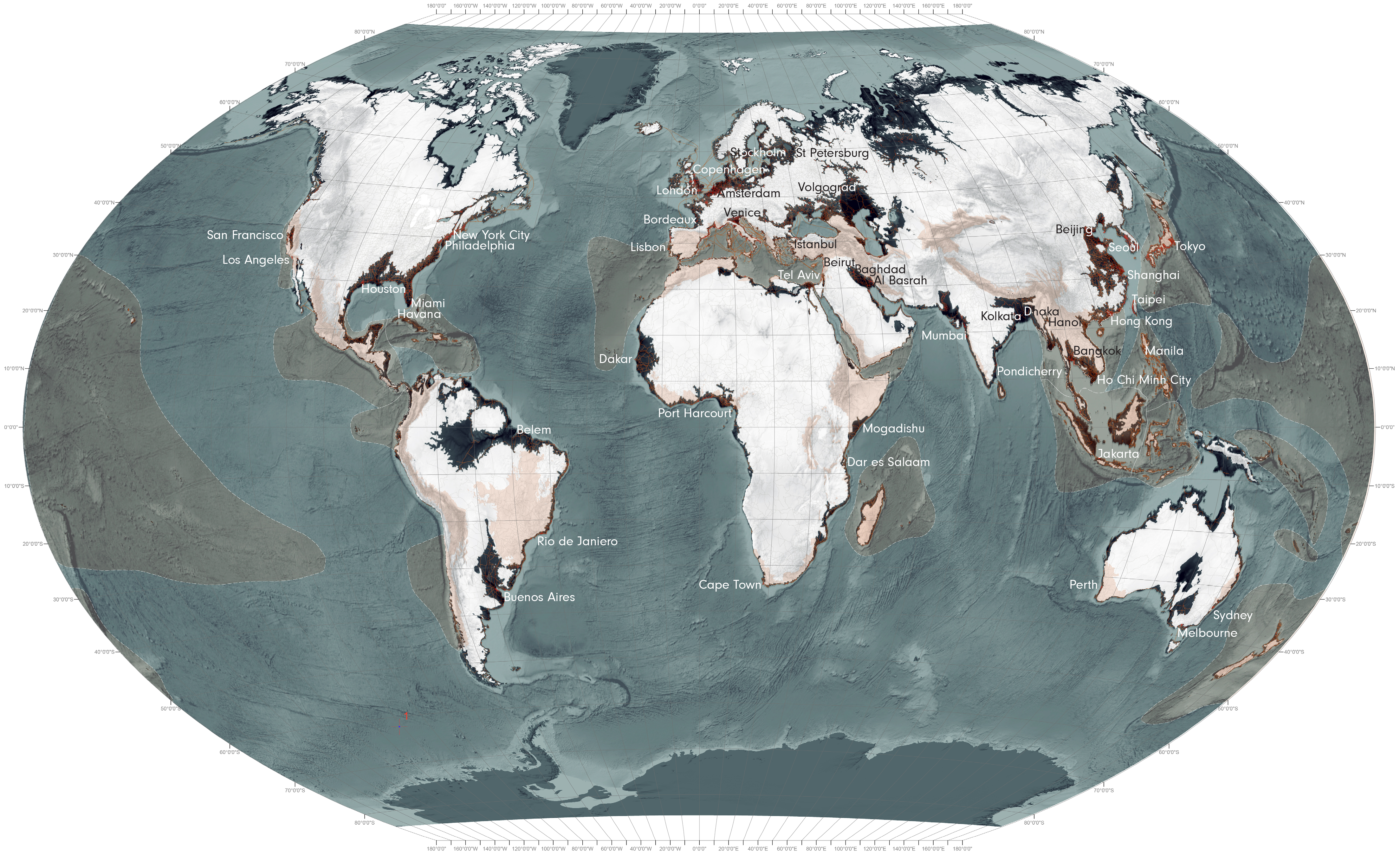
- Climate skeptics have new favorite graph; it shows the opposite of what they claim
RegalNose at 22:46 PM on 27 November, 2025Hi all,
I am absolute green when it comes to topic of Climate research (which is obviously not my field) and trying to make sense of some information presented to general public. I am writing here as I'd like your help with navigating this as it seems to me a bit contradictive with presented "news of the day".
If you navigate to the https://science.nasa.gov/climate-change/, there are two data points that are interesting to me:
1. current CO2 ppm = 430
2. increase of GMST of 1.5 degree C since pre-industry era.
What puzzles me, why is this so important to call for crisis mode?
When I look at the Judd's graph no. 2 I am reading that the planet was operating during The Mesozoic Era, which we know was lush, green and supported living of megafauna, on levels of CO2 between 500-2000ppm and with temperature s significantly higher comparing to current time. I am reading the graph as a path from local minimum and not as a path to glabal maximum, when it comes to GMST. I do understand the problem of how rapid is the incremental temperature increase, but don't see the issue of the increase itself.
In the context of Judd's graph, isn't the graphe used at https://science.nasa.gov/climate-change/evidence/ just pure scaremongring?
If you take 800,000 years, the CO2 ppm looks like massive spike, in the graph. But when you take the context of millions of years as Judd does, this increase is well.. insignificant.
What am I missing? Why the panic and crisis mode?
Thanks!
- Ice age predicted in the 70s
angusmac at 15:57 PM on 24 November, 2025BL@168 you have made so many comments that it would take a very large post to respond. Therefore, I shall respond to them with separate smaller replies.
Reply 1 to BL@168 you state that, “Your opinion that climate science should be subjected to a red team/blue team examination makes about as much sense as me saying that the Tacoma Narrows Bridge collapsed in 1940, and as a result we need to take a red team/blue team examination of the entire discipline of structural engineering."
This is a misinterpretation of what I state at angusmac@168 which was:

It is evident from the above that my comment refers to only major engineering projects, and consequently, it would only apply to major climate science projects. Therefore, your inference that my opinion was that every climate science paper should be subject to a read team/blue team approach is wrong and is based on your selective reading of my text.
Furthermore, the Tacoma Narrows collapse did instigate major changes in structural engineering.
Since then, all long-span suspension bridges and other flexible structures were required to be designed to resist aerodynamic loading. These changes eventually evolved into the red team/blue team approach for major structures, and I have already given an example of one such flexible structure, namely, the Burj Khalifa.
- On the Gates climate memo
Randy Allred at 09:27 AM on 24 November, 2025In Gates' memo, he writes:
"I wish there were enough money to fund every good climate change idea. Unfortunately, there isn’t..."
This facile assertion tells us that Bill Gates—rather astonishingly—doesn't understand how money and federal finance works. Money is not a scarce commodity, as Gates claims here. The US government is not financially constrained, it creates as much money as it chooses. Rather, it is real resources that are limited.
Money was invented by governments to marshall real resources into the public sphere for some desired public outcome. Private banks also issue money, but their motives are entirely different than those of government. We cannot depend on private finance to properly address climate issues.
Gates talks about companies, companies, companies, while giving short shrift to government action—which is the key to solving the climate crisis.
Perpetuating myths about money is not merely unhelpful, it's a huge drag on effective climate policy.
- Ice age predicted in the 70s
One Planet Only Forever at 13:37 PM on 14 November, 2025angusmac @164:
I am a retired, quite successful, Canadian Registered Professional Engineer (Structural) with an MBA. I have participated in the successful design of a diversity of structures using a diversity of materials and structural systems in a diversity of nations to a diversity of national standards. I feel obligated to respond to the following part of your comment.
Additionally, as a structural engineer, I am appalled that climate scientists resist a red team/blue team approach to the discussion of The Science™, because using a red team/blue team methodology is normal practice in major engineering projects worldwide. In fact, on exceptionally large projects, a third team is often tasked with independently reviewing and validating the results of the red and blue team process.
Of course, if engineers get it wrong, they can be sacked or fined, many people’s lives could be lost, and the engineers may go to jail.
The Wikipedia description of Red Team also covers the idea of Blue Teams. The Red Team (challengers) conceptualize attacks on the system and the Blue Team (originators) respond with measures that counteract the attacks.
I would argue that Structure designs are not ‘regularly’ subjected to Red Team attacks. I am familiar with an independent group of people with expertise related to the design being reviewed doing a detailed assessment of the developed design. I have been on many of those review teams. What is done is similar to Scientific Peer Review, not a Red Team attack.
A structure design must be safe. Engineering work should always be checked by a competent reviewer to ensure that the evaluation and design decisions fully meet the established minimum safety standards of the relevant regional building/structure design Codes. This is sort of like Scientific Peer Review ensuring the methodology and evaluation were done in a way that makes the results defendable. It is not a Red Team attack.
The engineer’s job is to knowledgeably rigorously think about and evaluate the performance of the structure they are designing, or any of its parts, in response to any potential condition or combination of conditions the structure could experience. An engineer’s design should be checked by a sufficiently capable review engineer. And a responsible professional engineer would not take on a design challenge that they lack the experience to properly perform. They would learn what they need to know from someone who has a better understanding (like good scientists learn from good peer review).
It would be irresponsible for an engineer to rely on a reviewer (Red Team attacker) to identify any weaknesses of their design. The majority of designs completed by an engineer should completely stand up to detailed expert review. A good engineer would be expected to occasionally make an error or miss a consideration, hence the importance of every design being adequately independently checked. The good engineer would learn from the experience of having weaknesses of their work discovered by an expert reviewer. And a responsible engineer would not attempt to perform a design task they lacked experience in. They would seek adequate education before doing the ‘new to them’ design task.
If an engineer does not learn to do better work in-spite of having the weaknesses of their work pointed out then they should not continue doing engineering work. The same should apply to scientists.
One comment in closing. I have no knowledge of the engineering work you do. But I would caution you that how you have been responding to having the weaknesses of your ‘non-engineering’ ‘new to you’ evaluations of climate science literature pointed out raises Red Flags. You should be careful and reflective to ensure that you do not have a similar ‘motivation that keeps you from learning’ compromise your ability to be a good, constantly improving, responsible structural engineer.
- On the Gates climate memo
Jonbo69 at 02:52 AM on 14 November, 2025While Bill Gates has done a lot of good in the world in many areas, I've never seen him as a good advocate for the necessary solutions to tackling climate breakdown, even before this memo. He's always mainly favoured techno-solutions that may not work, become reality, or even make the situation worse. I know this is speculation and I can't know for sure the real intentions behind this memo, but I can't help wondering if it is meant as some sort of peace offering to Donald Trump - given that it was only a few weeks ago that he was photographed, along with all our other tech titans, at a Dinner held by Trump, and sat just the other side of Trump with Melania between them.
- Climate Adam - Climate Scientist responds to Bill Gates
walschuler at 05:11 AM on 13 November, 2025As usual Climate Adam is clear and passionate. I have not read Gates' piece, and I will, but there is an action he is carrying out that relates to his argument, that is not commented on here, so I assume it is not mentioned by Gates. That action is that he has a permit for construction of a mini-nuclear powerplant in Wyoming that is based on uranium fuel and liquid sodium as primary coolant. Mini in this context means base load 345 Mwe, and with a short term (5 hour) peaking power at 500Mwe. Most recent power company nukes run base load at around 1,000Mwe. The Gates company collaborated with Hitachi, which is well established. But this design carries two burdens. First, the attempts to make liquid sodium reactors have failed. France has made the biggest efforts, in the form of the Phenix and Super-Phenix reactors. See wikipedia (https://en.wikipedia.org/wiki/Superph%C3%A9nix). The French designs had the goal of making them fast breeder reactors, that would generate more fissionable material while in operation than they would use up, using various purified natural sources, such as U238 (which is not a reactor or bomb isotope) or wastes from other reactors..Both reactors had serious problems. Among them is the fact that liquid sodium burns spontaneously if it comes in contact with air, so any leaks are potentially diasterous. Then there is the problem that like conventional reactors such reactors will end up with partly used fuel that will have high and low radiation level other elements as wastes that have to be separated and disposed of. One is Pu239, a great reactor fuel and atomic bomb material. So diversion of that is a threat, an easy threat if incoporated in a dirty bomb dispersed with conventional explosives, or an atomic threat if a critical mass can be purified and imploded. Disposal of it and other wastes demands separation from the environment for 10 half-lives, to reach a human-safe level of contact. For Pu239 that means reliable isolation for 249,000 years! Underground isolation in deep tunnels in geologically quiet and dry sites is needed for this and is the current working approach.. Finland is pioneering one, Sweden and France are gearing up. The USA had one designated at Yucca Mountain, adjacent to the underground test site of Yucca Flats, 65 miles north of Las Vegas. George W. Bush approved that, Nevada residents objected, and Barack Obama reversed it. It may have water leakage issues, but no further action has been taken there or or towards another site. So existing wastes (filled fuel rods) are containerized after cooling in swimming pools and are stored in various locations above ground. Other wastes, such as radioactivated structural materials and equipment, are separated and distributed to various "secure" locations. Potentially there is a second method of disposal, that uses a tuned subatomic particle accelerator or specially designed nuclear plant to convert wastes to either very short lived or stable isotopes. There is some work going on in Europe on this, but none in the US. It would be a way of making disposal of the hazards safe more quickly and it desrves serious funding, in order to dispose of slready generated and (possible) future wastes. To carry on generating nuclear power and wastes, even thogh the energy generated is mostly carbon-free, Gates' stated excuse for going nuclear, is irresponsible without safe operations and disposal guaranteed.
- Climate Adam - Climate Scientist responds to Bill Gates
nigelj at 12:23 PM on 12 November, 2025Agree with Eclectic. Gates, Musk, and Zuckerberg have all more or less downplayed climate concerns and need for strong mitigation or have been suddenly silent on advocating for such issues since Trumps election.
- Climate Adam - Climate Scientist responds to Bill Gates
Eclectic at 08:19 AM on 12 November, 2025Bbrowett @1 :
Perhaps Gates paying less attention to climate, and more attention to which way the wind is blowing. The wind in the White House.
- Climate Adam - Climate Scientist responds to Bill Gates
bbrowett at 07:36 AM on 12 November, 2025Who would have guessed that Bill Gates has a vested interest in blocking public policy, and policies against cooperative actions to deal with the climate emergency?
Maybe the problem starts with the billionaires who manipulate public opinion, especially in Western countries? - Debunking Joe Rogan, Dick Lindzen, and Will Happer
nigelj at 04:01 AM on 9 November, 2025Eclectic @ 17, said: "I suspect that the AI tools are only capable of going looking for evidence of partisan political affiliation, rather than for the "subconscious" evidence that a person is guided by the deeper (and often unworthy) motives that rule so much of the non-partisan aspect of politics. Power / money / psychological resentments."
I'm not so sure. If you asked an AI tool to investigate all possible motives for denialism including psychological motives, and listed them the AI would probably trawl the internet looking for commentary that mentions such things, or evidence that might suggest such things, and have a go at making sense of it.
What I've found is the performance of AI depends on asking very clear and precise questions and providing some explanatory background and even listing your own suspicions. And defining your terms carefully. This leads to more useful answers than just putting in a 5 word search, "Lindzen, motives for climate denialism." You have to help the AI.
The problem is the AI then tends to tell you what it thinks you want to hear. Accuracy can suffer. But at the very least you get a good list of relevant articles with links.
The AI has limits of course. I've found accuracy is variable but its good enough to be useful for simple issues, and the AI is so fast and that makes it useful. But I digress and I may have misinterpreted what you are getting at.
- 2025 SkS Weekly Climate Change & Global Warming News Roundup #29
One Planet Only Forever at 08:57 AM on 24 July, 2025People who deliberately fight against increased awareness and improved understanding of how to be less harmful and more helpful to others deserve to face questions and criticism they dislike. They deserve disrespect and ridicule.
The UN News report “World Court says countries are legally obligated to curb emissions, protect climate” makes it abundantly clear that regional governments with histories of acting in ways that delay the transition from undeniably harmful fossil fuels to less harmful alternatives deserve to face serious penalties. The UN News report includes the following "Reasoning of the Court":
The Court used Member States’ commitments to both environmental and human rights treaties to justify this decision.
Firstly, Member States are parties to a variety of environmental treaties, including ozone layer treaties, the Biodiversity Convention, the Kyoto Protocol, the Paris Agreement and many more, which oblige them to protect the environment for people worldwide and in future generations.
But, also because “a clean, healthy and sustainable environment is a precondition for the enjoyment of many human rights,” since Member States are parties to numerous human rights treaties, including the Universal Declaration of Human Rights, they are required to guarantee the enjoyment of such rights by addressing climate change.
So, in addition to the good questions proposed by wilddouglascounty @2, the fundamentals of the ruling raise questions about US government actions that have harmful impacts other than climate change impacts. An example would be Trump administration shuts down EPA's scientific research arm as reported by NPR which includes the following:
The agency is closing the Office of Research and Development, which analyzes dangers posed by a variety of hazards, including toxic chemicals, climate change, smog, wildfires, indoor air contaminants, water pollution, watershed destruction and drinking water pollutants. The office also manages grant programs that fund universities and private companies.
Under President Trump's leadership, EPA has taken a close look at our operations to ensure the agency is better equipped than ever to deliver on our core mission of protecting human health and the environment while powering the great American comeback," said EPA Administrator Lee Zeldin in a statement announcing the plan Friday. "This reduction in force will ensure we can better fulfill that mission while being responsible stewards of your hard-earned tax dollars.
The US government has also stopping funding NPR (Recently completing an action demanded by Trump in May of this year - NPR report: President Trump has issued an executive order to pull federal funds from NPR and PBS) to ‘selectively save tax dollars’.
The choice to stop supporting NPR is likely because NPR has a News section dedicated to Climate Change and it also reports many things like the above report.
An interesting related item is the CBC report “Green energy has passed 'positive tipping point,' and cost will come down, UN says”. That story about the UN report on renewable energy systems includes the following:
Renewables are booming despite fossil fuels getting nearly nine times the government consumption subsidies as they do, Guterres and the reports said. In 2023, global fossil fuel subsidies amounted to $620 billion US, compared with $70 billion US for renewables, the UN said.
A clear understanding of Taxes is important. I would argue that any negative consequences of government actions, and lack of action, are “Taxes’ (someone somewhere sometime pays a price). The massive subsidies for fossil fuels are clearly “Taxes”. But the harms resulting from insufficient investigation into and regulation of the harm done by economic pursuits are also Taxes.
One of the most damaging misunderstandings today is the belief that competition for perceptions of superiority will effectively self-regulate to minimize the harm done (limit the Taxes caused) by competitors and make harmful competitors adequately make amends for harm done.
It is clear that more freedom for competitors for perceptions of superiority results in dominance by people who believe they are the winners if they can be more threatening and more harmful to Others than Others can be to them.
There are no winners in a competition that allows perceptions of superiority to be obtained by ‘being more harmful or more unjustifiably threatening'.
People pursuing more benefit by being more harmful are the only ones who deserve to feel, and actually be, threatened with serious negative consequences.
- Fact brief - Is the climate as unpredictable as the weather?
lynnvinc at 00:14 AM on 16 May, 2025I'd also say "no," since I've used a geography map book from 70 years ago and their climate maps are still sort of valid even with climate change. I've seen elsewhere (like when to plant) that the zone lines have moved a bit with climate change, but not much.
Climate (which is an aggregate of a lot of data over many years) is what you expect, weather (a particular local, short-term configuration) is what you get. I live in what is known as a humid subtropical climate near the Rio Grande Valley, and it's been that way for a looooog time, and is quite different from a trundra climate. I did a calculation and we are getting a bit warmer over the past several decades, but not a huge amount.
In sociology over 100 yrs ago Durkheim noted that suicide rates (aggregate stats) were about the same year to year, and that while one cannot predict at the individual case level who will commit suicide (tho psychology can help), it is "social facts" (his term, which also includes "cultural facts") that determine suicide rates & whether they slightly go up or down.
I'm also thinking brownian motion — can't predict where each molecule will go, but on aggregate at a more macro level things become more predictable.
- Is Nuclear Energy the Answer?
tder2012 at 00:19 AM on 10 May, 2025Michael, since GHG emissions are global, why focus only on reactors being built in USA? Globally, there is 59 under construction. Do you have evidence to support these statements? "This is another com[plete falsehood promulgated by the online nucleear community" and "The people on the nuclear site tder2012 reads are lying to tder2012.
The people on the nuclear site tder2012 reads do not know anything about nuclear reactors." and "Why do you read and believe the crap the ignorant people on nuclear threads tell you? Then you bring their lies here where we try to only discuss facts." I'm sure you'll claim you already have provided evidence, but that is false.
Natrium doesn't use 20% enriched uranium because it hasn't been built yet. 20% enrichment is also required for medical isotopes. A bomb needs at least 80% enrichment.
I discuss on here because I think we need to place emphasis on reducing ghg emissions and permanently displace fossil fuel production, but these continue to increase year over year, despite spending $trillions globally over the last 25 years or so on wind, solar, storage. We are in a climate and energy crisis and emergency so all options need to be on the table.
- 2025 SkS Weekly Climate Change & Global Warming News Roundup #16
One Planet Only Forever at 05:45 AM on 24 April, 2025RedRoseAndy,
Your proposal would help achieve the required corrections of developed unsustainable fishing activity. It would be a little more work and would reduce the profitability of the currently developed fishing. But, as you correctly implied, the easier and more profitable fishing methods that have developed have no real future (and benefiting from burning non-renewable fossil fuels also has no future, even if it wasn’t causing harmful climate change impacts).
The assisted fertilization of eggs from ‘caught fish’ would be part of the actions to achieve the Sustainable Development Goals, specifically SDG 14: Conserve and sustainably use the oceans, seas and marine resources for sustainable development.
You should investigate the potential for your suggestion to be part of the SDG 14 related UN Event - Ocean Action Panel 10 : Enhancing the conservation and sustainable use of oceans and their resources by implementing international law as reflected in the UNCLOS
However, I would like to know more about ‘how’ (considering all of the aspects in a holistic evaluation) an increased amount of fish will produce a reduction of CO2 in the atmosphere (more going on than carbon in fish poop falling into the depths). It seems intuitive that, like trees, more fish would result in reduced CO2 levels. If increasing the amount of fish in the seas will sustainably reduce the amount of CO2 in the atmosphere, then any actions that sustainably increase fish populations would help.
Regardless of the question about increased fish stocks reducing CO2, it would be helpful to increase fish stocks.
Hopefully all reasonable helpful actions will be pursued by leaders, in business and politics, to limit the harm done by human activities. Unfortunately, the focus will likely be on the easier, more profitable, and more easily popular actions rather than pursuing actually possible actions (not ‘hoped to be developed’ technological solutions) that are more helpful but are harder, more expensive, or less likely to be popular.
- Do Americans really want urban sprawl?
One Planet Only Forever at 12:23 PM on 21 March, 2025Regarding nigelj’s comment and expanding onto other points.
Walkable development does not require expensive high-rise buildings. But it can be expensive to redevelop built cities to be walkable. However, the bigger issue is the ways that misunderstandings can be exploited by people who want to impede efforts to develop sustainable improvements.
Walkable development can be effective with multi-use buildings less than 10 stories high. The lower floors could be commercial uses with the upper floors being residential. (Note: This NFSA blog post from 2020 states that the International Building Code – It is not International. It only applies in regions of the US that choose to adopt it. But that is another matter – defines a high-rise as, “a building with an occupied floor located more than 75 feet (22,680 mm) above the lowest level of fire department vehicle access.”)
Very walkable cities developed before ‘car-based sprawl’ and ‘downtowns filled with skyscrapers’ became misleading symbols of superiority.
Cities that developed based on the desire for ‘car sprawl’ and ‘downtown office skyscrapers’, like Calgary, Alberta (where I live), are very expensive to ‘re-develop to be walkable’. That is unfortunate because those cities are at a competitive cost disadvantage if they do not re-develop.
People living in ‘car-sprawl’ cities ‘need’ less expensive housing due to the high cost of ‘car ownership’ (internet searching will find many estimates that it costs more than $10,000 per year to be a car owner). Those cities also have higher costs to build and maintain their sprawling public service infrastructure (roads, water mains, sewer mains, power distribution ...).
The ‘car sprawl’ cities have also developed a cultural attitude that resists sensible changes, like the change to be ‘a more walkable city’.
There is a global collective that develops misunderstandings in opposition to efforts to limit the harm done by fossil fuel use. A massive percentage of Calgary’s wealth potential is from ‘limiting the limiting of harm done by fossil fuel use’. That ‘opposition to learning to be less harmful’ includes political misleading messaging to promote misunderstandings about actions like carbon pricing. The following article presents a connection between opposition to carbon pricing and opposition to walkable cities.
There is powerful opposition in Calgary to efforts to increase density and redevelop already built areas to be more walkable and higher density. The following articles are examples. They do not represent all of the Calgary opposition to ‘learning to live less harmfully’.
Calgary Herald - Legal fight against city's blanket rezoning decision rages on, headed for appeal
CTV News Calgary - Glenmore Landing redevelopment defeated by vote at Calgary council
Note that the area councillor supported the development and mentioned her attempts to address misunderstandings. The development was opposed by councillors of other areas of the city who repeated misunderstandings about the proposed development. The following article is about a different council member attempting to more officially investigate and address those misunderstandings.
CBC News - Calgary city councillor wants review on impacts of false information
The suggestion that the popularity of misunderstandings was a serious concern prompted misunderstandings in response
Calgary Herald - Opinion: Is a Ministry of Truth coming to Calgary?
The Calgary opposition to ‘walkable 15-minute’ development is almost certainly a key part of the unjustified global collective that opposes ‘learning to be less harmful and more helpful to Others’ (a ‘big-tent’ collective of misleading promoters of a diversity of misunderstandings, including climate science misunderstandings).
And the ‘walkable 15-minute’ misunderstandings are related to efforts opposed to better understanding of climate science (refer back to The Hub article link above). More walkable implies less car use, which would mean less potential for benefit from fossil fuel use (note that the Calgary councillor also wanted misunderstanding regarding Calgary’s rapid transit system development to be investigated).
The following article mentions the international conspiracy theory promotion of misunderstandings regarding 15-minute walkable development.
And the global group coordinating that ‘opposition to learning’ is also likely heavily involved in the opposition to other harm limiting actions like New York City’s Congestion Pricing (see this NYC ABC news item - Trump administration extends deadline for New York City to end congestion pricing)
There are a multitude of problems to be addressed and corrected by efforts to develop sustainable improvements. But almost all of the problems can be understood to be parts of a global collective that wants to benefit by developing and promoting misunderstandings to limit ‘learning to be less harmful and more helpful to Others’.
- Climate Adam: Is it Game Over for the 1.5 Degree Climate Limit?
nigelj at 07:13 AM on 12 February, 2025Napalm doesnt look like a great idea for backing up renewables. Napalm is a mixture of petrol or diesel and a gelling agent and burns much hotter than petrol. But its not providing more energy than petrol would just by adding a gelling agent. I assume it burns hotter but not for as long as petrol (?) so has no advantage in power as a fuel source for generating electricity. And dealing with that high temperature and flammability would be a nightmare.
Its also higher carbon than gas fired backup power so its even worse for the climate. It looks like it would be higher cost than petrol or diesel, due to the manufacturing process.
Napalm might have more stable availability than gas, but this looks like it would be negated by the downsides. I just think its a classic example of a crank solution, where people see "higher temperatures" but fail to look at all the related issues.
- 2025 SkS Weekly Climate Change & Global Warming News Roundup #05
One Planet Only Forever at 03:57 AM on 5 February, 2025A supplement to my comment about the misleading Cenovus ad.
When the audio asks “But what if that system suddenly stopped working?” the video makes all the food, reusable bags, and the package disappear. The misleading implication is that other harmful petrochemical developments, like plastics and agrichemical, are essential needs that cannot be obtained by less harmful alternatives.
The ‘collective petrochemical misinformation effort’ is investigated and discussed in items listed in recent SkS Weekly News and Weekly Research.
In the 2025 SkS Weekly Climate Change & Global Warming News Roundup #03, the second item in the Public Misunderstandings about Climate Science category “New Study Shows How Fossil Fuel Sectors Create a Climate Denial Echo Chamber on Social Media” is about one of the ‘Open access notables’ on the Skeptical Science New Research for Week #3 2025: Networks of climate obstruction: Discourses of denial and delay in US fossil energy, plastic, and agrichemical industries, Kinol et al., PLOS Climate:.
Another New Research ‘notable’ in Week #3, Compartmentalization by industry and government inhibits addressing climate denial, Hendlin & Palazzo, PLOS Climate:, also investigates the way that ‘harmful interests join forces to collectively act for their harmfully obtained collective benefit’.
There is a tragic history of the collective gathering of pursuers of benefit by promoting misunderstandings, not just in business and politics (note how social conservatives and economic conservatives support or excuse each other's misunderstandings). Everybody loses when these (Us against all Others who are not like Us) collectives succeed in their misleading pursuits of perceptions of superiority relative to Others.
- At a glance - Is the CO2 effect saturated?
MA Rodger at 02:42 AM on 29 January, 2025sychodefender @30,
Another take on answering you questioning....
As you say, the climate forcing from mankind's CO2 emissions does cause feedbacks, these most evident in the water cycle, humidity, cloud cover, cloud height (this last the least understood). But there is no "self-sustaining loop" or even any significant CO2 emissions consequent from mankind's emissions as a feedback. There is thus no need for a natural mechanism to prevent run-away global warming.
You mention CO2 in this "natural mechanism" and CO2 has operated naturally as the major control knob for the climate through the eons. (Calling CO2 the 'control knob' should not be in any way controiversial.) The ancient Earth's climate is a bit of a mystery as the sun was less energetic in the early solar system (and from its weak beginning will continue to strengthen) and with no means of knowing the ancient atmospheric composition the 'faint sun paradox' remains unexplained. More recently, over the last 500 million years the temperature record is reasonably well known. (Through that time the sun has brightened by about 5% which is a climate forcing equivalent to roughly a quadrupling of CO2.)
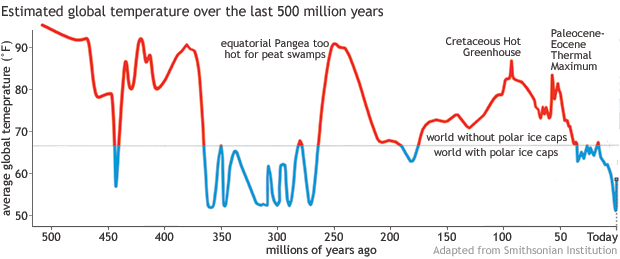
There are a few very-long-term mechanisms at work altering the carbon available for the carbon cycle (in the atmosphere, bliosphere and ocean waters, these being in equilibrium for multi-millenial periods).
Taking CO2 from the atmosphere into rocks as coal was a major process in warm climates for early parts of this 500My period as back then fungi were not well developed enough to decompose plants which could thus be buried and turned to coal. Modern fungi prevents such significant coal formation.
A second mechanism is the water-weathering of mountain rocks which allows the formation of carboniferous rock in sea water. When the 700Gt(C) humanity has emitted so far has reachen equilibrium between biosphere, ocean and atmosphere (which takes abut a millenium), the remaining 25% of our emissions in the atmosphere (assuming only natural processes) will require rock-weathering to be extracted, this taking tens of millenia to complete. At a similar rate of action, the formation of the Himalayas and associated increase in rock-weathering has seen the atmospheric CO2 content drop over the last 50 million years and with it the cooling of the planet.
Once this deposit of carbon into the geology occurs, it is volcanism that works to return it to the carbon cycle. Thus when the planet is so cold that there is no rain to weather rocks and no significant biosphere at work, the volcanic activity will slowly pump CO2 back into the atmosphere restoring the level of greenhouse effect. The emissions are very small relative to mankind's emissions (perhaps about 1%).
You mention Milankovitch cycles which have been waggling the planet's temperature for the past 3 million years (initially as a 40ky cycle, then 100ky).
The Milankovitch cycles are not so strong in themselves but are amplified by positive feedbacks. Within these cycles, CO2 is part of that positive feedback (increasing the size of the wobbles) with carbon being locked away under frozen land and in cooling oceans under increased sea ice. However the big driver of recent ice ages is albedo not CO2.
You mention the logarithmic relationship between CO2 levels and climate forcing. This is an empirical relationship for concentrations in the range 150ppm to 1300ppm. As Zhong & Haig (2013) fig 6 shows, beyond 1300ppm the forcings increase faster than logarithmic. By then, of course, an increase in the CO2 consentrations would need to be four-times an increase to add the same extra forcing. But we don't want to be creating a world with 1300ppm. It would have already been under a forcing of 8.4Wm^-2 from the extra CO2, perhaps global warming of +7ºC.
- Skeptical Science New Research for Week #1 2025
Bob Loblaw at 05:21 AM on 12 January, 2025One more foray into the overall world of research. The term "raw data" now appears 42 times in this comment thread. It was first introduced in comment #2. In comment 27, I stated that the use of this term represents an attempt to give certain data an air of authority - "...it must be better because it's raw!" We see this ploy frequently from climate contrarians (a point made by nigelj in comment 6).
So, in the context of the Wallace et al (2023) paper, the infamous eTable 1 was presented as being "raw data". In fact, the participant that introduced the term here has (I think) used "raw data" every time he has referred to that table. Is that table indeed the "raw data" used by Wallace et al?
In a word, no. We can find out more about Wallace et al's data sources by reading the paper. (What a novel idea!) It turns out that they have a section of the paper titled "Methodology".
- It turns out that the first paragraph of that section contains the following sentence, explaining where they got the mortality data:
- We obtained detailed US weekly mortality data from January 1, 2018, to December 31, 2021, from Datavant, an organization that augments the Social Security Administration Death Master File with information from newspapers, funeral homes, and other sources to construct an individual-level database containing 10 325 730 deaths in the US to individuals aged 25 or older during this period.
- The second paragraph starts with the following:
- We linked the mortality data at the individual level to 2017 Florida and Ohio voter registration files;
- Later in the paragraph, we see:
- For each record, the linked data included week of death, age of deceased, county of residence, and 2017 political party affiliation.
- ...and they also explain how they assigned a party affiliation to each individual.
Wallace et al also have a section titled "Statistical Analysis".
- The first sentence in that section is:
- We aggregated weekly death counts from January 1, 2018, to December 31, 2021, at the county-by-party-by-age level.
I'm willing to bet that they also aggregated the data over the entire time period, and by state and age level, in order to get the totals in eTable 1.
- The values in eTable 1 are nowhere close to "raw data".
- Even the data sources used as "raw" data by Wallace et al (i.e., the data they accepted from other sources, rather than collecting themselves) are not "raw" data:
- The mortality data comes from "newspapers, funeral homes, and other sources".
- Even those are not "raw" data.
- Party affiliation is based on voter registration files.
- Even those sources are derived from lower-level sources.
There are many more clues to what Wallace et al actually did buried in the text of the paper - if you take the time to read it.
So, the next time someone tries to pull the "raw data" argument on you, you can be pretty sure that they are trying to pull the wool over your eyes.
Don't drink the "raw data" Kool-Aid!
- Stop emissions, stop warming: A climate reality check
MA Rodger at 04:19 AM on 27 December, 2024rkrolph @8,
The quote you provide comes from a 900 word essay entitled 'Progressive myths harm the honest discourse' by Michael Huemer, a professor of philosophy at the University of Colorado at Boulder. The essay is really no more than an advert for his book 'Progressive Myths' (Amazon preview here).
In both book and essay he rails against "political activists" saying that "Nearly every piece of information they disseminate is a distortion or outright lie," and also that their influence is pervasive. In the essay he cites three exemplar "lies" promulgated by such "political activists." The three exemplars given are:-
(1) Women earn just 82 cents for every dollar that men earn for the same work;
(2) Police shootings show a marked racial bias against Black Americans;
(3) Global warming is an existential threat to America and the world.
These are, of course 'progressive' lies as are the nine "myths" featured in his book (according to this book review) and with Huemer apparently a 'libertarian' (according to the reviewer of the book who does say but not convincingly Huemer "also addresses falsehoods from the far right"). With the subject of the book being titled "Progressive Myths", some significant bias should bring no surprises. The Amazon book review linked above shows the book's Part VI containts three chapters:-
19 The Global Warming Consensus.
20 Existential Climate Risk.
21 Mask Science, which presumably is about spread of the recent pandemic.
(I should point out that, as I am a more-progressive less-libertarian Brit sat on the other side of the pond, I would consider the egregious lies and denials spread by 'libertarians' in the US should be far more of an issue and a concern. Thus I see the book as the lesson of Matthew 7:3-to-5 at play here.)
With that preamble from me, is there any merit to the notion of "global warming is an existential threat to America and the world" being nothing but a "progressive myth," as Huemer says? Is it indeed a lie? And do "Virtually no serious scientists think that global warming is an existential threat"?
The first thing required to be clear is what is meant by "existential threat."
There are some lunatics who talk of an "existential threat" to humanity, apparently suggesting that the Homo Sapiens species could become extinct. But such a notion is not being considered by Huemer.
The future exisitence of "America (USA) and the world" is the issue at hand. In the Amazon book review linked above which was lilely written by Huemer, the question is put "Is global warming really going to destroy human civilization?" Put another way, could we be** stoking a collapse of the USA and/or enough of the sovereign states of the world to collapse the world economic order. Note that more will be in play that AGW itself. Without collapsing the entire world order, the remaining sovereign states will almost certainly be arguing over resources, with the environmental impacts of AGW thus precipitating political conflict and thus further chaos.
(** There is considerable uncertainty with the climate effects of AGW, even when a global level of warming is a given. There is thus a lot of uncertainty even before the level of AGW is converted into a measure of economic impacts.) The evident uncertainties within any assessment of the economic damage from AGW means assessment has to account for a less-than precise answer. The average of the potential results does not really provide a worthy assessment. It would be properly some assessment of the worst likely outcome.
And that leads to the work apparently setting-out what will be the financial impacts of AGW. In the most recent IPCC AR6 the conclusion is that no identifiable range of economic impacts globally is apparent due to the varying methodologies producing such a wide range of results. This range has increased since the limited analyses reviewed in AR5. Further complications include there being non-linear impacts with increasing AGW and there will be significant regional variation.
But to at least put some numbers to it, the range shown in AR6 for +4ºC of AGW is +3% to +33% with the CI ranging from negative to +66%. (Note the authors of these lower evaluations do come under fire and the likes of Richard Tol are well known for presenting a denialist stance.) This range compares to the "2.5% of GDP by 2100" stated by Huemer without any mention of the level of AGW assumed. It also compares with the range given in AR5 Box 3.1 "These incomplete estimates of global annual economic losses for temperature increases of ~2.5°C above pre-industrial levels are between 0.2 and 2.0% of income (medium evidence, medium agreement)."
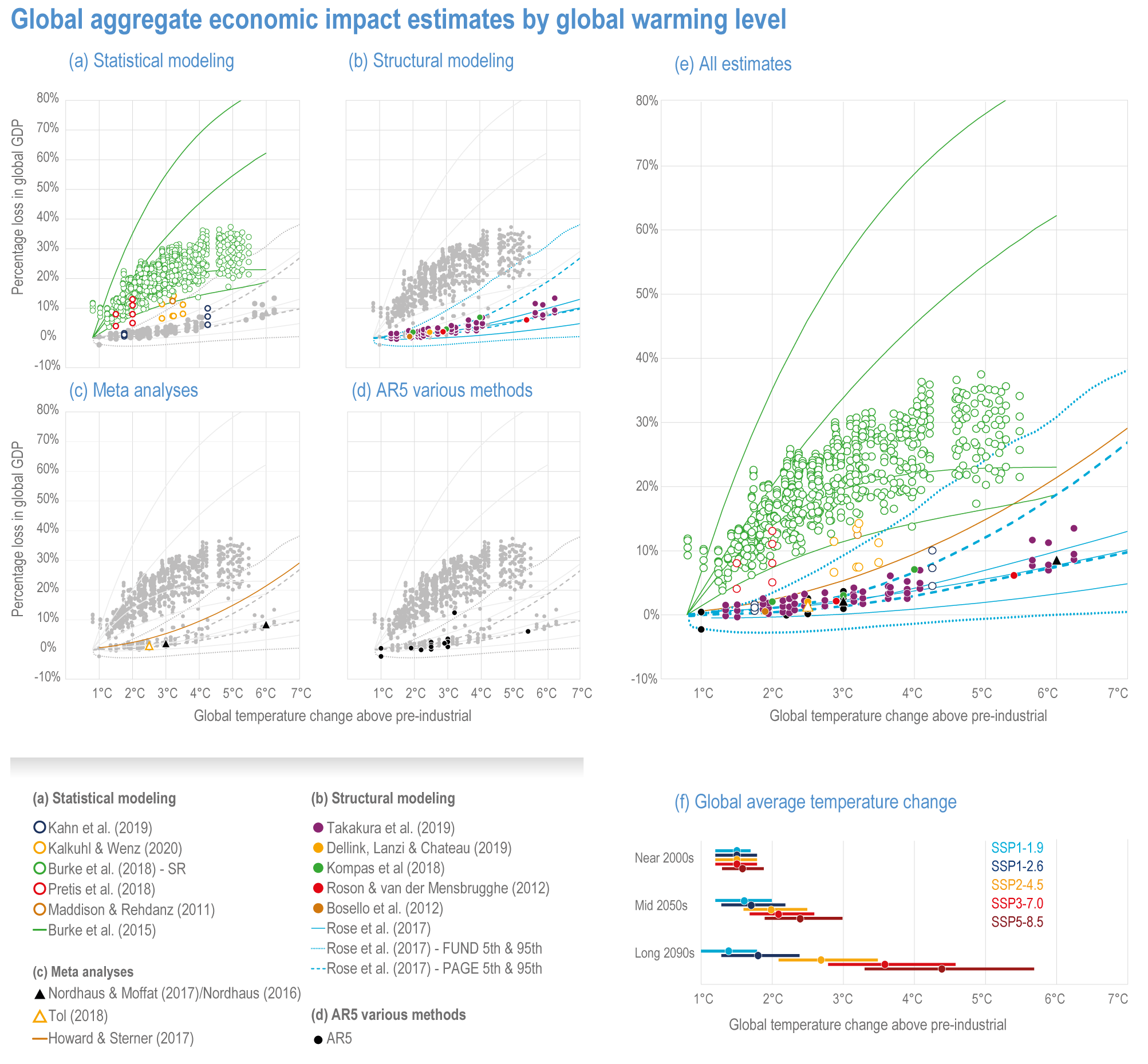
There are many difficulties facing these researchers trying to set some sort of economic cost to AGW, mitigated or unmitigated, some examples being:-
☻ The 2100 time-frame usually chosen ignores some very serious issues, not least Sea Level Rise over multi-century timescales. Greenland melt down will become inevitable at some point below 2ºC AGW if it continues at that level. Thus it becomes a certainty for continuing AGW of +2ºC to resultant +7m SLR over a millennium or so. At +4ºC, there would be an additional +8m SLR from other land ice loss.
☻ There are many saying the undeveloped nations will see negative economic growth under unmitigated AGW. This may well not have such a big simplistic impact on global economic growth as the deveolped world accounts for the vast majority of the global economy. So if say Madagascar were to melt into the Indian Ocean and disappear, the global economy shrinks by just 0.1%. But also the 30 million inhabitants would thus be looking for some sort of future beyond their lost homeland. Some may see such migrations boosting economies elsewhere while others may see it as a more significant annual cost than the $500/head/y lost from their present day autochthonic productivity.
☻ The potential size of unmitigated AGW has been reduced in the minds of some researchers because the world has turned against using coal. This is argued because there are insufficient non-coal FFs to create much more than +3ºC AGW. Yet such an assumption remains to be fully argued out.
And do "Virtually no serious scientists think that global warming is an existential threat"? There is another philosopher who talks as though no scientist could seriously say it is not an exisitential threat. "In the worst-case scenarios in scientists’ climate models, human-caused climate change is a threat to the continued existence of many species and to human society as we know it."
To conclude, Huemer presents a predictably denialist (and he insists he is not an AGW denialist) with his outlandish pronouncements entirely out-of-kilter with him being a growed-up philosopher and all.
- 2024 SkS Weekly Climate Change & Global Warming News Roundup #45
nigelj at 06:29 AM on 13 November, 2024The AI (artificial intelligence) does appear to use a lot of electricity. It raises the issue of where we should cut our electricity use to help mitigate the climate problem. One can talk about focusing on meeting needs rather than wants. We probably need some basics to survive in cities like a fridge and electric stove and a radio and home heating. We dont really need a television and vaccum cleaners and cars and fancy audio systems, and travelling to other countries or even cars in most cases. We probably mostly dont need AI unless it helps the healthcare sector. We dont even really need computers. We sure don't need bitcoin.
But wants are also very important. Its what makes life nice. So we have to decide on what wants are legitimate. Is a television legitimate? If it is, what sort of television is legitimate? How much long distance motorised travel is appropriate? Its all a nightmare really.
And one persons wants are another persons needs. Even deciding on what is a need and a want is not as easy as it seems. A computer is a perfect example. Its not absoluely essential but its getting close to being essential?
I'm not a huge energy user myself. Im just highlighting some of the challenges in figuring out wants versus needs, and what constitutes a workable low energy use society, and getting people to voluntarily adopt this.
- Models are unreliable
MA Rodger at 21:24 PM on 12 November, 2024Syme_Minitrue @1332,
You suggest CO2 can be extracted from climate models and it would be "then hard to use that model to claim that CO2 is what drives global warming." You then add "I have done a little bit of searching but not found any such falsification attempt."
I would suggest it is your searches that are failing as there are plenty "such falsification attempt(s)." They do not have the resources behind them to run detailed models like the IPCC does today. But back in the day the IPCC didn't have such detailed models yet still found CO2 driving climate change.
These 'attempts' do find support in some quarters and if they had the slightest amount of merit they would drive additional research. But they have all, so far, proved delusional, usually the work of a know bunch of climate deniers with nothing better to do.
Such clownish work, or perhaps clownish presentation of work, has been getting grander but less frequent through the years. An exemplar is perhaps Soon et al (2023) 'The Detection and Attribution of Northern Hemisphere Land Surface Warming (1850–2018) in Terms of Human and Natural Factors: Challenges of Inadequate Data'. Within the long list of authors I note Harde, Humlum, Legates, Moore and Scafetta who are all well known for these sorts of papers usually published in journals of little repute. If such work was onto something, it would be followed up by further work. That is how science is supposed to work.
Instead all we see is the same old stuff recycled again and again by the same old autors and being shown to be wrong again and again.
- 2024 SkS Weekly Climate Change & Global Warming News Roundup #44
prove we are smart at 06:52 AM on 4 November, 2024First a little thankyou to Sceptical Science for many years ago teaching me the science about Climate Change or as we called it then Global Warming. To also understand the extremes of the earths past climate cycles and their causes was fasinating.
Why we won't mitigate? It's really about the politics-the science was settled a long time ago.
I know I'm one of the lucky ones and also part of the problem. My island continent is liquifying the methane gas and digging up the "ores" at a faster and faster rate for the overseas sales.
Soon again with my adult children who will never afford to live my dream, we will all be hunkered down by candle or duracell light-lost power from a "rare" supercell thunderstorm. We tune in to the eveready powered radio for current news.
So I go to bed early or read for a while, looking at those " Twelve books to read about climate action before the election" highlighted above, I definitely like this one. What If We Get It Right? Visions of Climate Futures by Ayana Elizabeth Johnson (One World 2024, 496 pages, $34.00) "Visionary farmers and financiers, architects and advocates, help us conjure a flourishing future, one worth the effort it will take". Leave off all the media when the power returns and just keep reading...
- Climate Risk
Jess Scarlett at 06:55 AM on 24 October, 2024Being a Greenie all my life in Australia Ive bern watching this machine funded climate change take over the whole Green movement. Ive watched thousands of forests removed for external companies for woid chip and complete devastation of climate by removal of carbon balanced cooling environments. As I now start to see a massive alkiance with tge metal industry and using net zero bs agenda to deep sea mine the largest carbon storage in our deep seas for matals for the so called S.M.A.R.T technoligical movement that is part of the W.E.F agenda its very alatming to see how this doesnt look as corrupt as the whole petrolium industry. Under most forests in rich dence metals in the soils.. I just cant help but research back to around 2008 to 2009 when the IPCC shifted focus to humans effect on global warming so only collecting data on this rather than the vast reasons on global carbon increse. Drilling in the earth can release carbon and thats exactly what this new political global agenda is about. The IPCC was done for hiking temperatures and changing glacier melting times by over 100x the year amount. With all the removal of trees around the planet for toxic solar panels is a direct attack on sustainability. Recently hearing Bill Gates saying investing in trees is not science. Yet we have 50 countries playing with geo engineering as we debate means any data from here on is not natural or at least influenced. Finding these documents have become much longer a search based on the massive influx of paid science and topics of conversation. If anyone looks up Shares in Geo Engineering it will prove how much private companies are playing god at the moment. My father was a top scientist at the Bureau of Meteorology in Melbourne. In 2013-2015 most accurate data analyists and records were defunded and CSIRO and NASA gagged them all. Its a very big hot debate and appreciate researching way back if you commonly use government controlled internet search engines. I am driving up as passenger in a car.. So I apologise in advance for my 1st draft off top of head response. Im also dyslexic but I love this site and especially love the comments. I actually cannot go back to fix via phone.
- 4 Hiroshima bombs worth of heat per second
MA Rodger at 21:14 PM on 9 October, 2024One Planet Only Forever @52,
The difference (4 bombs & 9 bombs) is indeed due to a different EEI numbers which are increasing with time. The OP uses 8Zj/y. The 1.12Wm^-2 quoted by philalethes @48 is 18Zj/y. But even that could be now out-of-date.
The actual EEI wobbles a lot and through 2019 12-month average CERES number is 1.30Wm^-2.
The quoted 'EEI (from 2019) = 1.12 W/m²' value presumably comes from Loeb et al (2021) 'Satellite and Ocean Data Reveal Marked Increase in Earth’s Heating Rate' which puts it as "1.12 ± 0.48 W m−2 in mid-2019," this based on a linear (OLS) fit through CERES data, a linear rise 2000-19 backed by the OHC data for the same period. The CERES linear fit gave a +0.05Wm^−2/year increase in EEI, the OHC +0.04Wm^−2/year, both with big error bars (making the results barely statistically significant at 2sd).
While we now have had a few more years of looking at EEI, the 2000-to-date OLS thro' the CERES data is still yielding the same basic result suggesting today a value of 1.37Wm^-2/y. But the point of such an analysis (which as a strict linear value would point to AGW starting only in 1995) is to work towards an attribution of the increasing EEI.
(The EEI numbers presented by the ClimateChangeTracker EEI page stretches back to 1985 when estimates of EEI were cooling due to volcanic eruptions (El Chichón 1982 & Pinatuba 1991). Within the wobbles, the latest 12-month average (to June 2024) is +0.95Wm^-2.)
Reconciling CERES numbers with longer in-situ OHC data isn't entirely achieved with such OHC data significantly lower, although OHC calculated from sea level (geodetic) data gives a good match to CERES. The graphic below is from Cheng et al (2024). Note numbers in the insert in graph suggests 2020-23 OHC rising at 17.7Zj/y.
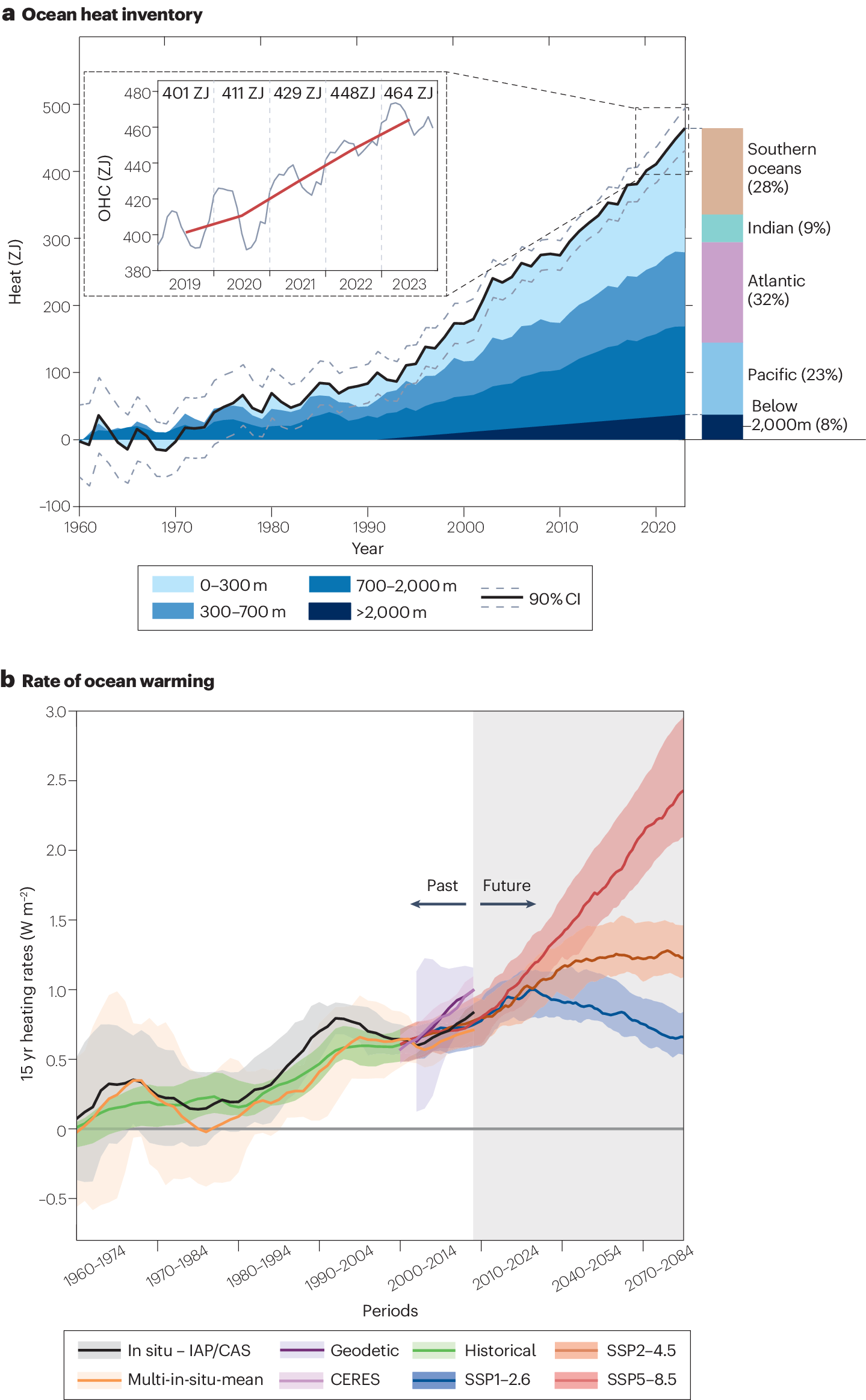
- Breathing contributes to CO2 buildup
Cedders at 20:47 PM on 5 October, 2024This is my attempt to contrast biogenic CO₂ and fossil CO₂ in one figure, referring back to this page. The diagram already seems too complex without all the ocean carbon cycles and weathering details. One implication: Bill Gates's recent comment about ineffectiveness of tree-planting is not far off the mark.

The animal carbon cycle estimate is based on rough caloric intake and vertebrate biomass estimates; I'd be interested in any better sources. Also notable from IPCC figure: ocean-air fluxes are up nearly 50% owing to human activity, and photosynthesis up 25%.
I'm not sure what the image constraints are here, but playing it safe: this is half-width the graphic is intended for.
- Are climate models overestimating warming?
ubrew12 at 21:58 PM on 19 August, 2024This article includes a graph of the worlds 1970-2023 prediction anomaly. This is pure speculation, but the anomaly in question may not be simply 'unforced variability'. We know that in the 30 years before 1970, the Corn Belt was recovering from the 'Dust Bowl': non-evaporative fallow land was being replaced by irrigated crops. Post 1970 this trend would have continued, as better agricultural practices filled the summer Corn Belt with evapotranspirating crops: a form of human agency the climate models may not include as a boundary condition. If so, then such a overprediction anomaly may also be found in other cropland areas, like in Ukraine.
An opposite effect might be expected in places where evapotranspirating jungle was, post 1970, being cut down and replaced with relatively inefficient ranchlands, soybeans, and palm oil plantations: Brazil and Borneo. Hence, they show up colored blue in that graph.
I'm just speculating. Do the climate models account for this kind of human agency, land-use change, as a boundary condition?
- 2024 SkS Weekly Climate Change & Global Warming News Roundup #29
One Planet Only Forever at 07:04 AM on 25 July, 2024I agree with the comments made by nigelj, Cleanair27, and Bob Loblaw.
I would add that part of the 2025 weapon of mass destruction is “The Seven Mountain Mandate” (link to Wikipedia here). Note that many prominent New Right (Wikipedia link here) Republicans have chosen to promote the Seven Mountain Mandate.
And, building on nigelj’s @1 suggestion that “we need to come back to some of the core problems we face as a society, and why this lead to the administrative state”, I would add the need to collectively effectively address anti-intellectualism (wikipedia link here), particularly the dislike for ‘learning to be less harmful and more helpful’ that applies to denial and attacks on climate science.
The core problem of the popularity of anti-intellectualism is an understandable threat to social democracy. Anti-intellectualism claims that emotional instinctive beliefs are superior to the results of rigorous skeptical investigation and thoughtful consideration.
A clear recent example of the harmful popularity of anti-intellectualism is Michael Gove’s, a misleading promoter of Leave in the Brexit referendum, declaration that “Oh we’ve had enough of experts”. His “we” was only himself and easily impressed anti-learning types.
The Wikipedia item regarding anti-intellectualism is quite informative. But the Nature Human Behaviour article “Anti-intellectualism and the mass public’s response to the COVID-19 pandemic” includes the following helpful description with my addition in [ ]:
“People tend to be persuaded by speakers they see as knowledgeable (that is, experts), but only when they perceive the existence of common interests [when the expert’s statement supports their preferred belief and interests]. Some groups of citizens, such as ideological conservatives, populists, religious fundamentalists and the like, may see experts as threatening to their social identities. Consequently, they will be less amenable to expert messages, even in times of crisis.”
Origins or causes of anti-intellectualism can be complex. Protestants opposed to being dictated to by The Vatican educated experts are an example. But evangelists also used it against established Protestant groups. However, it is clear that there have always been, and always will be, some anti-intellectualism.
It is important to understand that everyone can choose to learn to not be anti-intellectual. Nobody is ‘born to be, and destined to be, intractably anti-intellectual’. Being anti-intellectual is a ‘learned behaviour’.
In Alberta, I encounter many non-religious people who are selectively anti-intellectual and resist learning about climate science. They really dislike the related importance of rapidly ending the harmful impacts of fossil fuel use and making amends for the damage done. I also encounter many religious people who are more open-minded regarding climate science and the required corrections of what has developed and making amends for damage done.
There are many examples that highlight anti-intellectualism attacks on ‘climate science and the need to rapidly end the harmful impacts of fossil fuel use’. Al Gore presented this ‘problem in America’ in his 2007 book “The Assault on Reason”. In that book Gore presents many ways that the New Right Republicans make-up misleading attacks on evidence-based and reasoned understanding that ‘is not in common with their interests’.
A detailed explanation of the source/cause of anti-intellectualism in America was presented by the originator of the term ‘anti-intellectualism’, Richard Hofstadter, in his 1963 book “Anti-Intellectualism in American Life” (Wikipedia link here). In the 1700s anti-intellectual evangelism grew quicker in the US than organized established religions. That anti-intellectual revolution of religion extended into secular aspects of society, with business interests becoming engaged with evangelical interests in the 1800s.
The need for the welfare state to address the unjust inequities (marketplace failures) of freer misleading marketplace capitalism in America, free to fail to investigate the potential for harmful results and free to misleadingly excuse or deny that harm has been done, fuelled growth of anti-intellectualism beyond the Protestant-Evangelical anti-intellectual religious movements.
I will end my comment with an edited quote from the Hofstadter’s Introduction, Chapter 2, Section 4, with my inserts in [ ]. Note the ending lists targets (supporters) of anti-intellectual misleading politics that will look very similar to today’s New Right-wing targets of unjustified attack. Being anti-climate science is a major part of the New Right-wing anti-intellectual agenda because it connects to other anti-intellectual targets of attack.
“Compared with the intellectual as expert, who must be accepted even when feared, the intellectual as ideologist is an object of unqualified suspicion, resentment, and distrust [Now even the expert can be dismissed, disrespected, and attacked by the misleading New Right]. The expert appears as a threat to dominate or destroy the ordinary individual, but the ideologist is widely believed to have already destroyed a cherished American society. To understand the background of this belief, it is necessary to recall how consistently the intellectual has found himself ranged in politics against the right-wing mind. This is, of course, no peculiarity of American politics. ...
“... if there is anything that could be called an intellectual establishment in America, this establishment has been, though not profoundly radical (which would be unbecoming of an establishment), on the left side of center. And it has drawn the continuing and implacable resentment of the right, which has always liked to blur the distinction between the moderate progressive and the revolutionary. ...
“... The truth is that the right-winger needs his Communists [unjustified made-up threats] badly, and is pathetically reluctant to give them up. ...
“... Had the [McCarthy] Great Inquisition been directed only against Communists, it would have tried to be more precise and discriminating in its search for them: in fact, its leading practitioners seemed to care little for the difference between a Communist and a unicorn. ...
“... The inquisitors were trying to give satisfaction [create misleading anti-learning attacks] against liberals, New Dealers, reformers, internationalists, intellectuals, and finally even against the Republican administration that failed to reverse liberal policies [like the Tea Party and Freedom Caucus radical factions in the Republican Party. What was involved, above all, was a set of political hostilities in which the New Deal was linked to the welfare state, the welfare state to socialism, and socialism to Communism. In this crusade Communism was not the target but the weapon, ...
“... The deeper historical sources of the Great Inquisition are best revealed by the other enthusiasms of its devotees: hatred of Franklin D. Roosevelt, implacable opposition to New Deal reforms, desire to banish or destroy the United Nations, anti-semitism, Negrophobia, isolationism, a passion for repeal of the income tax, fear of poisoning by fluoridation of the water system, opposition to modernism in the churches.”
- Fact brief - Were scientists caught falsifying data in the hacked emails incident dubbed 'climategate'?
michael sweet at 01:36 AM on 17 July, 2024David Acct:
The OP points out that "climate-gate" was invegestated by 9 separate imvestigations. All of them found that there was no misconduct. Your factoid that one of the investigations did not relate to Mann & MBH98 & MBH99 is simply off-topic since the OP is about climate-gate emails and not the Mann papers. Please try to stay on topic with your posts.
- What’s next after Supreme Court curbs regulatory power: More focus on laws’ wording, less on their goals
Bob Loblaw at 23:18 PM on 16 July, 2024David-acct @ 58:
Well, I think you are over-generalizing, and I will make two points in response to your two points.
On the constitutional aspects:
The Chevron deference is not about agencies making new law - it is about interpreting existing law when the law is vague. Read the OP: the decision process (in court) had two steps (emphasis added):
- In Step 1, the court asks whether Congress directly addressed the issue in the statute. If so, then both the court and the agency have to do what Congress directs.
- In Step 2, however, if Congress is silent or unclear, then the court should defer to the agency’s interpretation if it is reasonable because agency staff is presumed to be experts on the issue.
The agencies do not get to ignore Congress. The discussion in the comments points out the risks and problems associated with waiting for Congress to act on every tiny detail that is unclear in existing legislation.
On the subject of experts:
Your "almost always" claim that government experts are worse than industry experts is condescending twaddle. This may come as a surprise, but the "A" in "EPA" is not "Accounting". Your narrow experience in one specialty does not necessarily extend to all disciplines.
In areas of science, such as climate, water quality, atmospheric pollution, etc., government research groups are often at the cutting edge of the discipline. And the research component within government is usually strongly tied to the monitoring and regulatory components. In the case of such areas of expertise, the "real world experience" involves going out into the field and actually observing the natural environment and how humans interact with it. Government monitoring and research agencies do this in spades.
I have worked in industry, academia, and government. In industry, the "expertise" is often brought into play through the use of consultants. As OPOF points out, "The problem with industry 'experts' can be that they are expert at hiding evidence, failing to investigate potential harms, and making up misleading statements because they have interests that conflict..."
- I once worked for an individual that was supposed to be an expert in permafrost engineering. He had developed a computer model to calculate soil/ground temperatures. In a meeting with a prospective client, he was asked "will the model handle the difference between south-facing and north-facing slopes?". He confidently answered "Yes, it can."
- After the meeting, he said (in private) "what difference does it make? South-facing or north-facing?" In spite of his supposed "expertise", he was completely unaware that south-facing slopes receive more sunlight than north-facing slopes (in the northern hemisphere). This leads to warmer surface temperatures (and thus, warmer soil). This carries through to lower likelihood of permafrost on south-facing slopes, and higher tree-line in mountainous areas.
- In other words, south- or north-facing is very important. And this industry "expert" was clueless.
- ...and this industry "expert" was quite willing to lie to a prospective client about what his model could do, just to get the contract.
Once things get to court, it is often a "battle of the experts". The government side will rely on its experts. The industry side will rely on its experts. The Chevron deference does not allow the agency to make unreasonable interpretations - it just sets a priority of trust.
If courts end up shifting to "we'll wait for Congress to act" every time something is unclear, then agencies will be unable to proactively deal with anything. We'll shift to a purely reactive management style - closing the door after the horses have escaped.
- Fact brief - Were scientists caught falsifying data in the hacked emails incident dubbed 'climategate'?
David-acct at 09:03 AM on 16 July, 2024Since the article discusses the climate gate investigations, its worth pointing out one of the major misconceptions of the investigations which was the investigation of M Mann by the NSF. Its investigation was limited to misconduct as defined in the NSF Research Misconduct Policy, which concerns only “fabrication, falsification and plagiarism … in research funded by NSF.” It stated that Mann “did not directly receive NSF research funding as a Principal Investigator until late 2001 or 2002.” Because the MBH98 & MBH99 falsification allegations pre-dated 2001, the NSF had no jurisdiction over these allegations. In summary, Mann's HS was not investigated by the NSF. Unfortunately, many advocates falsely have been led to believe that Mann & MBH98 & MBH99 were investigated by the NSF.
- At a glance - Was 1934 the hottest year on record?
nigelj at 06:48 AM on 19 June, 2024The following study published on researchgate explores the reasons why the 1930s were so hot and dry in the USA:
"Extraordinary heat during the 1930s US Dust Bowl and associated large-scale conditions. Unusually hot summer conditions occurred during the 1930s over the central United States and undoubtedly contributed to the severity of the Dust Bowl drought. We investigate local and large-scale conditions in association with the extraordinary heat and drought events, making use of novel datasets of observed climate extremes and climate reanalysis covering the past century. We show that the unprecedented summer heat during the Dust Bowl years was likely exacerbated by land-surface feedbacks associated with springtime precipitation deficits. The reanalysis results indicate that these deficits were associated with the coincidence of anomalously warm North Atlantic and Northeast Pacific surface waters and a shift in atmospheric pressure patterns leading to reduced flow of moist air into the central US. Thus, the combination of springtime ocean temperatures and atmospheric flow anomalies, leading to reduced precipitation, also holds potential for enhanced predictability of summer heat events. The results suggest that hot drought, more severe than experienced during the most recent 2011 and 2012 heat waves, is to be expected when ocean temperature anomalies like those observed in the 1930s occur in a world that has seen significant mean warming. (emphasis mine)"
- Of red flags and warning signs in comments on social media
Nick Palmer at 20:47 PM on 15 June, 2024I find that the 'it's all a plan to enable the evil Agenda 21’ has mutated in the last couple of years into 'it's all a plan to enable the evil WEF (World Economic Forum) plan for totalitarian global control. This is usually expressed as a neo-McCarthyist fear that Johnny Foreigner is planning to take away Americans' freedoms (and guns...). They'll often refer to 'super-wealthy globalists' like George Soros and Bill Gates, Mencken's 'hobgoblins' quote and go on to quote the 'Club of Rome'
"In searching for a new enemy to unite us, we came up with the idea that pollution, the threat of global warming, water shortages, famine and the like would fit the bill. In their totality and in their interactions these phenomena do constitute a common threat with demands the solidarity of all peoples. But in designating them as the enemy, we fall into the trap about which we have already warned namely mistaking systems for causes. All these dangers are caused by human intervention and it is only through changed attitudes and behaviour that they can be overcome. The real enemy, then, is humanity itself."
"The First Global Revolution", A Report by the Council of the Club of Rome by Alexander King and Bertrand Schneider 1991"
Another favourite quote is bt Ottmar Edenhofer - "But one must say clearly that we redistribute de facto the world's wealth by climate policy. Obviously, the owners of coal and oil will not be enthusiastic about this. One has to free oneself from the illusion that international climate policy is environmental policy. This has almost nothing to do with environmental policy anymore.
Ottmar Edenhofer
'UN IPCC official'" - 2024 SkS Weekly Climate Change & Global Warming News Roundup #19
One Planet Only Forever at 03:23 AM on 13 May, 2024Based on the Story of the Week:
The consensus of people who seriously and responsibly investigate global climate appears to be that, due to the undeniable failure of global leadership by the most harmful powerful people, humanity's future requires adaptation to more dramatically end the use of fossil fuels and other harmful developed human activities plus adaptation to the expensive effort to reduce the excessive accumulated harmful impacts.
When people resist learning to be less harmful 'liberty reducing law and order' can become the required corrective recourse (far better than the disaster of attempted rebellion against undeserving powerful harmful leaders) ... but that requires people who are focused on being less harmful and more helpful to others to 'govern law and order actions without compromising the actions to get along with people who resist learning to be less harmful'.
- Welcome to Skeptical Science
cookclimate at 09:28 AM on 4 April, 2024CO2 does not cause Earth’s climate change.
It is estimated that it will cost $62 trillion to eliminate fossil fuels, but eliminating fossil fuels will be a complete waste of our tax and corporate dollars, because it will not stop the warming. You can’t stop Mother Nature.
The IPCC (Intergovernmental Panel on Climate Change) frequently shows that temperature correlates with CO2 for the last 1,000 years as proof that CO2 is causing the warming. But if you extend that to the last 800,000 years, the temperature and CO2 lines do not correlate or fit (Figure 14 in Supplemental Data). If the lines don’t fit, then you must acquit CO2. CO2 is not guilty of causing climate change. CO2 does not control Earth’s temperature. The IPCC has not demonstrated any scientific evidence that CO2 controls Earth’s temperature (they only have unproven theories).
The facts:
• Earth is currently warming (it is still below the normal peak temperature).
• CO2 is increasing (it is above the normal CO2 peak).
• Earth’s current warming is being caused by a 1,470-year astronomical cycle.
The 1,470-year astronomical cycle warms the Earth for a couple of hundred years and melts ice sheets primarily in Greenland and the Arctic. It has repeated every 1,470-years for at least the last 50,000 years. It is normal that it would be happening again. It accelerates Earth’s rotation, stopping length of day increases (Figure 9). It warms the Earth. Based on historical data, the current warming should peak near the year 2060 and then it should start to cool.
For more information, see A 1,470-Year Astronomical Cycle and Its Effect on Earth’s Climate,
and Supplemental Data,
www.researchgate.net/publication/379431497_Supplemental_Data_for_A_1470-Year_Astronomical_Cycle_and_Its_Effect_on_Earth's_Climate#fullTextFileContent - A data scientist’s case for ‘cautious optimism’ about climate change
nigelj at 05:10 AM on 4 April, 2024William @ 38
"At what point - would you start to not trust a climate alarmist - if deaths continue to fall or not rise for another 40 years - would you think maybe we should not trust those who make these predictions and fuel the narrative. Or do they just get a forever pass - and you will always accept more predictions - even though the people and movements who made them before have always been wrong."
Scientists are making the best predictions and projections they can. The best evidence they have says heatwaves have already become significantly more frequent and intense (refer last IPCC report), and that this situation will get worse over time particularly as warming gets above 2 degrees C. I see no reason to doubt them. The predictions are rational, logical and evidence based. I am a sceptical sort of person but Im not a fool who thinks all predictions should be ignored or that everything is fake or a conspiracy.
Scientists generally predict heatwave mortality will increase and be greater than reducing deaths in winter due to warmer winters, as per the reference I posted @34. What scientists cannot possibly predict is what advances there might be in healthcare and technology that might keep the mortality rate low. All we know is there will likely be further improvements in healthcare and technology, but quantifying them is impossible and it would be foolish to assume there will be massive improvements. We have to follow the precautionary principle that things could be quite bad.
If warming over the next 20 years causes less harm than predicted mitigation policies can be adjusted accordingly. This is far better than just making wild assumptions that global warming would be a fizzer.
Please appreciate that contrary to your comments elsewhere, multiple climate predictions have proven to be correct. Just a few examples:
theconversation.com/20-years-on-climate-change-projections-have-come-true-11245
www.politifact.com/factchecks/2022/oct/25/charlie-kirk/many-climate-predictions-do-come-true
"I think people just want to believe things will be terrible and there are primed believe end of days narratives."
Some people yes. Other people think things will always be fine. Both are delusional views. I would suggest the vast majority of people between those extremes have a more rational, nuanced view and that they look at the overall evidence. Polling by Pew Research does show the majority of people globally accept humans are warming the climate and we need to mitigate the problem.
"Yes - anything could happen in the future and deaths and damage levels could rise again- but it is nor healthy to ignore the present - or trust people that wilfully distort it."
I'm not ignoring the present or past. The mortality rate from disasters has mostly fallen over the last 100 years and that looks like robust data. I didn't dispute this above. I dont recal anyone disputing it. However you cant assume that trend will always be the case. The climate projections show deadly heatwaves are very likely to become very frequent and over widespread areas, and so obviously there is a significant risk the mortality rate will go up.
It's almost completely certain that at the very least considerably increased resources will have to go into healthcare, air conditioning, adaptation, etc,etc. This means fewer resources available for other things we want to achieve in life. Once again its not all about the mortality rate per se. So when I look at the big picture there is a strong case to stop greenhouse gas emissions and transition to a new zero carbon energy grid.
- Climate - the Movie: a hot mess of (c)old myths!
scaddenp at 06:38 AM on 3 April, 2024Two dog. The OHC content data in red comes from the Argo array. You can find reasonable description here. The old pentadecadal data is ship-based and has much bigger error bars. I cant immediately find the paper that determined the accuracy of the Argo data but if interested I am sure I dig it out.
On interannual and to some extent the decadal scales, variations in surface temperature are strongly influenced by ocean-atmosphere heat exchange, but I think you would agree that the increasing OHC rules that out as cause of global warming?
"I did also read that the warming effect of CO2 decreases as its concentration increases so the warming is expected to reduce over time. Is there any truth in that?"
Sort of - there is a square law. If radiation increase from 200-400 is say 4W/m2, then you have to increase from CO2 from 400 to 800ppm to get 8W/m2. However, that doesnt translate directly into "warming" because of feedbacks. Water vapour is powerful greenhouse gas and its concentration in the atmosphere is directly related to temperature. Also as temperature rises, albedo from ice decreases so less radiation is reflected back. Worse, over century level scales, all that ocean heat reduces the ability of the ocean to absorb CO2. From memory, half of emissions are currently being absorbed there. Hot enough and the oceans de-gas. These are the calculation which have to go into those climate models.
Which brings us to natural sources. Geothermal heat and waste heat are insignificant so would you agree that the only natural source of that extra heat would be the sun? Now impact of sun on temperature has multiple components that climate models take into account. These are:
1/ variations in energy emitted from the sun.
2/ screening by aerosols (natural or manmade). Important in 20th century variations you see.
3/ changes in albedo (especially ice and high cloud)
4/ The concentration of greenhouse gases in the atmosphere.
Now climate scientist would say that changes to all of those can account for all past natural climate change using known physics. They would also say very high confidence that 1/ to 3/ are not a significant part of current climate change (you can see the exact amount for each calculated in the IPCC report). Why are they confident? If you were climate scientist investigating those factors, what would you want to measure to investigate there effects? Seriously, think about that and how you might do such investigations.
Is it possible there is something we dont understand at play? Of course, but there is no evidence for other factors. You can explain past and present climate change with known figures so trying to invoke the unknown seems to be clutching at straws.
- Climate - the Movie: a hot mess of (c)old myths!
michael sweet at 05:10 AM on 2 April, 2024Two Dog,
In 1989 Dr Hansen spoke before congress and warned the USA about Global Warming. He projected the temperature increase expected from human emissions. It is now 45 years after Dr Hansens projections. The temperature has increased almost exactly along the line Dr Hansen forecast. How do you explain the extraordinary accuracy of Dr. Hansens projections if scientists do not understand the climate system? You need to say what are very the strong natural processes causing the climate to change exactly at the time humans started releasing large amounts of greenhouse gasses into the atmosphere?
I note that the climate had been cooling for the 4,000 years previous to humans starting to release large amounts of greenhouse gasses. Can you explain why the Earth was cooling before humans started releasing large amounts of greenhouse gasses but now unknown natural processes have turned into heating at a rate not seen in the geological record for many millions of years? What a wild coincidence!! Human emissions are estimated to have caused 105% of current warming (ie that natural forcings woud have cooled the Earth in the absence of human pollution). You are simply uninformed about the facts of global warming. If you inform yourself you will find out that scientists have investigated everything you question and found out that natural processes currently are cooling the Earth.
Scientists predicted in 1850 that increasing the amount of carbon dioxide in the atmosphere would increase surface temperature. Arhennius projected in 1894 the approximate amount of heating from increasing carbon dioxide would be similar to what has been observed. Why are the scientists of the 1800's "a group who are highly unlikely to admit the strength and frequency of natural factors"?
- Just how ‘Sapiens’ in the world of high CO2 concentrations?
res01 at 02:45 AM on 30 March, 2024Skeptical Science Team, Eclectic @42, et. al,
Recent paper by P. Bierwith (2024)* notes, "There is now substantial evidence that permenant exposure to CO2 levels in the future will have significant effects on humans." The article goes on to summarize recent findings; all of which generally support the subject article here. I find though the article does contain a few "technical errors" as it was written with the knowledge as it was best known a few years back, it is in no way unnecessarily "alarmist." The problem I believe is that to some the subject itself is "alarmist", and in truth it should be.
To address Eclectic's concern a bit more succinctly; the human body's CO2 compensary mechanisms have been considered in the papers being questioned. Basically, though the body can compensate for very high levels of CO2 for short periods of time, eventually these mechanisms will "give out" over time as one is continually immersed in even mildly elevated levels of CO2; the effect becoming noticeable around 800-1200 ppm. The general effects are bone dimeneralization, calcification of soft tissues, and neurological agitation which will give rise to a range malidies not favorable for human health and well being.
*P. Bierwith, (2024), "Long-term carbon dioxide toxicty and climate change: a critical unapprehended risk for human health. Australian National University. https://www.researchgate.net/publication/311844520_Long-term_carbon_dioxide_toxicity_and_climate_change_a_critical_unapprehended_risk_for_human_health
- Is Nuclear Energy the Answer?
John ONeill at 07:32 AM on 24 February, 2024'Nuclear is not economic' - the 17 countries building new nuclear missed your memo.
'..takes too long to build..' Mean construction time was 7.5 years, with a long tail. Countries involved in a concerted buildout do rather better - Japan averaged less than 5 years, China and South Korea less than 6. Sheffield Forgemasters, one of the few companies qualified to make reactor pressure vessels, has just demonstrated a new method of ion beam welding, letting them weld around the girth of an RPV ring in one day. This weld, on a 4 metre diameter, 200 mm thick piece, with very tight inspection requirements, would normally take up to a year. RPVs have been one of the bottlenecks for nuclear growth. Other solutions, such as the heavy water reactors used in India, don't have RPVs.
'..there is not enough uranium.' This was the perceived reality when the industry was just starting up - and when Cold War bomb-making led to a frantic search for uranium reserves, since enriching to 90% U235 bomb-grade uses up far more feedstock than does the 3-5% used in light-water reactors, or the natural uranium used in mainly Canadian and Indian heavy water reactors. At the time, it was also assumed that energy demand would keep growing at 1960s rates, and that most of the growth would be from nuclear. L Ron Hubbard's famous graph of human energy use rising sharply from a low base, as fossil fuel reserves are used up, and dropping equally sharply back to pre-industrial levels, was used by Peak Oil doomers to predict a coming crash, to be followed by unending scarcity. In fact, Hubbard original graph showed nuclear growing as fast as fossil fuel energy, completely replacing it, and then maintaining that level indefinitely. Plans were in place to switch to fast reactors, converting the 99.3% U238 of natural uranium to fissile plutonium, and to use thorium, 3x more abundant again, as fissile U233. This effort stalled when demand fell, and uranium proved to be much more abundant than thought. Until recently, global production has been well below demand, due to oversupply causing very low prices. Many high grade mines, like MacArthur River in Saskatchewan, were closed during the drop in demand after Fukushima, with the word's third and fourth largest users, Japan and Germany, temporarily shutting their whole industries. With demand now booming, these mines are reopening, and new prospecting has resumed. (Many nuclear operators are on long-term contracts, and have existing stocks, so are not immediately affected.)
Hubbard's fossil peak has been slower to arrive than expected, and so has the nuclear growth he expected to replace it. Long term though, I expect his insight to be accurate. The drive for increasing energy use is still there - nobody wants to stay poor (religious orders aside). The down-ramp on fossil use will be steeper than the rise, as climate concerns spread. Can weather-based energy fill the gap? Not judging by the view out my window (mid summer, 8/8ths cloud cover, national wind fleet at 1/3 of capacity).
I've read some of Mark Jacobson's papers - all the way back to his cover article on Scientific American, in 2009. Before him, there was Amory Lovins' vision of a 'soft path' energy future, very influential on Jimmy Carter's policy. The two were actually diametrically opposite in their prescriptions. Lovins decried the cost and energy waste of the transmission grid, calling for efficiency ('negawatts'), small-scale, local wind and solar, backed by fluidised bed coal. Jacobson wants a maximal grid, moving greatly overbuilt wind and solar across continents, with probably battery backup, no biofuels or combustion energy, no new hydro. Neither prescription has done well when put into practice in reducing emissions. US CO2 emissions per capita hardly changed from the 70s to the 2000s, only falling with the switch from coal to gas (though increased methane leakage may have negated some of the climate benefit). Widespread, government-sponsored wind and solar growth, most notably in Germany, has bought a rapid rise in installation, but though the individual solar plants and wind turbines became much cheaper, their integration into the grid led to increasing power costs, while fossil fuel use persisted at a higher level than on grids that had already switched to nuclear for largely economic reasons.
Some countries whose governments had declared that nuclear power would cease have reversed course, and plan new build - notably Japan, South Korea, Sweden, and Italy. Others - Germany, Spain, Switzerland, Taiwan, which had 20 to 40% of their power from nuclear - currently persist in de-nuclearising. Russia is building plants in Turkey, Egypt, Iran, India, Bangla Desh, and shortly Hungary. Russia, United Arab Emirates, Iran, and possibly soon Saudi Arabia, are building nuclear plants at home because it displaces gas, which earns much more money as exports. Japan and South Korea are building nuclear for the opposite reason - it makes power much more cheaply than imported liquefied natural gas, at East Asian prices. The important question for the future is whether nuclear can take more than a toehold share in countries like India, Pakistan, South Africa, and Indonesia, where energy use is rising fast, and coal is now the chosen option.
- Skeptical Science New Research for Week #5 2024
One Planet Only Forever at 15:59 PM on 2 February, 2024Thank you for another informative and enlightening curated set of research reports.
I particularly recommend: How Economics Can Tackle the ‘Wicked Problem’ of Climate Change, Stiglitz et al., School of International and Public Affairs/Institute of Global Politics, Columbia University (from this week's government/NGO section)
The entire document is a relatively brief presentation. I am a fairly slow reader. And it only took me 40 minutes to read all of the document.
The following extracted points may encourage people to read the full document.
Introduction ends with:
This report describes how the tools of economics, when combined with insights from other disciplines, can help policymakers address tradeoffs, implement climate policies that are both equitable and cost-effective, and help the world achieve a more sustainable future.
The Conclusion ends with:
We cannot “optimize” climate actions with any useful precision by balancing the benefits and costs of action — understanding risk and uncertainty and the concomitant urgency of addressing climate change are central to climate policy. Carbon prices work best when combined with other policies to support the development of infrastructure, institutions, regulations, and alternative technologies. In addition, international treaties are most effective when they combine sticks and carrots to encourage deeper cuts in emissions over time while maintaining broad — if not universal — participation. As befits a “wicked” problem, we need to continue to learn from the past and adapt our strategies for reducing emissions as we go.
What I found particularly informative was in the section headed WHAT SHOULD BE THE GOAL OF CLIMATE CHANGE POLICY? The following quote is from the middle of the section:
A surprising source of fodder for the climate action naysayers has come from a group of economists who use models that generate so-called “optimal” pathways by attempting to balance the benefits and costs of climate action. While these models can be calibrated to show virtually any result, the versions that have received the most attention show that the “optimal” level of action would be to allow the earth to warm between three to four degrees Celsius by 2100 — a level of warming that most scientists say is truly frightening.4 Recent updates to the model suggest an optimal warming of 2.7 degrees in 2100.5
This level of warming is still high. Researchers at Columbia and elsewhere have investigated these models, called Integrated Assessment Models (or IAMs) because they integrate environmental effects with economics, something that all good models do. The assumptions ingrained in these models about the environment, the economy, and how they interact are badly flawed.
The section then elaborates on the flaws including the following selected quotes:
- ... while climate change is a threat multiplier that will affect societies in countless ways, damage estimates focus on the few effects of climate change that are easiest to capture. Many or most categories of climate damage — migration, conflict, ocean acidification, biodiversity loss, etc.— are not included in state-of-the-art models.
- ...the models usually ignore distributional concerns, which are highly relevant to policy responses because climate change has the greatest impact on the poor, who have the fewest resources to protect themselves.
- Future generations will also be disproportionately harmed by climate change, and they are typically undervalued in IAMs as well. Indeed, a critical assumption in the IAMs is how future benefits are “discounted.” A dollar today is worth more than a dollar 100 years from now, but how much more? And how do we value the reduced risk of a climate catastrophe confronting our grand-children? Most climate damage estimates implicitly undervalue future generations by discounting future benefits using market rates of return, which are determined largely by the preferences of individuals today over consumption at different points during their lifetimes — thus failing to grapple with the ethical issues raised by taking on risks that will be borne by future generations.
- More reasonably, and more ethically, we should value our children and grandchildren as much as we value ourselves. Consider a situation where climate change’s effects turn out to be particularly severe, which is a realistic possibility that most IAMs ignore. Incomes of future generations will be reduced as a result — but they will have to spend a lot to repair the damage and to adapt to the new climate, at precisely those times when they are least able to do so.
- In addition to undervaluing the benefits of action, the IAMs do not provide useful estimates of the costs of climate action, in part due to the extreme difficulty of forecasting technological innovation over centuries. The models also assume that markets are perfectly efficient, or that they would be efficient if only we could get the price of carbon right — the only distortion is caused by green-house gas pollution. But, as we discuss further in the next section, research over the past 50 years has highlighted the multiple inefficiencies in market economies that serve as barriers to emissions reductions — imperfections of competition, of information, of absent markets, and ill-informed or less-than-rational individuals.
- To be sure, the most recent studies have produced enormous improvements over earlier versions of IAMs. For example, an analysis by Danny Bressler of Columbia University shows a seven-fold in-crease in climate damages from incorporating an estimate of human mortality caused by temperature increases.9 The latest estimates from the U.S. Environmental Protection Agency now includes damages from temperature-related mortality.10 However, even the state-of-the-art estimates of climate damages are plagued by the same limitations noted earlier.
- I drove 6,000 miles in an EV. Here’s what I learned
nigelj at 04:44 AM on 29 December, 2023Prove we are smart @5. Thank's for the comments and links. Looks like useful information.
"Nigelj@3 Sorry you only lasted 4minutes longer, I suppose that was a lot considering you said " I already know the downsides of EVs, and I doubt some motor repair mechanic will add anything."
The entire first five minutes of the video (might have been a bit less, I wasnt timing it) was devoted to sarcastic, insulting, generalised comments about EVs and their drivers. There was not one specific factual claim about the actual technology. I decided I wasn't going to risk yet more of this.
"We need more renewable wholesale electric to support clean electric cars. This is where some detractors have valid points when they argue that electric cars are shifting the problem..."
Ok, but they are stating the obvious about needing more renewables. The same EV critics who say the problem is that renewables aren't expanding fast enough are sometimes the same people who criticise or oppose renewables. They contradict themselves. Their aim in most cases doesn't seem like true scepticism. It is just to throw mud at anything to mitigate the climate problem.
"Every electric car is forcing these electricity generators to work harder. In Australia thats 68% worth from fossil fuels.
Yes ok, but this is better than cars burning petrol which is 100% fossil fuels. The grid will also have to expand due to the extra demands, but thats obvious.
IMO its also a logistical exercise like this: Would you deploy millions of EVs In Australia at day one when the grid is all fossil fuels? No this wouldn't make sense because it would put too much demand on the grid and there is no benefit.
Do you wait until the grid is entirely renewables before deploying any EV's? No because you then have a long delay while Evs are scaled up and with climate change time is an issue and you miss out on some benefits of Evs.
So you phase EV's in gradually while the grid gradually moves to renewables and gets larger (but preferably faster than it is) . So the critics dont have much of a point.
Will get back to you on the video.
- Disinformation campaigns are undermining democracy. Here’s how we can fight back
One Planet Only Forever at 03:19 AM on 23 December, 2023Related to the "If Trump Wins" project John Hartz pointed to in his comment @17...
Anyone that the likes of Trump sense is exposing the harmful unjust actions of Trump and his likes, including everyone trying to expose and correct misinformation or disinformation, including the ones fighting against misunderstanding of climate science, faces potential violent responses from the likes of Team Trump.
This NPR report "Violent online rhetoric heats up after Colorado ballot ruling on Trump" highlights the problem that has developed.
Unjustified Rhetoric is a 'plausible deniability' gateway mechanism for triggering violent unjustified actions, including violent intimidation actions like making threats against promoters of improved climate science understanding.
Fuelling violent thoughts with unjustified rhetoric is very hard to legally prove directly caused violent actions. And even if proven that way, as in the Colorado case, or any environmental legal action, it can still be denied ... because ... well ... the likes of Team Trump well understand that even the laws and its judges can be unjustifiably biased by ideology.
The senseless 'common sense' of groups like Team Trump is a Tragedy of the Commons of Sense. It is almost impossible to establish and improve global common sense understanding when non-sense is allowed to be popular and be excused. Each COP session has provided proof of that point.
- At a glance - Evidence for global warming
Paul Pukite at 01:45 AM on 6 December, 2023But you asked why I commented on this post with respect to ENSO, when it was you that mentioned La Nina in the the post itself. But we're no longer in a La Nina regime but in El Nino.
I just wanted to test the waters here again to see if this site has changed its approach to being more about research than gatekeeping. I keep thinking that the name Skeptical Science describes the charter.
I am skeptical that ENSO is chaotic.
I am skeptical that ENSO is random.
I am skeptical that ENSO is triggered by a change in prevailing winds.
I think I get it — the skepticism is directed not at current models of bleeding edge climate science where millions of $$ are being poured into machine learning for ENSO predictions by the likes of Google and NVIDIA, but at skepticism to combat crackpot models that claim AGW is being generated by subsurface volcanic activity.
Cheers. I think I'm good now.
- CO2 effect is saturated
MA Rodger at 18:47 PM on 27 October, 2023chuck22 @709,
I would suggest it is more that Venus shows what a thick atmosphere does to climate while Mars shows it for a thin atmosphere. Both have an atmosphere comprising about 95% CO2. Yet the surface of Mars has zero GH-warming while on Venus it is an impressive +407ºC.
Venus has about 80% of the solar warning relative to Earth, this due to its higher albedo (left hand graphic below) which more than compensates for being closer to the Sun. Thus the "naked planet" temperature for Venus (230K) is lower that Earth's (254K). Venus has a 92 bar atmosphere and the clouds in such a thick atmosphere are a major insulation mechanism preventing IR across the entire spectrum from escaping to space from anywhere near the surface.

Zhong & Haig (2013) show (their Fig6b) that the climate forcing on Earth from CO2 (which at 389ppm provides with feedbacks GH-warming of +34ºC) would be perhaps trebled by CO2 levels up near the 90% mark, (Fig6b shows the direct forcing up to ~30% CO2) an unrealistically high level, but it does show that additional CO2 does not "saturate".
- John F. Clauser: the latest climate science-denying physicist
Eclectic at 09:19 AM on 27 October, 2023TWFA, you are skirting around the issue ~ of whether John Clauser is "yer average emeritus fruitcake" or whether he has achieved a brilliant Galileo-like stroke of genius . . . showing that all the prior scientific experts have been grossly wrong. While I do enjoy reading your discursive philosophical/lawyerly rhetoric, nevertheless you are failing to discuss the matter logically.
Please concentrate on whether Clauser is right or wrong about climate matters. (And note that the planetary history indicates that he is essentially wrong in his suppositions about clouds.) Do not dwell on whether Gore and/or Gates and/or China are offending your political identity issues or your personal economic-theory sensibiities.
Waffling discursions are quite easy ~ for instance , you will be aware of Kuebler-Ross's famous Five Stages of Grief. TWFA, you seem, climatically, to be showing the first two grief stages : Denial and Anger.
Have you reached the Bargaining stage (in hoping that that Clauser is right, despite a mountain of evidence that he is wrong) . . . or even the Depression stage? (Depression can indeed co-exist with the other stages of Anger etcetera.)
Are you fearful that the Acceptance stage threatens to change your inner character of personal identity? Personal change can be difficult for the ego to face up to ~ in the shorter run it's easier to keep in Denial.
See ~ rhetorical waffle is easy-peasy. And entertaining when it has an admixture of truth !
- John F. Clauser: the latest climate science-denying physicist
TWFA at 07:45 AM on 27 October, 2023How is it not?
Applied science is the use of the scientific method and knowledge obtained via conclusions from the method to attain practical goals.
Let's not get into the weeds over definitions, let's try to convey meaning, and to head off the next point of argument, they didn't invent them, Gates had a contract with IBM for the PC, Jobs saw a GUI at 3M, but they certainly formed conclusions and they applied them.
Now we have Al Gore and others who want to apply your conclusions upon the rest of us, like Gates and Jobs he has and others have profited immensly and have a vested interest in their experiment in climate control, but unlike Gates and Jobs if these folks have their way I will have no choice but participation in their experiment, just as if I had my way, wait for more data, they would be participating in mine.
But there is no profit motive in mine, only preservation of my standard of living and those of my descedents until such time as the real world data and not just the modeled projections show it is clearly being being affected by our behavior and beyond the control of nature or chance... at which point you would need to do something about China, currently participating in both experiments at once via dirty manufacturing of green products at a profit.
- John F. Clauser: the latest climate science-denying physicist
TWFA at 04:34 AM on 27 October, 2023I suppose you are referring to advancements in "pure" science as opposed to "applied" science, or perhaps even need to explain to me just what your concept of "science" is. Gates and Jobs made advances in applied science, their accomplishments and the consequences obvious and without which all the prior advances in computer science would have remained in the lab the same way communications advances were locked up in Bell Laboratories until TPC (The Phone Company in "The President's Analyst) was broken up.
Inconveniently for the masterminds, people actually have to live in a world with a combination of nature and applied science, unlike lab rats they have the ability to resist those who wish to experiment with their lives and livelihoods.
So when you take theories in pure climate science and then try to apply it to, or at great expense or sacrifice impose it upon folks accustomed to individual liberty there are consequences, one of them being that, like a good doctor, you need to do a better job of explaining your diagnosis, prognosis and recommended treatment to your patients than simply proclaiming that all of you doctors know more about this than anybody else and you are all in agreement that the rest of us need psychotherapy or brain surgery.
- John F. Clauser: the latest climate science-denying physicist
TWFA at 02:47 AM on 27 October, 2023I seem to recall that Bill Gates and Steve Jobs did not have any peer reviewed papers on computer science when as teenagers they charted the future of computing and communications and folks invested millions into their unproved, non peer reviewed theories.
I think it is healthy to get outside observation and critique from folks with good minds that may not be "set". One does not have to be a specialist or have studied the field all his life to ask why if none of the current models can accurately reproduce what has happened over the last century why should we have faith in their predictions for the next?
And "faith" is what it is all about, because nobody can "prove" the future while in the present, but we can hopefully understand the present with results from the past... if we choose to pay attention to them, and that applies to far more than climate science.
When folks accuse others of being "deniers" it means they themselves must be "believers", neither can prove their case with facts, neither can prove something will or will not happen in the future until the future arrives, meaning until then we are talking about religion and not science. "Show me a video of God and I will believe" vs "How could all of this come to be without Him?" If 99% of alleged scientists agree on something either it is no longer science or they are not scientists, it is either religion or they are evangelists.
As a non-peer reviewed entrepreneur, renaissance man and pilot flying ABOVE clouds I have always marveled at the weather, the incredible energy conversion and transmission capacity of phase change and latent heat, for decades before Clauser came along I have been screaming about cloud reflectivity because I have seen it first hand... all that light beneath me is going back to space. 70% of the Earth's surface is water, from which clouds will form, temperature goes up, more clouds form, more reflection, less insolation.
It's not rocket science, or even computer science, put a pot of water on the stove, no matter how high the heat the water temperature never gets above boiling. If what Al Gore said at Davos this year were true, that the oceans are boiling, presumably not just where magma is erupting, it would have defied the laws of physics and thermodynamics, it would be impossible to capture and retain such heat with the 100% cloud cover we certainly would have.
- Skeptical Science New Research for Week #38 2023
David00099 at 17:48 PM on 23 September, 2023I must say, the research presented in Week #38 of Skeptical Science has once again left me both astonished and hopeful. As I delved into the details provided by the scientists, my passion for understanding our planet's changing climate grew significantly.
In this week's research, the team at Skeptical Science dived into a previously unexplored aspect of climate change – the impact of reforestation on global temperatures. The study revealed that widespread reforestation efforts have the potential to mitigate the effects of rising <a href="https://kdramasduniya.blogspot.com/?m=1">KDramas</a> temperatures significantly. The presence of more trees not only helps sequester carbon dioxide but also promotes localized cooling by providing shade and reducing heat absorption by the ground.
One particular finding caught my attention: the relationship between reforestation and the frequency of heatwaves. The study showed that areas where reforestation efforts had been implemented saw a marked decrease in the intensity and duration of heatwaves. This correlation suggests that trees may act as natural air conditioners, helping to regulate local temperature extremes and protect communities from the adverse effects of heat stress.
Furthermore, the research team emphasized the importance of utilizing native tree species in reforestation projects. Native trees are better adapted to local climates, enhancing their resilience to changing conditions and ensuring their long-term survival. This key insight offers a valuable lesson for policymakers and environmental organizations collaborating on reforestation initiatives worldwide.
As I read through the research, it became apparent that the pursuit of reforestation is not only an environmental imperative but also a social responsibility. The study illustrates that by investing in reforestation projects, we can foster healthier ecosystems, safeguard biodiversity, mitigate climate change, and improve human well-being. It provides evidence that tackling climate change need not be a daunting task; rather, it presents a beacon of hope in the form of a practical and effective solution.
In conclusion, the research presented in Week #38 of Skeptical Science not only sheds light on the critical role reforestation plays in combatting climate change but also ignites a flame of inspiration within individuals like myself. It reaffirms the notion that by working together and taking sustainable action, we have the power to carve a better, greener future. Let us use this knowledge to strive for a world where forests thrive, temperatures stabilize, and harmony between humans and nature is restored.
With renewed optimism and determination,
CuriousNature79
As CuriousNature79 clicked the "Submit" button, they couldn't help but feel a sense of satisfaction. Their comment served as a testament to the impact that thoughtful research, such as the one presented by Skeptical Science, had on individuals around the world. Together, through knowledge and action, they believed that humanity could indeed navigate the complex challenges of climate change and create a brighter future.
- A Frank Discussion About the Propagation of Measurement Uncertainty
Nick Palmer at 21:36 PM on 11 August, 2023Bob Loblaw @11
I was interested in what the two reviewers listed actually said. I couldn't find it. Wunsch is highly unlikely to have given it a 5* review and I don't think Zanchettini, who is much less well known, would either.
The reason it would be helpful to know is that Frank's recent '23 paper and its past incarnations, such as '19, are currently being promulgated across the denialosphere as examples of published peer reviewed literature that completely undermines all of climate science. If one knew that Wunsch and Zanchettini had both said seomthing like 'the overall construction of the paper was interesting but has some major logical and statistical flaws in it', and Frontiers in Science had decided to publsih it anyway, that would be very useful anti-denialist 'ammo'. - 2023 SkS Weekly Climate Change & Global Warming News Roundup #29
One Planet Only Forever at 11:57 AM on 28 July, 2023Bob Loblaw,
I understand the focus on presenting defensible statements. But the science is pretty clear that the use of fossil fuels has produced the majority of human influence on observed Climate Change.
We are clearly in a system/state where the 'popularity of an idea' can trump the 'merit of an idea'. I am not sure that any significant portion of humanity has ever developed out of this condition. Even current day science, what is investigated and how it is reported, can be seen to be influenced by powerful interests that conflict with how a ‘pure pursuit of science’ would improve the understanding of what is going on.
It seems that the degree of power held by ‘popularity of impressions favouring those with higher status’ has varied. But ‘popularity of impressions’ has rarely been fully governed by the ‘pursuit of improved understanding’. In such a system/state it seems that people who are willing to mislead others in the hopes of benefiting from popular misunderstanding will have a competitive advantage ... no matter how carefully worded a statement of understanding that they dislike is ... no matter how much evidence supports the understanding they dislike ... no matter how much evidence contradicts the belief/misunderstanding they prefer and want to promote.
Competition for status has developed in a diversity of nations and cultures. The result is a diversity of ways that 'many people with higher status' potentially have to lose status relative to others if 'increased awareness and improved understanding governed'. That applies 'Big Time' to the matter of the harms of climate change.
It seems there is little chance of increased risk of harm from indicating that fossil fuel use is causing unacceptable climate change (unacceptable because the persons benefiting from harmful fossil fuel activity are not the persons being harmed by that activity).
- How big is the “carbon fertilization effect”?
daveburton at 01:45 AM on 14 July, 2023Eclectic wrote, "Daveburton @22 ~ Please explain more of your first chart [ IPCC's decadal Carbon Flux Comparison 1980-2019 ]. The natural sink flux figures… show a rather steady proportionality to the total carbon emissions."
Glad to. Any two things which steadily increase are thereby correlated. There's only a possibility that the relationship might be causal if there's a possible mechanism for such causality.
There's no possible mechanism by which the rate at which CO2 emerges from chimneys could govern the rate at which CO2 is taken up by trees & absorbed by the oceans, or vice-versa, so the relationship cannot be causal — just as this famous relationship is not causal:
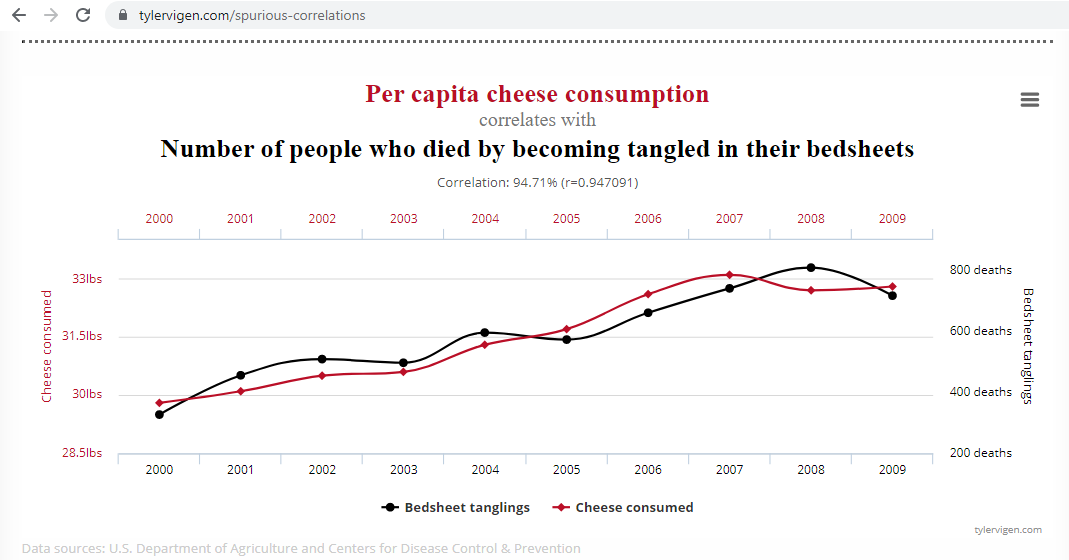
Eclectic wrote, "The land sink shows about 30-35% of total emissions, while the sum of land & ocean remains around 55-60%."
Yes, I usually say "about half," as in, "If our CO2 emissions were cut by more than about half then the atmospheric CO2 level would be falling, rather than rising."
It is important to recognize that the relationship is merely coincidental, not causal.
Eclectic wrote, "as the decades progress, the natural carbon sink flux in absolute terms rises with the rising emissions ~ but does not show a proportional increase."
The rate at which natural processes, such as ocean uptake, uptake by trees and soil ("greening"), and rock weathering, remove CO2 from the air, is affected in minor ways by many factors, but in a major way by only one: the current amount of CO2 in the air.
Our CO2 emission rate does not and cannot affect the natural removal rate, except indirectly, in the long term, by being one of the most important factors which affect the amount of CO2 in the air.
Eclectic wrote, "looking back in time ~ as the atmospheric CO2 level decreases, the size of the natural sink flux decreases also."
That is correct. It will also be correct looking forward in time, when CO2 levels are falling, someday.
Eclectic wrote, "this directly contradicts your hypothesis of 'if emissions were halved ... atmospheric CO2 level would plateau.'"
If you'll allow me to use "halved" as a shorthand for "reduced to the point at which emissions merely equal current natural removals, rather than exceed them," then those two statements are both correct, and perfectly consistent. It's pCO2 (level), not the rate of CO2 emissions, which (mostly) governs the rates of all the natural CO2 removal from the atmosphere.
Of course there are also minor factors which affect the removal rates. For instance, as we've already discussed, a 1°C rise in water temperature slows ocean uptake of CO2 by roughly 3%. Conversely, a rise in air temperature accelerates CO2 removal by rock weathering. (Sorry, I don't have a quantification of that.) But the main factor which controls the rate of CO2 removals is pCO2.
Eclectic wrote, "While the nutritive components of some food crops may reduce slightly as CO2 rises…"
Oh boy, another rabbit hole! That's the Loladze/Myers "nutrition scare."
It is of little consequence. That should be obvious if you consider that crops grown in commercial greenhouses with CO2 levels as high as 1500 ppmv are as nutritious as crops grown outdoors with only 30% as much CO2.
≥1500 ppmv CO2 is optimal for most crops. That's why commercial greenhouses typically use CO2 generators to raise daytime CO2 concentration to well above 1000 ppmv. It is expensive, but they go to that expense because elevated CO2 (eCO2) makes crops much healthier and more productive. (They don't typically supplement CO2 at night unless using grow-lamps, because plants can't use the extra CO2 without light.)
If elevating CO2 by >1000 ppmv doesn't cause crops to be less nutritious, then elevating CO2 by only 140 ppmv obviously doesn't, either.
Better crops yields, due to eCO2 or any other reason, can cause lower levels (but not lower total amounts) of nutrients which are in short supply in the soil. But that doesn't happen to a significant extent when agricultural best practices are employed.
I had an impromptu online debate about the nutrition scare with its most prominent promoter, mathematician Irakli Loladze, in the comments on a Quora answer. If you're not a Quora member you can't read it there, so I saved a copy here. He acknowledged to me that food grown in greenhouses at elevated CO2 levels is as nutritious as food grown outdoors.
Faster-growing, more productive crops require more nutrients per acre, but not more nutrients per unit of production.
Inadequate nitrogen fertilization reduces protein production relative to carbohydrate production, because proteins contain nitrogen, but carbohydrates don't. Likewise, low levels of iron or zinc in soils cause lower levels of those minerals in some crops. So, it is possible, by flouting well-established best agricultural practices, to contrive circumstances under which eCO2, or anything else which improves crop yields, causes reduced levels of protein or micronutrients in crops.
But farmers know that the more productive crops are, the more nutrients they need, per acre. Competent farmers fertilize accordingly.
Or, for nitrogen, they may plant nitrogen-fixing legumes — which benefit greatly from extra CO2.
If you don’t fertilize according to the needs of your crops, negative consequences may include reductions in protein and/or micronutrient levels in the resulting crops. The cause of such reductions isn't eCO2s, it's poor agricultural practices.
The nutrient scare is an attempt to put a negative "spin" on the most important benefit of eCO2: that it improves crop yields.
Eclectic wrote, "it is (as you state) beyond argument that higher CO2 benefits overall crop yield & plant mass."
That's correct. Moreover, agronomy studies show that for most crops the effect is highly linear as CO2 levels rise, until above about 1000 ppmv (which is far higher than we could ever hope to drive outdoor CO2 levels by burning fossil fuels). That linearity is obvious in the green (C3) trace, here:
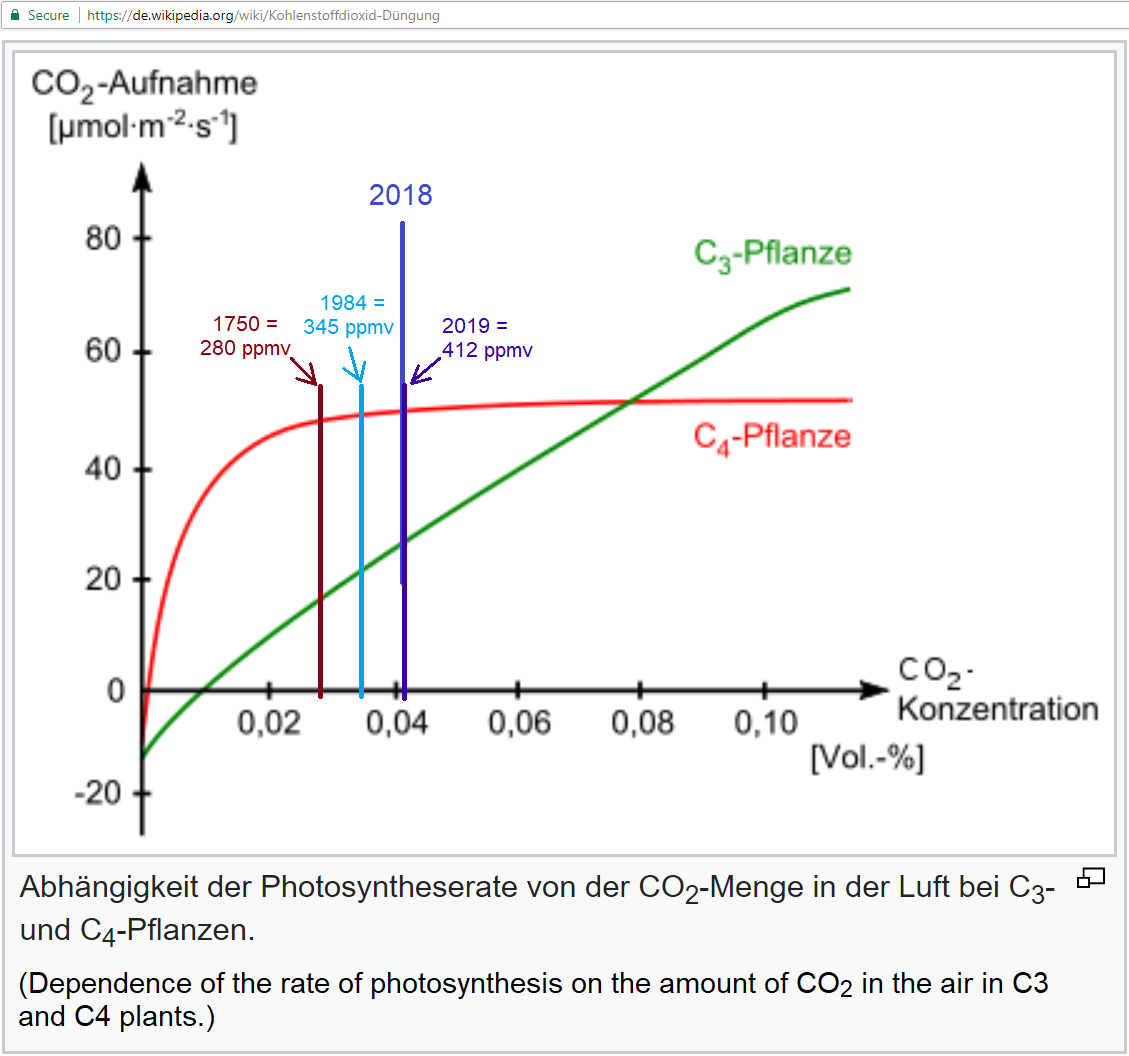
That improvement is one of several major reasons that catastropic famines are fading from living memory.
If you're too young to remember huge, catastrophic famines, count yourself blessed. Through all of human history, until very recently, famine was one of the great scourges of mankind, the "Third Horseman of the Apocalypse." But no more. This is a miracle!
https://ourworldindata.org/famines
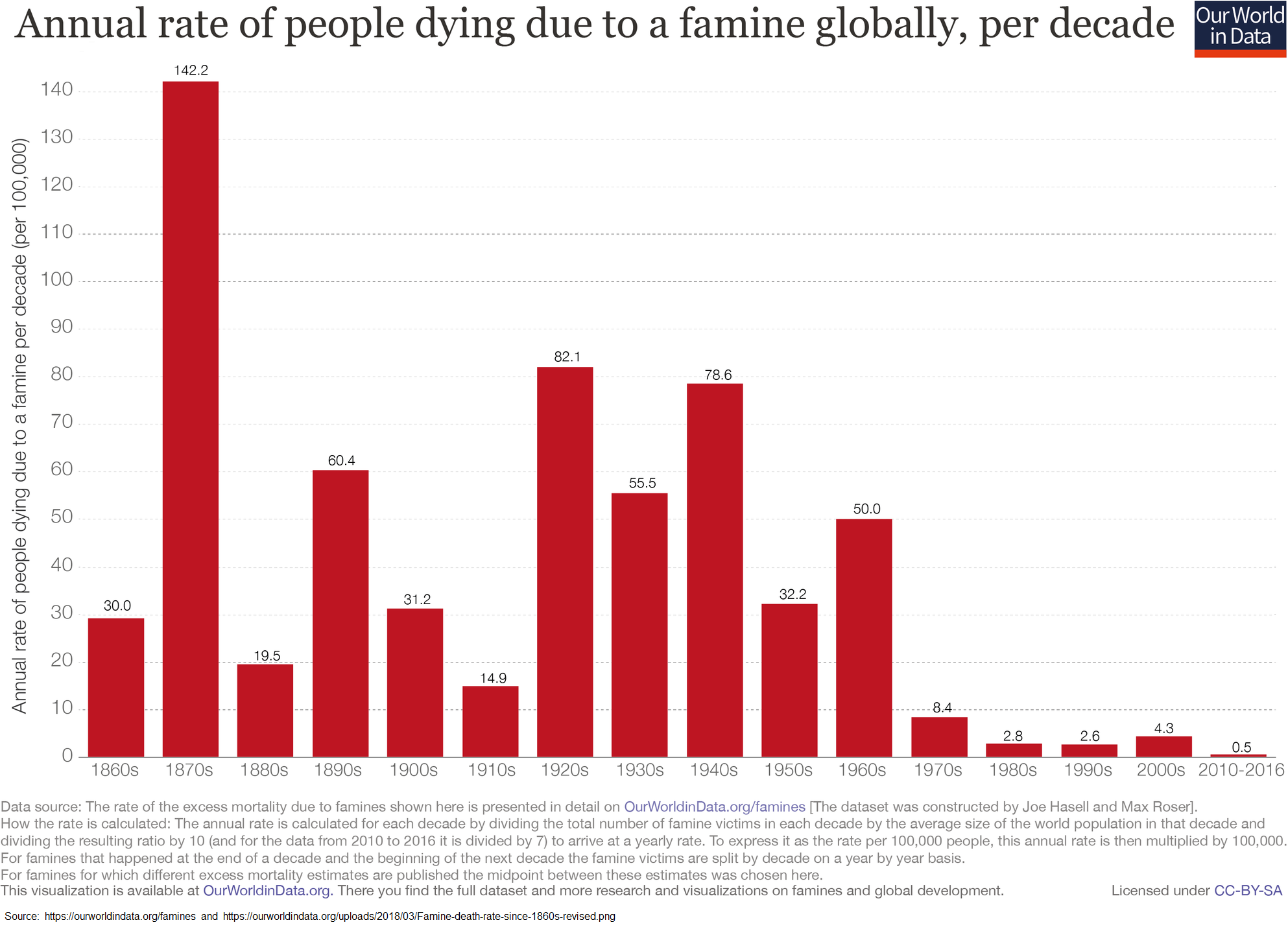
Ending famine is a VERY Big Deal, comparable to ending war and disease. Compare:
● Covid-19 killed 0.1% of world population.
● 1918 flu pandemic killed about 2%.
● WWII killed 2.7%.
● The near-global drought and famine of 1876-78 killed about 3.7% of the world population.
Eclectic wrote, "other CO2/AGW concomitant effects of increased droughts /floods /heat-waves can be harmful to crop yields in open-field agriculture. [And especially so for the staple crop of maize.]"
Well, let's examine those one at a time.
Heat-waves. Overall, temperature extremes are not worsened by the warming trend. Heat waves are slightly worsened, but by less than cold snaps are mitigated. That's because, thanks to "Arctic amplification," warming is disproportionately at chilly high latitudes, and it is greatest at night and in winter. The tropics warm less, which is nice, because they're warm enough already.
1°C is about the temperature change you get from a 500 foot elevation change. (That's calculated from an average lapse rate of 6.5 °C/km.)
On average, 1°C is similar in effect to a latitude change of about sixty miles, as you can see by looking at an agricultural growing zone map. Here's one, from the Arbor Day Foundation:
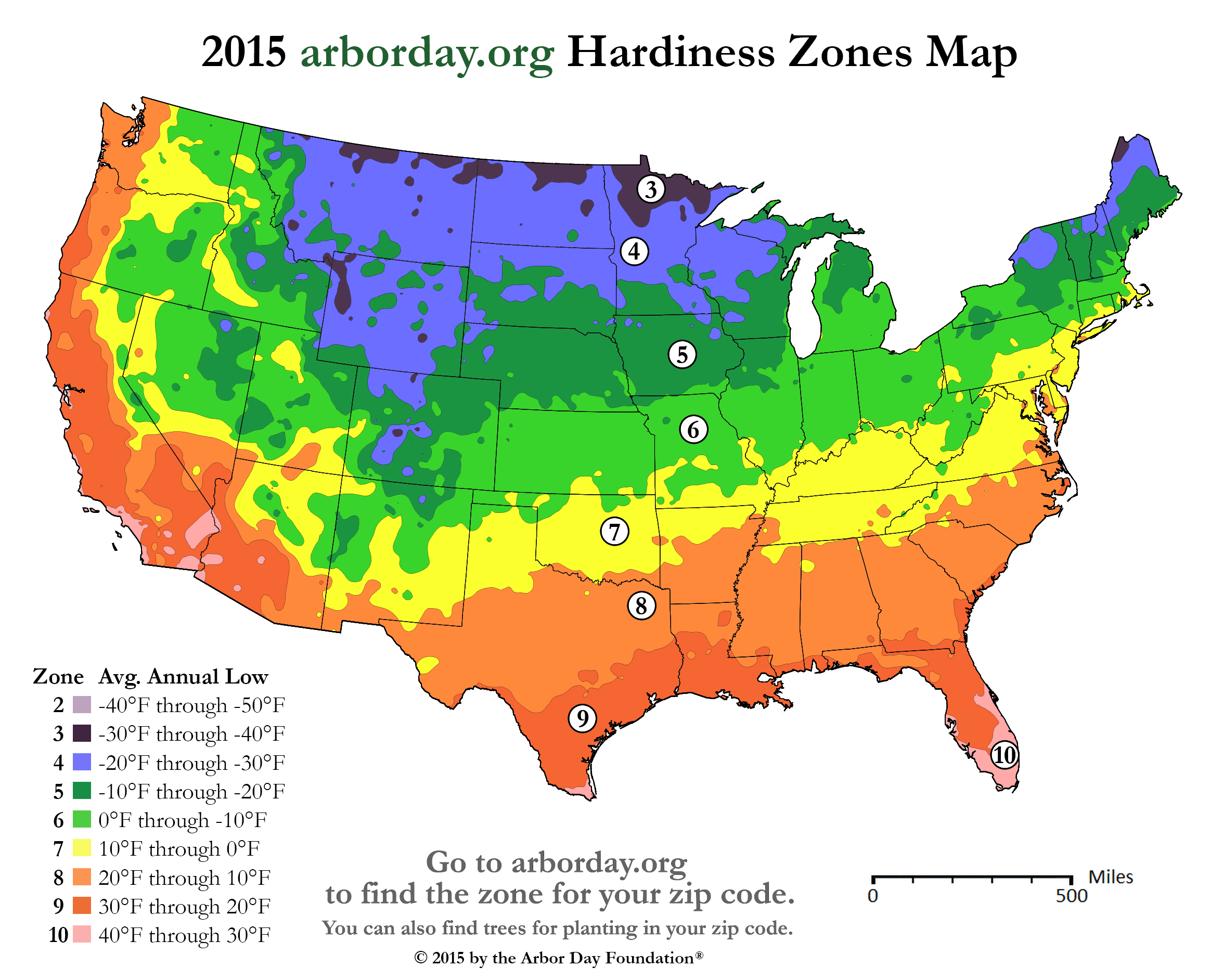
From eyeballing the map, you can see that 1°C (1.8°F) = about 50-70 miles latitude change.
James Hansen and his colleagues reported a similar figure: "A warming of 0.5°C... implies typically a poleward shift of isotherms by 50 to 75 km..."
1°C is less than the hysteresis ("dead zone") in your home thermostat, which is the amount that your indoor temperatures go up and down, all day long, without you even noticing.
In the American Midwest, farmers can fully compensate for 1°C of climate change by adjusting planting dates by about six days.
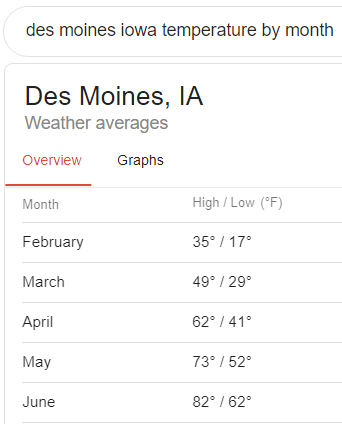
Floods. Theoretically, by accelerating the water cycle, climate change could increase the frequency or severity of floods. But the effect is too slight to be noticeable. AR6 says no change in global flood frequency is detectable:
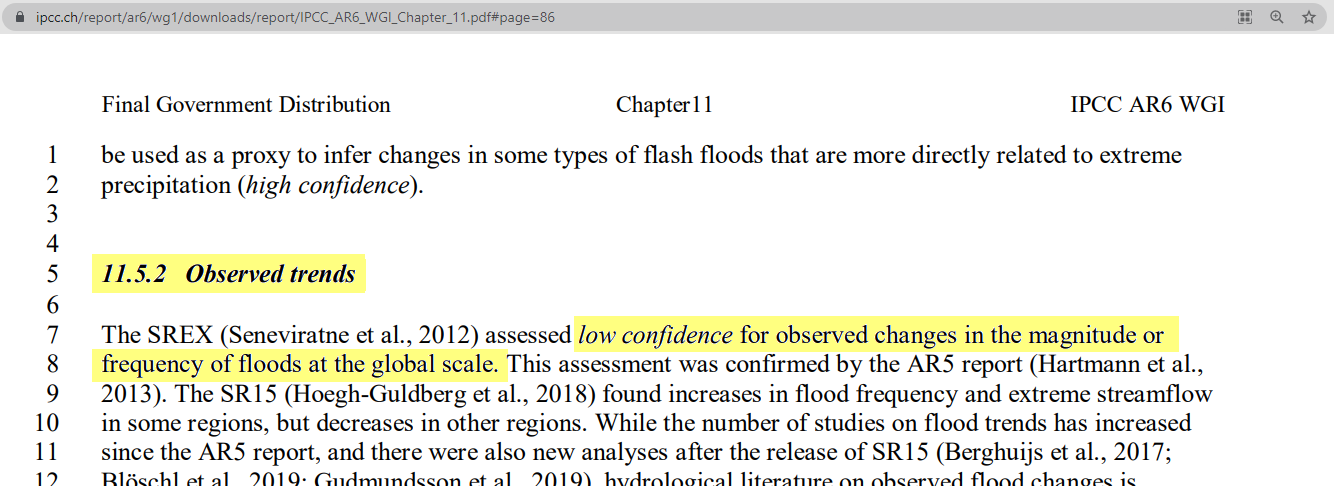
Droughts. Droughts have not worsened. In fact, the global drought trend is slightly down. Here's a study:
Hao et al. (2014). Global integrated drought monitoring and prediction system. Sci Data 1(140001). doi:10.1038/sdata.2014.1
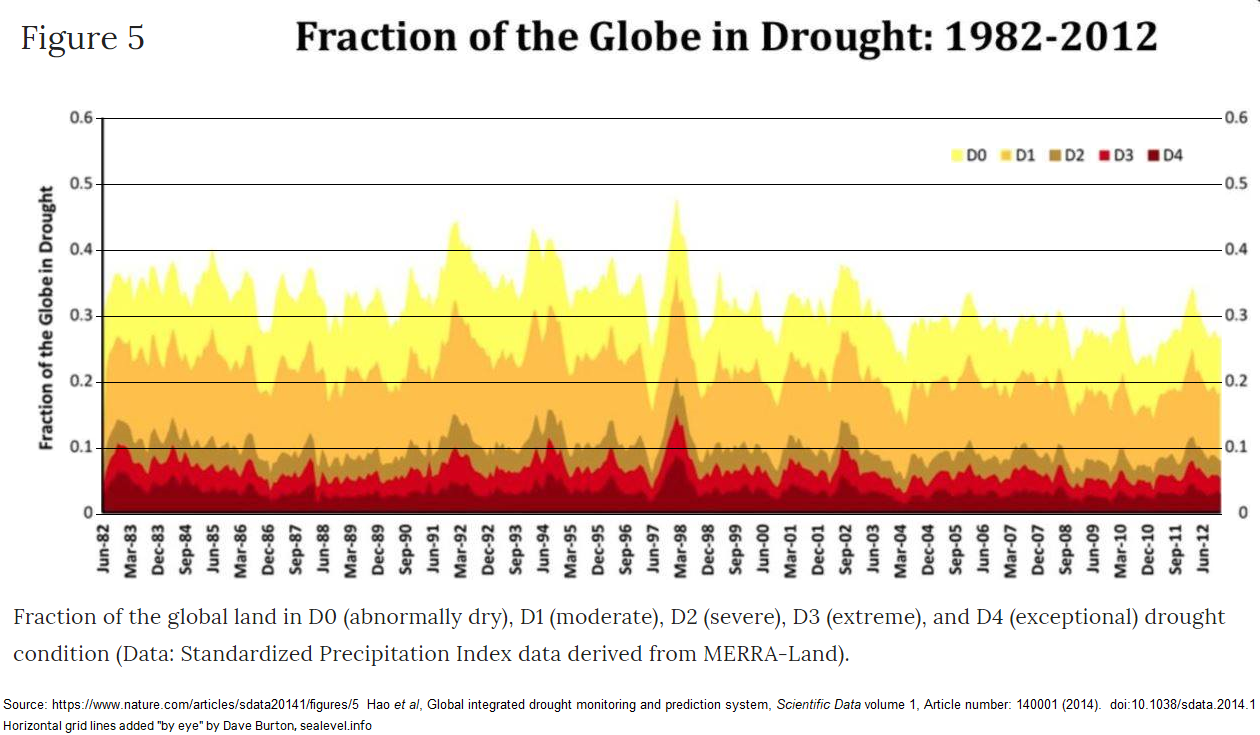
Here's the U.S. drought trend (the bottom/orange side of the graph):
https://www.ncei.noaa.gov/access/monitoring/uspa/wet-dry/0
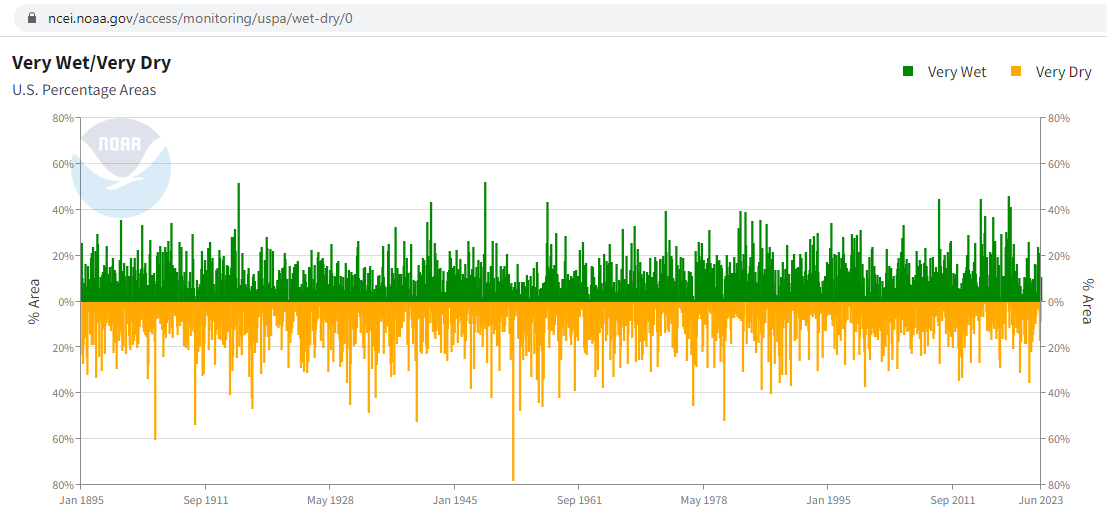
Not only does climate change not worsen droughts, it has long been settled science that eCO2 improves plants' water use efficiency (WUE) and drought resilience, by improving CO2 stomatal conductance relative to transpiration. So eCO2 is especially beneficial in arid regions, and for crops which are under drought stress.
Maize (corn) has been very heavily studied. Even though it is a C4 grass, it benefits greatly from elevated CO2, especially under drought stress. Here's a study (one of many):
Chun et al. (2011). Effect of elevated carbon dioxide and water stress on gas exchange and water use efficiency in corn. Agric For Meteorol 151(3), pp 378-384, ISSN 0168-1923. doi:10.1016/j.agrformet.2010.11.015.
EXCERPT:
"There have been many studies on the interaction of CO2 and water on plant growth. Under elevated CO2, less water is used to produce each unit of dry matter by reducing stomatal conductance."
Here's a similar study about wheat:
Fitzgerald GJ, et al. (2016) Elevated atmospheric [CO2] can dramatically increase wheat yields in semi-arid environments and buffer against heat waves. Glob Chang Biol. 22(6):2269-84. doi:10.1111/gcb.13263.
However, I agree with you that putting a monetary value on the benefits of CO2 for crops is difficult. In part that's because the price of food soars when it's in short supply, and plummets when it's plentiful. So, for example, if we were to attribute, say, 15% of current crop yields to CO2 fertilization & CO2 drought mitigation, and value that 15% using current crop prices, we would be underestimating the true value, because absent that 15% boost the prices would have been much higher.
- How big is the “carbon fertilization effect”?
Rob Honeycutt at 11:17 AM on 11 July, 2023Dave... Your reference to the inset on FAQ 5.1 is comical at best.
It states exactly what I'm telling you, as did the other bits I posted.
FAQ 5.1: Is natural removal of carbon
from the atmosphere weakening?
No, natural carbon sinks have taken up a near constant fraction of our carbon dioxide (CO2) emissions over the last six decades.
You were making the claim that natural sinks were removing more of our emissions, and that is not the case by any stretch of the imagination. And the caption you posted goes on to say...
However, this fraction is expected to decline in the future if CO2 emissions continue to increase.
How can you not understand this? Take note that AR6, though it's the most current IPCC report, came out nearly two years ago, and the report is relying on data and research that was completed well before even that.
The most recent papers are saying that, yes, that CO2 fertilization effect is now waning.
Tropical Forests’ Carbon Sink Is Rapidly Weakening – Crucial for Stabilizing Earth’s Climate
Once again, in your own citation the language is clear.
FAQ 5.1 | Is the Natural Removal of Carbon From the Atmosphere Weakening?
For decades, about half of the carbon dioxide (CO2) that human activities have emitted to the atmosphere has been taken up by natural carbon sinks in vegetation, soils and oceans. These natural sinks of CO2 have thus roughly halved the rate at which atmospheric CO2 concentrations have increased, and therefore slowed down global warming. However, observations show that the processes underlying this uptake are beginning to respond to increasing CO2 in the atmosphere and climate change in a way that will weaken nature’s capacity to take up CO2 in the future. Understanding of the magnitude of this change is essential for projecting how the climate system will respond to future emissions and emissions reduction efforts.
The "observations show" means they are already seeing this happening, and that is based on research that's at least half a decade old.
- 2nd law of thermodynamics contradicts greenhouse theory
Likeitwarm at 11:16 AM on 12 June, 2023I know this post will technically be off topic, but is a direct answer to scaddenp's inquiry.
scaddenp 1543 - I see there are many who claim their science is right on both sides of the climate argument and everyone presents what appears to be good arguments to support their position. I know that it is normal human behavior to have some bias toward one's own argument. This is the opinion of all that I talk to in the non-scientist group. Many don't know who to believe and pay any attention to what can be a confusing subject. Myself, not being a well educated physicist, feel at a disadvantage. My math is only basic, algebra 2 in high school. Someone very good with math could easily pull the wool over my eyes with complex formulas involved in this science. I am a machine designer/cost anayizer/production programmer/personel manager for the production of an old product who got there by the seat of my pants. I have been retired now 6 years.
I just could not believe a trace gas of .04% of the atmosphere could have such an effect, especially with the history of CO2 volumes and estimated historic atmospheric temperatures not jiving with each other. There are so many factors that have different affects, it is hard to discern which are reasonable causes. With "global" temperatures reportedly being fairly flat since 1998 and CO2 continuing to rise at a steady rate and the U.S. Government spending $375B, recently, towards climate initiatives(some is my tax money and yours if you pay U.S. taxes), I am still seeking the truth to inform my congress of the truth that I see. I do not believe we should be destroying the world economies and spending vast amounts of the public treasure when there is so much disagreement on what is causing climate change. That was the opinion of Dr. Allen Carlin of the EPA in 2009. He called the evidence for AWG incomplete.
I know you guys that support this site put a lot of time and effort into the science and site. That's why I come here to investigate.
If there is a better place to have this conversation, please let me know.
- At a glance - How reliable are climate models?
PSBaker at 21:44 PM on 2 June, 2023Goodness @Bob Loblaw @eclectic !
Much of your ire seems to be focussed on lack of specificity, vagueness etc …
Sorry, I didn’t realize there is some sort of rule about it … but if you look at the OP, it is a model of vagueness, no papers cited – frankly, it’s pretty much waffle.
In my response I did provide examples, albeit the first to hand. I could have done better, but since @eclectic stated “ . . . but uncertainties are, for the rest of us, probably not worth addressing” I felt that, together with the lack of specificity in the OP, this gave me some liberty to extemporize. I also did not want to finger specific papers since I know some of the scientists involved, who have enough problems trying to navigate their careers without feeling picked upon.
I’m not surprised by the response though, this has been my experience through the latter part of my career – that criticizing modelling evokes a particular snarky rage from the priesthood who elect to guard the eternal flame.
My central point however remains valid, the models are good at somethings, lousy at others and there’s a whole sub-industry of scientists applying them to make unrealistic projections. We who work in the field, trying to help (in my case poor farmers) find them of little use and even counterproductive.
That, in my humble opinion, is what the discussion of climate models should be addressing and what I, in my albeit halting fashion, was trying to convey.
Here’s Dr Baethgen covering some of these points better than I can, in a lecture from 2020, (start ~8 mins), esp. 18 & ~35m “So when you see these beautiful maps with reds and greens, don’t trust them, remember that behind that colour is a big uncertainty.”
https://worldcoffeeresearch.org/news/2020/watch-a-new-way-to-think-about-climate-change
- Antarctica is gaining ice
scaddenp at 07:54 AM on 23 May, 2023"Nobody knows.." Hmm. Certainly investigated. See "Interannual ice mass variations over the Antarctic ice sheet from 2003 to 2017 were linked to El Niño-Southern Oscillation"
Shows correlation of AP and WAIS with ENSO and anticorrelation of EAIS.

Hmm. ok, only 2017. What about GFO and recent records. There is some detailed analysis in "Spatially heterogeneous nonlinear signal in Antarctic ice-sheet mass loss revealed by GRACE and GPS (2023)"
and another study of links with other quasi-periodic cycles in Antarctica in "Antarctica ice-mass variations on interannual timescale: Coastal Dipole and propagating transports"
Evidence to date - based on correlations of where the changes in ice mass are occurring - links interannual change to short term (2-8 year) quasi-periodic weather cycles (ENSO, Antarctic Circumpolar Wave, Antarctic Occillation) influencing Antartica.
My money (literally) would be on continued long term ice loss. Short term variation as observed here to date would certainly NOT be a reason for change in climate mitigation policy.
- Why the food system is the next frontier in climate action
One Planet Only Forever at 03:08 AM on 2 May, 2023Evan @6,
I briefly reviewed the 2014 Research Article you pointed/linked to (note it is almost 10 years old). I would update my previous comments to add that human actions causing increased N2O in the nitrogen cycle are to be considered the same way I refer to impacts on the carbon cycle. And I would add that there are other good reasons for more aggressive reduction of nitrogen cycle impacts than climate change (refer to Planetary Boundaries).
I will also clarify that reducing methane emissions from rice is still an opportunity for reducing the peak level of ghg impacts even if that methane could be considered to be ‘part of the natural carbon cycle (an action that does not increase the amount of carbon in the carbon cycle the way that burning fossil fuels or leaks of methane from fossil fuel operations or permafrost melting do).
More specifically, the report’s evaluated floor level of non-CO2 emissions from food production and consumption (Global total 7 GtCO2e/year by 2050 with more if population continues to grow beyond 2050 and also influenced by 'potential changes of attitudes towards being less harmful') appears to be based on the perceived willingness of the UK population, at the time the report was prepared, to learn and be less harmful consumers. And the evaluated UK willingness is extended globally with all people expected to want develop to live in ways comparable to the less harmful ways that the UK population was evaluated to be willing to live.
The following is a quote from the “Options and barriers to mitigating food system non-CO2 emissions - Agriculture” section of the Research Article:
“For both N2O and CH4, socioeconomic and environmental circumstances dictate the extent to which changed agricultural technologies and practices can deliver cuts in emissions at a systems level. Stakeholders suggested that important factors influencing uptake of mitigation options affecting the UK revolve around cost, dominant practices, the aging farming community and attitudes of ‘young farmers’, existing infrastructure, cultural norms, changing climate as well as a feedback linked to levels and patterns of consumption.”
A quote from the “Options and barriers to mitigating food system non-CO2 emissions - Consumption” section of the Research Article:
“Within the UK consumption-based scenarios, the most significant dietary change considered was a 70% per capita cut in meat consumption, with the deficit replaced with rises in other food types. However, even with changes to per capita meat consumption, absolute emissions levels are driven by population growth (consistent across the scenarios) as well as growth in per capita consumption levels. Population growth per se strongly constrains N2O mitigation, as crops for consumption and for feed for livestock continue to require manure or mineral fertilizer. Barriers to changing patterns of consumption are confirmed through consumer focus group analysis: moderate changes in meat consumption (20% per capita) were considered in line with financial pressures to reduce expenditure given the context of the 2009–2012 recession, whereas a 70% reduction was perceived too substantial a change for many [Citation33].”
That indicates that the evaluation was (likely unwittingly) biased by accepting questionable opinions like ‘the higher cost of being less harmful is a valid reason to be more harmful’ and ‘the developed popularity of eating more meat is a valid reason to not reduce meat consumption’. Note that I tried to present both of those points in a way that highlights that populist political misleading messaging significantly caused those attitudes to develop to be so influential that they compromise the evaluation and the way it is reported.
Quote from “Discussion - Implications for cumulative GHG emissions”
“Finding ways of reliably reducing non-CO2 emissions will become increasingly pressing as global demand for food rises. A wide range of feasible CH4 mitigation options were put forward by stakeholders, taken from the literature and quantitatively assessed during the scenario process, providing evidence for greater scope for achieving substantial CH4 mitigation than for N2O. This, coupled with the much longer lifetime of N2O compared with CH4 as well as the influence of carbon cycle feedbacks in raising the GWP of CH4 from 21 to 34, highlights the critical importance of fully exploiting CH4 mitigation potential whilst increasing the research effort towards developing agricultural systems that can minimize N2O production.”
That indicates that if the developed research bias is corrected there could be more reduction of N2O resulting in a lower ‘floor level’.
Quote from “Discussion - Implications for managing and mitigating CO2”
“The focus here on non-CO2 reinforces other studies that identify the existence of an emissions floor, further emphasizing an urgent need to mitigate CO2 emissions where it is most feasible and quickest to do so. The higher the non-CO2 floor, the more rapidly CO2 emission cuts are needed within the constraints of a chosen climate target. Conversely, relying on a low or non-existent emissions floor suggests a larger CO2 budget is available, again relaxing the rates of mitigation for a chosen climate change target, delivering a more palatable but less realistic assessment of the climate change challenge.”
This emphasizes that the learning from the report is that more rapid efforts to reduce fossil fuel use are required.
Quotes from the “Conclusion” of the research article:
“A continuation of absolute growth in global N2O emissions, despite assuming optimistic mitigation has, because of cumulative emissions, direct implications for how urgently and deeply to cut both CO2 and CH4 for an assumed climate target.”
This reinforces the need for more research to reduce N2O and the need to more aggressively cut CO2 and CH4 unless new research develops viable ways to rapidly reduce N2O.
“As energy systems become decarbonized, global non-CO2 emissions largely associated with food consumption and production will increase in the share of annually produced GHGs. Emphasizing the importance of making cuts in food-related emissions highlights an urgent need for policymakers in Annex B nations to consider not only technological and supply-side interventions, but tackle the thorny issue of levels and types of consumption. Unlike large-scale infrastructure developments, measures tackling consumption and demand have the potential to cut emissions of CO2 and non-CO2 alike in the short term and could improve the diminishing chances of remaining within the carbon budget commensurate with the 2ーC threshold.”
That highlights the need for policymakers to “tackle the thorny issue of levels and types of consumption” because the reports conclusion is that current over-developed populations are not as willing to be less harmful as they should be.
A quote from the “Future perspectives” part of the research article:
“If the challenges posed by climate change are to be overcome, at least in part, a meeting of minds to define problems can offer new, much needed insights. This is already emerging in some quarters, with an increase in interest from research funders around the food–water–energy nexus as well as a rise in the number of researchers keen to engage in genuinely interdisciplinary activity. Of course disciplinary research may, out of necessity, continue to dominate, but the emerging expertise in interdisciplinary research needs support and encouragement given the extent of the systemic and complex challenges facing society.
"The climate change challenge becomes ever more urgent each year, with time limiting the options available for mitigating emissions to be largely those that can deliver change in the short term. Perhaps with agronomists, biologists, engineers, political and social scientists working increasingly in single units, systemic ‘solutions’ to the climate challenge can be found. Specialists in demand and consumption require the same prominence in the portfolio of research endeavour as technologists, physical scientists and engineers. Only then will resilient options be derived and ultimately implemented in a timescale befitting of the scale of change facing society.”
- Why the food system is the next frontier in climate action
One Planet Only Forever at 09:10 AM on 30 April, 2023Evan,
Your question may be questionable.
The climate change issue is primarily about human actions that are increasing ghgs in the carbon cycle (increasing the balanced state of ghgs in the atmosphere and causing other harms like increased CO2 absorption in oceans).
That perspective helps identify and understand the differences between the variety of ghg impacts caused by human actions. Most important, it helps understand that some causes of CO2e from human food production and consumption are ‘not the concern’.
Steady-state production of ghgs from food production and consumption is not the primary concern. That would be a sustainable carbon cycle. Food production and consumption that increases the level of ghgs, especially the use of fossil fuels, is the primary concern. An increasing population that eats less ‘higher impact food like meat or rice’ can actually result in a reduction of the steady-state level of ghgs. In addition to an increasing population having less consumption, the remaining consumption can be changed to be less harmful, like developing meat and rice production that does not cause as much ghg impact.
Therefore, an answer to the question about the ‘per capita CO2e’ is that, due to the current developed problem of significant excess ghgs, especially CO2, already in the atmosphere, unnecessary CO2e impacts from human activity need to be ended and actions that will reduce the steady-state ghg levels in the atmosphere are required. (The peak level of ghg increase due to the historic, and continuing, lack of interest in seriously restricting harmful and unnecessary actions will undeniably be a harmfully excessive level).
Also, the required changes of food production and consumption for the collective of human activity to be more sustainable will vary by region. Regions that currently have more people eating less than a ‘diet necessary for healthy living’ can be expected to have increasing impacts. But if such a region also has a significant amount of harmful unnecessary food consumption, due to a significant status gap in that region's society, then that region could, depending on how much harmful consumption is occurring in the region, reduce the total regional level of ghg impacts while the less fortunate in the region increase their impacts.
PS. The titles of the two study reports linked in the last paragraph you are questioning are informative (the reports are even more informative): “A meta-analysis of projected global food demand and population at risk of hunger for the period 2010–2050” and “Future warming from global food consumption”. However, developed socioeconomic-political biases can bias what is investigated, how it is investigated, and how it is reported. That is likely a significant root cause of the populist political attacks on less biased science that establishes a requirement for significant changes of developed beliefs and actions, especially if it highlights the need for rapid changes of popular and profitable developments. It may also be why I did not see the obvious problem of harmful over-consumption being highlighted.
- Arctic sea ice has recovered
Albert22804 at 17:00 PM on 20 April, 2023The Kinnard has Arctic ice extent increasing from about 750 to 1500 which is an absurdity. Vikings colonised Greenland about 980 and farmed some areas that today are permafrost.
But the graph shows 980 ice extent to be about the same as 1700 and by that time the areas farmed were permafrost.
The graph shows ice extent dropping dramatically from about 1400 but the little ice age was ramping up in 1400, not down.
The graph shows ice extent increasing dramatically from about 1600 but the LIA peaked around 1650-1700 and temperatures have risen sporadically ever since. The Central England Temperature database correlates well with this.
Here is a different reconstruction that shows 1940 Arctic ice to be about the same as
[LINK]
See figure 1b
But the guy was italian and what would they know? See, I can be sarcastic as well.
- CO2 limits will harm the economy
MA Rodger at 18:35 PM on 2 April, 2023retiredguy @112,
You do specifically ask about rebuttals of Lomborg's verbose 2020 paper 'Welfare in the 21st century: Increasing development, reducing inequality, the impact of climate change, and the cost of climate policies' and as has been pointed out, this paper is packed full of the usual Lomborg nonsense. I don't know of any specific rebuttal to this paper. I think with a 'broken record' like Lomborg, you need the expertise to unpick his nonsense as well as the dedication to keep at it. A month after this paper, Lomborg published a book 'False Alarm: How Climate Change Panic Costs Us Trillions, Hurts the Poor, and Fails to Fix the Planet' and that did result in a rebuttal.
As for the paper 'Welfare in the 21st century: Increasing development, reducing inequality, the impact of climate change, and the cost of climate policies,' we can cut through all Lomborg's nonsense and simply consider his basic argument which is that AGM mitigation preventing large levels of global warming (as in scenario SSP1-1.9) is, according to Lomborg, not as benificial to mankind as allowing fossil fuel use to continue without restriction (as in secanario SSP5-8.5, roughly similar to the previous RCP8.5). From the abstract:-
Long-term impacts of climate policy can cost even more [than 2030 costs]. The IPCC's two best future scenarios are the “sustainable” SSP1 and the “fossil-fuel driven” SSP5. Current climate-focused attitudes suggest we aim for the “sustainable” world, but the higher economic growth in SSP5 actually leads to much greater welfare for humanity. After adjusting for climate damages, SSP5 will on average leave grandchildren of today's poor $48,000 better off every year. It will reduce poverty by 26 million each year until 2050, inequality will be lower, and more than 80 million premature deaths will be avoided.
This argument is thus mainly based on the economic predictions set out by IPCC ARs within these SSPs and then downplaying to the point of insignificant the economic damage in a SSP5-8.5 world experiencing +4.4ºC by 2100 (this a central figure in the range +3.3ºC-5.7ºC) and which will continue warming post-2100, the 2300 range being given as +6.6ºC−14.1ºC. Now that is scary. (And note in the graphic below, the SSP5/RCP8.5 temperatures are still rising in 2300. There is even more to come.) Lomborg is advocating a really scary future while insisting there is no scary future.

- The Big Picture
One Planet Only Forever at 06:34 AM on 22 March, 2023Bart Vreeken @131,
There was no question. I was presenting an understanding based on observations of evidence in your comments. Your presented interpretation of my comments appears to support my observation in my comment @99 that:
"There is a wealth of evidence in Bart’s comment history that appears to indicate that their interests are not Big Picture. Their interests appear to be much smaller/narrower. They appear to be seeking ‘positive perceptions from the perspective of short-term regional interests’."
I have made other comments about the harm of pursuing positive perceptions because it delays learning the Truth about the Big Picture harm being done to the future of Humanity. Arguing for a 'positive, less panicked, perspective' has produced the current serious harm, and risk of more significant harm, to the future of humanity that is presented in the article I pointed to in my comment @130. Another report on that same topic is by NPR "Cut emissions quickly to save lives, scientists warn in a new U.N. report".
The harmful reality you appear try to avoid understanding, even if you present global interpretations, is not altered by speculation based on one year of heavy snow fall on Antarctica and an unsubstantiated perceived correlation between snowfall and sea ice extent, or because Greenland may only melt on its east coast (conclusions you appear to be interested in jumping to).
Also, as I presented in my comment @68, the very negative (panic level severity) of possible outcomes is what the people who benefit most from the harm need to 'mitigate'. It is important to understand that what is referred to as 'climate change impact adaptation' is mitigation required by others because of a failure of harmful people (success from their short-term limited regional interest perspective) to mitigate their harmfulness. And part of how the harmful try to justify being more harmful is by claiming that "It's not that Bad = positive perceptions that the harm is not very significant" or "Harm done is worth it because of the Perceived Positives".
The Big Picture understanding is that it is generally unacceptable to use benefits or potential benefits to excuse harm done or potential harm done. The only case where that 'may be' acceptable is a case where the individual pursuing or obtaining the benefit will be the only one suffering any harm. It does not even apply to a group because different members of a group may obtain different degrees of harm and benefit.
In spite of that undeniable Big Picture understanding regarding the importance of learning to minimize harm and help those who have been harmed, many people today try to excuse continuing to pursue more benefit from being more harmful. And part of their harmful effort is the pursuit of harmful misunderstandings or a focus on 'positive perceptions that minimize the need for helpful mitigation by reducing the perceptions of severity of harm being done' (like claiming that less fortunate people deserve to be less fortunate, or being dismissive of what is happening to places like Bangladesh).
- The Big Picture
Bob Loblaw at 04:47 AM on 20 March, 2023Bart @ various posts...
You don't see the problem with comparing numbers in % and mm/yr? You do understand the importance of units in geophysical measurements, don't you? 32°F is not warmer than 15°C. A person walking at 6km/hr is not moving faster than an airplane doing mach 0.8.
% is a ratio between two values that use the same units. It has a numerator and a denominator. The mm/yr in your figure in comment 84 are a "relative sea level change" - they are a difference from some unspecified base. They need context to become meaningful, and comparison is only possible if you can resolve differences in context and produce numbers with the same units.
Repeatedly in this forum, you fail to give context to quotes, diagrams, papers, etc. You change contexts at a whim, making your comments hard to follow and difficult to perceive. If you think people are misunderstanding you, then spend more time preparing your comments.
Now, back to your diagram posting in #84 (and repeated in #94). You failed to give context - in particular, you failed to given any indication of what those values are relative to. You also failed to give any source, until I asked. You didn't even include the caption that goes with the figure. Here is the figure, with caption:
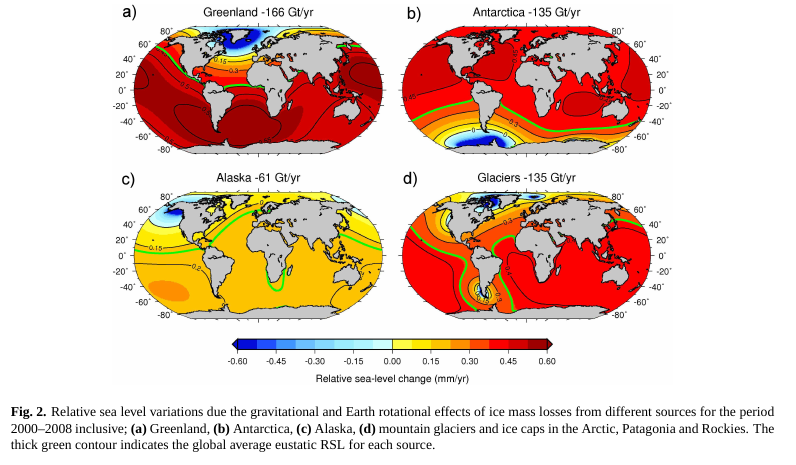
Note that the caption says "relative sea level variations due to the gravitational and Earth rotational effects of ice mass loss". [Emphasis added]
Do we have any other things to consider as context? How about the last paragraph of the paper's introduction?
We stress,however, that we consider, here, only the gravitationally consistent signature of ice melt. We do not include the response of ocean dynamics to the additional influx of fresh-water nor other changes in ocean dynamics due to predicted climate change, which can have a significant impact on RSL over decadal timescales. We also do not include spatially variable thermosteric effects on sea level.
So, figure 2 in their paper has a lot of context that you have left out. What do they say about their analysis? At the bottom of page 623, they say:
It is important to consider the separate fingerprints of RSL from the major sources to investigate their individual gravitationally-consistent “fingerprints”, but for present-day and future trends in sea level, it is the combined signal that is important. To first order, this can be approximated as the sum of the individual sources. We show the combined RSL changes, from all land ice sources considered, in Fig. 4.
And here is their figure 4:
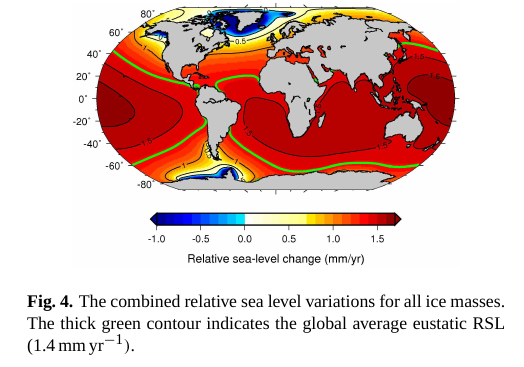
Things aren't looking so rosy for The Netherlands in that image. It certainly is not going to escape the effects of rising sea levels.
What else do Bamber and Riva have to say about their work?
In addition to GIA and surficial mass exchanges, there are two processes within the oceans that affect relative sea level. Steric effects (density changes due to salt and heat content variations) were responsible for about a quarter of the total SLR rise over the last 50 years, increasing to almost a half since 1993 but with large regional variations.
The paper clearly indicates that this regional fingerprinting (as displayed in their figure 2) is only one small part of a Big Picture (to get back to the topic of this blog post).
One more aspect of the paper you link to: it is doing an analysis base on Grace and other data up to 2008 - it is not a projection into the future. They even put a caveat in their Methods section (p622):
It is important to note, however, that this flux is time-evolving, including during the period of interest in this study. As a consequence, both the amplitude and pattern of RSL considered here may change in the future.
In short, you are frequently leaving out context of the information you provide - and as a result you are way over-stating the significance of what you present. Whether this in intentional or not, we cannot know.
All of this comes back to my very first question to you after your first comment here:
What exactly is your point?
You would be much better off with a small number of well-thought-out, reasoned, well-referenced posts than the scatter-blast that you've been doing.
- The Big Picture
John Mason at 16:24 PM on 19 March, 2023Just having first coffee of the day so will deal with comment #100 in a piecemeal fashion.
"Sections 6 (Human GG are causing global warming) and 8 (warming will continue) overstate the case. We know those to be true not from a simple application of "fundamental physics" but from elaborate computer models trying to approximate physics too complex for us to grapple with any other way."
Assuming the first principles of this topic are correct (they are) then how can that statement be inaccurate? We've known for over 150 years that if GHG concentrations are driven upwards, then a warmer climate will be the eventual result and that the warming will take decades to develop to its fullest extent. Now that may be a blunt object approach, but remember that set of conclusions was reached long, long before computers were around.
Models are not perfect but nevertheless extremely useful. They help us interrogate complex and highly variable systems to see how they respond to changes in those variables. Think of them as tools in the tool-kit, alongside observations, human resources, basic principles and so on. For we don't need models to tell us it will carry on warming the more CO2 emissions grow. We;ve known that all along. - The Big Picture
One Planet Only Forever at 03:17 AM on 18 March, 2023Peppers @36,
In spite of all that you have claimed the evidence-based understanding continues to be:
1. The climate impact problem of developed human activity is real.
2. The climate impact to date has already seriously compromised the future of humanity, especially due to the locking in of significant sea level rise). And because of the inertia of harmful developed over-consumption by the most harmful portion of the population things will be worse before humans stop making it worse. The continued harmful activity requires more repair (adaptation). And ‘adaptation effort’ delays human development of sustainable improvements. And the required adaptations will not be done for every body (I see not plans for the current portion of the population responsible for the rising sea levels to build flood mitigation systems that will be required for Bangladesh). And in some cases the harm is not repairable (The rising sea level impacts on Bangladesh may not be possible to adaptively mitigate).
3. The problem is the portion of the total population that is most harmful per-person. The total population increasing is a concern. But the problem of the total harm done is the real concern. And that can be understood to be due to the portion of the population that has developed a liking for over-consumption, not just unnecessary energy over-consumption. And the problem within that problematic ‘highest harm’ portion of the population is the portion that has less interest in learning about the harm caused (or the risk of harm) by their pursuits of ‘more personal enjoyment or benefit’
4. The problem can be solved. It just requires all people, even with an increasing population, to understand and accept the need to limit how harmful they are and to want to be more helpful to Others. There is a planetary limit on how many humans can live sustainably, concurrently live basic decent lives into the distant future. Many studies have established a consensus understanding that the maximum sustainable global population is a function of how much harmful over-consumption develops within the population. The planet can sustainably support more than 10 billion humans living basic decent lives (doing what is needed to live a decent basic live, and limiting the harm done by that essential activity). The planet cannot sustainably support the current 8 billion (or the most harmful 800 million) because of the developed harmful over-consumption within the population (and not just the harmful climate change impacts). Also, the developed systems fail to ensure that every body has the necessities of a basic decent life, including failing to provide basic minimum energy needs to every body and failing to have the ‘needed energy’ be as harmless as possible.
What is tragically missing from most discussion of the climate change problem, and other human harmful impact problems, is that the solutions require everybody to be governed by the desire to learn to be less harmful and more helpful to others. Some people 'doing their best to be less harmful and more helpful, and trying to help others be less harmful and more helpful' face the uphill challenge of overcoming the harm done by 'people who have developed other interests and related harmful misunderstandings'.
- Antarctica is gaining ice
Bart Vreeken at 18:56 PM on 10 March, 2023Hi Bob, the increase of the SMB of Antarctica is not so very speculative. It started last century, this NASA study says:
climate.nasa.gov/news/2836/antarcticas-contribution-to-sea-level-rise-was-mitigated-by-snowfall/
When we look at the last seven years then five of them were above average; four of them were far above average and none of them were far below average. So, it's not only last year.
Most of the uncertainty is in the expected discharge, I think.
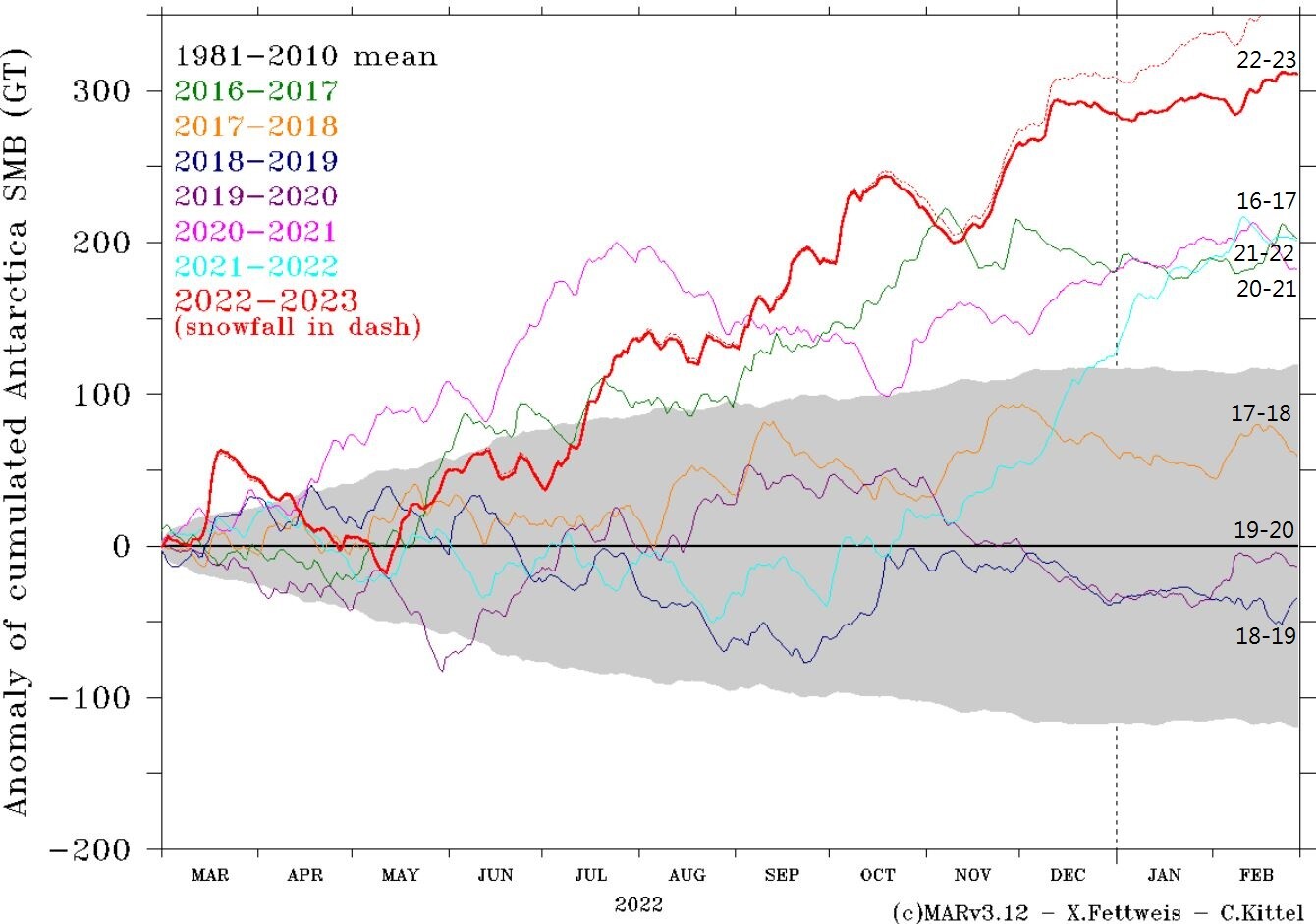
- It's not bad
MA Rodger at 21:57 PM on 19 February, 2023PollutionMonster @406,
I think I concur with Eclectic's 'snake pit'.
Zhao et al (2021) is a paper those climate deniers would find useful as it does show that for the period 2002-18 globally there was a decrease of 275,000/y deaths correllating with cold weather while the increase due to hot weather rose 113,000/y, simplistically suggesting AGW is 'good', although as today cold deaths are found to be much greater (4.6M/y) than hot deaths (0.5M/y), this finding is not so surprising.
In terms of this sort of analysis, this is very early work and likely an inaccurate account of the impact of "non-optimal ambient temperatures" on mortality. Note that a similar study Burkart et al (2021) drew criticism for its methods which found 1.3M/y cold deaths & 0.34M/y hot.
And given the numbers involved with global mortality, it is not difficult to establish large numbers of deaths in such simplistic correlations. The premature deaths due to pollution resulting from fossil-fuel-use is a case in hand. And when these studies point in the direction of 'hot is bad' or visa versa, they will be happily wielded by either 'warmists' or 'deinialists' with little thought to what is being 'wielded'. (Regarding 'visa versa', note Wu et al (2022) from the same team as Zhao et al finding an increase in excess deaths over the same period (2000-19) of +0.16M/y due to "short-term temperature variability".)
Much of this 'wielding' is remarkably poor. Note this Bloomberg headline - the 'subscriber only' article also covers Zhao et al (2021) and the actual account may be less ridiculous than the headline.
The impact of temperature directly on mortlity is surely today not as great as the indirect impacts described in the OP above although quantifying it all will be always controversial. (But should they be. I recall an argument we presented to a UK enquiry over an off-shore wind farm. Using even the smallest estimates of AGW deaths, we suggested the wind farm [Navitas off the Dorset coast] would globally save a very significant number of lives globally, that is very significant to such enquiries. Sadly the denialists won the day with the enquiry although the reasons given for the decision were entirely flawed.)
However, the direct impact of temperature should be a concern. Zhao et al point out "At a global level, the results indicate that global warming might slightly reduce net temperature-related deaths in the short term, although, in the long run, climate change is expected to increase the mortality burden." And the question, of course, is how big that "increase" will become. Myself, I would add that if AGW were allowed to intensify to +6ºC, we can say that the tropics will become a death zone for anybody outside an air conditioned environment. And +6ºC is not such a crazy number if we do nothing about AGW.
- Climategate CRU emails suggest conspiracy
Bob Loblaw at 23:40 PM on 15 February, 2023The Climategate and Peer-review link I gave above is #95 on SkS's "Most Used Climate Myths". (This thread is # 17.)
If you really want to read about corruption of the peer-review process, you should look at # 205 on the list: "How contrarians used pal review to publish contrarian papers". In the contrarians' world it is easy to imagine that the mainstream climate scientists are corrupting the process, because that's exactly what the contrarians are willing to do when they have control of a journal. Accuse your opponent of doing what you are doing...
- Climategate CRU emails suggest conspiracy
Bob Loblaw at 23:24 PM on 15 February, 2023JonJC, Eddie:
I suspect that the video in question is the one recently discussed on the "It's the sun" thread. MA Rodger's comment provides a link to the Curry/Peterson part of the video, with a pithy comment about the quality of Curry's blatherings.
I also suspect that there is nothing new in Curry/Peterson that isn't the result of a gross misrepresentation of the email contents. For the peer-review aspects, you should also read this SkS post on the subject:
- Climategate CRU emails suggest conspiracy
Eclectic at 20:40 PM on 15 February, 2023JonJC @85 ,
the Climategate biz is rather ancient history by now ~ but the science-denialists are desperatey short of ammunition . . . so they have to keep dredging it up (and they can never admit they got it wrong).
My favorite discussion of it is by science journalist "Potholer54" , back in about 2010. Google his youtube video titled "Climate Change - Those hacked e-mails".
His video runs 9 minutes, and you will find it amusing as well !
( The issue has had no significant developments since since then.)
- Climategate CRU emails suggest conspiracy
EddieEvans at 20:11 PM on 15 February, 2023JonJC
I'd like to listen to the suspect climate gate program. Do you have a link?
- Climategate CRU emails suggest conspiracy
JonJC at 16:54 PM on 15 February, 2023Judith Curry recently did an interview on Jordan Peterson's podcast - and she still leans very heavily on Climategate. She made some points which I've not seen covered here - about emails where climate researchers were bullying editors into silencing critics - it would be good to have some of that rebutted here (just because Peterson's reach is huge).
If you're not across it I'll suffer through listening to it again and will provide a summary - please let me know if you'd like me to do this. - It's the sun
Jim Hunt at 00:42 AM on 13 February, 2023As blind chance etc. would have it I currently find myself engaging with Judith Curry's denizens under her article about the recent joint venture with Jordan Peterson.
This is presumably the cause of some or all of the "it's the sun, stupid!" nonsense currently being promulgated in the Twittodenialosphere?
As a consequence my Arctic alter ego felt compelled to bring the following NASA article to the attention of one such Dunning-Kruger sufferer:
https://climate.nasa.gov/ask-nasa-climate/2949/why-milankovitch-orbital-cycles-cant-explain-earths-current-warming/
Elon's new thought police helpfully suggested that I might want to reconsider my attempted violation of Twitter's community guidelines:
The allegedly "offensive language" was merely echoing that of the DK sufferer in question.
What a "Brave New World" we currently inhabit!
- 2023 SkS Weekly Climate Change & Global Warming News Roundup #5
slumgullionridge at 12:22 PM on 8 February, 2023Well, I'm new here and I don't understand many of the "arguments" made by "some" of the contributors. There has never been a time in history when the wealthy have ever "rescued" the "proletariat". At the same time, an attack on the weathy (check: Marxist, especially Soviet or 20th Century Chinese history) didn't benefit the "poor". So it seems to me that any effort to escape the conditions leading to an uninhabitable planet might need to be made through mutual suffering, everyone will have to take their lumps.
Some suggestions: ground all airplanes, set a date for outlawing the use of private fossil fuel vehicles, eliminate industrial animal agriculture, place a moratorium on the manufacture of cement, and diminish all forms of international trade that require any form of physical transport.
That will cause all to suffer according to their own particular level of discomfort. The burden will be borne by everyone according to the "lifeboat principle" which burdens, yet saves everyone "on board".
If I understand the science correctly, cutting emissions along with its collateral injury to the environment, the above actions are enough to reverse climate change, not just mitigate/adapt to it. We could then expect the ice to return, the Amazon and other jungles to reforest, the oceans' pH to rise, many extinctions to slow down, and the human population explosion to shift into reverse. Localism will be the central operating principle of this effort, as it was before the age of Mercantilism (cir 1,500) and the advent of Capitalism (1776). The historical evidence shows that humanity entered this quandary at the dawn of the Industrial Revolution which is why, I suspect, we now label this the "Anthropogenic"?
- Don’t get fooled: Electric vehicles really are better for the climate
Philippe Chantreau at 03:56 AM on 6 January, 2023I believe that this has been looked at already in details by multiple teams:
arstechnica.com/cars/2021/07/electric-cars-have-much-lower-life-cycle-emissions-new-study-confirms/
Overall impact is highly dependent on battery manufacturing processes, and the ones made in Asia have an overall higher adverse impact:
www.sciencedirect.com/science/article/abs/pii/S0048969721079493
By far the most comprehensive analysis I have seen on the subjects is that of the EEA:
https://www.eea.europa.eu/publications/electric-vehicles-from-life-cycle
From section 6.1, summary of key findings, climate change impacts: ". In general, GHG emissions associated with the raw materials and production stage of BEVs are 1.3-2 times higher than for ICEVs (Ellingsen et al., 2016; Kim et al., 2016), but this can be more than offset by lower per kilometre use stage emissions, depending on the electricity generation source (Figure 6.1). Hawkins et al. (2013) reported life cycle GHG emissions from BEVs charged using the average European electricity mix 17-21 % and 26-30 % lower than similar diesel and petrol vehicles, respectively (Figure 6.1). This is broadly in line with more recent assessments based on the average European electricity mix (e.g. Ellingsen et al., 2016, Ellingsen and Hung, 2018."
The referenced papers are available, Hawkins et al (2013) is probably a little dated but not as European specific as others cited. Neugebauer, Zebrowski and Esmer (2022) has a variety of models that show benefits in most situations. Ellingsen and Hung (2018) is more specifically focused on the European generation mix. In general, CO2 emissions favor EVs, unless the EV would replace a still operational ICE car that is driven less than 5000miles/year. This holds even for generation mixes that are heavily reliant on coal.
- Skeptical Science New Research for Week #52 2022
Daniel Bailey at 07:57 AM on 1 January, 2023
Michael Mann has tweeted against the conclusions in this paper (see these whole threads):
https://twitter.com/MichaelEMann/status/1603437412272726017
https://twitter.com/MichaelEMann/status/1603446912073764865
Reading Hansen's piece, I was wondering why he never mentioned literally at least dozen papers (going back to before the AR5) plus the most recent assessment, the AR6 (I had a hard time believing that his entire author team also missed it, too).
This illustrates the need for peer review by non-affiliated experts prior to making things public...and to rely upon primarily the major scientific assessments and the published, peer-reviewed science.
This is the salient portion of the Lunt paper from 2010 that Mann references:
"Our combined modelling and data approach results in a smaller response (ESS/CS∼1.4) than has recently been estimated using palaeo data from the Last Glacial Maximum, 21,000 years ago (ESS/CS∼2). This is probably due to the fact that transitions from glacial to interglacial conditions in the Quaternary involve large changes in the Laurentide and Eurasian ice sheets (see, for example, ref. 36), which result in a significant large-scale albedo feedback in these regions that is irrelevant for climates warmer than present. Furthermore, the main driver of Quaternary climate change is ultimately orbital forcing, which is close to zero in the global mean, and is therefore difficult to reconcile with a traditional climate sensitivity analysis."
Note the expression of the ratio of ESS to CS (Earth System Sensitivity to Climate Sensitivity). If CS=3 C (per doubling), then therefore ESS would be about 4.2 C (and not 10).
- We’ll keep tweeting (for now) but have also started tooting.
One Planet Only Forever at 12:29 PM on 31 December, 2022Reviewing all of the comments helped me develop the following response to peppers @86. I hope it is helpful.
The following questions hopefully establish a common understanding regarding the harm done by the proliferation of misunderstandings on a public-service system like Twitter.
Note: The harmful results of efforts to delay or diminish the awakening of understanding of harm being done, including the attempts to over-power or threaten people who try to help others learn to be less harmful, is not restricted to climate science.
Important questions for everyone:
1. Do you understand how Bayes’ theorem explains the way (perhaps the only way) that humans ‘minimize conflict of interests by developing and improving common sense understanding’? Ideological indoctrination will make people resist following Bayes’ theorem and fail to develop common sense understanding. Problematic beliefs include:
- cheaper and easier (or more profitable, or more desired) justifies/excuses harm done
- richer and more powerful people are excused for being more harmful because they can afford to, and are able to, be more harmful
- harm done (to Others) can be excused if benefits are obtained (by the In Group).
Ideological beliefs can reduce conflicts within a group (or nation or group of nations). But the resulting group will increase their conflict with Others. Limiting the harm of global conflict requires everyone, or at least all leaders, to apply Bayes’ theorem in pursuit of improved awareness and understanding of what is harmful and how to be less harmful and more helpful to Others (that is the origin of important learning and presentations of understanding like the Universal Declaration of Human Rights, the IPCC, and the Sustainable Development Goals).
2. Do you accept that all of the Climate Myths presented under the Arguments tab are misunderstandings that everyone can learn to better understand? If not, revisit the Arguments after understanding the next question.
3. Do you accept that it is harmful to believe and propagate misunderstandings that would delay learning about the importance of rapidly ending fossil fuel use? Wouldn’t it be easier for everyone to learn to be less harmful and more helpful if there was less repetition of harmful misunderstandings, less temptation to excuse harmful actions? Wouldn’t it be better if there was a public gallery of misunderstandings with comprehensive, open to improvement, explanations everyone could learn from (like the SkS Arguments list)? Wouldn’t it be great if every posting that included a repetition of a misunderstanding directed viewers to the appropriate, already established, educational rebuttal?
4. Do you accept that a high level Ethical/Moral Rule is “Be less harmful (when possible)”? I admit that being harmless is not possible. To live you have to harm other life. But sustainable living is possible. It requires distinguishing ‘Needs essential to living’ from ‘All other desires’. The harm done by meeting essential needs can only be limited to ‘pursuing the least harmful ways to ensure those essential needs are met – By/For Everyone’. Desires, however, are not necessary. Desires should be screened/governed/limited so that the only desires acted on would be sustainable (without accumulating harm) if everybody did the desired action to the same degree (relates to the problem of developing people being tempted to want to live like the harmfully over-developed who are perceived to be superior).
That brings us to the population question raised by peppers. More people on the planet does result in more restrictions on ‘desired actions’. It also makes the provision of everyone’s essential needs more harmful. An understood solution is pursuing, and improving on, the Sustainable Development Goals (SDGs). Learning about the SDGs leads to understanding that pursuit of the goals would reduce the harmfulness of the developed and developing populations. And a recent research report in the Lancet “Fertility, mortality, migration, and population scenarios for 195 countries and territories from 2017 to 2100: a forecasting analysis for the Global Burden of Disease Study” indicates that achieving the SDGs would also be expected to reduce the peak global population, primarily due to the birth-rate reductions expected to occur in societies with ‘more educated and freer women’.
Also, the more harmful the climate change impacts are the harder it is to achieve the SDGs. Exceeding 1.0 C of impact has been identified as entering the realm of significant risk of harm. Refer to my comment regarding the Story of the Week “1.5 and 2°C: A Journey Through the Temperature Target That Haunts the World” in the “2022 SkS Weekly Climate Change & Global Warming News Roundup #50”
With the above established, responses to specific statements made by Peppers @86 are as follows:
Responding to the population question point that “The causation is fossil fuels, the proliferation of them. But if it is the explosion of bodies from 1 to 8B, exactly matching the rise of Co2, is ID'd as the cause, then our solution would be re-thought as well.”
nigelj’s response @88 is great. But there is more.
The problem is admitted to be fossil fuels. But there is no admission of the need to ‘end the harm of fossil fuel use’. Not mentioning the harmful unsustainability of the ways of living developed by the ‘supposedly more superior people that Others aspire to be like’ indicates a lack of understanding of the basics of the issue (refer to the questions above).
Also, saying “An important part of my 8 billion comment goes past the division of consumption calcs, which I understood too...”, indicates more may be going on than a lack of understanding. Claiming that the comment regarding population “looks past” the fact that a small portion of the population has massive harmful impact is questionable. It is looking through, or looking around, or looking away from the understanding that more harmful people have to make more, and more rapid, corrections of how they live and that developing people should be helped to develop more sustainable lives with the least harmful transition through the fossil fuel use phase of development (waiting for technological developments that will be cheaper and more popular to end the harm done will fail without increased awareness and effective governing to limit misunderstanding and related harm done. Technological solutions, like nuclear, could be unsustainable and harmful like the problem they were believed to solve).
The problem is made worse by people perceiving the more harmful people to be superior. That misunderstanding could cause people to want to develop to be ‘part of that group and live like they do’. Developing a sustainable solution requires all of the ‘perceived to be superior people (not just the ones who care to learn to be less harmful and more helpful to Others)’ leading the rapid transition/correction past (away from) fossil fuel use.
Responding to the “One Planet, If you can decide your are so correct in defining that more input is deemed impossible to add anything, then you could move forward with the censoring and re-education plan. The world has seen that before however, and they are still reflecting, what were we thinking?”
Common sense understanding of the pursuit of improved awareness and understanding of what is harmful and how to be less harmful and more helpful to Others is not ‘my decision or definition’. It is common sense ethics/morality.
Claiming that limiting the influence of the proliferation of misunderstanding is ‘censorship’ is a misunderstanding.
Using the term re-education rather than saying ‘learning to be less harmful and more helpful to Others’ is a misrepresentation because re-education has negative connotations that do not apply to learning to be less harmful and more helpful.
What the world ‘has seen before’ is the result of harmful misunderstandings becoming popular and powerful. That results in ideological indoctrination of populations (with nationalism and other selfish interests). And that causes the resulting population to powerfully and harmfully conflict with Others. They collectively resist learning to be less harmful and more helpful to Others. People should reflect on ‘Seeing what happened’ (continues to happen) within many political groups in many nations. Many groups become increasingly resistant to learning about ‘the harmful results’ of fossil fuel use. People should also reflect on and how other harmful beliefs are embraced by those groups as they ‘wrap themselves in flags’ and pursue the ability to have more influence to be more harmful.
- Climategate CRU emails suggest conspiracy
Long Knoll at 11:56 AM on 12 December, 2022Thanks for the quick response.
The article 'Were skeptic scientists kept out of the IPCC' shows evidence that the working group did not suppress contrarian papers but honestly critiqued them, hence it can be argued that they also honestly critiqued Briffa's tree ring data (and from what I know, they did indeed and there was a detailed discussion of Briffa's tree ring data in the report). But someone making the argument I laid out in the above post might still say the quotes, including apparently quite explicit ones from Briffa himself, are evidence of improper pressure to create consensus rather than uncertainty for the policy makers, even if in this case there was ultimately no impact on the results. As you say, I think there's a good chance the quotes are taken out of context like so much of the selective quoting done by 'Climategate' proponents, but if they have been I can't find any material showing how they have been taken out of context.
- 2022 SkS Weekly Climate Change & Global Warming News Roundup #46
wilddouglascounty at 02:39 AM on 4 December, 20222 Eddie,
Apologies for the delay; I just checked back today to see what you have done here. Thanks so much for this--I see that there are 137 folks as part of your channel, so I'll check out the other posts you've made there. I think small circles are really a good way to spread the conversation and discussions to elevate the discussion toward taking on the many tasks that will be required to create real change.
And 3/One Planet, I agree that acknowledging that climate change is a problem is the starting point for sustainable improvements. Different circles are at different points in this process, so fortunately we don't have to have all of humanity to agree to anything all at the same time in order to proceed.
I think also that the participants in the COP process are well past this point and that the real questions that have emerged in my mind and many others are: since fossil fuel interests have positioned themselves to be able to neutralize and even stop needed reforms called on by the scientific community in the COP meetings, how to proceed?
-Do we showcase their fossil fuel interests as sacrificing the ability to mitigate an increasingly hostile environment for short-term, selfish gain?
-Do we show that delays and resistance only increase the severity of large scale suffering, mass migrations, warfare and authoritarian regimes?
-Do we spend our time really showcasing successful transitions of large economies to drastically reducing emissions as well as showcasing economic development of the South in ways that are empowering and sustainable?
It's my sense that we need to be doing a mix of all of these and probably other initiatives if we are to have a chance. The important realization for me is that we cannot expect those changes to come through the COP process. There must be pressure applied in ways that the fossil fuels interests cannot so easily insert themselves into to stop.
I'm really interested in hearing more about these types of things and hope that this website will showcase these types of things more and more.
- Models are unreliable
EddieEvans at 22:16 PM on 27 November, 2022MA Rodger - - Thanks for the information. For the record, I'm still learning to navigate SS.
FYI: My chief goal, however useful, aims to make more information available on Youtube; I'd like to add your post to a growing project on climate deniers on one of my Youtube channels, "Climate Deception." Interestingly, my hobby with climate deception dovetails with climate damage, and global warming simplified. Although the global warming simplified project lags because it's hard to simplify beyond NASA's Climate Kids. So, I think I'm going to post the difficult reading on it too. I'm old and this is my most useful activity as it turns out. Regards.
More than 100 comments found. Only the most recent 100 have been displayed.
More than 100 comments found. Only the most recent 100 have been displayed.






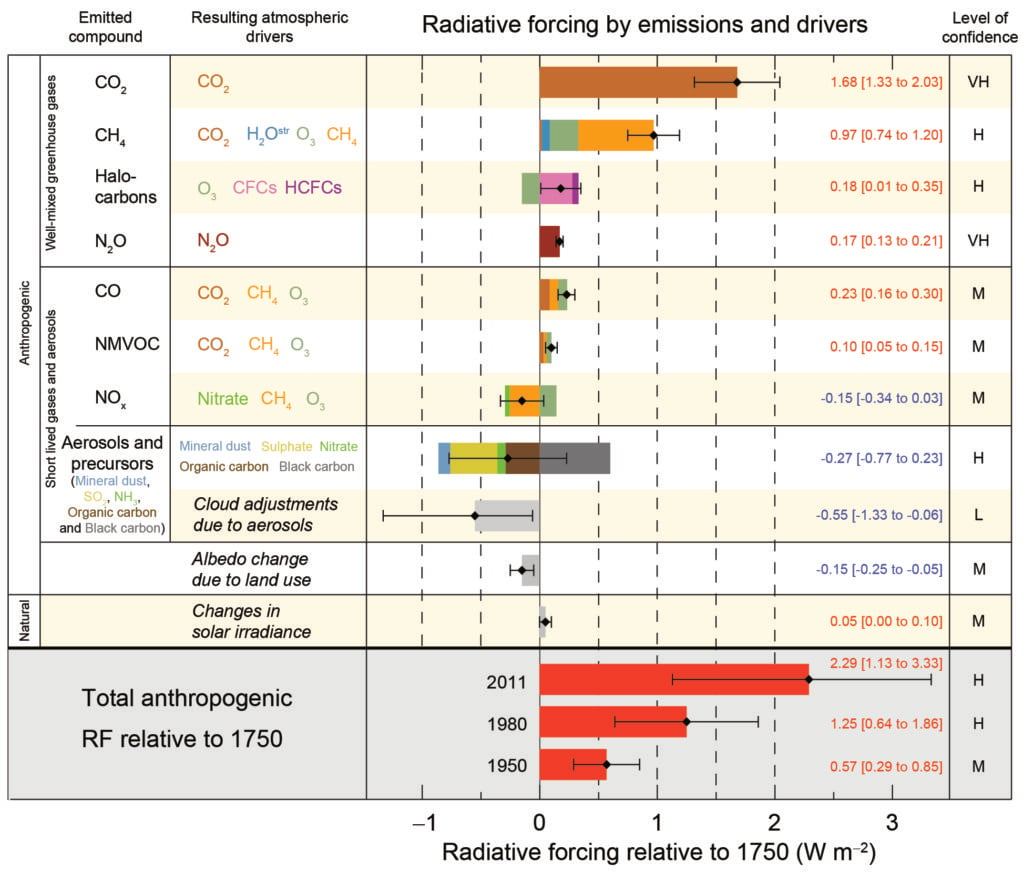
THE ESCALATOR
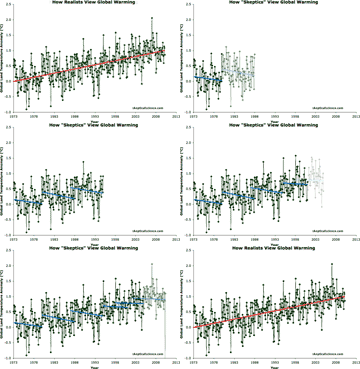
(free to republish)