



 Arguments









What were climate scientists predicting in the 1970s?
What the science says...
| Select a level... |
 Basic
Basic
|
 Intermediate
| |||
|
The vast majority of climate papers in the 1970s predicted warming. |
|||||
Climate Myth...
Ice age predicted in the 70s
"If you go back to Time Magazine, they actually were proclaiming the next ice age is coming, now it's become global warming… How do you believe the same people that were predicting just a couple decades ago that the new ice age is coming?" (Sean Hannity)
At a glance
If you are aged 60 or over, you may remember this particular myth first-hand. For a brief time in the early to mid-1970s, certain sections of the popular media ran articles describing how we were heading for a renewed ice-age. Such silliness endures to the present day, just with a different gloss: as an example, for the UK tabloid the Daily Express, October just wouldn't be October without it publishing at least one made-up account of the impending 100-day snow-apocalypse.
There were even books written on the subject, such as Nigel Calder's mischievously-entitled The Weather Machine, published in 1974 by the BBC and accompanying a “documentary” of the same name, which was nothing of the sort. A shame, because the same author's previous effort, The Restless Earth, about plate tectonics, was very good indeed.
Thomas Peterson and colleagues did a very neat job of obliterating all of this nonsense. In a 2008 paper titled The myth of the 1970s global cooling scientific consensus, they dared do what the popular press dared not to. They had a look at what was actually going on. Obtaining copies of the peer-reviewed papers on climate, archived in the collections of Nature, JSTOR and the American Meteorological Society and published between 1965 and 1979, they examined and rated them. Would there be a consensus on global cooling? Alas! - no.
Results showed that despite the media claims, just ten per cent of papers predicted a cooling trend. On the other hand, 62% predicted global warming and 28% made no comment either way. The take-home from this one? It's the old media adage, “Never let the truth get in the way of a good story”
Please use this form to provide feedback about this new "At a glance" section. Read a more technical version below or dig deeper via the tabs above!
Further details
In the thirty years leading up to the 1970s, available temperature recordings, with a poor global coverage compared to today, implied at times there might be an ongoing cooling trend. At the same time, research was continuing into the building levels of carbon dioxide and their effects on future climate, but the science world of that time was somewhat disconnected, compared to the modern age of instant communication, Zoom and so on.
There were also some notably cold winters scattered through that time, such as the UK one of 1962-63. As a result of these various goings-on, some scientists suggested that the current interglacial period could rapidly draw to a close, which might result in the Earth plunging into a new ice age over the next few centuries.
We now know that the smog that climatologists call ‘aerosols’ – emitted by human activities into the atmosphere – caused localised cooling closest to the areas where most of it originated. Smogs constitute a deadly health hazard and governments acted quickly to clean up that type of pollution: highly visible (unlike CO2), it was hard to ignore. Once largely removed, its effects no longer influenced Northern Hemisphere temperatures, that have steadily climbed since around 1970.
In fact, as temperature recording has improved in coverage, it’s become clear that the cooling trend was indeed localised – it was most pronounced in northern land areas. Other places around the world revealed a different story. Furthermore, at the same time as some scientists were suggesting we might be facing another ice age, a significantly greater number - approximately six times more - published papers indicating the opposite - that we were warming. Their papers showed that the growing amount of greenhouse gases that humans were putting into the atmosphere would cause much greater warming – warming that would exert a much stronger influence on global temperature than any possible natural or human-caused cooling effects.
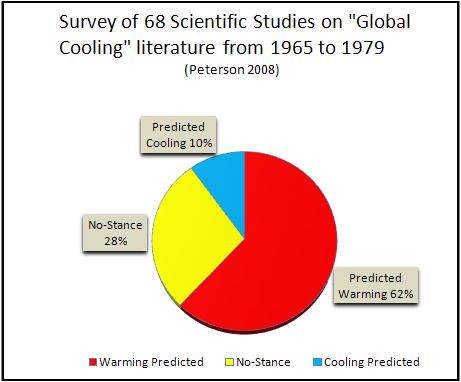
By 1980, with northern hemisphere smogs a distant memory, the predictions about ice ages had ceased, at least among those working on the science, due to the overwhelming evidence for warming presented in the scientific literature (Peterson et al. 2008). Unfortunately though, the small number of predictions of an ice age were far more 'sticky' than those of global warming, so it was those sensational 'Ice Age' stories in the 1970s popular press that so many people tend to remember. Sticky themes sell papers. Today of course, with 40+years more data, far better coverage and a far bigger research community, we've reached a clear scientific consensus: 97% of working climate scientists agree with the view that human beings are causing global warming.
Last updated on 8 March 2024 by John Mason. View Archives








BL@173 you have made so many comments; therefore, I shall respond in smaller bite-sized chunks
Reply 1 to BL@173, you do not seem to understand my reviews of the papers contained in my database. Therefore, let me explain by using Benton (1970) as an example.
Benton (1970) is typical of many scientific papers in that they are broadly divided into two main parts, namely:
Part 1: Present several hypotheses for the cause(s) of climate change and then discuss them.
Part 2: Present the conclusions.
I contend that the main part of a peer review classification of a paper is the conclusions – not the preceding discussion of the hypotheses. I think that this is where you (and the other commentators) on SkS have gone wrong because you focus on the hypotheses/discussion part of the paper, whereas the main part of the paper that matters is the conclusions.
I now present the conclusions from Benton (1970) below for ease of access for other readers (with my highlights):
It is evident from the above that, “Some years from now” Benson (1970) is primarily concerned about two things, namely “…the increase of carbon dioxide and particulate pollution”.
If you wish to argue against the Benson (1970) conclusions then please go ahead, but I suggest that any reasonable person reading these conclusions would agree that they are neutral on the causes of climate change, namely, either carbon dioxide warming or particulate cooling.
[BL] I see that you want to ignore the simple fact that your three quoted sentences in comment 173 are not connected in the way you want them to be.
I am really getting to understand why you are so wrong on the interpretations of the papers we have looked at, though. There is a lot more that goes into a scientific paper than discussing "hypotheses". If all you are looking at in detail is what you think are the "conclusions", then you are missing most of the picture.
A typical scientific paper is expected to cover the following:
Proper review of the quality of a paper involves examining all of the above to see if anything has been missed and if the conclusions follow logically from the presented evidence and analysis.
And this will probably come as a surprise to you: to a scientist, the most interesting part of a paper may be in the data and methodology portions of a paper. Often, these present interesting new ideas that can be helpful in understanding different problems that were not the original intent of the authors (and thus, not discussed in their conclusions). The authors of PCF-08 knew how to find those sorts of things in a scientific paper - even if the main purpose of the paper was not what PCF-08 wanted to look at. PCF-08 knew how to find the Easter eggs.
At slightly over one page in length, Benton (1970) barely qualifies as a scientific paper. It is really just a short summary of the state of climate science in a particular subject area. (Philippe Chantreau already explained this in comment 147.)
It does, however, make a few short statements that relate to the question posed by PCF-08: predictions of trends in the decades following the 1970s. The only clear prediction it makes is the one with respect to the effect of CO2 - namely a temperature rise of 0.6C by the year 2000. Discussion of all other factors affecting climate are limited to general terms, with no specific prediction or time frame.
Once again, you are creating a false equivalence between a clear statement of prediction (increasing T due to CO2) and vague generalities regarding other factors.
BL@176 you seem to be determined to misrepresent what I actually said.
Yes, having written many scientific papers, I am aware of the structure of scientific papers, and I did state that they are broadly divided into two parts. I also agree with the typical contents of a scientific paper presented by you, and that (using your elements) these would usually include some or all of the following:
Part 1: Introduction/Methodology/Analysis/Interpretation and Discussion.
Part 2: Conclusions
Consequently, I agree with your comment that:
However, I was focusing on Benton (1970) as an example, which is very clearly divided into two main parts, namely:
Part 1: Present several hypotheses for the cause(s) of climate change and then discuss them.
Part 2: Present the conclusions.
Furthermore, your comment below does not come as surprise to me:
I have systematically reviewed the existing methodologies contained in numerous scientific publications and have proposed enhancements where appropriate. Advancements in science and engineering often result from critically evaluating prevailing methods and introducing new approaches or techniques, which usually lead to alternative and more reliable conclusions.
I agree with your comment that the authors of PCF-08 knew how to find “Easter eggs”:
The reason I agree with your “Easter eggs” finding is because someone more sceptical than you might think that the authors of PCF-08 were data mining for information to support a preconceived warming position.
I also agree with your comment that Benton (1970) hardly merits the description of a paper:
However, I included it in my database because it was used by PCF-08.
I disagree with your comment regarding the clear prediction of warming in:
Benton (1970) only mentions 0.6°C warming in the discussion part of the paper by referring to “numerical studies have indicated” a warming of 0.6°C, namely:
I contend that if it were a clear prediction by Benton (1970) and not just an indication, then this warming would have been included in his conclusions as a clear prediction and not just an indication in the discussion part of the paper. Furthermore, if it were a prediction, I would have expected his conclusions to include an unequivocal statement similar to, “It is concluded that the present rate of increase in carbon dioxide would result an increase in temperature of approximately 0.6°C by the year 2000”.
However, the conclusions in Benton (1970) did not include an unequivocal prediction of warming.
Finally, I disagree that I am creating a false equivalence in:
On the contrary, Benton (1970) presented two main conclusions, namely: “Some years from now man will control his climate”, either by warming from “the increase of carbon dioxide” or by cooling from “particulate pollution”. It is evident from his conclusions that the Benton (1970) considers the possibility either warming or cooling to be equivalent and not a false equivalence.
However, I suspect that you will try to find some argument to postulate that “Some years from now” does not match your definition of a timeframe for a climate trend for some decades into the future.
It would appear to be you that is guilty of creating a false equivalence by taking a paragraph from the discussion part of a paper and elevating it to a conclusion of a clear prediction.
[BL] As far as I am concerned, this comment closes the discussion of Benton (1970). You are now just repeating previous assertions. It is clear that you want to ignore the portions of Benton that disagree with your own "preconceived ... position" on climate science. Benton is so short that it does not even have section headings.
Back in comment 173 you gave reasons for your neutral classification of Benton (1970):
I pointed out that your third quote does not apply to your first two. The full quote is:
However, the net effect of particulate matter on climate is difficult to analyze. Such pollutants, depending upon their size distribution and the elevation at which they occur, both intercept incoming solar radiation and trap outgoing radiation from the earth. The first process tends to depress the temperature of the earth's surface; the latter tends to increase it.
All you have done since then is try to deflect from this egregious error in interpreting Benton (1970) by trying to dismiss the contents of the middle section of Benton (where the proper context is explained) and pretend that somehow his very general "conclusions" somehow override the main body of the short paper.
I can only conclude that your actions fall into one or more of the following:
Hint: when Benton starts his last paragraph with "Several concluding statements may be advanced", this basically means that these will be his final words. These are not "conclusions drawn from a detailed analysis". It's more of a summary than "conclusions".
You give away your bias by stating [your emphasis] "the conclusions in Benton (1970) did not include an unequivocal prediction of warming." Your demand that a paper provide unequivocal statements represents yet another example of the techniques of science denial: Impossible Expectations:
e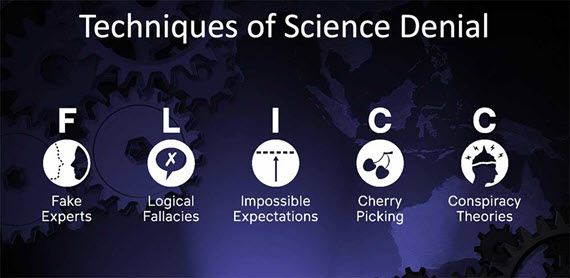
Your argument basically amounts to "Benton (1970) wasn't 100% sure about warming, so I get to treat his 90% statement of warming due to CO2 as if it is the same thing as his 0% confidence of aerosols having a possible warming or cooling effect".
You also give away your bias and need for selective quoting in the following paragraph:
On the contrary, Benton (1970) presented two main conclusions, namely: “Some years from now man will control his climate”, either by warming from “the increase of carbon dioxide” or by cooling from “particulate pollution”. It is evident from his conclusions that the Benton (1970) considers the possibility either warming or cooling to be equivalent and not a false equivalence.
The parts you place in quotes actually do appear in Benton's final paragraph, but where you say "warming from" and "cooling from", those words do not appear in Benton's final paragraph. Since you have hung your hat on "ignore the discussion part of the paper, only look at the conclusions", you are being disingenuous in manipulating the quotes from Benton as you have. Benton cannot be placing equal emphasis on two possibilities (warming and cooling) in a paragraph that does not even mention temperature trends directly. You need to look into the "discussion" part of the paper (which you want to ignore) to find the context. And the context regarding aerosols is not cooling: Benton clearly explains how aerosols can cause cooling in some circumstances, and warming in others. But you only know that if you pay attention to the discussion part of the paper. By claiming that Benton considers aerosols to be a cooling factor, you are perpetuating your error in your point #3 quoted above.
Let's be clear: In the entire paper, Benton only once puts numbers on the likely effects of various factors on climate over the decades following the 1970s: when he talks about CO2-induced warming. All your dodging and weaving does not change this.
So, no further discussion of Benton (1970) unless you are willing to admit to your error in your point #3 from comment 173. That error continues to permeate through your entire line of reasoning.
We await your response to the challenge I gave you in comment 173, regarding a summary of Sellers (1969). To wit:
Alternatively, you can get your analysis published in a peer-review journal, and then we'll see what you have to say.
BL@177.
Oh dear. Now you are playing the semantics game
[Snip]
with “conclusions” versus “concluding remarks” in your statement that:
If it were just a summary, then I reiterate that your alleged summary states that, “Some years from now man will control his climate...”, either by warming from “the increase of carbon dioxide” or by cooling from “particulate pollution”.
However, I disagree that “concluding statements” are just “final words”, and I reply below.
Conclusions tend to be more formal than concluding remarks, but in practice, they tend to be very similar.
Conclusions usually include (but are not limited to) the following:
Whereas, concluding remarks usually include (but are not limited to) the following:
Furthermore, you have worked in academia and will be aware that the use of either conclusions or concluding remarks tends to be journal specific. In practice, the terms are often used interchangeably, and the specific requirements for their use can depend on the journal, discipline, and/or publication guidelines.
It is evident from the above that “concluding remarks” are not just “final words”, but no doubt you are already aware of this having worked in academia. However, in your reply, you chose to play the semantics game by pretending that they are just “final words”.
[End snip]
P.S. You seem to be very keen on my response to your challenge at BL@173, and I have already confirmed that I will respond in due course. However, I do have a daytime job and, firstly, I would rather respond to your other allegations.
[BL]. I warned you. The discussion of Benton (1970) is over, unless you are willing to respond to your egregious error in comment 173, where you implied that Benton was talking about CO2 and particulate matter in the third quote you provided as your assessment of the paper. Once again, the three points you made were:
As I have pointed out more than once, the full context of that last quote from Benton is:
However, the net effect of particulate matter on climate is difficult to analyze. Such pollutants, depending upon their size distribution and the elevation at which they occur, both intercept incoming solar radiation and trap outgoing radiation from the earth. The first process tends to depress the temperature of the earth's surface; the latter tends to increase it.
You carry this error into your argument in comment 177, where you seem to be under the erroneous impression that Benton only talks about particulate matter causing cooling. Benton clearly knows that climate science of the 1970s understood that particulate matter sometimes has a cooling effect, and sometimes has a warming effect. (This is still our understanding, although our understanding now has much more detailed knowledge.)
Until you understand your error and correct your thinking, it is pointless to continue to discuss Benton.
Your summary of the importance of Sellers (1969) can wait. But given that you have claimed that you have read and understood all the papers on your list, the longer it takes for you to provide your summary, the more it looks like you really don't know what to say about it.
Addendum: Your summary of Sellers needs to be short. A few hundred words; a few short paragraphs. If you really understand the paper, you should be able to concisely describe its importance without a lot of excess verbiage..
BL@173, 177 and 178
Before responding to your challenge, I note that the points you raise would not normally be part of the guidelines that a publication would provide for an independent reviewer. Instead, they appear to be points derived by someone who has studied the paper at university and wishes to arrive at preconceived conclusions regarding my ability to carry out an independent review.
I now reply as follows.
Why did he do the work?
What aspects of climate science does he attempt to address?
The paper addresses some aspects of climate science, including:
What part of his paper represents "original work"?
He appears to have made several original contributions, including:
What part of his paper provides useful guidance to future work in climate science?
Part 2 “The Model” and Part 3 “Applications” provide particularly useful guidance for future climate science research for two main reasons:
Interestingly, Sellers (1973) is classified as neutral, and Sellers (1974) is classified as warming by both PCF-08 and me.
[BL] Congratulations. You have actually provided a reasonable summary of Sellers (1969) that covers the specific questions I have asked.
You claim that my questions "appear to be points derived by someone who has studied the paper at university and wishes to arrive at preconceived conclusions regarding my ability to carry out an independent review."
Yes, I have preconceived opinions on your ability to carry out an independent review, based on your posting here. And yes, I have an academic background, which includes a skill in identifying when the assignment handed in by a student does not match the quality or style of previous work by the student. Such a mismatch is often an indication that the work handed in is not really the work of the student. In academia, such actions fall under the categories "plagiarism" (handing in work that s not your own), or (more simply) "cheating".
Give that you have previously used perplexity.ai in your responses here, I decided to ask perplexity.ai to provide me with a summary of Sellers (1969). The text I sent to perplexity.ai was:
Please provide a summary of the Sellers (1969) paper at [link to PDF] and answer the following: Why did he do the work? What aspects of climate science does he attempt to address? What part of his paper represents "original work"? What part of his paper provides useful guidance to future work in climate science?
Guess what? Although the wording is not identical to yours, perplexity.ai has given me a summary that closely matches the points you make here, in much the same order, with a lot of similarity in wording. At the end of its summary, it also provided a list of related searches:
So, others have been asking before me. One of those people may have been you.
Now, when I initially made the challenge about Sellers (1969) I stated "please try to look at is as a chance to convince me and others that you know your stuff."
I therefore conclude that what you have posted is not an independent review.
Sadly, this is also pretty much what I expected from you.
Your credibility has pretty much reached zero here.
BL@179
I have provided an independent review. If you disagree then that is your opinion.
[BL] The initial challenge, in my comment on post 173, was "...to give you the opportunity to demonstrate that you really understand the papers that you have been reading and assessing". I also stated "Please tell me, in your own words..."
The problem with your "independent" review is that it is not your independent review. You did not write it independently - you got an AI to write it for you. You clearly are not capable of doing it yourself - i.e., independently.
Reading and regurgitating someone else's work without understanding it does not demonstrate that you understand the climate science literature you claim to understand. In fact, it provides more evidence that you simply do not have the competence (in climate science) to be able to assess what papers do or do not say.
You came in here challenging SkS to change this rebuttal about the 1970s cooling myth, on the basis of your "analysis". SkS will not change the rebuttal on the basis of the opinion of an uninformed, unqualified, incompetent, unfit, unskilled, inept, worthless, and amateurish dilettante. [Full disclosure: I wrote that sentence with the help of a thesaurus.]
As this discussion is circling back on itself (item 3 in the Comments Policy), any further comments from you on this thread will be deleted. [One exception: you can come back and let us know when you get your "analysis" published in the peer-reviewed literature.)
BL@173 referring to your comment that Benton (1970) is referring to the warming and cooling of particulate pollution. I have reread Benton (1970) and I agree with your interpretation. Therefore, I confirm that my point 3 in angusmac@173 is incorrect and should be deleted.
[BL] It has taken 17 days for you to accept this egregious error in your interpretation of Benton (1970).
As your entire viewpoint of Benton (1970) was based on continuing that error into the rest of the paper, this only demonstrates that you are unable to understand climate science papers to a degree that would make us believe that any assessments of other papers are worth our time.
After your error was pointed out, you posted three more times on Benton (1970), trying to convince us (convince yourself?) that your assessment was appropriate. The extremely slow pace with which you reflect on criticism is extremely discouraging.
Benton (1970) is only six paragraphs long, and less than 600 words. The space taken here in discussing it exceeds the length of the paper. (If anyone else is still following this thread, and is curious, here is a link to the Benton (1970) paper. The link has not actually appeared in this comments stream - you had to download angusmac's spreadsheet to find it.)
There is no point in polluting this comments section with more of your erroneous interpretations of the climate science literature. It takes far too much work to bash our heads against your stubbornness in having your errors pointed out.
I suggest that you go back to your assessment, and look at all the papers where you disagree with PCF-08 and revisit your thinking on why you came to a different conclusion. Then you may be able to look again at any other papers you have assessed with a better frame of reference.
I also previously suggested that you should read Spence Weart's "The Discovery of Global Warming", which looks back at the long history of people studying and trying to explain climate. You have an awful lot to learn.
We are not going to allow this comments section to continue as a circus where we try to change your mind one paper at a time. As previously stated, we're only willing to listen when you get your analysis published in the peer-reviewed literature.