



 Arguments









Global cooling - Is global warming still happening?
What the science says...
| Select a level... |
 Basic
Basic
|
 Intermediate
| |||
|
All the indicators show that global warming is still happening. |
|||||
It's cooling
"In fact global warming has stopped and a cooling is beginning. No climate model has predicted a cooling of the Earth – quite the contrary. And this means that the projections of future climate are unreliable." (source: Henrik Svensmark)
At a glance
Earth's surface, oceans and atmosphere are all warming due to our greenhouse gas emissions, but at different rates. Some places are also warming much faster than others: parts of the Arctic for example. That variability is partly because other phenomena act to offset or enhance warming at times. A good example are the effects of La Nina and El Nino, an irregular variation in winds and sea surface temperatures over the tropical eastern Pacific Ocean that can influence temperatures and rainfall patterns right around the world.
El Nino causes even warmer years whereas La Nina tends to peg temperatures back to an extent. Thus 2023 – an El Nino year - was the warmest year on record, according to the USA-based National Oceanic and Atmospheric Administration, but other recent years have not been far behind – 2016 and 2019 are in second and third place respectively. The worrying thing is that 2019 only saw a mild El Nino. And even with a La Nina featuring, 2021 and 2022 were, respectively, still the seventh and sixth hottest years on record.
The year 1998 featured a massive El Nino and consequent temperature spike that was a strong outlier, well above the steady upward trend. That spike and the subsequent return to a more “normal” warming pattern led to claims in the popular media that global warming had “paused” or had even stopped. This was a typical misinformation tactic that, as usual, time has proved wrong. As things currently stand, the top ten warmest years have all been since 2010 and 1998 is nowhere to be seen any more. By modern standards, it simply wasn't warm enough.
Please use this form to provide feedback about this new "At a glance" section. Read a more technical version below or dig deeper via the tabs above!
Further details
In the years following 1998, at the time the hottest year on record, there was a concerted misinformation campaign to convince the public that global warming had variously slowed down, stopped or even that we were entering a period of cooling. Of course, we now know that such claims were nowhere near correct. In today's top ten ranking of warmest years, the year 1998 is nowhere to be seen. It simply wasn't warm enough. So let's take a look at how the claims came about, because they reveal insights into the methodology of those who design and spread misinformation.
The entire planet continues to accumulate heat due to the energy imbalance created through our greenhouse gas emissions. Earth's atmosphere is warming. Oceans are accumulating energy. Land absorbs energy and ice absorbs heat to melt. Year to year ups and downs in these things are simply noise, reflecting variations in how that heat is moved around the planet and what other influences are at work, such as the irregular El Nino Southern Oscillation (ENSO) that can nudge the global temperature one way or another by up to 0.3C. That's why 1998 was such a warm outlier: it coincided with a very strong El Nino. El Nino conditions always warm things up whereas La Nina conditions cool things down (figure 1).
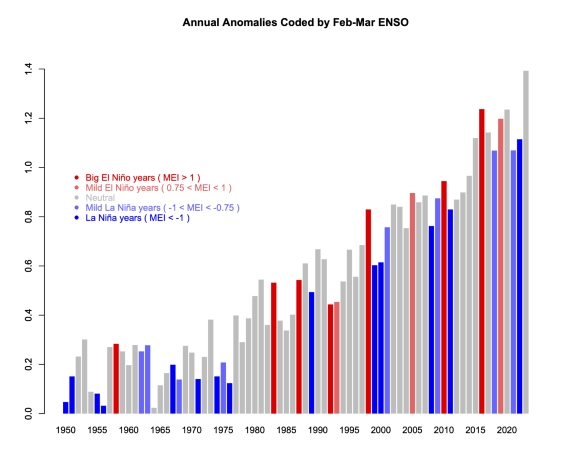
Figure 1: GISTEMP anomalies to end-2023 (with respect to late 19th Century), coded for ENSO state in the early spring - red is El Nino, blue La Nina. 2023 is in grey because that El Nino did not develop until later in the year. Graphic courtesy of Realclimate.
Climatologists routinely use multi-decadal blocks of time when presenting temperature trends for a very good reason. Such blocks allow you to stand back and look at the bigger picture. Due to the noise, taking a much shorter time-span – say just five or ten years – allows you to say anything you like about trends, depending on the particular block you pick.
For example, if you picked a short run of 5-10 years ending in 1998, you could have – if you were so inclined – said, “look how fast it's warming!” Likewise, taking a number of years starting with 1998, you could have made the equally invalid claim that global warming had stopped. And of course, that claim was made, vociferously, in the early-mid 2000s. It was a classic example of cherry-picking: the manifestly unscientific practice of choosing the data that supports the argument one is paid to make on behalf of those who sponsor misinformation campaigns. Once you know about such tricks, you can challenge them yourself. You can ask someone why they showed such a short temperature record when showing a much longer one is the normal practice.
It is difficult but technically possible to filter out the noise described above from temperature datasets. In the paper Foster and Rahmstorf (2011) the authors used the statistical technique of multiple linear regression to filter out the effects of ENSO, solar and volcanic activity (Figure 2). They found that the underlying global surface and lower atmosphere warming trends have in fact remained steady in recent years. There's still noise in there but nowhere near as much. We were still warming all along.
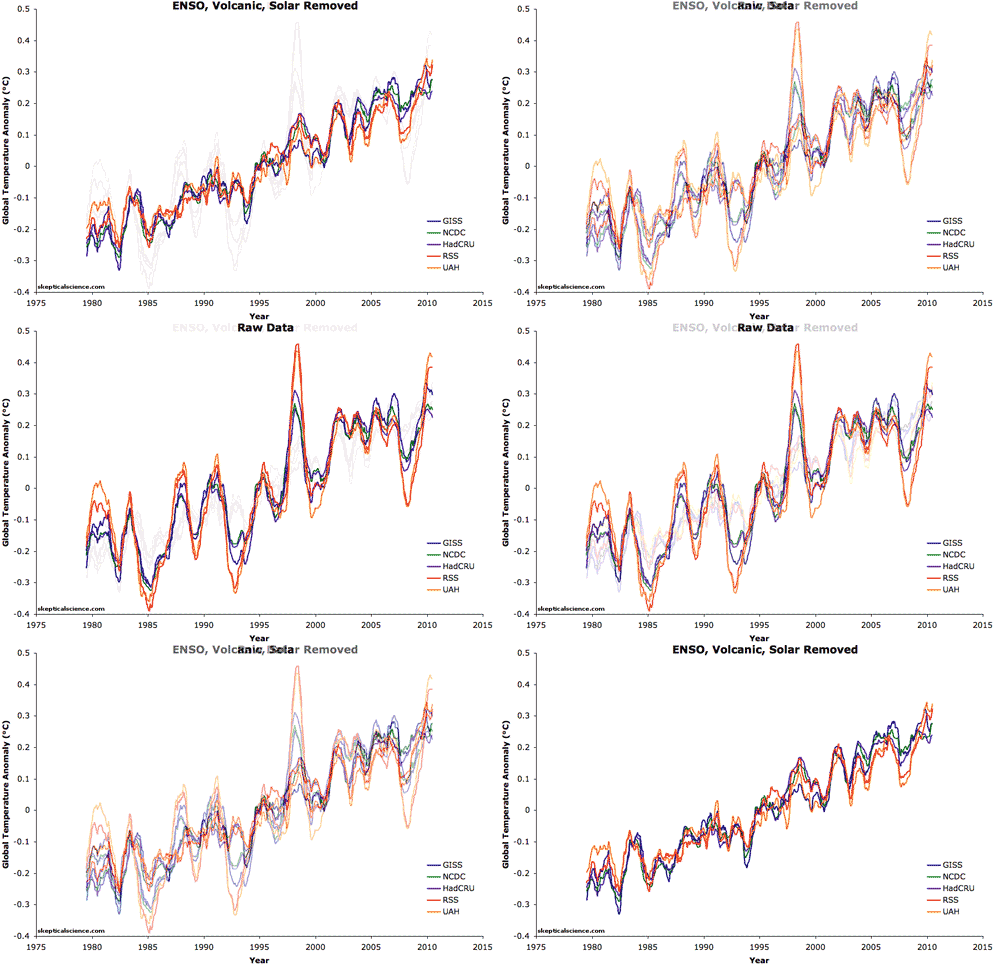
Figure 2: Five datasets of global surface temperature and lower troposphere temperature are shown before and after removing the short-term effects of the El Niño Southern Oscillation (ENSO), solar variability, and volcanic aerosols. A 12-month running average was applied to each dataset.
Last updated on 4 June 2024 by John Mason. View Archives
 Yes, Virginia, Polar Amplification is Real:
 The Yooper
 Yeah, it was colder in the NH where most of the people live, but that would be ignoring the rest of the world that was warming.
Scientists are concerned with the long-term trend, which is up. That doesn't mean that every month is of necessity warmer than the previous. Weather, like bodily functions, happens. But over longer periods of time, it shows definite trends (let's also remove cyclical stuff like oscillations [which do not add or subtract energy from the system] and volcanoes):
Yeah, it was colder in the NH where most of the people live, but that would be ignoring the rest of the world that was warming.
Scientists are concerned with the long-term trend, which is up. That doesn't mean that every month is of necessity warmer than the previous. Weather, like bodily functions, happens. But over longer periods of time, it shows definite trends (let's also remove cyclical stuff like oscillations [which do not add or subtract energy from the system] and volcanoes):
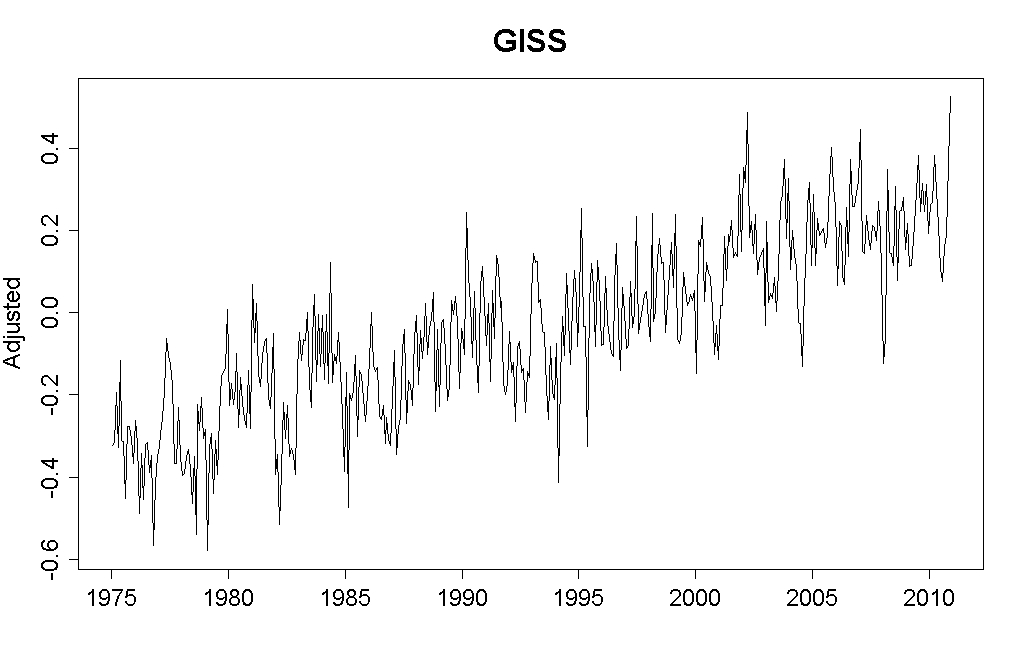 That's why climate scientists use 30 years or more of cumulative weather trends to make their studies of climate. Because any trends emerge from the noisy datasets. Too short of a period of time, like a month or too, will typically contain too much noise in the data for any background signal to be seen. Like asking your students how much they grew yesterday, last week, last month, etc. Eventually any growth trend will be revealed.
[ Edit:
As a footnote, GISS typically updates its online data in mid-month for the previous month, which is why the above graphics only have January data. February should be available at any time soon, here.
In Climate Science, "The trend's the thing" (apologies to the Bard).
End Edit- ]
Hope this helps,
The Yooper
That's why climate scientists use 30 years or more of cumulative weather trends to make their studies of climate. Because any trends emerge from the noisy datasets. Too short of a period of time, like a month or too, will typically contain too much noise in the data for any background signal to be seen. Like asking your students how much they grew yesterday, last week, last month, etc. Eventually any growth trend will be revealed.
[ Edit:
As a footnote, GISS typically updates its online data in mid-month for the previous month, which is why the above graphics only have January data. February should be available at any time soon, here.
In Climate Science, "The trend's the thing" (apologies to the Bard).
End Edit- ]
Hope this helps,
The Yooper
 This is part of an ongoing warm/cool oscillation of the climate that has been going on for millenia (at least). It's part of the "natural variability" that climate scientists often refer to. The only way heat can leave Earth is via radiation at the top of the atmosphere. ENSO events (El Nino & La Nina) just shuffle the heat around between the ocean and atmosphere. See discussion here: Global warming and the El Niño Southern Oscillation
There's no expectation that each year will be warmer than the previous one, but over longer time-frames we expect the atmosphere and oceans to warm as more heat is trapped by greenhouse gases. Therefore we should see the continual warming show up in long-term records. This is what we see when all temperature records are combined into one graph.
This is part of an ongoing warm/cool oscillation of the climate that has been going on for millenia (at least). It's part of the "natural variability" that climate scientists often refer to. The only way heat can leave Earth is via radiation at the top of the atmosphere. ENSO events (El Nino & La Nina) just shuffle the heat around between the ocean and atmosphere. See discussion here: Global warming and the El Niño Southern Oscillation
There's no expectation that each year will be warmer than the previous one, but over longer time-frames we expect the atmosphere and oceans to warm as more heat is trapped by greenhouse gases. Therefore we should see the continual warming show up in long-term records. This is what we see when all temperature records are combined into one graph.
 Hope this helps too.
 The Yooper







Climate Myth...