



 Arguments









How does the Medieval Warm Period compare to current global temperatures?
What the science says...
| Select a level... |
 Basic
Basic
|
 Intermediate
| |||
|
While the Medieval Warm Period saw unusually warm temperatures in some regions, globally the planet was cooler than current conditions. |
|||||
Climate Myth...
Medieval Warm Period was warmer
"For now, though, it is enough just to see the Medieval WARM Period shown to be global, and warmer than today." (Musings from the Chiefio)
At a glance
To explore this topic, the first question must surely be: what was the Medieval Warm Period? The answer lies in the dim and distant past, in modern human terms, that is. Compared to the age of the Earth, at 4.5 billion years, it is a fraction of a very small fraction of a blink of the eye. Nevertheless, let's continue.
The period of time known to archaeologists as the Common Era (CE) roughly covers the past 2000 years. Decades ago it was divided into a series of climate epochs. Although there is no firm consensus regarding their precise duration, the 'Roman Warm Period' covered the first few centuries. The 'Dark Ages Cold Period' was from around 400-800 CE, the 'Medieval Warm Period' was from 800-1200 CE and the 'Little Ice-Age' was from 1200-1850 CE.
Each of these climatic epochs has its origin in old pieces of paleoclimatic evidence from the Northern Hemisphere. Decades ago, it was assumed each such epoch must have been global in extent. But since that time, climatology has steadily moved on. More new ways of reconstructing the Common Era climate have been discovered and refined. Coverage has been extended from those few Northern Hemisphere localities to the entire globe.
Thanks to such improvements, we now know that many of these warming and cooling events were regional, not global effects. The evidence no longer supports the idea of epochs of globally coherent and synchronous climate. Yes it was warm in Europe in the Medieval Warm Period. However, it was much cooler, for example, over the Pacific than it is today.
The coldest epoch of the last millennium is known as the Little Ice Age. But here too, the effects were not the same everywhere at the same time, as pointed out in a recent paper published in Nature. Its authors commented that peak cold occurred at widely-spaced locations hundreds of years apart. Coldest temperatures occurred during the fifteenth century in the central and eastern Pacific Ocean. But by the seventeenth century it was coldest in northwestern Europe and southeastern North America.
In contrast the same study found that the warmest period of the past two millennia occurred during the 20th century. The warmth affects more than 98% of the globe. That constitutes solid evidence that modern human-caused global warming is unusual. As the paper says, it is, "unparalleled in terms of absolute temperatures and also unprecedented in global coverage within the past 2,000 years".
Please use this form to provide feedback about this new "At a glance" section. Read a more technical version below or dig deeper via the tabs above!
Further details
One of the most often cited arguments of those who deny anthropogenic global warming is that the Medieval Warm Period (800-1200 AD) was as warm, or even warmer, than today. Using this as proof to say that we cannot be causing current warming is a faulty notion based upon rhetoric rather than science. So what are the holes in this line of thinking?
Firstly, increasing evidence suggests that the Medieval Warm Period may have been warmer than today in parts of the globe such as in the North Atlantic. The warming thereby allowed Vikings to travel further north than had been previously possible because of reductions in sea ice and land ice in the Arctic. However, evidence also suggests that some places were much cooler than today, including the tropical Pacific. All in all, when the warm places are averaged out with the cool places, it becomes clear that the overall warmth was likely similar to early to mid 20th Century warming.
Since that early 20th Century warming, global temperatures have risen well beyond those reached during the Medieval Warm Period. The National Academy of Sciences released a report on climate reconstructions in 2006. In the Overview chapter, the authors stated it was 'likely' that current temperatures are hotter than during the Medieval Warm Period, saying the following:
"Presently available proxy evidence indicates that temperatures at many, but not all, individual locations were higher during the past 25 years than during any period of comparable length since A.D. 900".
Further evidence obtained since 2006 suggests that even in the Northern Hemisphere, temperatures have now gone well beyond those experienced during Medieval times (Figure 1). This was also confirmed by a major paper from 78 scientists representing 60 scientific institutions around the world in 2013. A Skeptical Science blog-post about the publication may be read here.
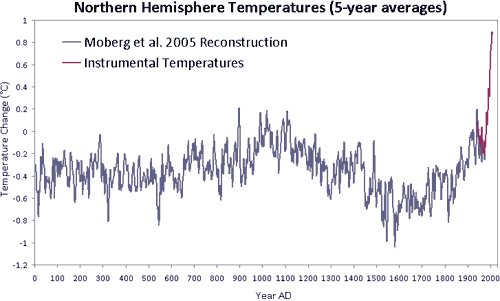
Figure 1: Northern Hemisphere Temperature Reconstruction by Moberg et al. (2005) shown in blue, Instrumental Temperatures from NASA shown in Red.
Secondly, the Medieval Warm Period has known causes. These explain both the scale of the warmth and its regional pattern. Importantly, both self-evidently differ from the modern-day warming caused predominantly by human activities. Based on global paleoclimate reconstructions over the past 2,000 years, a 2019 study found absolutely no evidence for pre-industrial globally-coherent cold or warm epochs. Instead, it found that the warmest period of the past two millennia occurred during the twentieth century and covered more than 98% of the globe. The paper concluded, "not only unparalleled in terms of absolute temperatures but also unprecedented in spatial consistency within the context of the past 2,000 years."
In the same paper, the authors commented that, in particular, the coldest epoch of the last millennium, long referred to as the Little Ice Age, seems to have seen peak cold at widely-spaced locations and hundreds of years apart, strongly emphasising both the regionality and non-synchronicity of the events. Coldest temperatures occurred, "during the fifteenth century in the central and eastern Pacific Ocean, during the seventeenth century in northwestern Europe and southeastern North America, and during the mid-nineteenth century over most of the remaining regions."
Overall, our conclusions are:
- Globally temperatures are warmer than they have been during the last 2,000 years;
- Both warmth and cold seem to have occurred at times in the last 2000 years but only on a regional and non-synchronous basis.
- the causes of Medieval warming are not the same as those causing late 20th century warming.
Last updated on 9 May 2024 by John Mason. View Archives








The third reference infers medieval warming based on rather weak evidence. Unfortunately, it has been picked up by climate sceptics claiming that the MWP was warmer than today, which the Nature paper does not say.
Their assertion that the Antarctic landscape is "one of the most stable environments on the Earth" is definitely not what it says in reference #3 in their paper, a comment by Richard Hindmarsh and myself Stabilists strike again.
Dick van der Wateren @276 :-
Dick, after making my @275 post, now my (admittedly-feeble) brain is somewhat confused by your @276 comment (second paragraph).
The Nature article you had linked [Forte et al., 2025] in the first sentence of its Abstract, said :- "The Antarctic landscape is one of the most stable environments on the Earth ... "
~ And the first sentence of the Introduction, states similarly :- "The Antarctic is considered to be one of the most stable environments on the Earth ... "
~ It seems quite a jump to mention your own paper (titled: "Stabilists strike again") which was indeed their reference #3 . . . which was from 30 years ago [1995] and is unfortunately (for me) behind a paywall.
I confess I am very unclear about the point you wish to make. Your thoughts and explanations would be most welcome !
The two Lüninget al (2019) papers linkedup-thread @273/274 are available in full - The Medieval Climate Anomaly in South America, and The Medieval Climate Anomaly in Antarctica. These will help the papers being used less selectively.
Thus in the South America paper we can read in its conclusions "A fully quantitative comparison of (medieval) and (present) temperatures is still complicated. Some sites suggest that the (present) may have been warmer than the (medieval), whilst others indicate the opposite."
Yet whatever an individual study (even when a review spanning a whole continent) may find, a bit of warming somewhere which coincides with the MWP or cooling coniciding with the LIA is surely no longer viable as some denialist rant. Consider this figure below from Kaufman et al (2020) 'Holocene global mean surface temperature, a multi-method reconstruction approach' . If we today have +1.5ºC AGW, where are we now on their Fig 3 below?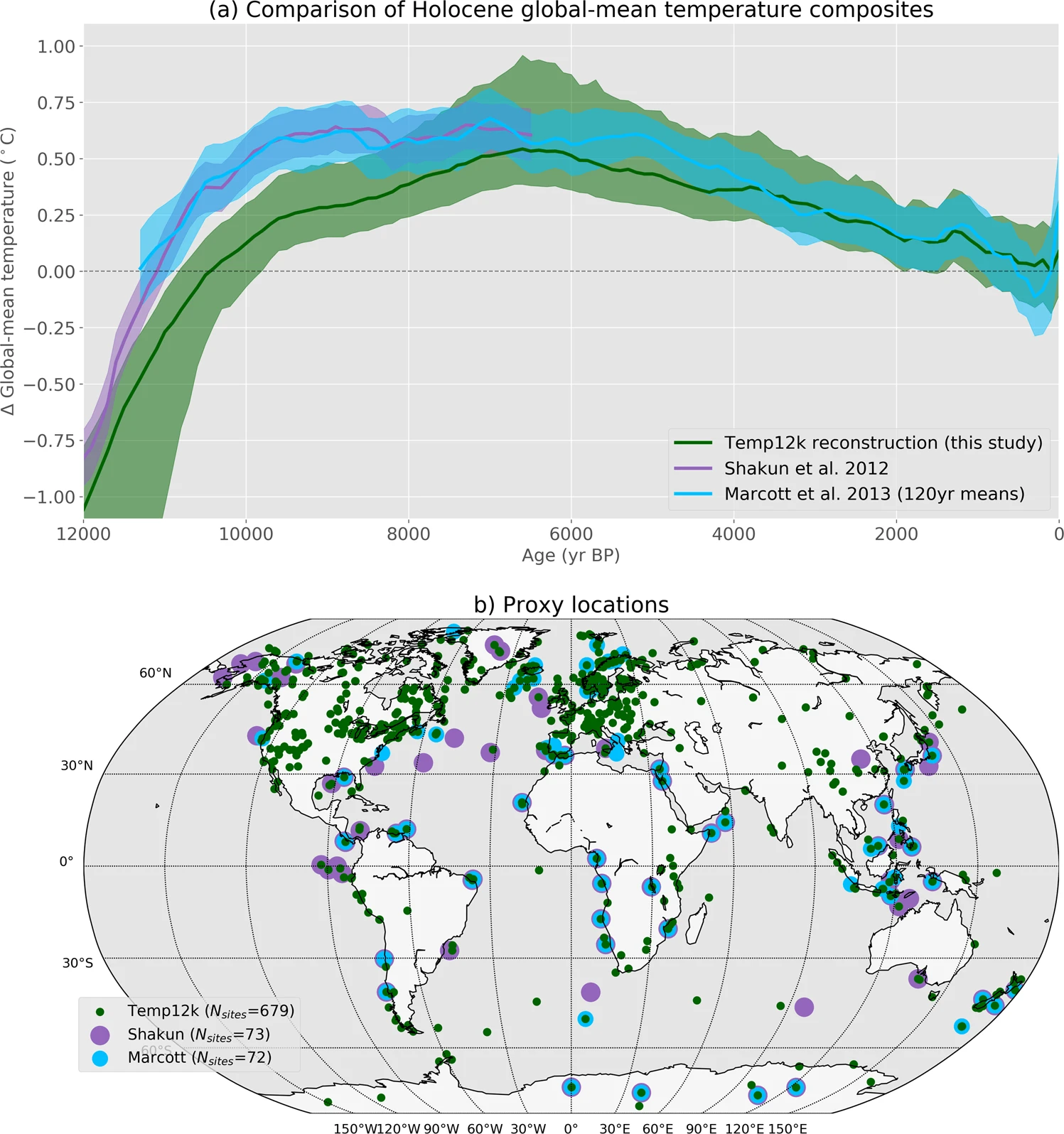
Another paper by some of the same authors shows evidence of MCA warming in Antarctica. See https://www.sciencedirect.com/science/article/abs/pii/S0031018219303190.
A more problematice paper stating evidence of Antarctic medieval warming appeared in Nature https://www.nature.com/articles/s43247-025-02259-4. It has already been picked up by denialists.
So, where does that leave us? Are there any good recent reports of the global temperature distribution during the MWP?
Dick van der Wateren @279 :-
It is not clear what you are interested in. As shown in MA Rodger's graph @278, the Medievel Warm Period was an extremely minor blip in the Holocene temperature record ~ barely a pimple on a pumpkin.
And a small fraction of a degree change would have had minimal effect especially in Antarctica, except perhaps for the (very limited) life-forms that exist on the on the Antarctic Peninsula.
You will note that the @278 graph shows a fair distribution of sampling sites.