



 Arguments
Software
Resources
Comments
The Consensus Project
Translations
About
Support
Arguments
Software
Resources
Comments
The Consensus Project
Translations
About
Support







Latest Posts
- Skeptical Science New Research for Week #24 2026
- June update: Help still needed to get translations prepared for our website relaunch!
- How many people does heat actually kill?
- Check out the brand-new hurricane ‘cone of uncertainty’ graphics arriving this season
- 2026 SkS Weekly Climate Change & Global Warming News Roundup #23
- SkS Housekeeping: Updating the Comments Policy
- Skeptical Science New Research for Week #23 2026
- Nobody knows the future of energy
- Fact brief - Do electric vehicles almost always have a lower carbon footprint than gasoline-powered cars?
- Solar, wind, and EVs have knocked out a doomsday climate scenario
- 2026 SkS Weekly Climate Change & Global Warming News Roundup #22
- Skeptical Science New Research for Week #22 2026
- The next era of Atlantic hurricanes could be far more destructive
- On the death of RCP8.5
- RCP8.5 Update
- 2026 SkS Weekly Climate Change & Global Warming News Roundup #21
- Skeptical Science New Research for Week #21 2026
- What’s a ‘super El Niño’? And other El Niño questions, answered
- Fact brief - Does electromagnetic radiation from wind turbines pose a threat to human health?
- Five things you need to know about El Niño’s likely comeback
- 2026 SkS Weekly Climate Change & Global Warming News Roundup #20
- Skeptical Science New Research for Week #20 2026
- Higher warming predictions for 2026 and 2027
- A look back at ‘An Inconvenient Truth,’ 20 years later
- Two videos about the Atlantic Meriodonal Overturning Circulation (AMOC)
- 2026 SkS Weekly Climate Change & Global Warming News Roundup #19
- EGU2026 - Five days of virtual learning
- Skeptical Science New Research for Week #19 2026
- Climate Adam - Climate Change is Destroying Lives... Now
- EGU2026 - Presentation about the Skeptical Science Experiment

Comment Search Results
Search for methane
Comments matching the search methane:
- Climate Adam - The Epstein Files & Climate Denial
lynnvinc at 01:44 AM on 20 March, 2026Good video, esp how it is the rich and powerful denying CC in their efforts to hold onto wealth/power even by abusing others or allowing their harm/abuse. Also the circular firing squad thing - arguing against CC and also for it.
RE warming Canada, esp in the Arctic region. I heard from someone up there that the permafrost soil is too poor for agriculture (without the centuries and millennia of organic matter decomposing), to support the idea that we can just move north as the climate warms and permafrost melts. It is not a solution that will work, aside from the melting permafrost releasing massive amounts of methane.
- CO2 increase is natural, not human-caused
MA Rodger at 03:54 AM on 3 December, 2025I think sychodefender may benefit from seeing a diagram of the carbon cycle.

He also mentions atmospheric methane levels which have almost trebled since pre-industrial times and contributed roughly a third to the man-made global warming. The initial pre-industrial value would not result in modern warming.
- CO2 increase is natural, not human-caused
sychodefender at 22:35 PM on 2 December, 2025Only 5% of global annual co2 emissions are man made. Thus 5% of the yearly rise in atmospheric co2 (2.4 ppm) is from human activities.
(2.4 ppm X 5% = 0.12 ppm pa)
Scientists argue about the existence and quantity of various positive feedbacks from the tiny amount of warming that 0.12 ppm produces, but generally they estimate that feedbacks add 300% to forcing.
(0.12 ppm X 300% = 0.36 ppm pa)
So the maximum reduction that we can achieve with net zero is 0.36 ppm pa and this is extremely unlikely to happen this century.
Some other process is occurring to make up the remaining 2.04 ppm pa that is being added to the atmosphere, does this suggest that feedback from the small temperature rise is much more powerful than previously thought?
Or is our belief that this coincidental co2 rise is the driver of significant warming erroneous?
Methane is calculated to be responsible for 30% of warming, 60% of global methane emissions are anthropological, hence theoretically by completely eliminating our methane emissions we could prevent 18% of its influence on temperature increase.
This would necessitate dramatic changes which in all honesty are massively unlikely, perhaps a 10% reduction might be possible this century.
It seems that the ability of these anthropological gases (and their associated feedbacks) to have any significant warming effect is very small indeed.
If we are certain that the measurements revealing an untypical rapid temperature rise are accurate we must search elsewhere for an explanation and hopefully a method of control that is potent, plausible and genuinely achievable on a global basis and timescale.
- It's the sun
kootzie at 04:32 AM on 4 November, 2025I am semi-active on Research Gate and elsewhere and doing my bit to [snip]
swat and bitch-slap denialists as they emit their oral-methane emissions to contaminate the discussions and spread anti-science drivel
I notice that the likes of
D*n P*rn
H. D*s L*oot
J*k Br*n
and others regularly engage in denialist mis-information
I notice that none of them appear to be significant enough to
merit (or dis-merit) inclusion in your rogues gallery
Their latest drivel stream purports that not only does increased atmospheric CO2 concentration not contribute ANY increase in global average temperatures, that CO2 does not have any effect on GAT at all.
They claim that WV aka Water Vapour, is a far more potent GHG
(which is arguably a defensible proposition) but that WV is the ONLY
GHG which has ANY effect on temperature, and ipso-facto ergo QED
anthropogenic Global Warming does not exist - its all on the natch.
They regularly mis-interpret mis-comprehend mis-represent physics.
They fundamentally deny that CO2, a non-condensible GHG with a long lifespan drives global temps and insist that WV, a condensible GHG with a short lifespan is not merely a feedback / feedforward mechanism but the fundamental / ONLY driver.
https://www.perplexity.ai/search/analyze-and-critique-vol-20-20-wis.z78fQn.WeNzqnj5Kkg#0
https://www.perplexity.ai/search/analyze-and-critique-the-error-7ZbX2nqyRgGc19k2y45u_Q#0
https://www.perplexity.ai/search/analyze-and-critique-paraphras-Lrr7UYOjQAitC93qUR10EA#1
https://www.researchgate.net/post/How_can_environmental_protection_and_biodiversity_be_improved_by_using_current_ecological_technologies#view=6908dd880ea281189c0a137f/312/313/312
- Climate change is accelerating, scientists find in ‘grim’ report
nigelj at 07:57 AM on 19 September, 2025Evan @3 said: "My point is that as we warm the planet, it is likely that the natural emissions will increase, and it is equally likely that the sinks that have removed the natural emissions, will decrease. Hence, the imbalance caused by our 4% emissions will likely be added to by the combination of increased natural emissions and decreased natural sinks. We don't have to perturb the 96% too much to completely swamp our efforts to reduce GHG emissions."
My understanding is your scenario would only happen if we let warming get so high that we crossed certain tipping points, so that even if we froze emissions at that point in time, CO2 and methane release would continue at very substantial levels thus offsetting or swamping our efforts to then drastically cut emissions. We haven't reached that point, and my understanding is we wont provided we keep warming under 2 degrees. Bear in mind theres a fine line between a positive feedback which stops when the primary forcing stops, and crossing a tipping point where emissions become self sustaining. And Im not sure how self sustaining they would really be.
- Climate change is accelerating, scientists find in ‘grim’ report
MA Rodger at 14:45 PM on 18 September, 2025Evan @3,
You set out your "point" that, in your opinion, "the warming would likely continue due to how we have already affected the balance of natural GHG sources and sinks" even after every humanity has effectively disappeared.
The carbon cycle is understood enough (and has been understood for some time) to allow studies to conclude that the carbon sinks will continue to outweigh any natural sources and the resulting reduction in GHG will roughly balance the remaining unfulfilled warming from our emissions. Thus warming effectively stops once our emissions stop.
There has been work looking at the potential for large new sources of natural emissions or the stifling of sinks. These include the likes of methane emissions from melting permafrost or warming Arctic seas, the cascading collapse of econsystems like the Amazon rainforest or the capacity of oceans to absorb CO2 in a warmer world. (Your mention of "feedbacks" @5 - you may have specific examples in mind.) Some of this past work has sounded pretty worrying but such worrying findings have not survived full analysis.
Beyond 'net zero', there are also calls for 'net-negative emissions' that don't get discussed as much as they should. These are seen as globally necessary if our emissions are not cut quickly enough, a situation which seems pretty certain to happen. 'Net-negative' does not address future warming but works to reduce the time over which peak warming continues.
- Climate change is accelerating, scientists find in ‘grim’ report
One Planet Only Forever at 02:19 AM on 18 September, 2025Evan,
My understanding is that the global warming, climate changes, and sea level rise due to increasing ghg levels is due to the 4%. How much future harm is done is indeed totally dependent on what global humanity collectively does in the future.
What global humanity has done to date, including the failure to dramatically reduce activities that undeniably increase ghg levels, especially the most fortunate failing to lead the transition to less harmful ways of living (and the related failure of the most fortunate to help those who are tragically unfortunate have better less harmful life experiences), made things worse now than it had to be.
If humans stop causing impacts that continue to increase ghg levels then the global warming, climate change and sea level rise impacts will stop getting worse.
So, “Future emissions [do] control future warming,” when those emissions are understood to be the human caused excess emissions increasing ghg levels (the 4%). And that understanding is reinforced by the complete quote “Future emissions control future warming, … And if the world were to rapidly act on carbon dioxide and methane emissions, we could halve the rate of warming.”
And that understanding can be extended to state that: If global humanity were to rapidly act on carbon dioxide and methane emissions and rapidly act to develop and implement effective sustainable reduction of levels of ghgs then the maximum level of future harm due to future human impacts will be less than would otherwise be created.
A reminder about an often ignored aspect of reality regarding effective methods to limit the total future harm of human climate change impacts. A significant action that can immediately be implemented, needing no technological development or growth of production and use of a technology, is the ending of energy use that, while potentially enjoyable or popular or profitable, is not required to live a decent healthy helpful (unharmful) life.
Technological developments that require less energy consumption should be the priority. Less energy use would reduce the harm done during the transition from harmful unsustainable energy systems to harmless sustainable energy systems.
- Is Nuclear Energy the Answer?
tder2012 at 22:58 PM on 1 July, 2025Philippe, I see you don't care that over 5,600 square kilometres of land was flooded, causing rotting vegetation and methane emissions for QC Hydro, however, I doubt the Indigenous people in the area feel the same way you do.
- Is Nuclear Energy the Answer?
tder2012 at 20:49 PM on 30 June, 2025Of course QC is hydro, as is BC. I find it puzzling when people promote wind, solar and batteries and state they can decarbonize, give examples of how it can be done, but hydro is used as the example. Going forward, which region will hit the Paris climate target that has not hit that target yet using mostly hydro? Which region has meet the Paris climate target with most of their electricity generated by wind, solar and batteries (reminder: that is less than 100 grams of CO2 emissions per kilowatt-hour, averaged on an annual basis). Which region has hit the Paris climate target with the majority of their electricity generated by wind, solar and batteries?
Quebec flooded land the size of the Canadian province of PEI for hydro. Is the methane emitted from that rotted vegetation accounted for in GHG emissions of QC hydro?
Over 95% of Manitoba's electricity is geneated by hydro. The dams are about 1000kms from where most of the electricity is consumed. Manitobans paid $5.3 billion for a new long distance HVDC transmission line, completed 7 years ago, big money for 1.5 million people. Here is a list of the top seven HVDC transmission line distances in the world, from 1400 to 2500 kms, all hydro. https://www.statista.com/statistics/1305820/longest-power-transmission-lines-worldwide/ I do wonder if, for long distance HVDC transmission lines, the amount of concrete, steel, aluminium, etc and the amount of land that needs to be cleared are factored into lifecycle CO2 emissions, raw material requirements and cost estimates of hydro dams.
Also, since you dislike nuclear so much, shouldn't you spend time lobbying all those regions and companies I identified making commitments to nuclear? How much money is being committed to nuclear, don't you consider this a waste of money? One example Nuclear Dawn: Africa’s $105 Billion Energy Revolution
- Electric vehicles have a net harmful effect on climate change
Charlie_Brown at 02:36 AM on 29 May, 2025Unfortunately, a key phrase was dropped from the source reference footnote [4] which makes the sentence in the green box for “What the Science Says” misleading. The reference says “EVs convert over 77% of the electrical energy from the grid (underline added) to power at the wheels. Conventional gasoline vehicles only convert about 12%–30% of the energy stored in gasoline to power at the wheels.” The source of power for EVs is not included in Eisenson, et al. “Electric vehicles have lower lifecycle emissions than traditional gasoline-powered cars because they are between 2.5 to 5.8 times more efficient.” Larson, et al., Final Report, p. 40, also compares units of electricity to units of gasoline. Furthermore, the articles do not define efficiency, whether it is g CO2/mile, g CO2(eq)/mile, or BTU/mi. Where coal is the power source for the grid, CO2 g/mi is about the same for EV and ICE. Where natural gas is the source, CO2(eq)/mi is close to the same after accounting for methane leakage from production and transport. Most simplified analyses use the source power mix from the regional grid. When the incremental power source to meet added demand for EVs (and other demands such as AI and growth), the situation is much more complex.
I am a strong supporter of EVs and I love my new car. To meet greenhouse gas emission reduction goals, transition to EVs is needed. The electric power grid also needs to reduce fossil fuel generation.
- At a glance - Is the CO2 effect saturated?
Bob Loblaw at 06:54 AM on 18 January, 2025Now for the question posed in #22, about the logarithmic effect of CO2.
There is more than one place in the CO2/climate system where we see logarithmic relationships.
The first place is in the fundamental aspect of the absorption of IR radiation by CO2 (or other greenhouse gases, such as methane). This is described mathematically by Beer's Law, which you can read about on Wikipedia, or by reading this post I made here at SkS about three years ago.
- In non-mathematical terms, the absorption of radiation by a given thickness of air occurs as a proportion of the radiation. If that thickness of air absorbs 10% of the radiation, it will absorb 100W/m2 out of 1000W/m2, but only 10W/m2 out of 100W/m2.
- So, if you start out with 1000W/m2, and absorb 100W/m2, you're left with 900 W/m2.
- But when that 900W/m2 passes through the next identical layer, only 90W/m2 is absorbed, and 810W/m2 is passed on.
- ...and in the next layer, 81W/m2 is absorbed, and 729 W/m2 is passed on.
- ...and so on.
- And this sequence is a logarithmic relationship.
- Although you never get to 0W/m2, after enough layers you do get to the point where it is essentially 0 for all practical purposes. At this point, you can say "with all those layers, absorption has reached a saturation point".
Those "skeptical" of the CO2 effect on climate focus on this "many layers already absorb all the IR" case and then argue "adding more CO2 will not absorb any more". They are wrong.
The catch is that this "saturation" idea only applies when you look at IR radiation that started in the beginning and passed through all those layers. There are two issues with this:
- Even if all the radiation is absorbed by many layers, adding CO2 will change how much was absorbed in layer 1, or layer 2, etc. Thus we are still changing where in the atmosphere the radiation is absorbed.
- This will alter the energy flows in the diagram I posted in the previous comment.
- This diagram shows how changing the absorption rate changes the amount absorbed in the earlier layers. (The diagram comes from this post, which I mentioned earlier.)
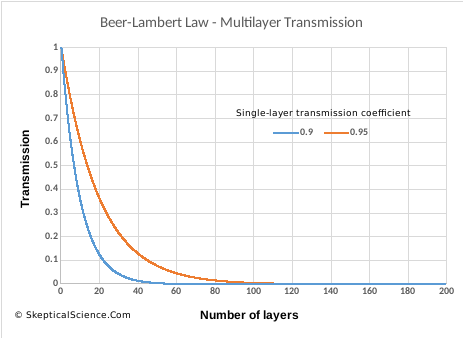
- The second issue related to what other commenters have said, that "skeptics" seem to ignore: that the atmosphere itself is emitting more IR radiation.
- Even though less and less of the original radiation entering layer 1 (closest to the surface, if we are thinking of our earth-atmosphere system) reaches the upper layers, constant emission of IR radiation locally (i.e., at that height) is replacing at least some of the IR radiation that was absorbed.
- The local emission depends on local temperature (the kinetic energy source)
- The local emission will be half upwards, and half-downwards, which means that it is now harder for that energy to reach a point where it can be lost to space (greenhouse effect discussion in previous comment).
There is another important place where a logarithmic relationship is seen. In Beer's Law, we talked about a layer containing something that absorbs IR radiation. What happens to the absorption ratio if we double the amount of CO2?
- We might think it doubles the amount of absorption, but this is only the case for low concentrations.
- At higher concentrations, the amount of absorption will not quite double
- ...and at yet higher concentrations, the absorption will not quite not quite double, etc.
- ...so we see a "law of diminishing returns".
- Eventually, at very high concentrations, there will be very little additional absorption. Again, we can call this "saturation".
- ...but current atmospheric CO2 concentrations are a loooong way from reaching this "saturation" point. We're a little over 400ppm now, and we'd need to get to concentrations several times higher before "saturation" is reached.
- From our starting point at 300ppm, we'll see 2-5C rise when we double to 600ppm, and then another 2-5C rise if we double again to 1200ppm, so we can see the logarithmic relationship.
- ...but a climate with 1200ppm of CO2 will not be a pleasant place compared to what we have now. The logarithmic decreasing effect will not save us from a very different world.
Whenever you see a "saturation" or "logarithmic" argument, you need to try to understand which version someone is claiming. The key error in all of them is that they are isolating one small part of a complex system and ignoring other parts that are affected by increasing CO2. Only by including the complex relationships among all the parts of the system can you determine the warming effects of CO2.
- At a glance - Is the CO2 effect saturated?
Charlie_Brown at 09:11 AM on 4 January, 2025The paper by Kubicki, Kopczyński, and Młyńczak., “Climatic consequence of the process of saturation of radiation absorption in gases,” Applications in Engineering Science, Vol. 17, March 2024 has been retracted by Elsevier. “After review by additional expert referees, the Editor-in-Chief has lost confidence in the validity of the paper and has decided to retract.”
www.sciencedirect.com/science/article/pii/S2666496823000456
Not explained in the retraction, but according to my interpretation in addition to the previous posts, Kubicki, et al., describe the emitted intensity for one monochromatic transmittance line for methane at 3.39 microns. However, when they describe absorptance for CO2, the description changes from a single line to a spectrum. They do not integrate the intensity of single lines for all lines in the full spectrum, which is the straightforward approach used in atmospheric radiation models and climate models. Rigorous models use line-by-line calculations while simple models utilize narrow bands for calculation efficiency with minimal loss of accuracy. Instead, Kubicki, et al., introduce a definition of “saturation mass” that reaches 95% of maximum value of absorptance for a large band for an unspecified wavelength range. They support their concept by describing experiments for a detected value at the end of a tube. This experimental design does not account for re-radiation in any direction apart from a straight line.
- CO2 effect is saturated
Bob Loblaw at 00:52 AM on 28 November, 2024One more. CallItAsItIs says in comment 769:
Because when we break down the EMR into the sum of contributions from the different frequencies it contain, we find that each such contribution is incoherent relative to the others.
The only things that is incoherent is CallItAsItIs's physics. Absorption and emission of radiation are independent events. Once again, I beg that CallItAsItIs read Eli Rabbet's blog post on the time scales involved in absorption, emission, and collisions with other molecules. [CallItAsItIs: the previous sentence includes the link to that blog post.]
To start, here is the opening section of Eli's post:
One of the useful things the Rabett used to do was to explain what happens to the energy when a molecule, say CO2 (carbon dioxide) although you could also say H2O (water vapor) or CH4 (methane) absorbs light. For the purpose of this post, the photon would be in the infrared region of the spectrum. This is an evergreen for two classes of bunnies
- Bunnies who don't realize that the molecule can also emit light. This is a popular one amongst organikers and analytical chemists whose experience with IR spectroscopy is in an absorption spectrum for analysis of samples
- Bunnies who think that the only way that an excited molecule can get rid of the energy is to emit a photon.
I will leave it as an exercise for the reader to decide whether CallItAsItIs falls into class 1, class 2, or both.
- 2024 SkS Weekly Climate Change & Global Warming News Roundup #44
prove we are smart at 06:52 AM on 4 November, 2024First a little thankyou to Sceptical Science for many years ago teaching me the science about Climate Change or as we called it then Global Warming. To also understand the extremes of the earths past climate cycles and their causes was fasinating.
Why we won't mitigate? It's really about the politics-the science was settled a long time ago.
I know I'm one of the lucky ones and also part of the problem. My island continent is liquifying the methane gas and digging up the "ores" at a faster and faster rate for the overseas sales.
Soon again with my adult children who will never afford to live my dream, we will all be hunkered down by candle or duracell light-lost power from a "rare" supercell thunderstorm. We tune in to the eveready powered radio for current news.
So I go to bed early or read for a while, looking at those " Twelve books to read about climate action before the election" highlighted above, I definitely like this one. What If We Get It Right? Visions of Climate Futures by Ayana Elizabeth Johnson (One World 2024, 496 pages, $34.00) "Visionary farmers and financiers, architects and advocates, help us conjure a flourishing future, one worth the effort it will take". Leave off all the media when the power returns and just keep reading...
- The doom spiral
MA Rodger at 00:07 AM on 23 September, 2024Jan @4,
I don't think I can agree with your assertion that with AGW, "we are now flying blind."
Climate scientists are well aware of the potential for nasty surprises being stoked by humanity's greenhouse gas emissions. For some time now, the message has been that anything warmer than a +1.5ºC world is running the risk of bringing on some of those nasty surprises. (This safety limit was originally +2.0ºC prior to ~2010.) Mind, extinction of the human race will be far from the first nasty surprise to arrive. Of course, logically it would be the last but, that said, it would be a long long way down the road in terms of global tmperature rise.
The big risk we face not addressing AGW (which is where we are today) is messing the climate enough to bring the global economy crashing down around our ears, an economy the vast majority of humanity rely on to keep them fed and watered.
You do make some very brave assertions which I consider are difficult to support.
As an example, I would question some of your comment on the "methane feedback."
Present natural methane emissions have not been easily quantified but they are included in the climate modelling and their growth has been a part of the projected methane forcing. Certainly recent work suggests the modelled natural emissions are running behind the assessed natural emissions and projections are not capturing the full picture. But this is not to the extent that natural methane would become a significant feedback mechanism. (See for instance Kleine et al (2021) or Zhang et al (2023).) However, the increase in natural methane emissions is one of the potential nasty surpises.
One area of natural methane emissions where people often express great concern is the Arctic emissions, an understandable concern but one which is misplaced. Years ago I went down this road myself.
But it should be said that your brave assertions do require supporting evidence.
- The doom spiral
Jan at 19:49 PM on 20 September, 2024Sadly, climate scientist have no time to follow the path single discussions on feedbacks take. Therefore, they think models can in anyway predict what is comming. Unfortunately they can't! So many models errors of Earth system developments now amerging that one can only vomit.
Thererby, models miss way too many feedbacks which are now soming into motion.
The Amazon is now trapped in the vicious cycle, speeding up its collapse decades earlier then predicted. Antarctic heatwaves and see ice losses also happens decades earlier then predicted.
The methane feedback has started while models did not see a significant signal till 2100 to emerge. The methane modul of models is crap! But do not know if the new one is already deployed.
Be it as it may, the warmings of the Arctic methane bomb are now out and will increase the comming years as recent observational studies are quite worring. Not only Yedoma permafrost emits much more, but the real danger will be geological methane from methane hydrates and gas rich sediment layers, which is a wild card, which is ever more observed and documented - methane of thermogenic origion reaches the atmosphere where measurements have been made, while ground water melts its way downward through cracs driven by osmosis.
Marine heatwaves, a feedback of oceans warming too fast, are also not predicable by models as they are driven by small scale to global circulation patterns in the oceans and atmosphere. We have now the first MHW in the North Pacific reaching in its peak regions some 7-8°C above the 1981-2011 average (one cause: Asian flooding amplifying the subtropical North Pacfic high via hot upper air currents).
Not only that marine heatwaves expanded non-linear, they are also a game changer in terms of ocean heat uptake, circulation patterns, and extreme events. Models were not able to predict their spread which can only be described as nuts.
Next problem we face is that over the oceans first 300m ocean heat is now building up, in the mode water and intermediate water mass regions the heat buildup spreads to deeper layers with subsurface water masses warming, freshening, and expanding. Very bad sign indeed!
First study came now out that vertical mixing of the oceans could already be suppresed by increasing stratification. Further, we see worrying changes in mode water masses in the Northern Hemisphere. At the same time recent changes around Antarctica (e.g. warming and hemispheric temperature gradient declining -oops!) are also worrying as it has been the Southern Ocean that had been mostly responsible for the monotoic trend of incrasing heat uptake the last 20 years - intensfying winds around Antarctica the major reson (Ozone hole supported that development of increasing hemispheric temeprature gradient).
Just now the experts of ocean mxing and ocean heat uptake trying frantically to find out which processes controlls heat uptake of the oceans as we did never really loocked into it. But now the changes become so worrying that our simple assumption that the oceans would continue their monotoic trend in increasing heat uptake like nothing was amiss doesn't matter how fast we warm our planet had been way too simple.
If ocean heat uptake declines from 90% of the extra energy to 80%, the whole goes fast bam, as a too fast warming had been the problem in the first place.
And if oceans should start to take less than 90% of the extrem energy kept in the system, all the other feedbacks will be triggered.
This can go very fast! Doomer? Stupid framing of the system, as the above is in all points a real possibility as we do not know when and how fast feedbacks could start to synchronize.
And if this should happen the only chance humanity will have, will be to reduce GHG conrentrations in the atmsphere as fast as we can do it united as a species figthing for its own survival!
Sadly, many climate scientist have become statisticans and thereby they have lost contact with reality as the discussions deep in the mechanics of our climate systems point something very clear out:
We are now flying blind and even an extinction level event is a possibility whch can progress fast!
- On Hens, Eggs, Temperature and CO2
MA Rodger at 19:27 PM on 4 September, 2024rkcannon @16.
Assuming Mark Johnson @18 is correct and you do refer to the graphic posted @6 (which seems entirely sensible), your question has still not been properly addressed.
And that presumably is to ask why the CO2 fluctuations through recent ice ages (180ppm to 280ppm) are associated with large temperature fluctuations (10ºC peak-to-peak) but the larger recent anthropogenic CO2 (280ppm to 420ppm) doesn't result in any commensurate temperature increase in the graph.
There are a number of factors to consider.
(1) The forcing from changes in CO2 is logarithmic, so the recent CO2 forcing would be slightly smaller than the ice age forcing (2.2Wm^-2 as opposed to 2.4Wm^-2).
(2) It takes time for the temperature to react to an imposed forcing so only about two-thirds of any CO2-forced increase would have occurred in the decades of man-made warming so far.
(3) The ice age CO2 forcing was not the major forcing through ice ages. The change in albedo due to the shrinking ice sheets and the rising oceans would be double the CO2 forcing. Other factors like methane and dust were also in play. (The orbital forcing that triggers ice ages is very minor.) Increasing CO2 contributed perhaps a third of the ice age forcings.
(4) The temperatures being plotted are from the EPIC ice core data and thus Antarctic temperatures which wobbled tiwce as much as global temperatures through the ice ages. (Note the modern CO2 value has been added, marked with an asterisk. Grafting on the modern EPIC temperature record would be difficult, and would not show much as the instrument record is more wobble than rise.)
So taking (1) to (4) into account, the 10ºC ice age cycle in the graphic @6 would be a little smaller, say 90% (1) then a third off (2) then two-thirds off (3) and finally halved (4). So the global temperature should be very roughly something like [10ºC x 0.9 x 0.67 x 0.33 x 0.5 =] +1ºC which is pretty-much what we see globally today. - A major milestone: Global climate pollution may have just peaked
Bob Loblaw at 04:54 AM on 24 July, 2024Joel:
The figure mentions OurWorldInData.org. They have a large collection of charts of CO2 and greenhouse gas information on this web page.
One of the charts (second row, right side, in the view I have) is for "Annual greenhouse gas emissions by world region". It looks like the total for that chart matches the values in the figure in this post, so I expect the figure here is using the same data (just not by region).
If you dig down into the information for that chart at OurWorldInData, it gives the following reference:
Jones, Matthew W., Glen P. Peters, Thomas Gasser, Robbie M. Andrew, Clemens Schwingshackl, Johannes Gütschow, Richard A. Houghton, Pierre Friedlingstein, Julia Pongratz, and Corinne Le Quéré. “National Contributions to Climate Change Due to Historical Emissions of Carbon Dioxide, Methane and Nitrous Oxide”. Scientific Data. Zenodo, March 19, 2024. https://doi.org/10.5281/zenodo.10839859.
That paper describes the data as "emissions CO2, CH4 and N2O from fossil and land use sources during 1851-2021."
If you follow the link to that paper, it then points to yet another paper that gives a more complete description: https://www.nature.com/articles/s41597-023-02041-1. The abstract of that paper starts with:
Anthropogenic emissions of carbon dioxide (CO2), methane (CH4) and nitrous oxide (N2O) have made significant contributions to global warming since the pre-industrial period and are therefore targeted in international climate policy.
From that information, it seems pretty clear that forest fires, peat, etc. are not included.
The figure here provides enough information that your question can be answered with a little effort tracking down sources.
- A major milestone: Global climate pollution may have just peaked
Joel_Huberman at 03:59 AM on 24 July, 2024Does the graph (and other data reported here) apply only to anthropogenic emissions or to total emissions? Total emissions would include all "natural" emissions, including CO2 due to forest fires and methane/CO2 from peat melting. Emissions like those I've mentioned seem likely to increase in the near future.
- What’s next after Supreme Court curbs regulatory power: More focus on laws’ wording, less on their goals
One Planet Only Forever at 07:23 AM on 16 July, 2024TWFA,
It is important to not be governed by interests that conflict with learning to be a more helpful and less harmful member of humanity. Note that current time period societies, like political party tribes in a nation, are sub-sets of global humanity including all future generations.
I recommend seriously considering the points I shared from Kahneman’s book “Noise”. Also, consider reading the entire book as well as his earlier book “Thinking Fast and Slow”. Otherwise a person is likely to produce nonsense noise on matters because of biases keeping them from thoughtful slow consideration and learning.
I also recommend reading “How Democracies Die” by Levitski and Ziblatt. They explain how institutions are important to democracy. But institutions need to be protected from corruption by harmful interests.
Sustaining and improving the responsible and reasonable freedoms of all members of a society (what democracy aspires to achieve) requires responsible reasonable civil society members to effectively govern what happens to protect the institutions of the democracy from being captured and controlled, or being significantly influenced, by interests that conflict with learning to be less harmful and more helpful.
The actions of the US SC regarding Chevron deference are just one of many examples of how the SC institution has been captured and controlled by interests that conflict with maintaining and improving democracy in the US. And that capture and control of the SC is the result of the US Republican Party failing to keep itself from being captured and controlled by harmful interests that conflict with learning to be less harmful and more helpful to Others. And the US Democratic Party has also failed by allowing its leadership actions to be significant influenced by harmful interests in conflict with learning to be less harmful and more helpful.
To be more pointed regarding climate change impacts, the harmful fossil fuel interests try to influence and control whatever political players are required to achieve their harmful interests (Tea Party, Joe Manchin...). They can be expected to take maximum advantage of the new SC decision regarding Chevron deference.
So the reality is that the ‘SC institutional leg of the US democracy stool’ has been harmful captured by interests in conflict with maintaining and improving US ‘Democracy for all’. The SC was significantly compromised before. But now the SC is significantly controlled by bias against learning to be less harmful and more helpful. What institution(s) can counter and limit the harms done by decisions made by such a biased SC?
BTW, regarding the following quote from TWFA @42,
for example a Clean Air Act of 1850 to control draft animal farts is applied to CO 60 years later, whether the regulators should have the power to decide on their own
Methane (CH4) from livestock is the concern (not CO). Also, the methane is in the burps, not farts, from animals like cows. Work animals commonly referred to as ‘draft animals’, like horses, do not digest their food in the same way as livestock. So, draft animals are not likely to be a methane generation problem. And a ‘general rule limiting sources of methane from human caused activity’ would not require legislators to spend time updating a detailed list of problematic methane sources that get identified by ‘experts in the matter’ (note that people wanting to benefit from harmful methane releases are unlikely to inform legislators of the harms their interests produce). And a ‘non-corrupted SC’ would be an effective check and balance institution to ensure that how the regulators identified and restricted harmful methane releases were reasonable.
- Climate Adam: Can we really suck up Carbon Dioxide?
One Planet Only Forever at 06:47 AM on 23 May, 2024An extreme example of carbon dioxide removal greenwashing is the marketing of the glory of the Pathways Alliance plans to make Alberta oil sands production 'Net-zero by 2050' (see here for their self promotion details).
As mentioned in Climate Adam's video, and the earlier CCS video he mentions (a link at the end of this Climate Adam video), CCS of oil sands operations will only keep part of the ghg impacts of the operations from entering the atmosphere, with risk of leaks of the stuff thought to have been captured and stored. In particular, any methane emissions are not captured for storage.
So, to be 'net-zero' the Pathways Alliance will have to divert (consume) some of the 'real carbon removal activity' that will almost certainly be necessary to bring total human impacts back down to 1.5 C levels (human impacts are expected to exceed the globally agreed 1.5 C level).
Pathways Alliance action, if they get subsidized to the degree they want and actually do something to reduce carbon emissions, would improve Canada's Climate Actions. But the most recent Climate Action Tracker evaluation of Canada linked here (pointed to by prove we are smart in this comment on another SkS item) is "Highly Insufficient" significantly due to leadership being compromised by being interested in profiting more from being more harmful and evading the costs of being less harmful. The Pathways Alliance improvement may only move Canada to "Insufficient" Climate Action.
It appears the (Canadian, Alberta, oil sands investors) hope is that some fossil fuel use will be globally agreed to be needed after 2050 to exclusively provide essential assistance for the least fortunate to live basic decent lives. And they (Canada, Alberta and oil sands investors), being net-zero suppliers by then, should be globally supported to be the chosen suppliers.
Harmful actions can only be justified if the harm is required to provide essential life assistance to the less fortunate (and it would be unacceptable for anyone to profit from providing that assistance - it should be not-for-profit).
That raises many questions including:
Will Canada, Alberta and oil sands investors all agree to be Net-zero-profit-takers after 2050?
And will they have taken action and paid what it costs to minimize the need to divert 'real carbon removal actions' to offset their remaining impacts (diversion required so they can claim to be 'net-zero' suppliers of a harmful product)?
And will they agree by 2050 that the only benefit from their 'net-zero product that will produce harmful impacts when used as expected' is to be obtained by the least fortunate (refusing to export it to questionable buyers)?
- CO2 is just a trace gas
JJones1960 at 17:58 PM on 3 May, 2024Bob Loblaw @ 51:
“CO2 is not "colourless" when it comes to infrared radiation. Just because JJones1960 can't see it doesn't mean it doesn't happen.”
The point that you miss that that CO2 is a trace gas, therefore cannot trap a significant amount of heat anyway.
OPOF @52:
Your quote:
“Tropospheric ozone (O3) is the third most important anthropogenic greenhouse gas after carbon dioxide (CO2) and methane (CH4).“
The point you miss is that ozone traps heat in relation to CO2 and methane as the ‘third most important greenhouse gas’ but that is IN RELATION to those gases. My point is that those gasses don’t and can’t trap a significant amount of heat because they are in trace amounts, therefore neither would ozone.
- CO2 is just a trace gas
One Planet Only Forever at 04:52 AM on 2 March, 2024JJones1960 @48,
I hope the following helps you understand that John and Bob have correctly pointed out that you have made a very weak counter-presentation regarding the significance of small amounts. The points presented in the Argument effectively counter the simplistic and understandably incorrect belief that the percentage of CO2 in the atmosphere is too small to make a difference.
A major weakness of your counter-presentation is that you appear to lack even a small amount of knowledge regarding the matter, here’s why:
You stated • You don’t use trace amounts of ozone to trap a significant amount of heat
That belief is contradicted by improved evidence-based understanding (contradicted by learning what is already known). One of the many presentations about the global surface temperature impacts of ozone is the NASA Aura item: The greenhouse effect of tropospheric ozone. It opens with the following:
Tropospheric ozone (O3) is the third most important anthropogenic greenhouse gas after carbon dioxide (CO2) and methane (CH4). Ozone absorbs infrared radiation (heat) from the Earth's surface, reducing the amount of radiation that escapes to space.
A lot can be learned from the items presented on SkS and other reliable information sources.
Learning from reliable sources can make a world of difference.
- How oil sands undermine Canada’s climate goals
One Planet Only Forever at 09:49 AM on 24 February, 2024This is a great summary of the reasons for the persistent failure of leadership to do what could and should be done.
Another way of presenting the problem is that it is the combination of:
- the need to remain popular enough to continue to be in control of leadership actions
- it is easier to be popular by misleadingly pursuing and excusing 'increased benefits from being more harmful' than it is to responsibly lead the reduction of harm.
A minor change of the title would make the nature of the problem clearer:
How the popularity of misleading promotion of benefiting from harm undermines Canada’s climate goals
And a 2021 article in Nature: Scientific Reports "Methane emissions from upstream oil and gas production in Canada are underestimated" indicates that the way that methane emissions are estimated significantly underestimate the magnitude of ghg emissions in Canada and other nations.
But at least the current Canadian Government is doing something about the concerns raised by this Yale Climate Connections article. They have renamed the rebate - CBC News - "Liberals rebranding carbon tax rebate to ensure Canadians know where the money comes from". That action will only reduce Canada's emissions if it improves the popularity of the current government enough to avoid having the more harmful Conservative Party become the leaders after the next election. The Conservative Party has made it clear that they would 'cancel the carbon tax and rebate program' and take other actions that would result in 'more benefit obtained by some people by being able to be more harmful'.
- Is Nuclear Energy the Answer?
John ONeill at 07:32 AM on 24 February, 2024'Nuclear is not economic' - the 17 countries building new nuclear missed your memo.
'..takes too long to build..' Mean construction time was 7.5 years, with a long tail. Countries involved in a concerted buildout do rather better - Japan averaged less than 5 years, China and South Korea less than 6. Sheffield Forgemasters, one of the few companies qualified to make reactor pressure vessels, has just demonstrated a new method of ion beam welding, letting them weld around the girth of an RPV ring in one day. This weld, on a 4 metre diameter, 200 mm thick piece, with very tight inspection requirements, would normally take up to a year. RPVs have been one of the bottlenecks for nuclear growth. Other solutions, such as the heavy water reactors used in India, don't have RPVs.
'..there is not enough uranium.' This was the perceived reality when the industry was just starting up - and when Cold War bomb-making led to a frantic search for uranium reserves, since enriching to 90% U235 bomb-grade uses up far more feedstock than does the 3-5% used in light-water reactors, or the natural uranium used in mainly Canadian and Indian heavy water reactors. At the time, it was also assumed that energy demand would keep growing at 1960s rates, and that most of the growth would be from nuclear. L Ron Hubbard's famous graph of human energy use rising sharply from a low base, as fossil fuel reserves are used up, and dropping equally sharply back to pre-industrial levels, was used by Peak Oil doomers to predict a coming crash, to be followed by unending scarcity. In fact, Hubbard original graph showed nuclear growing as fast as fossil fuel energy, completely replacing it, and then maintaining that level indefinitely. Plans were in place to switch to fast reactors, converting the 99.3% U238 of natural uranium to fissile plutonium, and to use thorium, 3x more abundant again, as fissile U233. This effort stalled when demand fell, and uranium proved to be much more abundant than thought. Until recently, global production has been well below demand, due to oversupply causing very low prices. Many high grade mines, like MacArthur River in Saskatchewan, were closed during the drop in demand after Fukushima, with the word's third and fourth largest users, Japan and Germany, temporarily shutting their whole industries. With demand now booming, these mines are reopening, and new prospecting has resumed. (Many nuclear operators are on long-term contracts, and have existing stocks, so are not immediately affected.)
Hubbard's fossil peak has been slower to arrive than expected, and so has the nuclear growth he expected to replace it. Long term though, I expect his insight to be accurate. The drive for increasing energy use is still there - nobody wants to stay poor (religious orders aside). The down-ramp on fossil use will be steeper than the rise, as climate concerns spread. Can weather-based energy fill the gap? Not judging by the view out my window (mid summer, 8/8ths cloud cover, national wind fleet at 1/3 of capacity).
I've read some of Mark Jacobson's papers - all the way back to his cover article on Scientific American, in 2009. Before him, there was Amory Lovins' vision of a 'soft path' energy future, very influential on Jimmy Carter's policy. The two were actually diametrically opposite in their prescriptions. Lovins decried the cost and energy waste of the transmission grid, calling for efficiency ('negawatts'), small-scale, local wind and solar, backed by fluidised bed coal. Jacobson wants a maximal grid, moving greatly overbuilt wind and solar across continents, with probably battery backup, no biofuels or combustion energy, no new hydro. Neither prescription has done well when put into practice in reducing emissions. US CO2 emissions per capita hardly changed from the 70s to the 2000s, only falling with the switch from coal to gas (though increased methane leakage may have negated some of the climate benefit). Widespread, government-sponsored wind and solar growth, most notably in Germany, has bought a rapid rise in installation, but though the individual solar plants and wind turbines became much cheaper, their integration into the grid led to increasing power costs, while fossil fuel use persisted at a higher level than on grids that had already switched to nuclear for largely economic reasons.
Some countries whose governments had declared that nuclear power would cease have reversed course, and plan new build - notably Japan, South Korea, Sweden, and Italy. Others - Germany, Spain, Switzerland, Taiwan, which had 20 to 40% of their power from nuclear - currently persist in de-nuclearising. Russia is building plants in Turkey, Egypt, Iran, India, Bangla Desh, and shortly Hungary. Russia, United Arab Emirates, Iran, and possibly soon Saudi Arabia, are building nuclear plants at home because it displaces gas, which earns much more money as exports. Japan and South Korea are building nuclear for the opposite reason - it makes power much more cheaply than imported liquefied natural gas, at East Asian prices. The important question for the future is whether nuclear can take more than a toehold share in countries like India, Pakistan, South Africa, and Indonesia, where energy use is rising fast, and coal is now the chosen option.
- A New 66 Million-Year History of Carbon Dioxide Offers Little Comfort for Today
nigelj at 05:38 AM on 13 December, 2023The information on earth system sensitivity of 5 - 8 degrees C is very sobering. There are many accounts of what a 6 degree world is like easily googled and its very inhospitable for humans and other species. Because ESS develops on long time frames we might adapt to some extent, but that doesn't really make it any less inhospitable.
This is one authors depiction of a 6 degree world based on available research. The description is based on such a world developing over the next couple of centuries and a failure to curb emissions, but even if it takes thousands of years as a result of ESS, many of the outcomes would be similar.
"Special coverage is given to the positive feedback mechanisms that could dramatically accelerate climate change. The book explains how the release of methane hydrate and the release of methane from melting permafrost could unleash a major extinction event. Carbon cycle feedbacks, the demise of coral, the destruction of the Amazon rainforest, and extreme desertification are also described, with five or six degrees of warming potentially leading to the complete uninhabitability of the tropics and subtropics, as well as extreme water and food shortages, possibly leading to mass migration of billions of people."
The IPCC seems to have focused most attention on warming and sea level rise rates by 2100. We have projections of around 3 degrees C of warming and worst case about 5 degrees, and SLR around 1 metre with a worst case 2 metres. The details on longer term trends several centuries into the future, or millenia into the future like earth system sensitivity, are buried away in their reports or not given much attention.
The IPCC have a chart buried in their reports showing a worst case of about 10 degrees C by about 2300 if equilibrium climate sensitivity turns out to be high and we just go on burning fossil fuels. Likewise by 2300 SLR could be well over 2 metres. This may be somewhat attenuated by the impacts of renewable energy already reducing projected coal use, but it would still be a big number and theres a lot of SLR already baked in even if we stop warming right now.
I wonder if this focus on year 2100 is a deliberate psychological strategy to focus on our immediate future. If they focused on the longer term trends there might be a risk that people would say why worry that won't effect me or my children.
However warming of for example 3 degrees by 2100 and one metre or so of SLR doesnt sound very scary to some people, while numbers like 5- 8 degrees longer term and SLR of 10 - 20 metres are obviously intuitively far more scary and certainly get my attention. Clearly we do need a focus on year 2100, for obvious reasons, because its in our lifetimes and adaptation would be very costly, but I wonder if a bit more attention on longer term time frames would have really shown people the huge scale of change we are facing.
- New report has terrific news for the climate
Fred Torssander at 21:22 PM on 20 October, 2023MA Roger @4;
Thanks for your answer.
a) My use of the word fraction was not meant to create misunderstanding. I ought to have used part or ppm instead. Sorry.
1.) The still accelerating growth of the CO2 part of the atmosphere can have several types explainations - I think. i) First of all (Occhams razor) itt might be that the growth is actually accelerating, and the measurements of emissions of GHG are wrong or falsified. There is still very big money being invested in further expanded use of fossil fuels. ii) Then comes non-antropogenic generation, which varies with the activity of volcanoes and the weather, like El Niño that you mention. iii) Then there is the different effects of growing CO2 part of the atmosphere and of rising temperature. Like for example melting ice-lids on gas kettles. Some containing methane.
There seems to be an adequate amount of scientific work on the non-antropogenic and maby also on the iii) category. But how much is done on the question of mistaken or falsified measurements of the emissions?
The temperature anomaly could be verified by scientific use of a common houshold thermometer. At least in populated areas.
Maby that makes temperature the only useful and reliable measure? In that case mabe good news using other measures should comment on the discrepancies between those and the rising of the temperature?
[Berkeley Earth story link]
Yours
Fred Torssander - At a glance - The tricks employed by the flawed OISM Petition Project to cast doubt on the scientific consensus on climate change
Nick Palmer at 22:24 PM on 11 August, 2023I've always thought that the exact wording of the Oregon Petition
"no convincing scientific evidence that human release of carbon dioxide, methane, or other greenhouse gases is causing or will, in the foreseeable future, cause catastrophic heating of the Earth's atmosphere and disruption of the Earth's climate"
was grammatically constructed to actually have been technically signable AT THE TIME OF FIRST LAUNCH even by such climate luminaries as James Hansen.
It comes down to the artful use of "is causing" and "will cause" - instead of 'may cause' - catastrophic heating and disruption etc. The petition does not state that its wording assumes that mainstream climate science was asserting that emissions will continue to rise sharply and that climate sensitivity to CO2e was at the top end of published expectations back then (somewhere around 6°C per doubling if I remember, although 10°C was mentioned https://skepticalscience.com/climate-sensitivity-advanced.htm ) but it is the underlying insinuation (of the text) that climate science was saying these things that enables the rhetorical deceit inherent in that exact wording. It allows any scientist who was fairly familiar with the science back then to jump to the conclusions that, because such emissions rises weren't certain to take place, and that ensemble figures for climate sensitivity were showing a 'most likely' figure of ~3°C per doubling, then it was definitely not certain that 'catastrophic heating' would occur. - Gas stoves are even worse for our health than previously known, new study finds
gws at 00:53 AM on 29 June, 2023Well, as is covered in the paper, methane flames have long been known to create benzene as a minor combustion product. The EPA even has an estimate of the associated annual national emissions (also in the paper).
The main point thus is not the finding that benzene is emitted from gas stoves, but that those emissions are much larger than the previous emission factor derived from a "clean" combustion suggested they are.
- Why the food system is the next frontier in climate action
One Planet Only Forever at 03:08 AM on 2 May, 2023Evan @6,
I briefly reviewed the 2014 Research Article you pointed/linked to (note it is almost 10 years old). I would update my previous comments to add that human actions causing increased N2O in the nitrogen cycle are to be considered the same way I refer to impacts on the carbon cycle. And I would add that there are other good reasons for more aggressive reduction of nitrogen cycle impacts than climate change (refer to Planetary Boundaries).
I will also clarify that reducing methane emissions from rice is still an opportunity for reducing the peak level of ghg impacts even if that methane could be considered to be ‘part of the natural carbon cycle (an action that does not increase the amount of carbon in the carbon cycle the way that burning fossil fuels or leaks of methane from fossil fuel operations or permafrost melting do).
More specifically, the report’s evaluated floor level of non-CO2 emissions from food production and consumption (Global total 7 GtCO2e/year by 2050 with more if population continues to grow beyond 2050 and also influenced by 'potential changes of attitudes towards being less harmful') appears to be based on the perceived willingness of the UK population, at the time the report was prepared, to learn and be less harmful consumers. And the evaluated UK willingness is extended globally with all people expected to want develop to live in ways comparable to the less harmful ways that the UK population was evaluated to be willing to live.
The following is a quote from the “Options and barriers to mitigating food system non-CO2 emissions - Agriculture” section of the Research Article:
“For both N2O and CH4, socioeconomic and environmental circumstances dictate the extent to which changed agricultural technologies and practices can deliver cuts in emissions at a systems level. Stakeholders suggested that important factors influencing uptake of mitigation options affecting the UK revolve around cost, dominant practices, the aging farming community and attitudes of ‘young farmers’, existing infrastructure, cultural norms, changing climate as well as a feedback linked to levels and patterns of consumption.”
A quote from the “Options and barriers to mitigating food system non-CO2 emissions - Consumption” section of the Research Article:
“Within the UK consumption-based scenarios, the most significant dietary change considered was a 70% per capita cut in meat consumption, with the deficit replaced with rises in other food types. However, even with changes to per capita meat consumption, absolute emissions levels are driven by population growth (consistent across the scenarios) as well as growth in per capita consumption levels. Population growth per se strongly constrains N2O mitigation, as crops for consumption and for feed for livestock continue to require manure or mineral fertilizer. Barriers to changing patterns of consumption are confirmed through consumer focus group analysis: moderate changes in meat consumption (20% per capita) were considered in line with financial pressures to reduce expenditure given the context of the 2009–2012 recession, whereas a 70% reduction was perceived too substantial a change for many [Citation33].”
That indicates that the evaluation was (likely unwittingly) biased by accepting questionable opinions like ‘the higher cost of being less harmful is a valid reason to be more harmful’ and ‘the developed popularity of eating more meat is a valid reason to not reduce meat consumption’. Note that I tried to present both of those points in a way that highlights that populist political misleading messaging significantly caused those attitudes to develop to be so influential that they compromise the evaluation and the way it is reported.
Quote from “Discussion - Implications for cumulative GHG emissions”
“Finding ways of reliably reducing non-CO2 emissions will become increasingly pressing as global demand for food rises. A wide range of feasible CH4 mitigation options were put forward by stakeholders, taken from the literature and quantitatively assessed during the scenario process, providing evidence for greater scope for achieving substantial CH4 mitigation than for N2O. This, coupled with the much longer lifetime of N2O compared with CH4 as well as the influence of carbon cycle feedbacks in raising the GWP of CH4 from 21 to 34, highlights the critical importance of fully exploiting CH4 mitigation potential whilst increasing the research effort towards developing agricultural systems that can minimize N2O production.”
That indicates that if the developed research bias is corrected there could be more reduction of N2O resulting in a lower ‘floor level’.
Quote from “Discussion - Implications for managing and mitigating CO2”
“The focus here on non-CO2 reinforces other studies that identify the existence of an emissions floor, further emphasizing an urgent need to mitigate CO2 emissions where it is most feasible and quickest to do so. The higher the non-CO2 floor, the more rapidly CO2 emission cuts are needed within the constraints of a chosen climate target. Conversely, relying on a low or non-existent emissions floor suggests a larger CO2 budget is available, again relaxing the rates of mitigation for a chosen climate change target, delivering a more palatable but less realistic assessment of the climate change challenge.”
This emphasizes that the learning from the report is that more rapid efforts to reduce fossil fuel use are required.
Quotes from the “Conclusion” of the research article:
“A continuation of absolute growth in global N2O emissions, despite assuming optimistic mitigation has, because of cumulative emissions, direct implications for how urgently and deeply to cut both CO2 and CH4 for an assumed climate target.”
This reinforces the need for more research to reduce N2O and the need to more aggressively cut CO2 and CH4 unless new research develops viable ways to rapidly reduce N2O.
“As energy systems become decarbonized, global non-CO2 emissions largely associated with food consumption and production will increase in the share of annually produced GHGs. Emphasizing the importance of making cuts in food-related emissions highlights an urgent need for policymakers in Annex B nations to consider not only technological and supply-side interventions, but tackle the thorny issue of levels and types of consumption. Unlike large-scale infrastructure developments, measures tackling consumption and demand have the potential to cut emissions of CO2 and non-CO2 alike in the short term and could improve the diminishing chances of remaining within the carbon budget commensurate with the 2ーC threshold.”
That highlights the need for policymakers to “tackle the thorny issue of levels and types of consumption” because the reports conclusion is that current over-developed populations are not as willing to be less harmful as they should be.
A quote from the “Future perspectives” part of the research article:
“If the challenges posed by climate change are to be overcome, at least in part, a meeting of minds to define problems can offer new, much needed insights. This is already emerging in some quarters, with an increase in interest from research funders around the food–water–energy nexus as well as a rise in the number of researchers keen to engage in genuinely interdisciplinary activity. Of course disciplinary research may, out of necessity, continue to dominate, but the emerging expertise in interdisciplinary research needs support and encouragement given the extent of the systemic and complex challenges facing society.
"The climate change challenge becomes ever more urgent each year, with time limiting the options available for mitigating emissions to be largely those that can deliver change in the short term. Perhaps with agronomists, biologists, engineers, political and social scientists working increasingly in single units, systemic ‘solutions’ to the climate challenge can be found. Specialists in demand and consumption require the same prominence in the portfolio of research endeavour as technologists, physical scientists and engineers. Only then will resilient options be derived and ultimately implemented in a timescale befitting of the scale of change facing society.”
- Why the food system is the next frontier in climate action
Evan at 20:29 PM on 30 April, 2023OPOF#4, I am not any kind of expert on GHG emissions in the food cycle, but from what I've seen and read, there are baseline emissions that are difficult to eliminate, such as methane emissions due to rice cultivation. I've heard and read of 1 ton CO2e/person/year as a reasonable baseline estimate (read the Conclusions here where they refer to an emissions floor).
nigelj#5, I don't disagree with your statements about the benefits of a vegetarian diet. My friend is a particular case in that he had cancer, and for his specific situation his doctor recommended he give up his vegetarian diet because his body needed animal protein to fight the effects of the cancer he had. So his was a special case, but it still highlights that there is not always a one-size fits all answer.
- Why the food system is the next frontier in climate action
One Planet Only Forever at 14:14 PM on 28 April, 2023Evan,
I agree that the last paragraph is stated poorly. The answers to your questions may be in the two studies linked to in that paragraph:
- “50 to 110%” contains per capita and global total values evaluated to 2050. However, a quick scan finds the following within that report: “How do the +60% to +110% figures compare to our findings? We find that under SSP2 (which, like the FAO projections, is regarded as a business-as-usual scenario), total food consumption will increase by 51%, with a 95% confidence interval of +45% to +56%. This is substantially lower than the FAO2 and Tilman et al.1 projections of 60–110%.”
- “research suggests” has the following in its Abstract: “We find that global food consumption alone could add nearly 1 °C to warming by 2100. Seventy five percent of this warming is driven by foods that are high sources of methane (ruminant meat, dairy and rice). However, over 55% of anticipated warming can be avoided from simultaneous improvements to production practices, the universal adoption of a healthy diet and consumer- and retail-level food waste reductions.”
So it is not clear how the last paragraph comes to be stated the way it has been stated.
However, my criticism of the report is that it fails to mention the following fairly obvious realities:
- Immediate significant reduction of harm done can be achieved by reducing unnecessary consumption. Few people want to discuss that ‘herd of elephants in the room’ because that would reduce perceptions of economic prosperity that are based on all the unnecessary consumption, especially the conspicuous unnecessary consumption displays of higher status – like eating more meat.
- The current developed socioeconomic results are loaded with harmful unsustainable activities. The system aspires to ‘meet the wishes of the winners of competition for status, power, popularity and profit’ and ignore, dismiss or make excuses for the harmful systemic inequities of the developed ‘starting point’.
- The obvious best ‘ideal’ action to aspire to is all humans being governed, self-governing preferred, to limit their harmful actions to ‘essential (necessary) needs’ and limit the harmfulness of those essential needs. That means that anything beyond ‘essential needs’ has to ‘ideally’ be strictly limited, again preferably by self-governing, to harmless actions.
An example of the report being written from the biased perspective of a '(potentially unwitting) promoter of the harmful unsustainable status quo' is the unquestioned inclusion of the following:
"According to the World Economic Forum, investment in plant-based protein offers the highest heat-trapping pollution savings per dollar of invested capital of any sector but remains significantly under-invested. This burgeoning industry offers a major opportunity for smart policymaking and investing."
That promotes 'unnecessary' industrial food production, potentially with many other harms 'but the focus is restricted to the climate impact'. Local family cooperatives producing 'natural meat in ways that sequester carbon' combined with diets corrected to consume less meat would be a better solution ... but that would reduce opportunities for investors and diminish their developed perceptions of wealth ... but 'investors pursuing their maximum benefit' are not necessarily beneficial, especially if they employ populist misleading messaging to hide or excuse harm done, especially if they promote positive perceptions that some people can be tempted to hope to obtain from more harm done.
- It's not urgent
One Planet Only Forever at 09:11 AM on 27 March, 2023PollutionMonster,
In addition to what MA Rogers has mentioned, it is important to clarify the following:
Storage of Carbon Captured from the emissions of burned fossil fuels may help reduce the rate of harm done. But it is not the same as Storage of CO2 Captured from the atmosphere.
The now almost certain to be needed is:
Ending the human activities that result in increased CO2 in the atmosphere (has always needed to be done as rapidly as possible).
Plus
Removing excess CO2 to bring global warming impact back below 1.5 C (almost certain to be needed because of the lack of responsible leadership actions to govern/limit how much harm was done).
The capture and storage of CO2 from fossil fuel burning is not really a solution for the following reasons (and maybe more reasons):
- Not all of the emissions will be captured. That will require more CO2 removal from the atmosphere.
- Not all of the captured emissions will be effectively stored. That will require more CO2 removal from the atmosphere.
- There will be other ghg emissions from the extraction, processing, transport (even leaks of methane before it is burned). That will require more CO2 removal from the atmosphere.
Attempts to frame CCS related to fossil fuels, or other uses for ancient buried hydrocarbons like Blue Hydrogen production, as 'solutions to the problem of increased atmospheric CO2 levels beyond 1.5 C impact' are 'Green Washing'.
As a resident of Alberta I am very familiar with the Government (Alberta's and Canada's) Green Washing in their pursuit of popular support for maximum revenue by maximizing the benefits obtained from harmful uses of 'ancient hydrocarbons buried in Canada'.
- It's not urgent
Rob Honeycutt at 07:22 AM on 9 March, 2023PM @17... Would you have the precise quote from Thunberg's book related to "50% chance of runaway greenhouse effects beyond human control at 2°C"?
My suspicion is that's not an entirely correct assessment, though I'm confident Thunberg's book went through a thorough review by researchers prior to publication. My understanding is, past 2°C we move into a realm of much greater uncertainties. Also, even at 2°C significant feedbacks (say, from methane releases) remain long tail uncertainties. But I could be wrong.
- It's not urgent
One Planet Only Forever at 05:36 AM on 9 March, 2023MA Rogers has correctly clarified that the total harmful warming impact is what matters. Limiting the impact to 1.5 C needs to continue to be the focus. And the reality that the peak impact will almost certainly exceed 1.5 C needs to be understood to mean that wealthy people today need to be paying for safe/harmless technological extraction of CO2 from the atmosphere. That extraction will be expensive and never be profitable. And the spending of tax money on it rather than other things will never be "most" popular.
That is the challenge. Leadership has to do something unpopular and unprofitable to benefit future generations. The diversity of developed socioeconomic-political systems is tragically lacking in the development of that type of leadership. And it is now undeniable that humanity only has a future if it develops governing of all significant human activity in ways that understandably limit and correct harm done.
A related point is that it is harmful to cause increased CO2 to be absorbed in the oceans. The fact that CO2 will continue to be absorbed in the oceans is not a positive.
Also, a lack of significant methane release from massive thawing of permafrost (a miss named item) is not a helpful positive.
It is essential to remain focused on the need to end harmful activity regardless of its developed popularity or profitability abnd related popular 'perceived to be positive' misunderstandings (and that applies to authoritarian as well as democratic governing).
- It's not urgent
MA Rodger at 00:37 AM on 9 March, 2023EddieEvans @13,
The net carbon sink into the oceans is far more predictable than the carbon interchange in/out of the biosphere. There is still some uncertainty and re-assessment (eg Watson et al 2020) in the matter but generally the only big variable is the ocean surface temperatures. So as long as we prevent massive SST rises, I would think it is safe to say "the global ocean will continue to act as a viable carbon sink." The actual size of that sink over the coming millennium will thus depend on how well we do preventing AGW but otherwise it's size is fairly predictable. What is far less predictable under AGW is the biosphere as a source/sink.
You also raise the threat of methane, this usually focusing on natural feedbacks and the melting permafrost. In the past I was rather worried by the poor coverage of this subject in the scientific literature but having dug into the subject I now feel more comfortable about it. Additionally the absence of significant methane fluxes resulting from the significant permafrost melt in recent decades is a reassuring sign.
- It's not urgent
EddieEvans at 23:24 PM on 8 March, 2023"These extractions from the atmosphere are additional to the natural draw-down of CO2 into the oceans.)"
And we have no idea if, at all, the global ocean will continue to act as a viable carbon sink, not to mention methane. Then there's the political will and economic resources to make the abrupt ideological and technological changes needed, assuming that critical tipping points were not breached long ago. I'm assuming that we don't know everything to know about the neew climate change and our test-tube earth mentality.
- Methane emissions from Siberian sinkholes
EddieEvans at 20:15 PM on 8 March, 2023Maybe "burst" is a better word for the release of pressure from the methane's underground vault?
- Methane emissions from Siberian sinkholes
Rob Honeycutt at 11:50 AM on 8 March, 2023Dennis... Reading the article you link to, I believe they're using the term "explosion" the same way you would say a balloon "explodes" if you blow too much air into it. There is no "source of ignition." The pressure is merely reaching a point to where the ground above the methane build up catastrophically fails to hold it in.
Note that the before and after photos shown at the end of the article don't indicate any fire or charring around the crater, suggesting there was no actual "ignition" event related to the formation of the crater.
- Methane emissions from Siberian sinkholes
DennisHorne at 11:26 AM on 8 March, 2023@scaddenp
I'm asking a question. When the methane explodes, as it clearly can, what is the source of the ignition?
- Methane emissions from Siberian sinkholes
scaddenp at 09:07 AM on 8 March, 2023I cant see anything in these that suggest the methane is igniting (explosion != ignition). In fact several of your sources explicitly discuss the gas blowout mechanism which I believe is what causes these. It is just build up a huge pressure from methane release until ground-strength is exceeded.
Pretty much same mechanism that causes gingerbeer or sauerkraut explosions, especially in days before plastic bottles and screw-tops.
- Methane emissions from Siberian sinkholes
DennisHorne at 08:11 AM on 8 March, 2023@scaddenp
https://uaf.edu/news/nova-episode-explores-arctic-methane-explosions.php
https://www.bbc.com/future/article/20201130-climate-change-the-mystery-of-siberias-explosive-craters
- Methane emissions from Siberian sinkholes
scaddenp at 05:46 AM on 8 March, 2023Dennis, did I miss something? What makes you think that the methane ignited? I understand these to be pressure-blasts.
- Methane emissions from Siberian sinkholes
DennisHorne at 20:45 PM on 7 March, 2023The methane explodes. What is the source of the ignition - lightning?
- Climate change: Water vapor makes for a wet argument
pewtergod at 06:56 AM on 26 January, 2023Why can't I find anything about methane and water vapor?
Climate denialists keep saying they absorb the same frequency, and I can't find a rebuttal.
- Veganism is the best way to reduce carbon emissions
Hareaza at 09:06 AM on 3 January, 2023Even if anyone is adamant that climate change is not anthropogenically induced, it is just one vertex in a multi-pronged polygon, so to speak. Even if scientists were to say all over the world tomorrow: “we we were wrong! Carnivores had it right all of this time! Mea culpa! mea culpa!”, you’d be still tragically wrong overall. See, as humanity becomes more and more numerous, more and more land has to be cleared for grazing animals, because most people eat bluish animal carcasses—the bright red you see at the store is because the meat is infused with carbon monoxide, carbon dioxide and nitrogen to make it look appealing, otherwise it turns darker, ‘deader’)—and this in turn brings a host of very negative consequences.
How anyone can be incapable of understanding that producing 60 billion land animals for consumption is unsustainable is beyond me.
But it is impossible for one’s mind to imagine this mind boggling quantity. So, I will help the reader visualize it. Imagine you have 1 billion dollars in the bank and suppose that every single second one dollar is spent. In order to spend your billion dollars, 32 years would have to pass. Now multiply this 60 times. That is what 60 billion means in numbers.
These 60 billion land animals need water, land, and food to grow before they’re killed for human consumption. There’s already scarcity or lack of access to in each of these areas. More people equals more meat consumed equals more of:
1. Zoonotic diseases
2. Methane emission
3. Ecosystem degradation
4. Effluent caused poisoning
5. Environmental inequality (poor countries give up their land to farm animals who end up on the dinner plate of wealthier countries instead of using it to feed their own citizens).
6. Deforestation
7. Mono-cropping
8. Heat/cool & transport cost & emissions
9. Food poison/pathogen
10. Water scarcity
11. Antibiotic resistance
12. biodiversity loss
And all of this is not just a matter of crucial public interest, this also includes the immorality of inflicting bloodcurdling pain to animals. The suffering they go through is unspeakable. It is a true, on-going, endless animal holocaust.
- CO2 effect is saturated
Charlie_Brown at 07:23 AM on 29 December, 2022BothoStr
I commend you for wading through the discussion from @587 onwards. I trust that you also reviewed the basic, intermediate, and advanced rebuttals, which are excellent. The comments contain a lot of great information along with some misinterpretation, misinformation, just plain wrong thinking, and quite a bit of misunderstanding about word choices. Being new, it takes serious study and critical thinking to sort it out, although it can become rather simple after some tough concepts are understood. I would be interested in which argument was most convincing to you. In addition to this discussion of “Is the CO2 Effect Saturated”, there is a closely related thread “The Beer Lambert Law and CO2 Concentration” that has more information.
To your point, reasonable sounding claims often begin with a kernel of truth that are misinterpreted and become distorted. Despite all of the technical explanation and arguments, it seems that almost everyone accepts that the effect of increasing CO2 tends to be logarithmic rather than linear. This means that each additional 100 ppm in CO2 has less effect than the prior increments (e.g., 100 to 200 to 300 to 400 ppm, etc.). It also means that each doubling of concentration (e.g., 100 to 200 to 400 to 800 ppm, etc.) has the same effect. The subjective debate is about whether CO2 is on the steep part of a linear curve or on a plateau. After plotting it, I conclude that it is in the middle. The effect may be diminishing or saturating, but it is not saturated.
This leads to another interesting observation. Where is methane, currently at 1.9 ppm, on its curve of effect? The answer is that it is on the steep part, and therein lies a reason for its strong power as a GHG.
- Skeptical Science New Research for Week #50 2022
Bob Loblaw at 01:15 AM on 17 December, 2022Peppers @ 4:
Your first sentence covers two standard myths, found on the SkS list of "Most used climate myths" (upper left of every page - here is a direct link to the list).
Your second sentence in nonsense. Humidity and clouds are indeed modelled and tracked. After all, we know that humidity exists (and changes with location and time), and I can see clouds out my window right now. We have long-standing data sets recording both for well over a century. Weather forecasts and climate models routinely include both in their calculations.
Controlling clouds and humidity? Maybe there you have a bit of a point. On a global scale, our "control" is limited to the changes we are causing due to warming caused by our emissions of CO2. (Read the above lings on trace gas and water vapor.)
In the rest of your paragraph, you seem to be confusing hydrogen and nitrogen. Nitrogen is 78% of the atmospheric gases. Hydrogen is less than 1%. And the information in the original post is how hydrogen will affect methane concentrations.
Whatever is guiding your understanding, you really badly need to find some better sources of information (or find a way of getting a better understanding of what you are reading).
- 2022 SkS Weekly Climate Change & Global Warming News Roundup #45
Bob Loblaw at 02:40 AM on 14 November, 2022Wayne:
The opening section of the post gives a link to a Carbon Brief article that discusses this. (Well, to pick a nit, it links to it three times...)
Perhaps you could look at it and tell us what you disagree with?
They considered the following. The first three items would seem to address your concerns.
- The estimate of global warming up to the present day;
- The assumed future warming from emissions of non-CO2 forcings such as methane and black carbon and the reduction of cooling sulphate emissions;
- The amount of warming still in the pipeline once emissions are brought back to zero;
- The ratio between cumulative CO2 emissions and global warming (also known as the transient climate response to cumulative carbon emissions, or “TCRE”); and
- The extra emissions from Earth system processes or feedbacks that are typically not included in the models used to make these estimates, such as thawing permafrost.
- Skeptical Science New Research for Week #43 2022
Bob Loblaw at 03:53 AM on 10 November, 2022OPOF's comment about cows is to point: it's the conversion of CO2 to methane that is the issue at hand when it comes to cows.
CO2 in (via plant photosynthesis), methane out is not the same as CO2 in , CO2 out.
- Skeptical Science New Research for Week #43 2022
One Planet Only Forever at 03:33 AM on 10 November, 2022In response to:
"The better way to make the point may be that what Art claims to have learned from a Professor of Geology is potentially Art fooling themself about the matter."
Art Vandelay @28 offered:
"For what it's worth, the same geologist is also of the view that cows are a contributing factor to climate change, even though they too, like us, are part of the natural carbon cycle. Assuming the number of cattle is static their contribution to rising greenhouse gas is zero.
So are cows a problem or not"
There are many easily learned about problems regarding human activities related to production of cows to be eaten by humans. But I will limit my response to the climate change impact aspects of the diversity of 'cattle raising' problems.
The current number of cattle is fairly static. So, setting aside the problem of humans having over-developed cattle raising to the current levels, I will limit my response to the static number of cattle.
There are many climate change impacts due to cattle production, including the reduction of forests to increase the area available for cattle raising. But I will also limit my response to the significant climate change impact factor of methane emissions from cattle. Methane is a more powerful ghg than the CO2 it eventually breaks down to after decades of being excess methane in the atmosphere.
Reducing the number of cattle would reduce the developed ghg impacts of human activity, off-setting some of the already excessive, and continuing to be made worse, global warming impacts caused by human activity.
So the 'static' climate impact of current developed levels of cattle production could be reduced by reducing the amount of cattle production. So, from that limited evaluation of the 'potential problems caused by the human raising of cattle' 'cows are a problem'.
All of that easily available understanding, understanding that has been well established for decades, would appear to confirm that:
"The better way to make the point may be that what Art claims to have learned from a Professor of Geology is potentially Art fooling themself about the matter."
Though, admittedly, it also could indicate that:
"Art Vandelay deliberately tries to fool others ... most likely motivated by the benefits of promoting or excusing fossil fuel use. They may even be the Professor they refer to."
- Skeptical Science New Research for Week #43 2022
Art Vandelay at 07:58 AM on 8 November, 2022Bob Loblaw @ 18, "..and those plants would have decayed into heat and CO2 anyway. Storing them in humans with typical life spans of 60+ years after they "stop growing" delays that decomposition by 60+ years. That slows the carbon cycle down, not speeds it up.
You don't get to pick and chose which parts of the carbon cycle you want to include in your accounting scheme."
Thanks Bob.... Probably best not let discussion get bogged down on this specific point. I did consult with an old professor of geology some time ago, so I always defer to his analysis... The assumption that humans exhaling is carbon neutral is correct but there's an inconvenient caveat, and there's no shortage of misinformation. Essentially, humans are combustine engines, so unlike plants and trees, over our lifetimes we emit an enormous amount of CO2 relative to our mass. In fact, we eat roughly our body mass every few weeks. You could argue that our existence is at the expense of other respiring animals - which offsets our impact on the carbon cycle, but all such arguements whether correct or not are ultimately spurious, because as we're all aware most of our impact on the carbon cycle, aside from fossil fuel combustion, comes from the clearing and burning of large proportions of the world's natural forests for food production, living space and lifestyle. Some of our activities and agri practices also increase the natural levels of methane and other greenhouse gasses which further adds to the greenhouse problem.
So, our collective respiration of CO2, although around 10% of global total CO2 emissions, which seems like a big number, is a problem we can easily exist with, and indeed there's probably some benefit to CO2 levels in the atmosphere higher than pre-industrial. On the other hand, our existence, at the expense of huge amounts of the biosphere is a HUGE problem.
- Science: What it is, how it works, and why it matters
MA Rodger at 08:40 AM on 2 September, 2022There was mention @10 of previous SkS words on van Wijngaarden and Happer. This 'mention' may refer to the treatment one of their un-published papers got in this thread from a year ago.
The top 3 listed 'publications' are the only ones that have these two authors van Wijngaarden and Happer, their first cooperation writing since they were doing physics back thirty years ago.
These 3 listed 'publications' seem rather odd to me. It is as though some other un-attributed authors have contributed to the work but who then had no input into the final version. I say that as many of the numbers presented are not entirely wrong) but the way the papers are written sets them out to give the wrong conclusion. And there are rather too many inconsistencies suggesting too many cooks.
Thus, for example, the third in the list tells us it is a "a summary of a more detailed paper on radiative forcing by greenhouse gases that the authors plan to publish in the near future." And while there are two different titles given for this "more detailed paper" of which there is no sign, they are presumably referring to the top two in the list, all three being pretty similar in their coverage but strangely different in how they say it (and none of which get published). And strangely this 'third' paper 'summary' gives an odd message in its abstract that doesn't really match that given the full account. I call the message in the abstract 'odd' as it tells us not to be scared by methane because it is adding a forcing only one-tenth the CO2 forcing (which agrees with the NOAA AGGI numbers of the last decade) and that together they are adding a climate forcing of +0.05Wm^-2/y (which is 50% higher than the NOAA AGGI numbers of the last decade) but this will apparently only increase global temperatures by +0.012ºC/y (this about half the warming rate of the last decade).
Within the full text, this message is lost with the message being that CO2 is far more powerful a GHG than methane but that the biggest power of a GHG is when it is at low concentration which is why small increases of methane have such a big effect molecule-for-molecule that the higher concentrations of CO2, this being entirely true. But so what?
Untangling the totality of all this strangeness would be quite a task but given the papers are evident garbage, such a debunking task isn't really merited.
- What on Earth is up with Heatwaves?
Jan at 01:42 AM on 12 August, 2022The video is a nice example of why even the experts loose the oversight and do not anymore understand what's going on or what's causing this heat to become so much more likely as you have to understand Earth for the complex answer!
(1) higher mean temperatures - so much is clear!
(2) non-linear increase in marine heat waves - neighboring landmasses get cut off from moisture and neighboring warm waters lead to higher temperatures over coastal areas.
(3) the drying out of the atmosphere - relative moisture values decline over the land masses leading to higher temperature increases as evaporation is not buffering temperature increases what is supercharging the drying out of the vegetation what is again reinforcing the drying out of the atmosphere - vicious cycle!
(4) early snow melt leads to dryer springs and summers which become warmer. And receding snow cover now in all seasons.
(5) drying our of rivers which is increasing the drying out of the vegetation and atmosphere. Here the smaller glaciers that are vanishing are important, as many small streams are now vanishing.
(6) higher water vapor content in the tropics leads via extreme convection in the tropics over the expanding warm water surfaces to an increased release of latent heat - condensation - and when the dry but extreme energetic air descends it gets extremely warm again on its way down (gets compressed again) where it causes extreme heat waves - across the subtropics where the air of the tropics normally descends. Further, the dry air descends into drier air thus no clouds forming.
(7) the meridional heat transfer in the Earth system in speeding up thus warmer waters and warmer air masses move farther away from the poles which are then contributing to extreme heat waves.
(8) As the tropical oceans are warming fast - e.g. indo-pacific warm water pool is expanding fast - extreme convection is intensified thus the brian dobson circulation in the stratosphere is enhanced - the air raises from the surface oceans ou into the stratosphere from where i risies further up on its way to the poles only to come down again in the mid to high latitudes. And where the air from the stratosphere descends it can reinforce heat waves (high pressure systems) across the mid and high latitudes. Further, the descending air from the stratosphere brings high Ozone loads to the surface what is also contributing to the heat at the surface.
(9) then we have a changing planetary circulation - the meridional direction (north/south) is increasing and the zonal direction (east/west) is weakening. The main cause is here that the zonal air flows are increasingly disturbed and redirected into a meridional direction by blocking systems.
(10) the increasing transport of cold air equatorward and warm air poleward leads to increasing zonal temperature differences which reinforce north/south air movements. And tropical/subtropical air moving poleward causes more heat waves.
(11) vanishing sea ice disturbs the jet around the Arctic and Antarctic now which is meandering more thus also contributing to an increasing meridional air transport leading to more heat waves.
(12) next dryer air leads to lesser clouds - and as we observe now large areas of the continents drying out the cloud feedback in heatwave-affected areas is getting stronger. Further, we observe now over heatwave regions and marine heat wave regions a decline of cloud cover thus we have here also a vicious cycle.
As a concluding remark: the emergence of large-scale exceptional heat waves is in many aspects a vicious cycle that will have an extreme impact on the carbon cycle and its subcycle the methane cycle now becoming an important driver for global warming - in short: we have now entered self-amplifying warming!
And sorry for the mistakes i have made, but this was only a short improvised oversight of the factors driving the recent emergence of extreme heat waves long before we anticipated them!
- Flying is worse for the climate than you think
Philippe Chantreau at 04:10 AM on 13 May, 2022The video takes a rather drastic shortcut when it comes NOx emissions. The overall long term effect of NOx at altitude is likely to be a net negative radiative forcing because of the shortening of the methane residence time. The effect of contrail clouds is more difficult to ascertain and is likely a small net positive. Of course, the CO2 emissions remain the main concern, but presenting NOx emissions as making flying even worse is misleading. The whole picture is more complex.
There is very large uncertainty as to the total net forcing and how it compares to the CO2 forcing alone. It is pretty much admitted, however, that the total net forcing is higher than the CO2 forcing alone.
NOx is much more of a concern for low altitude operations and air quality around airports. Unfortunately, a similar trade-off exists to that of diesel engines for cars and reducing NOx involves higher CO2 emissions.
The truth remains that aviation is the most bang for the buck that burning hydrocarbons can deliver. That is where energy density really hits the spot. Unlike many other applications, there is currently no viable, or even prospective, alternative technology that comes close to the performance obtained with ICEs for propelling aircrafts. This holds true for both turbines and reciprocating, the latter being surprisingly more efficient in that role than is ususally believed. If we are to give attention to low hanging fruits, aviation certainly is not one of them (no pun intended).
The only electric aircraft I know of that is currently well engaged in the certification process is ALICE. When ready, it will carry 8-10 passengers over 5 to 600 miles at speeds around 220 to 240 knots. That is the level of performance of a King-Air 200, without the ability to refuel and be ready for flight again in less than 30 min.
Biofuels produced with clean energy are the best bet for a future carbon neutral aviation. However, if all electricity production and terrestrial transportation could be carbon free, aviation would not be a much of a factor, as only these 2 dwarf aviation emissions.
- Is Nuclear Energy the Answer?
John ONeill at 00:05 AM on 30 April, 2022'France has temporally closed 4 nuclear power stations because of cracks and corrosion found near welds. That is about 13% of France's nuclear power. There is also a natural gas (methane) shortage this winter in the EU. Electricity prices are expected to rise. If there is a cold spell there will be difficulty dealing with it. Hopefully it will be windy so wind can help out.' (Michael Sweet, 280)
Despite the unscheduled downtime, France is still getting about 60% of its power from nuclear, at about a third the carbon footprint of the UK, and a quarter that of Germany. At the moment, Germany's 64 GW of wind is running at 4% capacity, and its 39 GW of coal is running at 54 % capacity. The 4 GW of German nuclear closed on December 31st had no mechanical faults, and nor do the last 4 GW they plan to close at the end of this year. That's been running all day at 95% or more. The 1.8 GW closed in France in 2020 also had no problems, apart from being nuclear. The French Energy Ministry is now the 'Ministry of the Ecological Transition', and the minister, Barbara Pompili, is a former Green party member with a history of opposition to the industry. (Power data from 'electricitymap.org', which anyone interested in energy should have on speed dial.)
- Addressing the Climate Crisis:
Evolution orRevolution1
michael sweet at 07:01 AM on 7 March, 2022Eclectic at 10:
The problem with hydrocarbons from renewable energy is that hydrocarbons are a completely wasteful use of energy. That generally means that making hdrocarbons from renewable energy will be expensive. Connelly et al 2020 (summarized at SkS here) (free similar paper) describe the steps to have a 100% renewble all energy economy. They use methane for storage and for powering those parts of the economy that cannot be converted to electricity. Generating the power to make the hydrocarbons needed is one of the most expensive parts of converting the entire economy to renewable energy. Hydrocarbons are very cheap to store (as much as 1,000 times cheaper than batteries) which offsets their high cost.
There are two ways to get renewable hydrofuels from renewable electricity. You can capture CO2 from the air (this uses energy). Than you use electricity to get hydrogen from water. Then you convert the hydrogen and CO2 into hydrocarbons. You lose about 30% or more of the energy during this step. Burning the hydrocarbons you only get back about 20-40% of the energy stored in the hydrocarbons. Net you only get about 5-25 joules of useful energy from every 100 joules of input electricity (common uses like cars are nearer to 5%). If you put the energy into car batteries and than run the car you get about 90 useful joules of energy from inputting 100 joules of energy. Converting everything possible to electricity saves so much energy that hydrocarbons are ony economic for purposes that cannot be converted into electric power like marine transport (some people propose using ammonia to power marine transport. Ammonia has the same issues as hydrocarbons.)
You can also get hydrocarbons by electrolysis of carbon containing materials like forest waste. That takes less energy than converting CO2 into hydrocarbons. The supply of plant waste is limited and it is still much more expensive than electricity so using electricity instead of hydrocarbons is more economic.
Fuels like biodiesel made from plant oils use too much land that is needed to raise food, although every little bit helps.
- SkS Analogy 1 - Speed Kills: How fast can we slow down?
One Planet Only Forever at 03:58 AM on 25 February, 2022Evan (and Eclectic),
Everyone's situation will result in different sensible actions they can take to reduce how harmful their way of living and earning a living is.
Their transportation choices are an example. Choosing the method of transportation that is the least harmful involves far more consideration than the amount of CO2 produced by the energy it requires. But a more significant consideration is the choice of where they live to reduce how much energy they need for their transportation requirements.
Like you and Eclectic I evaluated the variety of personal vehicle options. I settled on a hybrid sedan, and not a plug-in. My evaluation concluded that the regional electricity generation in Alberta would produce more harm than burning gasoline to power my hybrid. So a plug-in was worse that an efficient hybrid (not all hybrids are the same). A more important decision was choosing to live in the city close to regularly visited amenities and to public transit. That maximized my walking, biking and public transit use.
The recent discovery of how much 'fugitive methane emissions' are associated with natural gas operations makes the use of electricity in Alberta even worse. That also made me feel better about having already upgraded the windows, furnace and water heater of my 35 year old home. Another action I had taken was to buy a smaller home than I could afford but to pay more to buy a reasonably well built one (6 inch thick insulated exterior walls and thick attic insulation).
Another thing I learned when investigating my vehicle options was that having Renewable electricity generation capacity does not mean it will be used. Alberta has lots of wind generation capacity. But the Alberta grid does not maximize the generation and use of wind power. It maximizes the use of the base load coal power generation. And the conversion of that coal power generation to natural gas generation is not much of an improvement, especially considering the fugitive methane reality.
In closing, I agree with the value of focusing on the Keeling Curve. Increased CO2 is the most significant human ghg impact. But it is important to point out that the other ghgs of concern, identified and presented in the IPCC reports, are additional harmful results of human economic competition. That insatiable pursuit of More Impressions of Superiority, with the related need to create and disseminate More Misleading Marketing to increase the popularity of harmful misunderstandings that excuse the harmful pursuits of More, is the root 'systemic problem' that needs to be Governed by the persistent pursuit of increased awareness and improved understanding applied to limit harm done and help sustainably improve the future for all of humanity.
The developed popularity and profit based 'competitions for perceptions of superiority relative to Others' is tragically harmful in many more ways than the powerful misleading resistance to giving up the 'climate change impacting' developed ways of benefiting that SkS strives to correct.
- The 1.5 degrees goal: Beware of unintended consequences
swampfoxh at 13:18 PM on 14 January, 2022There is a study, currently in peer review, that approaches some elements of analysis differently than has been published over the last decade or two. This particular one asks the question, "what would we not have if we did not practice industrial animal agriculture?" The total absence of domesticated animals tended as food would see the reduction in methane and CO2 from animal respiration. The philosophical argument is: animal agriculture is a purely human invention, so the CO2 exhaled by livestock is no less unnatural than the CO2 emitted by cars and factories, etc.
- How weather forecasts can spark a new kind of extreme-event attribution
Bob Loblaw at 00:03 AM on 13 January, 2022The problem I have with the "it's not climate change, it's greenhouse gases" narrative is that the chain of causality never ends. And at each step of the chain, the contrarians will come up with an excuse to ignore it.
After "it's greenhouse gases", the contrarians wll come up with one of the following bogus arguments:
- It's not CO2, it's water vapour.
- Methane is a more powerful greenhouse gas.
- Climate sensitivty is low.
- CO2 lags temperature
- etc.
Once you successfully argue that it is CO2, then you get
- Human CO2 emissions are minor
- Volcanoes emit more CO2 than humans
- CO2 is coming from the ocean
- The rise in CO2 is natural
- etc.
and then if you manage to establish that the rise in CO2 is due to burning fossil fuels, you get all the "it's not bad", "technology will save us", "you'll hurt the poor", etc arguments.
There are many such arguments on the Skeptical Science "Arguments" page. I have only linked to a few.
- Is Nuclear Energy the Answer?
michael sweet at 03:57 AM on 19 December, 2021France has temporally closed 4 nuclear power stations because of cracks and corrosion found near welds. That is about 13% of France's nuclear power. There is also a natural gas (methane) shortage this winter in the EU. Electricity prices are expected to rise. If there is a cold spell there will be difficulty dealing with it. Hopefully it will be windy so wind can help out.
Tell me again about "always on" nuclear power. These plants also shut down during hot spells in summer because there is not enough cooling water.
Sekwisniewski: The paper you linked is an attempt by the nuclear industry to get certified as green. It does not address most of the objections to nuclear in Abbott (2012) (linked in the op) or Jacobson's problems with the very long build times for reactors. Opponents of nuclear will note that in the discussion of major accidents there is no mention of large expanses of land rendered unusable for decades in Japan and Russia.
John Hartz: In the article you link (originally posted in the Financial TImes of London) they claim nuclear fusion might be producing electricity in the 2030's. When I was 15 I remember reading an article about nuclear fusion that claimed they would produce electricity in 20 years. That was 50 years ago and their objective is no closer. I would not put a lot of weight on an article in a financial newspaper.
- Honest Government Ad | Net Zero by 2050 (feat. Greta Thunberg)
John Wise at 02:22 AM on 14 November, 2021swampfoxh: I am a farmer and have some understanding of agriculture's impact on emissions. There is a wide variation in percentage attribution among different sources. Certainly ag is responsible for significant methane and nitrous oxide emissions. But included in ag's overall emissions is the burning of fossil fuels in tractors, trucking, crop drying, etc. If we can use renewable electricity and alternative fuels like hydrogen to power equipment and dry crops, then agriculture's emissions become a smaller part of the problem.
- CO2 lags temperature
MA Rodger at 01:53 AM on 13 November, 2021Yoshi @635,
I fear you misinterpret the 90% figure. As described by Skakun et al (2012) (& discussed in this SkS post), the 90% is not the percentage of warming coming out of an ice age that is caused by CO2. It is the percentage when increases in CO2 occur prior to increases in global temperature.
The actual post-ice-age warming resulting from increased CO2 is a portion of the GHG warming (which also includes methane). The GHG warming is given as 37% of the total in this CarbonBrief explainer. (The remainder is given as 50% ice albedo & 13% dust & aerosols.) The actual CO2 forcing is about 2.5Wm^-2.
The cooling of the world that leads to a glacial maximum is much slower than the warming of the world that leads to an interglacial. The cooling begins with increased albedo in high northern latitudes as they lose sunlight through the orbital wobbles.
The warming is quicker because it takes less time to melt down an ice sheet than it does to build it up. As with the warming, CO2 reacts to this cooling and increases the effect.
- Tiny leaks, big impacts: New research points to urban indoor methane leaks
gws at 13:17 PM on 9 November, 2021Never mind, just found this recent overview:
Global methane emissions from the human body: Past, present and future
- Tiny leaks, big impacts: New research points to urban indoor methane leaks
gws at 13:14 PM on 9 November, 2021Interesting point Ian. Do you know of a study that has estimated human methane emissions?
- Tiny leaks, big impacts: New research points to urban indoor methane leaks
Ian Forrester at 04:53 AM on 9 November, 2021One of the big differences between a busy building (pre covid) and an empty building (post covid) is the lack of humans in the buildings. Humans are a well known source of methane. They should do further experiments to quantitate human produced methane. They could do an isotope analysis on the methane in the exhaust gas to determine how much is biologically produced versus fossil methane. Secondly they could analyse for minor constituents in the exhausted air (e.g. ethane) and compare to the natural gas supplied to the area..
- The Keeling Curve: Part I
JavaTom at 02:37 AM on 9 November, 2021Although I've been aware of the Keeling Curve for a few years, this article has given me a much better appreciation of its value. For example, I did not realize the strong relationship between atmospheric CO2 concentration and the temperature increase in 30 years time.
Of particular interest to me was the observation that this measure is the ultimate indication of the effectiveness of our efforts to reduce GHG emissions. I love the simplicity but I'm not clear on how the Keeling Curve which is a measure of CO2 can allow for methane emissions. Methane takes years to resolve into CO2 but in the meantime is a very potent GHG.
- SkS Analogy 25 - Emissions vs Accumulation
cph at 21:53 PM on 1 November, 2021evan@5 -"We need to be concerned with more than carbon cycling."
OK. - CO2 & CH4 are the second and third most important GHG - but what do you think of H2O as the most strongest one ?
nigelj@4 - "The whole process looks carbon neutral to me."
CH4 emissions, which are reduced just as quickly as they arise, would be neutral. - ! That is certainly not the case.
Cows and sheep livestock generate more greenhouse gases as measured in CO2 equivalents than the entire transportation sector. Livestock accounts for 9 percent of anthropogenic CO2, 65 percent of anthropogenic nitrous oxide and 37 percent of anthropogenic methane.
But these are not the only CH4 emitters:
en.wikipedia.org/wiki/Atmospheric_methane#Methane_emissions_monitoring
Natural and anthropogenic methane sources, according to the NASA Goddard Institute for Space Studies
- SkS Analogy 25 - Emissions vs Accumulation
Evan at 08:19 AM on 31 October, 2021nigelj@4, although not the expert your were hoping for, here is another view. Hopefully an expert will chime in at some point. :-)
We need to be concerned with more than carbon cycling. We need to be concerned with GHG quality. As you pointed out and most people know, methane has about 25 times the warming potential of CO2. So as long as we have cows processing hydrocarbons and emitting them as a higher grade GHG, we have a problem. In this sense, it is not just about the carbon cycle, but also about the GHG grade.
We calm ourselves down by saying that as soon as we eliminate methane emissions, that methane will disappear in 10-20 years. But if we maintain our herds of cows, they will continue to reprocess hydrocarbons into higher grade GHGs.
We further calm ourselves down by saying that compared to big bad belching smokestacks that cow methane emissions are much less. But if we are successful eliminating the big bad belching smokestacks, we will find that the reprocessor cows, that increase the quality of GHGs, will represent an increasing larger, remaining part of the problem, even though they are theoretically just cylcing carbon through the system.
- SkS Analogy 25 - Emissions vs Accumulation
nigelj at 06:57 AM on 31 October, 2021Swampfox. For domesticated animals to survive they must be eating grass or grains or whatever plant life, and these plants absorb CO2. The whole process looks carbon neutral to me.
However the demise of the meat eating predators like lions and tigers and the surge in livestock farming over the last hundred years has presumably increased the quantity of methane emissions, a potent greenhouse gas.
I'm not an expert and would welcome some clear, precise, umambiguous expert, informed opinion from a biologist.
- Implications for mitigating methane emissions in agriculture
Eclectic at 09:29 AM on 11 September, 2021Evan @ 3&4 :
Quite so. And getting rid of anthropogenic GHG's will be a slow business ~ much slower than by 2050, I fear. We will likely muddle through, eventually, to a warmer "nett-zero-carbon" world having rather worse than today's conditions. Worse in several ways.
Like you, I am somewhat dubious about the practical efficacy of ATTP's methane-reducing suggestion ~ though I confess the matter is indeed beyond my Ken (but not beyond his). Still, as the Scots say: Many a mickle makes a muckle. (My own non-vegan contribution runs to phasing veal schnitzel into pork schitzel. Having no political ambitions in the Grand Oral Party, I eschew hamburgers.)
Evan, please do not be too concerned about committing obvious typo errors. In one way, it is regrettable that the SkS posting system does not allow past errors to be corrected . . . yet in another way it is an object lesson ~ a metaphor for Life as she is lived. (Note: if you have committed a truly egregious typo which misinforms/misleads the reader, then you may ask the Moderator to edit/correct your mistake. Of course, you would not wish to be frequently invoking the Deus-ex-machina.)
- Implications for mitigating methane emissions in agriculture
Evan at 20:35 PM on 10 September, 2021ATTP, very interesting article. How would the average reader apply this to their own mitigation goals? If a person normally ate 100 hambugers/yr, with respect to mitigation of methane emissions only, could they feel like they were doing their part to stabilize the climate at the current temperature by eliminating 1 hamburger from their diet over a 3-yr period (a reduction of about 0.33%)? The next 3-yr period they would eliminate a second hamburger, etc. A person drinking 1 cup milk/day would have to skip 1 cup of milk the first year, then 2 cups the second year, etc. I realize my examples are simplistic and assumes that everything is held constant, but ultimately we need to put this in terms that people can digest (pun intended).
- The new IPCC Report includes – get this, good news
anticorncob6 at 05:39 AM on 15 August, 2021
To stay below the main Paris target of 2°C (3.6°F) warming, global carbon emissions in SSP1-2.6 plateau essentially immediately and begin to decline after 2025 at a modest rate of about 2% per year for the first decade, then accelerating to around 3% per year the next decade, and continuing along a path of consistent year-to-year carbon pollution cuts before reaching zero around 2075. The IPCC concluded that once global carbon emissions reach zero, temperatures will stop rising.
This makes no sense to me. We can still avoid the 2C limit by reducing CO2 emissions by just 2-3% per year? And aren't there positive feedback mechanisms that will cause the world to keep warming after emissions hit zero (e.g., artcic methane release)?
Current emissions are 38 billion metric tons per year. If we integrate (38 * 10^9)*(0.97^x) from x = 0 to x = 55 we get 1 trillion tons of CO2 that will be emitted by 2075, and I haven't seen a carbon budget for two degrees that's anywhere near that big. So a 3% reduction per year wouldn't be nearly enough.
This source here says we have 469 billion metric tons left, and that was written in 2013, meaning that now we only have about 200 billion metric tons left, which at current rates means we will blow the two-degree target in only five years.
www.climatecentral.org/news/ipcc-climate-change-report-contains-grave-carbon-budget-message-16569
Perhaps better data since then might give us a better budget, but could it change by that much?
- Key takeaways from the new IPCC report
MA Rodger at 00:35 AM on 11 August, 2021Tristan @1,
Quoting CarbonBrief coverage, "The AR6 report dedicates a whole chapter to “short-lived climate forcers” (SLCFs). These include aerosols – such sulphates, nitrates, dust and sea spray that are also known as “particulate matter” – as well as “chemically reactive gases,” including methane, ozone, nitrogen oxides and carbon monoxide. “In most cases,” they are also air pollutants, according to the report."
The Technical Summary p68 says "The net effect of SLFC and HFC changes in global surface temperature across the SSPs is a likely warming of 0.06°C–0.35°C in 2040 relative to 2019."
I haven't yet attempted to access the full report.
- Is Nuclear Energy the Answer?
Engineer-Poet at 11:26 AM on 30 July, 2021
You say “Um, you mean heat? Why wouldn't you just call it heat?” No, Abbott means entropy. You obviously did not take college chemistry or physics. Heat and energy are similar. Entropy is complicated but for this discussion it is similar to randomness.
I know I'm coming very late to this discussion, but I do happen to have a bunch of physics, chemistry AND thermodynamics under my belt. I wouldn't be surprised if I'm the first poster in this thread to have done a detailed analysis of a steam-cycle power plant as well as picking apart the thermochemistry of the reforming of methane and solid carbon to syngas (I got partway to a patent on that, I took a refund from Harness, Dickey and Pierce on the patent work because I delayed too long and the SOTA got ahead of me). Coincidentally, I have not only done my best to explain entropy to the ignorant, I wrote a blues about it in the early years of this century. I can not only summarize the science, I can make it humorous too. That's more than you can do; at your best, you come across as a scold.
In the scenario you describe the water coming in contact with the extremely hot salt would instantly cause a steam explosion that would destroy the facility.
Hogwash. In a molten salt reactor, the steam generator would be fed from a secondary salt loop and likely be sited outside the containment. In the case of the Elysium concept, water never ENTERS the containment; superheated steam is used to boil the feedwater to saturation, and only steam enters the containment (enters saturated, leaves superheated). This is one of the more elegant solutions to the various issues that I've ever seen; Ed Pheill has my admiration.
In the explosion a lot of hydrogen gas would be generated from the highly reducing salt solution.
You're full of crap; the salts are fully oxidized. Metallic sodium would generate hydrogen in mixture with steam, but chloride and fluoride salts cannot.
Abbott describes how many reactors would need to be built to illustrate the size of the problem.
Abbott overstates the number of reactors by a factor of 3. He makes errors which would fail a high-school physics exam, and his reviewers weren't competent enough to catch them. This disqualifies all of them; their institutions should revoke their degrees, and should be publicly shamed for having granted them.
For myself, I would prefer that reactors were made safer and not cheaper.
Nuclear reactors are orders of magnitude safer than any other source of electric power on the planet. I want them cheaper, because I want them to replace all the generation that's more dangerous. If that requires accepting a bit more danger from nuclear energy, it's still better than the alternatives.
- Is Nuclear Energy the Answer?
Engineer-Poet at 06:01 AM on 28 July, 2021
You say “Um, you mean heat? Why wouldn't you just call it heat?” No, Abbott means entropy. You obviously did not take college chemistry or physics. Heat and energy are similar. Entropy is complicated but for this discussion it is similar to randomness.
I know I'm coming very late to this discussion, but I do happen to have a bunch of physics, chemistry AND thermodynamics under my belt. I wouldn't be surprised if I'm the first poster in this thread to have done a detailed analysis of a steam-cycle power plant as well as picking apart the thermochemistry of the reforming of methane and solid carbon to syngas (I got partway to a patent on that, I took a refund from Harness, Dickey and Pierce on the patent work because I delayed too long and the SOTA got ahead of me).
Coincidentally, I have not only done my best to explain entropy to the ignorant, I wrote a blues about it in the early years of this century. I can not only summarize the science, I can make it humorous too. That's more than you can do; at your best, you come across as a scold.
In the scenario you describe the water coming in contact with the extremely hot salt would instantly cause a steam explosion that would destroy the facility.
Hogwash. In a molten salt reactor, the steam generator would be fed from a secondary salt loop and likely be sited outside the containment. In the case of the Elysium concept, water never ENTERS the containment; superheated steam is used to boil the feedwater to saturation, and only steam enters the containment (enters saturated, leaves superheated). This is one of the more elegant solutions to the various issues that I've ever seen; Ed Pheill has my admiration.
In the explosion a lot of hydrogen gas would be generated from the highly reducing salt solution.
You're full of crap; the salts are fully oxidized. Metallic sodium would generate hydrogen in mixture with steam, but chloride and fluoride salts cannot.
Abbott describes how many reactors would need to be built to illustrate the size of the problem.
Abbott overstates the number of reactors by a factor of 3. He makes errors which would fail a high-school physics exam, and his reviewers weren't competent enough to catch them. This disqualifies all of them; their institutions should revoke their degrees, and should be publicly shamed for having granted them.
For myself, I would prefer that reactors were made safer and not cheaper.
Nuclear reactors are orders of magnitude safer than any other source of electric power on the planet. I want them cheaper, because I want them to replace all the generation that's more dangerous. If that requires accepting a bit more danger from nuclear energy, it's still better than the alternatives.
- Is Nuclear Energy the Answer?
Engineer-Poet at 05:58 AM on 28 July, 2021
You say “Um, you mean heat? Why wouldn't you just call it heat?” No, Abbott means entropy. You obviously did not take college chemistry or physics. Heat and energy are similar. Entropy is complicated but for this discussion it is similar to randomness.
I know I'm coming very late to this discussion, but I do happen to have a bunch of physics, chemistry AND thermodynamics under my belt. I wouldn't be surprised if I'm the first poster in this thread to have done a detailed analysis of a steam-cycle power plant as well as picking apart the thermochemistry of the reforming of methane and solid carbon to syngas (I got partway to a patent on that, I took a refund from Harness, Dickey and Pierce on the patent work because I delayed too long and the SOTA got ahead of me).
Coincidentally, I have not only done my best to explain entropy to the ignorant, I wrote a blues about it in the early years of this century. I can not only summarize the science, I can make it humorous too. That's more than you can do; at your best, you come across as a scold.
In the scenario you describe the water coming in contact with the extremely hot salt would instantly cause a steam explosion that would destroy the facility.
Hogwash. In a molten salt reactor, the steam generator would be fed from a secondary salt loop and likely be sited outside the containment. In the case of the Elysium concept, water never ENTERS the containment; superheated steam is used to boil the feedwater to saturation, and only steam enters the containment (enters saturated, leaves superheated). This is one of the more elegant solutions to the various issues that I've ever seen; Ed Pheill has my admiration.
In the explosion a lot of hydrogen gas would be generated from the highly reducing salt solution.
You're full of crap; the salts are fully oxidized. Metallic sodium would generate hydrogen in mixture with steam, but chloride and fluoride salts cannot.
Abbott describes how many reactors would need to be built to illustrate the size of the problem.
Abbott overstates the number of reactors by a factor of 3. He makes errors which would fail a high-school physics exam, and his reviewers weren't competent enough to catch them. This disqualifies all of them; their institutions should revoke their degrees, and should be publicly shamed for having granted them.
For myself, I would prefer that reactors were made safer and not cheaper.
Nuclear reactors are orders of magnitude safer than any other source of electric power on the planet. I want them cheaper, because I want them to replace all the generation that's more dangerous. If that requires accepting a bit more danger from nuclear energy, it's still better than the alternatives.
(No preview, SS? Come on, get with it! That's been a standard feature at serious sites since the 90's!)
- Skeptical Science New Research for Week #25, 2021
Daniel Bailey at 06:51 AM on 26 June, 2021Reading the research paper and the Nature commentary on it, they are pretty much in-line with the recent 2019 SROCC (Chapter 4 is most relevant). Table 4.4 gives these numbers:
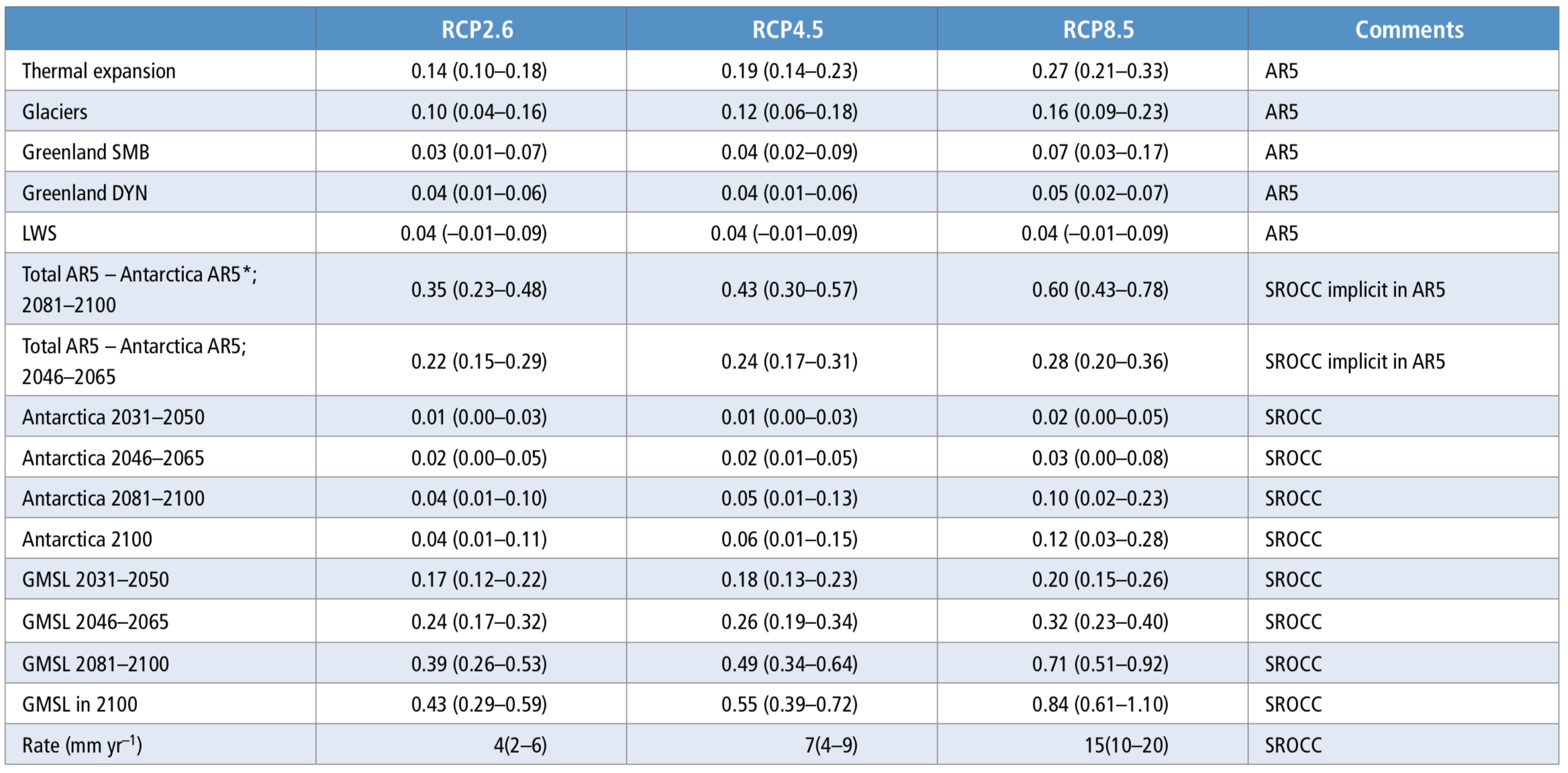
Don't take my word on it, though. There's a number of discussions out there already (like here and here) saying pretty much the same thing.
For me, the main thing is that they look at the recent research, both the early research by DeConto and the later stuff, which shows that some of the early concerns about marine ice cliff instability were not as bad as originally feared.
“What we found is that over long timescales, ice behaves like a viscous fluid, sort of like a pancake spreading out in a frying pan. So the ice spreads out and thins faster than it can fail and this can stabilize collapse. But if the ice can’t thin fast enough, that’s when you have the possibility of rapid glacier collapse.
There’s no doubt that sea levels are rising, and that it’s going to continue in the coming decades. But I think this study offers hope that we’re not approaching a complete collapse – that there are measures that can mitigate and stabilize things. And we still can change things by making decisions about things like energy emissions, methane and CO2.”
Does this mean that the land-based ice sheets of Antarctica and Greenland may not hold some SLR surprises in store for us? Of course they might. But without a magic crystal ball or a time machine to know with certainty what emissions pathways society will follow in the future, we have to go with what they physics of ice sheets informs us. This research does not rule out worse results this century than the SROCC delineates.
As scientists Joelle Gergis and Richard Alley told a group of us at a recent AGU meeting, the current models (CMIP3 and CMIP5) treat the land-based ice sheets of Greenland and Antarctica as "like rocks, but painted white". Meaning that they were not coupled or interactive with their surroundings in any climate-related way. The CMIP6 models, however, look to more fully couple those ice sheets with their surrounding ocean regimes.
Society will have an enormous difficulty in dealing with the first meter of SLR, due at some point this century. If it gets a second meter this century (perhaps not globally, but possibly in some regions), that will be catastrophic.
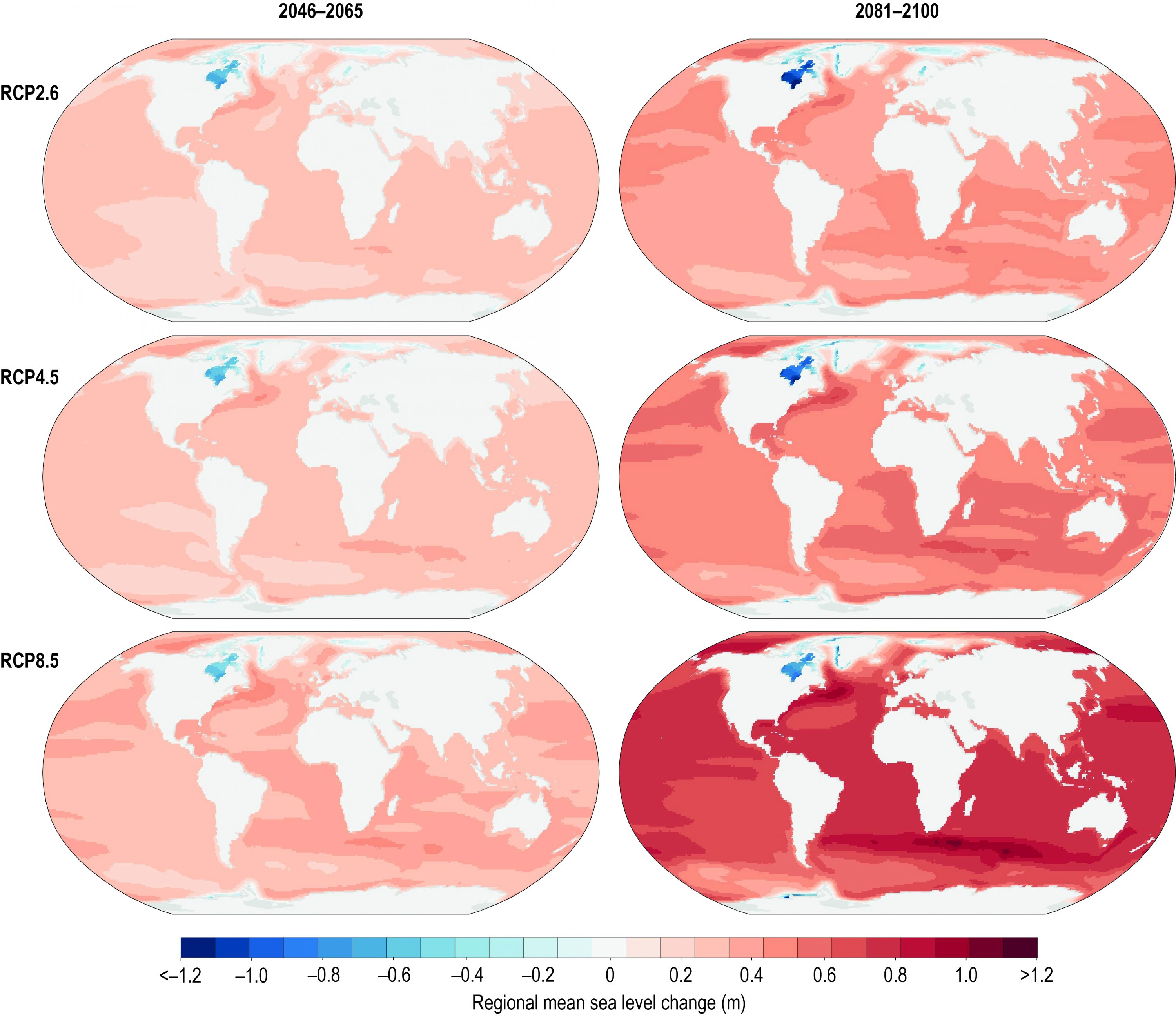
- Most important steps to build out a completely renewable energy system
michael sweet at 03:01 AM on 17 March, 2021David,
How to store excess energy from windy days to use on windless nights is the key issue of using renewables. I am surprised that you could not find where Jacobson et al and Williams et all address long term storage. Most of both papers is dedicated to addressing this issue.
In general, there are a lot of ways to address this issue. For example, current hydro power is used to supply primarily peak power in the middle of the day. If usage of the dams was altered, hydro power could provide a lot of the backup power needed on most nights instead (solar production is pretty constant. Windless nights are the harder problem.). Batteries can be used for storage of solar power for use at night or wind energy at night for use the next day. Long term storage (from summer to winter) is generally too expensive for batteries.
Storage of gasses and liquids is much cheaper than storage of electricity. Then the gasses (or liquids) can be used to generate electricity when it is needed. According to the EIA, currently existing underground storage of natural gas is about 6,000 billion cubic feet in the USA alone. source Usage (same source) is about 70 billion cubic feet on peak days. This is about 90 days of complete supply. Either electromethane or hydrogen can be stored in existing storage. On windy days in summer you make hydrogen (or electromethane) and store it. On windless winter nights you use the gas to generate electricity in currently existing gas turbines. Fuel cells using hydrogen are more energy efficient if they are developed in the next 10 years (this technology exists. The question is the cost of scale up to the entire country). This would easily supply the examples you give. Even if electrical usage was much greater there would still be enough storage.
Your wild claim that electromethane is not a viable option is completely unsupported. The three peer reviewed papers I cite show that storage is economically available to power 100% of the economy using current technology. If fuel cells are developed than hydrogen might be cheaper.
If you have trash to energy plants they can stockpile material to use to supply peak power. A lot of energy can be saved by customers who reduce use to get cheaper electricity. Many high users of electricity currently reduce use on peak usage days. My brother programs his electric car to charge only when there is excess power since the electricity is cheaper.
Williams et al and Jacobson et al describe their systems running for 4 years without problems supplying total energy to the economy.
In addition, scientists have found that the larger the grid the less incidence of windless nights occurs.
Germany will never generate 100% of all energy all the time, it is too small. They will be in a European grid that helps back them up. Norway has tremendous hydro that could imaginally back up all Europe.
You have to look at the big picture. Deniers in the past have used examples as small as a single wind turbine to argue against renewables. Scientists have shown that large grids (the bigger the better) generating All Energy for the economy are the cheapest way to go. Texas will have to connect to the grid.
- Most important steps to build out a completely renewable energy system
David-acct at 11:09 AM on 16 March, 2021
Michael - the above link shows the electric generation from wind dropped from the normal 45-70gw per hour down to 8gw - 20GW per hour across the entire US during the same period that ERCOT dropped wlectric generation from wind.( 2/8/2021 through 2/19/2021,) Germany which has one of the highest penetrations of wind generated electricy suffers from multiple days with low electric production from Wind. See the attached link which shows approx 7 days where germany's electric generation dropped from the 50-70gw per hour to less than 30gw per hour for 5-7+ days (my apologies, agora-energiewende site's charts are a little hard to read/adjust the dates)
The willaims study also includes the conversion of home heating to electric ( or at least new homes and replacement as furnaces wear out)
based on current techology and the anticipated technology, neither battery or electomethane appear to be viable options when there are 3-4+ days where electric generation drops like we experienced in the US for the 7-8+ days from February 8- feb 19th. Likewise the same issue in Germany for the 4+5 dys they experienced in Februay.
I could not find in the Williams study (or jacobson's prior studies) how they overcome those issues. If you can point to how they anticipate handling those Issues, I would appreciate the help
- Most important steps to build out a completely renewable energy system
michael sweet at 06:09 AM on 16 March, 2021David,
Williams et al 2021, the paper reviwed in the OP, primarily uses electromethane for use when there is little wind and solar. This could be stored in existing storage areas for natural gas and used in existing gas generators.
In addition, all the plans I have seen have a national or whole continent grid. Small grids like ERCOT are prone to failure when connection to a national grid would not fail. For example, during the recent shortage in Texas there might have been wind in the northern part of the country that could be delivered to Texas. The OP finds that renewable energy (primarily wind and solar) with storage is economically competitive with fossil fuels.
Recently I have seen some articles at CarbonBrief.org that suggest industry is leaning toward using hydrogen for storage. One key conclusion in the Williams et al 2021 is that we do not need to make that decision today. In any case we should build out wind and solar as rapidly as possible and switch everything over to electricity. Natural gas can provide adequate storage. In 10 years it will be clearer whether hydrogen or electromethane is a better choice for storage.
- Skeptical Science New Research for Week #9, 2021
SunBurst at 10:32 AM on 13 March, 2021MA Rodger @5
We would thus expect regional variations in the rate of AGW.
I agree in that we would not expect perfectly uniform warming, but when temperatures show a downward trend in some regions that is equally as strong as the upward trend in other regions, it definitely raises doubts about global warming. As I stated in my first posting, global warming means warming over the entire global, which certainly isn't happening. Also, many pro-AGW articles focus on the thawing permafrost in Alaska and the summer-like temperatures in London or Paris during the December-January months, but neglect the frozen-over Niagra Falls and ports on the Great Lakes, massive numbers of burst water mains in Chicago, shorter growing seasons in agricultural areas, and dozens of hypothermic deaths in cities throughout the midwestern and northeastern states. For people in these regions, global warming is not the problem and fossil fuels are necessary for making a living, or even just surviving. These people simply cannot afford governments imposing additional taxes (or "cap and trade") for their use of fossil fuels. Also, they can't afford governments shutting down pipelines or making "national monuments" of regions rich in methane.
Finally, with the failed prediction track records of Al Gore and other pro-AGW politicians, it cannot reasonably be expected that Americans would be more concerned about global warming than fixing the economy and getting back to work.
- Why renewable energy was not to blame for the Texas blackouts
michael sweet at 04:16 AM on 10 March, 2021Eric,
The amount of power from wind and solar is predicted 24 hours in advance. The remainder of power is supposed to be produced by thermal sources (fossil fuel and nuclear). Wind performed as expected. Solar outproduced forecasts. Thermal power collapsed. You want to keep all your bets on thermal?? In the future there will be storage that provides energy on windless nights like happened in Texas. Some proposed energy systems use electromethane as storage to power existng gas plants (Connelly el al 2016, Williams et al 2021). Keep in mind that an identical problem occured in Texas in 2011 (before wind and solar were installed) and the Texans decided not to do anything to prevent reoccurance. Are you blaming the 2011 failure on wind?
Poorly designed thermal power plants caused the failures in Texas. Blaming wind and solar for improperly designed thermal plants does not make sense.
- Increasing CO2 has little to no effect
devcarr at 02:07 AM on 12 February, 2021If we stopped emitting CO2, methane, and nitrous oxide tomorrow, how much would the average surface temperature rise before we reached equilibrium?
- Veganism is the best way to reduce carbon emissions
Guilhem_S at 07:13 AM on 1 February, 2021Hi all, I appreciate when people take time to debunk climate hoax, however I think this particular article is misleading, to say the least, and need major updates. It is both in the name of the truth in science, especially related to climate change, and the credibility of your page that I’m writing this very comprehensive exhaustive feedback on the many flaws I’ve identified.
We know that land use and food production are major actors in climate change. The argument for veganism from an environmental perspective is oftenly that animal agriculture is a big contributor to climate change and shifting toward a plant based diet is better for the environment. Most people would agree that Veganism isn't the single best solution to climate change, and that -for instance- collective suicide might probably be better, as well as a totalitarian regime imposing a zero carbon lifestyle. From an individual perspective, a non vegan eating a single slice of pork ham a year but living car and plane free is probably doing better for the environment than a vegan doing a Bali - New-York plane round trip every year. With these arguments in mind, “veganism isn’t the best way to reduce carbon footprint” is a no brainer. That being said, it is true that some animal right activists overestimate the impact that veganism can have so I understand why you wish to clarify to them that it is not as black and white as they wish it to be. However globally the impact of animal agriculture is hugely underestimated (see for instance https://www.nature.com/articles/s41558-018-0354-z) and by trying to debunk a very marginal argument (‘veganism is the single best way to reduce carbon footprint’), you end up downplaying the power that one have by shifting to a plant-based or even vegan diet. This kind of attitude might actually increase the total carbon footprint, or at least minimize the carbon mitigation of people’s action by discarding a sector on which people can have a huge impact which is widely unknown from the general public.
First, the livestock sector accounts for 65% of the food sector GHGE while only providing 18% of the world's calories. And while most of the food fed to animal is non-edible (in dry weight), meat production is still globally inefficient (it takes about 3kg of edible dry plant to produce 1kg of meat https://www.sciencedirect.com/science/article/abs/pii/S2211912416300013). Because the livestock sector is about 15% of all anthropogenic emissions as calculated from many LCA, notably by the FAO (http://www.fao.org/gleam/results/en/), it is a huge source of potential mitigations.
To get a first idea of what are the order of magnitude we’re talking about, governmental official French figures are as follows : An average omnivorous diet emits 2,8 tons of equivalent CO2 per year, about half of which is coming from animal products (meat, dairy and eggs). A diet with ruminant at every meal emits 6 tons of CO2 per year. A vegan diet can emit as low as 0.6 tons and is the least carbon intensive diet. To achieve Paris agreement on climate change we need an individual carbon footprint of 2 tons or less of CO2 per person per year, which is impossible to achieve on a cheese or meat-based diet. [1]. A vegan meal is, on average 0.8kg of CO2 [2], a egg-based meal is on average 2kg of CO2 [3], a cheese/pork/chicken based-meal is 5.4kg of CO2 [4] and a ruminant based meal is 25.2kg of CO2 [5]. According to the french national agency for climate transition, a vegan meal emits 2.5 to 31.5 times less CO2eq than any other meal and there is no reason that this figure should be much different in other countries. If anything, French carbon impact of animal products -especially ruminant- should be lower than in other countries such as Brazil. These kinds of figures appear nowhere in your article while they could provide useful insight to readers as to what are the best food sources to fight climate change.
[1] https://nosgestesclimat.fr/simulateur/bilan
[2] https://nosgestesclimat.fr/documentation/alimentation/plats/v%C3%A9g%C3%A9talien
[3] https://nosgestesclimat.fr/documentation/alimentation/plats/v%C3%A9g%C3%A9tarien
[4] https://nosgestesclimat.fr/documentation/alimentation/plats/viande-1
[5] https://nosgestesclimat.fr/documentation/alimentation/plats/viande-2
“Although veganism does have the potential to reduce GHG emissions associated with diet, it is important to consider other sectors that are also part of the problem.” → One might ask why we should consider other sectors when it is this one we are debating. This kind of “whataboutism” argument can be used to discard every policy on reducing carbon footprint.
Insisting on what people perceive (to be feasible, to be environmentally friendly, etc.) instead of what is factually positive for the environment is misleading. If you claim to answer the complex question of limiting the worst for the climate you cannot rely on people’s opinion. I know just as much as you that major societal and individual change are required to achieve climate goals and prevent the worst scenario. Claiming that veganism isn’t good because some people really want to eat meat as a main argument is unbelievable on a website such as yours and by trying to debunk such a minor myth in our society (PETA's claim), you perpetuate more dangerous myths (such that grass fed ruminants are carbon friendly). Because the myth that does currently more damage is that local, organic, grass fed animal are better for the environment you should reverse the debunking and show that actually, intensive exported plant food are way more carbon friendly (and that “organic” isn’t really doing much, except increasing the demand for land by decreasing the productivity)
When you’re pointing at non-vegan related issues such as food waste to dismiss the major changes that could be brought, you’re obscuring the debate further. When we talk about change, we have to think about counterfactual scenarios: the question is not ‘is veganism with a lot of fruit imported by plane wasted good?’ but ‘is veganism good, all things else being equal ?’. Otherwise it might sound like a strawman.
On the Kim et al. (2019) paper, I don’t know how you manage to distort the results that much in the process of trying to make veganism look bad. The paper is clear: the vegan diet is the less carbon intensive in all country studied (97% to be correct), only the low-food-chain diet is slightly above, but not statistically significantly different, from vegan diet*. The argument you make about vegetarianism has not his place here if you want to discuss Veganism. What the paper is saying is that it’s better to be ⅔ vegan than 100% vegetarian because dairy products have a massive impact so it doesn’t compensate for the ⅓ of omnivorism remaining. Therefore, your conclusion “there are arguments that a flexitarian diet with moderate amounts of meat is better than a vegetarian diet that cuts out meat completely, showing that stopping meat intake completely does not necessarily reduce dietary GHG emissions and cannot be assumed to do so in a vegan diet.” is a fallacious non-sequitur : vegan diet is better than both flexitarian and vegetarian diet (as shown by the very study you’re citing) because it eliminate both meat AND dairy which both are very carbon intensive. I can’t believe you haven’t seen that and I really wish I was able to assume you’ve made an honest mistake but I barely can. Such mistakes, always in the disadvantage of veganism, and repeated, seriously undermine the ideological neutrality of the author on these questions.
(*Please note that the low food chain diet is a diet where 90% of animal proteins are replaced with pulses, so we could say it’s a 90% vegan diet. That’s why it’s not statistically significantly different from vegan diet).
The vegan diet doesn’t lead to a higher consumption of fruit: because vegan doesn’t eat meat, cheese and eggs which are the main source of protein, fat and calories, we should expect vegan to eat protein and fat sources instead such as legumes, beans and nuts or oil. Increasing fruit consumption is within the nutritional guidelines of every country which have one. For these reasons, the whole paragraph appears as a non-sequitur. At best, the argument is very weak and it is on you to show that the eventual additional portion of fruit due to veganism (and not due to healthier lifestyle as vegans also usually have healthier lifestyle, but uniquely due to veganism, which its very existence is one of your unproven assumption) will increase carbon emission so much that it will cancel out the 8Gigaton of CO2 mitigation from quitting animal agriculture. I think because of the assumption it relies on, both the waste and plane-transported food fruits are not a valid argument
Speaking about the food waste, which is another issue a priori unrelated to and independent from veganism, there’s a paper titled “The opportunity cost of animal based diets exceeds all food losses” [https://www.pnas.org/content/115/15/3804]. The title is pretty straightforward: in the US, after adjusting for various nutrient density, the adoption of a vegan diet could feed 300 millions more people while the total elimination of all waste along the whole food production line (which is impossible) could only feed 100 millions more people. Once again, just like the “Vegetarian vs. vegan” paragraph, I don’t understand how you can try to use an unrelated issue to make veganism look bad but still fail.
As a reminder, the biggest meta-study on food impact shows that only 0.16% of the food on the planet is transported by plane [https://ourworldindata.org/food-transport-by-mode]. It is questionable to mention it only here, when talking about veganism. The main impact of the vast majority of food is on-farm emission, as shown by the same meta-study on 38000 farm in 119 countries [https://ourworldindata.org/food-choice-vs-eating-local] eating 100% local would only reduce emission by 5-10% whereas eating vegan can divide by several time the carbon footprint of diet.
The argument of carbon sequestration by grazing livestock, a favorite of the industry, have been proven wrong for a long time, as the methane and nitrous oxide emission from ruminant far exceed the best sequestration possible. See for instance this review of the literature (and note the discrepancy between figure from the academic domain and claim from outsider unpublished in journal such as Savory) [https://tabledebates.org/sites/default/files/2020-10/fcrn_gnc_report.pdf]. Also, wild ruminants could do the same job and it would be vegan, as grazing pasture doesn’t require either killing nor exploiting them. Many wild ruminants still exist, preceded humanity and very likely will still exist if humanity disappears.
You might want to update the carbon impact of a vegan diet because Scarborough and Berners-Lee are not really in agreement with current research. Current research from Poore and Nemecek [https://science.sciencemag.org/content/360/6392/987], of the BMJ paper by Springmann [https://www.bmj.com/content/370/bmj.m2322] show that a vegan diet emits several times less (>50% less) CO2 than conventional diet. The official French figure show that a vegan diet can emit 4 times less CO2 than the current diet. You might as well check out the IPCC report on land use showing that a vegan diet could prevent the emission of 8 Gigaton of equivalent CO2 per year, showing a massive reduction (roughly 20% of all current anthropogenic emission https://www.ipcc.ch/srccl/chapter/chapter-5/). A recent Science paper also showed that shifting toward a plant-based diet (EAT Lancet which is about 70% less white meat and 95% less red meat than current French diet) and other food change are mandatory to reach climate agreement [https://science.sciencemag.org/content/370/6517/705]. The Kim paper of 2019 you’ve cited above shows a global reduction of 70% GHGE (why did you choose to not mention it ?). In the light of these various paper, it seems strange that you choose to show only to moderate-impact paper.
The latest Lancet Countdown report shows that animal agriculture emits about 55% of the carbon footprint of food production (including the feed) while providing only 18% of the world's calories. What is really shocking to me is that 95% of the animal farming carbon footprint comes from ruminants which represent a tiny minority of the number of animals killed and meat consumed. How can you suggest that eating lamb or beef is sustainable in any way ? For an outsider it looks like you’ve internalized the rhetorics of the industry and are really detached from the reality of the current research. [https://www.thelancet.com/journals/lancet/article/PIIS0140-6736(20)32290-X/fulltext]
The occurrence of cowspiracy appears as you have something against this movie and seems to alter your neutrality. There are ways to criticize some element of cowspiracy (such as the Goodland paper and the 51% figure) without making such a poor quality argument against veganism as a whole.
I would like to add few points that you have eluded about the impact a vegan diet can have: it can do much more to the planet than just ‘reducing GHG emissions associated with diet’. It can, for instance, lower potential health crises by reducing zoonotic emergence risk (70% of new diseases are zoonotic https://royalsocietypublishing.org/doi/10.1098/rstb.2001.0888). Land which are not used could be left to the wild, and with the natural reforestation of pasture we could sequester up to 700 Gigatons of CO2, making the climate goal of +1.5°C by 2100 feasible at 66% as shown by this Nature Sustainability article of 2020 [https://www.nature.com/articles/s41893-020-00603-4]. In countries where the meat consumption is high, it could drastically reduce the disease burden and total mortality, according to this BMJ paper, it could reduce total mortality of several tenth of % [https://www.bmj.com/content/370/bmj.m2322]. Note that this article also explored the carbon impact and showed a vegan diet emit globally 80% less CO2 than what we are currently doing (and is of course the least carbon intensive of all diet studied)
I hope I have achieved to make you realise how this page may sound to an outsider who knows the figure, and I have provided you with many up-to-date research sources.
Please make an impartial page to properly inform about the climate impact of food and the huge potential of plant based, vegetarian but especially vegan diet to mitigate climate crisis. As you’re part of the Pro-Truth Pledge i’m sure you will take this matter seriously. I would be more than happy to help to write something about it if you want, or to answer any of your questions.
Thank you for your considerations,
Guilhem - How much does animal agriculture and eating meat contribute to global warming?
RedBaron at 07:39 AM on 15 November, 2020Worse yet, both actually omit the methane cycle, ie Methanotroph activity, but counting only emissions there too.
You could draw an almost identical graph as the one showing the CO2 cycle including both plants and animals, and simply adjust this by substituting CH4 for CO2 and Methanotrophs for plants. (the numbers vary, but the cycle is very similar)
Any analysis of methane emissions that omits methanotrophs is just as misleading as any analysis of CO2 emissions that omits plants.
Couting natural emissions only give misleading
- How much does animal agriculture and eating meat contribute to global warming?
Alan Russell at 23:59 PM on 14 November, 2020I'm glad to see this article but I think you should reconsider your reference to Poore & Nemecek in the link posted above (LINK).
I applaud Poore and Nemecek for their efforts to collate and present this information but I believe that any study that uses 100 year emission factors for methane and does not account for the carbon sequestration potential of grazing land (using the best available current evidence) should not be cited without review and correction. Note that accounting for methane GWP correctly, and modelling livestock grazing using best practice (the Savory Institute and Regeneration International have good information on this) wouldn't just change the picture slightly, they would be likely to change the representation of livestock farming into a carbon sink. From review of Poore and Nemecek's Science article that the data has been taken from, you can see in the Erratum that they originally had underestimated the carbon sink potential for land not used for food, but neither in the report, nor the Erratum have they noted the carbon sink potential for grazing land. This is probably mostly because the study is a meta-analysis and understanding of soil microbiology has advanced in recent years so findings based on meta-analyses of outdated information are unlikely to reflect the best of evidence.
On the representation of methane GWP, methane has a half-life in the atmosphere of about 10 years, so if cattle herd sizes remain the same over the lifetime of methane in the atmosphere they will maintain the same amount of additional methane in the atmosphere year on year. In terms of their contribution to warming, this, in a very simplistic sense, is equivalent to a closed power station (LINK, LINK). Note that the number of cattle in Europe and North America is actually lower than it was in the 1960's whilst India has fewer cattle than it did in the 1980s, LINK, so their associated methane emissions have actually dropped. I put the misrepresentation of methane GWP down to laziness - it's much easier to apply a single figure per head of cattle than to look at how herd size has changed over time.
- What does the global shift in diets mean for climate change?
nigelj at 08:30 AM on 22 October, 2020Wayne @24, I have no dispute with the studies you quote. And yes several things contribute to methane emissions including cattle and other animals, and rice paddies and leaking gas pipelines. The point is reducing red meat consumption is one of the easiest ways to reduce emissions.
Reducing areas in rice cultivation doesnt really make sense and just isnt going to happen. Billions of people are reliant on rice for basic nutrition. Red meat is a much easier target as its not essential in the diet and its such an inefficient use of resources. I think thats pretty much the essence of the issue.
- What does the global shift in diets mean for climate change?
wayne19608 at 10:57 AM on 21 October, 2020Hi Rob @23 that's why I said it was a start :) and was just adressing the impact of rice cultivation. Do we not think that 22% and 11% methane contributions compare unfavourably with those of cattle?
Organisms vary in their efficiency of feed conversion. Ruminants or foregut fermentation is one of the greatest developments in evolution since it's arrival some 50 million years ago. The benefit and efficiency of this system can be seen in their almost complete dominance of the herbivorous meso/megafauna. Virtually all non-ruminants or complete hindgut fermenters have since that time faced extinction. Out of some 450 ungulates today only about 25 non ruminants survive.
See (Demment MW, Van Soest PJ (1985) A nutritional explanation for body-size patterns of ruminant and nonruminant herbivores. Am Nat 125: 641–672) for an explanation on the distribution and relative efficiencies of these different fermentation systems. Notice that non-ruminants are fermenters as well, just that one of the fermentation products ie., methane comes out the back instead of the front.
This does not just apply to different digestive/fermentation systems but the inputs and outputs themselves.
Feeding high nutrient/digestable feed to ruminants may result in lower enteric methane outputs (Boadi, D. A., Wittenberg, K. M., Scott, S. L., Burton, D., Buckley, K., Small, J. A. and Ominski, K. H. 2004. Effect of low and high forage diet on enteric and manure pack greenhouse gas emissions from a feedlot. Can. J. Anim. Sci. 84: 445–453.), but see their qualification and comparison to IPCC estimates
A concern when evaluating animal feeding and management strategies to determine greenhouse gas mitigation potential is that significant emission reduction in one part of the production system may be negated if emissions are increased in another part of the production system. Table 6 demonstrates that inclusion of whole sunflower seed in general resulted in significantly lower (P < 0.05) total daily emissions of CH4 and NO2 expressed as CO2 equivalents. The observed reduction in total emissions is attributed to a significant reduction in enteric CH4, which contributed 95 to 96% of the total non-CO2 emissions from the feedlot. Enteric emissions by feedlot cattle fed a typical barley-based finishing ration were 72% of that estimated by IPCC (Tier 1). Use of whole sunflower seeds in the high forage:grain diet resulted in even lower emissions relative to estimates. Similarly, manure pack emissions in the current study were approximately 50% of that estimated using IPCC (Tier 1) coefficients.
Indeed over 7.5 times more CH4 kg–1 dung (DM basis) was emitted from grain-fed compared to their hay-fed counterparts.
Jarvis, S. C., Lovell, R. D. and Panayides, R. 1995. Patterns of methane emissions from excreta of grazing animals. Soil Biol. Biochem. 27: 1581–1588
Thus the "thermodynamically impossible" comment, but it goes much further than that.
People do realise that sheep and goats are just small ruminants and cattle are just large ruminants. You can even have cattle and sheep that approach each other very closely on a size basis. On the basis of size alone one of the biggest thermodynamic constraints will be the surface area to volume ratio, smaller organism will be energetically less efficient than larger ones, "having to run all day just to stay in one place". This is literally highschool physics and biology.
Monogut organisms like ourselves and for simplicity sake chickens and pigs cannot handle the feed inputs that hindgut and forgut fermenters can, generally requiring higher quality feed from both a nutrient and digestive quality standpoint. But those feed inputs didn't arrive out of the blue, they required huge (relative) inputs and resulting outputs. By focussing on enteric emissions we are missing the forest for the trees.
I can deal with monogut efficiency and energy inputs/outputs of cash crops later as I am running out of time, but these conversations always remind me of how little people understand about their food whether it be wheat, corn, chicken or cows
- What does the global shift in diets mean for climate change?
wayne19608 at 09:00 AM on 21 October, 2020ok moderator let's start with rice cultivation, which literally doesn't pass the smell test. Rice cultivation is responsible for 22% of global agricultural methane emissions and 11% of total anthropogenic methane emissions.
Smith P, Martino D, Cai Z, Gwary D, Janzen H, Kumar P, McCarl B, Ogle S, O’Mara F, Rice C, Scholes B, Sirotenko O. Agriculture. In: Solomon S, Qin D, Manning M, Chen Z, Marquis M, Averyt KB, Tignor M, Miller HL, editors. Climate Change 2007: The Physical Science Basis. Contribution of Working Group I to the Fourth Assessment Report of the Intergovernmental Panel on Climate Change. Cambridge: Cambridge University Press; 2007. pp. 498–540.
United States Environmental Protection Agency. Global Anthropogenic Non-CO2 Greenhouse Gas Emissions: 1990–2020 [Internet]. 2006. Available from: http://nepis.epa.gov/ Adobe/PDF/2000ZL5G.PDF
Then there's the N2O
https://www.pnas.org/content/115/39/9720
- What does the global shift in diets mean for climate change?
wayne19608 at 09:29 AM on 19 October, 2020one planet @ 15 much of what you said may be true, but is irrelevant if people are going to continue to promote these energy/methane/CO2eq numbers that are beyond questionable. But I guess it makes people feel better when they are eating their "organic" baby carrots and rice, and that's all that matters right!?!
- What does the global shift in diets mean for climate change?
John Hartz at 03:39 AM on 18 October, 2020I concur with Philippe Chantreau @12's statement:
I see numerous valid points from all contributors so far, suggesting that this is a complex problem and indeed it is.
The complexity of the agriculture's contribution to manmade climate change extends beyond CO2 and methane emissions. For example. it includes the use of nitrogen fertilizer as addressed in:
Nitrogen fertiliser use could ‘threaten global climate goals’ by Daisy Dunne, Science, Carbon Brief, Oct 7, 2020
- What does the global shift in diets mean for climate change?
wayne19608 at 08:36 AM on 17 October, 2020I find it hard to agree with the premise on a lot of this. Cattle don't need grain fed to them, only forage and maybe hay if you have a dry season or winter. Thus you only need to cut and bale the forage, and that's it no more inputs required. The cattle can even cut and bale the forage themselves if you're so inclined. It is a little harder to manage sheep(and to a lesser extent goats). But raising chickens and pigs without grain inputs is a huge amount of work. Grain cropping requires huge energy investment even with no-till. Rumination is one of the greatest evolutionary advancements, so maybe don't just pick on cattle as there a lot of ruminants walking the earth. The non ruminant/livestock methane production just comes out after digestion as their feces breaks down. And for anyone like myself who has stood in a rice paddy in Thailand, let me tell you it reeked, so I question the methane numbers there as well
- What does the global shift in diets mean for climate change?
nigelj at 08:32 AM on 16 October, 2020RedBaron @8
Thank's for the technical information. There's some good stuff there, but I have a few criticisms about a couple of things.
Firstly I did indeed not say cattle are 'the' problem as BL points out. Clearly many things contribute to the increase in atmospheric methane in recent decades, not only cattle. Many studies have confirmed that.
"If cattle numbers are dropping and methane levels are rising, it is a probable falsification of the hypothesis that cattle emissions were the problem."
Cattle numbers are not dropping overall globally which is obviously what matters. Both the links provided by Alan Russel and myself showed that.
"Cattle properly raised on grasslands restore degraded land, they do not "use" those limited resources, they are part of a system that generates those limited resources...."
Strawman. The statement I posted was cattle use a lot of land compared to crop farming. This is a simple fact. Nothing you have said changes that. It's something we have to consider. You appear to be looking at it from quite a narrow perspective.
But I don't disagree about the positive relationship you describe between cattle and resources. I did say I think grazing cattles on open grasslands has value. I agree cattle farming properly done can improve the land and sequester carbon, to an extent. Theres some good evidence. The trouble is so many things operate in the opposite direction. Warming causes soils to release carbon over time and also nitrogen oxides so dont get carried away with what can be achieved.
On balance I go along with lower red meat consumption for climate and other reasons. Obviously fewer cattle equals less of a methane problem. And properly managed environmentally sustainable grasslands farming requires low cattle density so probably lower numbers than currently, assuming the same area of land is used for cattle grazing. Its certainly unlikely to increase in area. This is consistent with a lower red meat diet.
That said, it seems to me that its really unlikely the entire world would go vegetarian, and some grasslands aren't very suitable for cropping or forestry, so we should clearly graze them in the most environmentally sustainable way possible as per your general prescription.
- What does the global shift in diets mean for climate change?
RedBaron at 21:20 PM on 15 October, 2020@6 7 Nigel,
That's not the only nonsensical thing you said Nigel.
"Firstly this is a tacit admission that cattles methane emissions are a problem, and less cattle equals less of a problem."
That statement is pretty wrong too. If cattle numbers are dropping and methane levels are rising, it is a probable falsification of the hypothesis that cattle emissions were the problem. There are plenty of other sources of methane that actually are the problem, natural gas leaks are the most likely culprit. However, grain production is way up there on the list because in the overwhelming majority of cases it destroys the ecosystem function of grasslands, which are a net sink for methane. Haber process nitrogen made from natural gas, commonly used to raise grains, is also rising. Cattle raised properly on grasslands can restore ecosystem services, and do not need haber process nitrogen to do it.
You also said,
"Since food, water and land are scarce in many parts of the world, this represents an inefficient use of resources."
Also wrong. Cattle properly raised on grasslands restore degraded land, they do not "use" those limited resources, they are part of a system that generates those limited resources. We all know they generate food. But commonly misunderstood is they generate water too.
Effect of grazing on soil-water content in semiarid rangelands of southeast Idaho
Notice that the best result for soil moisture is properly grazed land? Even better than no grazing at all? What do you suppose would happen if we plowed that land to grow grain? In case you didn't know, Google "dust bowl images" for a graphic explanation.
The proper use of animals, especially ruminants, generates new fertile land, food for human use, and water cycles. It does not use them up, it generates more of each.
Feedlots are a different matter. This is why I have asked multiple times on this forum that people use their words carefully. It's not the animals that is the problem, it's the way we raise or food that matter. Actually animals are a great help in this regard.
“As the small trickle of results grows into an avalanche — as is now happening overseas — it will soon be realized that the animal is our farming partner and no practice and no knowledge which ignores this fact will contribute anything to human welfare or indeed will have any chance either of usefulness or of survival.” Sir Albert Howard
- What does the global shift in diets mean for climate change?
nigelj at 10:23 AM on 15 October, 2020Alan Russel @5
Regarding your comments:
"Note that the amount of cattle in Europe and North America is actually lower than it was in the 1960's whilst India has fewer cattle than it did in the 1980s, (http://www.fao.org/faostat/en/#data/QA/visualize), so their associated methane emissions have actually dropped. This is a classic bit of information that is often unknown/ignored by those pushing the line "the importance of keeping animal products – particularly red meat, such as beef, and dairy – to a minimum". Even professional scientists like Mike Berners-Lee do this."
Firstly this is a tacit admission that cattles methane emissions are a problem, and less cattle equals less of a problem.
Secondly, although the numbers of cattle have decreased in some places, the production of cattle overall globally have increased in recent decades according to your charts. The charts below also show numbers of cattle globally increasing from 1890 - 2014. If you click on things you can get the exact numbers each year.
https://ourworldindata.org/meat-production
"From what I have seen, if you're trying to eat to maximise the sustainability of society, you'd probably be best to try and focus on nutrient density, meaning that most people would probably eat more eggs, fibrous veg, fish, and meat, and less flours, cereals, added fats and oils (mostly the unsaturated ones)....."sugars, and grains, which are much lower in nutrient density and satiety than meat, and are significant contributors to the obesity and diabetes problems we face, and are also responsible for most of the agricultural monocultures and (fossil fuel dependent) fertiliser and pesticide use. Maximising nutrient density and satiety means that you need to eat less (LINK, Marty Kendall also has a lot of good information on his Optimising Nutrition site), so reducing your impact and you'd probably waste less food (http://www.fao.org/save-food/resources/keyfindings/en/). "
I disagree. The core problem is expressed in this commentary:
Conversation LINK
"Meat production is highly inefficient – this is particularly true when it comes to red meat. To produce one kilogram of beef requires 25 kilograms of grain – to feed the animal ( and clearly huge areas of grass) – and roughly 15,000 litres of water. Pork is a little less intensive and chicken less still....The scale of the problem can also be seen in land use: around 30% of the earth’s land surface is currently used for livestock farming. Since food, water and land are scarce in many parts of the world, this represents an inefficient use of resources."
This just isnt sustainable with a growing population and multiple demands on uses for land. If we lived mostly on grains, fruits and vegetables we would need far less land. It should be very obvious we could get all the calories we need from much less volume of grain and vegetables etcetera than volume of meat.
The lower nutrient density of grains and vegetables doesn't matter because they require less land to farm despite us needing to eat a larger volume, and we can largely get what we need from eating them.
Diabetes is not caused by eating grains or fruits. Its caused by eating too many grains and fruits to the point it causes obesity. Vegans as a group do not appear to have diabetes problems.
Your comment neglects to mention the vast numbers of cattle fed on grains that require fertilisers.
And we dont absolutely need artificial fertilisers to grow grains for our own direct consumption, although productivity would fall.
That said, red meat is a good source of iron and protein and cattle fed just on grass doesn't require fertilisers and is quite a sustainable option in that specific sense, so there is probably a place for some level of open grasslands cattle farming. I think its actually intensive dairy farming that is the least sustainable option because its so inefficient by requiring so many grains and so much piped water and it also typically pollutes local water ways quite badly.
I think the best solution is just to reduce red meat consumption to about one half or one quarter of what developed countries typically consume. There are many reasons and its the combination that are compelling. consumption of red meat has already declined in the UK.
"The other really good thing you could do is support regenerative systems of food production ..."
Regenerative farming in general terms mostly make sense, and is supported by good evidence.
- What does the global shift in diets mean for climate change?
Alan Russell at 07:49 AM on 15 October, 2020As Anne Mottet (Livestock Development Officer at the FAO) has said: "people are continually exposed to incorrect information about livestock and the environment that is repeated without being challenged", however it is disappointing to see Skeptical Science contributing to this.
To a degree, this is fairly understandable as if you're looking at reports on the environmental impact of foods, it can be hard to find good, objective information, as even reports from professional scientists sometimes seem to verge closer to advocacy than science, but here are some things to look out for:
- Does it use 100 year carbon dioxide equivalent emissions factors to account for short-lived atmospheric emissions? If so, this is a red flag and you should probably stop paying attention to the author(s) other than being wary of further misinformation from them, see LINK1, and LINK2. Methane has a half-life in the atmosphere of about 10 years, so if cattle herd sizes remain the same over the lifetime of methane in the atmosphere they will maintain the same amount of additional methane in the atmosphere year on year. In simplistic terms, their contribution to warming is equivalent to a closed power station. Note that the amount of cattle in Europe and North America is actually lower than it was in the 1960's whilst India has fewer cattle than it did in the 1980s, (http://www.fao.org/faostat/en/#data/QA/visualize), so their associated methane emissions have actually dropped. This is a classic bit of information that is often unknown/ignored by those pushing the line "the importance of keeping animal products – particularly red meat, such as beef, and dairy – to a minimum". Even professional scientists like Mike Berners-Lee do this.
- Does it count rainfall as a water consumption i.e. does it distinguish between green water and blue water? For animals grazing on grass, the blue water consumption is pretty much zero: LINK3.
- Are the soil benefits of grazing accounted for? "Soil C sequestration from well-managed grazing may help to mitigate climate change" (https://www.sciencedirect.com/science/article/pii/S0308521X17310338) along with the provision of organic fertiliser, which reduces dependence on and impacts of fertiliser production and use.
- Does it compare indirect emissions with direct emissions in a flawed comparison? This error was committed in the 'Livestock's Long Shadow' report and despite a lot of effort to correct it, the damage it caused still persists (LINK4).
- Do reports which link beef to land clearing accurately represent the process that they are reporting on? Often they misrepresent a more complex process in which livestock farming plays a part by associating all of the impacts with livestock (LINK5).
- Do the reports accurately represent what livestock eat, the vast majority of which is stuff that we can't eat? See LINK6.
From what I have seen, if you're trying to eat to maximise the sustainability of society, you'd probably be best to try and focus on nutrient density, meaning that most people would probably eat more eggs, fibrous veg, fish, and meat, and less flours, cereals, added fats and oils (mostly the unsaturated ones), sugars, and grains, which are much lower in nutrient density and satiety than meat, and are significant contributors to the obesity and diabetes problems we face, and are also responsible for most of the agricultural monocultures and (fossil fuel dependent) fertiliser and pesticide use. Maximising nutrient density and satiety means that you need to eat less (LINK7, Marty Kendall also has a lot of good information on his Optimising Nutrition site), so reducing your impact and you'd probably waste less food (http://www.fao.org/save-food/resources/keyfindings/en/). The other really good thing you could do is support regenerative systems of food production - focussing on best practice and the appropriateness of where crops are grown can make a huge difference. From the 2017 FAO study that I've linked above, it was calculated that a 21% increase in world meat production could require 95m hectares more land (an increase of 4%). This is an increase in land demand however note that it is based on the following conservative assumptions:
- up to 15% improvement in feed conversion ratio, which compares to, for example, the halving of feed conversion ratios over the last thirty years for poultry and pigs in Brazil, Thailand, and Europe;
- constant yields on grasslands, i.e. no improvements from regenerative agriculture (https://www.rootsofnature.co.uk/regenerative-agriculture-subsidy/).
If you're trying to maximise your chances of food security, then reducing livestock farming, which contributes to food security by producing some of the most nutrient dense food we can eat from stuff we can't eat, on land where nothing else could be produced seems a bad idea.
If you're trying to find the best thing to do to maximise the sustainability of society, and you're in the richest 10% in the world, you should probably try to cut back on burning stuff. There are some excellent resources on Gapminder on this. If you haven't seen it already, this is a good place to start: LINK8. Most of the environmental communications against meat seem to me to be misdirection, either consciously or subconsciously. This seems to be for one of two reasons. It seems to be used as a means to look as if effective action is taking place whilst avoiding discussion and implementation of more effective actions e.g. what's an easier sell - you don't need to change your consumptive lifestyle and can have food that looks, tastes, and feels pretty similar to what you eat now but is "plant-based" (whatever the marketers choose that to mean) and therefore doesn't have the impacts of animal products, which may be fine if you don't look too closely at the nutrient density or impacts of whatever is in what you are eating, and the benefits of animal products, or you have to consume less (don't buy/build that thing, don't go that trip, switch that off)? It can also be the case that those propagating the information are so blinded by their anti-animal agriculture ideology, and so disconnected from nature, that they are unable to objectively reason. This is bad enough in itself, but when this is present amongst scientists, it borders on an abuse of their position - people are depending on them for rigorous, objective analysis, and if they are unable to do this, then they are unable to do their job pretending that they are causes more harm than good.
From all that I have seen and read over the last few years, a nutrient dense omnivorous diet produced using regenerative agriculture is the most sustainable for us as a species. I am just an enthusiastic amateur however, so if you have better information, I'd be interested in seeing it, though all of the publications I have seen that promoted reductions in animal product consumption have been based on the kinds of misinformation I've highlighted above.
Apologies for the long post but I've seen this kind of misinformation a lot and I think it's important that information like this is represented as accurately as possible as I think that people generally want to aid the sustainability of society, but are too busy to spend much time researching, so misinformation is believed if it is repeated often enough or people trust the source. Decisions based on bad information are dangerous as the consequences are often worse than the problem you tried to solve.
- Interactive: What is the climate impact of eating meat and dairy?
CD at 08:27 AM on 4 October, 2020@10 nigelj
You are correct. That is exactly what I am arguing. But I am also arguing that the actual percentage change in the carbon sinks due to "the big explosion in numbers of cattle and humans since 1900" is still relatively small when compared to the impact of fossil fuels.
I am also arguing that the two contributions are fundamentally different. If future carbon emissions from cattle and humans were to remain constant over time, then there will be no change in the carbon sinks. That means no future increase in atmospheric CO2 or methane levels. However, if fossil fuel emissions remain constant at current levels, then there will still be a continual increase in atmospheric CO2 levels over time.
That is why I say you cannot equate the two.
- Interactive: What is the climate impact of eating meat and dairy?
nigelj at 06:37 AM on 4 October, 2020I think slarty is saying that normally breathing and cattle releasing methane are carbon neutral, but the big explosion in numbers of cattle and humans since 1900 has thrown things out of equilibrium, with the ultimate result of high plant and meat consumption leading to degraded carbon sinks leading to more CO2 released from those sinks into the atmosphere. This looks correct to me. Where is the flaw in his reasoning?
- Interactive: What is the climate impact of eating meat and dairy?
CD at 09:50 AM on 3 October, 2020About 10 years ago SkepticalScience posted an article entitled “Does breathing [by humans] contribute to CO2 buildup in the atmosphere?”
(see here ) Their answer to the question was "no". Their reasoning was based on the carbon cycle: what goes in must come out. So nothing can change, except that it does.
Now we have another article on the same site that effectively argues the opposite: that breathing from farm animals contributes to global warming. The problem is that both these articles are wrong, at least in part, because they both fail to distinguish between the steady state and systems that are evolving over time.
As I pointed out in comment @152 in response to the first article, and also on my own blog (see Post 36), the carbon cycle only applies to the steady state. By definition climate change implies evolution over time. If the number of cows increases then they will change the distribution of carbon between the different reservoirs (air, plants, soil) until a new equilibrium distribution of carbon is achieved. In effect they divert carbon directly into the atmosphere that would otherwise have first entered the soil and then decomposed. I have estimated that the increase in atmospheric CO2 since 1900 due to the increase in human and livestock populations over the same time period to be (much) less than 30 ppm. That increase in CO2 is not going to end life on Earth. In fact it is less than the current increases we are seeing from fossil fuels every 15 years. Vegan lifestyles are not going to save the planet.
So when examining climate change it is the change in the number of animals and humans that is is crucial, not their actual number. And, since 1900, livestock numbers have increased dramatically, while over the same time period the human population has nearly quadrupled. That is the elephant in the room that no-one will discuss, and no amount of vegan virtue signalling will compensate for that.
The problem with this article, and others like it, is that it seeks to equate emissions from cows with emissions from fossil fuels. That is bad science. Even if animals and cars produce the same amount of CO2 and/or methane, they will not cause the same increase in atmospheric CO2 levels because they are acquiring their carbon input from entirely different sources. One is largely self-sustaining, returning the CO2 from whence it came (the atmosphere), with only slight changes to the balance of carbon in the different reservoirs of the carbon cycle due to its own rate of change; the other continuously adds more new carbon to the carbon cycle, starting with the atmosphere, and so dramatically changes the balance of carbon in the different reservoirs. Eating less meat is no substitute for consuming less fossil fuels.
More than 100 comments found. Only the most recent 100 have been displayed.
More than 100 comments found. Only the most recent 100 have been displayed.






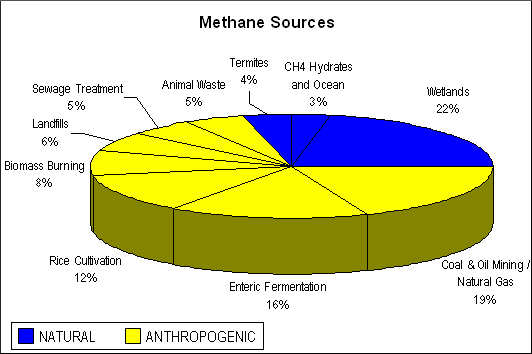
THE ESCALATOR

(free to republish)