Is the CO2 effect saturated?
What the science says...
| Select a level... |
Basic
|
Intermediate
|
Advanced
| ||||
|
The notion that the CO2 effect is 'saturated' is based on a misunderstanding of how the greenhouse effect works. |
|||||||
Climate Myth...
CO2 effect is saturated
"Each unit of CO2 you put into the atmosphere has less and less of a warming impact. Once the atmosphere reaches a saturation point, additional input of CO2 will not really have any major impact. It's like putting insulation in your attic. They give a recommended amount and after that you can stack the insulation up to the roof and it's going to have no impact." (Marc Morano, as quoted by Steve Eliot)
The mistaken idea that the Greenhouse Effect is 'saturated', that adding more CO2 will have virtually no effect, is based on a simple misunderstanding of how the Greenhouse Effect works.
The myth goes something like this:
- CO2 absorbs nearly all the Infrared (heat) radiation leaving the Earth's surface that it can absorb. True!
- Therefore adding more CO2 won't absorb much more IR radiation at the surface. True!
- Therefore adding more CO2 can't cause more warming. FALSE!!!
Here's why; it ignores the very simplest arithmetic.
If the air is only absorbing heat from the surface then the air should just keep getting hotter and hotter. By now the Earth should be a cinder from all that absorbed heat. But not too surprisingly, it isn't! What are we missing?
The air doesn't just absorb heat, it also loses it as well! The atmosphere isn't just absorbing IR Radiation (heat) from the surface. It is also radiating IR Radiation (heat) to Space. If these two heat flows are in balance, the atmosphere doesn't warm or cool - it stays the same.
Lets think about a simple analogy:
What might we do to increase the water level in the tank?
We might increase the speed of the pump that is adding water to the tank. That would raise the water level. But if the pump is already running at nearly its top speed, I can't add water any faster. That would fit the 'It's Saturated' claim: the pump can't run much faster just as the atmosphere can't absorb the Sun's heat any faster
But what if we restricted the outlet, so that it was harder for water to get out of the tank? The same amount of water is flowing in but less is flowing out. So the water level in the tank will rise. We can change the water level in our tank without changing how much water is flowing in, by changing how much water is flowing out.

Similarly we can change how much heat there is in the atmosphere by restricting how much heat leaves the atmosphere rather than by increasing how much is being absorbed by the atmosphere.
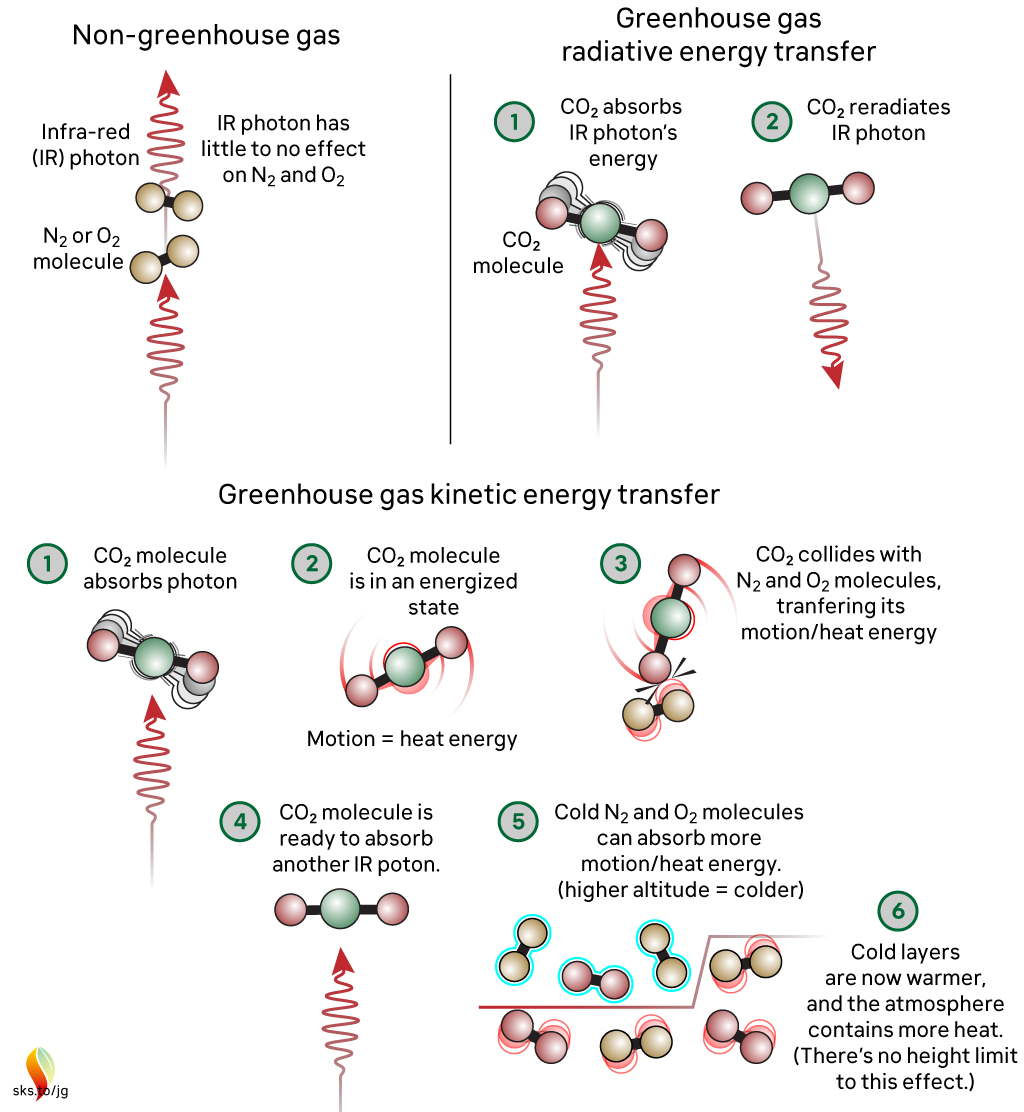
This is how the Greenhouse Effect works. The Greenhouse gases such as carbon dioxide and water vapour absorb most of the heat radiation leaving the Earth's surface. Then their concentration determines how much heat escapes from the top of the atmosphere to space. It is the change in what happens at the top of the atmosphere that matters, not what happens down here near the surface.
So how does changing the concentration of a Greenhouse gas change how much heat escapes from the upper atmosphere? As we climb higher in the atmosphere the air gets thinner. There is less of all gases, including the greenhouse gases. Eventually the air becomes thin enough that any heat radiated by the air can escape all the way to Space. How much heat escapes to space from this altitude then depends on how cold the air is at that height. The colder the air, the less heat it radiates.

(OK, I'm Australian so this image appeals to me)
So if we add more greenhouse gases the air needs to be thinner before heat radiation is able to escape to space. So this can only happen higher in the atmosphere. Where it is colder. So the amount of heat escaping is reduced.
By adding greenhouse gases, we force the radiation to space to come from higher, colder air, reducing the flow of radiation to space. And there is still a lot of scope for more greenhouse gases to push 'the action' higher and higher, into colder and colder air, restricting the rate of radiation to space even further.
The Greenhouse Effect isn't even remotely Saturated. Myth Busted!
Basic rebuttal written by dana1981
Update July 2015:
Here is a related lecture-video from Denial101x - Making Sense of Climate Science Denial
Last updated on 7 July 2015 by pattimer. View Archives
Arguments


Basic
Intermediate
Advanced


There is one thing that bothers me about figure 1 (the differential spectrum). The decreased emission in certain absorption bands makes perfect sense. But it's a fact of the (surface) instrumental record that the planet was (a little) warmer in 1996 than in 1970 (somewhere in the 0.1 to 0.2C range). So shouldn't the flat parts of the differential spectrum be just a bit above zero?
I suppose it's possible due to different instruments (i.e. different satellites) that they had to normalize, but it would have been so much better if they didn't. Does anyone have the answer?
If CO2 had a saturation point wouldn't Venus have reached it or am I totally misunderstanding the premise?
rlasker3, I think you are perfectly right. If the CO2 saturated, we woudn't see that runaway greenhouse effect in Venus.
The figure in this article is out going radiance but is only part of the actual figure from the Harris 2001 paper. It has been manipulated to highlight the drops in radiance CO2 and CH4. I'm not trying to suggest dishonesty it's just a way to present the data.
In the 'real' data the 0 point is actually lower, you can see this in the publication. So what you have comparing 1970 and 1996 is reductions in radiance at the C02 and CH4 positions but increases in radiance in the areas in between.
I've never seen any good explanations for the changes at these other wavelengths. Or seen any reasoning behind highlighting the spectra in the CO2 and CH4 regions and ignoring the rest of the spectra. My own explanation would be that while there is increased energy retention at the wavelengths absorbed by CO2 and CH4 there are also other changes which are allowing more energy to escape at different wavelengths.
I have no problem with suggesting that this paper identifies a signature in the radiance data for an increase in CO2 in the atmosphere but without complate analysis of the spectra (which the publication doesn't do) you can't conclude that this is leading to warming
I haven't been able to find anything to this effect, but a test in a laboratory using a similar method to observe the absorption rate of the same wavelengths passing through a chamber with various concentrations of the gasses we would expect to see in the upper atmosphere could show whether it does have an asymptotic behavior and thus 'saturates'?
Just seems somewhat fishy that the logic goes "It could reach a saturation point!" "But it's still increasing as we increase the CO2, so there is no saturation point!", analogous to "If you eat too much candy you get sick!" "But I've been eating candy for the last 20 minutes and I continue to feel fine!"
http://jimpeden.blogspot.com/2009/11/norm-kalmanovich-on-global-warming-hoax.html
I haven't read it thoroughly, but it seems like they are missing the fact that CO2 is absorbed at several different wavelengths.
The post devolves into the usual questioning of motives, but I was curious to hear thoughts on the main claim about the 14.77 micron band being used up.
Thanks, M
the problems with those guys is that their reasoning looks straightforward and anyone can understand it. The mistake he makes becomes apparent only if you know the physics. So common people tend to trust those bogus falsifications.
The problem with that "falsification" is not just related to the single band he considers, he arbitrarly put a limit to the amount of radiation CO2 can absorb. This is not true both experimentally (as shown in this post) and theoretically even for the 15 micron band alone; and it would not matter anyway.
Thanks for the answer and links. I have trouble enough keeping on top of the literature in my own field, so it is very useful to come to a place like this and have someone with a good knowledge of the particular issue provide/point me to a summary.
I saw a good clip on Richard Dawkin's TV today about how to spot baloney, which is perhaps apropos to this matter. One common form of baloney occurs when someone claims that his/her theory shoots down an existing and better understood theory, based on falsifying only one particular aspect of the better understood theory. The new theory, however, can't explain all the other phenomena that are explained by the better understood theory. Thus, the notion that all the multiple lines of evidence for a human forcing on climate can be falsified because all those silly (and agenda-driven!) scientists overlooked CO2 saturation seems to qualify as baloney.
Thanks again, M
http://www.scribd.com/doc/25071132/The-Saturated-Greenhouse-Effect-Theory-of-Ferenc-Miskolczi .
i would love it if you guys have a look at it and get back to me.. because it looks very very convincing.. so if someone can have a look at the math involved and see if its all legit that would be excellent.. here is the link to the summary report of his findings aswell;
http://www.scribd.com/doc/25071473/Saturated-Greenhouse-Effect-Theory
He says that the climate models used by the ipcc are based on old math from the 1920's which make an assumption that the atmosphere is infinitly large.. he redoes the math with proper boundary conditions and comes up with very interesting results.. i'll leave it up to you guys to look further into it
email me on coatesy91@hotmail.com if you'd like to send me your thoughts if youd prefer that than this comment
cheers
That's not a proper scientific paper, it's a paper from the partisan Science and Public Policy Institute (home of among others the rather badly discredited "Lord" Christopher Monkton, and the australian geologist Bob Carter). If there was any merit in the presentation/summary that you printed, then it would be easy for him to publish in a reputable scientific journal. So you have to ask the question why hasn't he?
The papers cited at the top of this page are a much better source for you to form your opinions from.
Miskolczi's "paper" is well known and badly flawed. As Eli at Rabett Run ironically puts it, his theory could be summarized in just two sentences:
"The greenhouse gas theory that has been used for the last century is TOTALLY WRONG! The proof is left as an exercise for the reader.".
Dr. Miskolczi first published his work in the Quarterly Journal of the Hungarian Meteorological Services in 2004, Volume 108, No 4. He published further statistical proof in the same Journal in 2007, Volume 111, No. 1. In the 5 years since he first published his results, not one peer review has come back disproving his theory, or his Constant. To date, not one scientist has come forward to disprove Miskolczi’s theory that the Earth’s climate is at equilibrium, and that Carbon Dioxide cannot be released in amounts great enough to upset that equilibrium.
http://miskolczi.webs.com/Answers_to_some_criticism.htm
it also has a link to his 2004 paper which people don't look at, that is why they get confused and see his paper as making too many assumptions etc.. its because 2007 paper is the sequel to his 2004 paper where he defines many of his terms and comes up with the science behind the theory
As for Scafetta, scroll down to the link to his paper in this post: It’s the sun.
How can these guys be right “Falsification of the Atmospheric CO2 greenhouse effect within the frame of physics” by Gerhard Gerlich and Ralf D. Tscheuschner ,
Ive beeen looking for rebuttals to there paper but now luck so far can anyone help ?
thanks Dave
ok ive realised from google searching that someone is posting this in just about any blog they can and by the body of the post it seems to be the same person .
thanks Dave
The short answer is that the "falsification" paper by G&T is just nonsense. You can find a rebuttal to it on this site at
The greenhouse effect and the 2nd law of thermodynamics
Or, if you want more depth, there's a lot of discussion of this at the website "Science of Doom":
On Having a Laugh – by Gerlich and Tscheuschner (2009)
On the Miseducation of the Uninformed by Gerlich and Tscheuschner (2009)
and subsequent posts at Science of Doom.
After another hour of searching I found Science of Dooms response in another blog with a link to his ? blog .
Griggs 2004
http://rose.bris.ac.uk/dspace/bitstream/1983/999/1/paper.pdf
Philipona 2004
http://www.agu.org/journals/ABS/2004/2003GL018765.shtml
However, I could not find the Chen 2007 article.
And thanks for the informative article.
Blessings,
The problem with the H2O feedback idea is it brings us back to the "skeptic" arguments raised in this article. H2O can approach (but never reach) saturation just like CO2 can. So each additional amount of H2O does less warming. Except now we don't have the counterarguments that the H2O is getting farther apart or that the H2O that is radiating is getting cooler and therefore radiates less (because it's getting warmner). I tried to be brief so I hope that makes sense.
"So we have multiple lines of empirical evidence for an enhanced CO2 greenhouse effect. Satellite measurements confirm that less longwave radiation is escaping to space. Surface measurements detect increased longwave radiation returning back to Earth at wavelengths matching increased CO2 warming. And of course the result of this energy imbalance is the accumulation of heat over the last 40 years."
Graph which indicates that longwave radiation is not following CO2 increase.
Explanation given to the above graph: "For the equatorial region, the diagram above suggests a certain chain of events, indicating the existence of a mechanism regulating the surface temperature: Periods of surface warming appears initially to be associated with decreasing outgoing longwave radiation (OLR). After some surface warming, OLR then stops decreasing and instead begins to increase, and after a while, surface air temperature then begins to decrease, etc. This chain of events is clearly illustrated by, e.g., the time period around the 1998 El Niño event (diagram above).
Part of the explanation of the above succession of events might be that tropical surface warming leads to enhanced atmospheric convectional transport of heat to high levels of the atmosphere above the Equator, resulting in enhanced longwave radiation at the top of the atmosphere. This, in turn, eventually leads to surface cooling, which results in reduced atmospheric convection, etc. Also the potential connection to variations in tropical sea surface temperatures and the tropical cloud cover is interesting, and should be considered in a more detailed analysis."
This graph shows poor correlation of CO2 to Longwave raditation.
This graph questions the conclusions of the Skeptical Science.
Outgoing longwave radiation cycles but does not trend down.
However, it says nothing about wavelength. The suggestion seems to be that increasing CO2 should reduce ALL wavelengths of OLR... which doesn't seem an accurate statement of greenhouse gas behavior to me. In short, a straw man... the graph shows that total long wave radiation is not decreasing, but the claim that it should be has no basis in AGW theory.
Energy trapped (delayed in escaping, really) by greenhouse gases raises the temperature of the atmosphere/land/water, which causes an increase in that system's attempted emission of radiation to space. Radiation outside of the greenhouse gases' absorption wavelengths will merrily escape to space, so total longwave radiation escaping will increase. The problem is that the escaping total cannot increase fast enough to prevent the temperature from increasing, because the increase in the escaping radiation is a response to the increasing temperature.
A first cut filter for the rubbish is the simple question of "is it published?". There are glittering prizes for anyone who can disprove climate theory or come up with an improved theory. If the analysis is sound then why wouldnt you publish? The unscrupulous will say one thing to a naive audience (eg congress) but dont make such claims to their peers.
However, this is a good site for finding out what is wrong with the some of wild stuff out there.
"Radiation outside of the greenhouse gases' absorption wavelengths will merrily escape to space, so total longwave radiation escaping will increase."
The graph does not seem to show this increase. It does not show a trend in increase or decrease, just cyclic pattern. If the Earth is warming then the Outgoing longwave radiation should increase for all wavelengths not absorbed by GHGs. I do not see an increase or decrease.
Went to Norman's website source for his graph & poked around a bit. On this page I noted that:
1. All data is in absolute temps, not anomalies
2. They establish the post-industrial runup in the temperature trend and use that trend to de-trend the signal in the data. I.e., they "hide the incline" in the 20th Century temperature data.
3. They attribute 100% of CO2's effects on temperatures when comparing the CO2 rise to temps, showing that since temps don't rise in lockstep with CO2 levels it can't be the CO2 affecting temps
4. They use a paper by Dr. Syun-Ichi Akasofu as a basis to say that any warming since the LIA is just a reflection of the Earth returning to "normal" and that it's a natural cycle.
Trenberth demolished Akasofu here.
The whole site is a bait-trap for the unwary.
The Yooper
The OLR is a balance between the increasing blackbody emission from the earth surface (some 250 W/m2 with a variability of some tens of W/m2) and anything that can block it, including CO2 absorption (of the order of 1 W/m2 over the full period of the figure). The former depends on temperature. Anything else being equal, if for some reason temperature does not rise fast enough the OLR decreases (of a fraction of a W/m2), and viceversa. If you add ENSO, clouds, GHG and all other sources of variability, it's a mess. Trying to draw any conclusions eyeballing a graph like the one shown by Norman is meaningless.
Norman, detrending the data without saying you're doing it is rather deceptive (the real data is there, but at least one level deeper, and the detrended graphs are not labeled clearly as such). I would rate Climate4you as a junk site as well.
I also went to a ring of sites linking to it (there are dozens) - all very similar, some with even more polish.
Some of the data manipulation gets sophisticated - to the point that (coupled with the quality graphics) the "errors" become intentional (the knowledge needed to pull off what they're trying to do makes it obvious they should know better).
That's why I called it a bait-pile (deer season in 6 days colors my thinking process a bit).
The Yooper
Figure 1: Change in spectrum from 1970 to 1996 due to trace gases. 'Brightness temperature' indicates equivalent blackbody temperature (Harries 2001).
Well, well, well. Let's see.
FIGURE 1. Examples of IRIS and IMG observed and simulated spectra for a three-month average (April–June) over selected regions. a, Observed IRIS and IMG clear sky brightness temperature spectra for the central Pacific (10°N–10°S, 130°W–180°W). b, Top, observed difference spectrum taken from a; middle, simulated central Pacific difference spectrum, displaced by -5 K; bottom, observed difference spectrum for 'near-global' case (60°N–60°S), displaced by –10 K. c, Component of simulated spectrum due to trace-gas changes only. 'Brightness temperature' on the ordinate indicates equivalent blackbody brightness temperature.
"Component of simulated spectrum due to trace-gas changes only" is not the same as "Change in spectrum [...] due to trace gases". If you have references, you are expected to omit misquotations.
Observed (as opposed to simulated) near-global difference spectrum (Fig. 1. b, bottom) does not show an overall energy imbalance. There is simply more outgoing longwave radiation in the atmospheric window, compensating for somewhat less radiation elsewhere. It is consistent with a slightly decreasing average upper tropospheric IR optical depth at water vapor absorption bands (especially in the water vapor continuum).
I would also like to know if measurements were performed in the 400 cm-1 - 1600 cm-1 (6.25 μm - 25 μm) range, why Harries at al. only show the 710 cm-1 - 1400 cm-1 (7.14 μm - 14.08 μm) range? The so called arctic window is below 625 cm-1 (above 16 μm). At these frequencies all absorption/emission is from water vapor, therefore changes in brightness temperature spectrum here should be rather informative.
Norman, the answer given to you by Riccardo is expanded in the comments of that other post. I suggest you start with comment 72 by Pierre-Normand, followed by my much less technical analogy in comment 71.
Also note that a large portion of the many comments on that post (Have American Thinker Disproven Global Warming?) is in response to the American Thinker article's writer suffering a similar misunderstanding that Norman has--that total outgoing longwave radiation must change in lockstep with greenhouse gas levels. See further the comments 80 by me and 81 by Pierre-Normand.
The entire set of comments on that post is very enlightening, by folks far more knowledgeable than me, so I suggest that BP and Norman read them all.
BP, those graphs you pasted were presented and discussed thoroughly in the comments section of the post Have American Thinker Disproven Global Warming?
Not thoroughly enough. Near-global difference spectrum of brightness temperature between 750 cm-1 and 900 cm-1, where the atmospheric window is really transparent (except for the water vapor continuum), is about +2 K. No layer has warmed nearly that much between 1970 and 1996, therefore the upper troposphere must have got more transparent at this IR frequency band, making lower (warmer) layers "visible" to satellites. It means a negative water vapor feedback. Worth mentioning that effective warming (by lowering) of photosphere in this band should have been even greater, because brightness temperatures are calculated for black body equivalent temperatures, while actual emissivity is always lower than that. It is also consistent with balloon radiosonde measured decreasing humidity trends above the 700 mbar level.
"Norman, detrending the data without saying you're doing it is rather deceptive (the real data is there, but at least one level deeper, and the detrended graphs are not labeled clearly as such)."
Not sure which page in Climate4you you looked at. You must have done a very quick look to make the conclusion it is a a "junk" site. He does label his graphs as detrended and he explains the purpose (sometimes it pay to take time to read what the analysis is about). The claim was made that the warming from 1981 to present was unique. The warming slope from 1908 to 1940 is very similar to the present one. Have another look and see what the person is attempting with his analysis.
Please clarify. Do you believe that the CO2 effect is saturated?
update your citation database, apparently NCEP is biased.