



 Arguments









What were climate scientists predicting in the 1970s?
What the science says...
| Select a level... |
 Basic
Basic
|
 Intermediate
| |||
|
The vast majority of climate papers in the 1970s predicted warming. |
|||||
Climate Myth...
Ice age predicted in the 70s
"If you go back to Time Magazine, they actually were proclaiming the next ice age is coming, now it's become global warming… How do you believe the same people that were predicting just a couple decades ago that the new ice age is coming?" (Sean Hannity)
At a glance
If you are aged 60 or over, you may remember this particular myth first-hand. For a brief time in the early to mid-1970s, certain sections of the popular media ran articles describing how we were heading for a renewed ice-age. Such silliness endures to the present day, just with a different gloss: as an example, for the UK tabloid the Daily Express, October just wouldn't be October without it publishing at least one made-up account of the impending 100-day snow-apocalypse.
There were even books written on the subject, such as Nigel Calder's mischievously-entitled The Weather Machine, published in 1974 by the BBC and accompanying a “documentary” of the same name, which was nothing of the sort. A shame, because the same author's previous effort, The Restless Earth, about plate tectonics, was very good indeed.
Thomas Peterson and colleagues did a very neat job of obliterating all of this nonsense. In a 2008 paper titled The myth of the 1970s global cooling scientific consensus, they dared do what the popular press dared not to. They had a look at what was actually going on. Obtaining copies of the peer-reviewed papers on climate, archived in the collections of Nature, JSTOR and the American Meteorological Society and published between 1965 and 1979, they examined and rated them. Would there be a consensus on global cooling? Alas! - no.
Results showed that despite the media claims, just ten per cent of papers predicted a cooling trend. On the other hand, 62% predicted global warming and 28% made no comment either way. The take-home from this one? It's the old media adage, “Never let the truth get in the way of a good story”
Please use this form to provide feedback about this new "At a glance" section. Read a more technical version below or dig deeper via the tabs above!
Further details
In the thirty years leading up to the 1970s, available temperature recordings, with a poor global coverage compared to today, implied at times there might be an ongoing cooling trend. At the same time, research was continuing into the building levels of carbon dioxide and their effects on future climate, but the science world of that time was somewhat disconnected, compared to the modern age of instant communication, Zoom and so on.
There were also some notably cold winters scattered through that time, such as the UK one of 1962-63. As a result of these various goings-on, some scientists suggested that the current interglacial period could rapidly draw to a close, which might result in the Earth plunging into a new ice age over the next few centuries.
We now know that the smog that climatologists call ‘aerosols’ – emitted by human activities into the atmosphere – caused localised cooling closest to the areas where most of it originated. Smogs constitute a deadly health hazard and governments acted quickly to clean up that type of pollution: highly visible (unlike CO2), it was hard to ignore. Once largely removed, its effects no longer influenced Northern Hemisphere temperatures, that have steadily climbed since around 1970.
In fact, as temperature recording has improved in coverage, it’s become clear that the cooling trend was indeed localised – it was most pronounced in northern land areas. Other places around the world revealed a different story. Furthermore, at the same time as some scientists were suggesting we might be facing another ice age, a significantly greater number - approximately six times more - published papers indicating the opposite - that we were warming. Their papers showed that the growing amount of greenhouse gases that humans were putting into the atmosphere would cause much greater warming – warming that would exert a much stronger influence on global temperature than any possible natural or human-caused cooling effects.
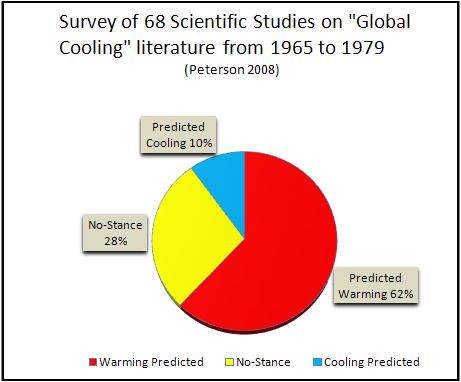
By 1980, with northern hemisphere smogs a distant memory, the predictions about ice ages had ceased, at least among those working on the science, due to the overwhelming evidence for warming presented in the scientific literature (Peterson et al. 2008). Unfortunately though, the small number of predictions of an ice age were far more 'sticky' than those of global warming, so it was those sensational 'Ice Age' stories in the 1970s popular press that so many people tend to remember. Sticky themes sell papers. Today of course, with 40+years more data, far better coverage and a far bigger research community, we've reached a clear scientific consensus: 97% of working climate scientists agree with the view that human beings are causing global warming.
Last updated on 8 March 2024 by John Mason. View Archives








Here is another one, figuring as "confirmed cooling": Borisov (1969)
Only the abstract comes up: "Soviet climatologists are vitally concerned with the problem of ameliorating the climate of Siberia and other northern lands as a means of developing these regions for an expanding population. P. M. Borisov, a candidate in geographic sciences, Moscow, examines one means of warming the climate by the transport of Atlantic Ocean water across the Arctic Basin. This could be done by pumping water out of the Arctic Ocean at the Bering Strait, thus accelerating the flow of warmer Atlantic water into the basin. Flow direction would be controlled by means of a dam across the Bering Strait. Borisov predicts dramatic improvement in Arctic climate would result. Huge areas of permafrost would be freed for agriculture in northern Canada and Siberia. Grass would grow in the Sahara Desert. This article, appearing first in the Soviet journal, Priroda, was translated by the Canadian Defence Research Board. It is reprinted here through the courtesy of the Board and by special permission of the editors of Priroda." I don't see how this paper makes a prediction that future global climate will be cooling.
I think I am done with this little list of "papers."
[BL] It has taken the SkS team a bit of time to response to angusmac's comment 146, but we have finally added a moderator's note to his comment. We agree that his comment and attached database of papers has little merit, and have noted some of the weaknesses you present in your series of comments (147-151). Of particular note is the lack of any explanation regarding criteria used to define "warming", "cooling" and "neutral".
You (Philippe) have dug further into the database angusmac has presented than I did. I only chose one paper to look at in detail: Sellers (1969), JAM 8, 392-400. I chose this for two reasons:
angusmac is fooling himself in thinking that Sellers (1969) represents a neutral position on predictions of climate change in the decades to century that covers the period of interest - i.e., the period that represents "imminent cooling" as of the 1970s, as addressed in the myth in this rebuttal (and the PCF-08 paper).
The Sellers paper present a new, simple one-dimensional (zonally-averaged) climate model. Sellers then examines how this model reacts to several hypothetical changes in input conditions:
Only one of those hypothetical changes is considered to be something that Sellers expected to change in the short term: atmospheric CO2. His paragraph on this matter ends with "Hence, the global mean temperature should slowly rise due to this factor." None of the other factors that Sellers examined in his model represent any sort of prediction of trends likely to happen in the decades or century following the 1970s.
Given angusmac's mischaracterization of Sellers (1969) I did not see any value in digging further.
Readers that end up here without reading the moderator's comment to angusmac's post 146 should take a look at the following two SkS posts, which discuss the problems associated with NoTrcksZone's database of "cooling" papers. Unfortunately, angusmac has used NoTricksZone's database as a primary source for his own analysis.
https://skepticalscience.com/70s-cooling-myth-tricks-part-I.html
https://skepticalscience.com/70s-cooling-myth-tricks-part-II.html
I will attempt to work through your comments but, firstly, I reply that the Sellers (1969) paper should be considered to be neutral because it states that the "major conclusions" are:
I fail to se why any rational person could not view the Sellers paper as being anything except neutral since it concluded that its model could be either “another ice age” or “14C warmer than today”. Both of these outcomes were “specified so as to be physically realistic”.
Consequently, I contend that I have not mischaracterized Sellers (1969).
[BL] Wow. Talk about selective reading. Let's put in more text from Sellers (1969), not your cherry-picked partial quote. At the start of his section "Variations in the solar constant" (p397), we see (emphasis added):
"One of the favorite theories of climatic change during the last million years attributes the ice ages to variations in the intensity of solar radiation..."
At the end of the section (p398), Sellers says:
"...the model seems to indicate quite conclusively that a decrease in the solar constant of less than 5% would be sufficient to start another ice age."
The whole purpose of his examination of changes in solar constant was to look at possible explanations of known past variations in climate, over long time periods. Absolutely nowhere in the paper does Sellers suggest that such a decrease in the solar constant was likely to happen in the decades or century following the 1970s.
I fail to see how any rational person could confuse "millions of years" with "decades to a century".
Consequently, I contend that you either are incapable of understanding what Sellers (1969) has done and written, or you are intentionally ignoring the aspect of the PCF-08 paper that specified that the evaluation of the Sellers (1969) paper (and all papers they evaluated) was based on "time scales from decades to a century".
You are changing the criteria for evaluation to one that is different from PCF-08. We have yet to see exactly what your criteria are. The NoTricksZone analysis did exactly the same shifting of goal posts that you are doing here.
Angusmac @152 :
I have been following your commentary, and that of your respondents.
From what you have quoted @152, that paper points to two scenarios ~ (A) a major/colossal decrease in the solar constant, versus (B) ongoing industrial activities, as was already evident at the time of the paper.
Since (B) was the scenario actually taking place, and (A) was not in evidence (nor expected) . . . then surely one must deduce that the paper must fit in the "cooling" category.
Have I misunderstood your position?
[BL] I agree with your take on this (subject to your correction of "cooling" to "warming", as indicated in your next comment). Angusmac's table linked in his first post explicitly indicates that he disagrees with the PCF-08 evaluation of Sellers (1969). PCF-08 said "warming", while angusmac says "neutral".
To claim that PCF-08 is wrong, angusmac needs to evaluate using the same criteria: a time scale of decades to centuries. If he is to gain any credibility, he needs to outline where in Sellers (1969) he finds support to argue that Sellers thought that the solar constant would decrease by this amount (or any amount) over the next century. To paraphrase Law and Order" "Objection your honour. Assumes facts not in evidence."
Belated apologies.
Major typo (or brain flatulence?).
@153 should read : "... paper must fit in the 'warming' category."
And nowhere near "neutral" category.
@152 & @153
BL, you state that, “To claim that PCF-08 is wrong, angusmac needs to evaluate using the same criteria: a time scale of decades to centuries. If he is to gain any credibility, he needs to outline where in Sellers (1969) he finds support to argue that Sellers thought that the solar constant would decrease by this amount (or any amount) over the next century.”
In response, I now enclose an image of a paragraph from p.399 of Sellers (1969).
Note that Sellers (1969) states that "...in as little as 100 years…it is not inconceivable that the solar constant will change”. Consequently, it is obvious that my classification of Sellers (1969) is based on "time scales from decades to a century".
Notwithstanding the above, he does state that such a change in the solar constant for an extended period is, “on the fringe of being highly unlikely”. Furthermore, I would suggest that “on the fringe” means that the possibility cannot be discounted. Additionally, nowhere in Sellers (1969) is a change to the solar constant ruled out. Indeed, he includes such a possibility of solar change as one of his "major conclusions" (as highlighted below).
I contend that all of the Sellers (1969) conclusions are valid because all of them “were specified to be physically realistic” (although some outcomes may be more likely than others).
Consequently, I still maintain that my change to the PCF-08 classification of Sellers (1969) from warming to neutral is valid because he did state that there was a possibility of another ice age and that it was specified to be "physically realistic” .
[BL] Congratulations on continuing your habit of taking any wording that matches your preconceptions and twisting it into what you think is a convincing argument.
The first section you quote clearly states that it is the warming due to "man's activity" that could take "as little as 100 years or as long as 1000 years".
Sellers does not give any indication how much he thinks the solar constant will change over that time period. He just says that it is "not inconceivable that the solar constant will change." He also does not indicate whether he is thinking about the short end (100 years) or the long end (1000 years). He does explicitly say that it would take a 7% drop in the solar constant to counteract the warming due to CO2. And he says "such a large drop [7%] in the solar constant over any extended period is on the fringe of being highly unlikely".
So, in your argument, saying that something is highly unlikely is the same as making a prediction that it is likely. Contrast this with the wording that Sellers uses on p398, with respect to the CO2 rise (variations in infrared transmissivity": "the global mean temperature should slowly rise due to this factor."
And once again, you misinterpret the conclusions. The "physically realistic" statement is simply a recognition that the solar constant can change over extended time periods (indeed it has, over millions of years). It says nothing at all about what is likely over the next few decades to a century. The paper as a whole does not limit itself to the next century - it looks at possible climate effects (as modelled) over very long periods. It is only in your imagination that you can take Sellers' results over millions of years (ice age) and claim that they represent a prediction over the next century.
Angusmac @155 :
Over the past 500 million years, the solar output has been increasing by 1% every 120 million years (approx). Such is the nature of the beast, according to astro-physicists, in having a gradual increase in the hydrogen fusion rate.
A reduction in solar output of 2-5% (or even the 7% you mentioned earlier) would represent a truly colossal alteration in our Sun.
I think you have confused the term "physically realistic" (in practical terms) with the abstract mathematical exercise which Sellers has performed for the reader's interest & comparison.
BL@155 & Eclectic@156
I disagree that I am twisting the wording in Sellers (1969) to suit preconceptions and I also disagree with your interpretation of Sellers (1969). However, I will prepare an amended database that will include SkS’s interpretation of the scientific papers.
Consequently, if I were to amend Sellers (1969) from neutral to warming then the number of papers would be as follows:
In summary, there would be 39 more cooling papers than warming papers.
I reiterate that I find it astonishing that PCF-08 only uncovered 7 cooling papers and that they did not uncover the 86 cooling papers that my literature survey found in major scientific journals.
Please let me know of the next paper on which you disagree with my assessment.
[BL] I will accept your decision to not continue to debate the details of Sellers (1969) as an admission that you can't find anything more in the paper to quote that supports your assessment. The fact that you won't change your mind, despite several attempts to explain the paper to you does not bode well for any further discussion of your list.
No, you do not have 86 cooling papers, 57 neutral papers, and 47 warming papers. You have a list of papers that you have decided to assign those labels to. What you have not done is:
In the discussion of Sellers (1969), what you have shown is:
The reason that PCF-08 only found seven cooling papers is because the authors of that paper understood how to properly read a scientific paper and determine what parts of the paper applied to the specific question that PCF-08 was looking at. To repeat what was said to you before, PCF-08 restricted their analysis to the following:
When restricting their analysis to papers that actually met these criteria, PCF-08 noted "While some of these articles make clear predictions of global surface temperature changes by the year 2000, most of them do not.". What we have seen clearly in your discussion of Sellers (1969) is that you can't tell the difference between portions of the paper that do apply to the question posed by PCF-08 and those that do not.
In addition to Sellers (1969), Philippe Chantreau has looked at several papers on your list, as stated in his comments here. In each case, he found reasons to reject your assessment of those papers.
The second SkS blog post on the NTZ analysis also lists a variety of papers that NTZ messed up on. You are making the same sort of errors, covered more general in the first SkS blog post on the NTZ list.
All the evidence in this discussion here points in one direction: your selection of papers and assessment of "cooling", etc. in these papers is highly unreliable. It seems highly unlikely that looking at any more papers in detail will result in a different conclusion. And to be clear, I use the term "highly unlikely" as an indication that it is possible that you have properly classified some of those papers, but the chance of that happening in sufficient numbers to be important is too small to be worthy of further consideration.
Angusmac @157 (and earlier) :
~ Looking at the Bigger Picture, why is it that you are bothering to argue about the exact percentage of scientific papers that were classed in cooling / neutral / warming ?
For us now viewing with the advantage of hindsight, the climate situation is very clear. But back in the sixties, there was a modicum of uncertainty ~ the scientists could see that the world had been warming for nearly a century (despite the long-term cooling from Milankovitch Cycle causes) . . . and yet there seemed to be more than a hint of unexpected relative cooling. [Later satisfactorily explained by the effect of industrial air pollution.]
But nowadays the uncertainty is gone. It is all over and done with, and the Fat Lady has finished singing.
So, what now? Plenty of room for political arguing about what are the best moves for tackling our Global Warming problem. Should we temporarily put up our feet and continue Business As Usual, or all go and live in a cave . . . or something inbetween, like pursuing Carbon Taxes combined with massive research on cheaper solar panels / cheaper sodium batteries / and a much bigger look at fusion power?
These are the questions for today. Not what Dr Sellers and others were meaning 50+ years ago. Why would one wish to argue on it?
Eclectic@158
Regarding your comment that, “Looking at the Bigger Picture, why is it that you are bothering to argue about the exact percentage of scientific papers that were classed in cooling/neutral/ warming?”, since science (and technology) have moved on.
My answer is simple: both SkS and PCF-08 have stated that there was an overwhelming consensus for warming in the 1970s. To the contrary, I have shown that this is untrue. PCF-08 (and SkS) have ignored the 86 cooling papers that my literature survey found in major scientific journals.
Therefore, I recommend that the SkS 1970s ice age web page should be amended to represent the actual scientific facts (i.e. 86 cooling papers) and, as I have stated @146, PCF-08 should be either withdrawn or subjected to a detailed corrigendum to correct its obvious inaccuracies.
I hope that this answers your query.
[BL]. No, you have not shown that there are "86 cooling papers" that should have been included in PCF-08. All you have shown is:
As Baerbel points out in comment 161, your assertions here carry no weight. Your arguments, as presented here, are extremely weak. I am sure that you can find blogs where uninformed people find your arguments convincing. If you can find a proper scientific journal with proper peer review that accepts your analysis as reasonable, then go for it. Based on what we have seen, you have a lot of work to do to reach that point, though.
Angusmac @159 :
No ~ my query was with regard to your motivation for pursuing this long-out-of-date topic.
This thread was started in 2007. That is 18 years ago. Even then it was rather outmoded, and, as I point out ~ the science has moved on, well and truly. And as you look through the thread's posts, you will find several oddball commenters ~ but overall, the topic has not received much attention. Rightly so. The whole topic subject is of only minor (dare I say, trivial?) historical interest, and is of almost zero relevance to today's climate problems.
So that is why I ask for you to explain your motivation. Are you a fervent amateur historian? Have you discovered a Nobel-Prize-eligible factor of critical value to the world? Have you looked inside yourself, and reflected [as we all should] on your internal processes of thought, to understand yourself? I am sure that other readers also would benefit from understanding your motivation here.
If you have a Quixotic mindset, then SkepticalScience has at your choice many threads on the modern relevance of wind turbines (or windmills, as our respected leader calls them).
angusmac @159
Our rebuttals are based on papers published in the peer-reviewed literature and not on some randomly compiled lists or databases published on a blog or website. Write up your arguments with explaining your methods and reasoning, submit your manuscript to a respected journal with proper peer review and have it published. Then we can revisit this rebuttal.
The motivation is simple and as crude as it gets in the denialist bag of tricks: Scientists predicted an ice age in the 70s and it didn't happen, so there is no reason to believe what they are predicting now. The funniest thing is that it no longer is a prediction, it is happening right in front of us.
Now, Angusmac is only increasing word count, throwing smoke and mirrors to try to hide the abysmal shortcomings of that little list. A first step would be to make sure that every link actually leads somewhere. I'm not holding my breath. The whole thing is a pitiful attempt at twisting reality.
Philippe @162 :
I am shocked. Shocked, I tell you.
To learn that you have such a cynical streak in your character.
Doubtless, Angusmac will promptly explain all.
BL@159 and BaerbelW@161
I had contemplated submitting my paper to a climate journal for (what you call) a “proper peer review”. However, I chose not to submit it because I thought that it wouldn’t get published – not because my review was inaccurate, but because current climate journals do not countenance a red team/blue team approach.
Current climate journals only allow blue team opinions, whist banning any red team opinions that the question the current climate consensus, aka, The Science™. Furthermore, climate science appears to be the only branch of science and engineering that does not allow a red team/blue team approach. Indeed, the history of science shows that our scientific knowledge has mainly increased by those who chose to challenge the prevailing consensus.
Additionally, as a structural engineer, I am appalled that climate scientists resist a red team/blue team approach to the discussion of The Science™, because using a red team/blue team methodology is normal practice in major engineering projects worldwide. In fact, on exceptionally large projects, a third team is often tasked with independently reviewing and validating the results of the red and blue team process.
Of course, if engineers get it wrong, they can be sacked or fined, many people’s lives could be lost, and the engineers may go to jail. However, when climate scientists get it wrong, they usually just move their prediction(s) out by a few years and carry on as if nothing had gone wrong with their earlier prediction(s).
To sum up, I believe that my paper would have been declined by a climate journal because it would have been considered to be part of the (banned) red team.
[BL] In other words, you are accusing the entire climate science community of engaging in a conspiracy to hide your genius. Item five in the list of the techniques of science denial.
I agree that your analysis would very likely be rejected by any proper journal - if all you have is what we've seen here. What would be needed to pass review has been explained to you before:
Your postings here fail on all three counts. All you have is opinions, and unsupported opinions rarely get published in scientific journals.
Our scientific knowledge has mainly increased by those who chose to challenge the prevailing science - and provided evidence that their new ideas provide a better understanding of the science. It is not advanced by people that can do nothing more than "I created a list and applied labels to the papers". Especially when it is clear that those labels do not agree with the contents of the papers.
Philippe Chantreau @162
Your comment that I am trying to “hide the abysmal shortcomings of that little list” is verging on the vituperation.
Nevertheless, if my “little list” is (as you put it) “abysmal” how would you describe a list that contained less than half of the references to the peer-reviewed literature. Would it be “littler”, “miniscule” or “minute”.
Wait a minute! PCF-08 contains only 71 papers, whereas my database of the peer-reviewed literature contains 190 (and it includes 71 papers from PCF-08). Surely you would not wish to belittle PCF-08 by calling it “abysmal” or perhaps you might prefer to refer to it as “more abysmal” than my paper.
[BL] The difference between your list and PCF-08's list is that PCF-08 clearly explains that their initial search produced a much larger list, and that examination of that larger list winnowed the list down to a small number that actually applied to their question about temperature predictions over the decades or century following the 1970s.
Their initial search was clearly stated in the paper:
... we conducted a rigorous literature review of the American Meteorological Society’s electronic archives as well as those of Nature and the scholarly journal archive Journal Storage (JSTOR). To capture the relevant topics, we used global temperature, global warming, and global cooling, as well as a variety of other less directly relevant search terms. Additionally, in order to make the survey more complete, even at the expense of no longer being fully reproducible by electronic search techniques, many references mentioned in the papers located by these searches were evaluated, as were references mentioned in various history-of-science documents.
And, as you have been told before, they stated:
While some of these articles make clear predictions of global surface temperature changes by the year 2000, most of them do not.".
You, on the other hand, have made it clear that you do not have the skill to recognize that when Sellers (1969) talks about changes in the solar constant over periods of millions of years, that this is not a prediction over the decades to a century following the 1970s. You do not have the skill to recognize that when Sellers (1969) says that something is highly unlikely, that this is not a prediction that it will happen soon. You do not have the skill to recognize that when a paper talks about cooling over the period 1940 to 1970, that this is not a prediction of cooling over the decades to a century following the 1970s (Philippe Chantreau's comment 147). You do not have the skill to recognize that a paper mentioning recent colder winters in Michigan is not a prediction of global cooling over the decades to a century following the 1970s (Philippe Chantreau's comment 150).
Your search is the equivalent of using a web search engine that produces 1,802,603 hits, and failing to realize that most of those hits do not actually cover the question you posed.
What makes PCF-08 useful is the skill of the authors to be able to read and understand the papers they found and do a good job of assessing whether or not their broad search terms actually found papers that gave an actual prediction over the time period in question (decades to a century following the 1970s). Skill is not bias. You have bias. You lack skill.
So now we're playing a "my list is bigger" game, that's hilarious.
If I had the patience to waddle through it, I would pick out every piece that does not deserve the name "paper" and I know there will be plenty of them because, without exercising such patience, I already found some.
Then I would pick out all the ones that are irrelevant or make no forecasting of future global temperatures, that will be plenty more, because I also found that with a very limited sampling.
Then I will pick out the ones that were classified as "cooling" or "neutral" and make no such prediction and here, again, there will be plenty, because, again, a limited sample showed them.
You haven't successfully addressed any of the moderator's remarks. These attempts at distracting are almost as pathetic as the little big list.
As for myself, I am at an age where patience changes from being a virtue to becoming a luxury, and I don't enjoy wasting my time with nonsense, so I will leave the drudgery of sorting through the little big list to whomever wishes to engage. I have seen enough.
[BL] Indeed. There is a limit to the patience one might have in going over this stuff time after time after time.
Angusmac is not presenting arguments that haven't been made before. The two skeptical Science posts cover the NoTricksZone were prepared in 2018 - seven and a half years ago - and even then it was addressing a zombie myth.
https://skepticalscience.com/70s-cooling-myth-tricks-part-I.html
https://skepticalscience.com/70s-cooling-myth-tricks-part-II.html
The Petersen et al paper (PCF-08) was written in 2008, so it is now 17 years old - almost old enough to drink in most jurisdictions.
And I have known (in an Internet sense, not person-to-person) the second author of PCF-08 (William Connolley) since the 1990s when we both participated in climate discussions on Usenet news groups. William had an open challenge for "skeptics" to send him papers that they thought represented "cooling" predictions. You can even still find an old web page of his that includes the challenge. (It has not been updated since 2007, but the Internet never forgets. The OP links to this page in the Further Reading section.) This small individual effort eventually grew into a proper scientific examination of the literature that became PCF-08.
As previously mentioned, I picked up on the Sellers (1969) paper because I have known about it for more than 45 years, and I knew what was in it and what the paper was trying to do (present a model, and apply it to several hypothetical - but reasonable - aspects of climate and climatic change). An implementation of the Sellers model was used as a teaching tool in the undergraduate climate courses I was taking.
Angusmac is just the latest in a long series of people that keep making the same bogus arguments.
I suspect that Angusmac probably does not understand the difference between a search engine and a book index. A book index does not simply list every page in the book that contains the word in question. A book index is the result of a thinking person examining the contents of the book to determine which of the many uses of a word is one that actually provides useful information - defining terms, explaining significant concepts, etc. A paper that uses the word "cooling" is not necessarily one that predicts cooling, and one that predicts cooling is not necessarily talking about the next century, or global climate.
angusmac @164:
I am a retired, quite successful, Canadian Registered Professional Engineer (Structural) with an MBA. I have participated in the successful design of a diversity of structures using a diversity of materials and structural systems in a diversity of nations to a diversity of national standards. I feel obligated to respond to the following part of your comment.
Additionally, as a structural engineer, I am appalled that climate scientists resist a red team/blue team approach to the discussion of The Science™, because using a red team/blue team methodology is normal practice in major engineering projects worldwide. In fact, on exceptionally large projects, a third team is often tasked with independently reviewing and validating the results of the red and blue team process.
Of course, if engineers get it wrong, they can be sacked or fined, many people’s lives could be lost, and the engineers may go to jail.
The Wikipedia description of Red Team also covers the idea of Blue Teams. The Red Team (challengers) conceptualize attacks on the system and the Blue Team (originators) respond with measures that counteract the attacks.
I would argue that Structure designs are not ‘regularly’ subjected to Red Team attacks. I am familiar with an independent group of people with expertise related to the design being reviewed doing a detailed assessment of the developed design. I have been on many of those review teams. What is done is similar to Scientific Peer Review, not a Red Team attack.
A structure design must be safe. Engineering work should always be checked by a competent reviewer to ensure that the evaluation and design decisions fully meet the established minimum safety standards of the relevant regional building/structure design Codes. This is sort of like Scientific Peer Review ensuring the methodology and evaluation were done in a way that makes the results defendable. It is not a Red Team attack.
The engineer’s job is to knowledgeably rigorously think about and evaluate the performance of the structure they are designing, or any of its parts, in response to any potential condition or combination of conditions the structure could experience. An engineer’s design should be checked by a sufficiently capable review engineer. And a responsible professional engineer would not take on a design challenge that they lack the experience to properly perform. They would learn what they need to know from someone who has a better understanding (like good scientists learn from good peer review).
It would be irresponsible for an engineer to rely on a reviewer (Red Team attacker) to identify any weaknesses of their design. The majority of designs completed by an engineer should completely stand up to detailed expert review. A good engineer would be expected to occasionally make an error or miss a consideration, hence the importance of every design being adequately independently checked. The good engineer would learn from the experience of having weaknesses of their work discovered by an expert reviewer. And a responsible engineer would not attempt to perform a design task they lacked experience in. They would seek adequate education before doing the ‘new to them’ design task.
If an engineer does not learn to do better work in-spite of having the weaknesses of their work pointed out then they should not continue doing engineering work. The same should apply to scientists.
One comment in closing. I have no knowledge of the engineering work you do. But I would caution you that how you have been responding to having the weaknesses of your ‘non-engineering’ ‘new to you’ evaluations of climate science literature pointed out raises Red Flags. You should be careful and reflective to ensure that you do not have a similar ‘motivation that keeps you from learning’ compromise your ability to be a good, constantly improving, responsible structural engineer.
[BL] This is a useful perspective.
A "red team" that does not look at the details of the project and structural design is unlikely to detect problems that have been missed. A "red team" that consists of some other profession (your dentist, an accountant, etc.) but thinks they know structural engineering because they built their own backyard shed is unlikely to provide constructive feedback.
And a "red team" that keeps raising objections that were raised on similar projects 20 years ago, and were shown to be wrong (several times over), is also not providing useful alternatives.
Although I am not an engineer, I worked in an engineering company at one time in my career, on northern pipeline projects. Why? Because my background in permafrost and freezing soils provided expertise and experience related to frost heave - expertise not usually found in engineering training. I could provide useful advice on what the soil would do when it froze - but I for sure would not try to tell the engineers how much force the pipe could handle. That's where the engineers' expertise takes over. I might have questions, but it behooves me to listen to the answers that are given by people with relevant expertise. To quote Harry Callahan, a man's gotta know his limitations.
One Planet Only Forever @167
Thank you for your sensible comments on the red team/blue team approach, and also without the animus of many of the other comments on this thread. I now reply as follows.
Yes, Wikipedia describes this approach as the red team (challengers) conceptualize attacks on the system and the blue team (originators) respond with measures that counteract the attacks. However, the Wikipedia description only deals with computer systems and potential cyber threats. It does not deal with this approach being used in other disciplines, where the term attacks are replaced by challenges.
Regarding your statement that you, “would argue that Structure designs are not ‘regularly’ subjected to Red Team attacks.” I did not state that structural designs are regularly subjected to red team attacks. What I did state was that [emphasis added], “…using a red team/blue team methodology is normal practice in major engineering projects worldwide. In fact, on exceptionally large projects, a third team is often tasked with independently reviewing and validating the results of the red and blue team process.”
Perhaps our difference of opinion is due to the size of the project and its jurisdiction, as I explain below.
I have worked on many major structural projects in the Middle East, Asia, and Australia, in which the red team/blue team approach was used, and when I asked perplexity.ai about its use in Australia, the response was the following:
Furthermore, I summarise an example of one of my projects – the Burj Khalifa (BK) in Dubai in which I was Structural Director:
The process outlined for BK is much more detailed and complex than a simple peer review – it is evaluating and eventuating a solution that is much better than the original design. It is challenging (and improving) the original design – not attacking it.
Additionally, The Line in Saudi Arabia is another project in which I am working as part of the red team. However, in this project (due to the considerable number of design consultants) there is not just one blue team, but many blue teams.
I hope that the above is a reasonable explanation of the red team/blue team approach in major structural engineering projects.
Finally, regarding climate science, I am of the opinion that “saving the planet” constitutes a major project, and consequently, it should be subjected to the red team/blue team approach.
[BL] First, this is getting well off-topic with respect to the predictions of climate trends in the century following the 1970s. I will leave this comment intact, but expect to see major pruning if subsequent comments continue so far off-topic.
Second, you are exhibiting extreme naivete when it comes to understanding climate science (and, probably, science in general).
I think you should read Spence Weart's "The Discovery of Global Warming", which looks back at the long history of people studying and trying to explain climate.
Your opinion that climate science should be subjected to a red team/blue team examination makes about as much sense as me saying that the Tacoma Narrows Bridge collapsed in 1940, and as a result we need to take a red team/blue team examination of the entire discipline of "structural engineering". After all "building the world" sounds like a pretty major project.
And please do not waste our time by repeating AI-generated crud in your comments. If you are incapable of writing a summary yourself, then don't bother at all.
Angusmac @168 :
Yes, I like your idea of adding a Purple Team to the color mix.
Though if you are indeed working on the Saudi project called "The Line" . . . then I suspect you are no longer on the Red Team nor the Blue Team nor the Purple Team ~ but that you are transitioning onto the Gray Team (thus called, because the project designers are rapidly developing gray hairs).
As for a Red Team attack on the mainstream climate science, IIRC there has been no such "investigation" for a decade at least. #The last attempt I can cite is the January 2014 climate workshop held by the American Physical Society [a Society re Physics, not Yoga].
~ The transcript of the "investigation" is about 570 pages. Prominently featured is the bright intellect of Dr Steven Koonin. Koonin had much to say himself, but the whole workshop was an armchair discussion rather than a scientifically-illuminating thrust & riposte featuring cogent points.
~ In short, "Team Skeptic" was a great flop, and Koonin showed that his intellect had been sabotaged by his own subconscious (in other words, he was a victim of his own Motivated Reasoning on the climate issue).
So I would be happy to hear if there has been any genuine & successful refuting of the mainstream [i.e. consensus] climate science in recent decades.
Sad perhaps ~ but at this stage of things, the commissioning of a Red Team to attack/review the mainstream science . . . would be like gathering an engineering team to design wheels to fit on the bottom of a ship ~ a ship that had already sailed many years ago.
[BL] Please note that this red team stuff is getting way off topic, as I have pointed out in the angusmac comment that precedes yours. Please tread carefully.
angusmac @168,
An attempt to challenge or refute a developed ‘climate science item like PCF-08’ by ‘identifying weaknesses, errors, omissions and harmful unsustainable aspects of the developed item being reviewed, or developing improved alternatives’ can be called many things (including an attack). But it is the description of the objective, not the name/term used, that is important.
The objective should be: Pursuing increased awareness and improved understanding to limit harmful results and develop more sustainable outcomes (more beneficial for the future of humanity).
Some people may believe that your comments starting @146 present a valid challenge to the PCF-08 evaluation. There are claims about having identified weaknesses, errors, omissions, and claims that you have developed a ‘better alternative’.
What you have presented is clearly is not a defensible challenge to PCF-08. What you have presented is a non-peer-reviewed, unchecked, non-expert, alternate evaluation that needs its own rigorous review by people with relevant expertise.
The responses provided, that you appear to resist accepting and learning from, are valid challenges of ‘your unchecked alternative evaluation’. Many helpful reviewers have pointed out weaknesses, errors and omissions in your ‘alternative evaluation’. A reasonable and reasonably knowledgeable ‘third party evaluator’ will almost certainly consider your alternative to be highly questionable, lacking in integrity.
I will add that it is also almost certain that a reasonable individual interested in learning to be less harmful and more helpful to others will appreciate that the vast majority of the presentations in SkS, perhaps all of them, are:
In pursuit of increased awareness and improved understanding to limit harmful results and develop more sustainable outcomes related to human-caused rapid recent climate change. They identify weaknesses, errors, and omissions, in the presentations of alternative beliefs and claims that attempt to discredit or dismiss the constantly improving ‘climate science’ understanding. They also improve awareness and understanding of the corrections of the harmful unsustainable aspects of the developed global set of socioeconomic political systems that are required to develop a sustainably improved future for all of humanity.
Climate science is an integral part of the constantly improving understandings currently presented in the Sustainable Development Goals. The more that is done to limit and reverse harmful climate change impacts the easier it will be to develop sustainable improvements for humanity.
BL@165
I have read, and I do understand, the papers presented in PCF-08. I have also read, and I do understand, those papers presented in my database.
I also reiterate (although you keep denying it) that my methodology was identical to PCF-08. However, I will amend my paper to highlight that my database is limited to papers that include climate change trends that are “relevant to, time scales from decades to a century” so that anyone who reads my paper, and the database, will be able realise that I have used the same methodology as PCF-08.
Regarding your purported rebuttal of my database at:
https://skepticalscience.com/70s-cooling-myth-tricks-part-I.html
https://skepticalscience.com/70s-cooling-myth-tricks-part-II.html
My database, and the review therein, is different from the NTZ papers that you quote. Nevertheless, I shall conduct an independent assessment of the above 2018 SkS “Zombie Myth” posts and revert to you on how those posts compare with my database vis-a-vie completeness, content, and accuracy. Perhaps my assessment may turn out to be a red team review of your “Zombie Myth” posts.
Regarding your comment that PCF-08, “is now 17 years old – almost old enough to drink in most jurisdictions” is trite. Science, and scientific issues, are never too old to be revisited, and corrected if necessary.
[BL] Despite your repeated assertions that your analysis is sound, the evidence you have presented here strong indicates that you cannot tell when a paper is talking about long term trends (millions of years) rather than decades to a century. You cannot tell the difference between a paper saying something is "highly unlikely" and saying that something else is quite probable. You cannot tell the difference between a paper that looks at the observed cooling trend from 1940 to 1970, and a paper that makes a prediction for the period following the 1970s. You cannot tell the difference between a paper that looks at historical local cooling and a paper that makes a prediction for future global trends.
I see two possible explanations, which are not mutually exclusive. Both are supported by the evidence you have provided in your comments here.
The SkS debunkings of NTZ are not debunkings of your database, as they were written at a time when your datebase was not known to SkS. What the SkS debunking shows is that the NTZ analysis has serious weaknesses and errors, and provides examples of papers where NTZ gets things wrong. What has been pointed out is that your database - to the limited extent it has been examined here - suffers the same broad issues.
The second part of that SkS debunking lists several specific papers and discusses why the NTZ classification is poor. Feel free to go to that post and look at those papers (which may or may not be on your list) and see whether you agree with the SkS evaluation or the NTZ one.
You have also not addressed any of the criticisms that Philippe Chantreau provided to indicate errors in your evaluation of papers he looked at.
What has been shown here is that a sampling of your database shows serious errors in your categorization, based on the PCF-08 criteria you claim to have used. In my mind, this sample (combined with your comments here) gives enough evidence to make a preliminary determination that looking further is unlikely to produce a different conclusion.
Old items and papers can be corrected if necessary, but repeating the same bad reanalysis that has been made before and shown to be bad before is not a constructive use of time. The zombie myth about predicting an imminent ice age in the 1970s was already old and tired and wrong when PCF-08 debunked the myth in 2008. Your efforts (from what we have seen) continue to make the same mistakes that created the myth and were promoted by NTZ.
Eclectic@169
At last, a humorous comment, regarding the grey team/purple team. No, I am not turning grey, because I am an independent hourly-paid contractor.
The only people who may be turning grey are the blue team(s) because they are major multi-national consultants working on a project that may be downsized.
Phillipe Chantreau@147
I note that Benton (1970) is included in PCF-08 as warming and NTZ as cooling. Yes, I do agree with your comment that,
However, please note that I have classified it as neutral for the following reasons:
Benton (1970) concludes that [emphasis added], “At present, the natural causes of climatic change are probably more important than the effects of man-made gaseous [CO₂] and particulate pollution. However, the balance is changing as industrialization, urbanization, and transportation continue to grow at an accelerating rate. Some years from now, man will control his climate, inadvertently or advertently. Before that day arrives, it is essential that scientists understand thoroughly the dynamics of climate.”
Note that his conclusions give equal emphasis to warming, i.e., man-made “gaseous pollution” [CO₂] and cooling, i.e., “particulate pollution”. He does not single out CO₂ as the only problem. Furthermore, he also points out that we do not fully understand the dynamics of climate.
I hope that the above is a reasonable explanation of the reasons that I have arrived at the neutral classification and not cooling as you incorrectly stated.
[BL] I agree with Philippe Chantreau's evaluation of Benton (1970) over yours. Once again, you do two things wrong:
Do you approach structural engineering with this same method of analysis? If your engineering design was subject to external review, how would you respond if the external review came back and said "we see an issue with the design that we are pretty sure will lead to weakening by fatigue and likely cause failure within 30 years, but there is an aspect of the design that we don't understand that might prevent that". Would you decide "that was a neutral review, so there is nothing to worry about"? I hope not.
And again, you selectively quote items from that report that tell me you have not properly understood what Benton (1970) has said. You have quoted:
The first process tends to depress the temperature of the earth's surface; the latter tends to increase it.
The two processes that Benton is talking about in that sentence are not CO2 and aerosols. He is talking about two different aerosol effects
This is clearly explained in Benton, in the sentences that immediately precedes the quote you provide as item 3. The full quote (emphasis added):
However, the net effect of particulate matter on climate is difficult to analyze. Such pollutants, depending upon their size distribution and the elevation at which they occur, both intercept incoming solar radiation and trap outgoing radiation from the earth. The first process tends to depress the temperature of the earth's surface; the latter tends to increase it.
If you are intentionally trying to mislead us by pretending that your third point compares your first and second point, then stop it. You are not fooling anyone. If you have made an honest mistake and erroneously thought that Benton was still comparing CO2 and aerosols, then you need to improve your reading skills.
CO2 is not particulate matter. Benton has changed the subject away from CO2 in that paragraph. Benton is not making an equivalency between warming due to CO2 and cooling due to aerosols - he is considering the possible (not yet well understood, as of 1970) opposing effects of different types of aerosols.
I am going to issue a challenge to you, to give you the opportunity to demonstrate that you really understand the papers that you have been reading and assessing. (You are, of course, free to ignore the challenge, but please try to look at is as a chance to convince me and others that you know your stuff.)
Please provide a response telling me if you accept this challenge and when you might respond it detail (if you can't respond in detail immediately).
BL@173
I shall reply to your comments and your Sellers challenge in due course but, firstly, I respond to your repeated allegations that I lack the skill to carry out a peer review.
I contend that our allegations are wrong because I have carried out many tens of peer reviews of papers proposed for the journals of well-respected professional engineering institutions. I could count the actual number of these reviews, if I thought that you would care.
Furthermore, these professional institutions think that I am a good peer reviewer and, therefore, I continue in this role. I suggest that these institutions should rank higher than the opinions of the SkS commentators on this thread.
Consequently, I suggest that my peer-review skills are at least as good (if not better) than those of the SkS commentators.
[BL] Let's think a bit about what "peer review" actually means. Wikipedia has an article on it, which begins with
Peer review is the evaluation of work by one or more people with similar competencies as the producers of the work
In order to provide proper peer review, one needs to have competency in the topic.
I do not have the proper competency to provide peer review of a paper on some aspect of structural engineering. My training is in physical geography, specializing in climatology. I have extensive experience in the measurement of climatologically-important radiation, and meteorological instrumentation. (You can read more about my background on the SkS Team page.) I have published papers in the discipline, acted as reviewer on publications, and participated in international conferences, working groups, and instrument comparisons related to climatology.
You are exhibiting extreme hubris in thinking that your experience in structural engineering makes you an expert in climate science. Although you may be capable of reviewing papers in structural engineering, what we have seen here is strong evidence that you lack the knowledge and skill in climate science to be able to understand and review papers in climate science.
BL@168 you have made so many comments that it would take a very large post to respond. Therefore, I shall respond to them with separate smaller replies.
Reply 1 to BL@168 you state that, “Your opinion that climate science should be subjected to a red team/blue team examination makes about as much sense as me saying that the Tacoma Narrows Bridge collapsed in 1940, and as a result we need to take a red team/blue team examination of the entire discipline of structural engineering."
This is a misinterpretation of what I state at angusmac@168 which was:
It is evident from the above that my comment refers to only major engineering projects, and consequently, it would only apply to major climate science projects. Therefore, your inference that my opinion was that every climate science paper should be subject to a read team/blue team approach is wrong and is based on your selective reading of my text.
Furthermore, the Tacoma Narrows collapse did instigate major changes in structural engineering.
Since then, all long-span suspension bridges and other flexible structures were required to be designed to resist aerodynamic loading. These changes eventually evolved into the red team/blue team approach for major structures, and I have already given an example of one such flexible structure, namely, the Burj Khalifa.
[BL] And you completely miss the point. The Tacoma Narrows bridge collapse did not result in an evaluation of the complete discipline of "structural engineering". It resulted in (by your own admission) changes in designing suspension bridges and flexible structures - one small part of "structural engineering".
As I pointed out in the moderator's comment to 168, "climate science" is a broad categorization covering many, many difference sub-disciplines. Your statement in 168 called "saving the planet" a major project in climate science. This is creating a strawman: there is no such "major project" in the discipline of climate science.